Managing ResourcesManaging Resources
Planning & Managing WorkPlanning & Managing Work
PlanningPlanning
? 12 miles
?? 15 miles
? 7 miles
PlanningPlanning
““Planning is brining the future into the present so that you canPlanning is brining the future into the present so that you can
do something about it now”do something about it now”
Alan LakeinAlan Lakein
““Failing to plan is planning to failFailing to plan is planning to fail””
ProverbProverb
3
Step 1.Step 1. DEFINE THE TASKDEFINE THE TASK
What would we need to know about theWhat would we need to know about the
assignment before we accept?assignment before we accept?
All the facts and figures: where, when, how, what and whoAll the facts and figures: where, when, how, what and who
The objective or goal of the assignment:The objective or goal of the assignment: what we are trying towhat we are trying to
accomplishaccomplish
Step 2.Step 2. IDENTIFYIDENTIFY
RESOURCESRESOURCES
When we consider the resources needed and available,When we consider the resources needed and available,
we need to ask ourselves:we need to ask ourselves:
What resources do we need to accomplish theWhat resources do we need to accomplish the
task?task?
What do we already have?What do we already have?
Where do we get what we don’t have?Where do we get what we don’t have?
Are there any resources that requireAre there any resources that require
special attention, advance planning,special attention, advance planning,
or significant expense? Are thereor significant expense? Are there
alternatives?alternatives?
Step 3.Step 3. CONSIDERCONSIDER
ALTERNATIVESALTERNATIVES
This step relates to alternate methods and procedures forThis step relates to alternate methods and procedures for
a training course. These might include:a training course. These might include:
What kind of training aids should we use?What kind of training aids should we use?
Which technique will be best forWhich technique will be best for
getting the message across?getting the message across?
How should we arrange the tablesHow should we arrange the tables
and chairs?and chairs?
Step 3.Step 3. CONSIDERCONSIDER
ALTERNATIVESALTERNATIVES
This also relates to emergencies or the unexpected. WeThis also relates to emergencies or the unexpected. We
should have a backup plan (Plan B).should have a backup plan (Plan B).
Are we prepared for equipment failures?Are we prepared for equipment failures?
Do we have an alternative session elementDo we have an alternative session element
ready to use while a problem is corrected?ready to use while a problem is corrected?
Do we have backup presenters in case a memberDo we have backup presenters in case a member
of the training team suddenly becomes ill andof the training team suddenly becomes ill and
cannot attend?cannot attend?
Do we have modules that can be compressed orDo we have modules that can be compressed or
deleted if there are time constraints?deleted if there are time constraints?
Step 3.Step 3. CONSIDERCONSIDER
ALTERNATIVESALTERNATIVES
As trainers, we must set a good example.As trainers, we must set a good example.
If training courses are to run smoothly, we mustIf training courses are to run smoothly, we must
be prepared for the unexpected.be prepared for the unexpected.
We need to decide which optionsWe need to decide which options
are best, and what alternativeare best, and what alternative
measures should be taken.measures should be taken.
Step 4. CREATE THE PLANStep 4. CREATE THE PLAN
Creating a workable plan can be a challenge.Creating a workable plan can be a challenge.
Training session outlines are provided in BSATraining session outlines are provided in BSA
training manuals.training manuals.
We need to fill in the blank spaces.We need to fill in the blank spaces.
A written plan tells everyone concerned what is expected,A written plan tells everyone concerned what is expected,
and when.and when.
It provides a permanent record that will be helpfulIt provides a permanent record that will be helpful
the next time we conduct the course.the next time we conduct the course.
It can serve as a backdated checklistIt can serve as a backdated checklist
Step 4. CREATE THE PLANStep 4. CREATE THE PLAN
We should always create our plans inWe should always create our plans in
written form.written form.
We may want to include events that precedeWe may want to include events that precede
the training course, as well.the training course, as well.
Step 5. WORK THE PLANStep 5. WORK THE PLAN
• Be sure you are ready.Be sure you are ready.
• Review the previous steps.Review the previous steps.
• Do it! Hold the training course.Do it! Hold the training course.
• Follow the written plan, but be flexible and make anyFollow the written plan, but be flexible and make any
adjustments needed.adjustments needed.
Step 6. EVALUATEStep 6. EVALUATE
What should we evaluate about a training course?What should we evaluate about a training course?
•Did we accomplish what we set out to do?Did we accomplish what we set out to do?
•Will we conduct it the same way again?Will we conduct it the same way again?
•If not, what changes would we make?If not, what changes would we make?
BENEFITS OF PLANNINGBENEFITS OF PLANNING
We all know that problems occur from poorWe all know that problems occur from poor
planning, but what benefits can we expectplanning, but what benefits can we expect
from good planning?from good planning?
BENEFITS OF PLANNINGBENEFITS OF PLANNING
– Increased attendance at the next training session.Increased attendance at the next training session.
– Trainers build confidence and skill in handlingTrainers build confidence and skill in handling
training aids and equipment.training aids and equipment.
– Leaders receive accurate and complete information,Leaders receive accurate and complete information,
and do a better job as a result.and do a better job as a result.
– Trainers know what is expected.Trainers know what is expected.
– Trainers stay within the time limits.Trainers stay within the time limits.
– Trainers give enthusiasm and confidence to otherTrainers give enthusiasm and confidence to other
leaders.leaders.
– Learning objectives are achieved.Learning objectives are achieved.
TWO TYPES OF PLANSTWO TYPES OF PLANS
There are two types of plans that relate to training:There are two types of plans that relate to training:
SHORT-RANGE PLANSSHORT-RANGE PLANS
LONG-RANGE PLANSLONG-RANGE PLANS
SHORT-RANGE PLANSSHORT-RANGE PLANS
• Meet a particular objective in the near futureMeet a particular objective in the near future
• Cover a limited area of trainingCover a limited area of training
• Answer the question: Are we doing thingsAnswer the question: Are we doing things
right?right?
• Should fit well within and contribute to long-Should fit well within and contribute to long-
range plansrange plans
Some examples:Some examples:
– Plans for basic training sessions for new leaders whoPlans for basic training sessions for new leaders who
have just been recruitedhave just been recruited
LONG RANGE PLANSLONG RANGE PLANS
• Cover a longer timeCover a longer time
• May include a variety of different types ofMay include a variety of different types of
trainingtraining
Some examples:Some examples:
– An annual plan, including Fast Start and basicAn annual plan, including Fast Start and basic
trainingtraining
– Makeup training sessionsMakeup training sessions
– Den chief trainingDen chief training
– Regular monthly roundtablesRegular monthly roundtables
– Supplemental trainingSupplemental training
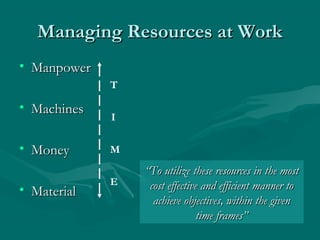
Managing Resources at WorkManaging Resources at Work
• ManpowerManpower
• MachinesMachines
• MoneyMoney
• MaterialMaterial
““To utilize these resources in the mostTo utilize these resources in the most
cost effective and efficient manner tocost effective and efficient manner to
achieve objectives, within the givenachieve objectives, within the given
time frames”time frames”
T
I
M
E
Managing Yourself & OthersManaging Yourself & Others
• Set objectives following the SMART formulaSet objectives following the SMART formula
• Start with an end in mindStart with an end in mind
• Break them down into manageable chunks on aBreak them down into manageable chunks on a
monthly, weekly and daily basismonthly, weekly and daily basis
• Work BackwardsWork Backwards
• Prioritize objectives and tasks by using thePrioritize objectives and tasks by using the
Urgent/Important matrixUrgent/Important matrix
– Use the Urgent/Important matrix to determine time spent onUse the Urgent/Important matrix to determine time spent on
each activityeach activity
Urgent/Important MatrixUrgent/Important Matrix
UrgentUrgent Not UrgentNot Urgent
ImportantImportant Crisis Long-Term
Not ImportantNot Important Time Wasters Time Wasters

Managing resources

  • 1.
    Managing ResourcesManaging Resources Planning& Managing WorkPlanning & Managing Work
  • 2.
  • 3.
    PlanningPlanning ““Planning is briningthe future into the present so that you canPlanning is brining the future into the present so that you can do something about it now”do something about it now” Alan LakeinAlan Lakein ““Failing to plan is planning to failFailing to plan is planning to fail”” ProverbProverb 3
  • 4.
    Step 1.Step 1.DEFINE THE TASKDEFINE THE TASK What would we need to know about theWhat would we need to know about the assignment before we accept?assignment before we accept? All the facts and figures: where, when, how, what and whoAll the facts and figures: where, when, how, what and who The objective or goal of the assignment:The objective or goal of the assignment: what we are trying towhat we are trying to accomplishaccomplish
  • 5.
    Step 2.Step 2.IDENTIFYIDENTIFY RESOURCESRESOURCES When we consider the resources needed and available,When we consider the resources needed and available, we need to ask ourselves:we need to ask ourselves: What resources do we need to accomplish theWhat resources do we need to accomplish the task?task? What do we already have?What do we already have? Where do we get what we don’t have?Where do we get what we don’t have? Are there any resources that requireAre there any resources that require special attention, advance planning,special attention, advance planning, or significant expense? Are thereor significant expense? Are there alternatives?alternatives?
  • 6.
    Step 3.Step 3.CONSIDERCONSIDER ALTERNATIVESALTERNATIVES This step relates to alternate methods and procedures forThis step relates to alternate methods and procedures for a training course. These might include:a training course. These might include: What kind of training aids should we use?What kind of training aids should we use? Which technique will be best forWhich technique will be best for getting the message across?getting the message across? How should we arrange the tablesHow should we arrange the tables and chairs?and chairs?
  • 7.
    Step 3.Step 3.CONSIDERCONSIDER ALTERNATIVESALTERNATIVES This also relates to emergencies or the unexpected. WeThis also relates to emergencies or the unexpected. We should have a backup plan (Plan B).should have a backup plan (Plan B). Are we prepared for equipment failures?Are we prepared for equipment failures? Do we have an alternative session elementDo we have an alternative session element ready to use while a problem is corrected?ready to use while a problem is corrected? Do we have backup presenters in case a memberDo we have backup presenters in case a member of the training team suddenly becomes ill andof the training team suddenly becomes ill and cannot attend?cannot attend? Do we have modules that can be compressed orDo we have modules that can be compressed or deleted if there are time constraints?deleted if there are time constraints?
  • 8.
    Step 3.Step 3.CONSIDERCONSIDER ALTERNATIVESALTERNATIVES As trainers, we must set a good example.As trainers, we must set a good example. If training courses are to run smoothly, we mustIf training courses are to run smoothly, we must be prepared for the unexpected.be prepared for the unexpected. We need to decide which optionsWe need to decide which options are best, and what alternativeare best, and what alternative measures should be taken.measures should be taken.
  • 9.
    Step 4. CREATETHE PLANStep 4. CREATE THE PLAN Creating a workable plan can be a challenge.Creating a workable plan can be a challenge. Training session outlines are provided in BSATraining session outlines are provided in BSA training manuals.training manuals. We need to fill in the blank spaces.We need to fill in the blank spaces. A written plan tells everyone concerned what is expected,A written plan tells everyone concerned what is expected, and when.and when. It provides a permanent record that will be helpfulIt provides a permanent record that will be helpful the next time we conduct the course.the next time we conduct the course. It can serve as a backdated checklistIt can serve as a backdated checklist
  • 10.
    Step 4. CREATETHE PLANStep 4. CREATE THE PLAN We should always create our plans inWe should always create our plans in written form.written form. We may want to include events that precedeWe may want to include events that precede the training course, as well.the training course, as well.
  • 11.
    Step 5. WORKTHE PLANStep 5. WORK THE PLAN • Be sure you are ready.Be sure you are ready. • Review the previous steps.Review the previous steps. • Do it! Hold the training course.Do it! Hold the training course. • Follow the written plan, but be flexible and make anyFollow the written plan, but be flexible and make any adjustments needed.adjustments needed.
  • 12.
    Step 6. EVALUATEStep6. EVALUATE What should we evaluate about a training course?What should we evaluate about a training course? •Did we accomplish what we set out to do?Did we accomplish what we set out to do? •Will we conduct it the same way again?Will we conduct it the same way again? •If not, what changes would we make?If not, what changes would we make?
  • 13.
    BENEFITS OF PLANNINGBENEFITSOF PLANNING We all know that problems occur from poorWe all know that problems occur from poor planning, but what benefits can we expectplanning, but what benefits can we expect from good planning?from good planning?
  • 14.
    BENEFITS OF PLANNINGBENEFITSOF PLANNING – Increased attendance at the next training session.Increased attendance at the next training session. – Trainers build confidence and skill in handlingTrainers build confidence and skill in handling training aids and equipment.training aids and equipment. – Leaders receive accurate and complete information,Leaders receive accurate and complete information, and do a better job as a result.and do a better job as a result. – Trainers know what is expected.Trainers know what is expected. – Trainers stay within the time limits.Trainers stay within the time limits. – Trainers give enthusiasm and confidence to otherTrainers give enthusiasm and confidence to other leaders.leaders. – Learning objectives are achieved.Learning objectives are achieved.
  • 15.
    TWO TYPES OFPLANSTWO TYPES OF PLANS There are two types of plans that relate to training:There are two types of plans that relate to training: SHORT-RANGE PLANSSHORT-RANGE PLANS LONG-RANGE PLANSLONG-RANGE PLANS
  • 16.
    SHORT-RANGE PLANSSHORT-RANGE PLANS •Meet a particular objective in the near futureMeet a particular objective in the near future • Cover a limited area of trainingCover a limited area of training • Answer the question: Are we doing thingsAnswer the question: Are we doing things right?right? • Should fit well within and contribute to long-Should fit well within and contribute to long- range plansrange plans Some examples:Some examples: – Plans for basic training sessions for new leaders whoPlans for basic training sessions for new leaders who have just been recruitedhave just been recruited
  • 17.
    LONG RANGE PLANSLONGRANGE PLANS • Cover a longer timeCover a longer time • May include a variety of different types ofMay include a variety of different types of trainingtraining Some examples:Some examples: – An annual plan, including Fast Start and basicAn annual plan, including Fast Start and basic trainingtraining – Makeup training sessionsMakeup training sessions – Den chief trainingDen chief training – Regular monthly roundtablesRegular monthly roundtables – Supplemental trainingSupplemental training
  • 18.
    Managing Resources atWorkManaging Resources at Work • ManpowerManpower • MachinesMachines • MoneyMoney • MaterialMaterial ““To utilize these resources in the mostTo utilize these resources in the most cost effective and efficient manner tocost effective and efficient manner to achieve objectives, within the givenachieve objectives, within the given time frames”time frames” T I M E
  • 19.
    Managing Yourself &OthersManaging Yourself & Others • Set objectives following the SMART formulaSet objectives following the SMART formula • Start with an end in mindStart with an end in mind • Break them down into manageable chunks on aBreak them down into manageable chunks on a monthly, weekly and daily basismonthly, weekly and daily basis • Work BackwardsWork Backwards • Prioritize objectives and tasks by using thePrioritize objectives and tasks by using the Urgent/Important matrixUrgent/Important matrix – Use the Urgent/Important matrix to determine time spent onUse the Urgent/Important matrix to determine time spent on each activityeach activity
  • 20.
    Urgent/Important MatrixUrgent/Important Matrix UrgentUrgentNot UrgentNot Urgent ImportantImportant Crisis Long-Term Not ImportantNot Important Time Wasters Time Wasters

Editor's Notes

  • #3 There is a saying that goes If you don’t know where you are going, any road will get you there. No matter how you get a training assignment, once you accept the challenge the next step is to create a plan. Let’s discuss the six steps of planning. We will be creating a diagram of the six steps of planning. We will provide you with a copy at the conclusion.
  • #5 When we begin to answer the what, when, where, how and who; when we begin to gather the facts and figures,, we are beginning to define the task. At this point we might not have identified everything, but our process allows us to come back to address anything that may come up as we proceed through the other steps.
  • #6 What kind of resources should we be considering? Responses should include trainers equipment facilities refreshments As the “manager” of the training assignment we need to identify what resources are needed and we decide where to obtain them.
  • #12 Once we’ve gone this far, we don’t have much choice. We decide to conduct the course.
  • #13 Most training manuals have a convenient training session evaluation form for this purpose. You might want to create your own to gather more specific data, or your Council might require you to use yet another. This is a decision that you probably made when you created your written plan. We need to determine what went well and what did not. What we learn from our evaluation becomes input to our first step when we begin to plan our next training event. Also, councils sometimes need information from these forms for trend analysis. Training trends Satisfaction publicity surveys We would like to see everyone using these planning steps for individual sessions and larger training events even when a written syllabus is provided. Distribute copies of the planning diagram.
  • #20 S= Specific M= Measurable A= Achievable R= Realistic T= Time Bound (Goals are dreams with deadlines)