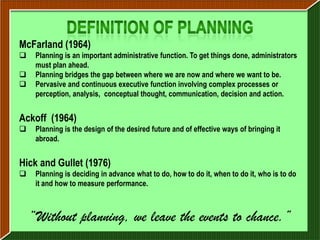
McFarland (1964)
    Planning is an important administrative function. To get things done, administrators
     must plan ahead.
    Planning bridges the gap between where we are now and where we want to be.
    Pervasive and continuous executive function involving complex processes or
     perception, analysis, conceptual thought, communication, decision and action.


Ackoff (1964)
    Planning is the design of the desired future and of effective ways of bringing it
     abroad.


Hick and Gullet (1976)
    Planning is deciding in advance what to do, how to do it, when to do it, who is to do
     it and how to measure performance.


    “Without planning, we leave the events to chance.”
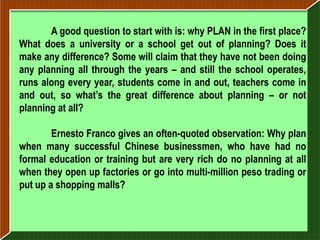
A good question to start with is: why PLAN in the first place?
What does a university or a school get out of planning? Does it
make any difference? Some will claim that they have not been doing
any planning all through the years – and still the school operates,
runs along every year, students come in and out, teachers come in
and out, so what’s the great difference about planning – or not
planning at all?

        Ernesto Franco gives an often-quoted observation: Why plan
when many successful Chinese businessmen, who have had no
formal education or training but are very rich do no planning at all
when they open up factories or go into multi-million peso trading or
put up a shopping malls?
Franco explains. Chinese businessmen – like all
businessmen, and all administrators – do planning. Very deep and
experiential planning, in their heads. As they wake up in the
morning, they already plan ahead – whom to see, what to decide
upon the basis for decisions, and what points never to give up on.
Planning is accomplished in their heads, not on paper, nor
computer machines, nor in planning workshops. Always, no
Chinese businessman does anything without planning. Except that
it is informal, unwritten, undocumented, secretive, judgmental,
experiential. It’s all in the mind, so to speak.
        With school owners, politicians and founders. No manager
or school administrator or politician or school founder in real life
ever does anything at all without some kind of planning. Except in
most cases it is never formal, written or shared with someone. They
plan –– always, but informally. If that is the case, Franco advises,
then why not proceed in the right way? Do it right–– so the right
things can be done the right way.
“Why should we plan, and what can we gain from it?”

       Planning is vital to all schools because it helps build better
programs for students. It does this by helping you to:

   Decide how and where to set priorities in the use of limited
   human and economic resources.
   Decide how to accomplish not only your short-range goals, but
   also your medium and long-range goals.
   Build on the strong and successful parts of the program, as well
   as to identify and improve the weak points.
   Reach agreement in the school community about what to do and
   how to do it.
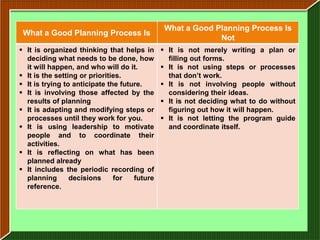
What a Good Planning Process Is
 What a Good Planning Process Is
                                                            Not
 It is organized thinking that helps in       It is not merely writing a plan or
  deciding what needs to be done, how           filling out forms.
  it will happen, and who will do it.          It is not using steps or processes
 It is the setting or priorities.              that don’t work.
 It is trying to anticipate the future.       It is not involving people without
 It is involving those affected by the         considering their ideas.
  results of planning                          It is not deciding what to do without
 It is adapting and modifying steps or         figuring out how it will happen.
  processes until they work for you.           It is not letting the program guide
 It is using leadership to motivate            and coordinate itself.
  people and to coordinate their
  activities.
 It is reflecting on what has been
  planned already
 It includes the periodic recording of
  planning       decisions     for   future
  reference.
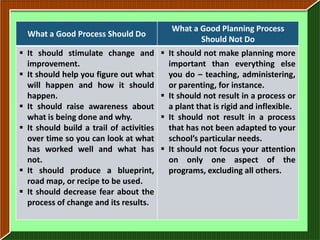
What a Good Planning Process
  What a Good Process Should Do
                                                    Should Not Do
 It should stimulate change and           It should not make planning more
  improvement.                              important than everything else
 It should help you figure out what        you do – teaching, administering,
  will happen and how it should             or parenting, for instance.
  happen.                                  It should not result in a process or
 It should raise awareness about           a plant that is rigid and inflexible.
  what is being done and why.              It should not result in a process
 It should build a trail of activities     that has not been adapted to your
  over time so you can look at what         school’s particular needs.
  has worked well and what has             It should not focus your attention
  not.                                      on only one aspect of the
 It should produce a blueprint,            programs, excluding all others.
  road map, or recipe to be used.
 It should decrease fear about the
  process of change and its results.
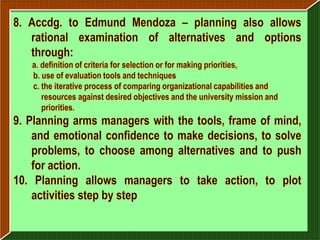
Y. DROR defined PLANNING as the process or preparing a set of decisions for action in
the future directed at achieving goals by optimal means. In this sense, Ernesto Franco
adds, educational planning is a group of related activities which establish objectives and
targets for educational development over a defined period using given resources properly
managed.


 It is a dynamic process of on-going activities, not a one-shot or once-for all static
  function
 It is a preparatory step, resulting in findings and recommendations that will have to be
  approved and then implemented in the proper order
 Planning not only solves problems and facilitates decision-making, it involves sets of
  decisions which are linked to each other
 It should be action-directed, implementable, and cast in the practice of management,
  not theory or academic bias alone;
 It takes note of existing arrangements and sets directions for the future, but which
  directions can only be made if decisions are made now, and not tomorrow
 These directions are articulated in terms of goals, objectives and targets, over given
  time frames; and
 These are to be achieved in cost-effective strategies and tactics directed by efficient
  management mobilizing needed funds and resources, including community
  participation.
(i) Where are we today?
(ii) Where do we want to go?
(iii)How do we get from where we are today to
     where we want to go tomorrow?
Planners in Third World countries including the Philippines, observes
Ernesto Franco, lack the ability to recognize, and accept as real, the forces for
change, and are unable to establish a favorable climate or ambience for introducing
change in their education systems. They are able to prepare good-looking, rich-
sounding, and properly-formatted paper documents on education policies-
programs-projects.


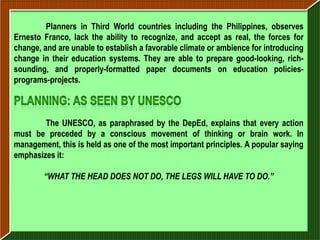
        The UNESCO, as paraphrased by the DepEd, explains that every action
must be preceded by a conscious movement of thinking or brain work. In
management, this is held as one of the most important principles. A popular saying
emphasizes it:

        “WHAT THE HEAD DOES NOT DO, THE LEGS WILL HAVE TO DO.”
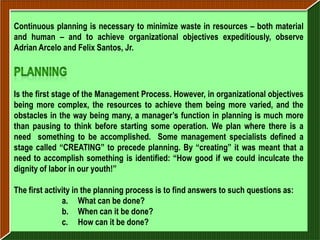
Continuous planning is necessary to minimize waste in resources – both material
and human – and to achieve organizational objectives expeditiously, observe
Adrian Arcelo and Felix Santos, Jr.


Is the first stage of the Management Process. However, in organizational objectives
being more complex, the resources to achieve them being more varied, and the
obstacles in the way being many, a manager’s function in planning is much more
than pausing to think before starting some operation. We plan where there is a
need something to be accomplished. Some management specialists defined a
stage called “CREATING” to precede planning. By “creating” it was meant that a
need to accomplish something is identified: “How good if we could inculcate the
dignity of labor in our youth!”

The first activity in the planning process is to find answers to such questions as:
               a. What can be done?
               b. When can it be done?
               c. How can it be done?
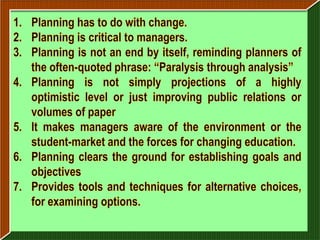
Is not just optimistic projections, improved communications, or a
public relations statement. The contents of a plan document contain
the mechanics or the plan – such as the statement of policies,
criteria for priorities, objectives, strategy, implementation
arrangement, budget and resources, timetable..etc. They are part
and parcel of the plan – but they do not mean that they are the plan
itself. Many plans contain flowery statement, literary devices,
splashy illustrations and graphic – statements that impress
ministers, secretaries, donors and beneficiaries. However, it may
have a dangerous consequence, Ernesto Franco warns.
FRANCO, stresses that planning should
 build on past gains or achievements: at
  the same time however, it should start
    new initiatives and strike for new
   grounds precisely because change
 never ends, is always taking place, and
 will even be more complex and rapid in
               years ahead.
Strategic planning

Strategic planning

  • 2.
    McFarland (1964)  Planning is an important administrative function. To get things done, administrators must plan ahead.  Planning bridges the gap between where we are now and where we want to be.  Pervasive and continuous executive function involving complex processes or perception, analysis, conceptual thought, communication, decision and action. Ackoff (1964)  Planning is the design of the desired future and of effective ways of bringing it abroad. Hick and Gullet (1976)  Planning is deciding in advance what to do, how to do it, when to do it, who is to do it and how to measure performance. “Without planning, we leave the events to chance.”
  • 4.
    A good questionto start with is: why PLAN in the first place? What does a university or a school get out of planning? Does it make any difference? Some will claim that they have not been doing any planning all through the years – and still the school operates, runs along every year, students come in and out, teachers come in and out, so what’s the great difference about planning – or not planning at all? Ernesto Franco gives an often-quoted observation: Why plan when many successful Chinese businessmen, who have had no formal education or training but are very rich do no planning at all when they open up factories or go into multi-million peso trading or put up a shopping malls?
  • 5.
    Franco explains. Chinesebusinessmen – like all businessmen, and all administrators – do planning. Very deep and experiential planning, in their heads. As they wake up in the morning, they already plan ahead – whom to see, what to decide upon the basis for decisions, and what points never to give up on. Planning is accomplished in their heads, not on paper, nor computer machines, nor in planning workshops. Always, no Chinese businessman does anything without planning. Except that it is informal, unwritten, undocumented, secretive, judgmental, experiential. It’s all in the mind, so to speak. With school owners, politicians and founders. No manager or school administrator or politician or school founder in real life ever does anything at all without some kind of planning. Except in most cases it is never formal, written or shared with someone. They plan –– always, but informally. If that is the case, Franco advises, then why not proceed in the right way? Do it right–– so the right things can be done the right way.
  • 7.
    “Why should weplan, and what can we gain from it?” Planning is vital to all schools because it helps build better programs for students. It does this by helping you to: Decide how and where to set priorities in the use of limited human and economic resources. Decide how to accomplish not only your short-range goals, but also your medium and long-range goals. Build on the strong and successful parts of the program, as well as to identify and improve the weak points. Reach agreement in the school community about what to do and how to do it.
  • 8.
    What a GoodPlanning Process Is What a Good Planning Process Is Not  It is organized thinking that helps in  It is not merely writing a plan or deciding what needs to be done, how filling out forms. it will happen, and who will do it.  It is not using steps or processes  It is the setting or priorities. that don’t work.  It is trying to anticipate the future.  It is not involving people without  It is involving those affected by the considering their ideas. results of planning  It is not deciding what to do without  It is adapting and modifying steps or figuring out how it will happen. processes until they work for you.  It is not letting the program guide  It is using leadership to motivate and coordinate itself. people and to coordinate their activities.  It is reflecting on what has been planned already  It includes the periodic recording of planning decisions for future reference.
  • 9.
    What a GoodPlanning Process What a Good Process Should Do Should Not Do  It should stimulate change and  It should not make planning more improvement. important than everything else  It should help you figure out what you do – teaching, administering, will happen and how it should or parenting, for instance. happen.  It should not result in a process or  It should raise awareness about a plant that is rigid and inflexible. what is being done and why.  It should not result in a process  It should build a trail of activities that has not been adapted to your over time so you can look at what school’s particular needs. has worked well and what has  It should not focus your attention not. on only one aspect of the  It should produce a blueprint, programs, excluding all others. road map, or recipe to be used.  It should decrease fear about the process of change and its results.
  • 15.
    Y. DROR definedPLANNING as the process or preparing a set of decisions for action in the future directed at achieving goals by optimal means. In this sense, Ernesto Franco adds, educational planning is a group of related activities which establish objectives and targets for educational development over a defined period using given resources properly managed.  It is a dynamic process of on-going activities, not a one-shot or once-for all static function  It is a preparatory step, resulting in findings and recommendations that will have to be approved and then implemented in the proper order  Planning not only solves problems and facilitates decision-making, it involves sets of decisions which are linked to each other  It should be action-directed, implementable, and cast in the practice of management, not theory or academic bias alone;  It takes note of existing arrangements and sets directions for the future, but which directions can only be made if decisions are made now, and not tomorrow  These directions are articulated in terms of goals, objectives and targets, over given time frames; and  These are to be achieved in cost-effective strategies and tactics directed by efficient management mobilizing needed funds and resources, including community participation.
  • 16.
    (i) Where arewe today? (ii) Where do we want to go? (iii)How do we get from where we are today to where we want to go tomorrow?
  • 19.
    Planners in ThirdWorld countries including the Philippines, observes Ernesto Franco, lack the ability to recognize, and accept as real, the forces for change, and are unable to establish a favorable climate or ambience for introducing change in their education systems. They are able to prepare good-looking, rich- sounding, and properly-formatted paper documents on education policies- programs-projects. The UNESCO, as paraphrased by the DepEd, explains that every action must be preceded by a conscious movement of thinking or brain work. In management, this is held as one of the most important principles. A popular saying emphasizes it: “WHAT THE HEAD DOES NOT DO, THE LEGS WILL HAVE TO DO.”
  • 20.
    Continuous planning isnecessary to minimize waste in resources – both material and human – and to achieve organizational objectives expeditiously, observe Adrian Arcelo and Felix Santos, Jr. Is the first stage of the Management Process. However, in organizational objectives being more complex, the resources to achieve them being more varied, and the obstacles in the way being many, a manager’s function in planning is much more than pausing to think before starting some operation. We plan where there is a need something to be accomplished. Some management specialists defined a stage called “CREATING” to precede planning. By “creating” it was meant that a need to accomplish something is identified: “How good if we could inculcate the dignity of labor in our youth!” The first activity in the planning process is to find answers to such questions as: a. What can be done? b. When can it be done? c. How can it be done?
  • 22.
    Is not justoptimistic projections, improved communications, or a public relations statement. The contents of a plan document contain the mechanics or the plan – such as the statement of policies, criteria for priorities, objectives, strategy, implementation arrangement, budget and resources, timetable..etc. They are part and parcel of the plan – but they do not mean that they are the plan itself. Many plans contain flowery statement, literary devices, splashy illustrations and graphic – statements that impress ministers, secretaries, donors and beneficiaries. However, it may have a dangerous consequence, Ernesto Franco warns.
  • 23.
    FRANCO, stresses thatplanning should build on past gains or achievements: at the same time however, it should start new initiatives and strike for new grounds precisely because change never ends, is always taking place, and will even be more complex and rapid in years ahead.