

All B3 Objectives B.3.1:  Describe the structural features of monosaccharides. B.3.2:  Draw the straight-chain and ring structural formulas of glucose and fructose. B.3.3:  Describe the condensation of monosaccharides to form disaccharides and polysaccharides. B.3.4:  List the major functions of carbohydrates in the human body. B.3.5:  Compare the structural properties of starch and cellulose, and explain why humans can digest starch but not cellulose. B.3.6:  State what is meant by the term dietary fibre. B.3.7:  Describe the importance of a diet high in dietary fibre.
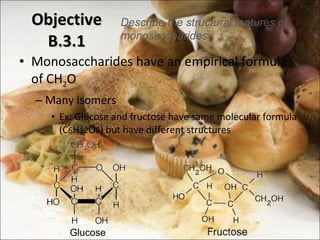
Monosaccharides have an empirical formula of CH 2 O Many isomers Ex: Glucose and fructose have same molecular formula (C 6 H 12 O 6 ) but have different structures Objective B.3.1 Glucose Describe the structural features of monosaccharides
Made up of covalent bonds Contain one carbonyl group (C=O) Contain at least two hydroxyl groups (-OH) Ex. Glucose, fructose, and galactose Objective B.3.1 Describe the structural features of monosaccharides
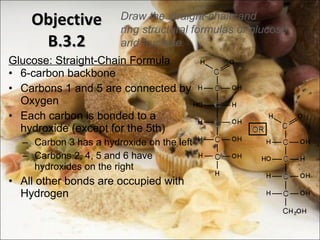
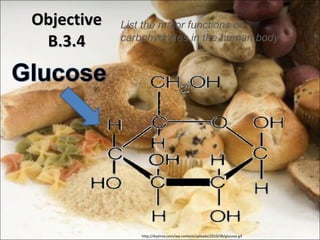
Objective B.3.2 Glucose: Straight-Chain Formula 6-carbon backbone Carbons 1 and 5 are connected by Oxygen Each carbon is bonded to a hydroxide (except for the 5th) Carbon 3 has a hydroxide on the left Carbons 2, 4, 5 and 6 have hydroxides on the right All other bonds are occupied with Hydrogen Draw the straight-chain and ring structural formulas of glucose and fructose
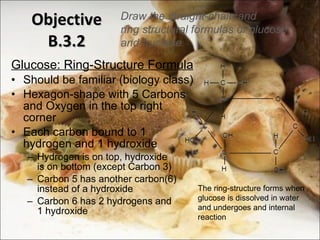
Objective B.3.2 Glucose: Ring-Structure Formula Should be familiar (biology class) Hexagon-shape with 5 Carbons and Oxygen in the top right corner Each carbon bound to 1 hydrogen and 1 hydroxide Hydrogen is on top, hydroxide  is on bottom (except Carbon 3) Carbon 5 has another carbon(6)  instead of a hydroxide Carbon 6 has 2 hydrogens and  1 hydroxide Draw the straight-chain and ring structural formulas of glucose and fructose The ring-structure forms when glucose is dissolved in water and undergoes and internal reaction
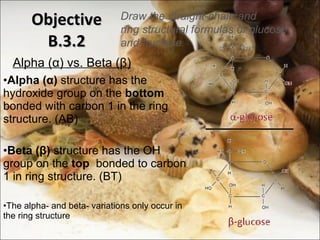
Alpha ( α ) vs. Beta ( β ) Alpha ( α )  structure has the hydroxide group on the  bottom  bonded with carbon 1 in the ring structure. (AB) Beta ( β )  structure has the OH group on the  top   bonded to carbon 1 in ring structure. (BT) The alpha- and beta- variations only occur in the ring structure Objective B.3.2 Draw the straight-chain and ring structural formulas of glucose and fructose
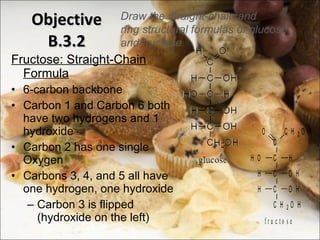
Objective B.3.2 Fructose: Straight-Chain Formula 6-carbon backbone Carbon 1 and Carbon 6 both have two hydrogens and 1 hydroxide Carbon 2 has one single Oxygen Carbons 3, 4, and 5 all have one hydrogen, one hydroxide Carbon 3 is flipped (hydroxide on the left) Draw the straight-chain and ring structural formulas of glucose and fructose
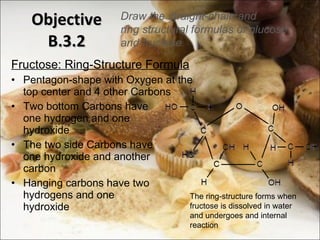
Objective B.3.2 Fructose: Ring-Structure Formula Pentagon-shape with Oxygen at the top center and 4 other Carbons Two bottom Carbons have one hydrogen and one  hydroxide The two side Carbons have one hydroxide and another carbon Hanging carbons have two hydrogens and one  hydroxide Draw the straight-chain and ring structural formulas of glucose and fructose The ring-structure forms when fructose is dissolved in water and undergoes and internal reaction
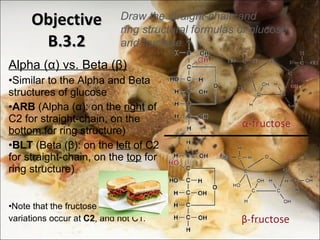
Objective B.3.2 Alpha ( α ) vs. Beta ( β ) Similar to the Alpha and Beta structures of glucose ARB  (Alpha   ( α ): on the  right  of C2 for straight-chain, on the  bottom  for ring structure) BLT  (Beta   ( β ): on the  left  of C2 for straight-chain, on the  top  for ring structure) Note that the fructose  variations occur at  C2 , and not C1. Draw the straight-chain and ring structural formulas of glucose and fructose
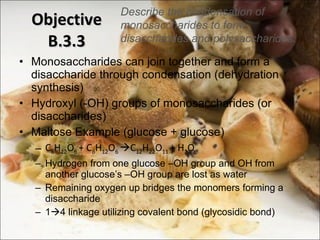
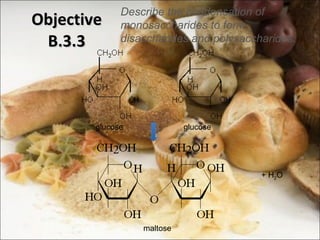
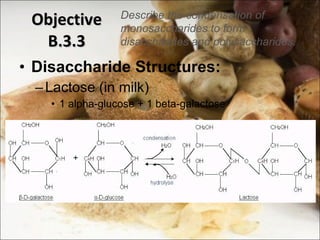
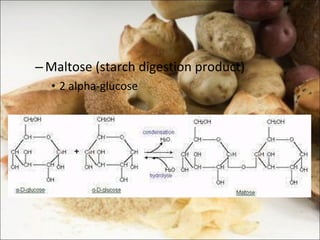
Objective B.3.3 Monosaccharides can join together and form a disaccharide through condensation (dehydration synthesis) Hydroxyl (-OH) groups of monosaccharides (or disaccharides) Maltose Example (glucose + glucose) C 6 H 12 O 6  + C 6 H 12 O 6   C 12 H 22 O 11  + H 2 O Hydrogen from one glucose –OH group and OH from another glucose’s –OH group are lost as water Remaining oxygen up bridges the monomers forming a disaccharide 1  4 linkage utilizing covalent bond (glycosidic bond) Describe the condensation of monosaccharides to form disaccharides and polysaccharides. 
Objective B.3.3 Describe the condensation of monosaccharides to form disaccharides and polysaccharides.  maltose glucose glucose + H 2 O H   H
Objective B.3.3 Monosaccharide examples: Glucose, Fructose, Galactose Disaccharide examples: Lactose, Maltose, Sucrose Polysaccharide examples: Starch, Glycogen, Cellulose Describe the condensation of monosaccharides to form disaccharides and polysaccharides.
Objective B.3.3 Disaccharide Structures: Lactose (in milk) 1 alpha-glucose + 1 beta-galactose Describe the condensation of monosaccharides to form disaccharides and polysaccharides.
Maltose (starch digestion product) 2 alpha-glucose
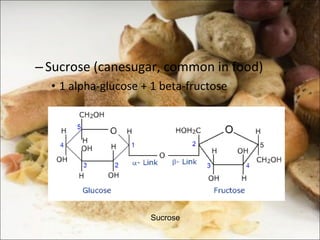
Sucrose (canesugar, common in food) 1 alpha-glucose + 1 beta-fructose Sucrose
Objective B.3.4 Major functions: Energy Source Energy Storage Important for Other Molecules List the major functions of carbohydrates in the human body
Objective B.3.4 Energy Source: Glucose Glucose  is a monosaccharide which helps provide the body with energy Glucose  is oxidized in respiration to help form ATP energy for the body to use List the major functions of carbohydrates in the human body http://www.individualsole.com/wp-content/uploads/2010/05/SpSu10_Running_02035_ipod-540x360.jpg
Objective B.3.4 http://drpinna.com/wp-content/uploads/2010/08/glucose.gif List the major functions of carbohydrates in the human body
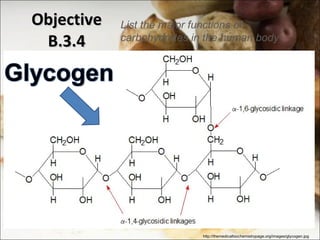
Objective B.3.4 Energy Storage: Glycogen Energy, in animals, is stored in the form of  Glycogen  (in the liver muscles) Glycogen  is formed through Glycogenesis when there ’s an abundance of glucose in the body The polysaccharide  Glycogen  breaks down through Glycogenolysis when more energy is needed  List the major functions of carbohydrates in the human body http://findstorageauctionriches.com/IMAGES/self-storage-units.jpg
Objective B.3.4 List the major functions of carbohydrates in the human body http://themedicalbiochemistrypage.org/images/glycogen.jpg
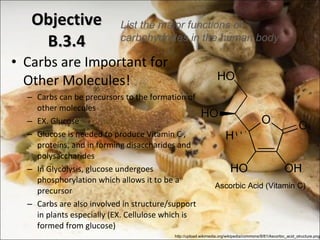
Objective B.3.4 Carbs are Important for Other Molecules! Carbs can be precursors to the formation of other molecules EX. Glucose Glucose is needed to produce Vitamin C , proteins, and in forming disaccharides and polysaccharides In Glycolysis, glucose undergoes phosphorylation which allows it to be a precursor Carbs are also involved in structure/support in plants especially (EX. Cellulose which is formed from glucose) List the major functions of carbohydrates in the human body http://upload.wikimedia.org/wikipedia/commons/8/81/Ascorbic_acid_structure.png Ascorbic Acid (Vitamin C)
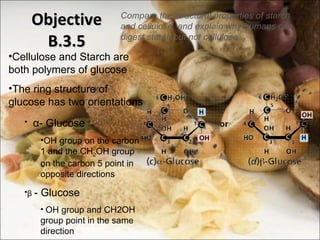
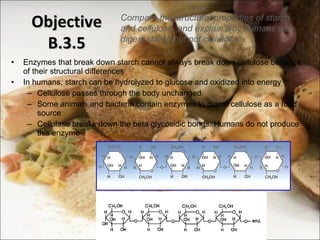
Objective B.3.5 Compare the structural properties of starch and cellulose, and explain why humans can digest starch but not cellulose.  Cellulose and Starch are both polymers of glucose The ring structure of glucose has two orientations α - Glucose OH group on the carbon 1 and the CH 2 OH group on the carbon 5 point in opposite directions β  - Glucose OH group and  CH2OH group point in the same direction
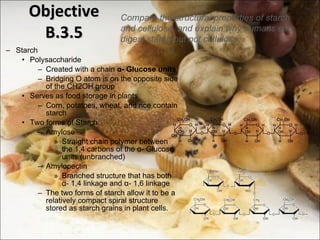
Starch Polysaccharide Created with a chain  α - Glucose units Bridging O atom is on the opposite side of the CH2OH group  Serves as food storage in plants Corn, potatoes, wheat, and rice contain starch Two forms of Starch Amylose Straight chain polymer between the 1,4 carbons of the  α - Glucose units (unbranched) Amylopectin  Branched structure that has both  α - 1,4 linkage and  α - 1,6 linkage The two forms of starch allow it to be a relatively compact spiral structure stored as starch grains in plant cells.  Objective B.3.5 Compare the structural properties of starch and cellulose, and explain why humans can digest starch but not cellulose.
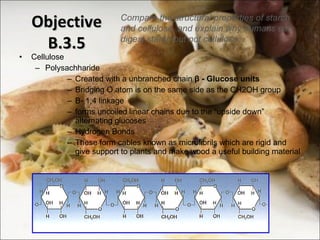
Cellulose Polysachharide Created with a unbranched chain  β  - Glucose units Bridging O atom is on the same side as the CH2OH group  Β - 1,4 linkage forms uncoiled linear chains due to the “upside down” alternating glucoses  Hydrogen Bonds These form cables known as microfibrils which are rigid and give support to plants and make wood a useful building material  Objective B.3.5 Compare the structural properties of starch and cellulose, and explain why humans can digest starch but not cellulose.
Enzymes that break down starch cannot always break down cellulose because of their structural differences In humans, starch can be hydrolyzed to glucose and oxidized into energy Cellulose passes through the body unchanged Some animals and bacteria contain enzymes to digest cellulose as a food source Cellulase breaks down the beta glycosidic bonds. Humans do not produce this enzyme Objective B.3.5 Compare the structural properties of starch and cellulose, and explain why humans can digest starch but not cellulose.
Objective B.3.6 Dietary fibre is mainly plant material  Characteristics: Can ’t be hydrolysed (digested) by enzymes in the human digestive tract may be digested by microflora in the gut Examples: Cellulose Hemicellulose Lignin Pectin State what is meant by the term dietary fibre.
Objective B.3.7 Dietary fiber passes through the body without being changed or digested much. Aids the health of the large intestine by stimulating the production of mucous  and helping the other products of digestion to pass out of the body more easily.  Foods that are high in fiber: bran, dried herbs, spices, and peppers, soy beans, dark chocolate, and nuts. Prevents: Constipation Obesity Crohn's disease Hemorrhoids Diabetes mellitus  Describe the importance of a diet high in dietary fiber.
 
References http://www.elmhurst.edu/~chm/vchembook/540carbohydrates.html http://ibchem.com/IB/ibnotes/brief/pdf/optB.pdf http://www.chem.purdue.edu/courses/chm333/Fall%202009/Lectures/Fall%202009%20Lecture%2028.pdf http://www.mansfield.ohio-state.edu/~sabedon/biol1025.htm http://www.3dchem.com/molecules.asp?ID=423 http://www.edinformatics.com/math_science/science_of_cooking/glucose.htm http://www.elmhurst.edu/~chm/vchembook/547cellulose.html

B3 carbohydrates

  • 1.
  • 2.
    All B3 ObjectivesB.3.1: Describe the structural features of monosaccharides. B.3.2: Draw the straight-chain and ring structural formulas of glucose and fructose. B.3.3: Describe the condensation of monosaccharides to form disaccharides and polysaccharides. B.3.4: List the major functions of carbohydrates in the human body. B.3.5: Compare the structural properties of starch and cellulose, and explain why humans can digest starch but not cellulose. B.3.6: State what is meant by the term dietary fibre. B.3.7: Describe the importance of a diet high in dietary fibre.
  • 3.
    Monosaccharides have anempirical formula of CH 2 O Many isomers Ex: Glucose and fructose have same molecular formula (C 6 H 12 O 6 ) but have different structures Objective B.3.1 Glucose Describe the structural features of monosaccharides
  • 4.
    Made up ofcovalent bonds Contain one carbonyl group (C=O) Contain at least two hydroxyl groups (-OH) Ex. Glucose, fructose, and galactose Objective B.3.1 Describe the structural features of monosaccharides
  • 5.
    Objective B.3.2 Glucose:Straight-Chain Formula 6-carbon backbone Carbons 1 and 5 are connected by Oxygen Each carbon is bonded to a hydroxide (except for the 5th) Carbon 3 has a hydroxide on the left Carbons 2, 4, 5 and 6 have hydroxides on the right All other bonds are occupied with Hydrogen Draw the straight-chain and ring structural formulas of glucose and fructose
  • 6.
    Objective B.3.2 Glucose:Ring-Structure Formula Should be familiar (biology class) Hexagon-shape with 5 Carbons and Oxygen in the top right corner Each carbon bound to 1 hydrogen and 1 hydroxide Hydrogen is on top, hydroxide is on bottom (except Carbon 3) Carbon 5 has another carbon(6)  instead of a hydroxide Carbon 6 has 2 hydrogens and 1 hydroxide Draw the straight-chain and ring structural formulas of glucose and fructose The ring-structure forms when glucose is dissolved in water and undergoes and internal reaction
  • 7.
    Alpha ( α) vs. Beta ( β ) Alpha ( α ) structure has the hydroxide group on the bottom bonded with carbon 1 in the ring structure. (AB) Beta ( β ) structure has the OH group on the top bonded to carbon 1 in ring structure. (BT) The alpha- and beta- variations only occur in the ring structure Objective B.3.2 Draw the straight-chain and ring structural formulas of glucose and fructose
  • 8.
    Objective B.3.2 Fructose:Straight-Chain Formula 6-carbon backbone Carbon 1 and Carbon 6 both have two hydrogens and 1 hydroxide Carbon 2 has one single Oxygen Carbons 3, 4, and 5 all have one hydrogen, one hydroxide Carbon 3 is flipped (hydroxide on the left) Draw the straight-chain and ring structural formulas of glucose and fructose
  • 9.
    Objective B.3.2 Fructose:Ring-Structure Formula Pentagon-shape with Oxygen at the top center and 4 other Carbons Two bottom Carbons have one hydrogen and one  hydroxide The two side Carbons have one hydroxide and another carbon Hanging carbons have two hydrogens and one  hydroxide Draw the straight-chain and ring structural formulas of glucose and fructose The ring-structure forms when fructose is dissolved in water and undergoes and internal reaction
  • 10.
    Objective B.3.2 Alpha( α ) vs. Beta ( β ) Similar to the Alpha and Beta structures of glucose ARB (Alpha ( α ): on the right of C2 for straight-chain, on the bottom for ring structure) BLT (Beta ( β ): on the left of C2 for straight-chain, on the top for ring structure) Note that the fructose variations occur at C2 , and not C1. Draw the straight-chain and ring structural formulas of glucose and fructose
  • 11.
    Objective B.3.3 Monosaccharidescan join together and form a disaccharide through condensation (dehydration synthesis) Hydroxyl (-OH) groups of monosaccharides (or disaccharides) Maltose Example (glucose + glucose) C 6 H 12 O 6 + C 6 H 12 O 6  C 12 H 22 O 11 + H 2 O Hydrogen from one glucose –OH group and OH from another glucose’s –OH group are lost as water Remaining oxygen up bridges the monomers forming a disaccharide 1  4 linkage utilizing covalent bond (glycosidic bond) Describe the condensation of monosaccharides to form disaccharides and polysaccharides. 
  • 12.
    Objective B.3.3 Describethe condensation of monosaccharides to form disaccharides and polysaccharides.  maltose glucose glucose + H 2 O H H
  • 13.
    Objective B.3.3 Monosaccharideexamples: Glucose, Fructose, Galactose Disaccharide examples: Lactose, Maltose, Sucrose Polysaccharide examples: Starch, Glycogen, Cellulose Describe the condensation of monosaccharides to form disaccharides and polysaccharides.
  • 14.
    Objective B.3.3 DisaccharideStructures: Lactose (in milk) 1 alpha-glucose + 1 beta-galactose Describe the condensation of monosaccharides to form disaccharides and polysaccharides.
  • 15.
    Maltose (starch digestionproduct) 2 alpha-glucose
  • 16.
    Sucrose (canesugar, commonin food) 1 alpha-glucose + 1 beta-fructose Sucrose
  • 17.
    Objective B.3.4 Majorfunctions: Energy Source Energy Storage Important for Other Molecules List the major functions of carbohydrates in the human body
  • 18.
    Objective B.3.4 EnergySource: Glucose Glucose is a monosaccharide which helps provide the body with energy Glucose is oxidized in respiration to help form ATP energy for the body to use List the major functions of carbohydrates in the human body http://www.individualsole.com/wp-content/uploads/2010/05/SpSu10_Running_02035_ipod-540x360.jpg
  • 19.
    Objective B.3.4 http://drpinna.com/wp-content/uploads/2010/08/glucose.gifList the major functions of carbohydrates in the human body
  • 20.
    Objective B.3.4 EnergyStorage: Glycogen Energy, in animals, is stored in the form of Glycogen (in the liver muscles) Glycogen is formed through Glycogenesis when there ’s an abundance of glucose in the body The polysaccharide Glycogen breaks down through Glycogenolysis when more energy is needed List the major functions of carbohydrates in the human body http://findstorageauctionriches.com/IMAGES/self-storage-units.jpg
  • 21.
    Objective B.3.4 Listthe major functions of carbohydrates in the human body http://themedicalbiochemistrypage.org/images/glycogen.jpg
  • 22.
    Objective B.3.4 Carbsare Important for Other Molecules! Carbs can be precursors to the formation of other molecules EX. Glucose Glucose is needed to produce Vitamin C , proteins, and in forming disaccharides and polysaccharides In Glycolysis, glucose undergoes phosphorylation which allows it to be a precursor Carbs are also involved in structure/support in plants especially (EX. Cellulose which is formed from glucose) List the major functions of carbohydrates in the human body http://upload.wikimedia.org/wikipedia/commons/8/81/Ascorbic_acid_structure.png Ascorbic Acid (Vitamin C)
  • 23.
    Objective B.3.5 Comparethe structural properties of starch and cellulose, and explain why humans can digest starch but not cellulose. Cellulose and Starch are both polymers of glucose The ring structure of glucose has two orientations α - Glucose OH group on the carbon 1 and the CH 2 OH group on the carbon 5 point in opposite directions β - Glucose OH group and CH2OH group point in the same direction
  • 24.
    Starch Polysaccharide Createdwith a chain α - Glucose units Bridging O atom is on the opposite side of the CH2OH group Serves as food storage in plants Corn, potatoes, wheat, and rice contain starch Two forms of Starch Amylose Straight chain polymer between the 1,4 carbons of the α - Glucose units (unbranched) Amylopectin Branched structure that has both α - 1,4 linkage and α - 1,6 linkage The two forms of starch allow it to be a relatively compact spiral structure stored as starch grains in plant cells. Objective B.3.5 Compare the structural properties of starch and cellulose, and explain why humans can digest starch but not cellulose.
  • 25.
    Cellulose Polysachharide Createdwith a unbranched chain β - Glucose units Bridging O atom is on the same side as the CH2OH group Β - 1,4 linkage forms uncoiled linear chains due to the “upside down” alternating glucoses Hydrogen Bonds These form cables known as microfibrils which are rigid and give support to plants and make wood a useful building material Objective B.3.5 Compare the structural properties of starch and cellulose, and explain why humans can digest starch but not cellulose.
  • 26.
    Enzymes that breakdown starch cannot always break down cellulose because of their structural differences In humans, starch can be hydrolyzed to glucose and oxidized into energy Cellulose passes through the body unchanged Some animals and bacteria contain enzymes to digest cellulose as a food source Cellulase breaks down the beta glycosidic bonds. Humans do not produce this enzyme Objective B.3.5 Compare the structural properties of starch and cellulose, and explain why humans can digest starch but not cellulose.
  • 27.
    Objective B.3.6 Dietaryfibre is mainly plant material Characteristics: Can ’t be hydrolysed (digested) by enzymes in the human digestive tract may be digested by microflora in the gut Examples: Cellulose Hemicellulose Lignin Pectin State what is meant by the term dietary fibre.
  • 28.
    Objective B.3.7 Dietaryfiber passes through the body without being changed or digested much. Aids the health of the large intestine by stimulating the production of mucous and helping the other products of digestion to pass out of the body more easily. Foods that are high in fiber: bran, dried herbs, spices, and peppers, soy beans, dark chocolate, and nuts. Prevents: Constipation Obesity Crohn's disease Hemorrhoids Diabetes mellitus  Describe the importance of a diet high in dietary fiber.
  • 29.
  • 30.
    References http://www.elmhurst.edu/~chm/vchembook/540carbohydrates.html http://ibchem.com/IB/ibnotes/brief/pdf/optB.pdfhttp://www.chem.purdue.edu/courses/chm333/Fall%202009/Lectures/Fall%202009%20Lecture%2028.pdf http://www.mansfield.ohio-state.edu/~sabedon/biol1025.htm http://www.3dchem.com/molecules.asp?ID=423 http://www.edinformatics.com/math_science/science_of_cooking/glucose.htm http://www.elmhurst.edu/~chm/vchembook/547cellulose.html

Editor's Notes

  • #4 Both are hexose sugars with molecular formula C 6 H 12 O 6
  • #13 1 st carbon of one glucose is covalently bonded to the 4 th carbon of the other glucose
  • #14 Condensation can be repeated with disaccharides to form polysaccharides
  • #15 Condensation can be repeated with disaccharides to form polysaccharides