Structure of
     Glucose
          CHEM 81
      Professor Hoover

       Allyson Camitta
         Ruby Davila
      Tamra Fukumoto
       Maria Calderon


1
2


Structure of Glucose

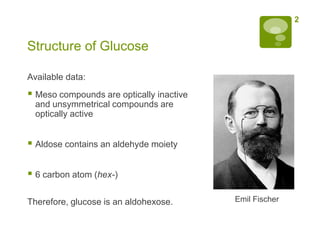
Available data:
 Meso compounds are optically inactive
  and unsymmetrical compounds are
  optically active


 Aldose contains an aldehyde moiety

 6 carbon atom (hex-)

Therefore, glucose is an aldohexose.      Emil Fischer
3
Structure of Glucose (cont.)


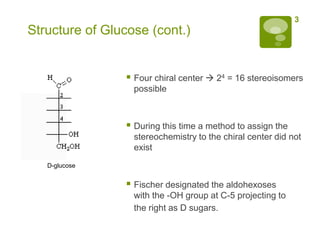
                 Four chiral center  24 = 16 stereoisomers
                  possible


                 During this time a method to assign the
                  stereochemistry to the chiral center did not
                  exist
   D-glucose


                 Fischer designated the aldohexoses
                  with the -OH group at C-5 projecting to
                  the right as D sugars.
4
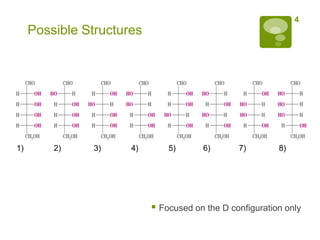
     Possible Structures


1)       2)    3)     4)       5)      6)       7)        8)


                            Focused on the D configuration only
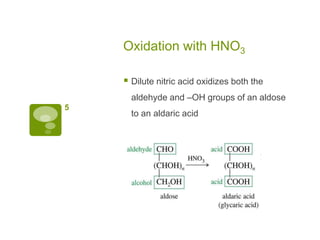
Oxidation with HNO3

     Dilute nitric acid oxidizes both the
      aldehyde and –OH groups of an aldose
5
      to an aldaric acid
6

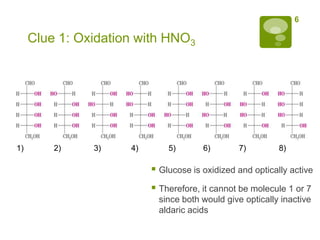
     Clue 1: Oxidation with HNO3


1)       2)    3)    4)       5)       6)        7)        8)

                           Glucose is oxidized and optically active
                           Therefore, it cannot be molecule 1 or 7
                            since both would give optically inactive
                            aldaric acids
7
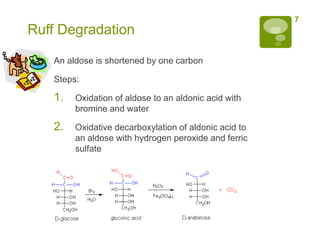
Ruff Degradation

   An aldose is shortened by one carbon

   Steps:

   1.   Oxidation of aldose to an aldonic acid with
        bromine and water

   2.   Oxidative decarboxylation of aldonic acid to
        an aldose with hydrogen peroxide and ferric
        sulfate
8
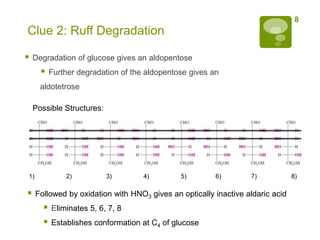
Clue 2: Ruff Degradation

   Degradation of glucose gives an aldopentose
          Further degradation of the aldopentose gives an
      aldotetrose

    Possible Structures:


1)             2)          3)        4)        5)        6)       7)            8)

    Followed by oxidation with HNO3 gives an optically inactive aldaric acid
          Eliminates 5, 6, 7, 8
          Establishes conformation at C4 of glucose
9
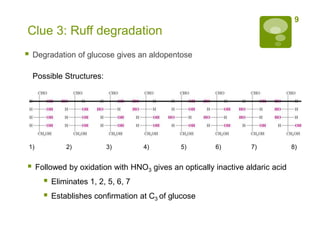
Clue 3: Ruff degradation
   Degradation of glucose gives an aldopentose

    Possible Structures:


1)             2)          3)         4)       5)       6)        7)            8)


    Followed by oxidation with HNO3 gives an optically inactive aldaric acid
          Eliminates 1, 2, 5, 6, 7
          Establishes confirmation at C3 of glucose
10


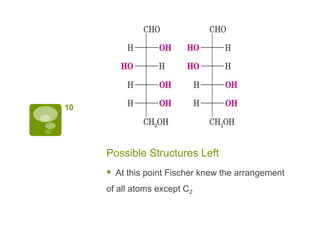
     Possible Structures Left
      At this point Fischer knew the arrangement
     of all atoms except C2
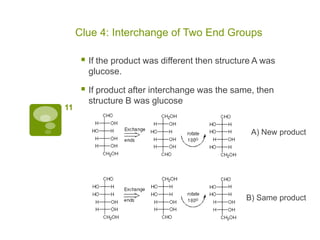
Clue 4: Interchange of Two End Groups

       If the product was different then structure A was
        glucose.

       If product after interchange was the same, then
        structure B was glucose
11


                                                  A) New product


                                                 B) Same product
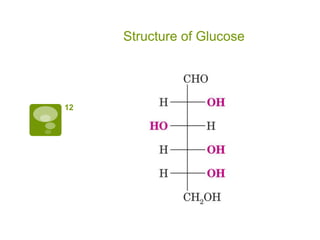
Structure of Glucose


12

Organic Chemistry Emil Fischer Glucose

  • 1.
    Structure of Glucose CHEM 81 Professor Hoover Allyson Camitta Ruby Davila Tamra Fukumoto Maria Calderon 1
  • 2.
    2 Structure of Glucose Availabledata:  Meso compounds are optically inactive and unsymmetrical compounds are optically active  Aldose contains an aldehyde moiety  6 carbon atom (hex-) Therefore, glucose is an aldohexose. Emil Fischer
  • 3.
    3 Structure of Glucose(cont.)  Four chiral center  24 = 16 stereoisomers possible  During this time a method to assign the stereochemistry to the chiral center did not exist D-glucose  Fischer designated the aldohexoses with the -OH group at C-5 projecting to the right as D sugars.
  • 4.
    4 Possible Structures 1) 2) 3) 4) 5) 6) 7) 8)  Focused on the D configuration only
  • 5.
    Oxidation with HNO3  Dilute nitric acid oxidizes both the aldehyde and –OH groups of an aldose 5 to an aldaric acid
  • 6.
    6 Clue 1: Oxidation with HNO3 1) 2) 3) 4) 5) 6) 7) 8)  Glucose is oxidized and optically active  Therefore, it cannot be molecule 1 or 7 since both would give optically inactive aldaric acids
  • 7.
    7 Ruff Degradation An aldose is shortened by one carbon Steps: 1. Oxidation of aldose to an aldonic acid with bromine and water 2. Oxidative decarboxylation of aldonic acid to an aldose with hydrogen peroxide and ferric sulfate
  • 8.
    8 Clue 2: RuffDegradation  Degradation of glucose gives an aldopentose  Further degradation of the aldopentose gives an aldotetrose Possible Structures: 1) 2) 3) 4) 5) 6) 7) 8)  Followed by oxidation with HNO3 gives an optically inactive aldaric acid  Eliminates 5, 6, 7, 8  Establishes conformation at C4 of glucose
  • 9.
    9 Clue 3: Ruffdegradation  Degradation of glucose gives an aldopentose Possible Structures: 1) 2) 3) 4) 5) 6) 7) 8)  Followed by oxidation with HNO3 gives an optically inactive aldaric acid  Eliminates 1, 2, 5, 6, 7  Establishes confirmation at C3 of glucose
  • 10.
    10 Possible Structures Left  At this point Fischer knew the arrangement of all atoms except C2
  • 11.
    Clue 4: Interchangeof Two End Groups  If the product was different then structure A was glucose.  If product after interchange was the same, then structure B was glucose 11 A) New product B) Same product
  • 12.