Genetic engineering
Scientists can remove a gene from one
organism and insert it into a DNA of
another organism.
This species of jelly
fish naturally have the
ability to glow in the
dark.
The gene that is
responsible for this
has been used in
genetic engineering…
Genetic engineering
WALT: To understand how genetic engineering can be
used to treat diseases and to consider the advantages
and disadvantages behind this technology.
WILF: ~ State what genetic engineering is and list
examples of when it is used. (D)
~ Discuss some of the advantages and disadvantages of
genetic engineering for particular examples. (C)
~ Explain how the process of genetic engineering occurs
using enzymes. (B)
~ Evaluate the issues behind genetic engineering. (A/A*)
Keywords
genetic engineering
genetically modified organisms
insulin
beta-carotene
herbicide
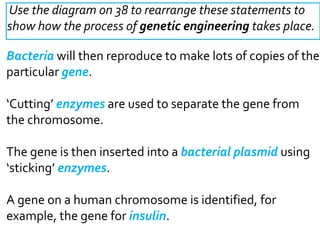
Use the diagram on 38 to rearrange these statements to
show how the process of genetic engineering takes place.
Bacteria will then reproduce to make lots of copies of the
particular gene.

‘Cutting’ enzymes are used to separate the gene from
the chromosome.
The gene is then inserted into a bacterial plasmid using
‘sticking’ enzymes.
A gene on a human chromosome is identified, for
example, the gene for insulin.
A gene on a human
chromosome is identified, for
example, the gene for insulin.
‘Cutting’ enzymes are used to
separate the gene from the
chromosome.
The gene is then inserted into a
bacterial plasmid using
‘sticking’ enzymes.

Bacteria will then reproduce to
make lots of copies of the
particular human gene.
What’s the question?
Write a question that will fit the answers below.

1.Genetic
engineering
2. Insulin

1.Plasmid
2.Enzymes
Examples of genetic
engineering
Production of
human insulin

Beta-carotene
in wild rice

Read the information
on page 38 and 39 to
identify the
advantages and
disadvantages of
using genetic
engineering for these
three examples.

Herbicideresistant crops
Used to be
May produce
Decreases the
extracted
herbicide
number of animals
from pigs but resistant
killed.
now it is
weeds.
extracted GM
Doesn’t suit every
bacteria it
diabetic.
Loss of
can be used
biodiversity.
Needed by
by vegans.
humans to make
Can be made in
vitamin A.
large quantities
and cheaply. Reduce the
amount of crop
Contaminate
spraying.
Might harm
other crops by
people.
crossbreeding.
Write a piece of for
a campaign
website, arguing if
you are either for or
against genetic
engineering.

Success criteria
~ What is genetic engineering?
~ Describe some examples
~ Explain your own opinion
Exam practice
Genetic engineering involves removing a particular
gene from one organism and inserting into the DNA
of another.
Using you knowledge explain one example of how
genetic engineering is used, discussing the
advantages and disadvantages. (4 marks)
B2.6 genetic engineering

B2.6 genetic engineering

  • 1.
    Genetic engineering Scientists canremove a gene from one organism and insert it into a DNA of another organism.
  • 2.
    This species ofjelly fish naturally have the ability to glow in the dark. The gene that is responsible for this has been used in genetic engineering…
  • 4.
    Genetic engineering WALT: Tounderstand how genetic engineering can be used to treat diseases and to consider the advantages and disadvantages behind this technology. WILF: ~ State what genetic engineering is and list examples of when it is used. (D) ~ Discuss some of the advantages and disadvantages of genetic engineering for particular examples. (C) ~ Explain how the process of genetic engineering occurs using enzymes. (B) ~ Evaluate the issues behind genetic engineering. (A/A*) Keywords genetic engineering genetically modified organisms insulin beta-carotene herbicide
  • 5.
    Use the diagramon 38 to rearrange these statements to show how the process of genetic engineering takes place. Bacteria will then reproduce to make lots of copies of the particular gene. ‘Cutting’ enzymes are used to separate the gene from the chromosome. The gene is then inserted into a bacterial plasmid using ‘sticking’ enzymes. A gene on a human chromosome is identified, for example, the gene for insulin.
  • 6.
    A gene ona human chromosome is identified, for example, the gene for insulin. ‘Cutting’ enzymes are used to separate the gene from the chromosome. The gene is then inserted into a bacterial plasmid using ‘sticking’ enzymes. Bacteria will then reproduce to make lots of copies of the particular human gene.
  • 7.
    What’s the question? Writea question that will fit the answers below. 1.Genetic engineering 2. Insulin 1.Plasmid 2.Enzymes
  • 8.
    Examples of genetic engineering Productionof human insulin Beta-carotene in wild rice Read the information on page 38 and 39 to identify the advantages and disadvantages of using genetic engineering for these three examples. Herbicideresistant crops
  • 9.
    Used to be Mayproduce Decreases the extracted herbicide number of animals from pigs but resistant killed. now it is weeds. extracted GM Doesn’t suit every bacteria it diabetic. Loss of can be used biodiversity. Needed by by vegans. humans to make Can be made in vitamin A. large quantities and cheaply. Reduce the amount of crop Contaminate spraying. Might harm other crops by people. crossbreeding.
  • 10.
    Write a pieceof for a campaign website, arguing if you are either for or against genetic engineering. Success criteria ~ What is genetic engineering? ~ Describe some examples ~ Explain your own opinion
  • 11.
    Exam practice Genetic engineeringinvolves removing a particular gene from one organism and inserting into the DNA of another. Using you knowledge explain one example of how genetic engineering is used, discussing the advantages and disadvantages. (4 marks)

Editor's Notes

  • #6 Rearrange and use coloured paper, scissors and glue to model. Support
  • #9 Complete table.
  • #13 The blue rose was created using genetic modification by Suntory Flowers in 2008 (see http://www.telegraph.co.uk/news/worldnews/asia/japan/3329213/Worlds-first-blue-roses-after-20-years-of-research.html), while the ‘black’ tulip is actually a dark purple colour and has been around since before the advent of genetic engineering.
  • #14 Purple tomatoes have been created by genetic modification to contain more antioxidants than normal tomatoes (see http://news.bbc.co.uk/1/hi/7688310.stm), whereas these purple carrots are naturally occurring and may have been one of the earliest forms of carrot, originating in modern-day Afghanistan over 5000 years ago (see http://www.carrotmuseum.co.uk/history.html).