Managing E-business: Business to Business E-business (B2B) Ron Cenfetelli  –  January 9, 2008 These notes will span both Weeks 1 and 2
Before we get to B2B … E-business changes business So, let ’ s look at how e-business influences a company ’ s overall  strategy .
Three General Strategies According to Porter (1980) there are three basic strategies for gaining an advantage over competitors … Low cost leadership : faster, cheaper Best for commodities  Differentiation : Making your company stand out by offering differences (e.g. really good service) Niche : Finding something no one else is doing
The Benefits of  E-business  for Strategy Strategy: Low Cost Leadership Price advantage Disintermediation : pass along savings from one less firm(s) seeking margin in the supply chain Reducing cost: Operations Inbound logistics (more efficient procurement, lower material inventories, defects & errors) Manufacturing (lower WIP inventory) Outbound logistics - distribution of product, service and information (lower product inventory, efficient dispatching) Transaction costs Reduced search costs, online ordering, B2B coordination… Get your customer to do your work for you!  Less labour costs for sales & support  See "More Clicks in the Bricks“ on WebCT
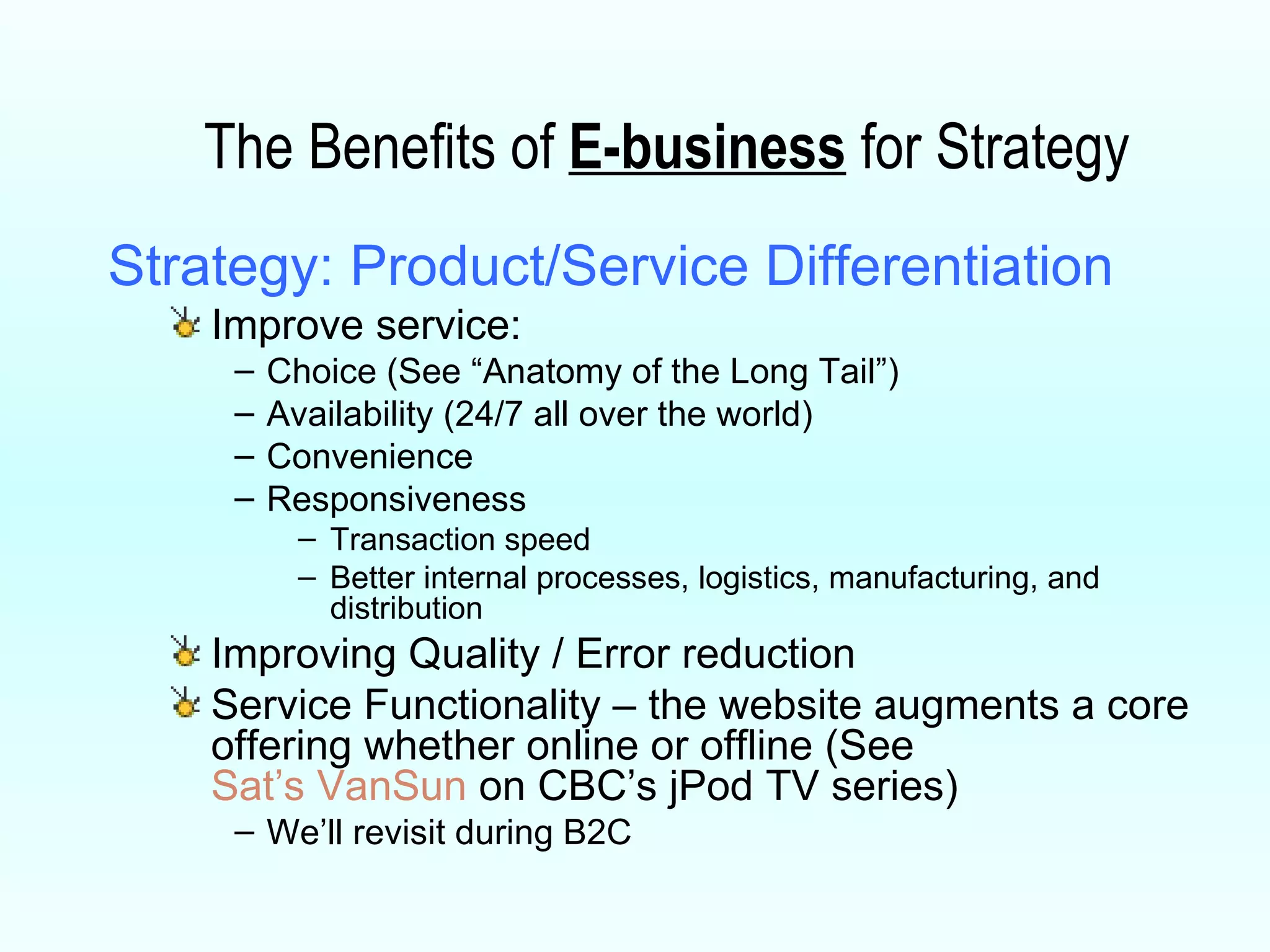
The Benefits of  E-business  for Strategy Strategy: Product/Service Differentiation Improve service:  Choice (See “Anatomy of the Long Tail”) Availability (24/7 all over the world) Convenience Responsiveness Transaction speed Better internal processes, logistics, manufacturing, and distribution Improving Quality / Error reduction  Service Functionality – the website augments a core offering whether online or offline (See  Sat’s VanSun  on CBC’s jPod TV series)  We’ll revisit during B2C
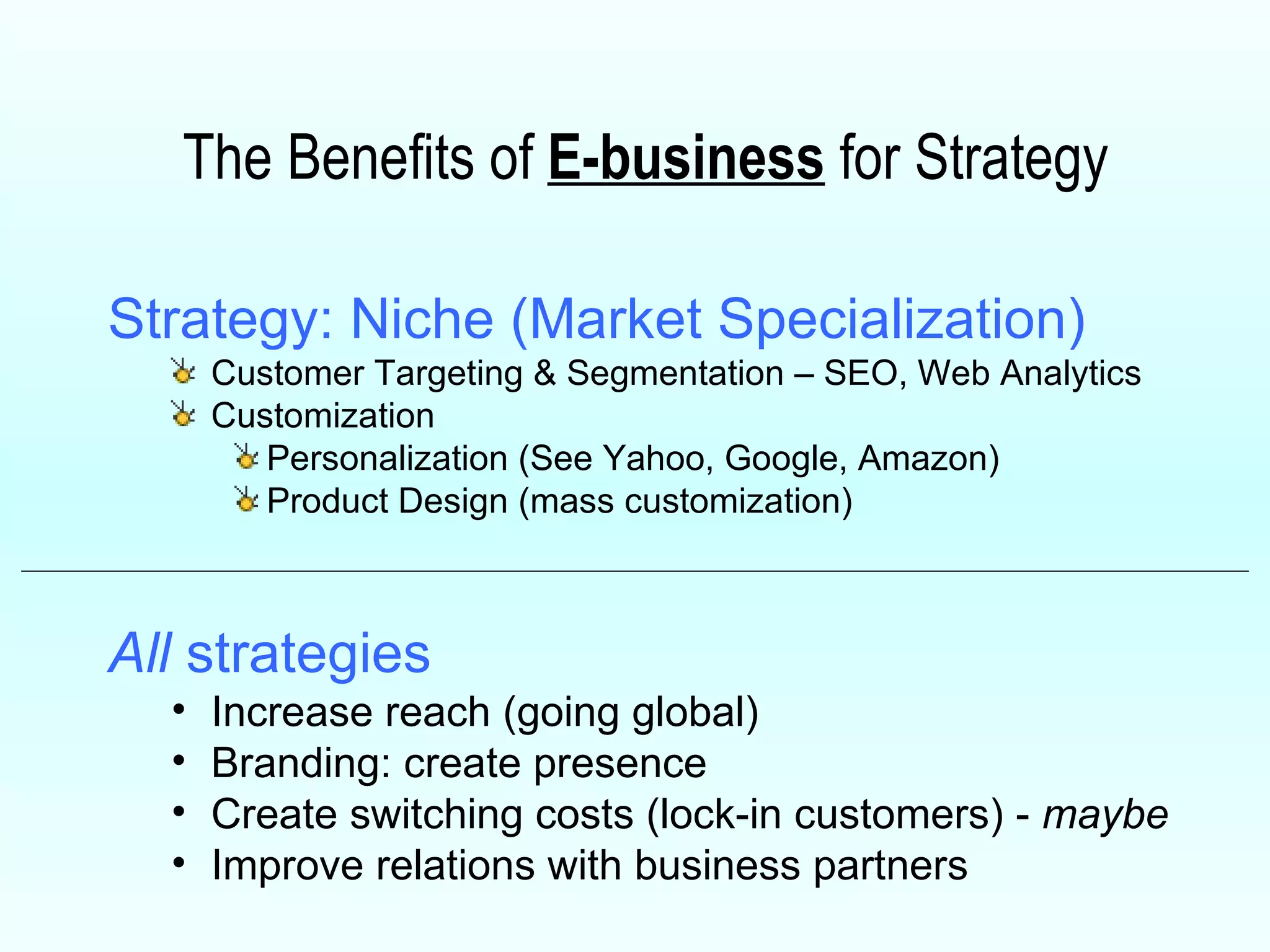
The Benefits of  E-business  for Strategy Strategy: Niche (Market Specialization) Customer Targeting & Segmentation – SEO, Web Analytics Customization Personalization (See Yahoo, Google, Amazon) Product Design (mass customization)  All  strategies Increase reach (going global) Branding: create presence Create switching costs (lock-in customers) -  maybe Improve relations with business partners
Business Models are a Choice The companies in many industries choose to organize around highly similar business models -- with highly similar business results over the long term. E-business and Business models
E-business Models?  E-business offers an opportunity to change the rules of an industry by competing on the basis of  new  business models or vastly improving old ones. E-business and Business models
E- Business model formulation New or revised top line models Auctions (Ebay) A market for  everything Prosper.com; dating websites; GHXC Infomediaries Motionbased.com http://www.samba.biz “ Direct” merchants (Dell, Land’s End, Spud.ca) Affiliates ($ for click through’s) Passive income taken to a new level (see  http://www.amazon.com/affiliate ) Web 2.0 Social/Community models Facebook, etc. And more… Slaying ogres online
E- Business model formulation Bottom line considerations Less brick, less mortar, less people But costs of establishing presence “ One thing important to me as a manager is being able to find ways to get low cost, high potential leads to my website. Search engine advertising, partner engagements (listing - intelligently – our offerings on partner sites) etc ” –  Mudit Mittal General Manager at NetCom Information Technology Being  too  successful Gauging infrastructural needs Mudit Mittal: “ Sudden web success finds us delivering 4 - 5 times the number of events on a weekly basis, than what we were used to. This is also something to watch out for.  Not being operationally ready results in dissatisfied customers, who wouldn't want to come back .”
E- Business model formulation Bottom line considerations Bandwidth isn’t free! Youtube in mid-2006 was distributing 200TB/day (200,000 gigabytes) At $0.05/GB/Month: $1 million/month
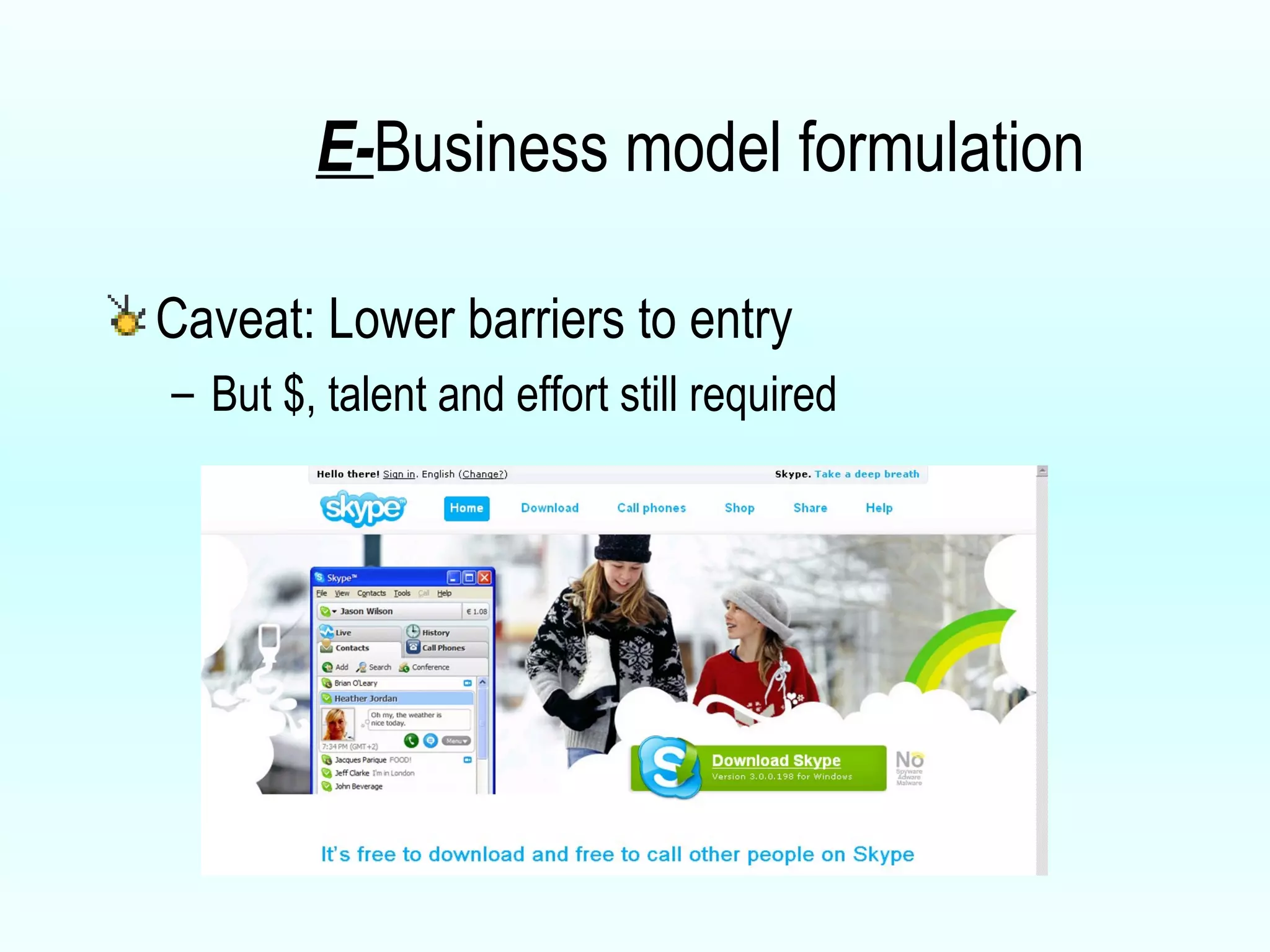
E- Business model formulation Caveat: Lower barriers to entry But $, talent and effort still required
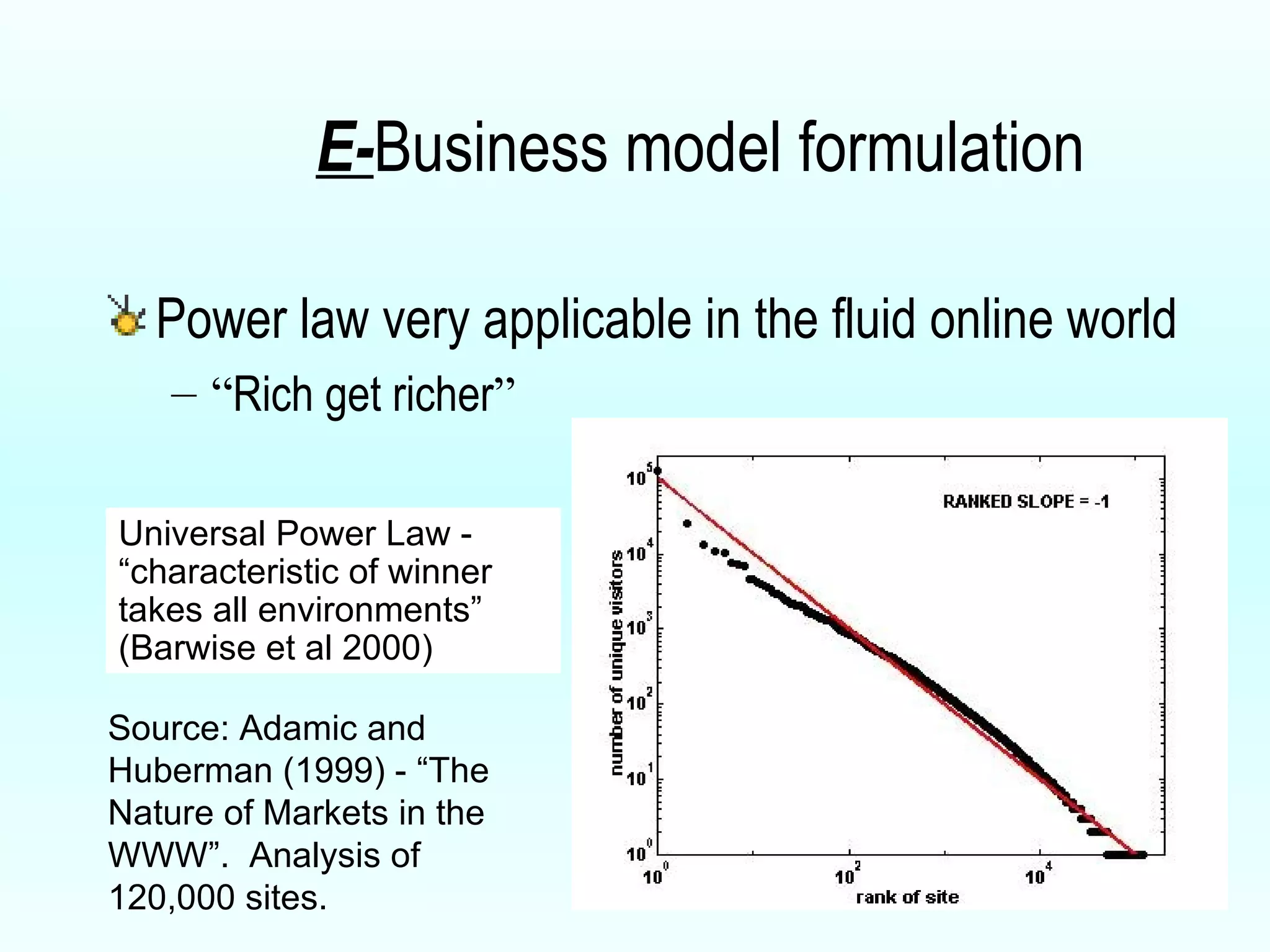
E- Business model formulation Power law very applicable in the fluid online world “ Rich get richer ” Universal Power Law - “characteristic of winner takes all environments” (Barwise et al 2000) Source: Adamic and Huberman (1999) - “The Nature of Markets in the WWW”.  Analysis of 120,000 sites.
 
One more diversion before B2B Before implementing B2B E-business, a company must have its own house in order B2B solutions are weak at best, impossible at worst, if a company ’ s own internal systems aren ’ t as integrated as possible Let ’ s talk briefly about a company ’ s needed technological infrastructure and systems integration
Technological Infrastructure & Integration Business IT infrastructure Enterprise Application integration (EAI) Business process flow and EAI Inter-organizational integration (EDI/XML)
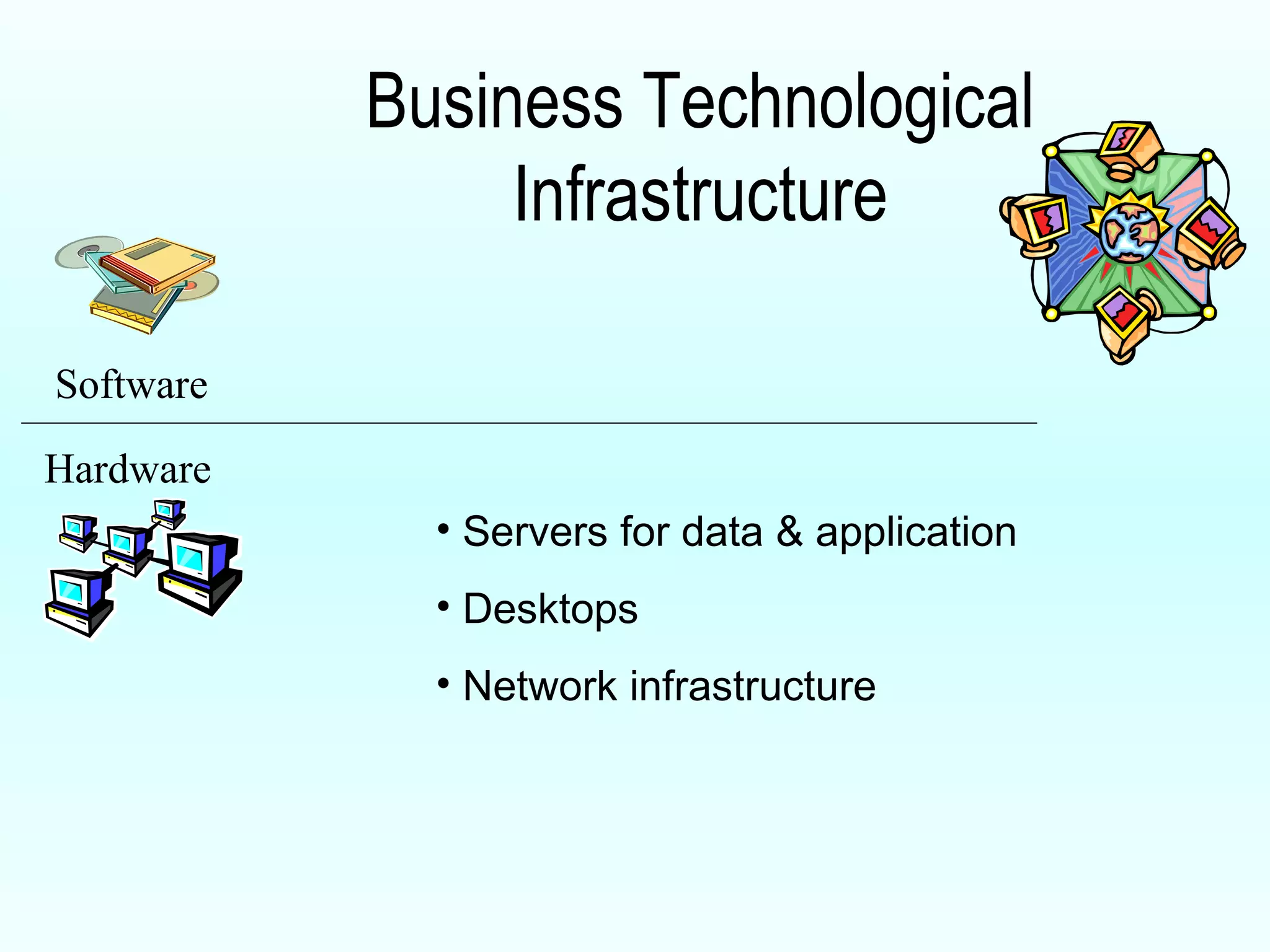
Business Technological Infrastructure Servers for data & application Desktops  Network infrastructure Hardware Software
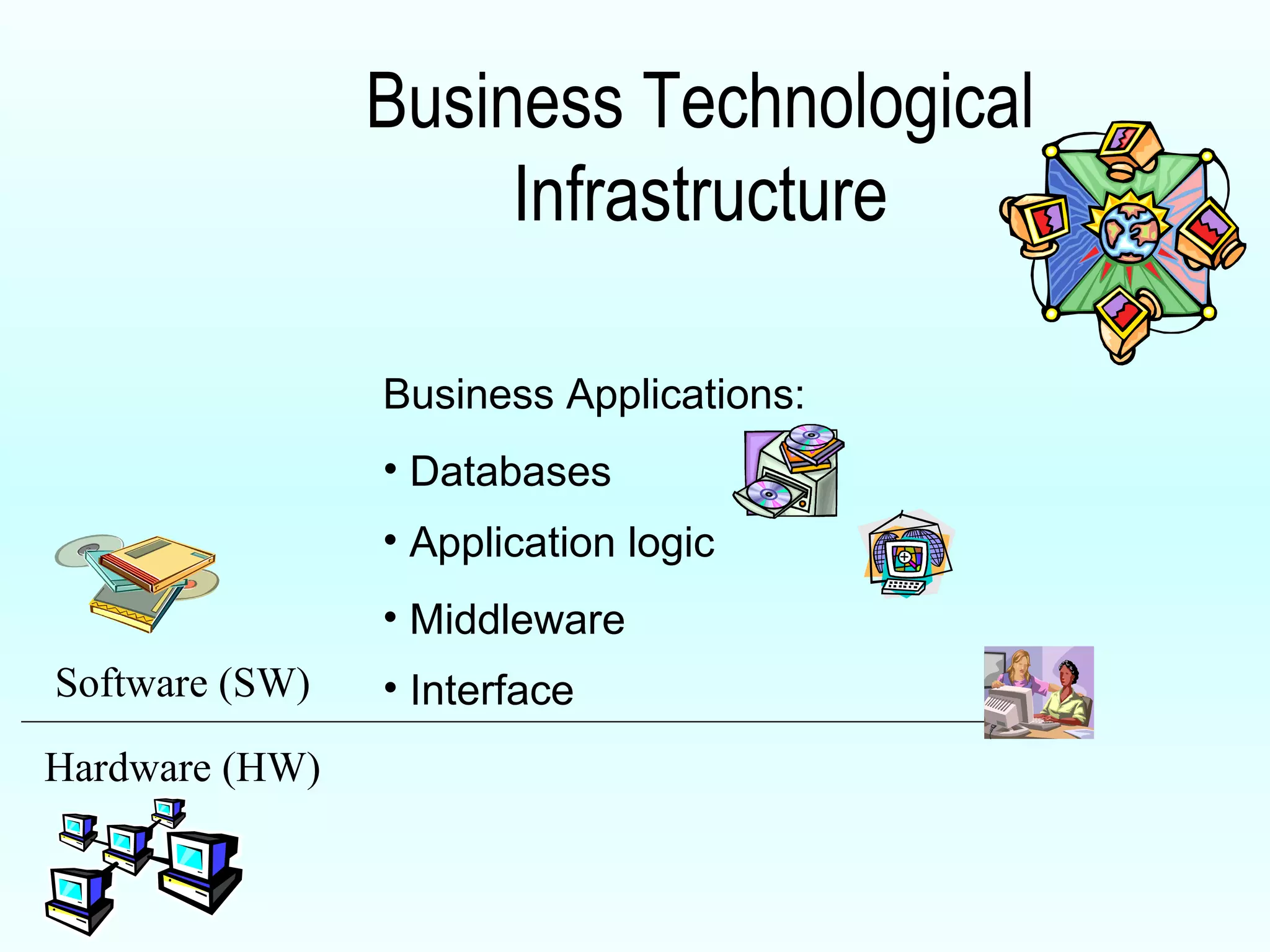
Business Technological Infrastructure Hardware (HW) Software (SW) Business Applications: Databases Application logic Middleware Interface
Technological Infrastructure & Integration Business IT infrastructure Enterprise Application integration (EAI) Business process flow and EAI Inter-organizational integration & EDI
Example: Simple Integration Sharing data between Microsoft Word and Excel Microsoft Excel-Access integration Importing/exporting text files to Excel
Motivation for EAI Say we’re developing an online sales application for the BAIT513 Inc. <product> company: How can we allow our <place> customers to view our <product> inventory?  How could customers view the status of their order after they have made the purchase? (Let’s pretend) most of the required information is contained in legacy applications
Motivation for EAI To answer these questions: What existing applications contain the information customers require? What is involved in integrating the new sales application with the legacy inventory and order tracking applications?
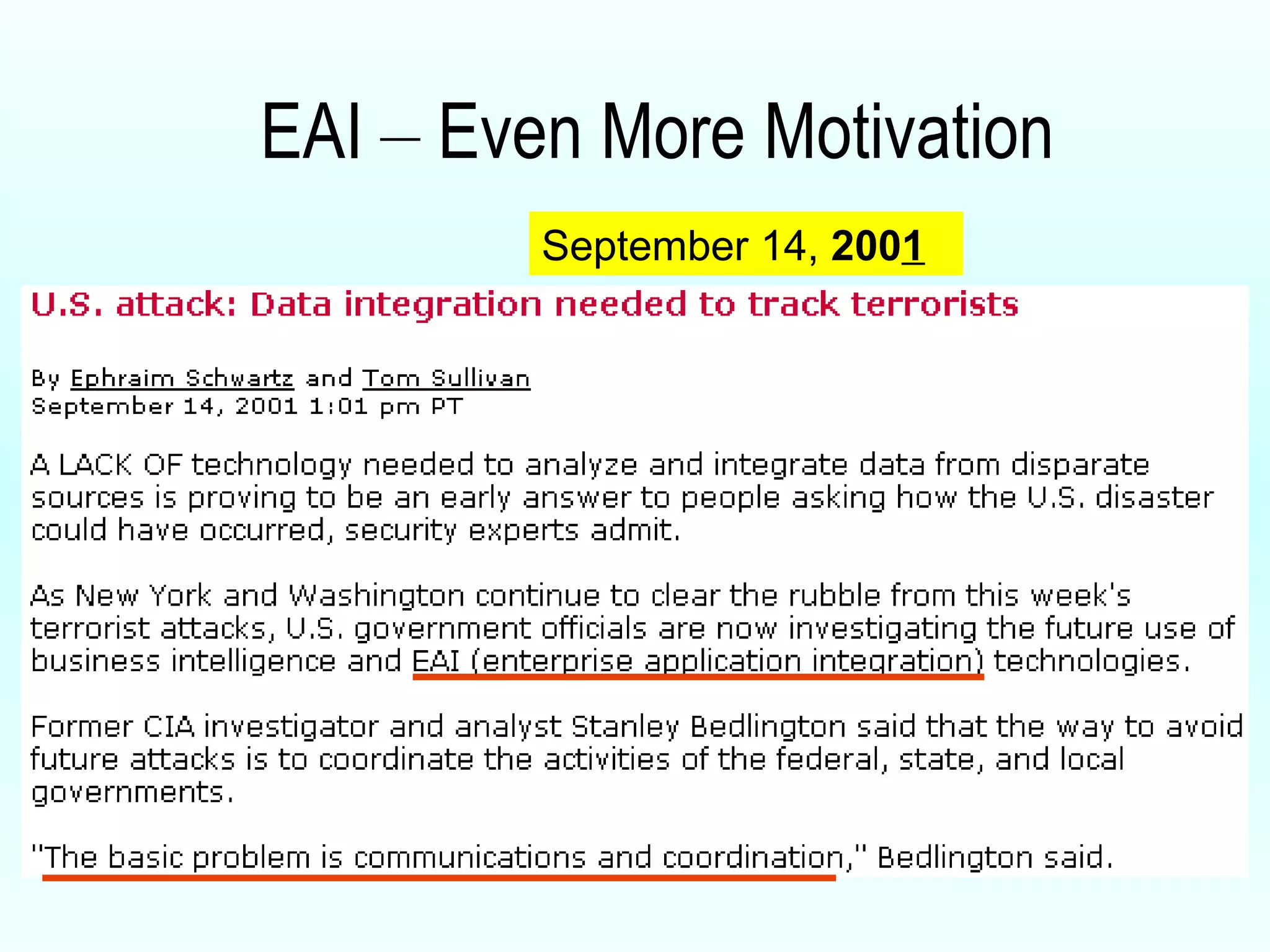
EAI  –  Even More Motivation September 14,  200 1
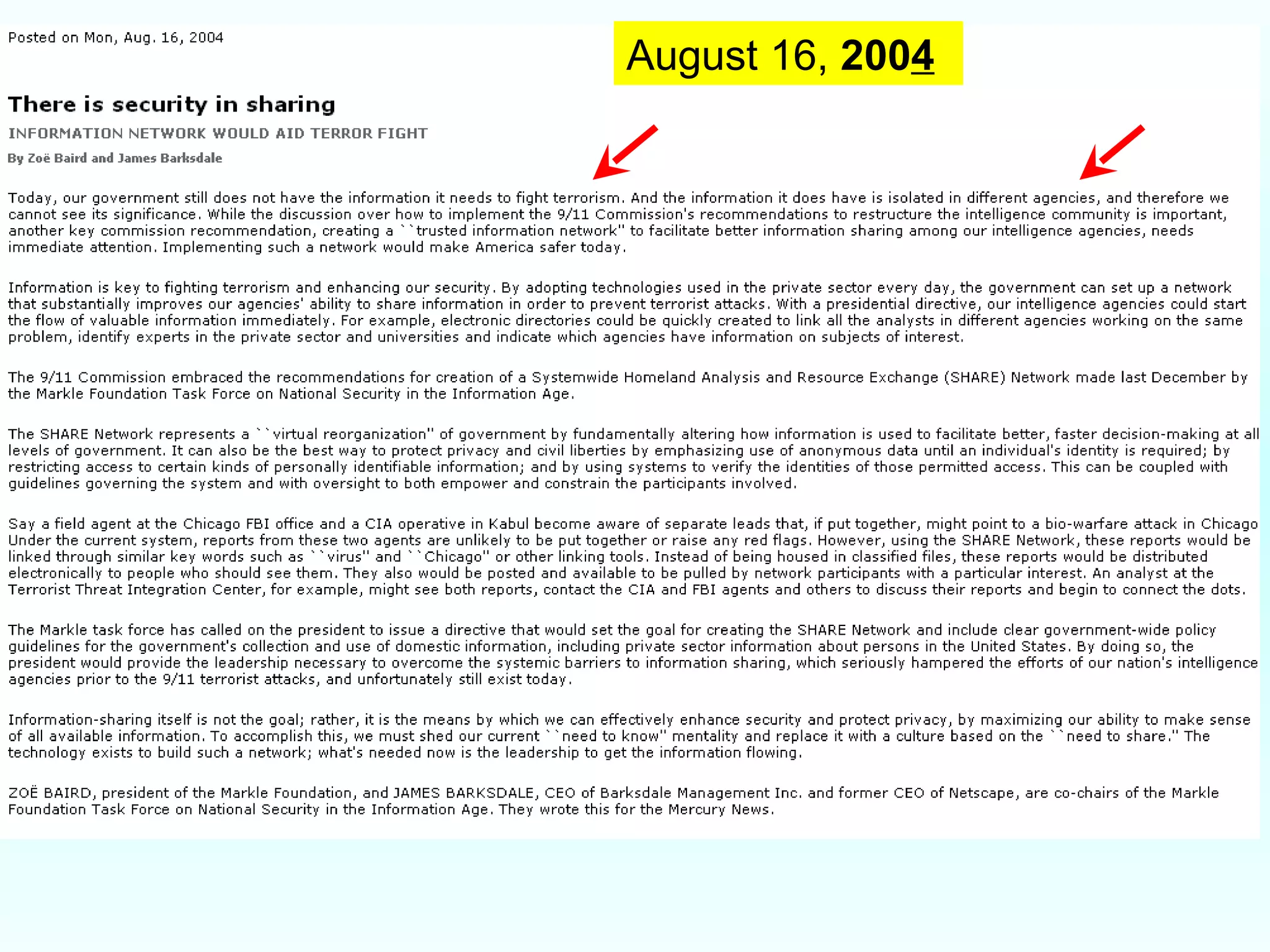
August 16,  200 4
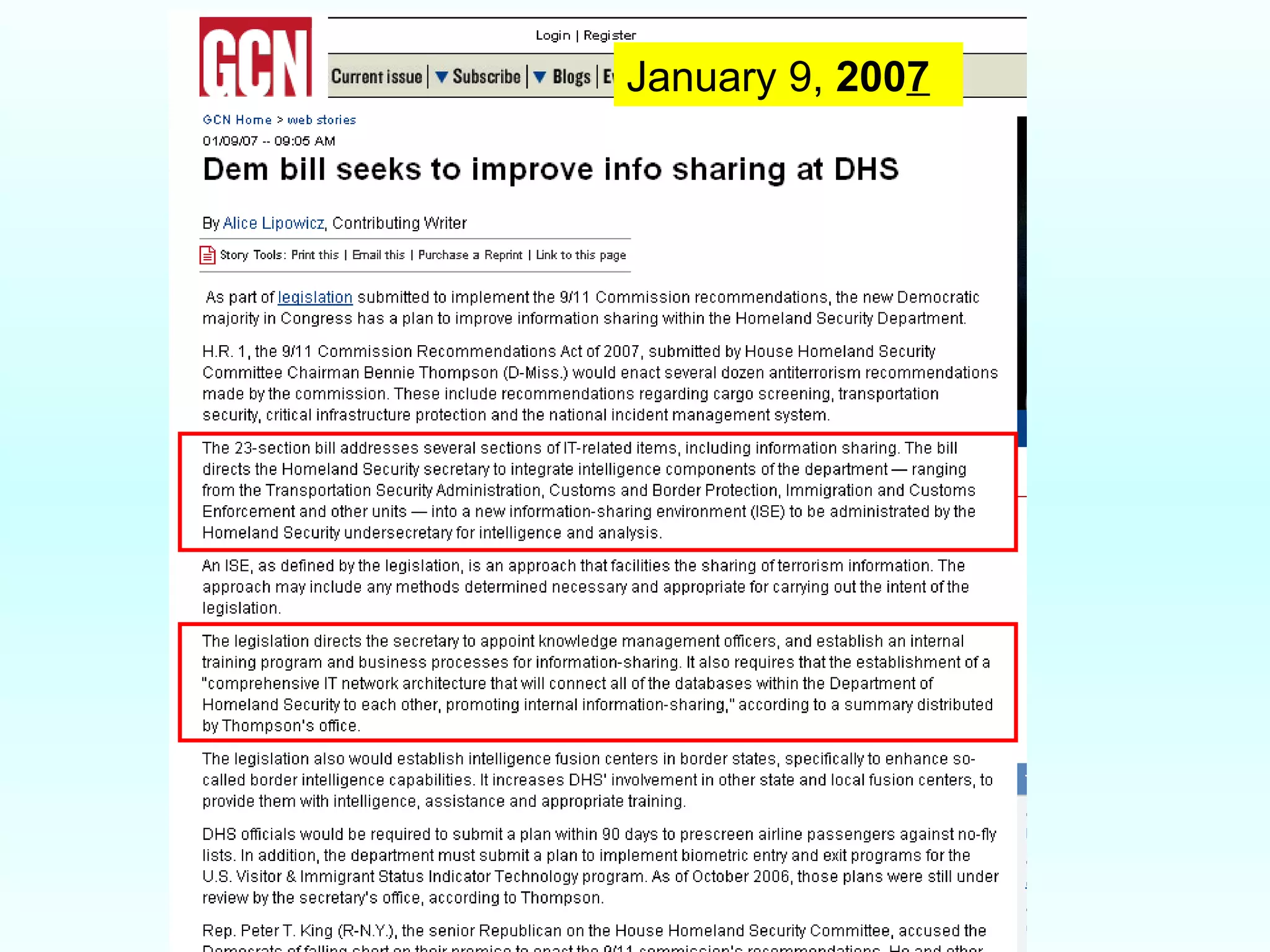
January 9,  200 7
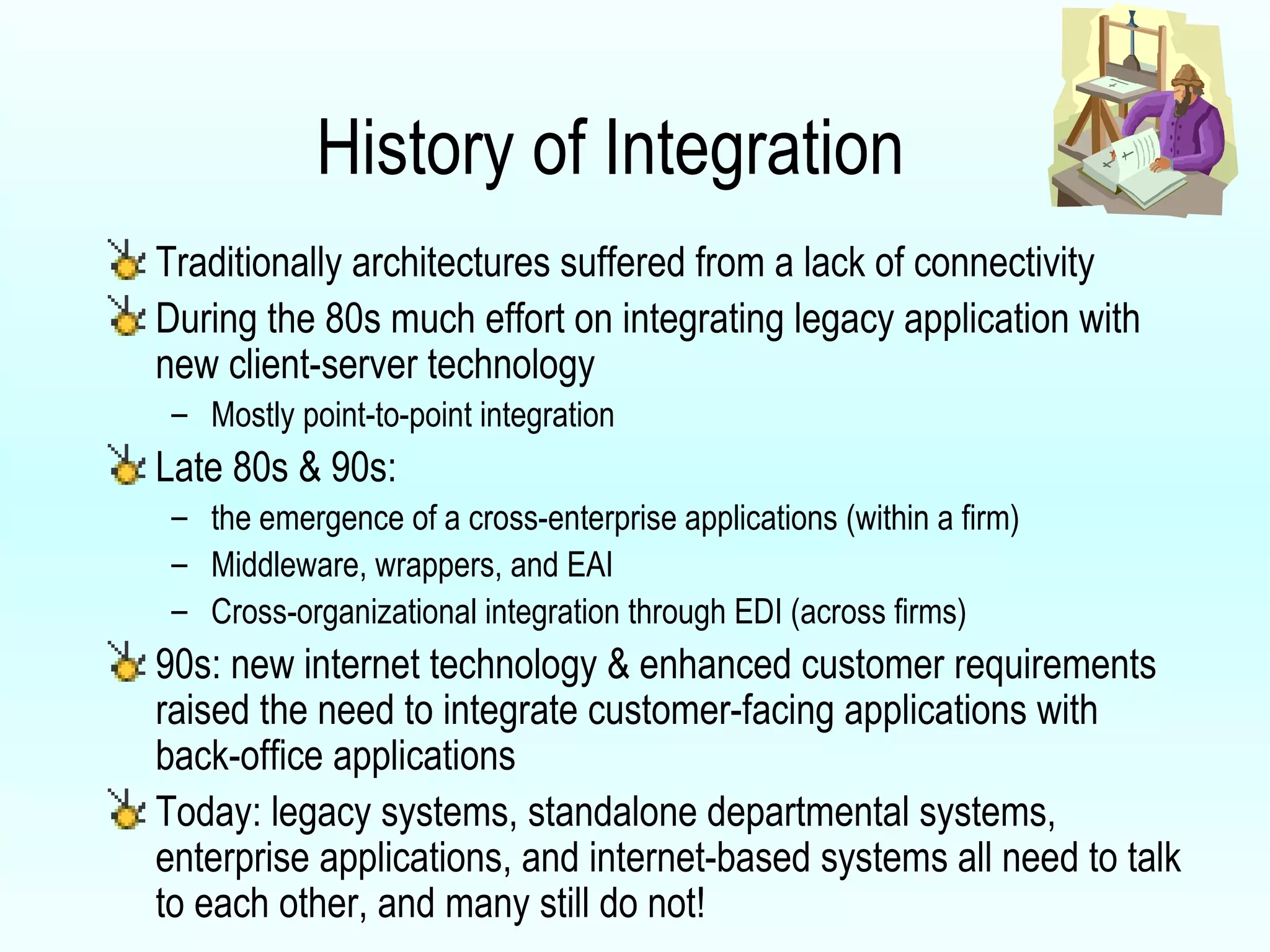
History of Integration Traditionally architectures suffered from a lack of connectivity During the 80s much effort on integrating legacy application with new client-server technology Mostly point-to-point integration Late 80s & 90s: the emergence of a cross-enterprise applications (within a firm) Middleware, wrappers, and EAI Cross-organizational integration through EDI (across firms) 90s: new internet technology & enhanced customer requirements raised the need to integrate customer-facing applications with back-office applications Today: legacy systems, standalone departmental systems, enterprise applications, and internet-based systems all need to talk to each other, and many still do not!
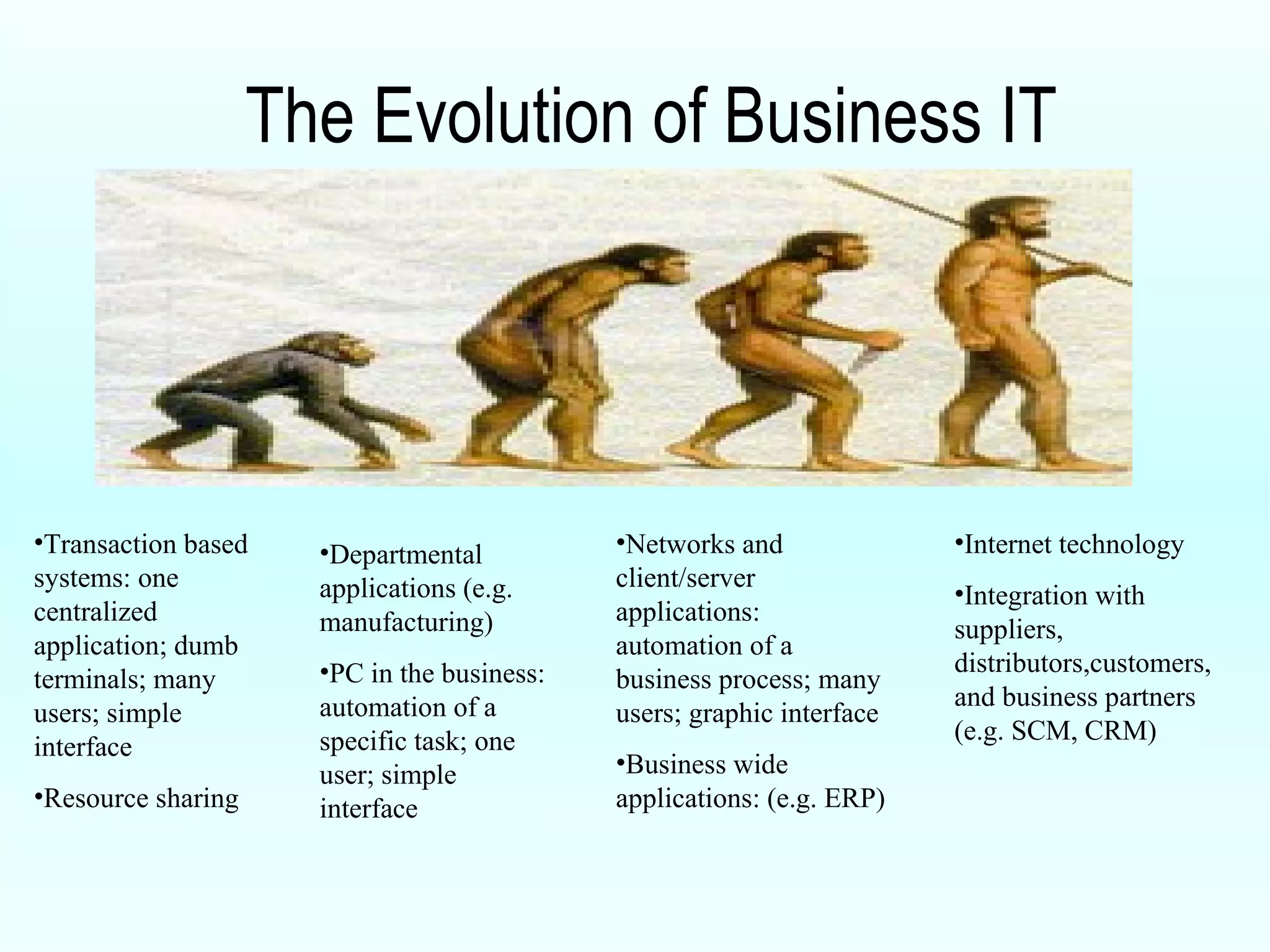
The Evolution of Business IT Departmental applications (e.g. manufacturing) PC in the business: automation of a specific task; one user; simple interface Transaction based systems: one centralized application; dumb terminals; many users; simple interface Resource sharing Networks and client/server applications: automation of a business process; many users; graphic interface Business wide applications: (e.g. ERP) Internet technology Integration with suppliers, distributors,customers, and business partners (e.g. SCM, CRM)
Challenges Why are large IT projects that require application integration so challenging? What additional difficulties (beyond the standard challenges of IT development) are associated with application integration?
Application Integration: Intra -Organizational Technological issues: Data integration Syntactic interoperability (LASTNAME    NAME) Semantic interoperability (Same words, different meanings; different words, same meaning) Platform disparity (e.g. Mac, Wintel, Linux…) Complexity of systems and  constant flux   Process issues (exception handling): What if only part of the order can be filled? What if a customer wants a special option?
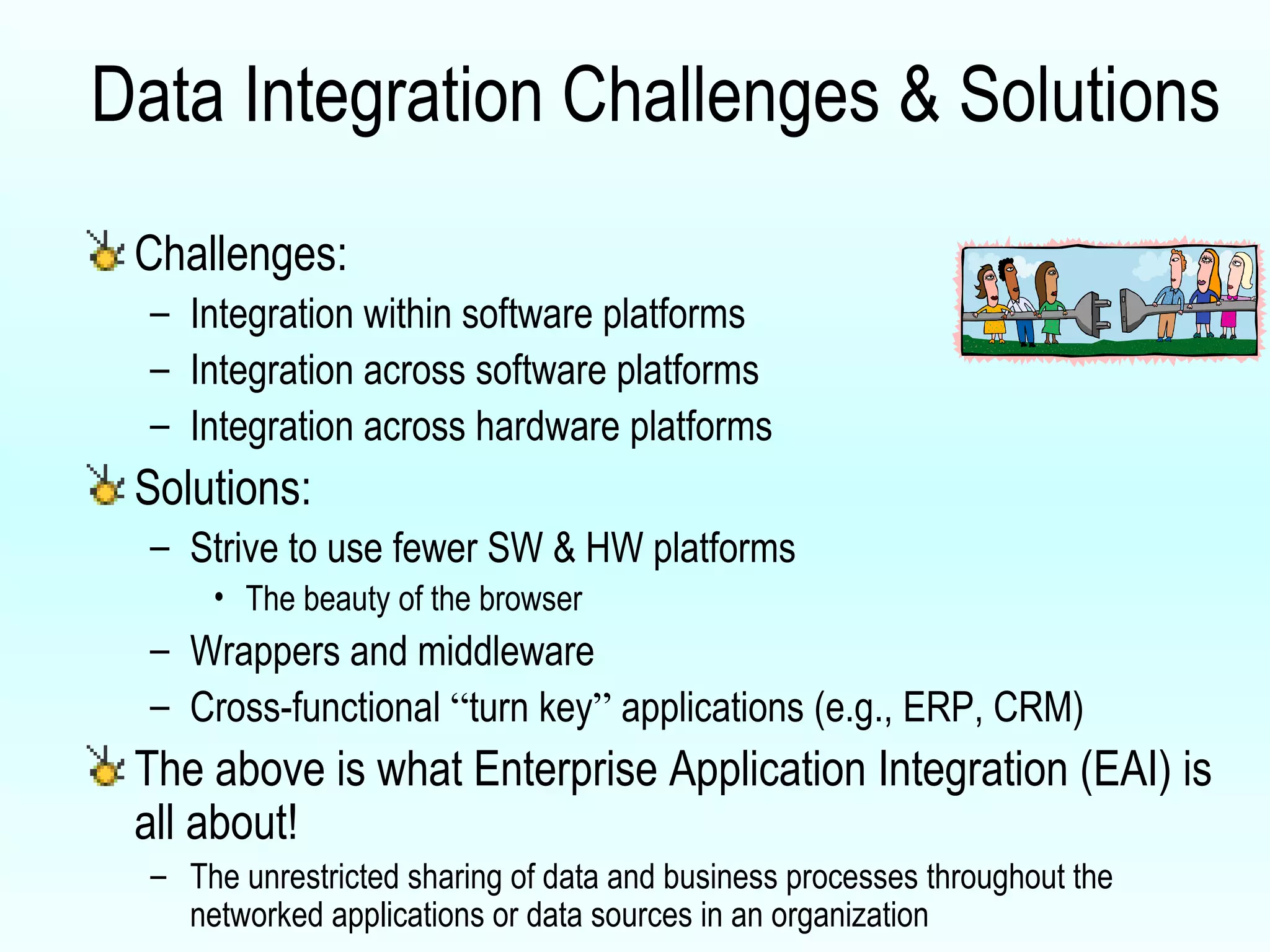
Application Integration: Intra -Organizational Organizational issues Senior management buy-in and commitment The  “ E-Logistics ”  system at Otis Elevator was a good example of this (way back in the Core days) Difficulties with deployment of integration  Support for, or resistance against, change
Data Integration Challenges & Solutions Challenges: Integration within software platforms  Integration across software platforms Integration across hardware platforms Solutions: Strive to use fewer SW & HW platforms The beauty of the browser Wrappers and middleware Cross-functional  “ turn key ”  applications (e.g., ERP, CRM) The above is what Enterprise Application Integration (EAI) is all about! The unrestricted sharing of data and business processes throughout the networked applications or data sources in an organization
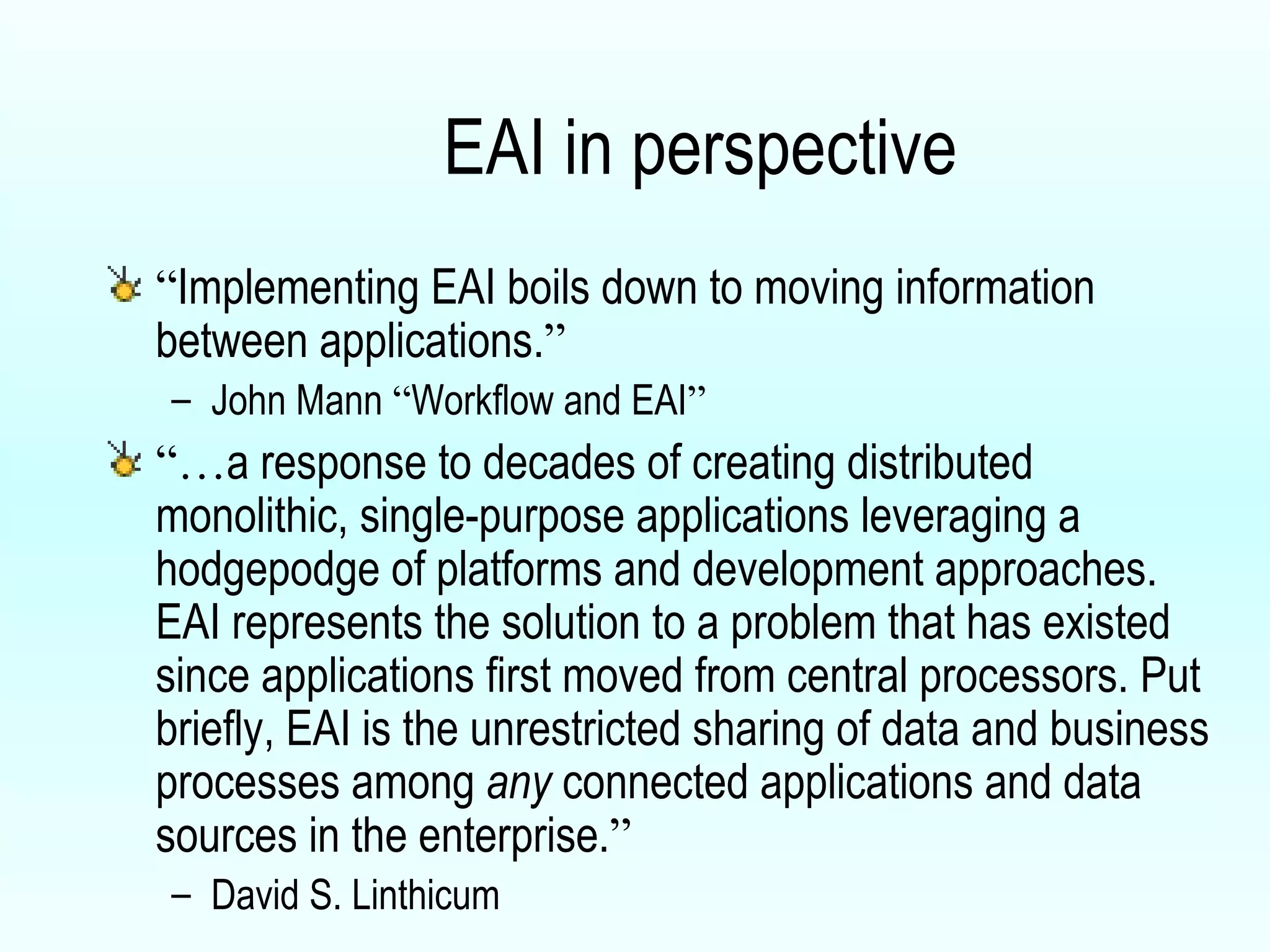
EAI in perspective “ Implementing EAI boils down to moving information between applications. ” John Mann  “ Workflow and EAI ” “… a response to decades of creating distributed monolithic, single-purpose applications leveraging a hodgepodge of platforms and development approaches. EAI represents the solution to a problem that has existed since applications first moved from central processors. Put briefly, EAI is the unrestricted sharing of data and business processes among  any  connected applications and data sources in the enterprise. ” David S. Linthicum
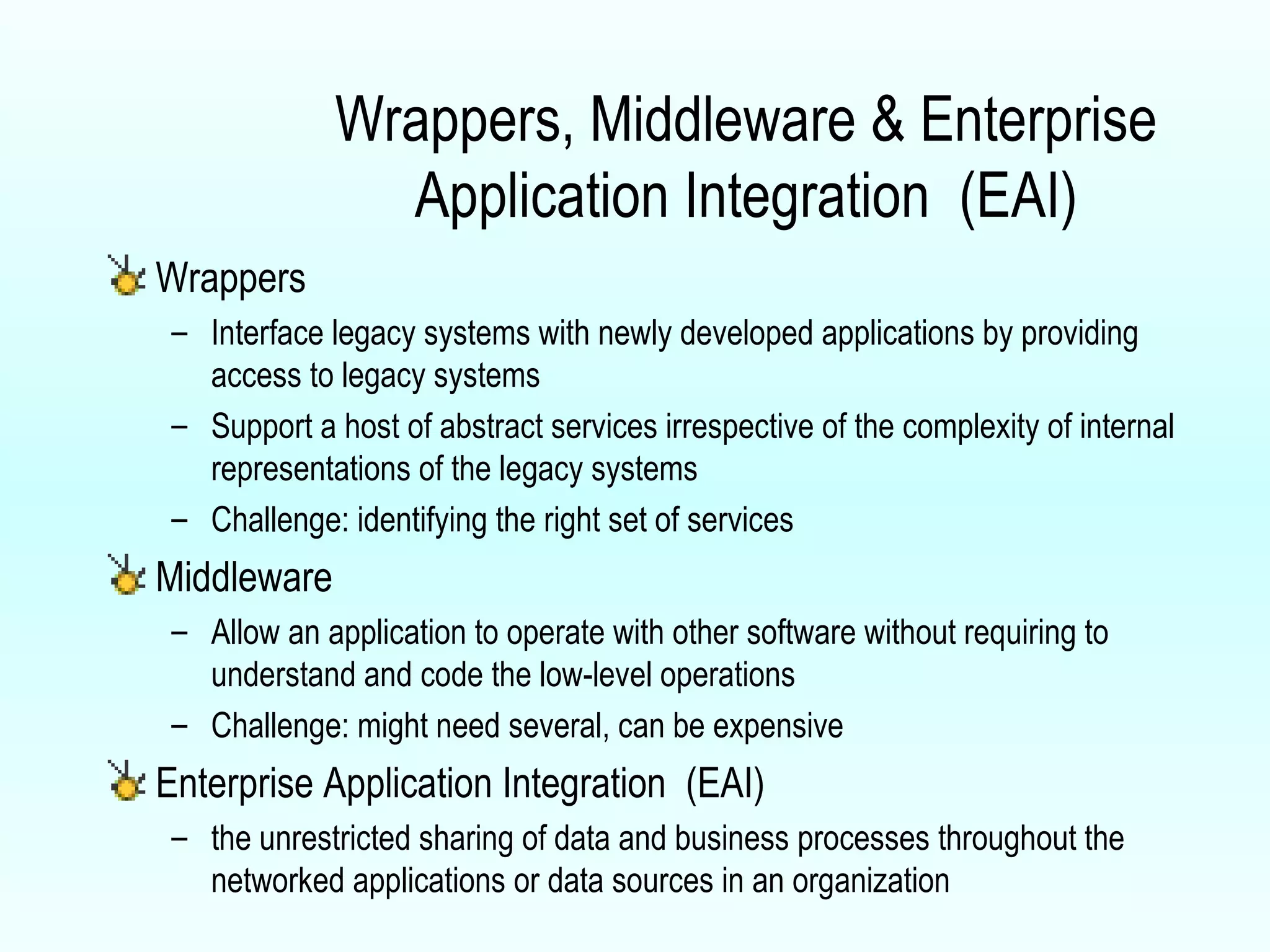
Wrappers, Middleware & Enterprise Application Integration  (EAI) Wrappers Interface legacy systems with newly developed applications by providing access to legacy systems Support a host of abstract services irrespective of the complexity of internal representations of the legacy systems Challenge: identifying the right set of services Middleware Allow an application to operate with other software without requiring to understand and code the low-level operations Challenge: might need several, can be expensive Enterprise Application Integration  (EAI) the unrestricted sharing of data and business processes throughout the networked applications or data sources in an organization
Putting Them Together middleware legacy wrapper accounting system application system 1 application system 2 Enterprise Application Integration
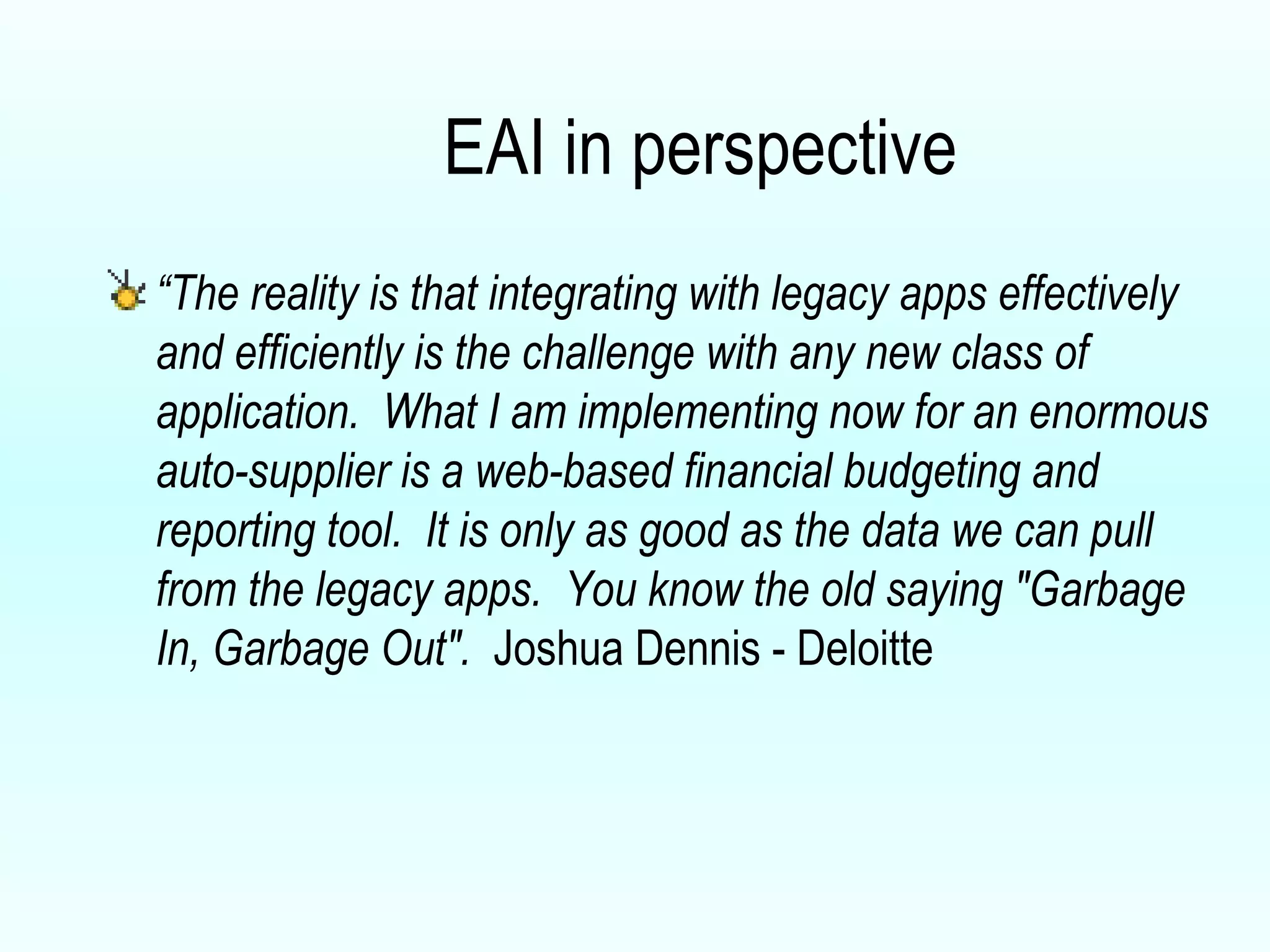
EAI in perspective “ The reality is that integrating with legacy apps effectively and efficiently is the challenge with any new class of application.  What I am implementing now for an enormous auto-supplier is a web-based financial budgeting and reporting tool.  It is only as good as the data we can pull from the legacy apps.  You know the old saying &quot;Garbage In, Garbage Out&quot;.  Joshua Dennis - Deloitte
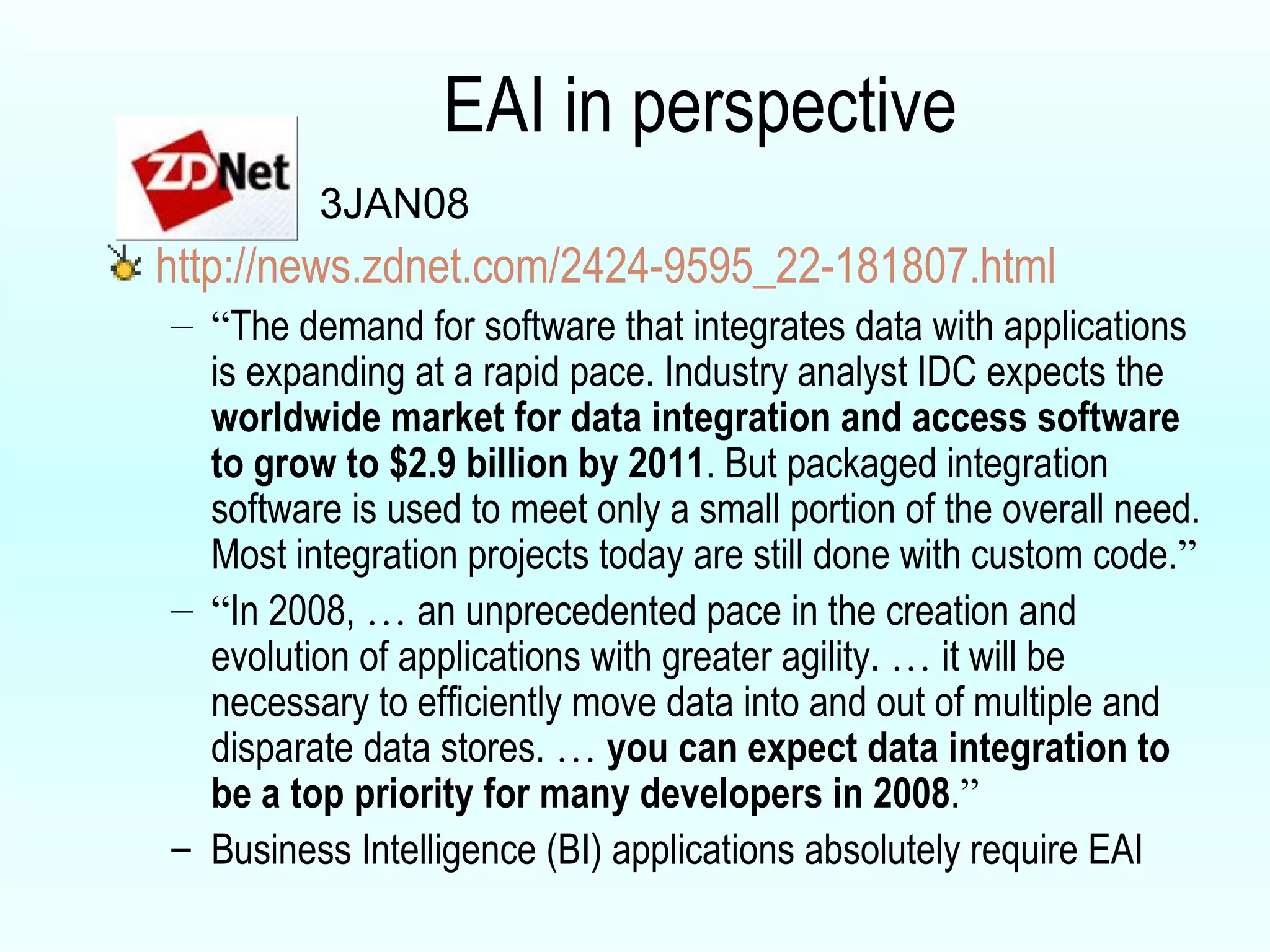
EAI in perspective http://news.zdnet.com/2424-9595_22-181807.html “ The demand for software that integrates data with applications is expanding at a rapid pace. Industry analyst IDC expects the  worldwide market for data integration and access software to grow to $2.9 billion by 2011 . But packaged integration software is used to meet only a small portion of the overall need. Most integration projects today are still done with custom code. ” “ In 2008,  …  an unprecedented pace in the creation and evolution of applications with greater agility.  …  it will be necessary to efficiently move data into and out of multiple and disparate data stores.  …   you can expect data integration to be a top priority for many developers in 2008 . ” Business Intelligence (BI) applications absolutely require EAI 3JAN08
Levels of Integration Batch  –  when there isn ’ t a need for real-time integration: Accumulating data for analysis and reporting Off-line application integration  Real-time  –  when people or systems require the most updated information E.g., customer inquiring about the status of an urgent delivery
Technological Infrastructure & Integration Business IT infrastructure Enterprise Application integration (EAI) Business process flow and EAI Inter-organizational integration & EDI
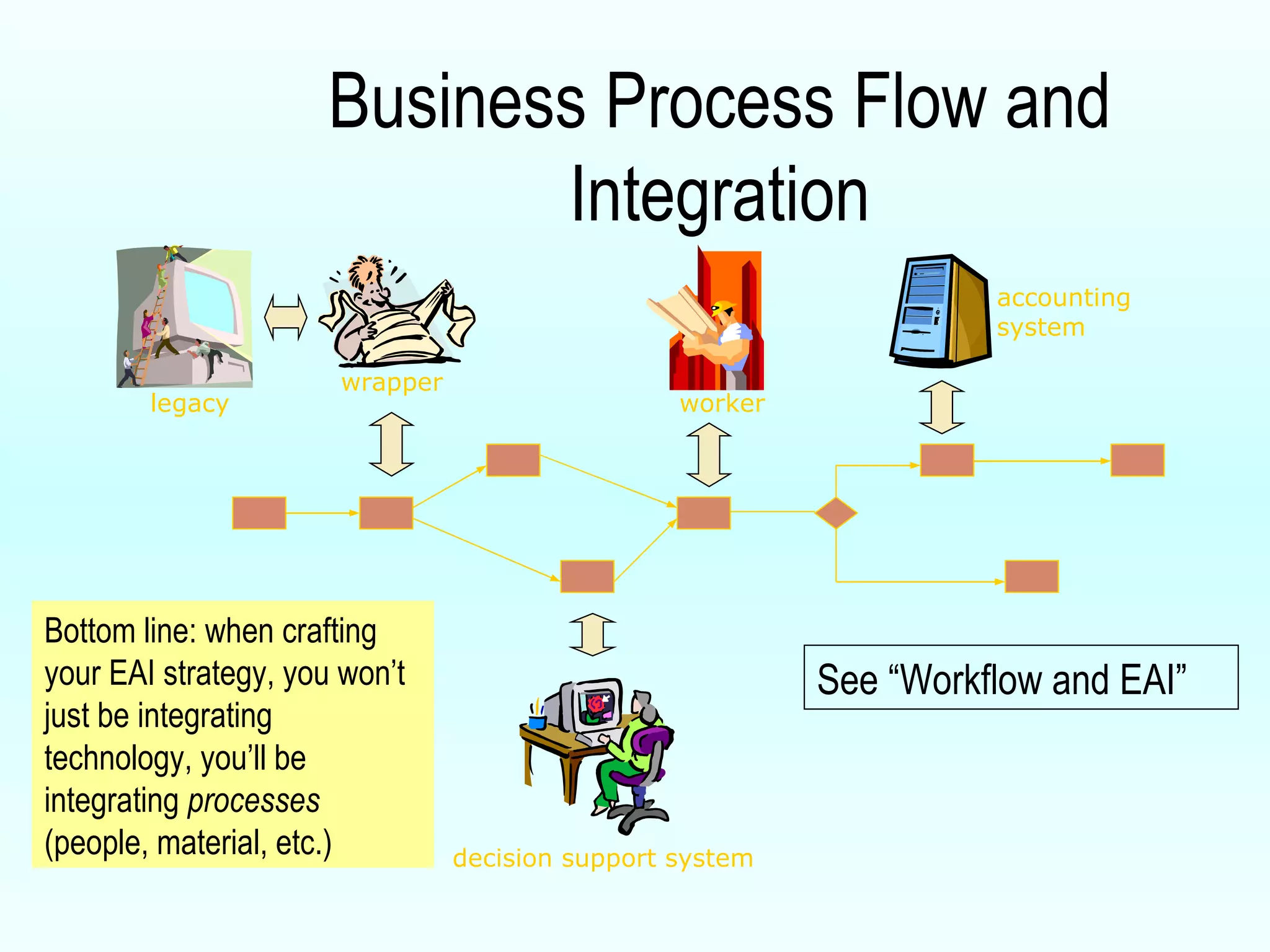
Business Process Flow and Integration See “Workflow and EAI” Bottom line: when crafting your EAI strategy, you won’t just be integrating technology, you’ll be integrating  processes  (people, material, etc.) legacy wrapper decision support system worker accounting system
Technological Infrastructure & Integration Business IT infrastructure Enterprise Application integration (EAI) Business process flow and EAI Inter-organizational integration & EDI (now we ’ re talking B2B!)
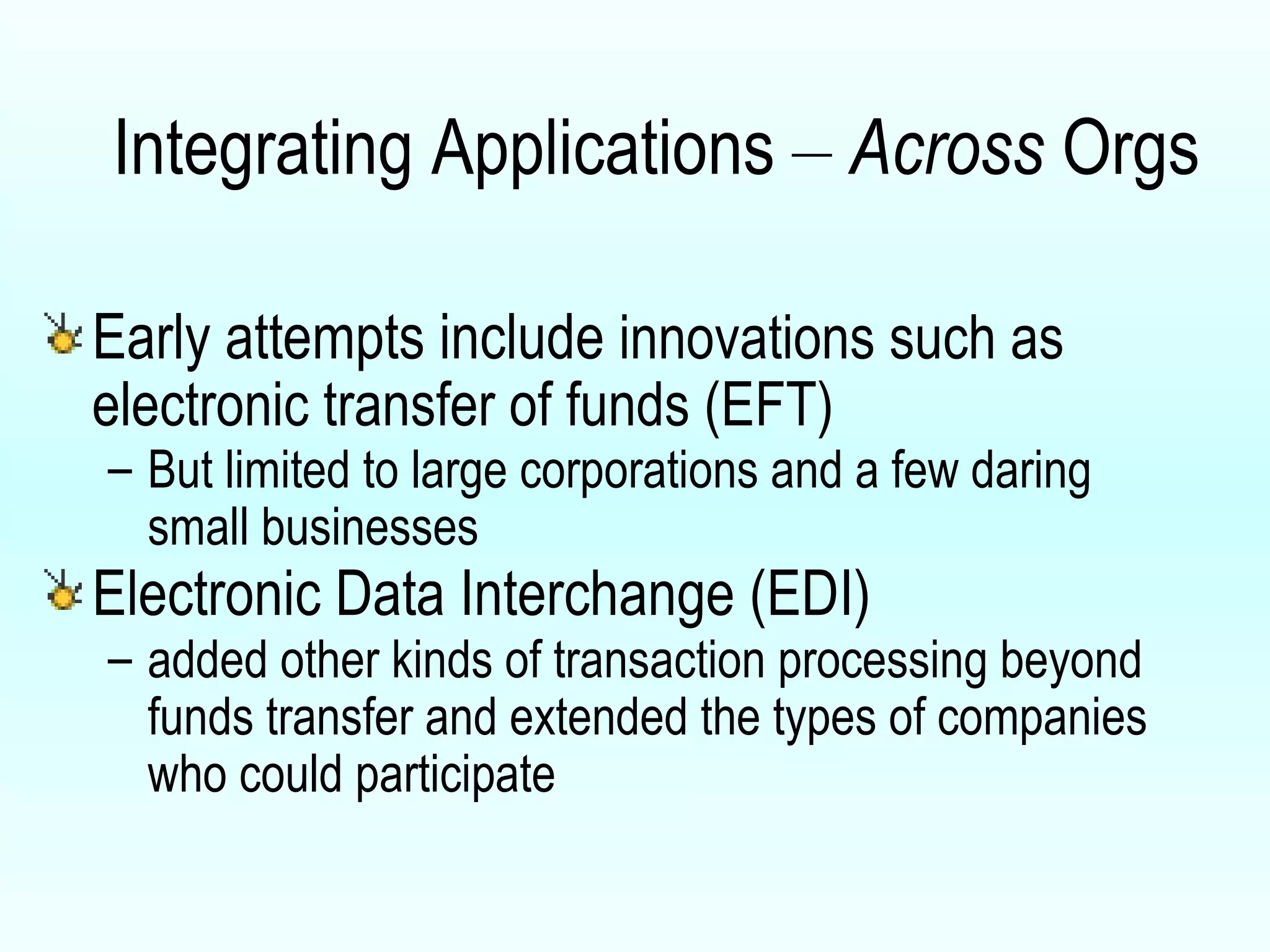
Integrating Applications  –   Across  Orgs Early attempts include  innovations such as electronic transfer of funds (EFT) But limited to large corporations and a few daring small businesses Electronic Data Interchange (EDI) added other kinds of transaction processing beyond funds transfer and extended the types of companies who could participate
Direct exchange of standardized  business transaction  “ documents ” 2 or more organizations independent application systems created by the parties sharing independent standards (formatting rules) again created by the parties sharing dedicated connections EDI : Electronic Data Interchange Invented in the  70 ’ s
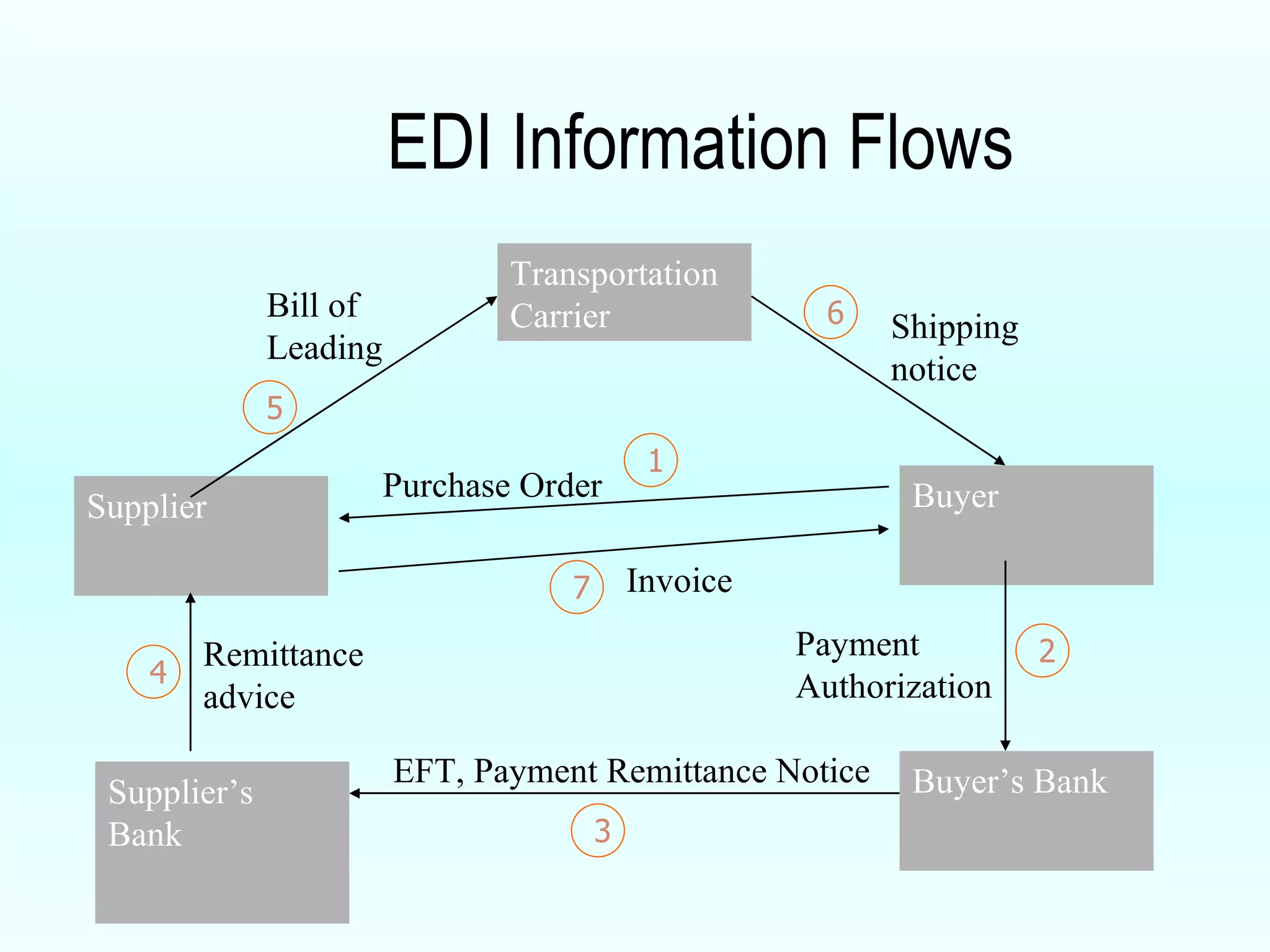
EDI Information Flows Transportation Carrier Buyer Supplier Supplier’s Bank Buyer’s Bank 1 Purchase Order 7 Invoice 3 EFT, Payment Remittance Notice 2 Payment Authorization 4 Remittance advice 5 Bill of Leading 6 Shipping notice
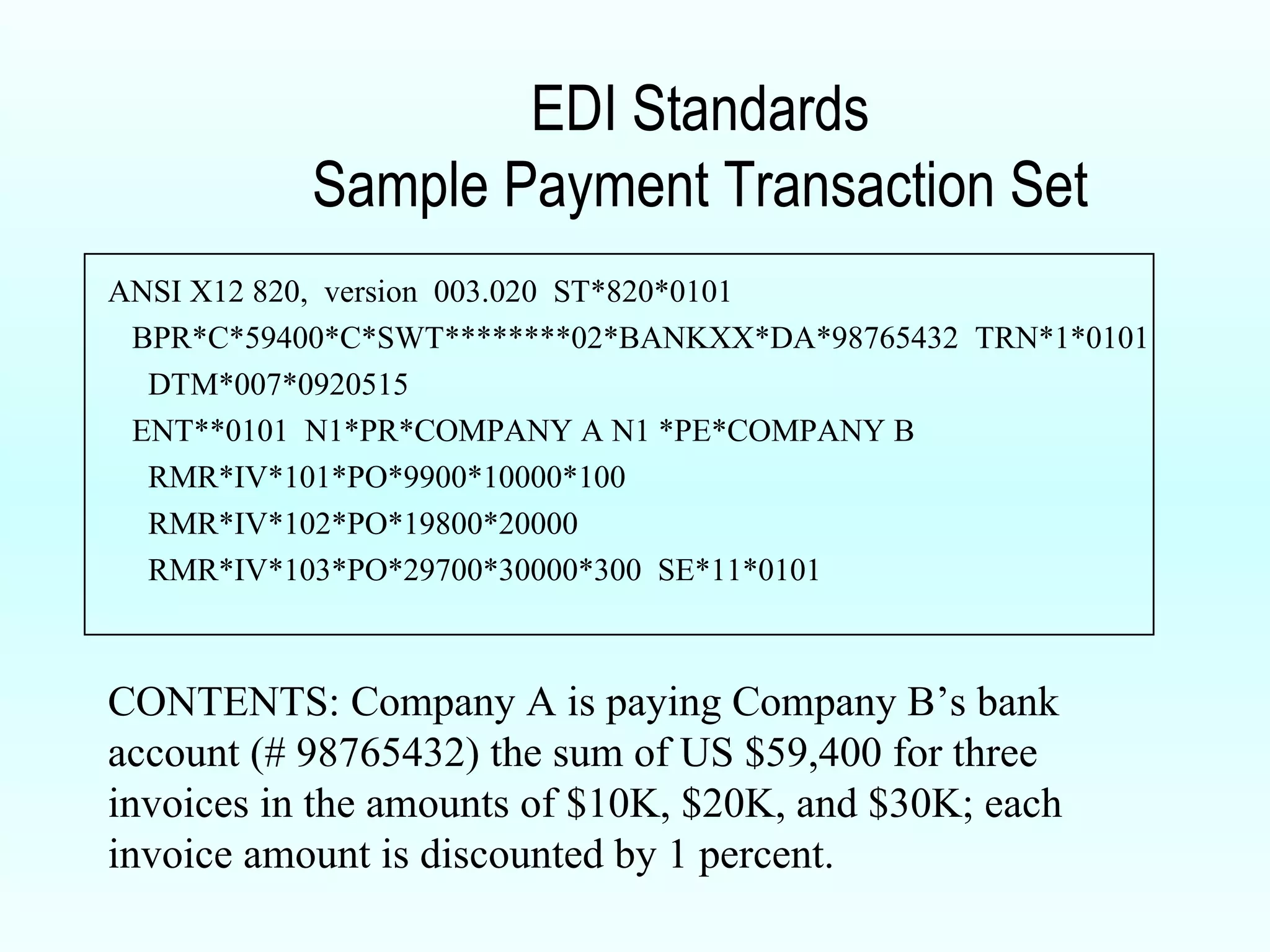
EDI Standards Sample Payment Transaction Set CONTENTS: Company A is paying Company B’s bank account (# 98765432) the sum of US $59,400 for three invoices in the amounts of $10K, $20K, and $30K; each invoice amount is discounted by 1 percent. ANSI X12 820,  version  003.020  ST*820*0101 BPR*C*59400*C*SWT********02*BANKXX*DA*98765432  TRN*1*0101 DTM*007*0920515 ENT**0101  N1*PR*COMPANY A N1 *PE*COMPANY B RMR*IV*101*PO*9900*10000*100 RMR*IV*102*PO*19800*20000 RMR*IV*103*PO*29700*30000*300  SE*11*0101
From EDI to XML Along comes the Internet HTML: Hypertext Markup Language (~1990) The founding language of Internet communication XML: eXtensible Mark-up Language Developed in the  90 ’ s  Same underlying technology as HTML
From EDI to XML A specification developed especially for Web documents. It allows designers to  create their own customized tags , enabling the definition, transmission, validation, and interpretation of data between applications and between organizations.  www.wmo.ch/web/www/WDM/Guides/Internet-glossary.html
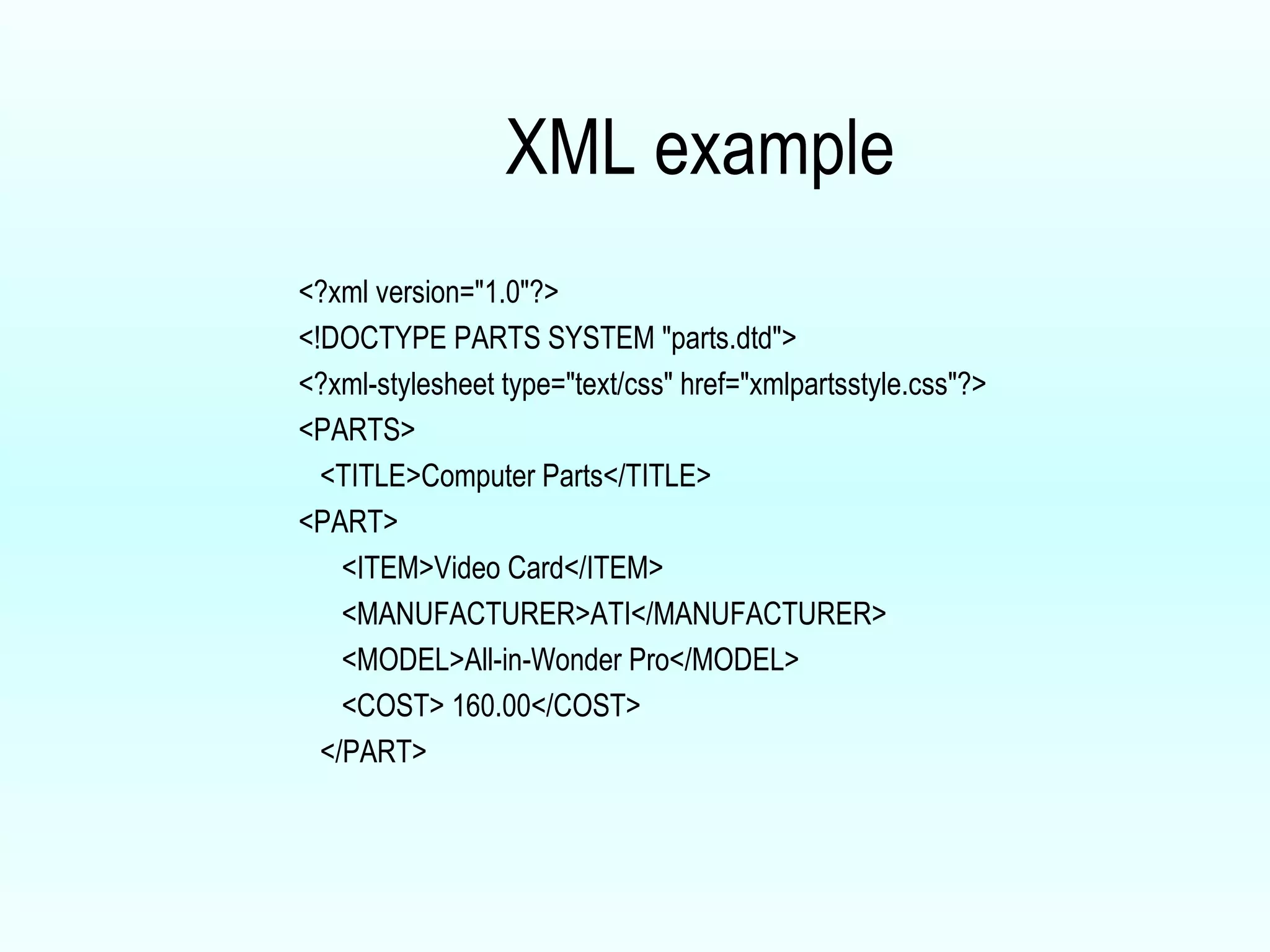
XML example <?xml version=&quot;1.0&quot;?> <!DOCTYPE PARTS SYSTEM &quot;parts.dtd&quot;> <?xml-stylesheet type=&quot;text/css&quot; href=&quot;xmlpartsstyle.css&quot;?> <PARTS> <TITLE>Computer Parts</TITLE> <PART> <ITEM>Video Card</ITEM> <MANUFACTURER>ATI</MANUFACTURER> <MODEL>All-in-Wonder Pro</MODEL> <COST> 160.00</COST> </PART>
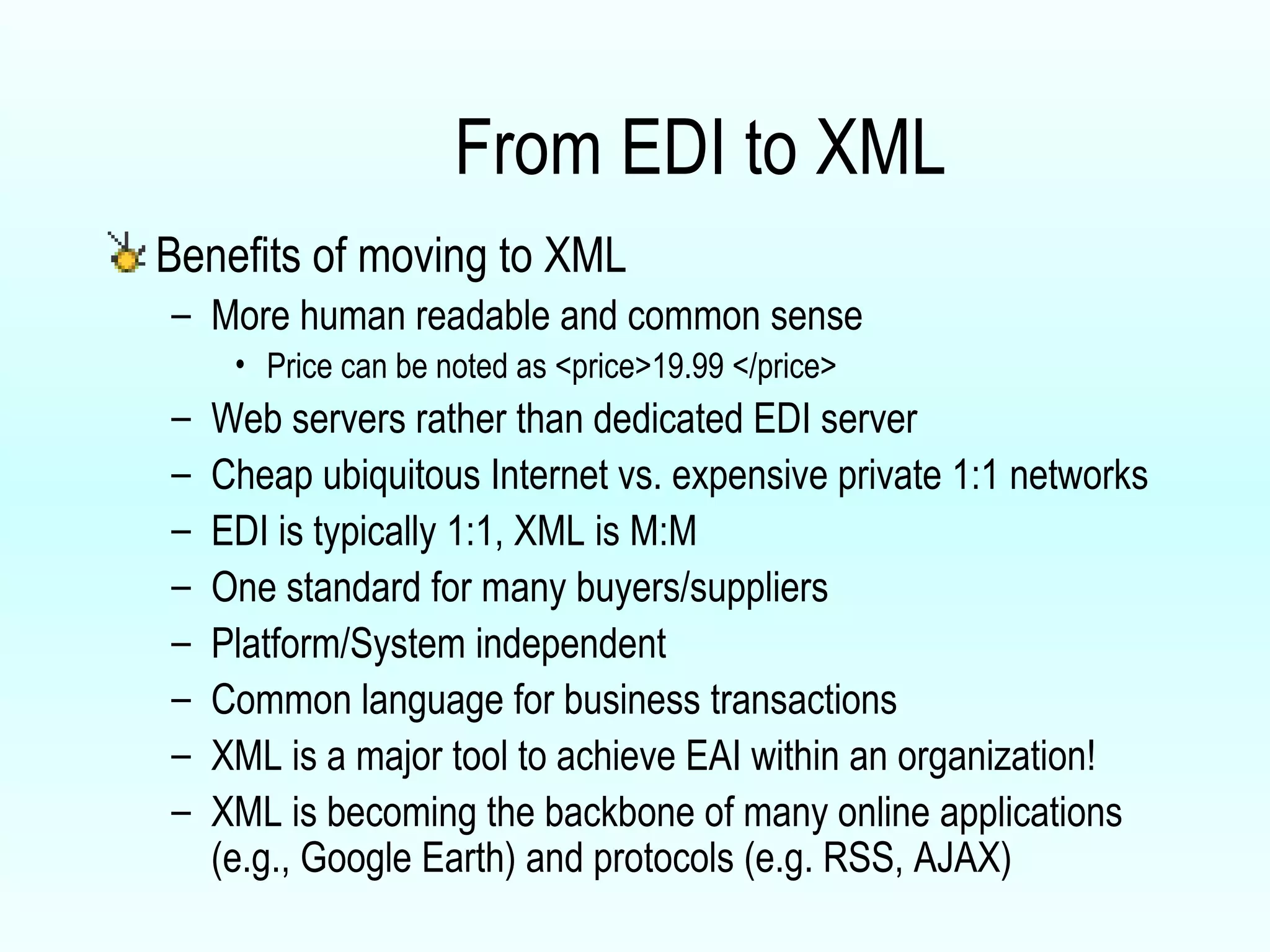
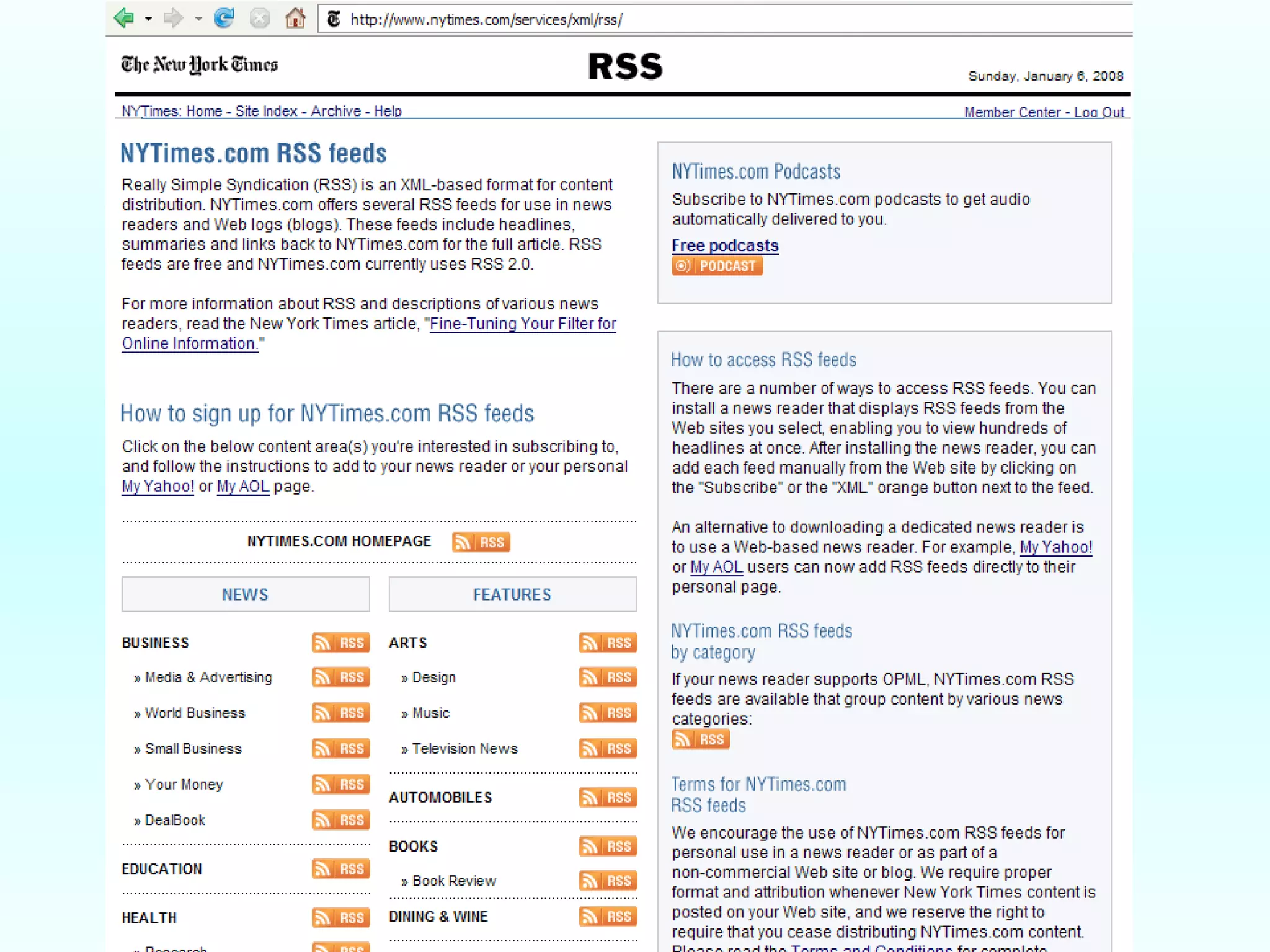
From EDI to XML Benefits of moving to XML More human readable and common sense Price can be noted as <price>19.99 </price> Web servers rather than dedicated EDI server Cheap ubiquitous Internet vs. expensive private 1:1 networks EDI is typically 1:1, XML is M:M One standard for many buyers/suppliers Platform/System independent Common language for business transactions XML is a major tool to achieve EAI within an organization! XML is becoming the backbone of many online applications (e.g., Google Earth) and protocols (e.g. RSS, AJAX)
 
 
EDI: Why should I care? EDI is still an important technology: 95% of Fortune 1000 still use EDI Most transactions still done via EDI Lessons from the EDI past, about the future Illustrates the importance of communications standards for B2B E-business Demonstrates that adoption of B2B is NOT just a technology issue
Technological Infrastructure & Integration Summary Rarely do IT applications stand  unconnected For e-business, this isn ’ t even an option The e-business challenge is trying to keep the old linked with the new To develop new e-business applications we need to understand: the business process and workflows involved What information is required, and what other applications contain that data
Technological Infrastructure & Integration  Summary You are no longer just developing systems for internal use.  Multiple stakeholders (customers, suppliers, etc.) Integration with other applications poses major technological and  organizational  challenges
Business to Business E-business:  Supply Chain Management, Buy/Sell Applications and e-Markets
B2B E-Business B2B interactions include: Selling (to other firms) B2B is different from B2C Buying (from other firms) Internet technology can support both types of interactions
B2B Supply Chain Management (SCM) and B2B B2B Applications: Buy Side Sell Side Exchanges or e-markets
B2B Supply Chain Management (SCM) and B2B B2B Applications: Buy Side Sell Side Exchanges
SCM and B2B - Outline Supply Chain (SC) Supply Chain Management (SCM)  From SCM to B2B B2B IT
SCM & B2B Before understanding B2B & SCM, let ’ s review what the supply chain is: The supply chain is a series of links and shared processes that exist between suppliers and customers. Link and processes – all activities from the acquisition of raw materials to the delivery of finished goods to the the end consumer. “ Supply Chain Management Primer,” www.clarkstongroup.com
Supply Chain  –  More Definitions The facilities for acquisition, distribution, storage and movement of raw materials, intermediate products, non-production physical resources, and finished goods. The  supply chain  encompasses all activities associated with the flow and transformation of goods from the raw materials stage, through to the end user as well as the associated information flows.  Supply chain management  is the integration of these activities through improved supply chain relationships, to achieve a competitive advantage. Robert B. Hanfield, Introduction to Supply Chain Management, Prentice Hall
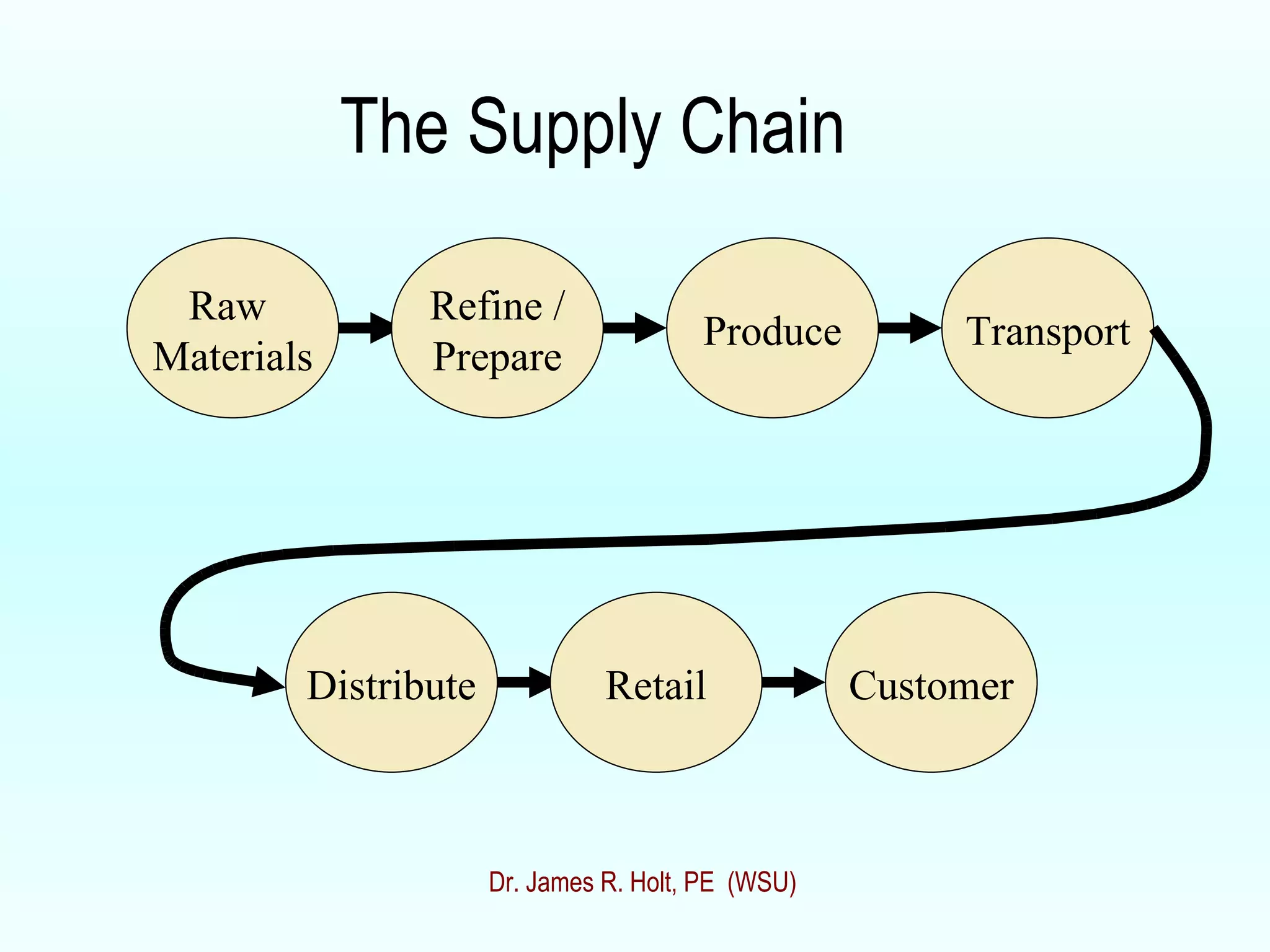
The Supply Chain Raw  Materials Refine / Prepare Produce Transport Distribute Retail Customer Dr. James R. Holt, PE  (WSU)
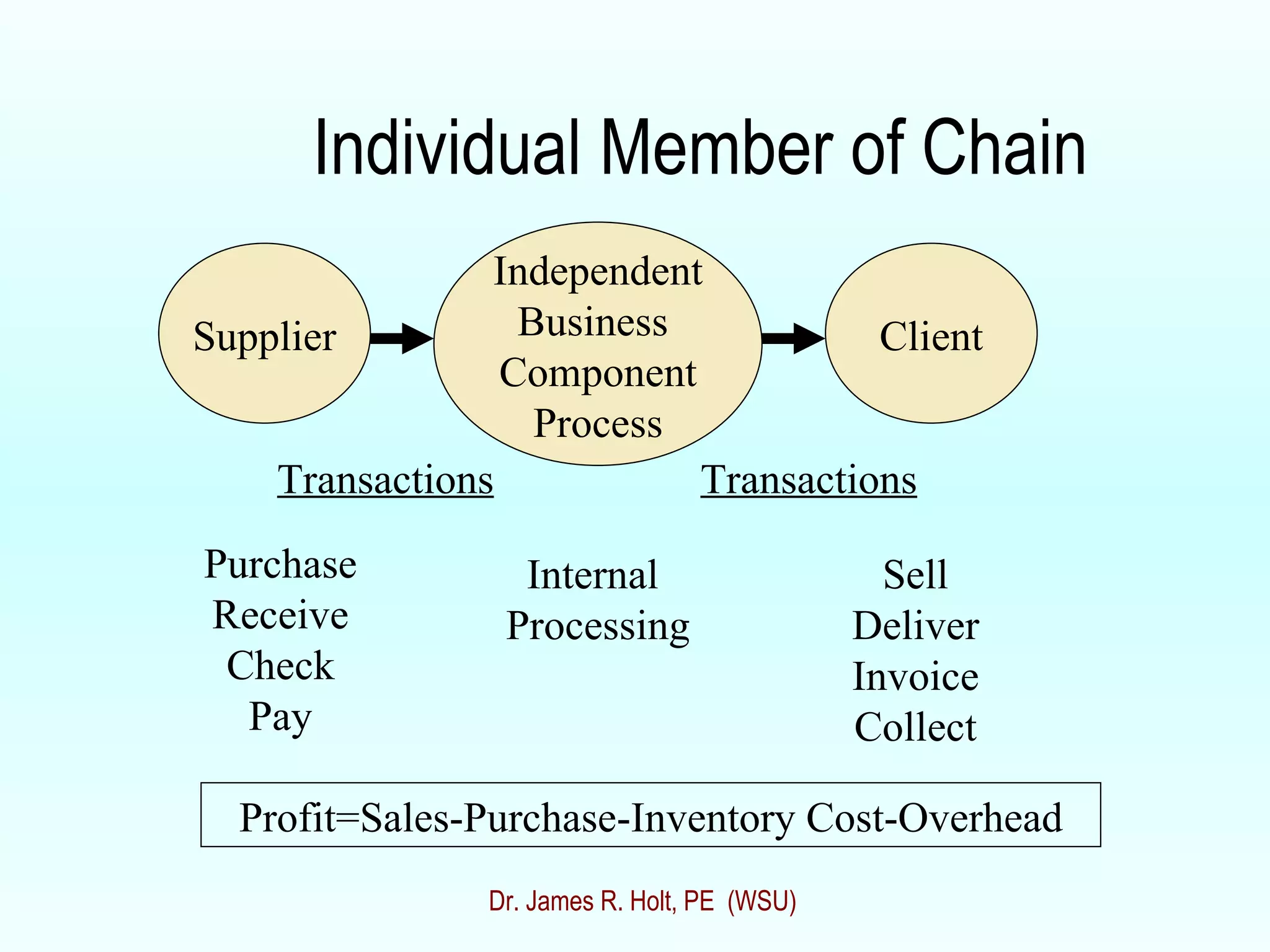
Individual Member of Chain Independent Business  Component Process Supplier Client Transactions Transactions Purchase Receive Check Pay Internal  Processing Sell Deliver Invoice Collect Profit=Sales-Purchase-Inventory Cost-Overhead Dr. James R. Holt, PE  (WSU)
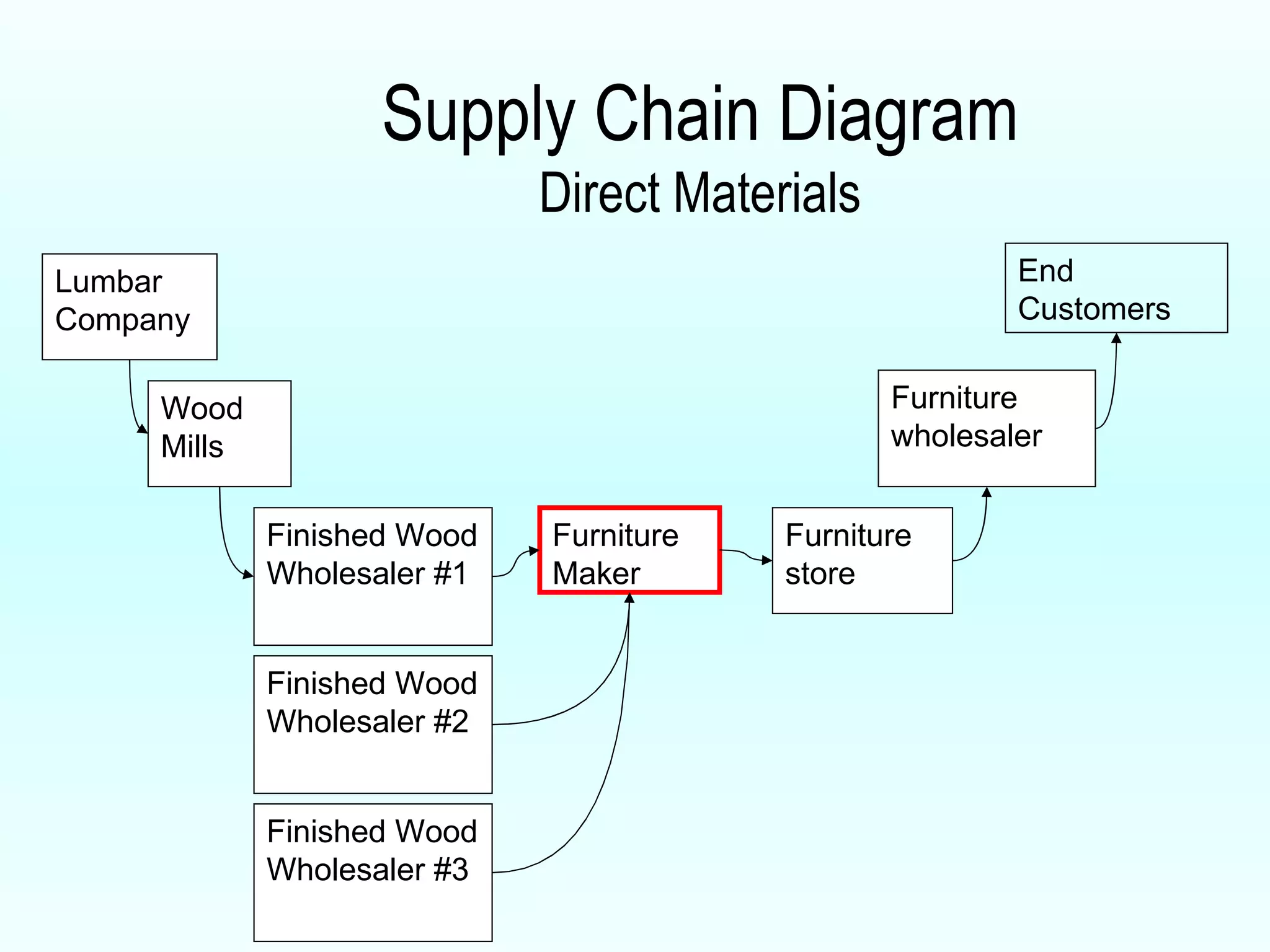
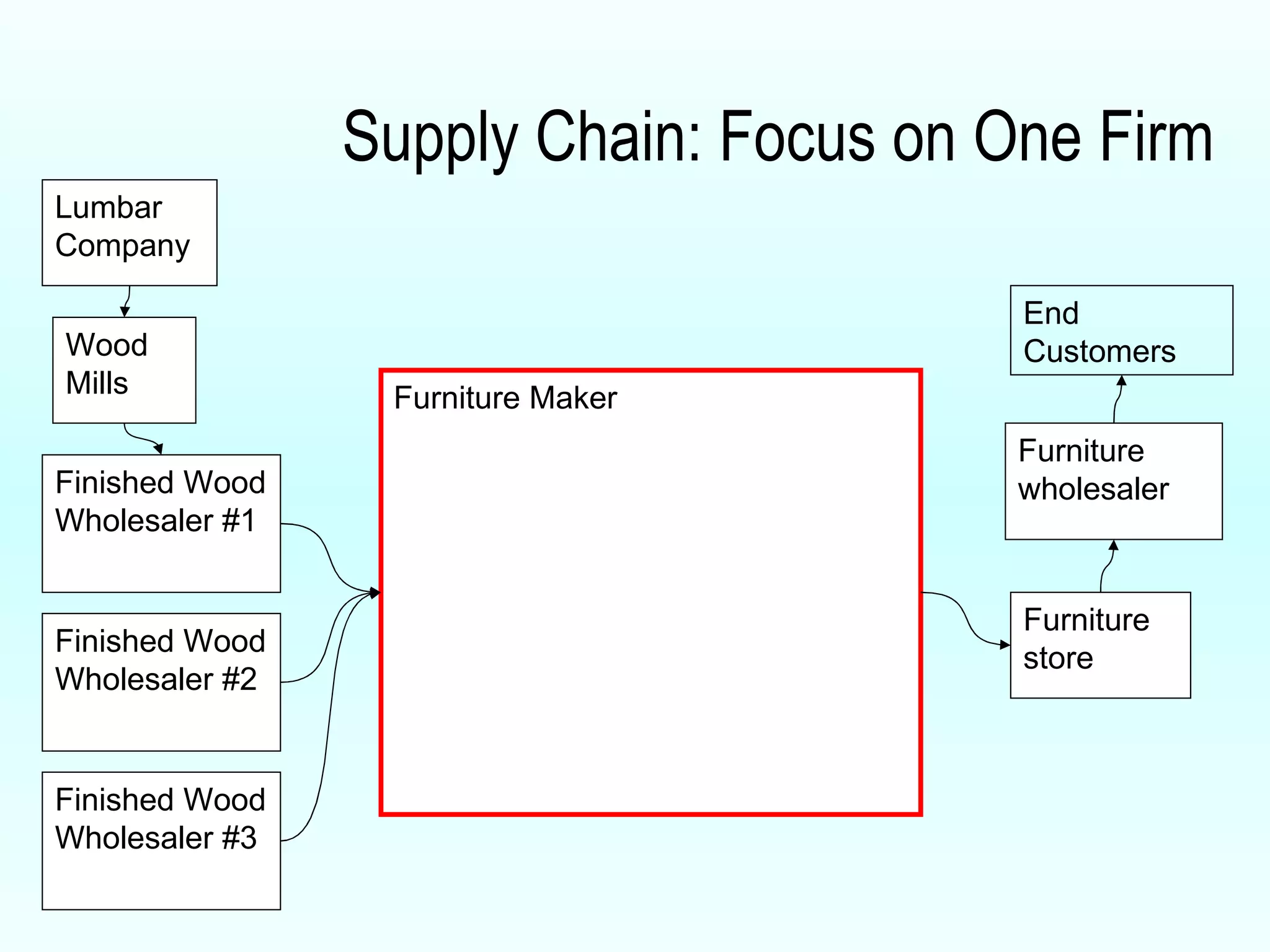
Supply Chain Diagram Direct Materials Lumbar Company Wood Mills Finished Wood Wholesaler #1 Furniture Maker Furniture wholesaler Furniture store End Customers Finished Wood Wholesaler #3 Finished Wood Wholesaler #2
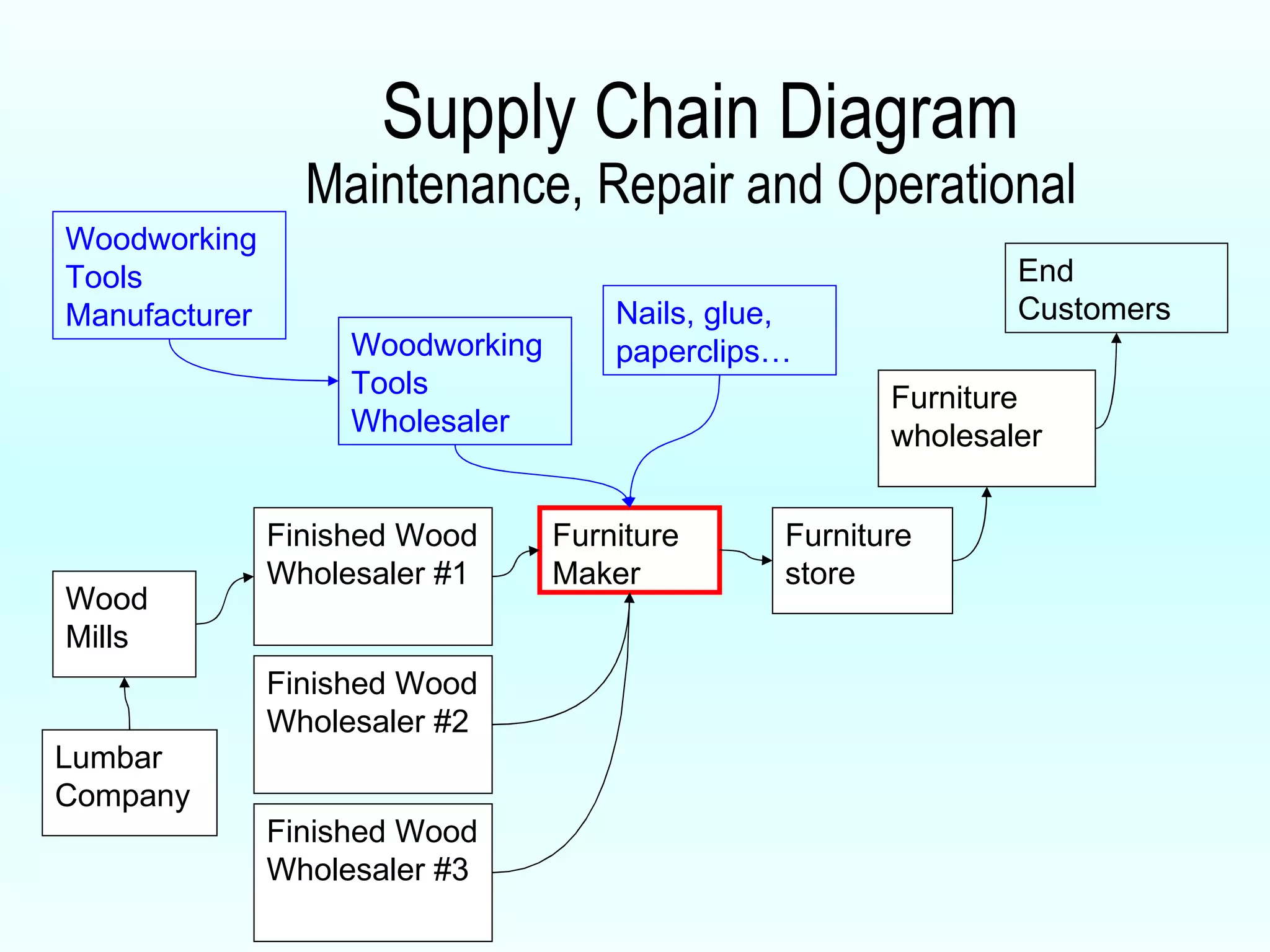
Supply Chain Diagram Maintenance, Repair and Operational   Nails, glue, paperclips… Lumbar Company Wood Mills Finished Wood Wholesaler #1 Furniture Maker Furniture wholesaler Furniture store End Customers Finished Wood Wholesaler #3 Finished Wood Wholesaler #2 Woodworking Tools Manufacturer Woodworking Tools Wholesaler
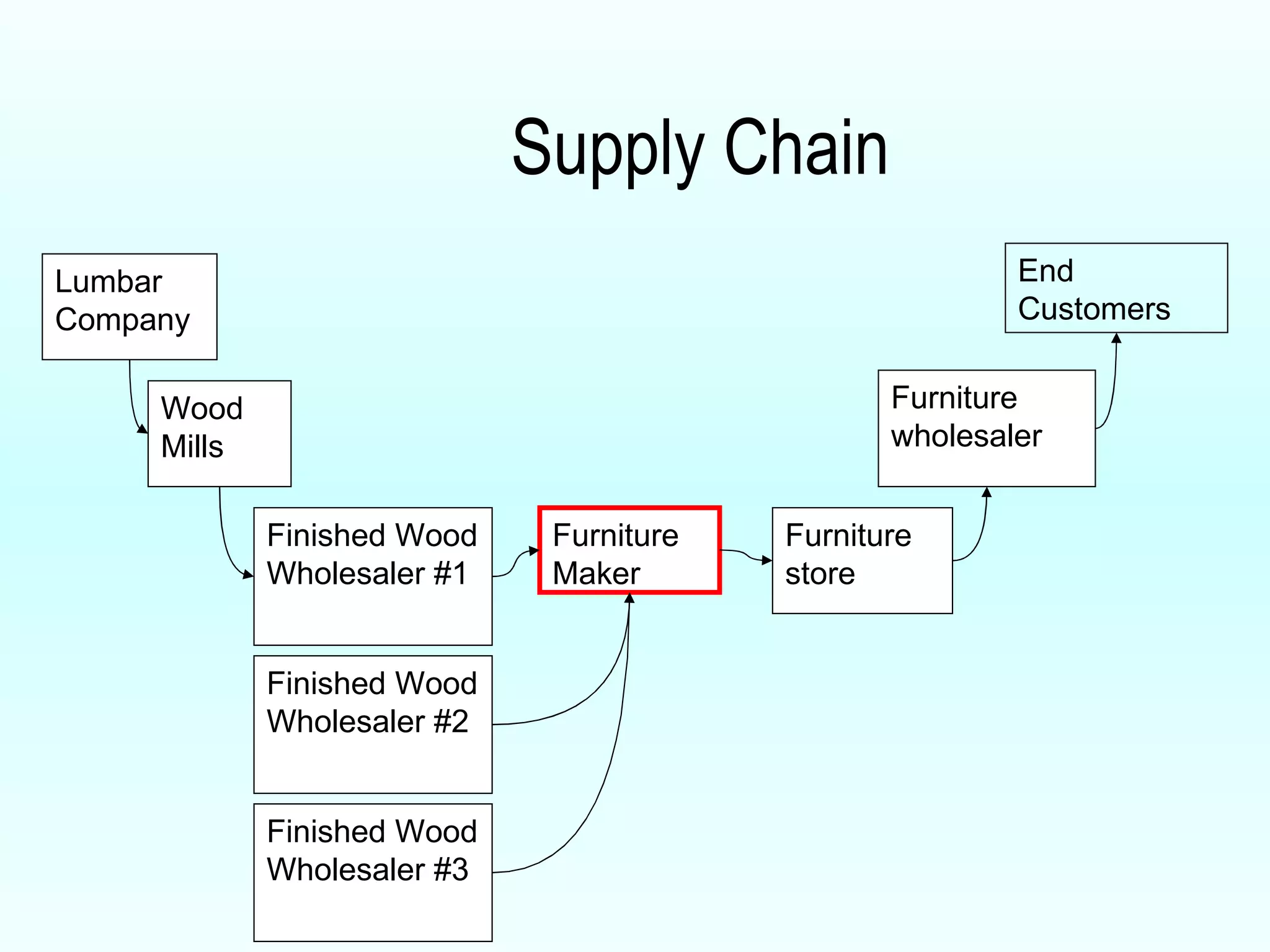
Supply Chain Lumbar Company Wood Mills Finished Wood Wholesaler #1 Furniture Maker Furniture wholesaler Furniture store End Customers Finished Wood Wholesaler #3 Finished Wood Wholesaler #2
Supply Chain: Focus on One Firm Lumbar Company Wood Mills Finished Wood Wholesaler #1 Furniture Maker Furniture wholesaler Furniture store End Customers Finished Wood Wholesaler #3 Finished Wood Wholesaler #2
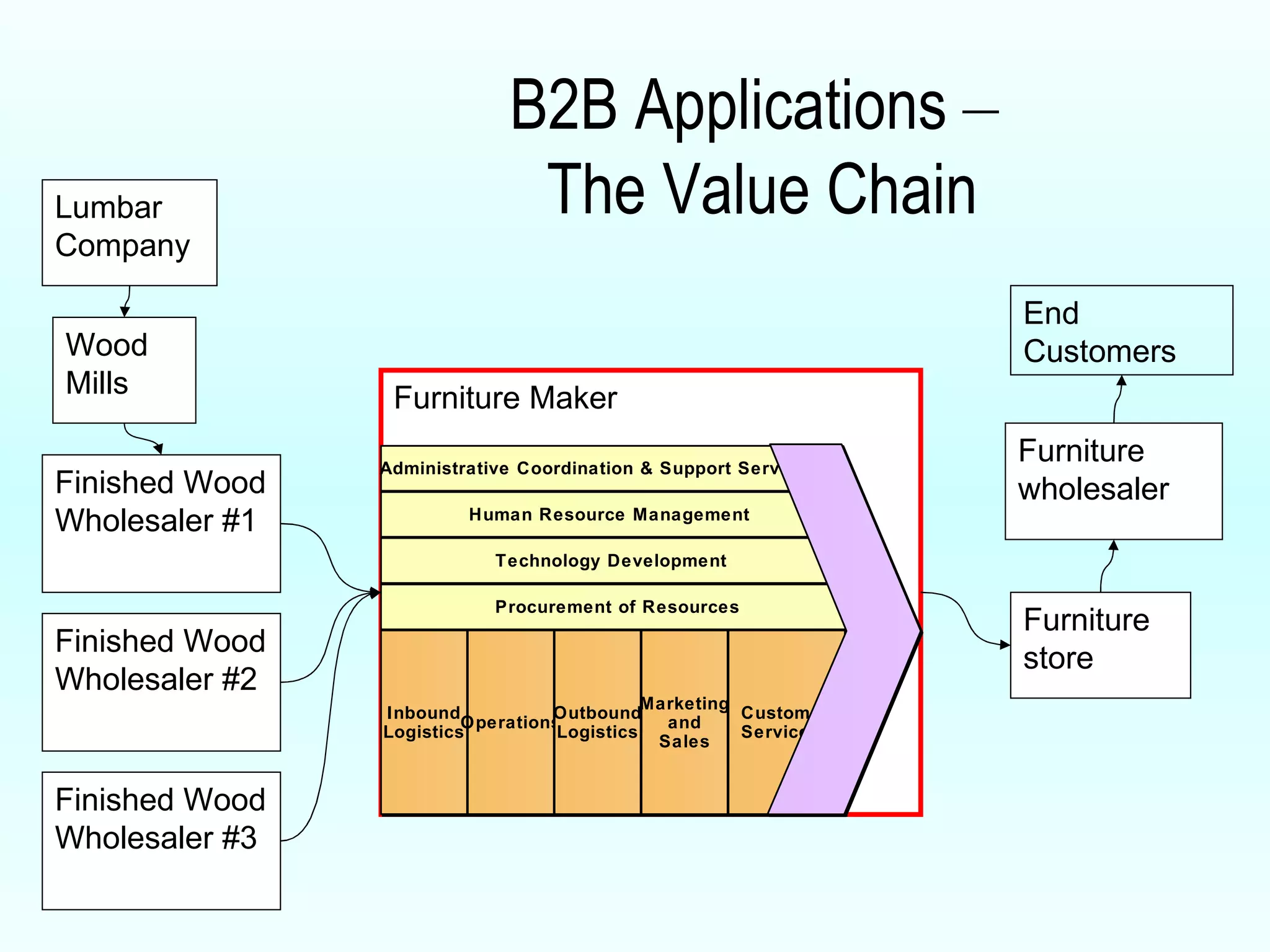
B2B Applications  –   The Value Chain Lumbar Company Wood Mills Finished Wood Wholesaler #1 Furniture Maker Furniture wholesaler Furniture store End Customers Finished Wood Wholesaler #3 Finished Wood Wholesaler #2 Administrative Coordination & Support Services Human Resource Management Technology Development Procurement of Resources Inbound Logistics Operations Outbound Logistics Marketing and Sales Customer Service
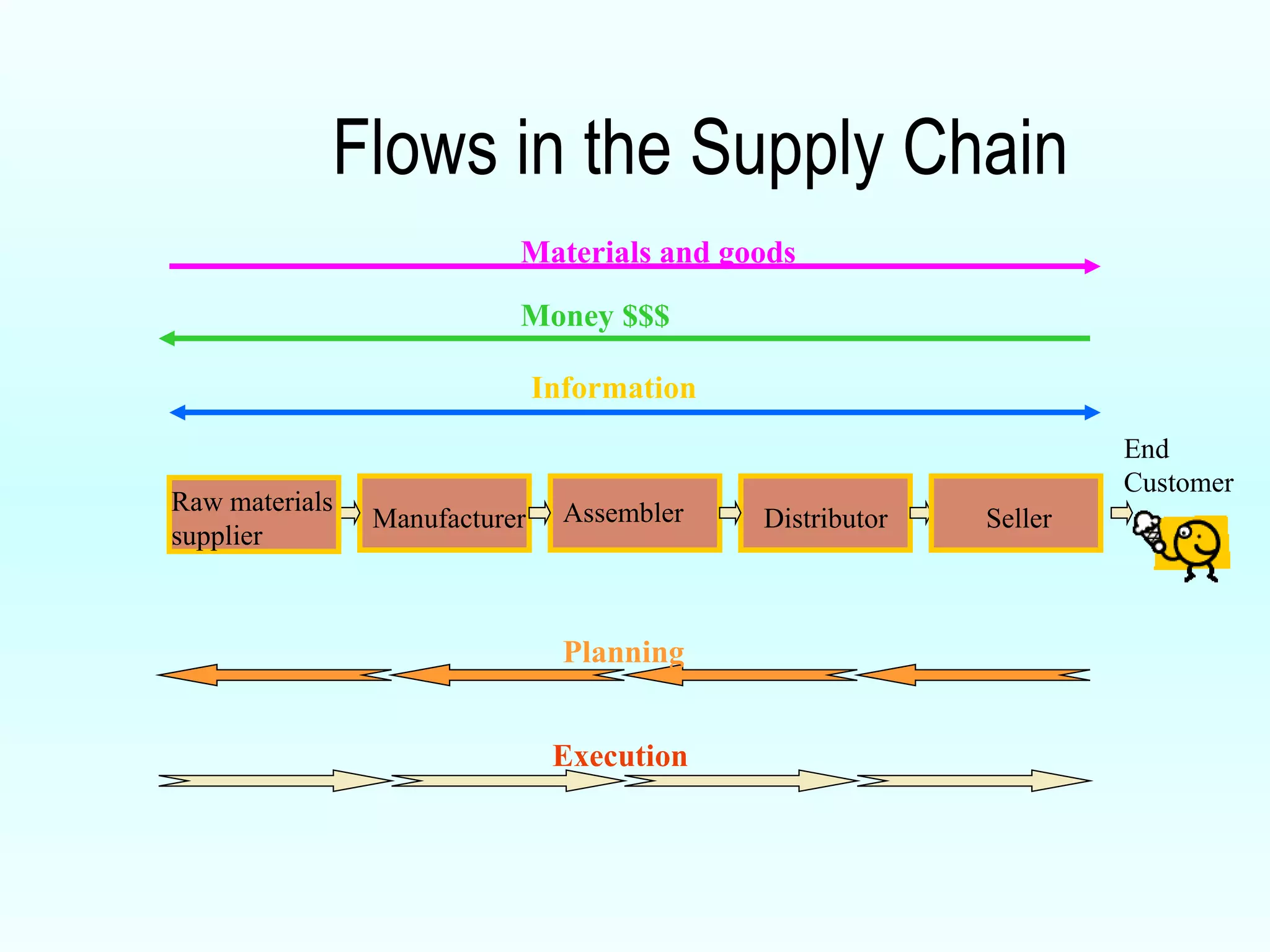
Flows in the Supply Chain Information Money $$$ Materials and goods Manufacturer Assembler Distributor Raw materials supplier Seller End Customer Execution Planning
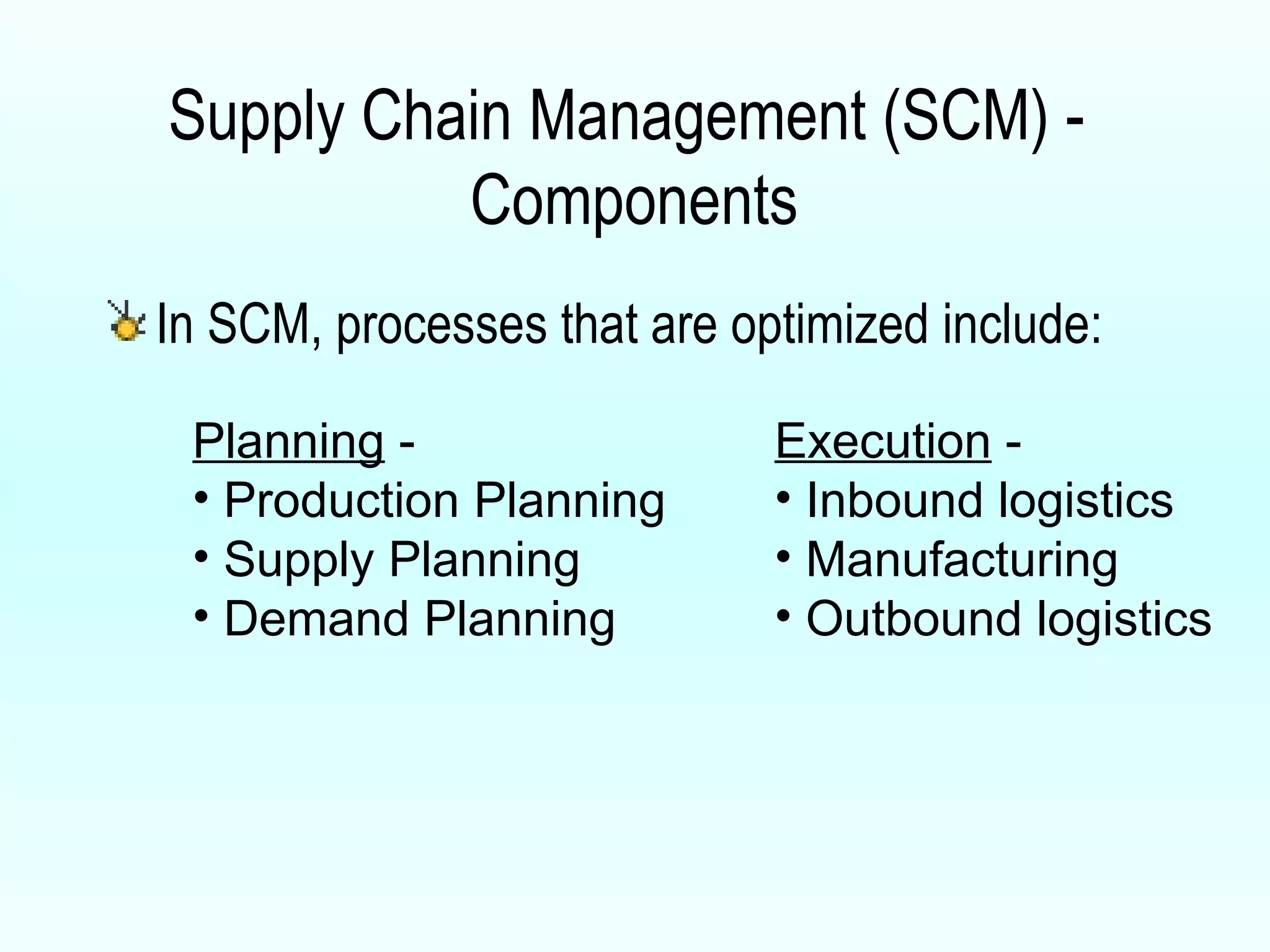
Supply Chain Management (SCM) -  Components In SCM, processes that are optimized include:  Planning  - Production Planning Supply Planning Demand Planning Execution  - Inbound logistics Manufacturing Outbound logistics
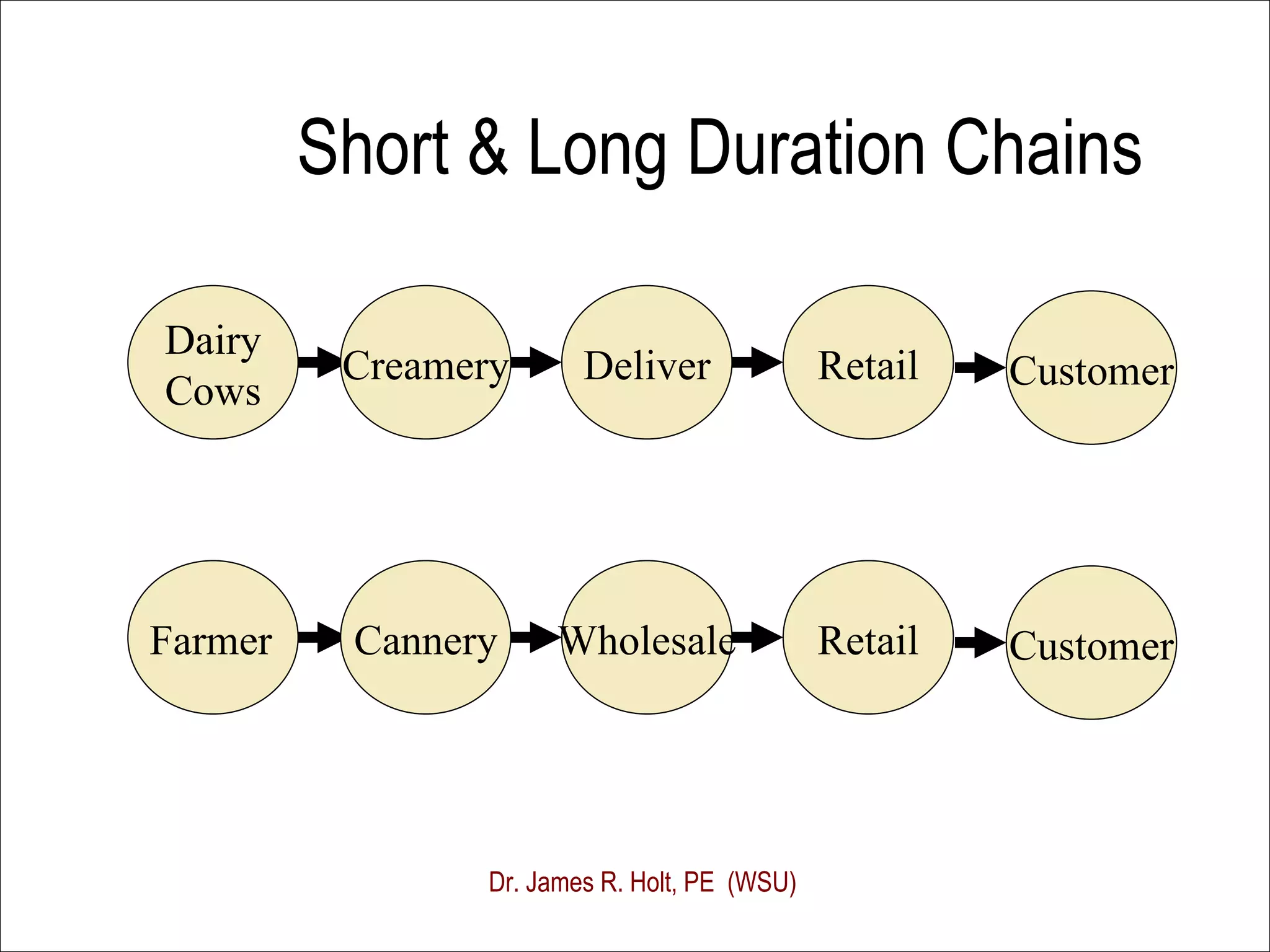
Short & Long Duration Chains Dairy Cows Creamery Deliver Retail Customer Farmer Cannery Wholesale Retail Customer Dr. James R. Holt, PE  (WSU)
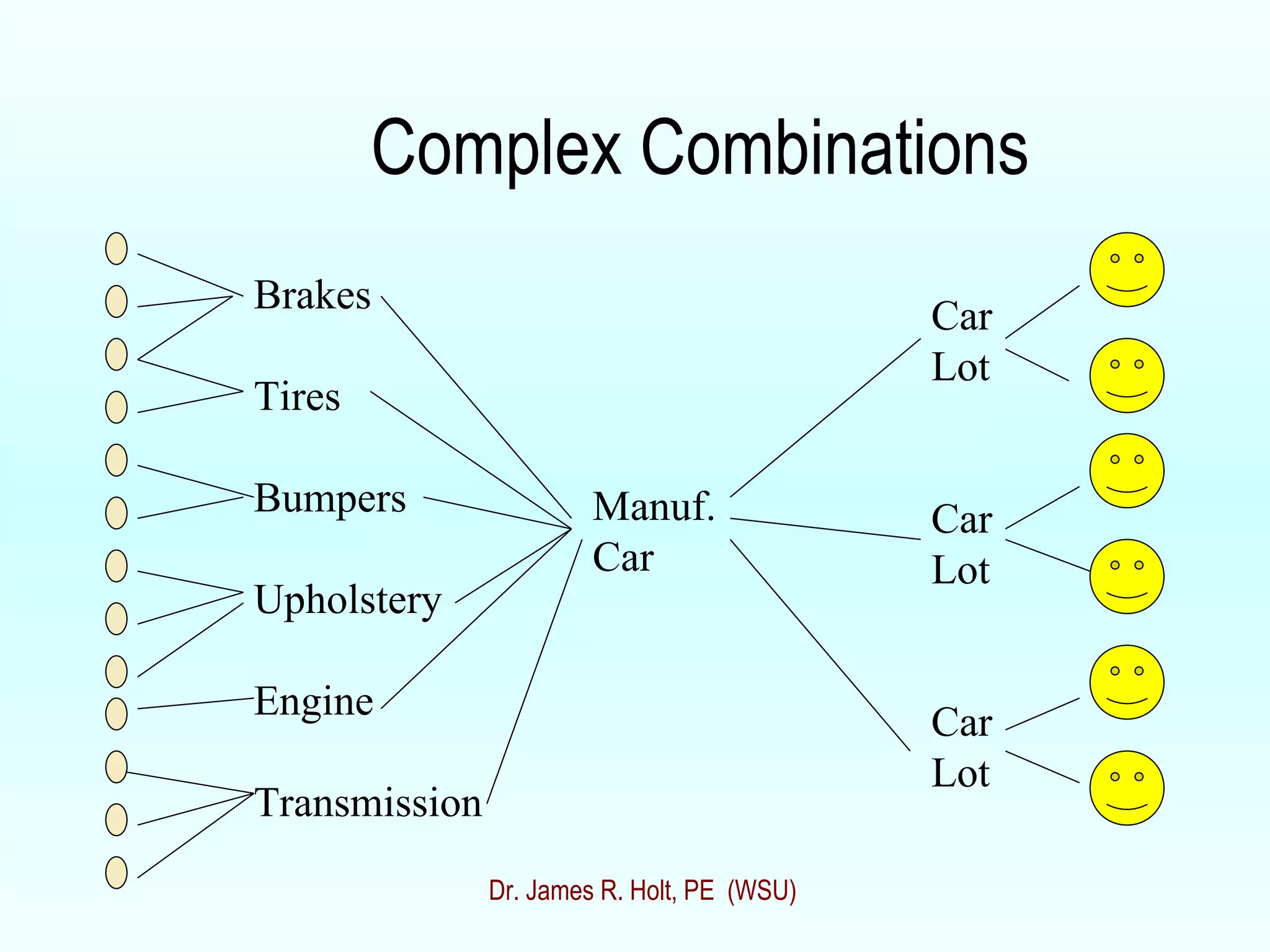
Complex Combinations Brakes Tires Bumpers Upholstery Engine Transmission Manuf. Car Car  Lot Car  Lot Car  Lot Dr. James R. Holt, PE  (WSU)
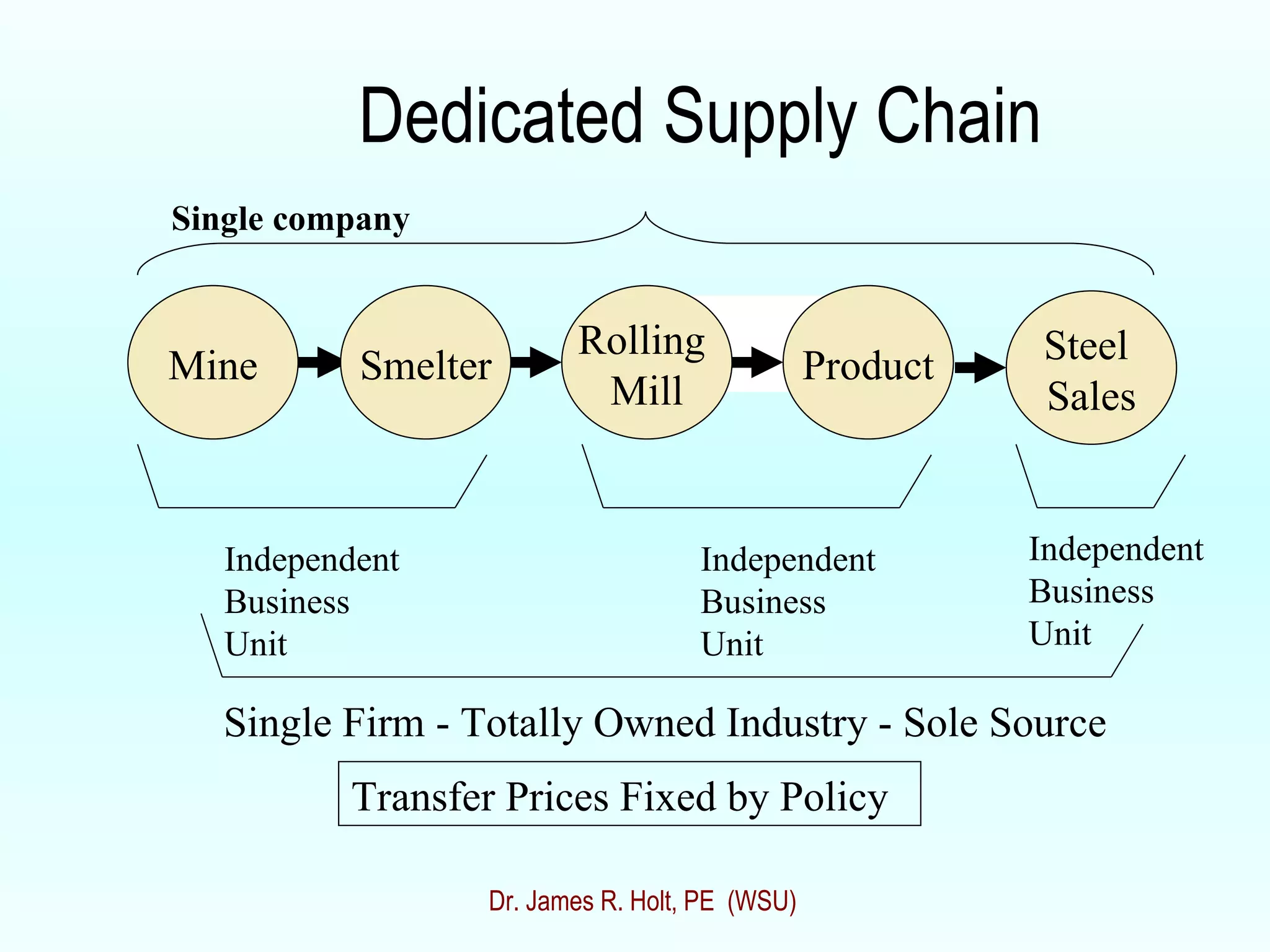
Dedicated Supply Chain Mine Smelter Rolling  Mill Product Steel  Sales Independent Business  Unit Independent Business  Unit Independent Business  Unit Single Firm - Totally Owned Industry - Sole Source Transfer Prices Fixed by Policy Dr. James R. Holt, PE  (WSU) Single company
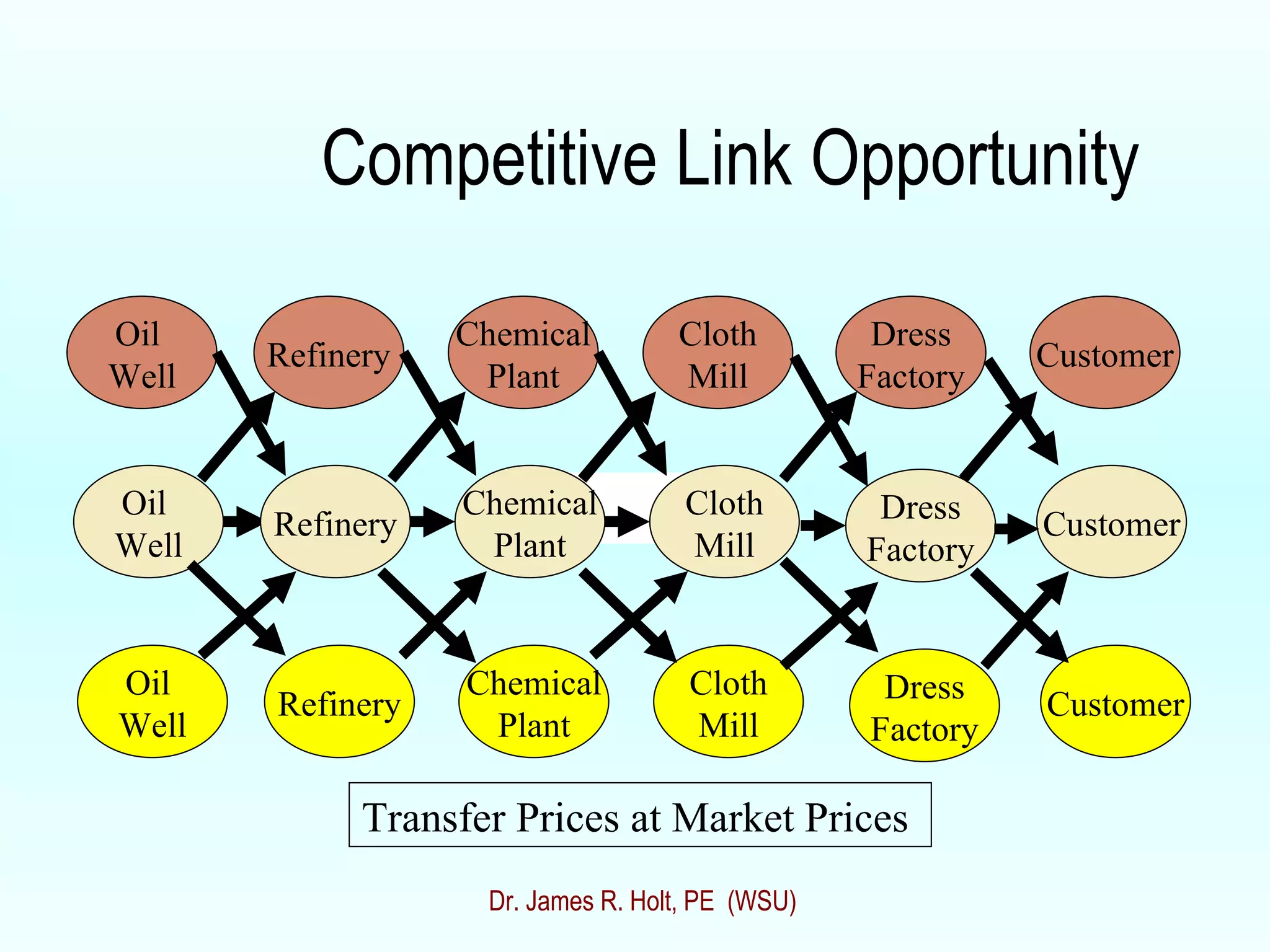
Competitive Link Opportunity Oil  Well Refinery Chemical Plant Cloth Mill Dress Factory Customer Oil  Well Refinery Chemical Plant Cloth Mill Dress Factory Customer Oil  Well Refinery Chemical Plant Cloth Mill Dress Factory Customer Transfer Prices at Market Prices Dr. James R. Holt, PE  (WSU)
Managing the SC MRP System Design Specifications (click here) Managing the SC is a full time job for a big chunk of a company’s staff.
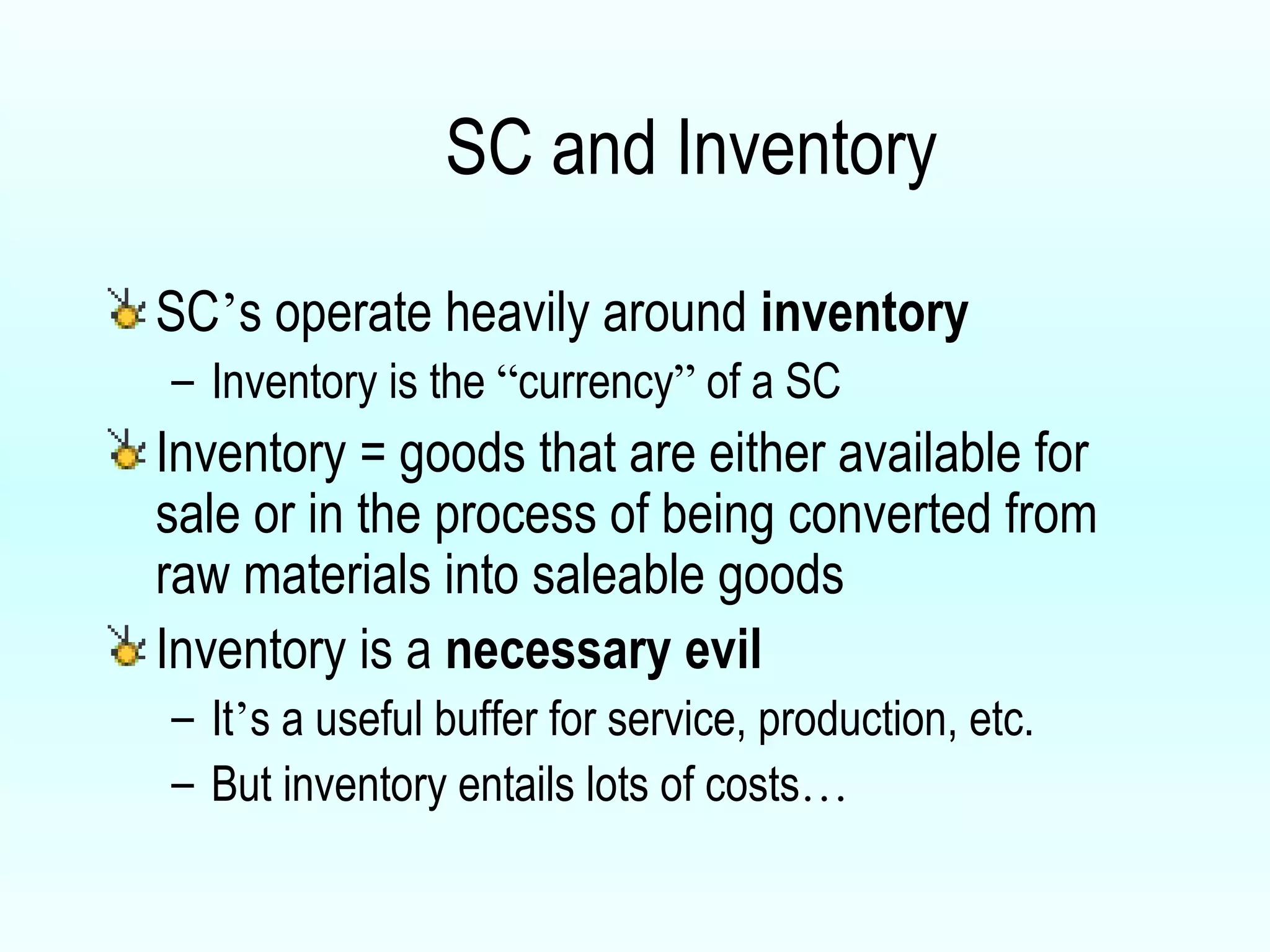
SC and Inventory  SC ’ s operate heavily around  inventory Inventory is the  “ currency ”  of a SC Inventory = goods that are either available for sale or in the process of being converted from raw materials into saleable goods Inventory is a  necessary evil It ’ s a useful buffer for service, production, etc. But inventory entails lots of costs …
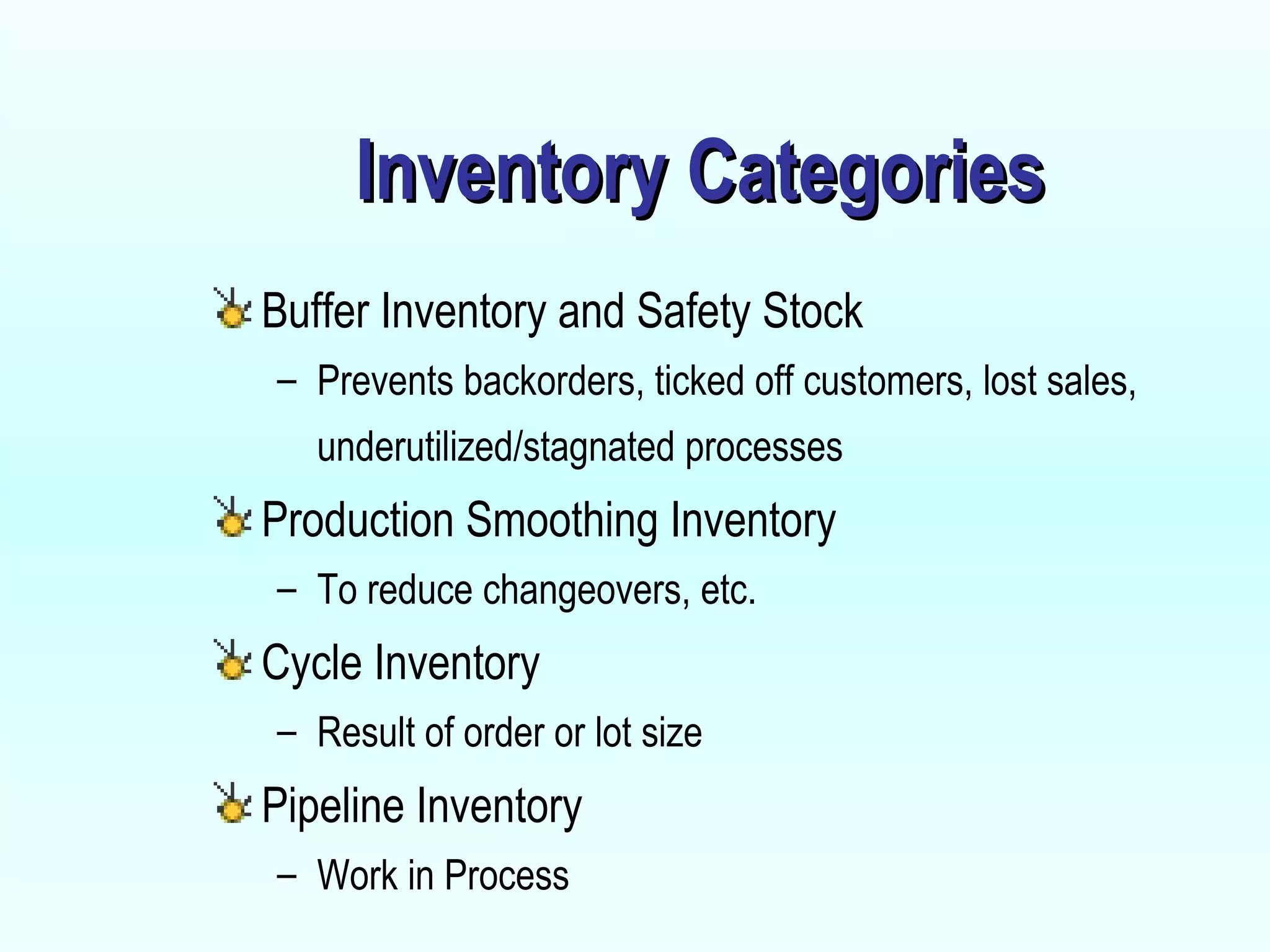
Inventory Categories Buffer Inventory and Safety Stock Prevents backorders, ticked off customers, lost sales, underutilized/stagnated processes Production Smoothing Inventory To reduce changeovers, etc. Cycle Inventory  Result of order or lot size Pipeline Inventory Work in Process
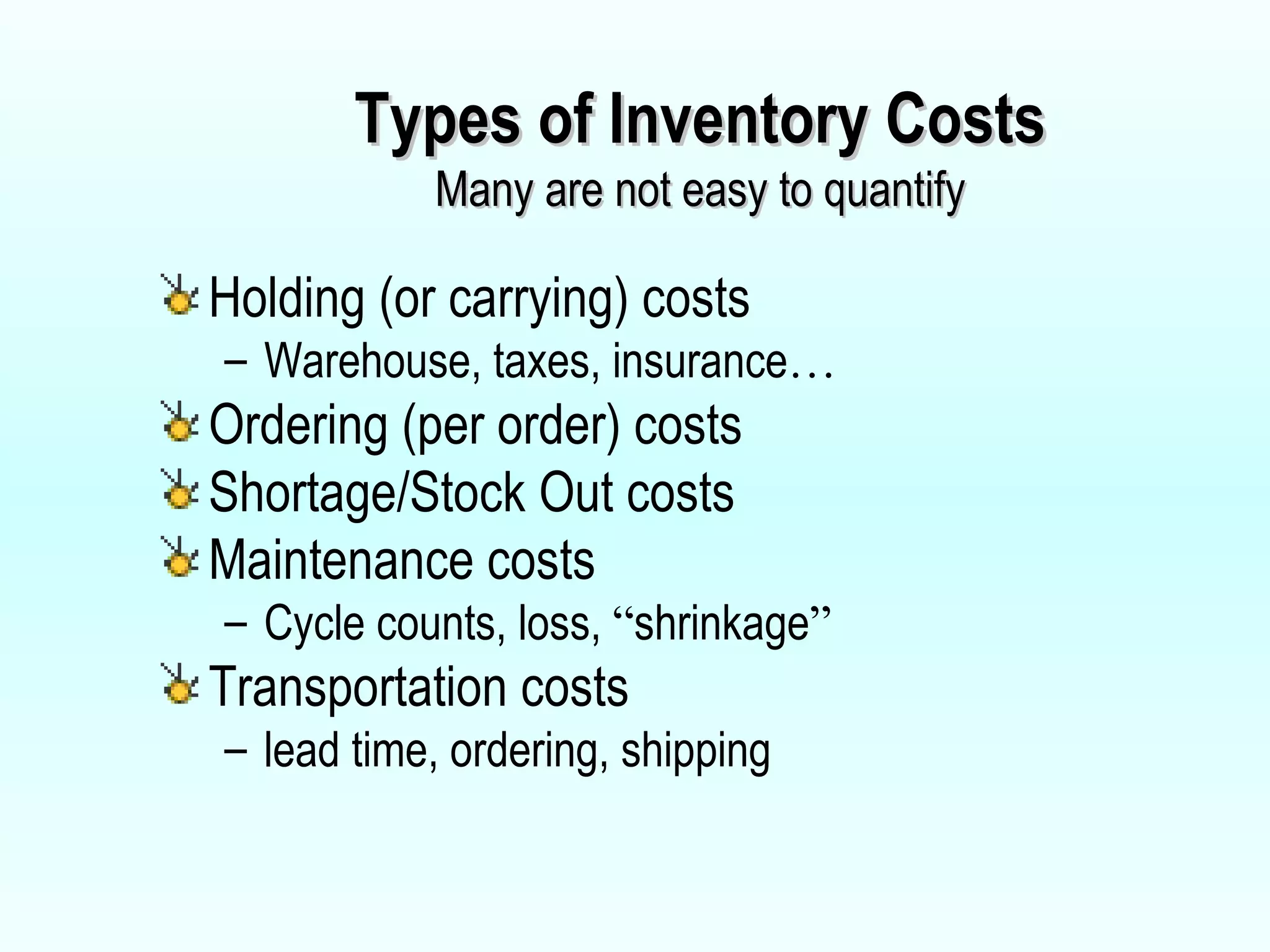
Types of Inventory Costs Many are not easy to quantify Holding (or carrying) costs Warehouse, taxes, insurance … Ordering (per order) costs Shortage/Stock Out costs Maintenance costs Cycle counts, loss,  “ shrinkage ” Transportation costs  lead time, ordering, shipping
Some key Non-Cost Inventory Policy Drivers Average Demand &  Variation How much will the customer order in the future Average Lead time &  Variation How long will it take to get it to the customer Service Level Mandate How forgiving is the customer of backorders Supplier Ordering Constraints Can the supplier meet my needs
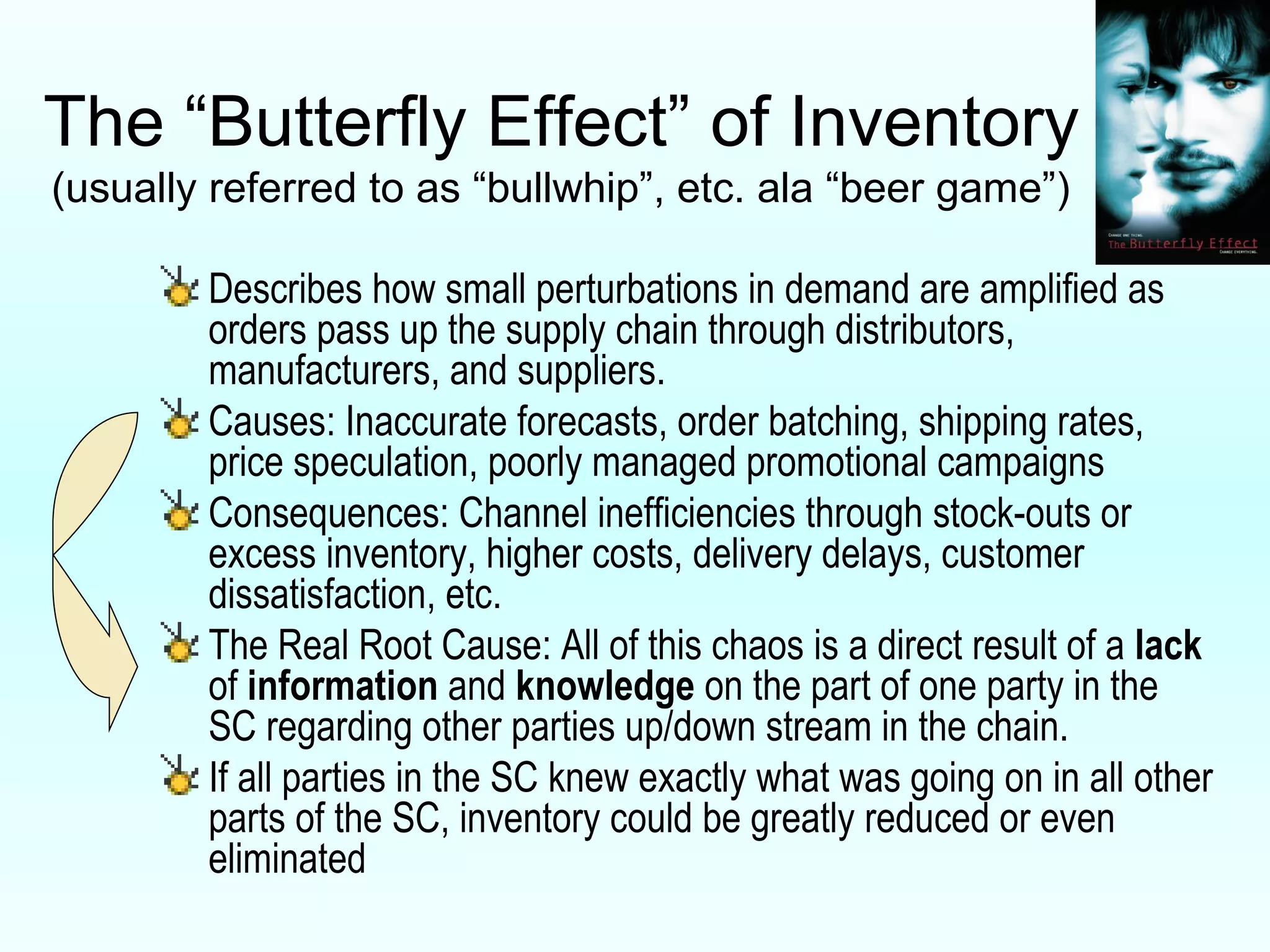
The “Butterfly Effect” of Inventory (usually referred to as “bullwhip”, etc. ala “beer game”) Describes how small perturbations in demand are amplified as orders pass up the supply chain through distributors, manufacturers, and suppliers. Causes: Inaccurate forecasts, order batching, shipping rates, price speculation, poorly managed promotional campaigns Consequences: Channel inefficiencies through stock-outs or excess inventory, higher costs, delivery delays, customer dissatisfaction, etc. The Real Root Cause: All of this chaos is a direct result of a  lack  of  information  and  knowledge  on the part of one party in the SC regarding other parties up/down stream in the chain. If all parties in the SC knew exactly what was going on in all other parts of the SC, inventory could be greatly reduced or even eliminated
The big attraction  An Internet-based supply chain lets companies monitor all parts of the chain simultaneously -- instead of having to collect information from one link and then pass it to the next, and then the next, like a giant game of  “ ghost ” .  The goal  To react more quickly to changing markets and make fewer mistakes in the process. SCM  –  the Role of E-business
SCM  –  the Role of E-business Use information to  Reduce uncertainties Create  visibility  of entire supply chain Enforce supplier compliance Requires: Fast, real-time information flow to all links Inter-enterprise coordination (between companies) Fast response Flexibility in production  Sharing knowledge about production plans Trust: reliable information, reliable fulfillment
SCM Benefits Efficiency Reduced inventory costs Increased capacity utilization Effectiveness  increased customer satisfaction (thus more sales)
SCM - Critical Issues Managing relationships with suppliers and customers How tightly should firms be bound together? To what extent can a firm trust its partner? What kind of a commitment can a firm make? How much data to share? Who gets the biggest share of the  “ soft $3 ” ? The additional value created though SCM efficiencies
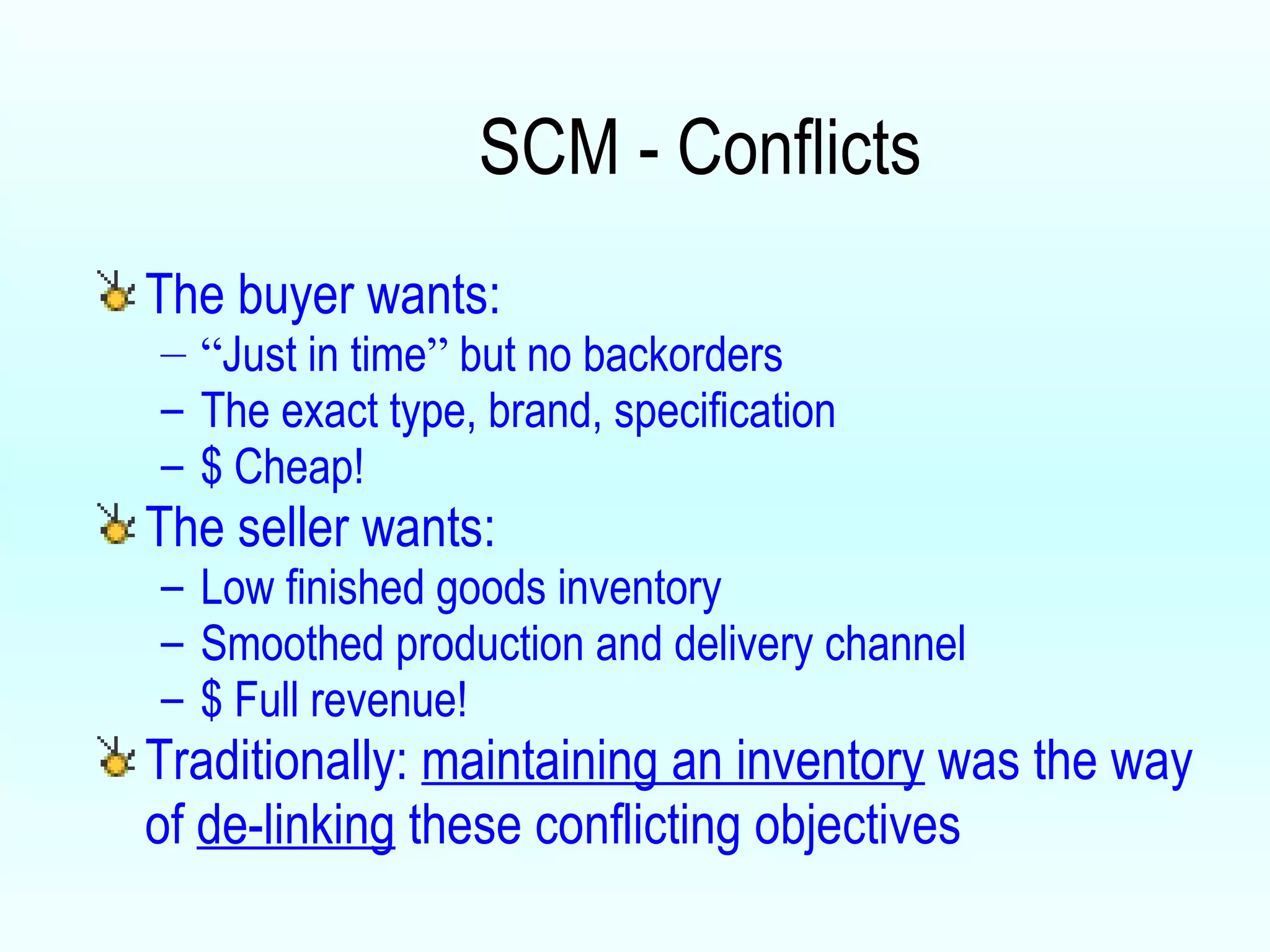
SCM - Conflicts The buyer wants: “ Just in time ”  but no backorders The exact type, brand, specification $ Cheap! The seller wants: Low finished goods inventory Smoothed production and delivery channel $ Full revenue! Traditionally:  maintaining an inventory  was the way of  de-linking  these conflicting objectives
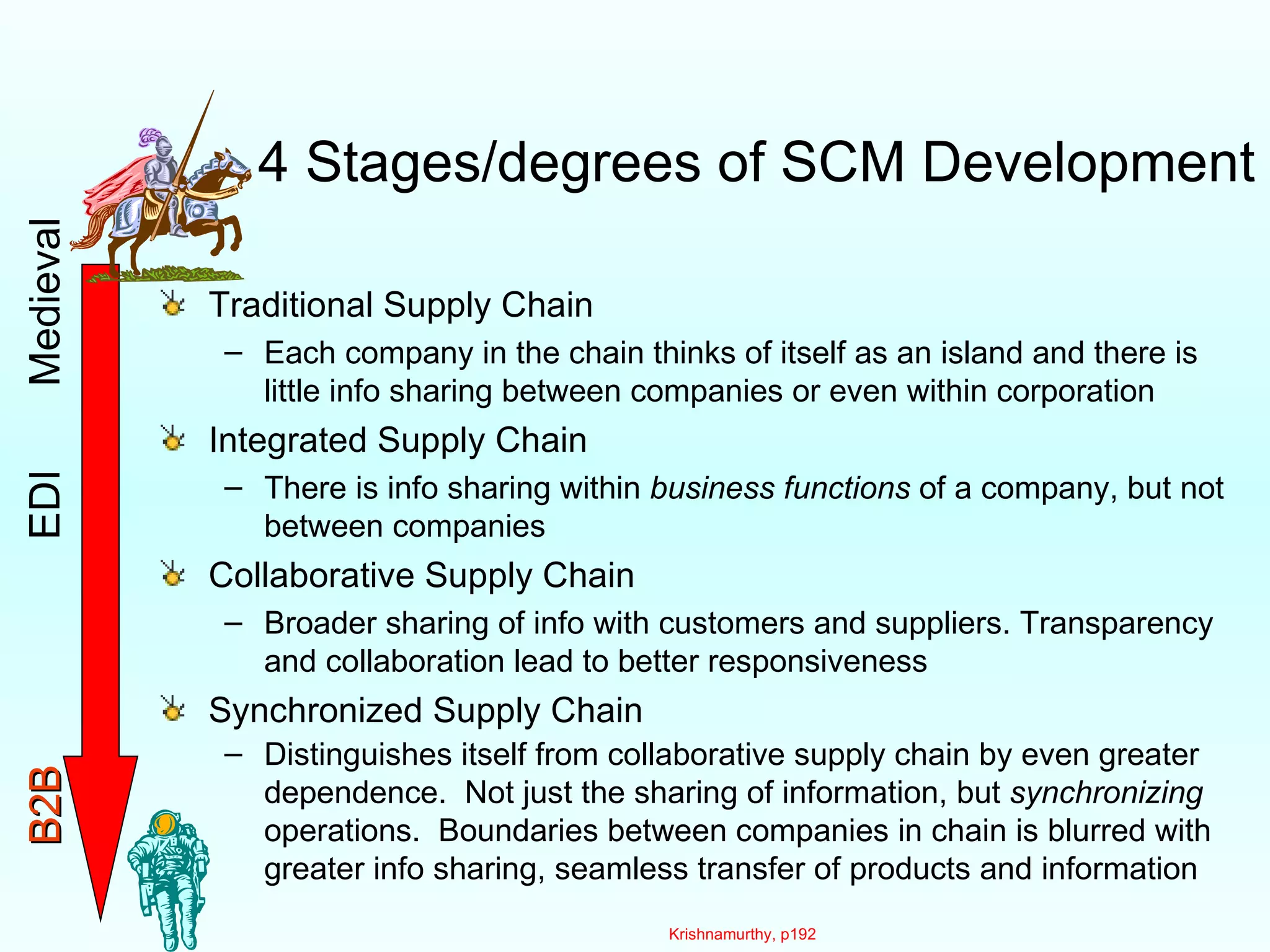
4 Stages/degrees of SCM Development Traditional Supply Chain  Each company in the chain thinks of itself as an island and there is little info sharing between companies or even within corporation Integrated Supply Chain There is info sharing within  business functions  of a company, but not between companies Collaborative Supply Chain Broader sharing of info with customers and suppliers. Transparency and collaboration lead to better responsiveness Synchronized Supply Chain Distinguishes itself from collaborative supply chain by even greater dependence.  Not just the sharing of information, but  synchronizing  operations.  Boundaries between companies in chain is blurred with greater info sharing, seamless transfer of products and information Krishnamurthy, p192 B2B   EDI  Medieval
SCM & B2B  –   Summary Definitions of Supply Chain (SC), Supply Chain Management, (SCM), Inventory SCM is very complex; IT can help streamline information and integrate business processes  Most SC interactions are B2B; interactions in B2B are significantly different from B2C B2B IT: Traditional  –  EDI Current  –  internet-based (+benefits)
B2B Buy/Sell Applications & e-Markets
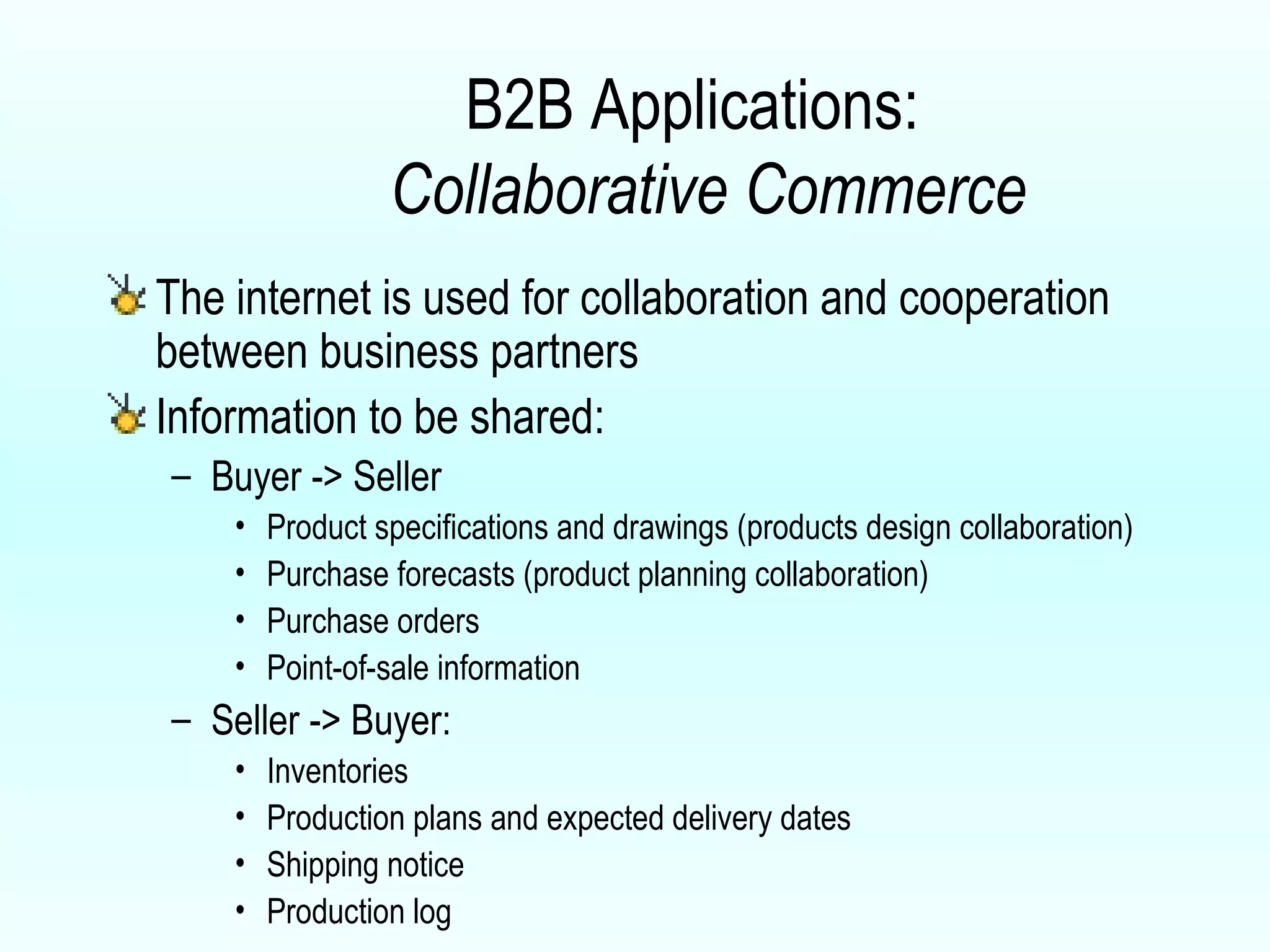
B2B Applications:    Collaborative Commerce The internet is used for collaboration and cooperation between business partners Information to be shared: Buyer -> Seller Product specifications and drawings (products design collaboration) Purchase forecasts (product planning collaboration) Purchase orders Point-of-sale information Seller -> Buyer: Inventories Production plans and expected delivery dates Shipping notice Production log
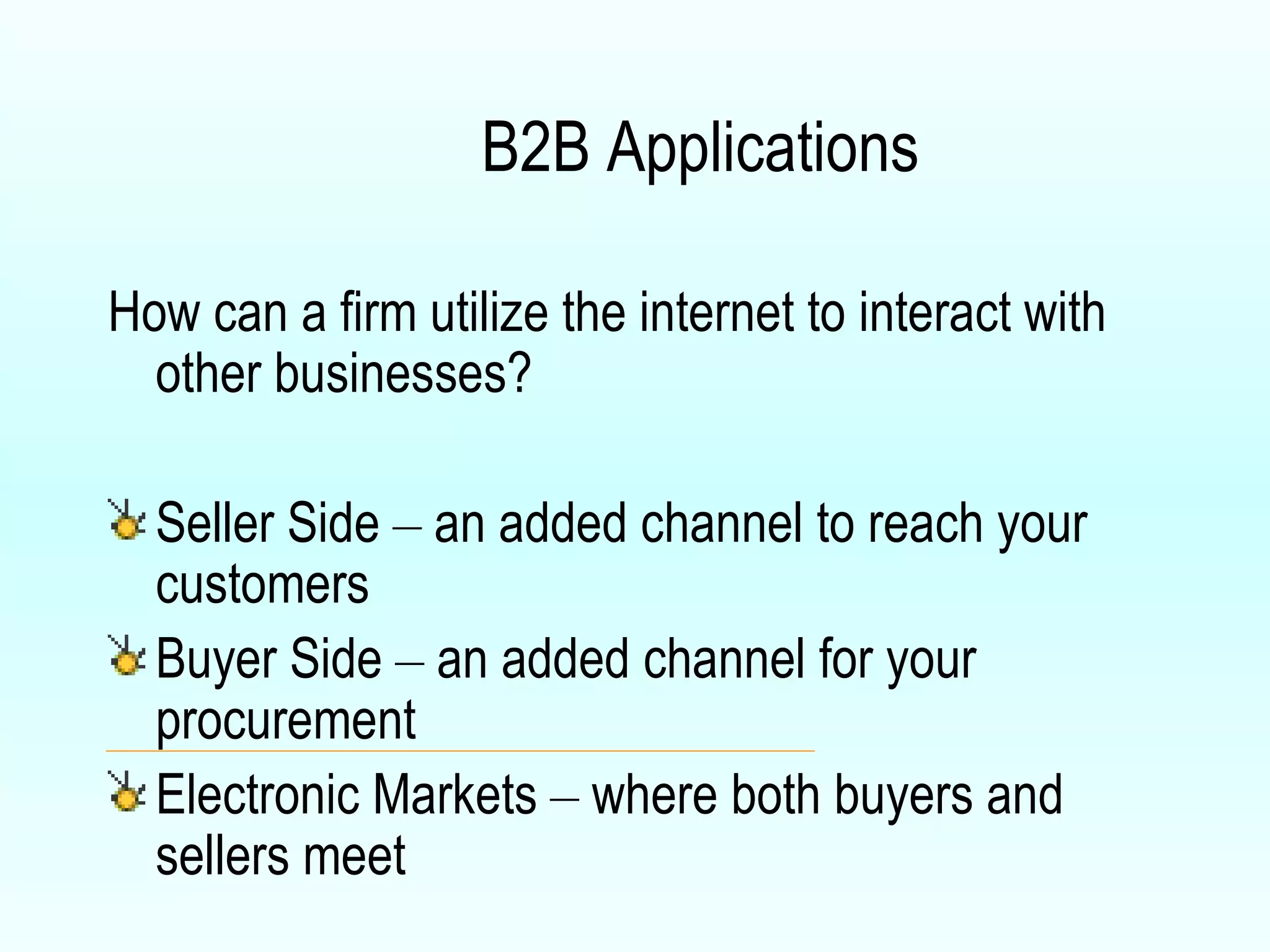
B2B Applications How can a firm utilize the internet to interact with other businesses? Seller Side  –  an added channel to reach your customers Buyer Side  –  an added channel for your procurement Electronic Markets  –  where both buyers and sellers meet
B2B Applications  –  Seller Side EC Seller Side EC Buyer Side EC Electronic Markets
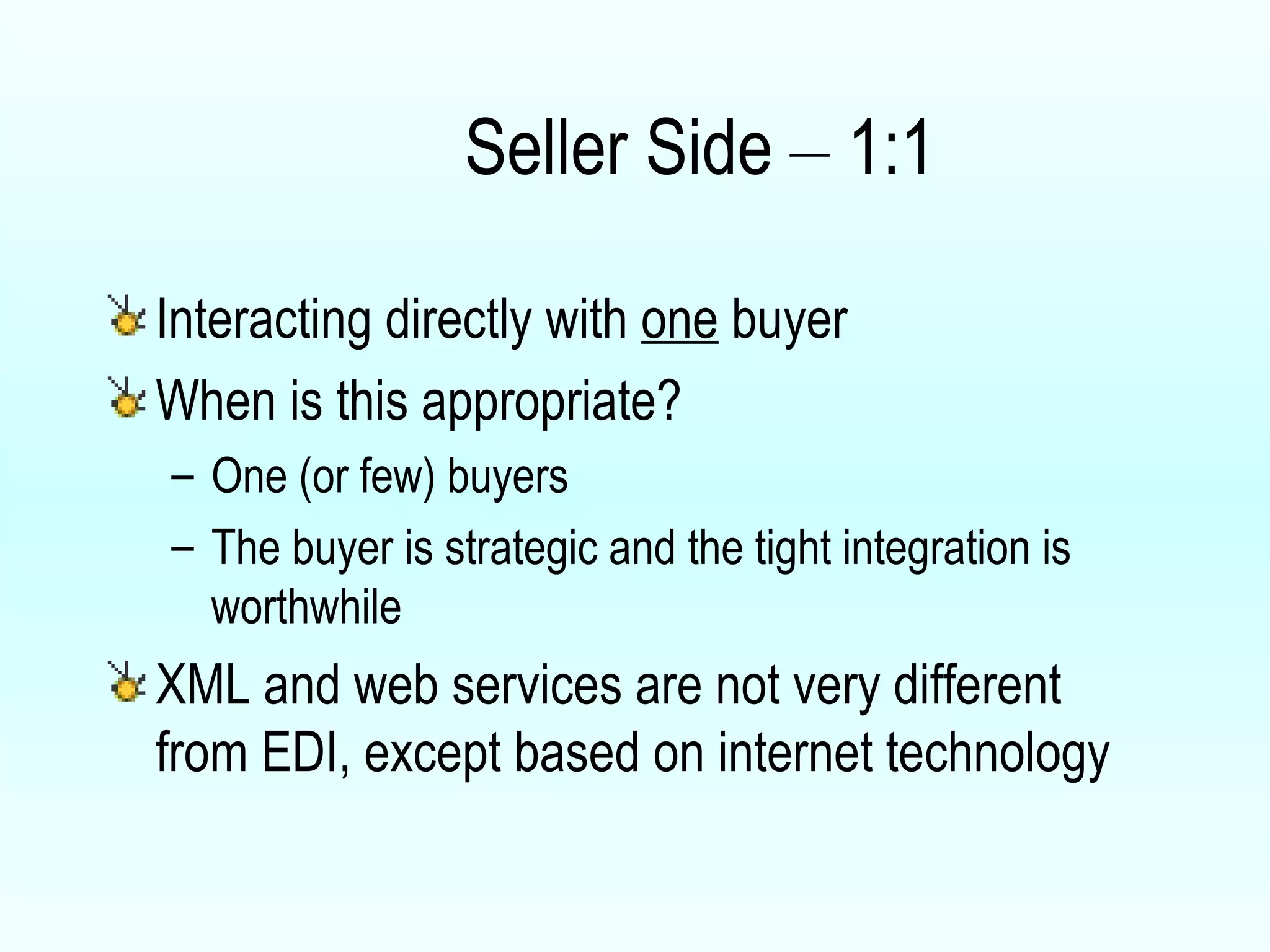
Seller Side  –  1:1 Interacting directly with  one  buyer When is this appropriate? One (or few) buyers The buyer is strategic and the tight integration is worthwhile XML and web services are not very different from EDI, except based on internet technology
Seller Side  –  1: Many Selling: Web storefront Integration with buyer ’ s systems  Auctions Support & Service Online catalogue Customer service
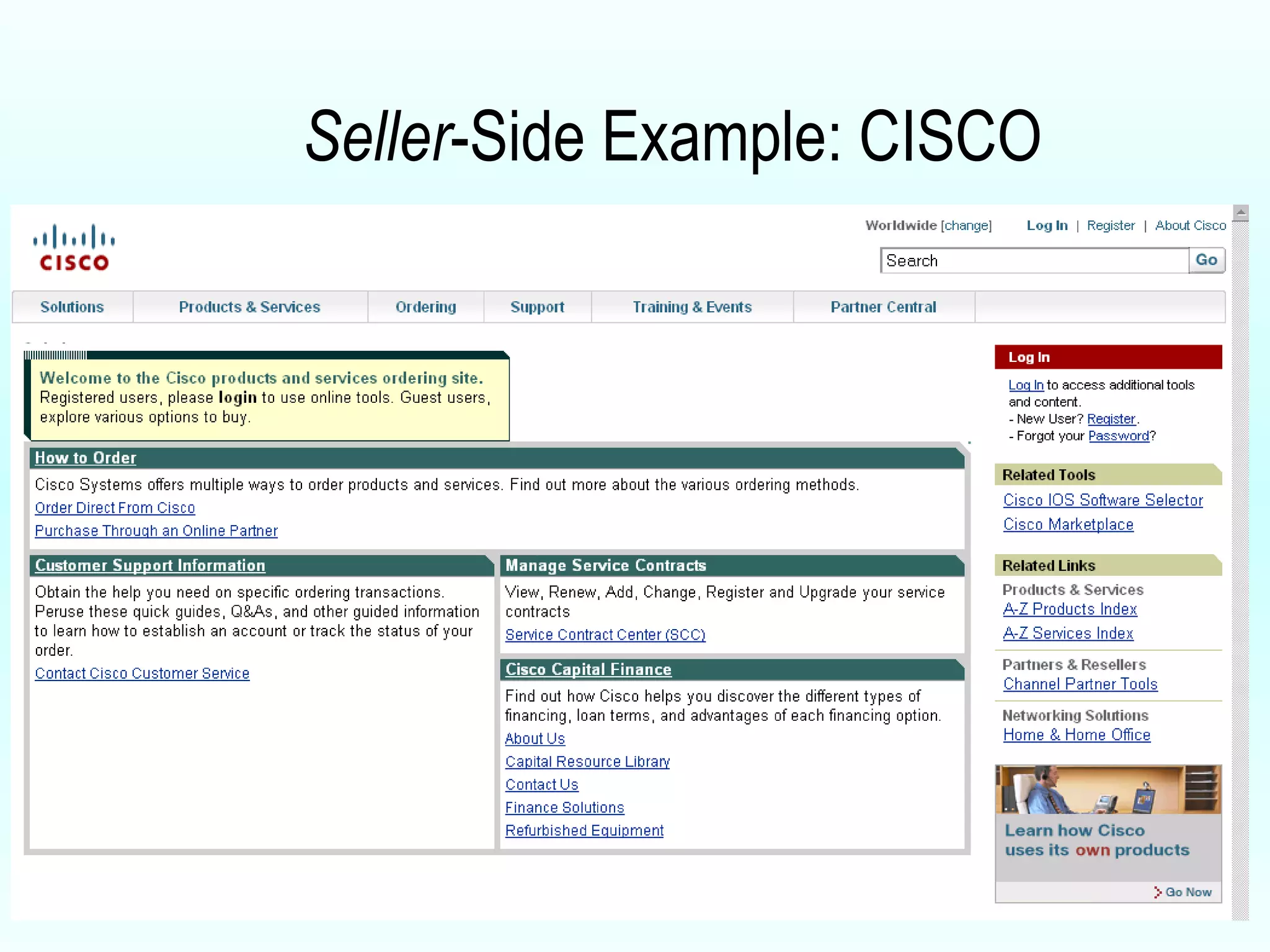
Seller -Side  Example: CISCO
Seller-Side 1:Many - Example: CISCO Functionality: Online Ordering—  Internet Product Center builds virtually all its products to order Finding Order Status—  gives the customers tools to find answers to order status inquiries by themselves Customer Service—  Cisco Connection online Includes a web storefront, integration with supplier’s systems and customer service Benefits—  saves the company $363 million per year from technical support, human resources, software distribution and marketing material 98% of sales through the internet
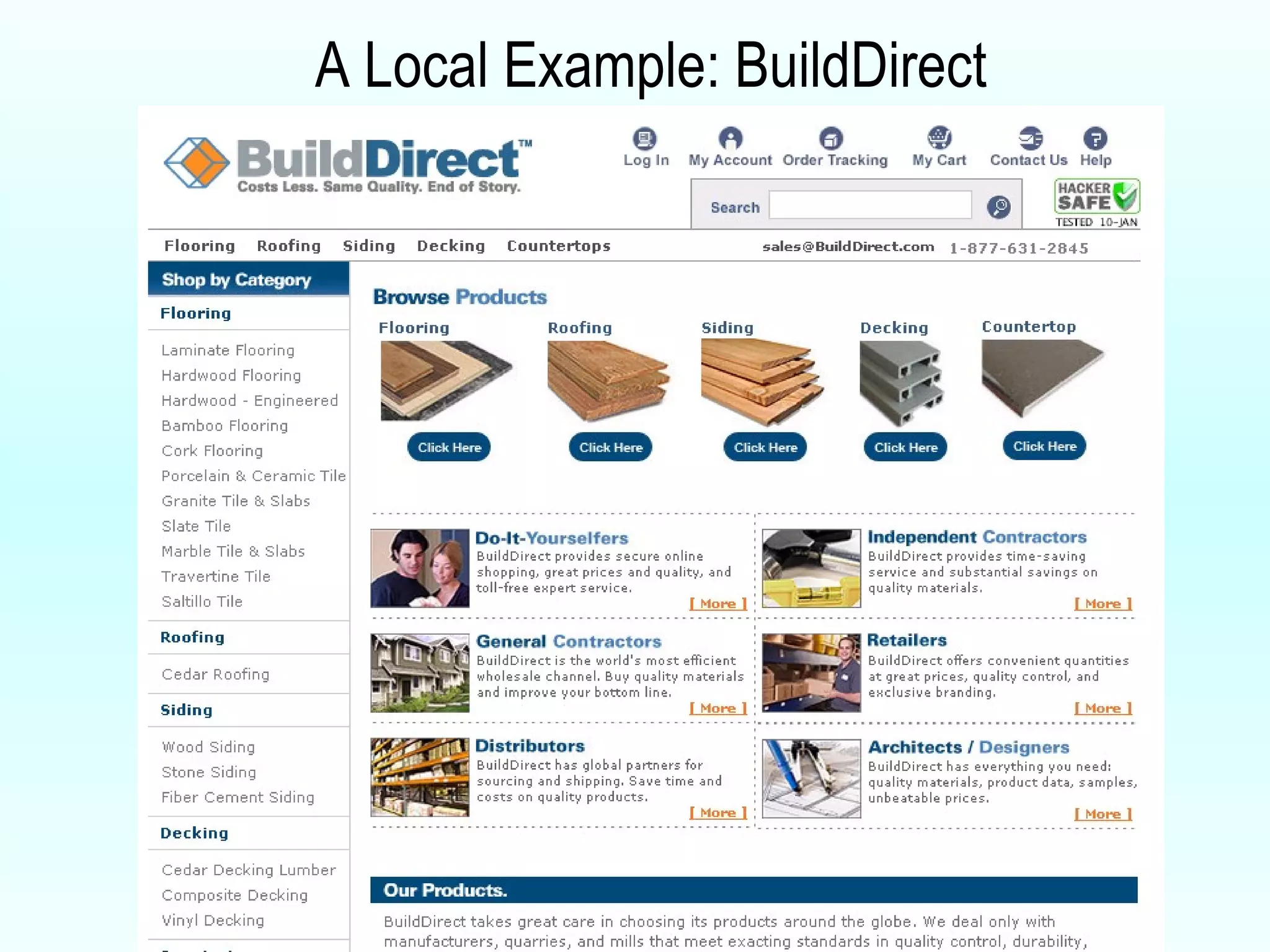
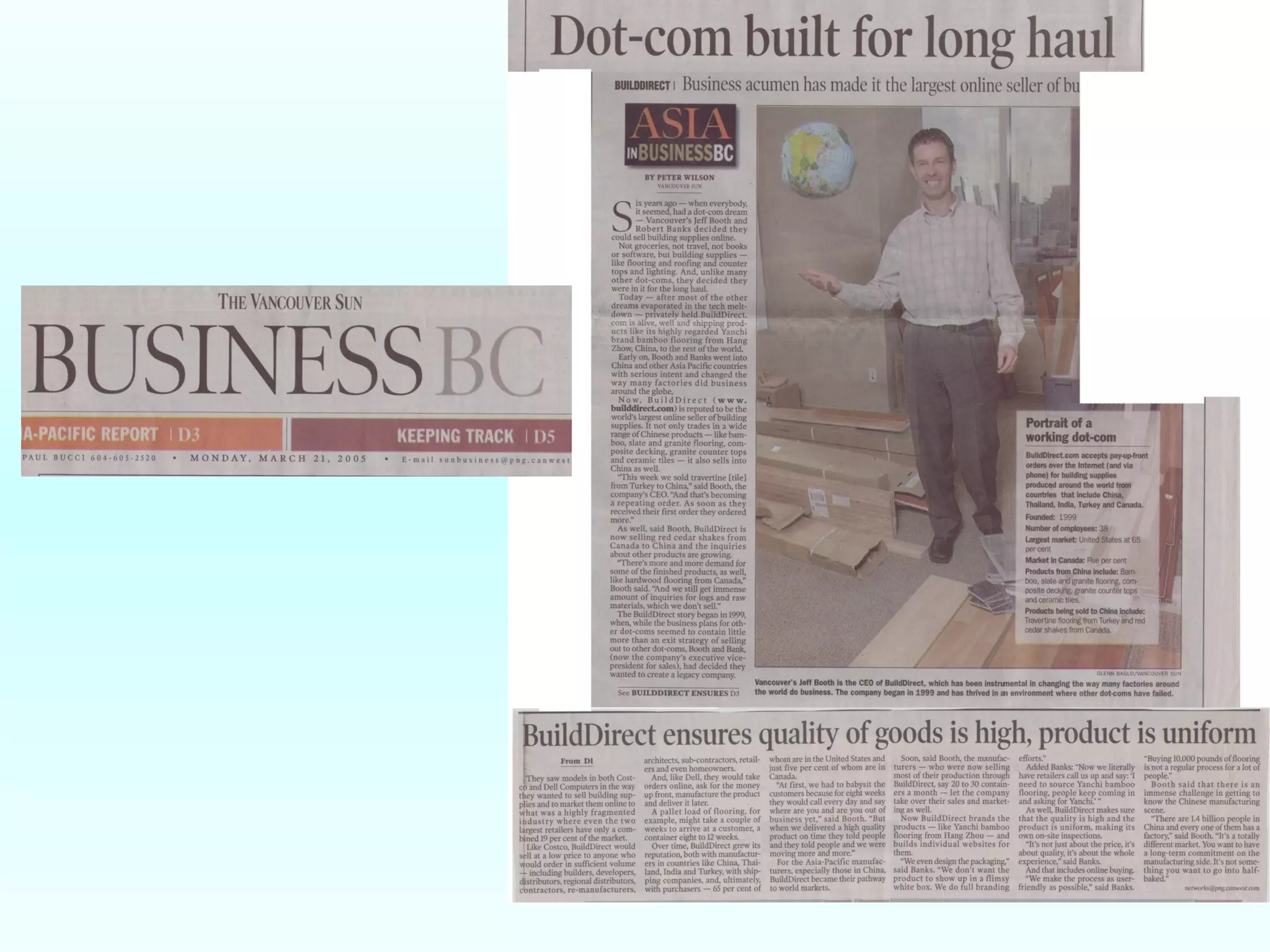
A Local  Example: BuildDirect
 
Mini Case Study: BuildDirect Founded in 1999 by Jeff Booth and Robert Banks. Located at 1900-570 Granville Street. 38 employees A  pure B2B e-business  that sells building materials online (yes; big, heavy, pallet-loads of  building materials) Estimated 2006 sales: >$60 MM (???)
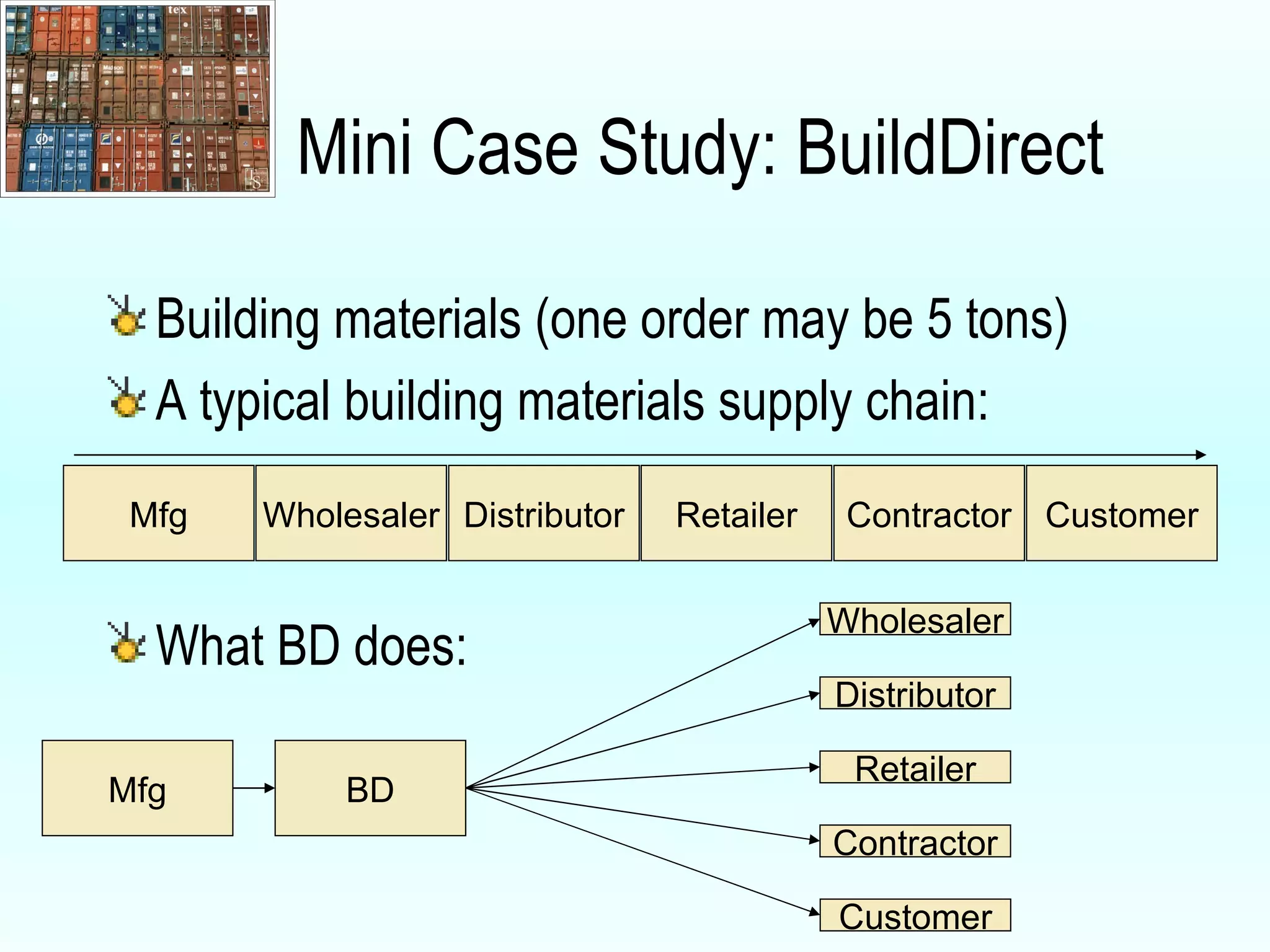
Mini Case Study: BuildDirect Building materials (one order may be 5 tons) A typical building materials supply chain: What BD does: Wholesaler Mfg Distributor Retailer Contractor Customer Mfg BD Wholesaler Distributor Retailer Contractor Customer
Mini Case Study: BuildDirect BD eats it way up the supply chain Sometimes it ’ s a retailer, sometimes a wholesaler Depends on volume In some cases completely moves so far up the chain that it takes over the Mfg ’ s sales channel! The  “ Dell ”  of building materials Payment up front! (and 30 to 90 days A/P, nice float) No inventory! One source of competitive advantage lies in its proprietary algorithms that manage long, complex, multi-party shipping processes.
Seller Side B2B EC  –  Summary Benefits:  Increase customer satisfaction Increase sales Reduce selling expenditures & administrative costs Increase delivery speed Outsource work to your customer!
B2B Applications  –  Buyer Side Seller side   Buyer side Exchange
Buyer -Side B2B E-Commerce Procurement: How can a firm utilize the internet to buy more efficiently? Purchasing (actual buying related activities  –  from RFQ to purchase order) Transportation Warehousing Inbound receiving Typically used by  powerful ,  large  buyers (e.g. GE, GM, et al)
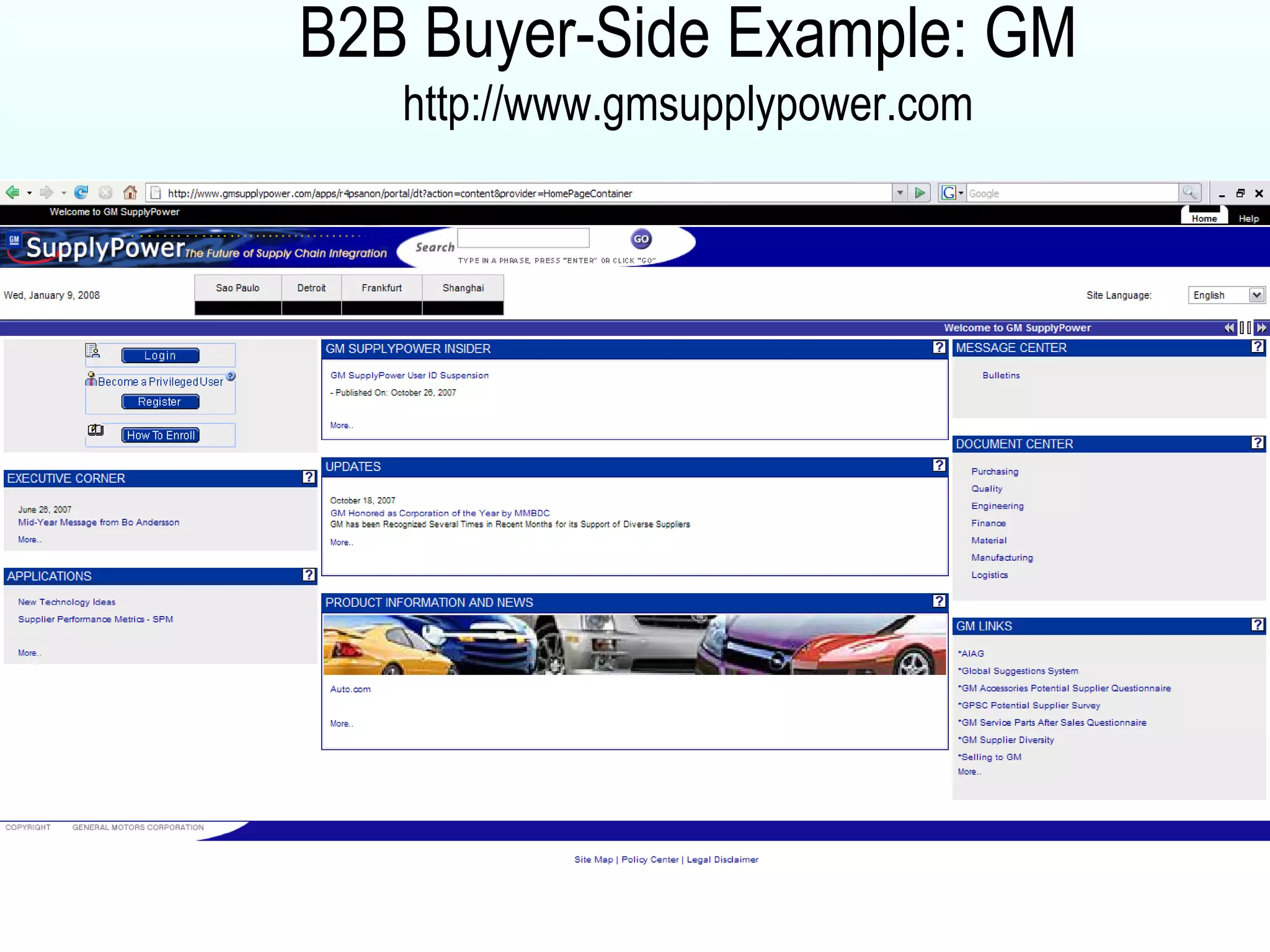
B2B Buyer-Side  Example: GM http://www.gmsupplypower.com
Buyer-Side 1:Many - Indirect Materials  Example: GM Buying commodity products GM spends over $100 billion annually 200,000 products; 20,000 suppliers Bidding process (tender) Problems with  “ legacy ”  means of tendering: Duration - weeks or even months Transaction costs to GM and suppliers Solution: reverse auction on GM ’ s site
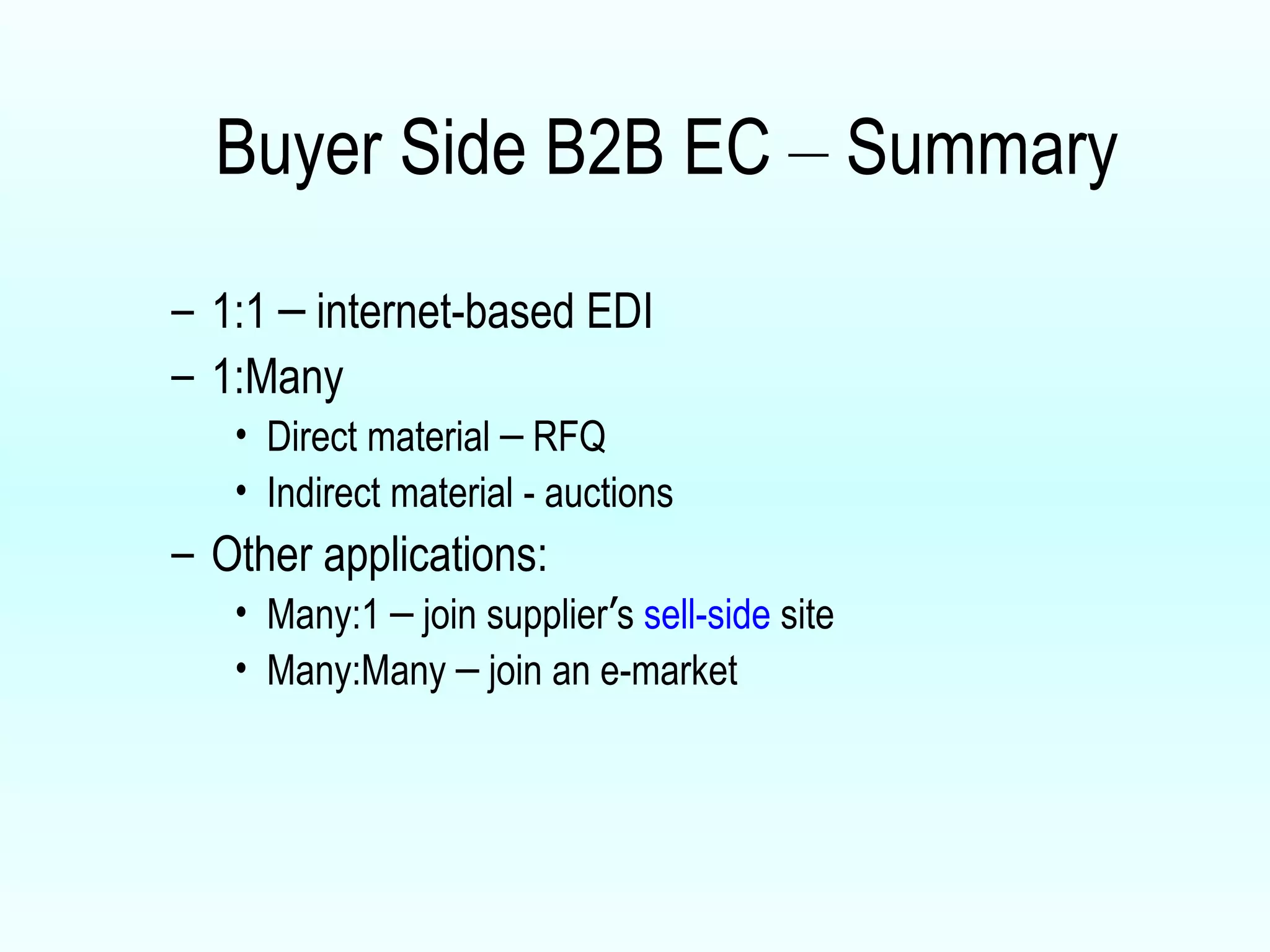
Buyer Side B2B EC  –  Summary 1:1  –  internet-based EDI 1:Many Direct material  –  RFQ Indirect material - auctions Other applications: Many:1  –  join supplier ’ s  sell-side  site Many:Many  –  join an e-market
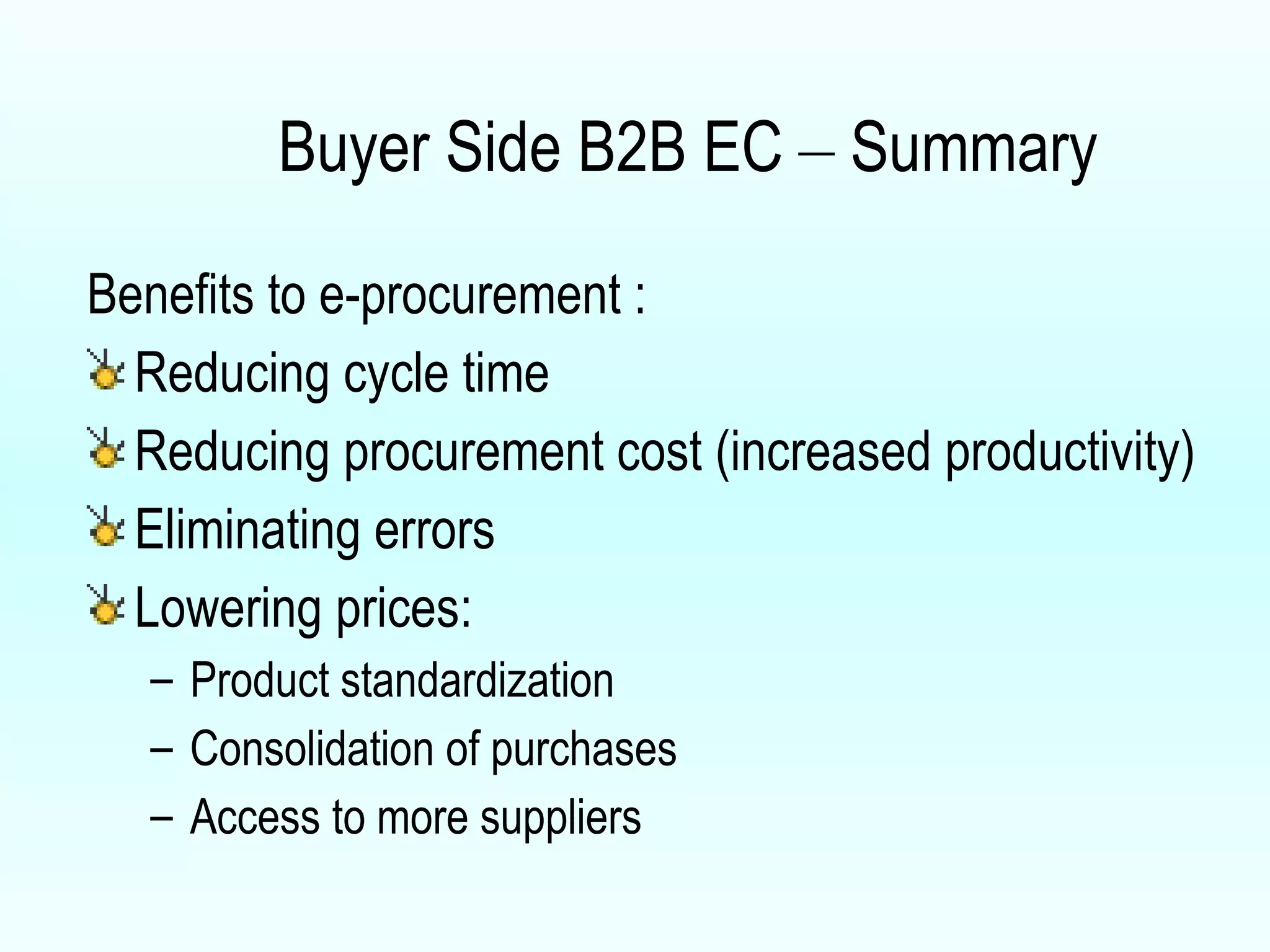
Buyer Side B2B EC  –  Summary Benefits to e-procurement :  Reducing cycle time Reducing procurement cost (increased productivity) Eliminating errors Lowering prices: Product standardization Consolidation of purchases Access to more suppliers
B2B Applications - Summary Seller Side EC  Buyer Side EC Electronic Markets
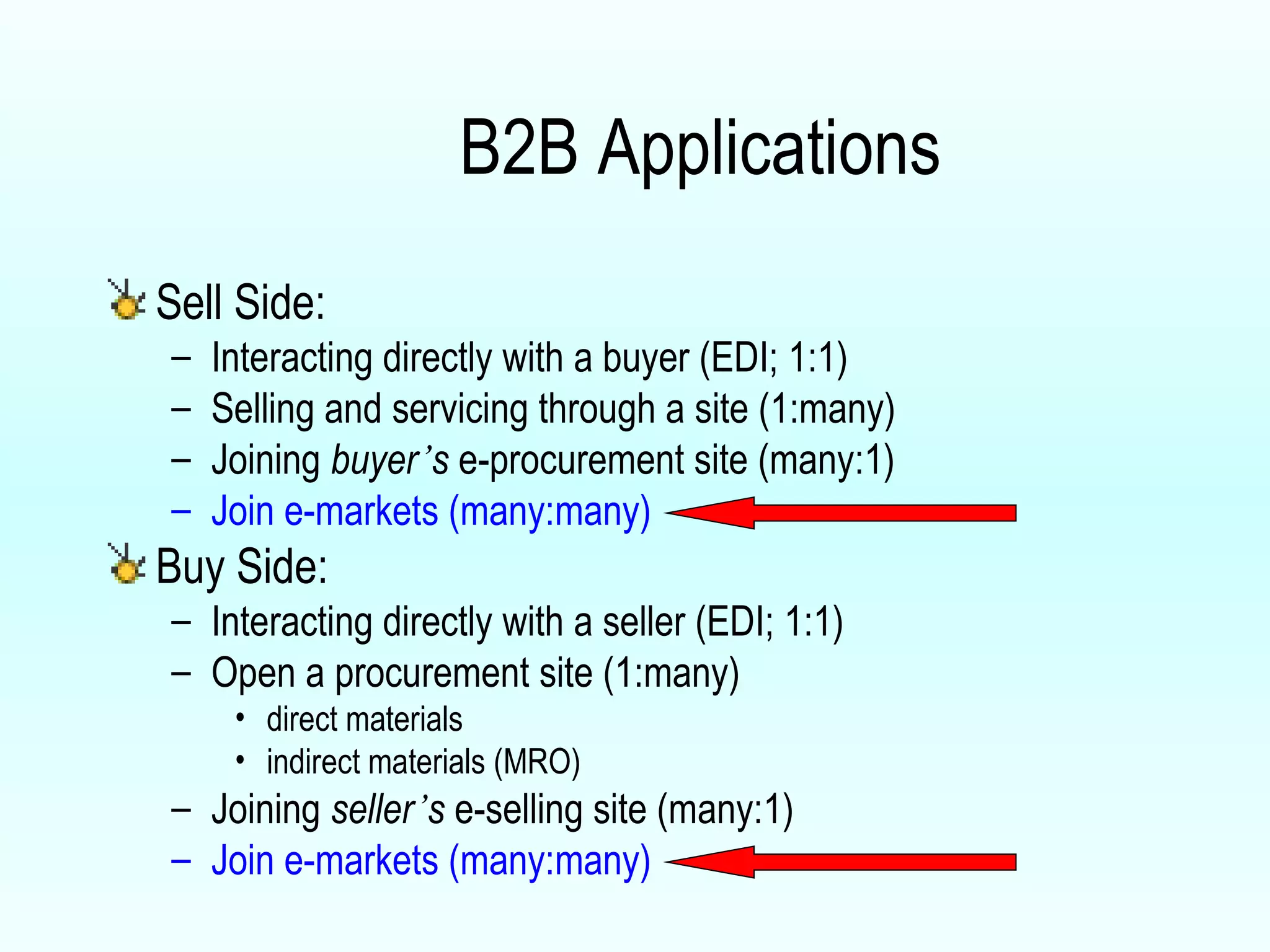
B2B Applications Sell Side: Interacting directly with a buyer (EDI; 1:1) Selling and servicing through a site (1:many) Joining  buyer ’ s  e-procurement site (many:1) Join e-markets (many:many) Buy Side: Interacting directly with a seller (EDI; 1:1) Open a procurement site (1:many) direct materials indirect materials (MRO)  Joining  seller ’ s  e-selling site (many:1) Join e-markets (many:many)
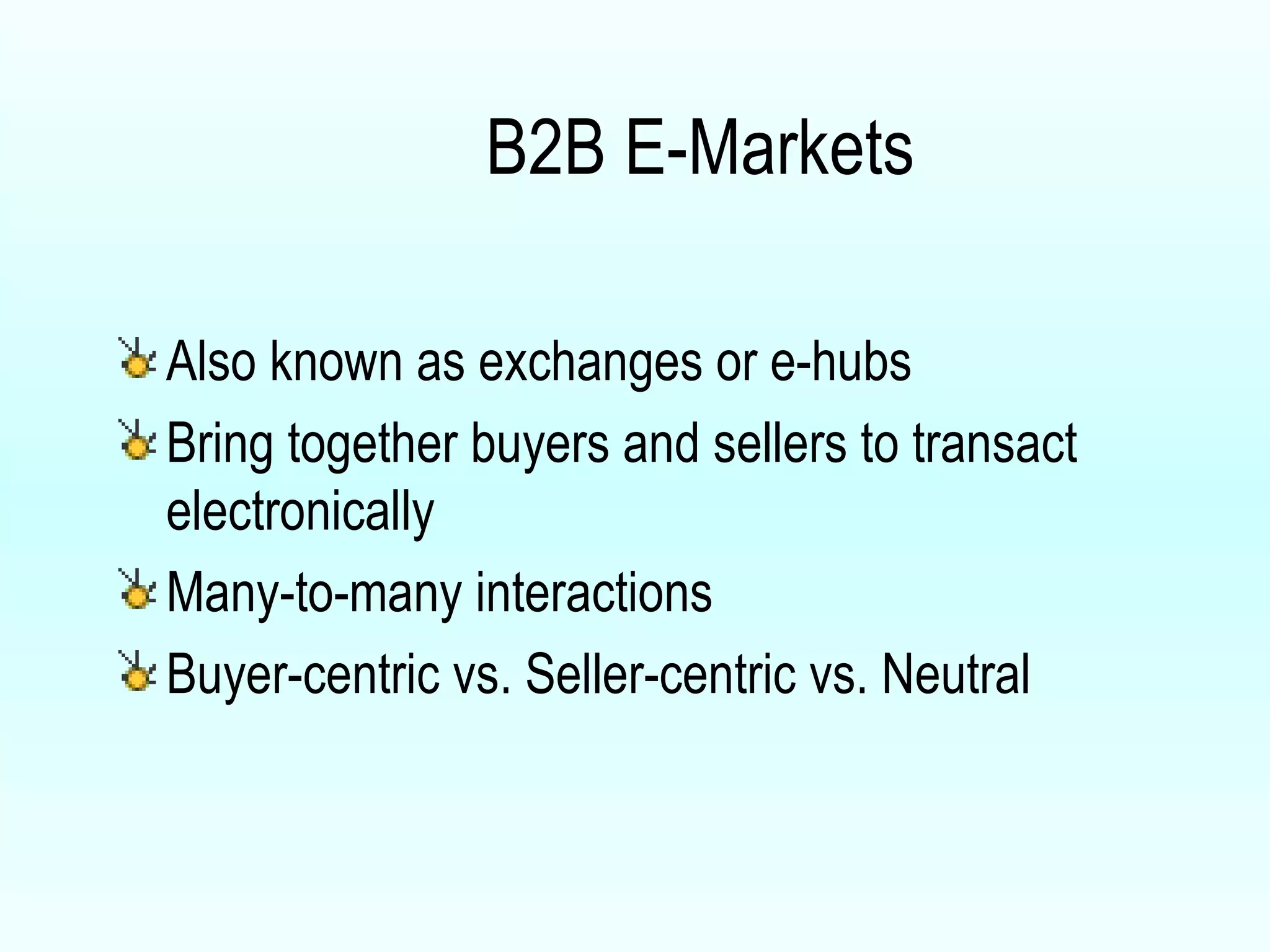
B2B E-Markets Also known as exchanges or e-hubs Bring together buyers and sellers to transact electronically Many-to-many interactions Buyer-centric vs. Seller-centric vs. Neutral
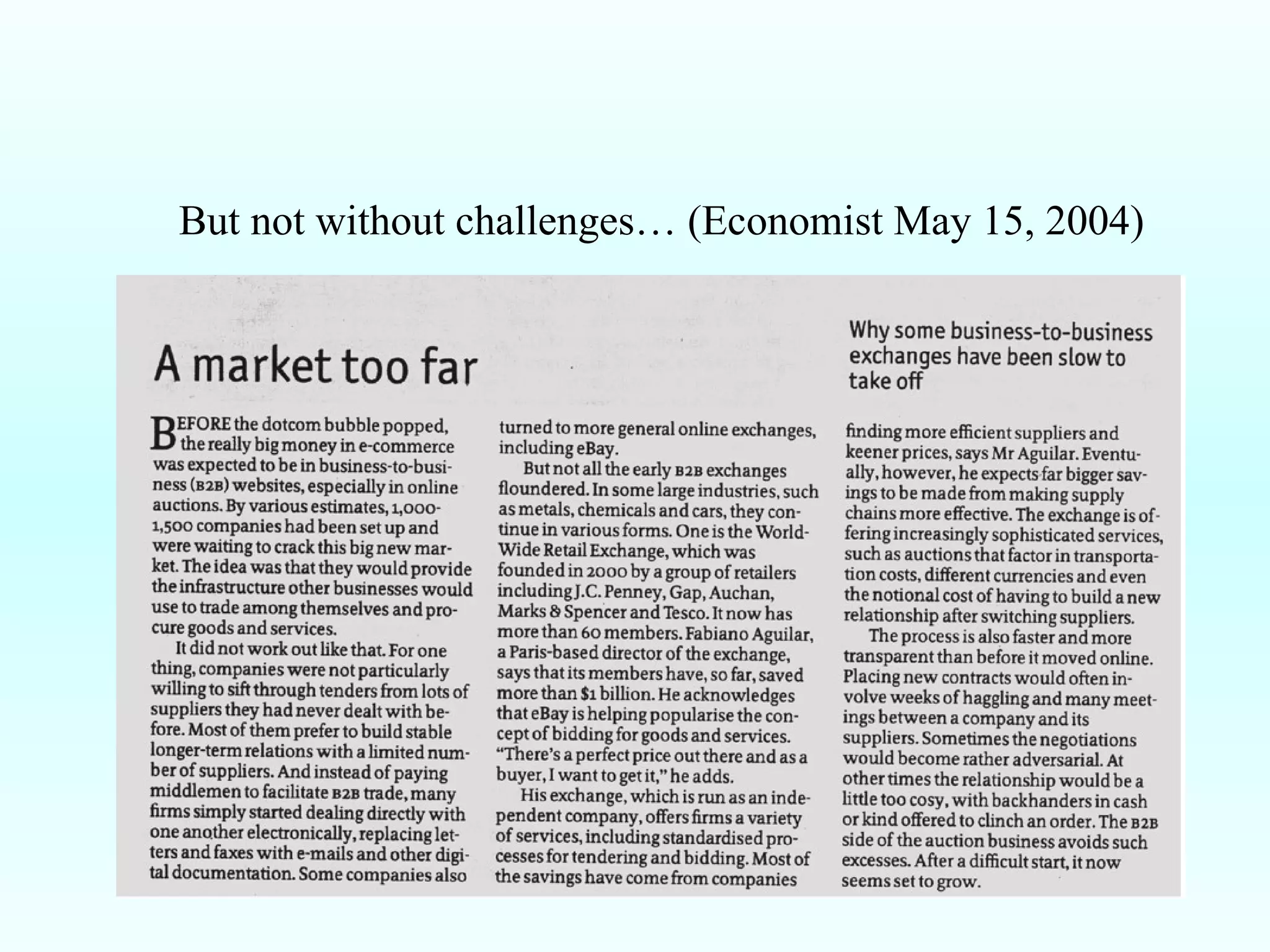
But not without challenges… (Economist May 15, 2004)
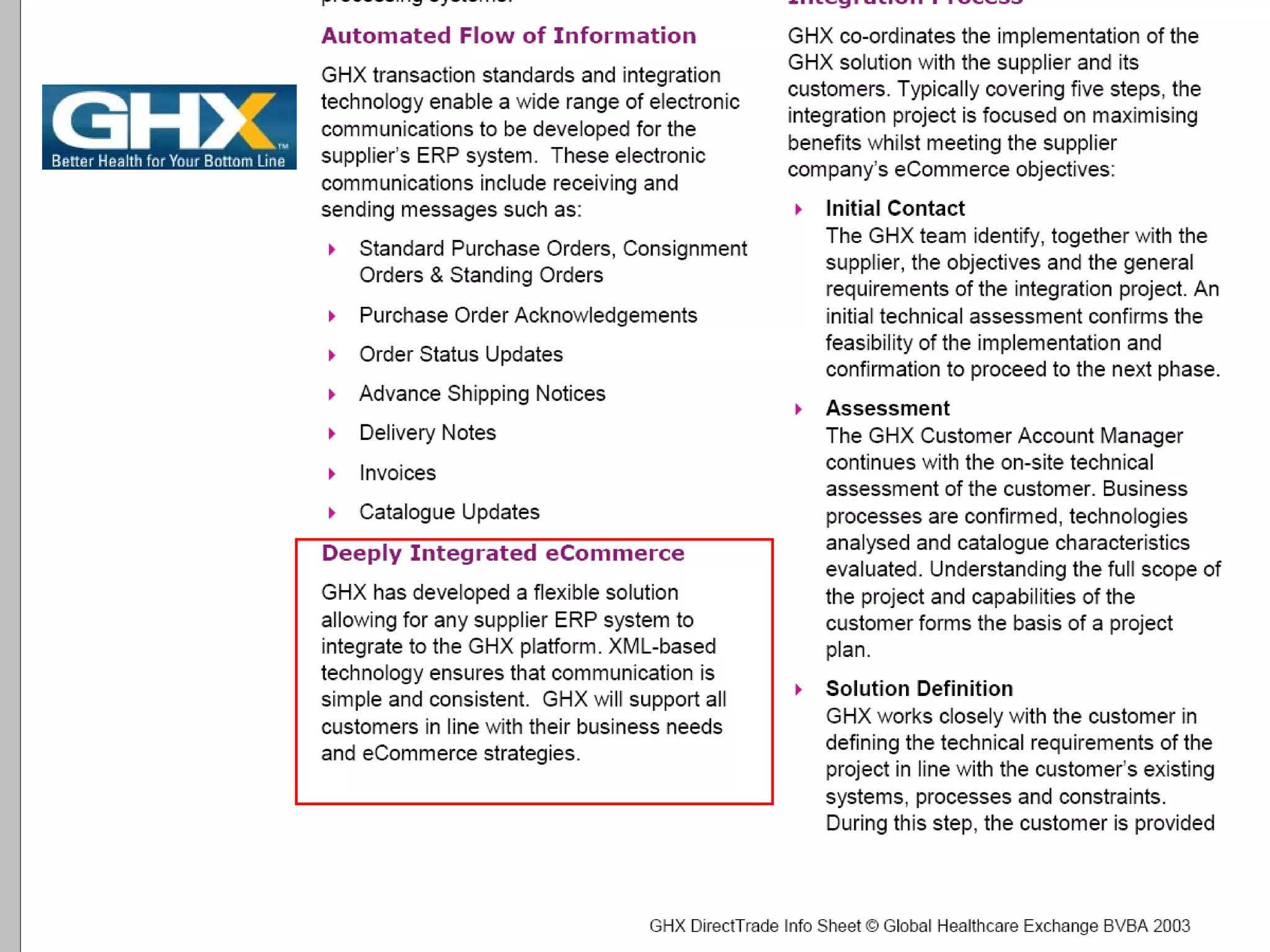
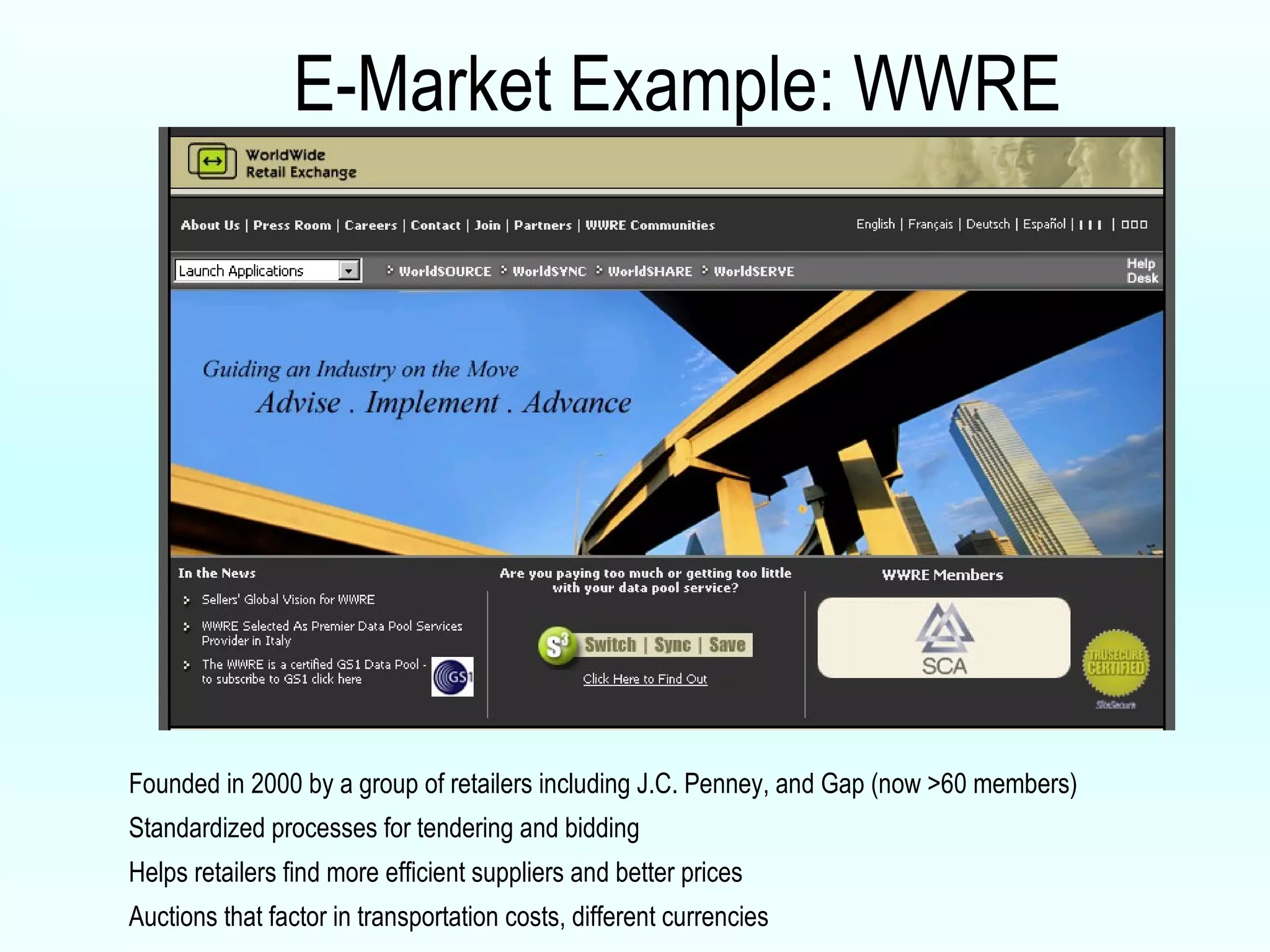
E-Market Example: WWRE Founded in 2000 by a group of retailers including J.C. Penney, and Gap (now >60 members)  Standardized processes for tendering and bidding Helps retailers find more efficient suppliers and better prices Auctions that factor in transportation costs, different currencies
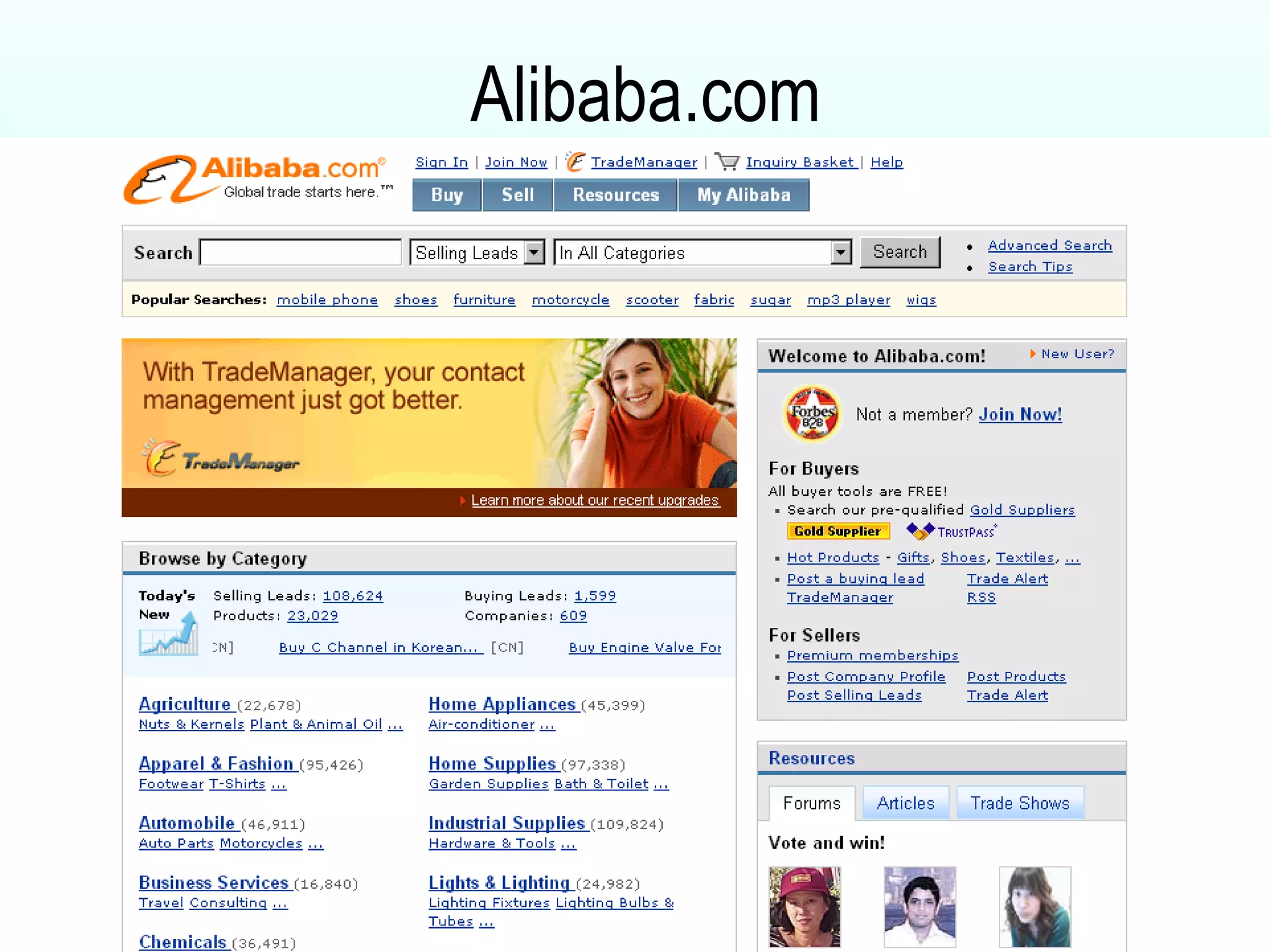
Alibaba.com
 
The Topic of Next Week’s Case
E-Marketplace Resources Good listings of B2B marketplaces at …   http://www.dmoz.org/Business/E-Commerce/Marketplaces/ http://www.alexa.com/browse/general/?&CategoryID=327478&mode=general&Start=1&SortBy=Popularity http://www.bocat.com/
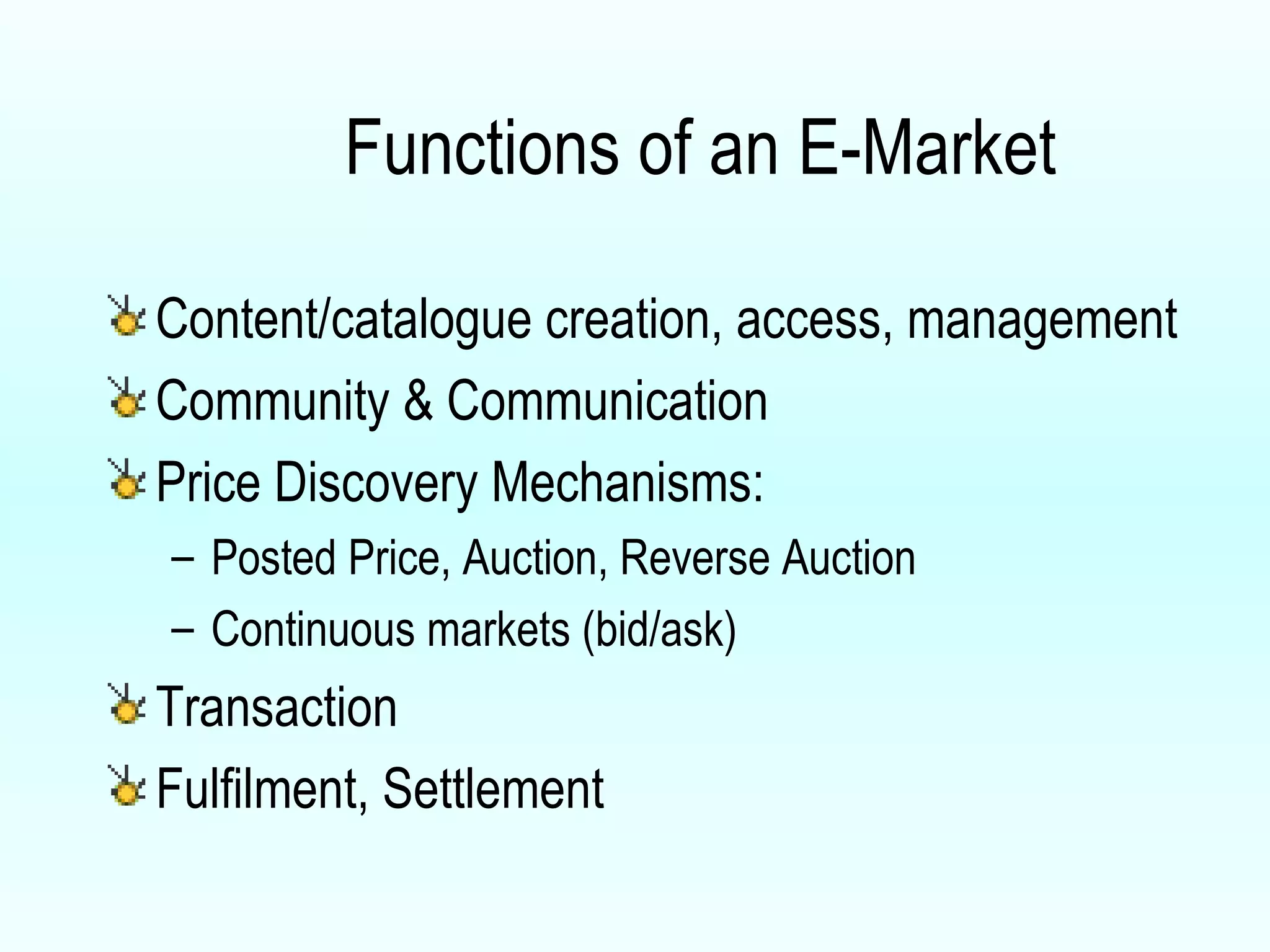
Functions of an E-Market Content/catalogue creation, access, management Community & Communication Price Discovery Mechanisms: Posted Price, Auction, Reverse Auction Continuous markets (bid/ask) Transaction Fulfilment, Settlement
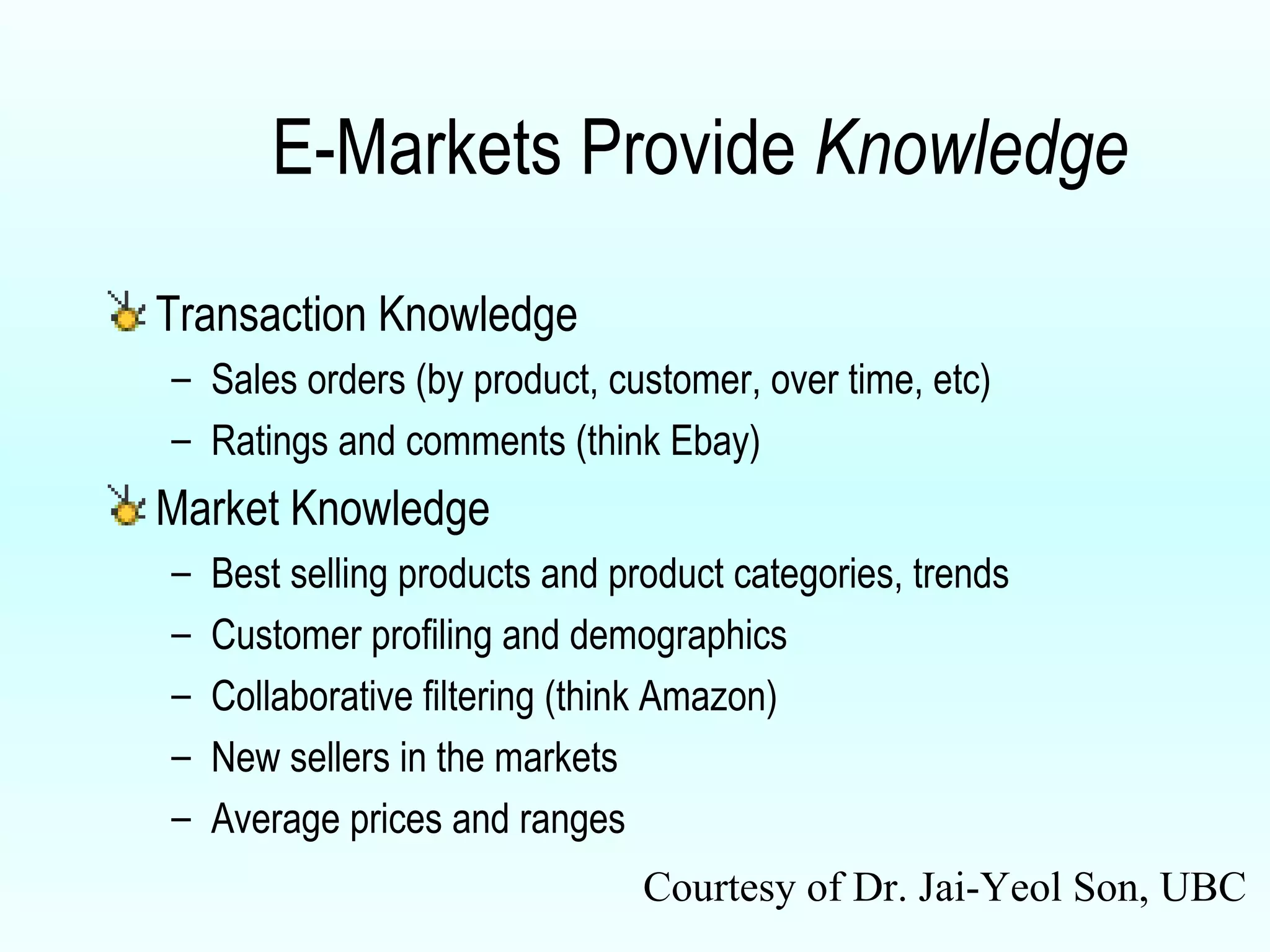
E-Markets Provide  Knowledge Transaction Knowledge Sales orders (by product, customer, over time, etc) Ratings and comments (think Ebay) Market Knowledge Best selling products and product categories, trends Customer profiling and demographics Collaborative filtering (think Amazon) New sellers in the markets Average prices and ranges Courtesy of Dr. Jai-Yeol Son, UBC
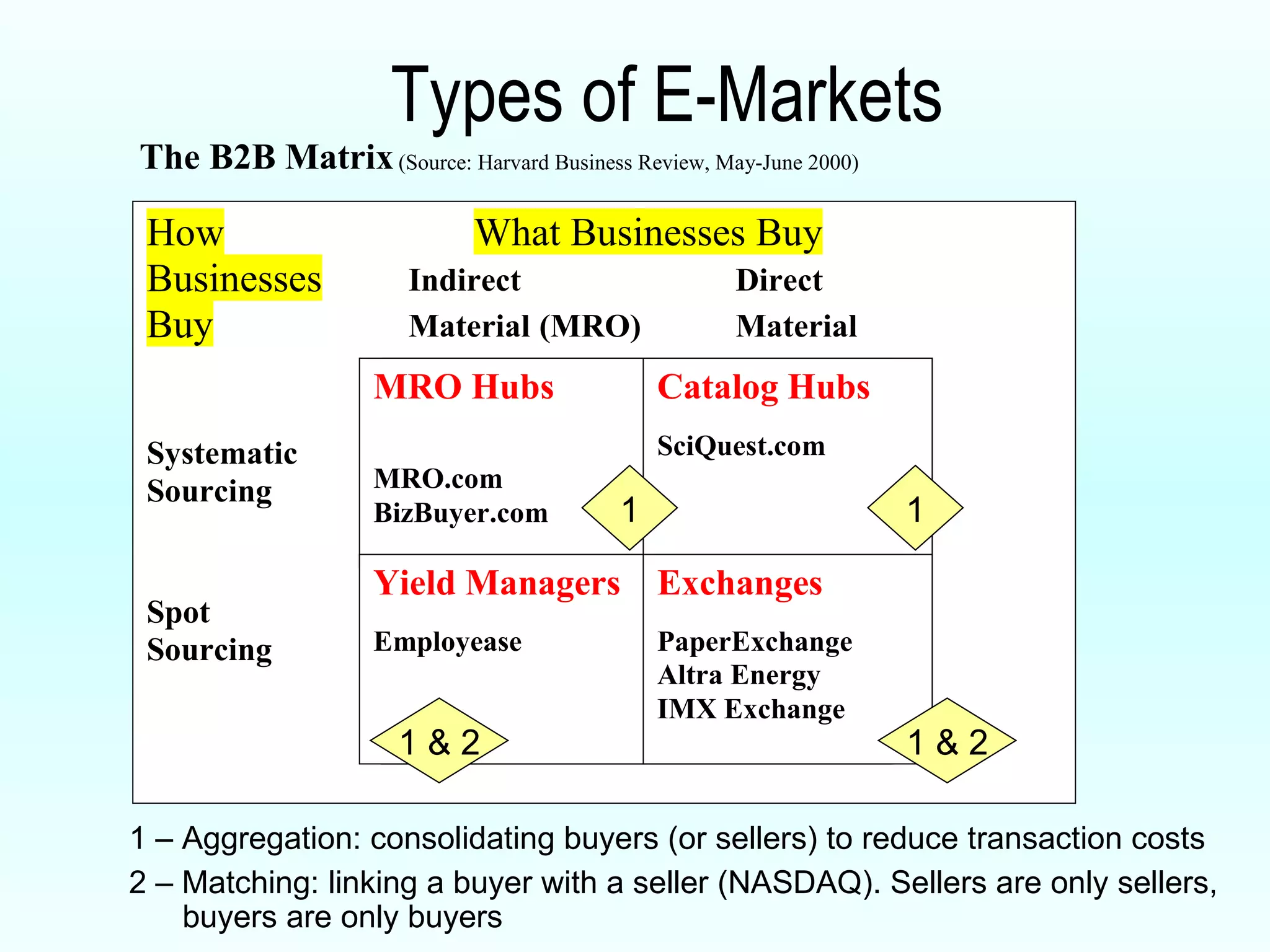
Types of E-Markets 1 – Aggregation: consolidating buyers (or sellers) to reduce transaction costs 2 – Matching: linking a buyer with a seller (NASDAQ). Sellers are only sellers,    buyers are only buyers 1 & 2 1 & 2 1 1
E-Market: Thinking Critically As a seller, why would I want to join an e-market?  How much would I be willing to pay for it? As a buyer, why would I want to join an e-market?  How much would I be willing to pay for it? Why would I want to  own  the e-market? These are good questions to consider for next week’s GHXC business case
E-Markets:  Sellers Motivation for a seller to join an e-market? Access to more customers Or else lose markets to the competition Reduced transaction costs What ’ s the downside? High competition (often based on prices) May shift from a relational to transactional interaction with your buyers Difficult to differentiate products IT infrastructure costs “ The old way works just fine ”
E-Markets:  Buyers Motivation for a buyer to join an e-market? More selection (suppliers and products) Reduced prices Reduced transaction costs What ’ s the downside? Competing for the same resources (no exclusive sources) IT infrastructure costs Dealing with lots of unknown suppliers  Possible preference for stable longer-term relations with a limited number of suppliers.  Added costs: Paying middlemen to facilitate B2B trade More general online exchanges available, including eBay “ The old way works just fine ”
E-Markets:  Market Owners   –   The Market as a Business E-market owned by a  “ neutral ”  third party Value provided by the exchange Aggregation (cut  transaction costs  for both buyers/sellers) Matching buyers and sellers Motivation for a market maker to open an e-market? Commissions Software Support and services See GHXC Case next week!
B2B E-business  –  Major Summary B2B is not new, but the advent of the Internet has made a significant impact Links to many  more  other businesses More consistent  standards Creation of  “ virtual ”  companies that can outsource non-core aspects to others Supply Chain and Supply Chain Management All about  communication  and  visibility Avoiding the  “ bullwhip ”  effect and the dreaded evil of excess inventory
B2B Applications  –  for buyers or sellers Buy Side applications for procurement Sell Side applications for an additional customer channel E-markets as a business in and of itself (infomediary) More on this with GHXC  B2B E-business  –  Major Summary
B2B Markets: what you should take with you To manage the supply chain businesses need to interact with other businesses for buying & selling products and services E-selling: Interacting directly with a buyer (EDI; 1:1) Selling and servicing through a site (1:many) Joining buyer ’ s e-procurement site (many:1) Join e-markets (many:many) E-procurement: Interacting directly with a seller (EDI; 1:1) Open a procurement site (1:many) direct materials indirect materials (MRO)  Joining seller ’ s e-selling site (many:1) Join e-markets (many:many)
B2B Markets: what you should take with you (cont) There are different types of e-markets Based on the type of product (direct vs. indirect) Based on the procurement process (systematic vs. spot) Based on ownership Firms should think strategically about joining an e-market  –  as buyers and as sellers As a business (for intermediaries), e-markets have a big potential, but must overcome some crucial challenges
B2B: The Future B2B e-business has huge potential, but some fundamental challenges still have to be addressed: Business models still fluid Further development of standards to support B2B transactions Security Legal issues: enforceability, international differences, taxation
Questions?  Comments?

B2 B Sc And Emarkets

  • 1.
    Managing E-business: Businessto Business E-business (B2B) Ron Cenfetelli – January 9, 2008 These notes will span both Weeks 1 and 2
  • 2.
    Before we getto B2B … E-business changes business So, let ’ s look at how e-business influences a company ’ s overall strategy .
  • 3.
    Three General StrategiesAccording to Porter (1980) there are three basic strategies for gaining an advantage over competitors … Low cost leadership : faster, cheaper Best for commodities Differentiation : Making your company stand out by offering differences (e.g. really good service) Niche : Finding something no one else is doing
  • 4.
    The Benefits of E-business for Strategy Strategy: Low Cost Leadership Price advantage Disintermediation : pass along savings from one less firm(s) seeking margin in the supply chain Reducing cost: Operations Inbound logistics (more efficient procurement, lower material inventories, defects & errors) Manufacturing (lower WIP inventory) Outbound logistics - distribution of product, service and information (lower product inventory, efficient dispatching) Transaction costs Reduced search costs, online ordering, B2B coordination… Get your customer to do your work for you! Less labour costs for sales & support See &quot;More Clicks in the Bricks“ on WebCT
  • 5.
    The Benefits of E-business for Strategy Strategy: Product/Service Differentiation Improve service: Choice (See “Anatomy of the Long Tail”) Availability (24/7 all over the world) Convenience Responsiveness Transaction speed Better internal processes, logistics, manufacturing, and distribution Improving Quality / Error reduction Service Functionality – the website augments a core offering whether online or offline (See Sat’s VanSun on CBC’s jPod TV series) We’ll revisit during B2C
  • 6.
    The Benefits of E-business for Strategy Strategy: Niche (Market Specialization) Customer Targeting & Segmentation – SEO, Web Analytics Customization Personalization (See Yahoo, Google, Amazon) Product Design (mass customization) All strategies Increase reach (going global) Branding: create presence Create switching costs (lock-in customers) - maybe Improve relations with business partners
  • 7.
    Business Models area Choice The companies in many industries choose to organize around highly similar business models -- with highly similar business results over the long term. E-business and Business models
  • 8.
    E-business Models? E-business offers an opportunity to change the rules of an industry by competing on the basis of new business models or vastly improving old ones. E-business and Business models
  • 9.
    E- Business modelformulation New or revised top line models Auctions (Ebay) A market for everything Prosper.com; dating websites; GHXC Infomediaries Motionbased.com http://www.samba.biz “ Direct” merchants (Dell, Land’s End, Spud.ca) Affiliates ($ for click through’s) Passive income taken to a new level (see http://www.amazon.com/affiliate ) Web 2.0 Social/Community models Facebook, etc. And more… Slaying ogres online
  • 10.
    E- Business modelformulation Bottom line considerations Less brick, less mortar, less people But costs of establishing presence “ One thing important to me as a manager is being able to find ways to get low cost, high potential leads to my website. Search engine advertising, partner engagements (listing - intelligently – our offerings on partner sites) etc ” – Mudit Mittal General Manager at NetCom Information Technology Being too successful Gauging infrastructural needs Mudit Mittal: “ Sudden web success finds us delivering 4 - 5 times the number of events on a weekly basis, than what we were used to. This is also something to watch out for. Not being operationally ready results in dissatisfied customers, who wouldn't want to come back .”
  • 11.
    E- Business modelformulation Bottom line considerations Bandwidth isn’t free! Youtube in mid-2006 was distributing 200TB/day (200,000 gigabytes) At $0.05/GB/Month: $1 million/month
  • 12.
    E- Business modelformulation Caveat: Lower barriers to entry But $, talent and effort still required
  • 13.
    E- Business modelformulation Power law very applicable in the fluid online world “ Rich get richer ” Universal Power Law - “characteristic of winner takes all environments” (Barwise et al 2000) Source: Adamic and Huberman (1999) - “The Nature of Markets in the WWW”. Analysis of 120,000 sites.
  • 14.
  • 15.
    One more diversionbefore B2B Before implementing B2B E-business, a company must have its own house in order B2B solutions are weak at best, impossible at worst, if a company ’ s own internal systems aren ’ t as integrated as possible Let ’ s talk briefly about a company ’ s needed technological infrastructure and systems integration
  • 16.
    Technological Infrastructure &Integration Business IT infrastructure Enterprise Application integration (EAI) Business process flow and EAI Inter-organizational integration (EDI/XML)
  • 17.
    Technological Infrastructure &Integration Business IT infrastructure Enterprise Application integration (EAI) Business process flow and EAI Inter-organizational integration (EDI/XML)
  • 18.
    Business Technological InfrastructureServers for data & application Desktops Network infrastructure Hardware Software
  • 19.
    Business Technological InfrastructureHardware (HW) Software (SW) Business Applications: Databases Application logic Middleware Interface
  • 20.
    Technological Infrastructure &Integration Business IT infrastructure Enterprise Application integration (EAI) Business process flow and EAI Inter-organizational integration & EDI
  • 21.
    Example: Simple IntegrationSharing data between Microsoft Word and Excel Microsoft Excel-Access integration Importing/exporting text files to Excel
  • 22.
    Motivation for EAISay we’re developing an online sales application for the BAIT513 Inc. <product> company: How can we allow our <place> customers to view our <product> inventory? How could customers view the status of their order after they have made the purchase? (Let’s pretend) most of the required information is contained in legacy applications
  • 23.
    Motivation for EAITo answer these questions: What existing applications contain the information customers require? What is involved in integrating the new sales application with the legacy inventory and order tracking applications?
  • 24.
    EAI – Even More Motivation September 14, 200 1
  • 25.
  • 26.
  • 27.
    History of IntegrationTraditionally architectures suffered from a lack of connectivity During the 80s much effort on integrating legacy application with new client-server technology Mostly point-to-point integration Late 80s & 90s: the emergence of a cross-enterprise applications (within a firm) Middleware, wrappers, and EAI Cross-organizational integration through EDI (across firms) 90s: new internet technology & enhanced customer requirements raised the need to integrate customer-facing applications with back-office applications Today: legacy systems, standalone departmental systems, enterprise applications, and internet-based systems all need to talk to each other, and many still do not!
  • 28.
    The Evolution ofBusiness IT Departmental applications (e.g. manufacturing) PC in the business: automation of a specific task; one user; simple interface Transaction based systems: one centralized application; dumb terminals; many users; simple interface Resource sharing Networks and client/server applications: automation of a business process; many users; graphic interface Business wide applications: (e.g. ERP) Internet technology Integration with suppliers, distributors,customers, and business partners (e.g. SCM, CRM)
  • 29.
    Challenges Why arelarge IT projects that require application integration so challenging? What additional difficulties (beyond the standard challenges of IT development) are associated with application integration?
  • 30.
    Application Integration: Intra-Organizational Technological issues: Data integration Syntactic interoperability (LASTNAME  NAME) Semantic interoperability (Same words, different meanings; different words, same meaning) Platform disparity (e.g. Mac, Wintel, Linux…) Complexity of systems and constant flux Process issues (exception handling): What if only part of the order can be filled? What if a customer wants a special option?
  • 31.
    Application Integration: Intra-Organizational Organizational issues Senior management buy-in and commitment The “ E-Logistics ” system at Otis Elevator was a good example of this (way back in the Core days) Difficulties with deployment of integration Support for, or resistance against, change
  • 32.
    Data Integration Challenges& Solutions Challenges: Integration within software platforms Integration across software platforms Integration across hardware platforms Solutions: Strive to use fewer SW & HW platforms The beauty of the browser Wrappers and middleware Cross-functional “ turn key ” applications (e.g., ERP, CRM) The above is what Enterprise Application Integration (EAI) is all about! The unrestricted sharing of data and business processes throughout the networked applications or data sources in an organization
  • 33.
    EAI in perspective“ Implementing EAI boils down to moving information between applications. ” John Mann “ Workflow and EAI ” “… a response to decades of creating distributed monolithic, single-purpose applications leveraging a hodgepodge of platforms and development approaches. EAI represents the solution to a problem that has existed since applications first moved from central processors. Put briefly, EAI is the unrestricted sharing of data and business processes among any connected applications and data sources in the enterprise. ” David S. Linthicum
  • 34.
    Wrappers, Middleware &Enterprise Application Integration (EAI) Wrappers Interface legacy systems with newly developed applications by providing access to legacy systems Support a host of abstract services irrespective of the complexity of internal representations of the legacy systems Challenge: identifying the right set of services Middleware Allow an application to operate with other software without requiring to understand and code the low-level operations Challenge: might need several, can be expensive Enterprise Application Integration (EAI) the unrestricted sharing of data and business processes throughout the networked applications or data sources in an organization
  • 35.
    Putting Them Togethermiddleware legacy wrapper accounting system application system 1 application system 2 Enterprise Application Integration
  • 36.
    EAI in perspective“ The reality is that integrating with legacy apps effectively and efficiently is the challenge with any new class of application. What I am implementing now for an enormous auto-supplier is a web-based financial budgeting and reporting tool. It is only as good as the data we can pull from the legacy apps. You know the old saying &quot;Garbage In, Garbage Out&quot;. Joshua Dennis - Deloitte
  • 37.
    EAI in perspectivehttp://news.zdnet.com/2424-9595_22-181807.html “ The demand for software that integrates data with applications is expanding at a rapid pace. Industry analyst IDC expects the worldwide market for data integration and access software to grow to $2.9 billion by 2011 . But packaged integration software is used to meet only a small portion of the overall need. Most integration projects today are still done with custom code. ” “ In 2008, … an unprecedented pace in the creation and evolution of applications with greater agility. … it will be necessary to efficiently move data into and out of multiple and disparate data stores. … you can expect data integration to be a top priority for many developers in 2008 . ” Business Intelligence (BI) applications absolutely require EAI 3JAN08
  • 38.
    Levels of IntegrationBatch – when there isn ’ t a need for real-time integration: Accumulating data for analysis and reporting Off-line application integration Real-time – when people or systems require the most updated information E.g., customer inquiring about the status of an urgent delivery
  • 39.
    Technological Infrastructure &Integration Business IT infrastructure Enterprise Application integration (EAI) Business process flow and EAI Inter-organizational integration & EDI
  • 40.
    Business Process Flowand Integration See “Workflow and EAI” Bottom line: when crafting your EAI strategy, you won’t just be integrating technology, you’ll be integrating processes (people, material, etc.) legacy wrapper decision support system worker accounting system
  • 41.
    Technological Infrastructure &Integration Business IT infrastructure Enterprise Application integration (EAI) Business process flow and EAI Inter-organizational integration & EDI (now we ’ re talking B2B!)
  • 42.
    Integrating Applications – Across Orgs Early attempts include innovations such as electronic transfer of funds (EFT) But limited to large corporations and a few daring small businesses Electronic Data Interchange (EDI) added other kinds of transaction processing beyond funds transfer and extended the types of companies who could participate
  • 43.
    Direct exchange ofstandardized business transaction “ documents ” 2 or more organizations independent application systems created by the parties sharing independent standards (formatting rules) again created by the parties sharing dedicated connections EDI : Electronic Data Interchange Invented in the 70 ’ s
  • 44.
    EDI Information FlowsTransportation Carrier Buyer Supplier Supplier’s Bank Buyer’s Bank 1 Purchase Order 7 Invoice 3 EFT, Payment Remittance Notice 2 Payment Authorization 4 Remittance advice 5 Bill of Leading 6 Shipping notice
  • 45.
    EDI Standards SamplePayment Transaction Set CONTENTS: Company A is paying Company B’s bank account (# 98765432) the sum of US $59,400 for three invoices in the amounts of $10K, $20K, and $30K; each invoice amount is discounted by 1 percent. ANSI X12 820, version 003.020 ST*820*0101 BPR*C*59400*C*SWT********02*BANKXX*DA*98765432 TRN*1*0101 DTM*007*0920515 ENT**0101 N1*PR*COMPANY A N1 *PE*COMPANY B RMR*IV*101*PO*9900*10000*100 RMR*IV*102*PO*19800*20000 RMR*IV*103*PO*29700*30000*300 SE*11*0101
  • 46.
    From EDI toXML Along comes the Internet HTML: Hypertext Markup Language (~1990) The founding language of Internet communication XML: eXtensible Mark-up Language Developed in the 90 ’ s Same underlying technology as HTML
  • 47.
    From EDI toXML A specification developed especially for Web documents. It allows designers to create their own customized tags , enabling the definition, transmission, validation, and interpretation of data between applications and between organizations. www.wmo.ch/web/www/WDM/Guides/Internet-glossary.html
  • 48.
    XML example <?xmlversion=&quot;1.0&quot;?> <!DOCTYPE PARTS SYSTEM &quot;parts.dtd&quot;> <?xml-stylesheet type=&quot;text/css&quot; href=&quot;xmlpartsstyle.css&quot;?> <PARTS> <TITLE>Computer Parts</TITLE> <PART> <ITEM>Video Card</ITEM> <MANUFACTURER>ATI</MANUFACTURER> <MODEL>All-in-Wonder Pro</MODEL> <COST> 160.00</COST> </PART>
  • 49.
    From EDI toXML Benefits of moving to XML More human readable and common sense Price can be noted as <price>19.99 </price> Web servers rather than dedicated EDI server Cheap ubiquitous Internet vs. expensive private 1:1 networks EDI is typically 1:1, XML is M:M One standard for many buyers/suppliers Platform/System independent Common language for business transactions XML is a major tool to achieve EAI within an organization! XML is becoming the backbone of many online applications (e.g., Google Earth) and protocols (e.g. RSS, AJAX)
  • 50.
  • 51.
  • 52.
    EDI: Why shouldI care? EDI is still an important technology: 95% of Fortune 1000 still use EDI Most transactions still done via EDI Lessons from the EDI past, about the future Illustrates the importance of communications standards for B2B E-business Demonstrates that adoption of B2B is NOT just a technology issue
  • 53.
    Technological Infrastructure &Integration Summary Rarely do IT applications stand unconnected For e-business, this isn ’ t even an option The e-business challenge is trying to keep the old linked with the new To develop new e-business applications we need to understand: the business process and workflows involved What information is required, and what other applications contain that data
  • 54.
    Technological Infrastructure &Integration Summary You are no longer just developing systems for internal use. Multiple stakeholders (customers, suppliers, etc.) Integration with other applications poses major technological and organizational challenges
  • 55.
    Business to BusinessE-business: Supply Chain Management, Buy/Sell Applications and e-Markets
  • 56.
    B2B E-Business B2Binteractions include: Selling (to other firms) B2B is different from B2C Buying (from other firms) Internet technology can support both types of interactions
  • 57.
    B2B Supply ChainManagement (SCM) and B2B B2B Applications: Buy Side Sell Side Exchanges or e-markets
  • 58.
    B2B Supply ChainManagement (SCM) and B2B B2B Applications: Buy Side Sell Side Exchanges
  • 59.
    SCM and B2B- Outline Supply Chain (SC) Supply Chain Management (SCM) From SCM to B2B B2B IT
  • 60.
    SCM & B2BBefore understanding B2B & SCM, let ’ s review what the supply chain is: The supply chain is a series of links and shared processes that exist between suppliers and customers. Link and processes – all activities from the acquisition of raw materials to the delivery of finished goods to the the end consumer. “ Supply Chain Management Primer,” www.clarkstongroup.com
  • 61.
    Supply Chain – More Definitions The facilities for acquisition, distribution, storage and movement of raw materials, intermediate products, non-production physical resources, and finished goods. The supply chain encompasses all activities associated with the flow and transformation of goods from the raw materials stage, through to the end user as well as the associated information flows. Supply chain management is the integration of these activities through improved supply chain relationships, to achieve a competitive advantage. Robert B. Hanfield, Introduction to Supply Chain Management, Prentice Hall
  • 62.
    The Supply ChainRaw Materials Refine / Prepare Produce Transport Distribute Retail Customer Dr. James R. Holt, PE (WSU)
  • 63.
    Individual Member ofChain Independent Business Component Process Supplier Client Transactions Transactions Purchase Receive Check Pay Internal Processing Sell Deliver Invoice Collect Profit=Sales-Purchase-Inventory Cost-Overhead Dr. James R. Holt, PE (WSU)
  • 64.
    Supply Chain DiagramDirect Materials Lumbar Company Wood Mills Finished Wood Wholesaler #1 Furniture Maker Furniture wholesaler Furniture store End Customers Finished Wood Wholesaler #3 Finished Wood Wholesaler #2
  • 65.
    Supply Chain DiagramMaintenance, Repair and Operational Nails, glue, paperclips… Lumbar Company Wood Mills Finished Wood Wholesaler #1 Furniture Maker Furniture wholesaler Furniture store End Customers Finished Wood Wholesaler #3 Finished Wood Wholesaler #2 Woodworking Tools Manufacturer Woodworking Tools Wholesaler
  • 66.
    Supply Chain LumbarCompany Wood Mills Finished Wood Wholesaler #1 Furniture Maker Furniture wholesaler Furniture store End Customers Finished Wood Wholesaler #3 Finished Wood Wholesaler #2
  • 67.
    Supply Chain: Focuson One Firm Lumbar Company Wood Mills Finished Wood Wholesaler #1 Furniture Maker Furniture wholesaler Furniture store End Customers Finished Wood Wholesaler #3 Finished Wood Wholesaler #2
  • 68.
    B2B Applications – The Value Chain Lumbar Company Wood Mills Finished Wood Wholesaler #1 Furniture Maker Furniture wholesaler Furniture store End Customers Finished Wood Wholesaler #3 Finished Wood Wholesaler #2 Administrative Coordination & Support Services Human Resource Management Technology Development Procurement of Resources Inbound Logistics Operations Outbound Logistics Marketing and Sales Customer Service
  • 69.
    Flows in theSupply Chain Information Money $$$ Materials and goods Manufacturer Assembler Distributor Raw materials supplier Seller End Customer Execution Planning
  • 70.
    Supply Chain Management(SCM) - Components In SCM, processes that are optimized include: Planning - Production Planning Supply Planning Demand Planning Execution - Inbound logistics Manufacturing Outbound logistics
  • 71.
    Short & LongDuration Chains Dairy Cows Creamery Deliver Retail Customer Farmer Cannery Wholesale Retail Customer Dr. James R. Holt, PE (WSU)
  • 72.
    Complex Combinations BrakesTires Bumpers Upholstery Engine Transmission Manuf. Car Car Lot Car Lot Car Lot Dr. James R. Holt, PE (WSU)
  • 73.
    Dedicated Supply ChainMine Smelter Rolling Mill Product Steel Sales Independent Business Unit Independent Business Unit Independent Business Unit Single Firm - Totally Owned Industry - Sole Source Transfer Prices Fixed by Policy Dr. James R. Holt, PE (WSU) Single company
  • 74.
    Competitive Link OpportunityOil Well Refinery Chemical Plant Cloth Mill Dress Factory Customer Oil Well Refinery Chemical Plant Cloth Mill Dress Factory Customer Oil Well Refinery Chemical Plant Cloth Mill Dress Factory Customer Transfer Prices at Market Prices Dr. James R. Holt, PE (WSU)
  • 75.
    Managing the SCMRP System Design Specifications (click here) Managing the SC is a full time job for a big chunk of a company’s staff.
  • 76.
    SC and Inventory SC ’ s operate heavily around inventory Inventory is the “ currency ” of a SC Inventory = goods that are either available for sale or in the process of being converted from raw materials into saleable goods Inventory is a necessary evil It ’ s a useful buffer for service, production, etc. But inventory entails lots of costs …
  • 77.
    Inventory Categories BufferInventory and Safety Stock Prevents backorders, ticked off customers, lost sales, underutilized/stagnated processes Production Smoothing Inventory To reduce changeovers, etc. Cycle Inventory Result of order or lot size Pipeline Inventory Work in Process
  • 78.
    Types of InventoryCosts Many are not easy to quantify Holding (or carrying) costs Warehouse, taxes, insurance … Ordering (per order) costs Shortage/Stock Out costs Maintenance costs Cycle counts, loss, “ shrinkage ” Transportation costs lead time, ordering, shipping
  • 79.
    Some key Non-CostInventory Policy Drivers Average Demand & Variation How much will the customer order in the future Average Lead time & Variation How long will it take to get it to the customer Service Level Mandate How forgiving is the customer of backorders Supplier Ordering Constraints Can the supplier meet my needs
  • 80.
    The “Butterfly Effect”of Inventory (usually referred to as “bullwhip”, etc. ala “beer game”) Describes how small perturbations in demand are amplified as orders pass up the supply chain through distributors, manufacturers, and suppliers. Causes: Inaccurate forecasts, order batching, shipping rates, price speculation, poorly managed promotional campaigns Consequences: Channel inefficiencies through stock-outs or excess inventory, higher costs, delivery delays, customer dissatisfaction, etc. The Real Root Cause: All of this chaos is a direct result of a lack of information and knowledge on the part of one party in the SC regarding other parties up/down stream in the chain. If all parties in the SC knew exactly what was going on in all other parts of the SC, inventory could be greatly reduced or even eliminated
  • 81.
    The big attraction An Internet-based supply chain lets companies monitor all parts of the chain simultaneously -- instead of having to collect information from one link and then pass it to the next, and then the next, like a giant game of “ ghost ” . The goal To react more quickly to changing markets and make fewer mistakes in the process. SCM – the Role of E-business
  • 82.
    SCM – the Role of E-business Use information to Reduce uncertainties Create visibility of entire supply chain Enforce supplier compliance Requires: Fast, real-time information flow to all links Inter-enterprise coordination (between companies) Fast response Flexibility in production Sharing knowledge about production plans Trust: reliable information, reliable fulfillment
  • 83.
    SCM Benefits EfficiencyReduced inventory costs Increased capacity utilization Effectiveness increased customer satisfaction (thus more sales)
  • 84.
    SCM - CriticalIssues Managing relationships with suppliers and customers How tightly should firms be bound together? To what extent can a firm trust its partner? What kind of a commitment can a firm make? How much data to share? Who gets the biggest share of the “ soft $3 ” ? The additional value created though SCM efficiencies
  • 85.
    SCM - ConflictsThe buyer wants: “ Just in time ” but no backorders The exact type, brand, specification $ Cheap! The seller wants: Low finished goods inventory Smoothed production and delivery channel $ Full revenue! Traditionally: maintaining an inventory was the way of de-linking these conflicting objectives
  • 86.
    4 Stages/degrees ofSCM Development Traditional Supply Chain Each company in the chain thinks of itself as an island and there is little info sharing between companies or even within corporation Integrated Supply Chain There is info sharing within business functions of a company, but not between companies Collaborative Supply Chain Broader sharing of info with customers and suppliers. Transparency and collaboration lead to better responsiveness Synchronized Supply Chain Distinguishes itself from collaborative supply chain by even greater dependence. Not just the sharing of information, but synchronizing operations. Boundaries between companies in chain is blurred with greater info sharing, seamless transfer of products and information Krishnamurthy, p192 B2B EDI Medieval
  • 87.
    SCM & B2B – Summary Definitions of Supply Chain (SC), Supply Chain Management, (SCM), Inventory SCM is very complex; IT can help streamline information and integrate business processes Most SC interactions are B2B; interactions in B2B are significantly different from B2C B2B IT: Traditional – EDI Current – internet-based (+benefits)
  • 88.
  • 89.
    B2B Applications: Collaborative Commerce The internet is used for collaboration and cooperation between business partners Information to be shared: Buyer -> Seller Product specifications and drawings (products design collaboration) Purchase forecasts (product planning collaboration) Purchase orders Point-of-sale information Seller -> Buyer: Inventories Production plans and expected delivery dates Shipping notice Production log
  • 90.
    B2B Applications Howcan a firm utilize the internet to interact with other businesses? Seller Side – an added channel to reach your customers Buyer Side – an added channel for your procurement Electronic Markets – where both buyers and sellers meet
  • 91.
    B2B Applications – Seller Side EC Seller Side EC Buyer Side EC Electronic Markets
  • 92.
    Seller Side – 1:1 Interacting directly with one buyer When is this appropriate? One (or few) buyers The buyer is strategic and the tight integration is worthwhile XML and web services are not very different from EDI, except based on internet technology
  • 93.
    Seller Side – 1: Many Selling: Web storefront Integration with buyer ’ s systems Auctions Support & Service Online catalogue Customer service
  • 94.
    Seller -Side Example: CISCO
  • 95.
    Seller-Side 1:Many -Example: CISCO Functionality: Online Ordering— Internet Product Center builds virtually all its products to order Finding Order Status— gives the customers tools to find answers to order status inquiries by themselves Customer Service— Cisco Connection online Includes a web storefront, integration with supplier’s systems and customer service Benefits— saves the company $363 million per year from technical support, human resources, software distribution and marketing material 98% of sales through the internet
  • 96.
    A Local Example: BuildDirect
  • 97.
  • 98.
    Mini Case Study:BuildDirect Founded in 1999 by Jeff Booth and Robert Banks. Located at 1900-570 Granville Street. 38 employees A pure B2B e-business that sells building materials online (yes; big, heavy, pallet-loads of building materials) Estimated 2006 sales: >$60 MM (???)
  • 99.
    Mini Case Study:BuildDirect Building materials (one order may be 5 tons) A typical building materials supply chain: What BD does: Wholesaler Mfg Distributor Retailer Contractor Customer Mfg BD Wholesaler Distributor Retailer Contractor Customer
  • 100.
    Mini Case Study:BuildDirect BD eats it way up the supply chain Sometimes it ’ s a retailer, sometimes a wholesaler Depends on volume In some cases completely moves so far up the chain that it takes over the Mfg ’ s sales channel! The “ Dell ” of building materials Payment up front! (and 30 to 90 days A/P, nice float) No inventory! One source of competitive advantage lies in its proprietary algorithms that manage long, complex, multi-party shipping processes.
  • 101.
    Seller Side B2BEC – Summary Benefits: Increase customer satisfaction Increase sales Reduce selling expenditures & administrative costs Increase delivery speed Outsource work to your customer!
  • 102.
    B2B Applications – Buyer Side Seller side Buyer side Exchange
  • 103.
    Buyer -Side B2BE-Commerce Procurement: How can a firm utilize the internet to buy more efficiently? Purchasing (actual buying related activities – from RFQ to purchase order) Transportation Warehousing Inbound receiving Typically used by powerful , large buyers (e.g. GE, GM, et al)
  • 104.
    B2B Buyer-Side Example: GM http://www.gmsupplypower.com
  • 105.
    Buyer-Side 1:Many -Indirect Materials Example: GM Buying commodity products GM spends over $100 billion annually 200,000 products; 20,000 suppliers Bidding process (tender) Problems with “ legacy ” means of tendering: Duration - weeks or even months Transaction costs to GM and suppliers Solution: reverse auction on GM ’ s site
  • 106.
    Buyer Side B2BEC – Summary 1:1 – internet-based EDI 1:Many Direct material – RFQ Indirect material - auctions Other applications: Many:1 – join supplier ’ s sell-side site Many:Many – join an e-market
  • 107.
    Buyer Side B2BEC – Summary Benefits to e-procurement : Reducing cycle time Reducing procurement cost (increased productivity) Eliminating errors Lowering prices: Product standardization Consolidation of purchases Access to more suppliers
  • 108.
    B2B Applications -Summary Seller Side EC Buyer Side EC Electronic Markets
  • 109.
    B2B Applications SellSide: Interacting directly with a buyer (EDI; 1:1) Selling and servicing through a site (1:many) Joining buyer ’ s e-procurement site (many:1) Join e-markets (many:many) Buy Side: Interacting directly with a seller (EDI; 1:1) Open a procurement site (1:many) direct materials indirect materials (MRO) Joining seller ’ s e-selling site (many:1) Join e-markets (many:many)
  • 110.
    B2B E-Markets Alsoknown as exchanges or e-hubs Bring together buyers and sellers to transact electronically Many-to-many interactions Buyer-centric vs. Seller-centric vs. Neutral
  • 111.
    But not withoutchallenges… (Economist May 15, 2004)
  • 112.
    E-Market Example: WWREFounded in 2000 by a group of retailers including J.C. Penney, and Gap (now >60 members) Standardized processes for tendering and bidding Helps retailers find more efficient suppliers and better prices Auctions that factor in transportation costs, different currencies
  • 113.
  • 114.
  • 115.
    The Topic ofNext Week’s Case
  • 116.
    E-Marketplace Resources Goodlistings of B2B marketplaces at … http://www.dmoz.org/Business/E-Commerce/Marketplaces/ http://www.alexa.com/browse/general/?&CategoryID=327478&mode=general&Start=1&SortBy=Popularity http://www.bocat.com/
  • 117.
    Functions of anE-Market Content/catalogue creation, access, management Community & Communication Price Discovery Mechanisms: Posted Price, Auction, Reverse Auction Continuous markets (bid/ask) Transaction Fulfilment, Settlement
  • 118.
    E-Markets Provide Knowledge Transaction Knowledge Sales orders (by product, customer, over time, etc) Ratings and comments (think Ebay) Market Knowledge Best selling products and product categories, trends Customer profiling and demographics Collaborative filtering (think Amazon) New sellers in the markets Average prices and ranges Courtesy of Dr. Jai-Yeol Son, UBC
  • 119.
    Types of E-Markets1 – Aggregation: consolidating buyers (or sellers) to reduce transaction costs 2 – Matching: linking a buyer with a seller (NASDAQ). Sellers are only sellers, buyers are only buyers 1 & 2 1 & 2 1 1
  • 120.
    E-Market: Thinking CriticallyAs a seller, why would I want to join an e-market? How much would I be willing to pay for it? As a buyer, why would I want to join an e-market? How much would I be willing to pay for it? Why would I want to own the e-market? These are good questions to consider for next week’s GHXC business case
  • 121.
    E-Markets: SellersMotivation for a seller to join an e-market? Access to more customers Or else lose markets to the competition Reduced transaction costs What ’ s the downside? High competition (often based on prices) May shift from a relational to transactional interaction with your buyers Difficult to differentiate products IT infrastructure costs “ The old way works just fine ”
  • 122.
    E-Markets: BuyersMotivation for a buyer to join an e-market? More selection (suppliers and products) Reduced prices Reduced transaction costs What ’ s the downside? Competing for the same resources (no exclusive sources) IT infrastructure costs Dealing with lots of unknown suppliers Possible preference for stable longer-term relations with a limited number of suppliers. Added costs: Paying middlemen to facilitate B2B trade More general online exchanges available, including eBay “ The old way works just fine ”
  • 123.
    E-Markets: MarketOwners – The Market as a Business E-market owned by a “ neutral ” third party Value provided by the exchange Aggregation (cut transaction costs for both buyers/sellers) Matching buyers and sellers Motivation for a market maker to open an e-market? Commissions Software Support and services See GHXC Case next week!
  • 124.
    B2B E-business – Major Summary B2B is not new, but the advent of the Internet has made a significant impact Links to many more other businesses More consistent standards Creation of “ virtual ” companies that can outsource non-core aspects to others Supply Chain and Supply Chain Management All about communication and visibility Avoiding the “ bullwhip ” effect and the dreaded evil of excess inventory
  • 125.
    B2B Applications – for buyers or sellers Buy Side applications for procurement Sell Side applications for an additional customer channel E-markets as a business in and of itself (infomediary) More on this with GHXC B2B E-business – Major Summary
  • 126.
    B2B Markets: whatyou should take with you To manage the supply chain businesses need to interact with other businesses for buying & selling products and services E-selling: Interacting directly with a buyer (EDI; 1:1) Selling and servicing through a site (1:many) Joining buyer ’ s e-procurement site (many:1) Join e-markets (many:many) E-procurement: Interacting directly with a seller (EDI; 1:1) Open a procurement site (1:many) direct materials indirect materials (MRO) Joining seller ’ s e-selling site (many:1) Join e-markets (many:many)
  • 127.
    B2B Markets: whatyou should take with you (cont) There are different types of e-markets Based on the type of product (direct vs. indirect) Based on the procurement process (systematic vs. spot) Based on ownership Firms should think strategically about joining an e-market – as buyers and as sellers As a business (for intermediaries), e-markets have a big potential, but must overcome some crucial challenges
  • 128.
    B2B: The FutureB2B e-business has huge potential, but some fundamental challenges still have to be addressed: Business models still fluid Further development of standards to support B2B transactions Security Legal issues: enforceability, international differences, taxation
  • 129.

Editor's Notes