E-Business and E-Commerce
Definition: Electronic Business
(U.S. Census Bureau)
 An process that an organization conducts
over a computer-mediated network
• Production – procurement, ordering, stock
replenishment, payment processing, production
control, etc.
• Customer-focused – marketing, selling,
customer order processing, etc.
• Internal or management-focused – employee
service, training, recruiting, information sharing,
etc.
Definition: Electronic Commerce
 Any transaction completed over a
computer-mediated network that involves
the transfer of ownership or rights to use
goods or services.
 Completed transactions may have a zero
price.
Definition: Electronic-
Business Infrastructure
 The share of total economic infrastructure
used to support e-business processes and
conduct e-commerce transactions.
• Hardware
• Software
• Telecommunication networks
• Support services
• Human resources
Definition: Computer-
Mediated Networks
 Electronically-linked devices that
communicate interactively over network
channels.
• Computers, personal digital assistants, web TV
• Internet-enabled cellular phones, interactive
telephone systems
• Internet, intranets, extranets, telecommunication
networks, EDI
New Business Rules from
E-Business
 Customers determine everything.
 Knowledge and information become more
valuable than physical assets.
 People want more choices of products and
services.
 Time is present time, distance is zero.
 Technology and network determine how the
business is conducted.
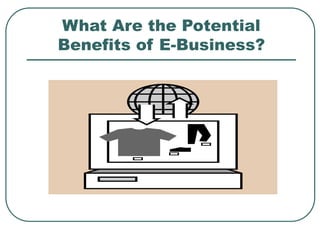
What Are the Potential
Benefits of E-Business?
Potential Benefits of E-Business
 More product/service selections
 Higher Productivity
 Improved accessibility and convenience
 Better availability of information
 Shorter lead time
 Improved communication
 Stronger competitive position
Examples of E-Business
Applications?
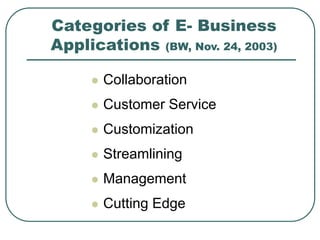
Categories of E- Business
Applications (BW, Nov. 24, 2003)
 Collaboration
 Customer Service
 Customization
 Streamlining
 Management
 Cutting Edge
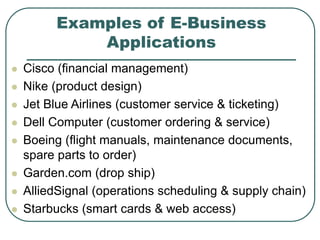
Examples of E-Business
Applications
 Cisco (financial management)
 Nike (product design)
 Jet Blue Airlines (customer service & ticketing)
 Dell Computer (customer ordering & service)
 Boeing (flight manuals, maintenance documents,
spare parts to order)
 Garden.com (drop ship)
 AlliedSignal (operations scheduling & supply chain)
 Starbucks (smart cards & web access)
How Can An Automobile
Manufacturer Apply E-Business?
How Can An Automobile
Manufacturer Apply E-Business?
 Sales
 Customer Service
 Supplier management
 Marketing
 Product Design
 Financing
 Employees Training
The Internet’s Influence on
Industry Structure – Michael Porter
 Bargaining power of supplier
 Bargaining power of buyers
 Rivalry among existing competitors
 Barriers to entry
 Threat of substitute products or services
Launching E-Business
Initiatives
 Define what an e-business initiative means
for the organization.
 Ask key questions to develop a strategy.
 Communicate the plan to executives and
employees extensively.
 Prepare for mistakes and develop effective
recovery systems.
Types of E-Commerce
 Customer-to-Customer (C2C)
 Business-to-Customer (B2C)
 Business-to-Business (C2C
 Government-to-Business (G2B)
 Government-to-Citizens (G2C)
Examples of E-Commerce?
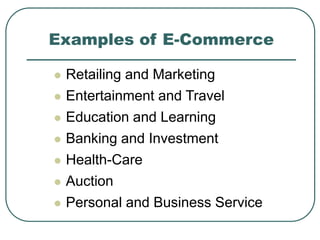
Examples of E-Commerce
 Retailing and Marketing
 Entertainment and Travel
 Education and Learning
 Banking and Investment
 Health-Care
 Auction
 Personal and Business Service
Who Are Potential E-Commerce
Supply Chain Members?
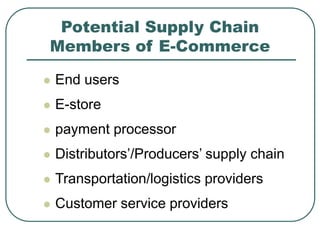
Potential Supply Chain
Members of E-Commerce
 End users
 E-store
 payment processor
 Distributors’/Producers’ supply chain
 Transportation/logistics providers
 Customer service providers
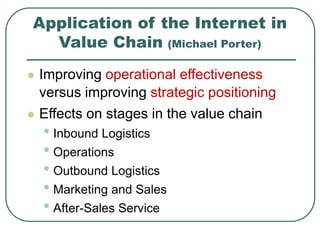
Application of the Internet in
Value Chain (Michael Porter)
 Improving operational effectiveness
versus improving strategic positioning
 Effects on stages in the value chain
• Inbound Logistics
• Operations
• Outbound Logistics
• Marketing and Sales
• After-Sales Service
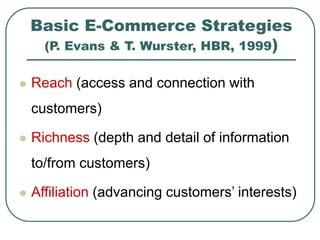
Basic E-Commerce Strategies
(P. Evans & T. Wurster, HBR, 1999)
 Reach (access and connection with
customers)
 Richness (depth and detail of information
to/from customers)
 Affiliation (advancing customers’ interests)
Key Business Drivers of
E-Commerce
 Internet
 Information
 Collaboration
 Agility
 Speed
 Service
Competitive Advantages of
E-Commerce
 Offers personalized products/services
 Enables customer self-service
 Reduces lead time
 Reduces overall cost for seller and customers
 Improves utilization of resources throughout
the supply chain
 Increases customer satisfaction and loyalty
 Expands to global marketplace
What Could Be the Tasks
Performed by Customers?
Tasks Performed by Customers
 Browse catalogs
 Conduct research on products/services
 Configure and place orders
 Look up pricing
 Look up lead time and order status
 Access invoicing information
 Access customer service information
B2C E-commerce
Implementation Strategies
 Educate the customer
 Make the shopping fun
 Serve customers well
 Personalize the sales pitch
 Cross sell and up sell
 Low price
 Painless returns
Ways to Improve E-Commerce
Operations
 Technology (hardware and software)
 Business Process Reengineering
 Agile production (mass customization)
 Just-in-time system
 Supply chain management
 Business intelligence
 Customer relationship management

e-business and e-commerce (1).ppt

  • 1.
  • 2.
    Definition: Electronic Business (U.S.Census Bureau)  An process that an organization conducts over a computer-mediated network • Production – procurement, ordering, stock replenishment, payment processing, production control, etc. • Customer-focused – marketing, selling, customer order processing, etc. • Internal or management-focused – employee service, training, recruiting, information sharing, etc.
  • 3.
    Definition: Electronic Commerce Any transaction completed over a computer-mediated network that involves the transfer of ownership or rights to use goods or services.  Completed transactions may have a zero price.
  • 4.
    Definition: Electronic- Business Infrastructure The share of total economic infrastructure used to support e-business processes and conduct e-commerce transactions. • Hardware • Software • Telecommunication networks • Support services • Human resources
  • 5.
    Definition: Computer- Mediated Networks Electronically-linked devices that communicate interactively over network channels. • Computers, personal digital assistants, web TV • Internet-enabled cellular phones, interactive telephone systems • Internet, intranets, extranets, telecommunication networks, EDI
  • 6.
    New Business Rulesfrom E-Business  Customers determine everything.  Knowledge and information become more valuable than physical assets.  People want more choices of products and services.  Time is present time, distance is zero.  Technology and network determine how the business is conducted.
  • 7.
    What Are thePotential Benefits of E-Business?
  • 8.
    Potential Benefits ofE-Business  More product/service selections  Higher Productivity  Improved accessibility and convenience  Better availability of information  Shorter lead time  Improved communication  Stronger competitive position
  • 9.
  • 10.
    Categories of E-Business Applications (BW, Nov. 24, 2003)  Collaboration  Customer Service  Customization  Streamlining  Management  Cutting Edge
  • 11.
    Examples of E-Business Applications Cisco (financial management)  Nike (product design)  Jet Blue Airlines (customer service & ticketing)  Dell Computer (customer ordering & service)  Boeing (flight manuals, maintenance documents, spare parts to order)  Garden.com (drop ship)  AlliedSignal (operations scheduling & supply chain)  Starbucks (smart cards & web access)
  • 12.
    How Can AnAutomobile Manufacturer Apply E-Business?
  • 13.
    How Can AnAutomobile Manufacturer Apply E-Business?  Sales  Customer Service  Supplier management  Marketing  Product Design  Financing  Employees Training
  • 14.
    The Internet’s Influenceon Industry Structure – Michael Porter  Bargaining power of supplier  Bargaining power of buyers  Rivalry among existing competitors  Barriers to entry  Threat of substitute products or services
  • 15.
    Launching E-Business Initiatives  Definewhat an e-business initiative means for the organization.  Ask key questions to develop a strategy.  Communicate the plan to executives and employees extensively.  Prepare for mistakes and develop effective recovery systems.
  • 16.
    Types of E-Commerce Customer-to-Customer (C2C)  Business-to-Customer (B2C)  Business-to-Business (C2C  Government-to-Business (G2B)  Government-to-Citizens (G2C)
  • 17.
  • 18.
    Examples of E-Commerce Retailing and Marketing  Entertainment and Travel  Education and Learning  Banking and Investment  Health-Care  Auction  Personal and Business Service
  • 19.
    Who Are PotentialE-Commerce Supply Chain Members?
  • 20.
    Potential Supply Chain Membersof E-Commerce  End users  E-store  payment processor  Distributors’/Producers’ supply chain  Transportation/logistics providers  Customer service providers
  • 21.
    Application of theInternet in Value Chain (Michael Porter)  Improving operational effectiveness versus improving strategic positioning  Effects on stages in the value chain • Inbound Logistics • Operations • Outbound Logistics • Marketing and Sales • After-Sales Service
  • 22.
    Basic E-Commerce Strategies (P.Evans & T. Wurster, HBR, 1999)  Reach (access and connection with customers)  Richness (depth and detail of information to/from customers)  Affiliation (advancing customers’ interests)
  • 23.
    Key Business Driversof E-Commerce  Internet  Information  Collaboration  Agility  Speed  Service
  • 24.
    Competitive Advantages of E-Commerce Offers personalized products/services  Enables customer self-service  Reduces lead time  Reduces overall cost for seller and customers  Improves utilization of resources throughout the supply chain  Increases customer satisfaction and loyalty  Expands to global marketplace
  • 25.
    What Could Bethe Tasks Performed by Customers?
  • 26.
    Tasks Performed byCustomers  Browse catalogs  Conduct research on products/services  Configure and place orders  Look up pricing  Look up lead time and order status  Access invoicing information  Access customer service information
  • 27.
    B2C E-commerce Implementation Strategies Educate the customer  Make the shopping fun  Serve customers well  Personalize the sales pitch  Cross sell and up sell  Low price  Painless returns
  • 28.
    Ways to ImproveE-Commerce Operations  Technology (hardware and software)  Business Process Reengineering  Agile production (mass customization)  Just-in-time system  Supply chain management  Business intelligence  Customer relationship management