Welcome to
   ITECH3214 & ITECH6214
Emerging Technologies in
       Business
 Lecturer: Cinthia Joy Godly
           Office: 401D
       Phone: 9269 6943
    Email: cjgodly@iibit.edu.au
Welcome to
      ITECH3214 & ITECH6214
  Emerging Technologies in
         Business

Week 1: Introduction to Class &
  Emerging Technologies
Course Layout
• 2 hour lecture
• 2 hour lab
• In-class writing assignment - 10%
  – Linked to labs in week 1-4

• Team Report - 15%
• Team Presentation - 25%
• Exam - 50%
  – Linked to labs
  – More discussion in week-12
Course Resources
• Moodle- main site includes:
  – Lecture slides
  – Assessments
  – Links or files for weekly reading
  – Labs
  – Demos & Discussions
  – Newsfeeds
  – Podcast or video lectures
Course Objectives & Content


    Course objectives from the course description

    Planned content of the course

    Possible sequence and delivery of lectures

    What will happen in labs

    The integration of the lectures, labs, and
    assessments

    Reading for this course - no text!
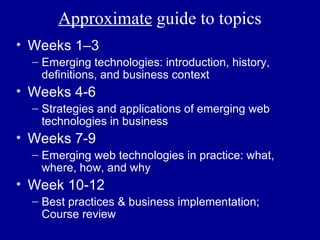
Approximate guide to topics
• Weeks 1–3
  – Emerging technologies: introduction, history,
    definitions, and business context
• Weeks 4-6
  – Strategies and applications of emerging web
    technologies in business
• Weeks 7-9
  – Emerging web technologies in practice: what,
    where, how, and why
• Week 10-12
  – Best practices & business implementation;
    Course review
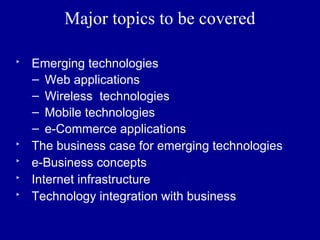
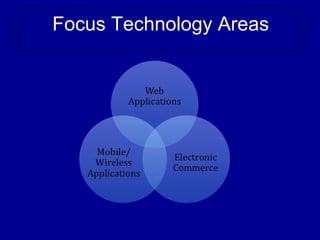
Major topics to be covered

‣   Emerging technologies
    – Web applications
    – Wireless technologies
    – Mobile technologies
    – e-Commerce applications
‣   The business case for emerging technologies
‣   e-Business concepts
‣   Internet infrastructure
‣   Technology integration with business
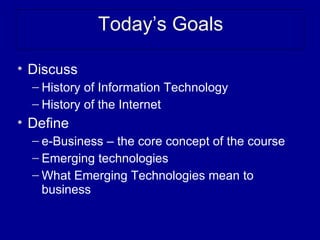
Today’s Goals

• Discuss
  – History of Information Technology
  – History of the Internet
• Define
  – e-Business – the core concept of the course
  – Emerging technologies
  – What Emerging Technologies mean to
    business
A brief history of the Internet
Focus Technology Areas
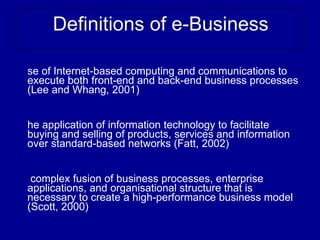
Definitions of e-Business

se of Internet-based computing and communications to
execute both front-end and back-end business processes
(Lee and Whang, 2001)


he application of information technology to facilitate
buying and selling of products, services and information
over standard-based networks (Fatt, 2002)


 complex fusion of business processes, enterprise
applications, and organisational structure that is
necessary to create a high-performance business model
(Scott, 2000)
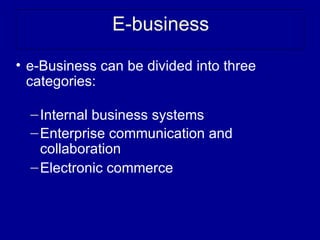
E-business

• e-Business can be divided into three
  categories:

  – Internal business systems
  – Enterprise communication and
    collaboration
  – Electronic commerce
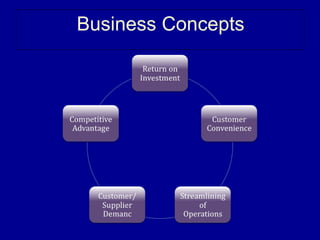
Business Concepts
Business Concepts
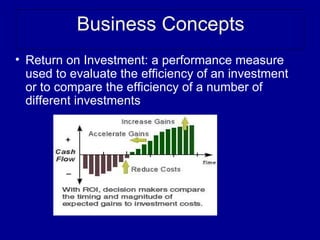
• Return on Investment: a performance measure
  used to evaluate the efficiency of an investment
  or to compare the efficiency of a number of
  different investments
Return on Investment
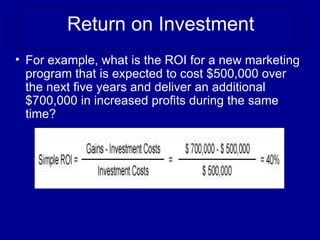
• For example, what is the ROI for a new marketing
  program that is expected to cost $500,000 over
  the next five years and deliver an additional
  $700,000 in increased profits during the same
  time?
Streamlining of Operations
• Streamlining of Operations: implementing
  solutions that create integrity, continuity and
  consistency across processes, allow information
  to be easily shared throughout the entire
  organization.
• Streamlining in modern business is a matter of
  producing the best product or service at the best
  price, and in the shortest possible time-frame
  (lead time to shipping
Competitive Advantage

• Competitive Advantage: the means by which
  a firm manages to keep making money and
  sustain its position against its competitors.
• A condition which enables a company to operate
  in a more efficient or otherwise higher-quality
  manner than the companies it competes with, and
  which results in benefits
Customer/Supplier Demand
• Customer/Supplier Demand: Supply chain
  activities transform natural resources, raw
  materials and components into a finished product
  that is delivered to the end customer.
• A good relationship between the customer and
  the supplier contributes to reliable information
  flows, and reliable demand information flows in
  turn contribute to high efficiency
Customer Convenience
• Customer Convenience: doing business the way
  customers want to do business with you
• Customer satisfaction is what a business is all
  about. If there are no customers, there is no
  business
• It is very important that we know what our
  customer’s wants or needs for them to be
  returning customers and build loyalty
  • Observe customer behaviour and concentrate on their
    favourite part
  • Example: Mobile banking, ATM location, Cash out at
    the register
Internal Business Systems
• A complete set of business applications that enables you to
  efficiently manage customer interactions, manufacture
  products, ship orders, collect payments and more—all from
  a business system that shares a single technology
  foundation (Oracle, 2003)
• Enterprise Application Integration - an emerging generation of
  integration software that addresses more effectively the need to integrate both
  intra and inter-organisational systems

• Cloud Computing - creates a social cloud where users can store data and
  applications, and interact using devices such as mobile phones and computers

• Software as a Service (SaaS) - used for delivering software
  applications over networks (ie. the Internet)
Internal business systems

lectronic Customer Relationship Management


trategy used to learn more about the customers’
needs and behaviours in order to develop
stronger relationships with them.


he applications transform existing customer data
into real sales, sales opportunities and marketing
insights using new technologies (CIMRU, 2002)
Internal business systems

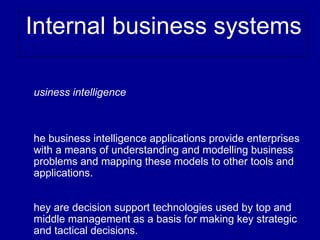
usiness intelligence


he business intelligence applications provide enterprises
with a means of understanding and modelling business
problems and mapping these models to other tools and
applications.


hey are decision support technologies used by top and
middle management as a basis for making key strategic
and tactical decisions.
Internal business systems

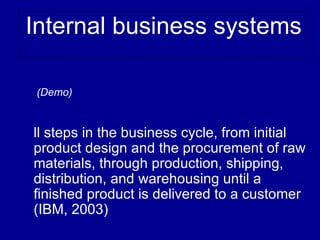
 (Demo)


ll steps in the business cycle, from initial
product design and the procurement of raw
materials, through production, shipping,
distribution, and warehousing until a
finished product is delivered to a customer
(IBM, 2003)
Internal business systems

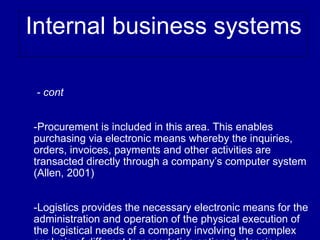
 - cont


-Procurement is included in this area. This enables
purchasing via electronic means whereby the inquiries,
orders, invoices, payments and other activities are
transacted directly through a company’s computer system
(Allen, 2001)


-Logistics provides the necessary electronic means for the
administration and operation of the physical execution of
the logistical needs of a company involving the complex
Enterprise Communication &
          Collaboration
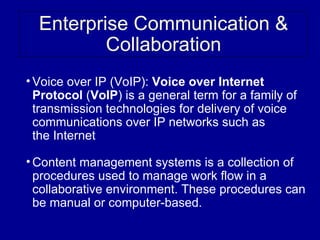
• Voice over IP (VoIP): Voice over Internet
  V
  Protocol (VoIP) is a general term for a family of
  transmission technologies for delivery of voice
  communications over IP networks such as
  the Internet

• Content management systems is a collection of
  procedures used to manage work flow in a
  collaborative environment. These procedures can
  be manual or computer-based.
Enterprise Communication &
          Collaboration
• Electronic mail/web-based mail
• Social Networking
• Voice mail
• Web conferencing: is used to conduct live meetings,
  training, or presentations via the Internet
• Business Process Management: a management approach
  focused on aligning all aspects of an organization with the
  wants and needs of clients
E-Commerce
• Electronic commerce includes different types of
  activities related to the online sales of goods and
  services with transfer of funds, through digital
  communications

• Includes business-to-business (B2B) or
  business-to-consumer (B2C)
   – e-Tailer (Retail store online)
     e
   – Electronic supply chain management
   – Online marketing
   – e-Customer Relationship Management
   – Marketplaces
Difference Between E-business and
           E-commerce
• E-Commerce has a narrower meaning than e-Business.

• It refers to using the Internet to order and pay for products
  or services so e-commerce is a sub-set of e-business.
• E-commerce happens when a consumer orders a product
  from a business and pays for it either when they receive
  the product or directly online at the time of ordering.

• It happens when a business pays another business via its
  website for supplies.

• E-commerce refers specifically to the paying for goods
  and services, whereas e-business covers the full range of
  business activities that can happen or be assisted via
  email or the Web.
Things that we’ll do in this class

• Lectures and labs will include lots of
  examples, demonstrations, and discussions
  about emerging technology

  – Team assessments are based on creativity
  – Some lectures YOU will do the demo


• We’ll use lots of the technologies
  we talk about
e-Commerce Innovation
• “Virtual Modeling” allows customers to “try on”
  clothing before they buy:
For this week…
      Read over your course description
          Continue work on Lab One
Reading for next week will be posted on Moodle


              Next Week
     What are Emerging Technologies?
         Definitions, Samples, Demos
References
•   Allen, S., Leveraging procurement: the quiet eBusiness. Logist. Trans. Focus, 2001, 3(4), 29–30.
•   CIMRU, Deliverable 8—Roadmap for Digital Business—BRIDGES IST-1999-14038, p. 105, 2002
    (National University of Ireland, Galway: Galway, Ireland).

•   Fatt, C.K., E-commerce: The New Wave, 2002 (PriceWaterhouseCoopers: London).

•   IBM, Glossary of computing terms. Available online at:
    http://www.ibm.com/ibm/terminology/goc/gatmst09.htm

•   Lee, H.L. and Whang, S., e-Business and Supply Chain Integration, 2001 (Stanford Global Supply
    Chain Management Forum: Stanford, CA).

•   Oracle. Oracle e-Business suite. Available online at:
    http://www.oracle.com/applications/index.html?content.html.

•   Scott, K.V., The technical writer as software process catalyst, in Proceedings of IEEE Professional
    Communication Society International Professional Communication Conference and Proceedings of
    the 18th Annual ACM International Conference on Computer Documentation: Technology and
    Teamwork, Cambridge, Massachusetts, IEEE, 2000.

•   Wall, B., Jagdev, H.S. and Browne, J., An approach to developing an eBusiness roadmap. Prod.
    Plan. Con., 2005, 16(7), 701–715.

•   Weseley, M.J., Critical success factors for e-Commerce. Logist.Trans. Focus, 2001, 3(4), 18–20.

Lecture01 introduction

  • 1.
    Welcome to ITECH3214 & ITECH6214 Emerging Technologies in Business Lecturer: Cinthia Joy Godly Office: 401D Phone: 9269 6943 Email: cjgodly@iibit.edu.au
  • 2.
    Welcome to ITECH3214 & ITECH6214 Emerging Technologies in Business Week 1: Introduction to Class & Emerging Technologies
  • 3.
    Course Layout • 2hour lecture • 2 hour lab • In-class writing assignment - 10% – Linked to labs in week 1-4 • Team Report - 15% • Team Presentation - 25% • Exam - 50% – Linked to labs – More discussion in week-12
  • 4.
    Course Resources • Moodle-main site includes: – Lecture slides – Assessments – Links or files for weekly reading – Labs – Demos & Discussions – Newsfeeds – Podcast or video lectures
  • 5.
    Course Objectives &Content  Course objectives from the course description  Planned content of the course  Possible sequence and delivery of lectures  What will happen in labs  The integration of the lectures, labs, and assessments  Reading for this course - no text!
  • 6.
    Approximate guide totopics • Weeks 1–3 – Emerging technologies: introduction, history, definitions, and business context • Weeks 4-6 – Strategies and applications of emerging web technologies in business • Weeks 7-9 – Emerging web technologies in practice: what, where, how, and why • Week 10-12 – Best practices & business implementation; Course review
  • 7.
    Major topics tobe covered ‣ Emerging technologies – Web applications – Wireless technologies – Mobile technologies – e-Commerce applications ‣ The business case for emerging technologies ‣ e-Business concepts ‣ Internet infrastructure ‣ Technology integration with business
  • 8.
    Today’s Goals • Discuss – History of Information Technology – History of the Internet • Define – e-Business – the core concept of the course – Emerging technologies – What Emerging Technologies mean to business
  • 9.
    A brief historyof the Internet
  • 10.
  • 11.
    Definitions of e-Business seof Internet-based computing and communications to execute both front-end and back-end business processes (Lee and Whang, 2001) he application of information technology to facilitate buying and selling of products, services and information over standard-based networks (Fatt, 2002) complex fusion of business processes, enterprise applications, and organisational structure that is necessary to create a high-performance business model (Scott, 2000)
  • 12.
    E-business • e-Business canbe divided into three categories: – Internal business systems – Enterprise communication and collaboration – Electronic commerce
  • 13.
  • 14.
    Business Concepts • Returnon Investment: a performance measure used to evaluate the efficiency of an investment or to compare the efficiency of a number of different investments
  • 15.
    Return on Investment •For example, what is the ROI for a new marketing program that is expected to cost $500,000 over the next five years and deliver an additional $700,000 in increased profits during the same time?
  • 16.
    Streamlining of Operations •Streamlining of Operations: implementing solutions that create integrity, continuity and consistency across processes, allow information to be easily shared throughout the entire organization. • Streamlining in modern business is a matter of producing the best product or service at the best price, and in the shortest possible time-frame (lead time to shipping
  • 17.
    Competitive Advantage • CompetitiveAdvantage: the means by which a firm manages to keep making money and sustain its position against its competitors. • A condition which enables a company to operate in a more efficient or otherwise higher-quality manner than the companies it competes with, and which results in benefits
  • 18.
    Customer/Supplier Demand • Customer/SupplierDemand: Supply chain activities transform natural resources, raw materials and components into a finished product that is delivered to the end customer. • A good relationship between the customer and the supplier contributes to reliable information flows, and reliable demand information flows in turn contribute to high efficiency
  • 19.
    Customer Convenience • CustomerConvenience: doing business the way customers want to do business with you • Customer satisfaction is what a business is all about. If there are no customers, there is no business • It is very important that we know what our customer’s wants or needs for them to be returning customers and build loyalty • Observe customer behaviour and concentrate on their favourite part • Example: Mobile banking, ATM location, Cash out at the register
  • 20.
    Internal Business Systems •A complete set of business applications that enables you to efficiently manage customer interactions, manufacture products, ship orders, collect payments and more—all from a business system that shares a single technology foundation (Oracle, 2003) • Enterprise Application Integration - an emerging generation of integration software that addresses more effectively the need to integrate both intra and inter-organisational systems • Cloud Computing - creates a social cloud where users can store data and applications, and interact using devices such as mobile phones and computers • Software as a Service (SaaS) - used for delivering software applications over networks (ie. the Internet)
  • 21.
    Internal business systems lectronicCustomer Relationship Management trategy used to learn more about the customers’ needs and behaviours in order to develop stronger relationships with them. he applications transform existing customer data into real sales, sales opportunities and marketing insights using new technologies (CIMRU, 2002)
  • 22.
    Internal business systems usinessintelligence he business intelligence applications provide enterprises with a means of understanding and modelling business problems and mapping these models to other tools and applications. hey are decision support technologies used by top and middle management as a basis for making key strategic and tactical decisions.
  • 23.
    Internal business systems (Demo) ll steps in the business cycle, from initial product design and the procurement of raw materials, through production, shipping, distribution, and warehousing until a finished product is delivered to a customer (IBM, 2003)
  • 24.
    Internal business systems - cont -Procurement is included in this area. This enables purchasing via electronic means whereby the inquiries, orders, invoices, payments and other activities are transacted directly through a company’s computer system (Allen, 2001) -Logistics provides the necessary electronic means for the administration and operation of the physical execution of the logistical needs of a company involving the complex
  • 25.
    Enterprise Communication & Collaboration • Voice over IP (VoIP): Voice over Internet V Protocol (VoIP) is a general term for a family of transmission technologies for delivery of voice communications over IP networks such as the Internet • Content management systems is a collection of procedures used to manage work flow in a collaborative environment. These procedures can be manual or computer-based.
  • 26.
    Enterprise Communication & Collaboration • Electronic mail/web-based mail • Social Networking • Voice mail • Web conferencing: is used to conduct live meetings, training, or presentations via the Internet • Business Process Management: a management approach focused on aligning all aspects of an organization with the wants and needs of clients
  • 27.
    E-Commerce • Electronic commerceincludes different types of activities related to the online sales of goods and services with transfer of funds, through digital communications • Includes business-to-business (B2B) or business-to-consumer (B2C) – e-Tailer (Retail store online) e – Electronic supply chain management – Online marketing – e-Customer Relationship Management – Marketplaces
  • 28.
    Difference Between E-businessand E-commerce • E-Commerce has a narrower meaning than e-Business. • It refers to using the Internet to order and pay for products or services so e-commerce is a sub-set of e-business. • E-commerce happens when a consumer orders a product from a business and pays for it either when they receive the product or directly online at the time of ordering. • It happens when a business pays another business via its website for supplies. • E-commerce refers specifically to the paying for goods and services, whereas e-business covers the full range of business activities that can happen or be assisted via email or the Web.
  • 29.
    Things that we’lldo in this class • Lectures and labs will include lots of examples, demonstrations, and discussions about emerging technology – Team assessments are based on creativity – Some lectures YOU will do the demo • We’ll use lots of the technologies we talk about
  • 30.
    e-Commerce Innovation • “VirtualModeling” allows customers to “try on” clothing before they buy:
  • 31.
    For this week… Read over your course description Continue work on Lab One Reading for next week will be posted on Moodle Next Week What are Emerging Technologies? Definitions, Samples, Demos
  • 32.
    References • Allen, S., Leveraging procurement: the quiet eBusiness. Logist. Trans. Focus, 2001, 3(4), 29–30. • CIMRU, Deliverable 8—Roadmap for Digital Business—BRIDGES IST-1999-14038, p. 105, 2002 (National University of Ireland, Galway: Galway, Ireland). • Fatt, C.K., E-commerce: The New Wave, 2002 (PriceWaterhouseCoopers: London). • IBM, Glossary of computing terms. Available online at: http://www.ibm.com/ibm/terminology/goc/gatmst09.htm • Lee, H.L. and Whang, S., e-Business and Supply Chain Integration, 2001 (Stanford Global Supply Chain Management Forum: Stanford, CA). • Oracle. Oracle e-Business suite. Available online at: http://www.oracle.com/applications/index.html?content.html. • Scott, K.V., The technical writer as software process catalyst, in Proceedings of IEEE Professional Communication Society International Professional Communication Conference and Proceedings of the 18th Annual ACM International Conference on Computer Documentation: Technology and Teamwork, Cambridge, Massachusetts, IEEE, 2000. • Wall, B., Jagdev, H.S. and Browne, J., An approach to developing an eBusiness roadmap. Prod. Plan. Con., 2005, 16(7), 701–715. • Weseley, M.J., Critical success factors for e-Commerce. Logist.Trans. Focus, 2001, 3(4), 18–20.