LOGISTICS & SUPPLY CHAIN MANAGEMENT
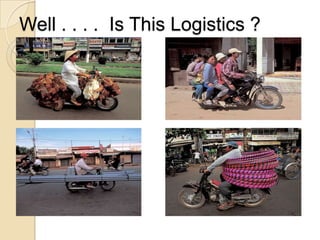
Well . . . .  Is This Logistics ?
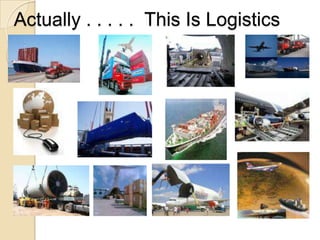
Actually . . . . .  This Is Logistics
Logistics ManagementLOGISTICS …………IS “THE PROCESS OF PLANNING IMPLEMENTING AND CONTROLLING THE EFFECTIVE AND EFFICIENT FLOW AND STORAGE OF GOODS, SERVICES AND RELATED INFORMATION FROM THE POINT OF ORIGIN TO THE POINT OF CONSUMPTION FOR THE PURPOSE OF CONFORMING TO CUSTOMER REQUIREMENTS.”                         ( COUNCIL OF LOGISTICS MANAGEMENT/USA)ITS ORIGINS BELONG TO MILITARY OPERATIONS RELATING TO THE COMPLETE SYSTEM OF MOVING, SUPPLYING AND QUATERING TROOPS AND ALL THE RESOURCES THEY NEED.IN TODAY’S HIGHLY COMPETITIVE INDUSTRIAL SCENARIO OF GLOBAL COMPETITIVENESS, LOGISTICS HAS TRULY BECOME A STRATEGIC WEAPON AND MOST IMPORTANT FACTOR IN THE SUPPLY CHAIN
Contd……“Getting the right product to the right place in the right quantity at the right time, in the best condition and at an acceptable cost. “(The Chartered Institute of Logistics & Transport)Logistics involves ‘8 Rs’- Logistics involves getting, in the right way, the right product, in the right quantity and right quality, in the right place at the right time, for the right customer at the right cost.
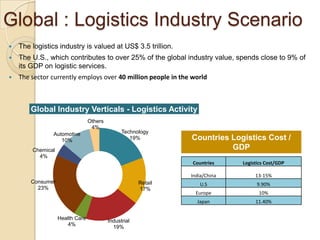
Global : Logistics Industry ScenarioThe logistics industry is valued at US$ 3.5 trillion.The U.S., which contributes to over 25% of the global industry value, spends close to 9% of its GDP on logistic services.The sector currently employs over 40 million people in the worldCountries Logistics Cost / GDP
India : Logistics Industry ScenarioTotal GDP US$ 3 Trillion.
India spends 13% of its GDP on logistics compared to an average of 10% in other developing countries.
India logistics market to double by 2012.
The industry would need 4,20,000 skilled people in the ‘Senior Resource Category’ in warehouse management it self, by 2015.
Currently, India logistics industry has only 14,000 Warehouse Managers  but  required are approx. 35,000 .
Technological change in the logistics industry demands a trained workforce in all areas of the  sector.
Indian logistics industry is at an inflection point and will reach a market size of over $125 billion in year 2010.
The organized logistics, which is about 6% of the total logistics market, is growing  @ 15-20% a year. Logistics MixLogistics covers the following functional areas, and are termed as Logistics Mix by Martin Cristopher.Information flow- Order registration, order checking & editing, order processing, coordinationWarehousing- Material storage, material handling, site selection & network planning, despatch documentationPackaging- Handling & damage preventionTransportation- Route planning, mode selection & vehicle scheduling
Logistics Functions The major logistics functions are:Order processingInventory managementWarehousingTransportationMaterial handling & storage systemLogistical PackagingInformation
Objectives of Logistics ManagementThe objective of Logistics management are:Inventory reductionReliable and consistent delivery performanceFreight economyMinimum product damagesQuick response
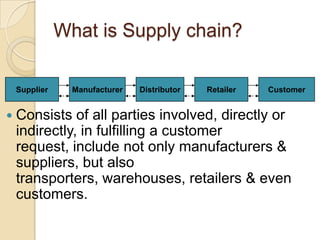
What is Supply chain?Consists of all parties involved, directly or indirectly, in fulfilling a customer request, include not only manufacturers & suppliers, but also transporters, warehouses, retailers & even customers.SupplierManufacturerDistributorRetailerCustomer
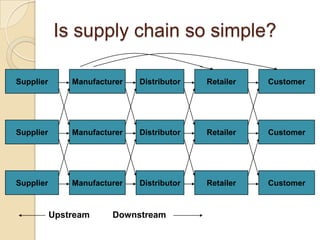
Is supply chain so simple?SupplierManufacturerDistributorRetailerCustomerSupplierManufacturerDistributorRetailerCustomerSupplierManufacturerDistributorRetailerCustomerUpstreamDownstream
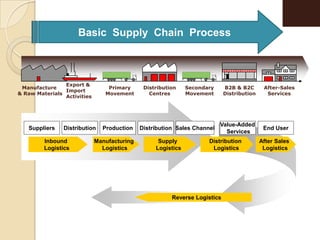
SuppliersProductionDistributionSales ChannelValue-Added ServicesEnd UserDistributionAfter Sales LogisticsDistribution LogisticsManufacturing LogisticsInbound LogisticsSupply LogisticsManufacture & Raw MaterialsExport &ImportActivitiesPrimaryMovementDistributionCentresSecondaryMovementB2B & B2CDistributionAfter-SalesServicesReverse LogisticsBasic  Supply  Chain  Process
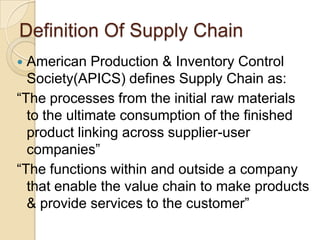
Definition Of Supply ChainAmerican Production & Inventory Control Society(APICS) defines Supply Chain as:“The processes from the initial raw materials to the ultimate consumption of the finished product linking across supplier-user companies”“The functions within and outside a company that enable the value chain to make products & provide services to the customer”
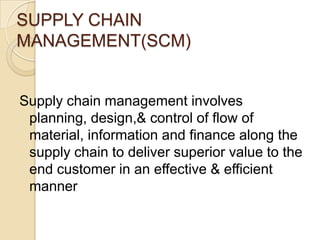
SUPPLY CHAIN MANAGEMENT(SCM)Supply chain management involves planning, design,& control of flow of material, information and finance along the supply chain to deliver superior value to the end customer in an effective & efficient manner
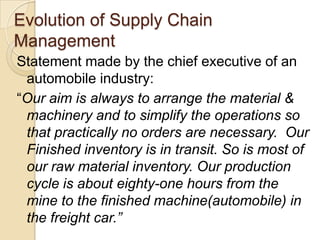
Evolution of Supply Chain ManagementStatement made by the chief executive of an automobile industry:“Our aim is always to arrange the material & machinery and to simplify the operations so that practically no orders are necessary.  Our Finished inventory is in transit. So is most of our raw material inventory. Our production cycle is about eighty-one hours from the mine to the finished machine(automobile) in the freight car.”
Contd……………….The First Revolution(1910-1920): The Ford Supply ChainThe Second Revolution(1960-1970): The Toyota Supply ChainThe Third Revolution(1995-2000): The Dell Supply Chain
Objective of Supply ChainObjective of every supply chain should be to maximize the overall value generated. The value a supply chain generates is the difference between what the final product is worth to the customer and the costs the supply chain incurs in filling the customer’s request Reduced inventory, reduced lead times, reduced warehouse costs, helps in forecast accuracy.
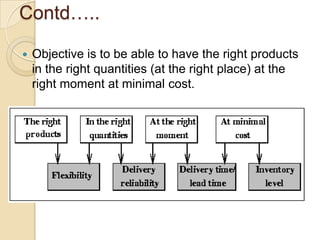
Contd…..Objective is to be able to have the right products in the right quantities (at the right place) at the right moment at minimal cost.
Major Drivers of Supply ChainThe major supply chain drivers are:ProductionInventoryLocationTransportationInformation
Importance of the Supply ChainMajor trends that have emerged to make supply chain management a critical success factor in most industries:Proliferation in product lineShorter product life cyclesHigher level of outsourcingShift in power structure in the chainGlobalization of manufacturing
Decision Phases in a Supply ChainSuccessful supply chain management requires many decisions relating to the flow of information, product & funds. The decision falls in three categories:Supply chain strategy or design: Supply chain planningSupply chain operation
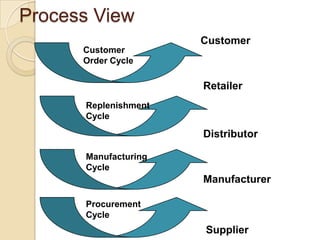
Process views of a Supply Chain There are two ways:1.Cycle view:  Customer order cycle, replenishment cycle, manufacturing cycle, procurement cycle2. Push/pull view: Pull are initiated by customer order & push by anticipation of customer orders
Process ViewCustomerCustomer Order CycleRetailerReplenishment CycleDistributorManufacturing CycleManufacturerProcurement CycleSupplier
Push vs Pull processPush process ,execution is initiated in anticipation of customer orders whereas pull is initiated in response to a customer orderPull process customer demand is known with certainty whereas in push, demand is not known and must be forecastPull process is referred to as reactive & push as speculative process.
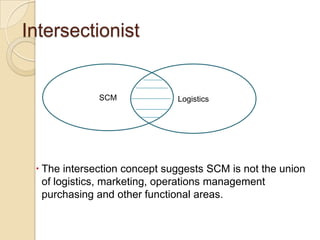
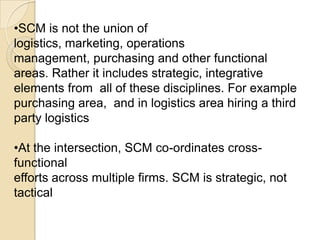
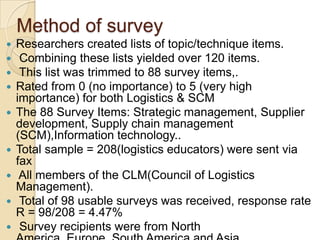
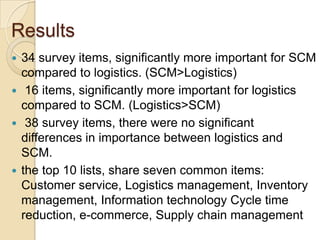
Logistics Versus Supply Chain Management Four unique perspectives on the relationship between logistics and SCM. Four perspectives: traditionalist , relabeling ,unionist , inter-sectionist The result of an international survey of logistics / SCM experts are reported. For logistics educators, researchers and practitioners
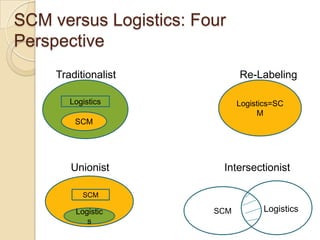
SCM versus Logistics: Four Perspective                 Traditionalist                                          Re-Labeling                      Unionist                                       IntersectionistLogistics=SCMLogisticsSCMLogisticsSCMSCMLogistics
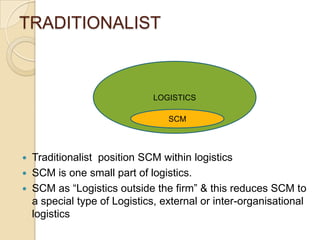
TRADITIONALISTTraditionalist  position SCM within logisticsSCM is one small part of logistics.SCM as “Logistics outside the firm” & this reduces SCM to a special type of Logistics, external or inter-organisational logistics LOGISTICSSCM
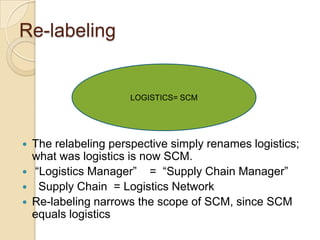
Re-labelingThe relabeling perspective simply renames logistics; what was logistics is now SCM. “Logistics Manager”    =  “Supply Chain Manager”  Supply Chain  = Logistics NetworkRe-labeling narrows the scope of SCM, since SCM equals logisticsLOGISTICS= SCM
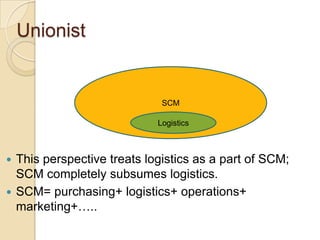
UnionistThis perspective treats logistics as a part of SCM; SCM completely subsumes logistics.SCM= purchasing+ logistics+ operations+ marketing+…..SCMLogistics
Mentzer et al. (2001)“all the traditional business functions should be included”1. Marketing & Sales2. Research & development3. Forecasting4. Production5. Purchasing6. Logistics7. Information systems8. Finance9. Customer service

Supply Chain Management

  • 1.
    LOGISTICS & SUPPLYCHAIN MANAGEMENT
  • 2.
    Well . .. . Is This Logistics ?
  • 3.
    Actually . .. . . This Is Logistics
  • 4.
    Logistics ManagementLOGISTICS …………IS“THE PROCESS OF PLANNING IMPLEMENTING AND CONTROLLING THE EFFECTIVE AND EFFICIENT FLOW AND STORAGE OF GOODS, SERVICES AND RELATED INFORMATION FROM THE POINT OF ORIGIN TO THE POINT OF CONSUMPTION FOR THE PURPOSE OF CONFORMING TO CUSTOMER REQUIREMENTS.” ( COUNCIL OF LOGISTICS MANAGEMENT/USA)ITS ORIGINS BELONG TO MILITARY OPERATIONS RELATING TO THE COMPLETE SYSTEM OF MOVING, SUPPLYING AND QUATERING TROOPS AND ALL THE RESOURCES THEY NEED.IN TODAY’S HIGHLY COMPETITIVE INDUSTRIAL SCENARIO OF GLOBAL COMPETITIVENESS, LOGISTICS HAS TRULY BECOME A STRATEGIC WEAPON AND MOST IMPORTANT FACTOR IN THE SUPPLY CHAIN
  • 5.
    Contd……“Getting the rightproduct to the right place in the right quantity at the right time, in the best condition and at an acceptable cost. “(The Chartered Institute of Logistics & Transport)Logistics involves ‘8 Rs’- Logistics involves getting, in the right way, the right product, in the right quantity and right quality, in the right place at the right time, for the right customer at the right cost.
  • 6.
    Global : LogisticsIndustry ScenarioThe logistics industry is valued at US$ 3.5 trillion.The U.S., which contributes to over 25% of the global industry value, spends close to 9% of its GDP on logistic services.The sector currently employs over 40 million people in the worldCountries Logistics Cost / GDP
  • 7.
    India : LogisticsIndustry ScenarioTotal GDP US$ 3 Trillion.
  • 8.
    India spends 13%of its GDP on logistics compared to an average of 10% in other developing countries.
  • 9.
    India logistics marketto double by 2012.
  • 10.
    The industry wouldneed 4,20,000 skilled people in the ‘Senior Resource Category’ in warehouse management it self, by 2015.
  • 11.
    Currently, India logisticsindustry has only 14,000 Warehouse Managers but required are approx. 35,000 .
  • 12.
    Technological change inthe logistics industry demands a trained workforce in all areas of the sector.
  • 13.
    Indian logistics industryis at an inflection point and will reach a market size of over $125 billion in year 2010.
  • 14.
    The organized logistics,which is about 6% of the total logistics market, is growing @ 15-20% a year. Logistics MixLogistics covers the following functional areas, and are termed as Logistics Mix by Martin Cristopher.Information flow- Order registration, order checking & editing, order processing, coordinationWarehousing- Material storage, material handling, site selection & network planning, despatch documentationPackaging- Handling & damage preventionTransportation- Route planning, mode selection & vehicle scheduling
  • 15.
    Logistics Functions Themajor logistics functions are:Order processingInventory managementWarehousingTransportationMaterial handling & storage systemLogistical PackagingInformation
  • 16.
    Objectives of LogisticsManagementThe objective of Logistics management are:Inventory reductionReliable and consistent delivery performanceFreight economyMinimum product damagesQuick response
  • 17.
    What is Supplychain?Consists of all parties involved, directly or indirectly, in fulfilling a customer request, include not only manufacturers & suppliers, but also transporters, warehouses, retailers & even customers.SupplierManufacturerDistributorRetailerCustomer
  • 18.
    Is supply chainso simple?SupplierManufacturerDistributorRetailerCustomerSupplierManufacturerDistributorRetailerCustomerSupplierManufacturerDistributorRetailerCustomerUpstreamDownstream
  • 19.
    SuppliersProductionDistributionSales ChannelValue-Added ServicesEndUserDistributionAfter Sales LogisticsDistribution LogisticsManufacturing LogisticsInbound LogisticsSupply LogisticsManufacture & Raw MaterialsExport &ImportActivitiesPrimaryMovementDistributionCentresSecondaryMovementB2B & B2CDistributionAfter-SalesServicesReverse LogisticsBasic Supply Chain Process
  • 20.
    Definition Of SupplyChainAmerican Production & Inventory Control Society(APICS) defines Supply Chain as:“The processes from the initial raw materials to the ultimate consumption of the finished product linking across supplier-user companies”“The functions within and outside a company that enable the value chain to make products & provide services to the customer”
  • 21.
    SUPPLY CHAIN MANAGEMENT(SCM)Supplychain management involves planning, design,& control of flow of material, information and finance along the supply chain to deliver superior value to the end customer in an effective & efficient manner
  • 22.
    Evolution of SupplyChain ManagementStatement made by the chief executive of an automobile industry:“Our aim is always to arrange the material & machinery and to simplify the operations so that practically no orders are necessary. Our Finished inventory is in transit. So is most of our raw material inventory. Our production cycle is about eighty-one hours from the mine to the finished machine(automobile) in the freight car.”
  • 23.
    Contd……………….The First Revolution(1910-1920):The Ford Supply ChainThe Second Revolution(1960-1970): The Toyota Supply ChainThe Third Revolution(1995-2000): The Dell Supply Chain
  • 24.
    Objective of SupplyChainObjective of every supply chain should be to maximize the overall value generated. The value a supply chain generates is the difference between what the final product is worth to the customer and the costs the supply chain incurs in filling the customer’s request Reduced inventory, reduced lead times, reduced warehouse costs, helps in forecast accuracy.
  • 25.
    Contd…..Objective is tobe able to have the right products in the right quantities (at the right place) at the right moment at minimal cost.
  • 26.
    Major Drivers ofSupply ChainThe major supply chain drivers are:ProductionInventoryLocationTransportationInformation
  • 27.
    Importance of theSupply ChainMajor trends that have emerged to make supply chain management a critical success factor in most industries:Proliferation in product lineShorter product life cyclesHigher level of outsourcingShift in power structure in the chainGlobalization of manufacturing
  • 28.
    Decision Phases ina Supply ChainSuccessful supply chain management requires many decisions relating to the flow of information, product & funds. The decision falls in three categories:Supply chain strategy or design: Supply chain planningSupply chain operation
  • 29.
    Process views ofa Supply Chain There are two ways:1.Cycle view: Customer order cycle, replenishment cycle, manufacturing cycle, procurement cycle2. Push/pull view: Pull are initiated by customer order & push by anticipation of customer orders
  • 30.
    Process ViewCustomerCustomer OrderCycleRetailerReplenishment CycleDistributorManufacturing CycleManufacturerProcurement CycleSupplier
  • 31.
    Push vs PullprocessPush process ,execution is initiated in anticipation of customer orders whereas pull is initiated in response to a customer orderPull process customer demand is known with certainty whereas in push, demand is not known and must be forecastPull process is referred to as reactive & push as speculative process.
  • 32.
    Logistics Versus SupplyChain Management Four unique perspectives on the relationship between logistics and SCM. Four perspectives: traditionalist , relabeling ,unionist , inter-sectionist The result of an international survey of logistics / SCM experts are reported. For logistics educators, researchers and practitioners
  • 33.
    SCM versus Logistics:Four Perspective Traditionalist Re-Labeling Unionist IntersectionistLogistics=SCMLogisticsSCMLogisticsSCMSCMLogistics
  • 34.
    TRADITIONALISTTraditionalist positionSCM within logisticsSCM is one small part of logistics.SCM as “Logistics outside the firm” & this reduces SCM to a special type of Logistics, external or inter-organisational logistics LOGISTICSSCM
  • 35.
    Re-labelingThe relabeling perspectivesimply renames logistics; what was logistics is now SCM. “Logistics Manager” = “Supply Chain Manager” Supply Chain = Logistics NetworkRe-labeling narrows the scope of SCM, since SCM equals logisticsLOGISTICS= SCM
  • 36.
    UnionistThis perspective treatslogistics as a part of SCM; SCM completely subsumes logistics.SCM= purchasing+ logistics+ operations+ marketing+…..SCMLogistics
  • 37.
    Mentzer et al.(2001)“all the traditional business functions should be included”1. Marketing & Sales2. Research & development3. Forecasting4. Production5. Purchasing6. Logistics7. Information systems8. Finance9. Customer service