E-Business Models_2
Agenda
• B2C business models
• B2B business models
• Business models in other emerging areas
of e-commerce
Classsification of E-commerce
Business Models
• There is more than one way of
classification (No single correct way)
• Some companies use multiple business
models
Classifications may be according to:
• Interacting participants
– B2C, B2B, C2C, G2C, G2B, P2P
• Value proposition (offer)
• Revenue model
• Main theme, key processes
• Customers’ role
• Type of e-commerce technology
• etc.
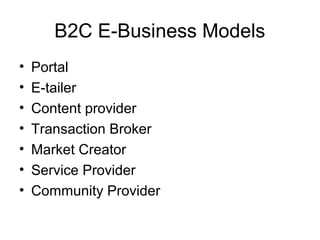
B2C E-Business Models
• Portal
• E-tailer
• Content provider
• Transaction Broker
• Market Creator
• Service Provider
• Community Provider
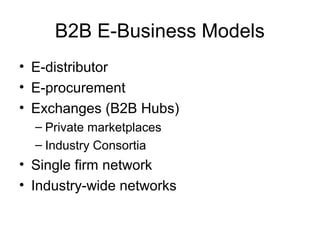
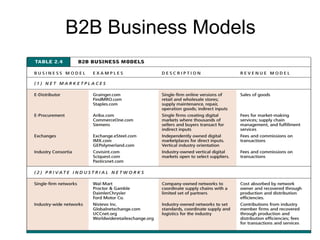
B2B E-Business Models
• E-distributor
• E-procurement
• Exchanges (B2B Hubs)
– Private marketplaces
– Industry Consortia
• Single firm network
• Industry-wide networks
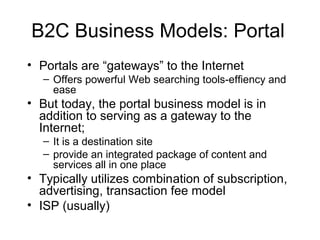
B2C Business Models: Portal
• Portals are “gateways” to the Internet
– Offers powerful Web searching tools-effiency and
ease
• But today, the portal business model is in
addition to serving as a gateway to the
Internet;
– It is a destination site
– provide an integrated package of content and
services all in one place
• Typically utilizes combination of subscription,
advertising, transaction fee model
• ISP (usually)
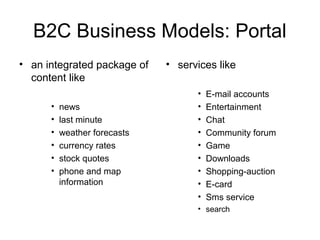
B2C Business Models: Portal
• an integrated package of
content like
• news
• last minute
• weather forecasts
• currency rates
• stock quotes
• phone and map
information
• services like
• E-mail accounts
• Entertainment
• Chat
• Community forum
• Game
• Downloads
• Shopping-auction
• E-card
• Sms service
• search
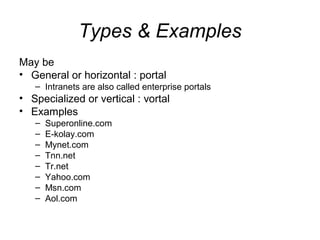
Types & Examples
May be
• General or horizontal : portal
– Intranets are also called enterprise portals
• Specialized or vertical : vortal
• Examples
– Superonline.com
– E-kolay.com
– Mynet.com
– Tnn.net
– Tr.net
– Yahoo.com
– Msn.com
– Aol.com
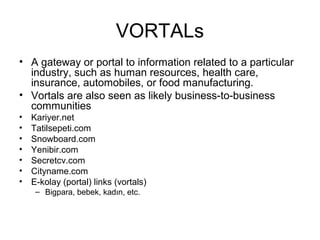
VORTALs
• A gateway or portal to information related to a particular
industry, such as human resources, health care,
insurance, automobiles, or food manufacturing.
• Vortals are also seen as likely business-to-business
communities
• Kariyer.net
• Tatilsepeti.com
• Snowboard.com
• Yenibir.com
• Secretcv.com
• Cityname.com
• E-kolay (portal) links (vortals)
– Bigpara, bebek, kadın, etc.
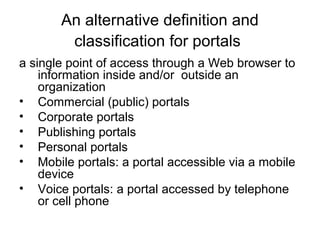
An alternative definition and
classification for portals
a single point of access through a Web browser to
information inside and/or outside an
organization
• Commercial (public) portals
• Corporate portals
• Publishing portals
• Personal portals
• Mobile portals: a portal accessible via a mobile
device
• Voice portals: a portal accessed by telephone
or cell phone
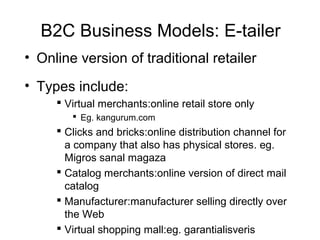
B2C Business Models: E-tailer
• Online version of traditional retailer
• Types include:
 Virtual merchants:online retail store only
 Eg. kangurum.com
 Clicks and bricks:online distribution channel for
a company that also has physical stores. eg.
Migros sanal magaza
 Catalog merchants:online version of direct mail
catalog
 Manufacturer:manufacturer selling directly over
the Web
 Virtual shopping mall:eg. garantialisveris
Barriers to entry into the e-tailer
marketplace, high or low?
• Barrier to entry means
– the total cost of entering a new marketplace
• Barrier to entry for e-tailers is LOW
BUT
• Becoming profitable and surviving is very difficult
with no prior brand name
– How can a new electronic e-tailer compete with
teknosa.com?
– Is it easy for a new toy company to compete with
toysRUs which has alliance with amazon.com
Business Model:
Market Creator
• Uses Internet technology to create markets in
digital environment that bring buyers and sellers
together
– To display products
– Search for products
– Establish a price
• Auction, reverse auction
(promena.com.tr,myfutura.com=4build.com) or
fixed price marketplaces
• Typically uses a transaction fee revenue model
• They don’t have inventory or production cost
Market Creators
• They are middleman
• The success factor is:
– attracting sufficient critical number of sellers and
buyers to the marketplace
– Speed, ability to become operational quickly
• Examples:
– Gittigidiyor.com, muzayede.com, eskidji.com
– eBay.com, Priceline.com
• E-tailers have also started auction sites to create
market on their e-tail sites
Content Provider
• Information and entertainment companies that
provide digital content, such as news, photos,
video, artwork, deviantart.com, youtube.com
over the Web
• Typically utilizes
– subscription,
– pay for download, or
– advertising revenue model
• The success factor is owning the content
• eg. Online books, online perodicals,
broadcasters of TV and radio
Syndication-Aggregation
Aggregation is a variation of standard
content provider model
• Infomediaries:
electronic intermediaries that control information
flow in cyberspace, often aggregating information
and selling it to others
• They do not own but aggregate and distribute
the content produced by others
• Difficult to succeed unless it has a unique
information source that other can not have
Transaction Broker-Intermediaries
• Processes online transactions for consumers
normally handled in person by phone or e-mail
• Primary value proposition – saving of time and
money by providing timely, accurate information
and opinion
• Typical revenue model – transaction fee
• Industries using this model:
– Financial services
– Travel services
– Job placement services
Difference of transaction brokers from
market creators
• Transaction brokers
– actually carry out the transaction for their
customers
– act as agents in large markets
• Market creators
– Sellers and buyers are their own agents
Service Provider
• Offers services online, like consultancy,
trade knowledge, expertise, eg.
Rega.com.tr
• Value proposition – valuable, convenient,
time-saving, low-cost alternatives to
traditional service providers
• Revenue models – subscription fees or
one-time payment
Community Provider
• Sites that create a digital online
environment. people with similar interests
can transact, communicate, and receive
interest-related information.
• Typically rely on a hybrid revenue model
• Alliances like Linux, Kazaa,I-mesh,
Naspter, bearshare, limeware, emule can
be classified as community provider
22
B2B Business Models
E-distributor
• An intermediary that connects
manufacturers (suppliers) with buyers by
aggregating the catalogs of many
suppliers in one place and services
directly to individual businesses
• E-distributors in B2B
– Maintenance, repair, and operation items
(MROs):
Routine items that are usually not under regular
contract with suppliers
E-procurement Companies
• Create and sell access to digital electronic
markets
• B2B service provider is one type – offer
purchasing firms sophisticated set of sourcing
and supply chain management tools
• Application service providers a subset of B2B
service providers
• Examples:
 Ariba
 CommerceOne
Exchanges (B2B Hubs)
• An electronic digital marketplace where
suppliers and commercial purchasers can
conduct transactions
• Usually owned by independent firms whose
business is making a market
• Generate revenue by charging transaction fees
• Usually serve a single vertical industry
• http://www.b2bprofile.com/turkey
• Wtpfed.org
Industry Consortia
• Industry-owned vertical marketplaces that
serve specific industries
• Horizontal marketplaces, in contrast, sell
specific products and services to a wide
range of industries
• Leading example: Covisint
Private Industrial Networks
• Digital networks (usually, but not always
Internet-based) designed to coordinate the
flow of communications among firms
engaged in business together
• Single firm network: the most common
form (example – Walmart)
• Industry-wide networks: often evolve out
of industry associations
28
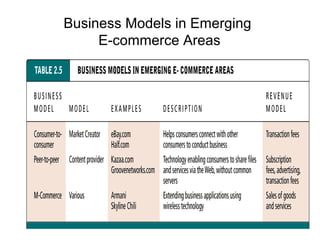
Business Models in Emerging
E-commerce Areas
Consumer-to-Consumer (C2C)
P2P
P4P
• C2C Provide a way for consumers to sell
to each other, with the help of a online
marketmaker. E.g. gittigidiyor.com,
eBay.com
• P2P Peer to peer
• P four P
Peer-to-Peer (P2P) Business Models
• Links users, enabling them to share files and
common resources without a common server
• Challenge is for P2P ventures to develop viable,
legal business models
• Example: Kazaa; Groovenetworks
• Facebook
• youtube
• Eksisozluk.com
• Yonja.com
E-commerce Enablers:
The Gold Rush Model
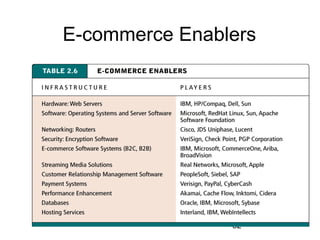
• Internet infrastructure companies: Companies whose
business model is focused on providing infrastructure
necessary for e-commerce companies to exist, grow and
prosper
• Provide
• hardware, software, networking,
• security, e-commerce software systems
• payment systems, databases, hosting services, etc.
• Examples: turkticaret.net, est.com.tr, imat.com.tr
32
E-commerce Enablers
Auctions as EC Market Mechanisms
• Auction:
A market mechanism by which a seller
places an offer to sell a product and buyers
make bids sequentially and competitively
until a final price is reached
• Auctions can be done:
– online
– off-line
– at public sites (eBay)
– at private sites (by invitation)
Auctions as EC Market Mechanisms
• Electronic auctions (e-auctions):
Auctions conducted online
• Host sites on the Internet serve as brokers,
offering services for sellers to post their
goods for sale and allowing buyers to bid on
those items
• Conventional business practices that
traditionally have relied on contracts and
fixed prices are increasingly being
converted into auctions with bidding for
online procurements
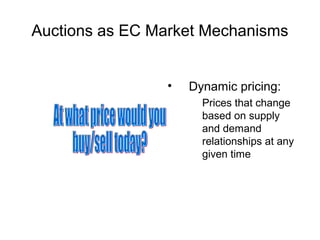
Auctions as EC Market Mechanisms
• Dynamic pricing:
Prices that change
based on supply
and demand
relationships at any
given time
Auctions as EC Market Mechanisms
• Four major categories of dynamic pricing
1. One buyer, one seller
2. One seller, many potential buyers
3. One buyer, many potential sellers
4. Many sellers, many buyers
Auctions as EC Market Mechanisms
1. One buyer, one seller
Forward auction: An auction in which a
seller entertains bids from buyers
One seller, many potential buyers
Forward auctions used for fast liquidation
and as a selling channel. Price is
increasing; the highest bidder wins
Auctions as EC Market Mechanisms
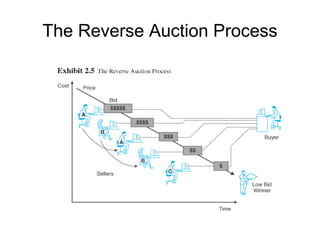
2. One buyer, many potential suppliers
Reverse auction (bidding or tendering
system):
Auction in which the buyer places an item for
bid (tender) on a request for quote (RFQ)
system, potential suppliers bid on the job,
with price reducing sequentially, and the
lowest bid wins; primarily a B2B or G2B
mechanism
Auctions as EC Market Mechanisms
3. One buyer, many potential sellers
(special model)
“name-your-own-price” model:
Auction model in which a would-be buyer
specifies the price (and other terms) they
are willing to pay to any willing and able
seller. It is a C2B model, pioneered by
Priceline.com
Auctions as EC Market Mechanisms
4. Many sellers, many buyers
Double auction:
Auctions in which multiple buyers and their
bidding prices are matched with multiple
sellers and their asking prices, considering
the quantities on both sides
The Reverse Auction Process
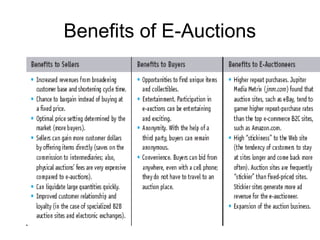
Benefits of E-Auctions
SOURCES and REFERENCES
Prepared from the books and other supplementary
materials of the books and their ppt
presentations
• Kenneth C. Laudon and Carol Guercio Traver;
2004; E-commerce, business, technology and
society;Addison Wesley
• Efraim Turban; 2002 Electronic Commerce, A
Managerial Perspective; Prentice Hall

E business models

  • 1.
  • 2.
    Agenda • B2C businessmodels • B2B business models • Business models in other emerging areas of e-commerce
  • 3.
    Classsification of E-commerce BusinessModels • There is more than one way of classification (No single correct way) • Some companies use multiple business models
  • 4.
    Classifications may beaccording to: • Interacting participants – B2C, B2B, C2C, G2C, G2B, P2P • Value proposition (offer) • Revenue model • Main theme, key processes • Customers’ role • Type of e-commerce technology • etc.
  • 5.
    B2C E-Business Models •Portal • E-tailer • Content provider • Transaction Broker • Market Creator • Service Provider • Community Provider
  • 6.
    B2B E-Business Models •E-distributor • E-procurement • Exchanges (B2B Hubs) – Private marketplaces – Industry Consortia • Single firm network • Industry-wide networks
  • 7.
    B2C Business Models:Portal • Portals are “gateways” to the Internet – Offers powerful Web searching tools-effiency and ease • But today, the portal business model is in addition to serving as a gateway to the Internet; – It is a destination site – provide an integrated package of content and services all in one place • Typically utilizes combination of subscription, advertising, transaction fee model • ISP (usually)
  • 8.
    B2C Business Models:Portal • an integrated package of content like • news • last minute • weather forecasts • currency rates • stock quotes • phone and map information • services like • E-mail accounts • Entertainment • Chat • Community forum • Game • Downloads • Shopping-auction • E-card • Sms service • search
  • 9.
    Types & Examples Maybe • General or horizontal : portal – Intranets are also called enterprise portals • Specialized or vertical : vortal • Examples – Superonline.com – E-kolay.com – Mynet.com – Tnn.net – Tr.net – Yahoo.com – Msn.com – Aol.com
  • 10.
    VORTALs • A gatewayor portal to information related to a particular industry, such as human resources, health care, insurance, automobiles, or food manufacturing. • Vortals are also seen as likely business-to-business communities • Kariyer.net • Tatilsepeti.com • Snowboard.com • Yenibir.com • Secretcv.com • Cityname.com • E-kolay (portal) links (vortals) – Bigpara, bebek, kadın, etc.
  • 11.
    An alternative definitionand classification for portals a single point of access through a Web browser to information inside and/or outside an organization • Commercial (public) portals • Corporate portals • Publishing portals • Personal portals • Mobile portals: a portal accessible via a mobile device • Voice portals: a portal accessed by telephone or cell phone
  • 12.
    B2C Business Models:E-tailer • Online version of traditional retailer • Types include:  Virtual merchants:online retail store only  Eg. kangurum.com  Clicks and bricks:online distribution channel for a company that also has physical stores. eg. Migros sanal magaza  Catalog merchants:online version of direct mail catalog  Manufacturer:manufacturer selling directly over the Web  Virtual shopping mall:eg. garantialisveris
  • 13.
    Barriers to entryinto the e-tailer marketplace, high or low? • Barrier to entry means – the total cost of entering a new marketplace • Barrier to entry for e-tailers is LOW BUT • Becoming profitable and surviving is very difficult with no prior brand name – How can a new electronic e-tailer compete with teknosa.com? – Is it easy for a new toy company to compete with toysRUs which has alliance with amazon.com
  • 14.
    Business Model: Market Creator •Uses Internet technology to create markets in digital environment that bring buyers and sellers together – To display products – Search for products – Establish a price • Auction, reverse auction (promena.com.tr,myfutura.com=4build.com) or fixed price marketplaces • Typically uses a transaction fee revenue model • They don’t have inventory or production cost
  • 15.
    Market Creators • Theyare middleman • The success factor is: – attracting sufficient critical number of sellers and buyers to the marketplace – Speed, ability to become operational quickly • Examples: – Gittigidiyor.com, muzayede.com, eskidji.com – eBay.com, Priceline.com • E-tailers have also started auction sites to create market on their e-tail sites
  • 16.
    Content Provider • Informationand entertainment companies that provide digital content, such as news, photos, video, artwork, deviantart.com, youtube.com over the Web • Typically utilizes – subscription, – pay for download, or – advertising revenue model • The success factor is owning the content • eg. Online books, online perodicals, broadcasters of TV and radio
  • 17.
    Syndication-Aggregation Aggregation is avariation of standard content provider model • Infomediaries: electronic intermediaries that control information flow in cyberspace, often aggregating information and selling it to others • They do not own but aggregate and distribute the content produced by others • Difficult to succeed unless it has a unique information source that other can not have
  • 18.
    Transaction Broker-Intermediaries • Processesonline transactions for consumers normally handled in person by phone or e-mail • Primary value proposition – saving of time and money by providing timely, accurate information and opinion • Typical revenue model – transaction fee • Industries using this model: – Financial services – Travel services – Job placement services
  • 19.
    Difference of transactionbrokers from market creators • Transaction brokers – actually carry out the transaction for their customers – act as agents in large markets • Market creators – Sellers and buyers are their own agents
  • 20.
    Service Provider • Offersservices online, like consultancy, trade knowledge, expertise, eg. Rega.com.tr • Value proposition – valuable, convenient, time-saving, low-cost alternatives to traditional service providers • Revenue models – subscription fees or one-time payment
  • 21.
    Community Provider • Sitesthat create a digital online environment. people with similar interests can transact, communicate, and receive interest-related information. • Typically rely on a hybrid revenue model • Alliances like Linux, Kazaa,I-mesh, Naspter, bearshare, limeware, emule can be classified as community provider
  • 22.
  • 23.
    E-distributor • An intermediarythat connects manufacturers (suppliers) with buyers by aggregating the catalogs of many suppliers in one place and services directly to individual businesses • E-distributors in B2B – Maintenance, repair, and operation items (MROs): Routine items that are usually not under regular contract with suppliers
  • 24.
    E-procurement Companies • Createand sell access to digital electronic markets • B2B service provider is one type – offer purchasing firms sophisticated set of sourcing and supply chain management tools • Application service providers a subset of B2B service providers • Examples:  Ariba  CommerceOne
  • 25.
    Exchanges (B2B Hubs) •An electronic digital marketplace where suppliers and commercial purchasers can conduct transactions • Usually owned by independent firms whose business is making a market • Generate revenue by charging transaction fees • Usually serve a single vertical industry • http://www.b2bprofile.com/turkey • Wtpfed.org
  • 26.
    Industry Consortia • Industry-ownedvertical marketplaces that serve specific industries • Horizontal marketplaces, in contrast, sell specific products and services to a wide range of industries • Leading example: Covisint
  • 27.
    Private Industrial Networks •Digital networks (usually, but not always Internet-based) designed to coordinate the flow of communications among firms engaged in business together • Single firm network: the most common form (example – Walmart) • Industry-wide networks: often evolve out of industry associations
  • 28.
    28 Business Models inEmerging E-commerce Areas
  • 29.
    Consumer-to-Consumer (C2C) P2P P4P • C2CProvide a way for consumers to sell to each other, with the help of a online marketmaker. E.g. gittigidiyor.com, eBay.com • P2P Peer to peer • P four P
  • 30.
    Peer-to-Peer (P2P) BusinessModels • Links users, enabling them to share files and common resources without a common server • Challenge is for P2P ventures to develop viable, legal business models • Example: Kazaa; Groovenetworks • Facebook • youtube • Eksisozluk.com • Yonja.com
  • 31.
    E-commerce Enablers: The GoldRush Model • Internet infrastructure companies: Companies whose business model is focused on providing infrastructure necessary for e-commerce companies to exist, grow and prosper • Provide • hardware, software, networking, • security, e-commerce software systems • payment systems, databases, hosting services, etc. • Examples: turkticaret.net, est.com.tr, imat.com.tr
  • 32.
  • 33.
    Auctions as ECMarket Mechanisms • Auction: A market mechanism by which a seller places an offer to sell a product and buyers make bids sequentially and competitively until a final price is reached • Auctions can be done: – online – off-line – at public sites (eBay) – at private sites (by invitation)
  • 34.
    Auctions as ECMarket Mechanisms • Electronic auctions (e-auctions): Auctions conducted online • Host sites on the Internet serve as brokers, offering services for sellers to post their goods for sale and allowing buyers to bid on those items • Conventional business practices that traditionally have relied on contracts and fixed prices are increasingly being converted into auctions with bidding for online procurements
  • 35.
    Auctions as ECMarket Mechanisms • Dynamic pricing: Prices that change based on supply and demand relationships at any given time
  • 36.
    Auctions as ECMarket Mechanisms • Four major categories of dynamic pricing 1. One buyer, one seller 2. One seller, many potential buyers 3. One buyer, many potential sellers 4. Many sellers, many buyers
  • 37.
    Auctions as ECMarket Mechanisms 1. One buyer, one seller Forward auction: An auction in which a seller entertains bids from buyers One seller, many potential buyers Forward auctions used for fast liquidation and as a selling channel. Price is increasing; the highest bidder wins
  • 38.
    Auctions as ECMarket Mechanisms 2. One buyer, many potential suppliers Reverse auction (bidding or tendering system): Auction in which the buyer places an item for bid (tender) on a request for quote (RFQ) system, potential suppliers bid on the job, with price reducing sequentially, and the lowest bid wins; primarily a B2B or G2B mechanism
  • 39.
    Auctions as ECMarket Mechanisms 3. One buyer, many potential sellers (special model) “name-your-own-price” model: Auction model in which a would-be buyer specifies the price (and other terms) they are willing to pay to any willing and able seller. It is a C2B model, pioneered by Priceline.com
  • 40.
    Auctions as ECMarket Mechanisms 4. Many sellers, many buyers Double auction: Auctions in which multiple buyers and their bidding prices are matched with multiple sellers and their asking prices, considering the quantities on both sides
  • 41.
  • 42.
  • 43.
    SOURCES and REFERENCES Preparedfrom the books and other supplementary materials of the books and their ppt presentations • Kenneth C. Laudon and Carol Guercio Traver; 2004; E-commerce, business, technology and society;Addison Wesley • Efraim Turban; 2002 Electronic Commerce, A Managerial Perspective; Prentice Hall