Chapter One Moving from  E-commerce to  E-business
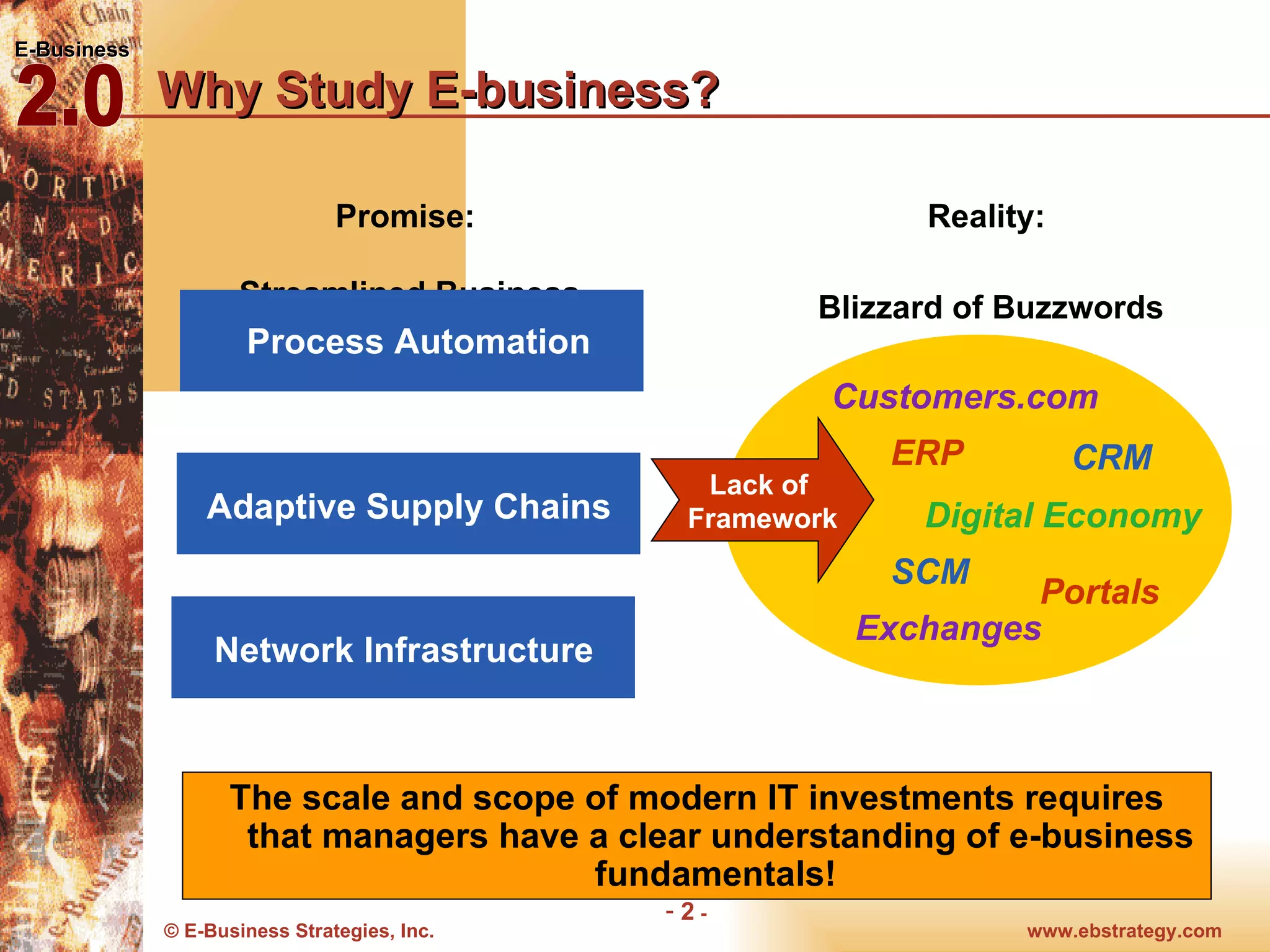
Why Study E-business? Promise:  Streamlined Business Lack of  Framework Reality:  Blizzard of Buzzwords Customers.com CRM ERP Digital Economy SCM Portals Exchanges The scale and scope of modern IT investments requires that managers have a clear understanding of e-business fundamentals!  Network Infrastructure Adaptive Supply Chains Process Automation
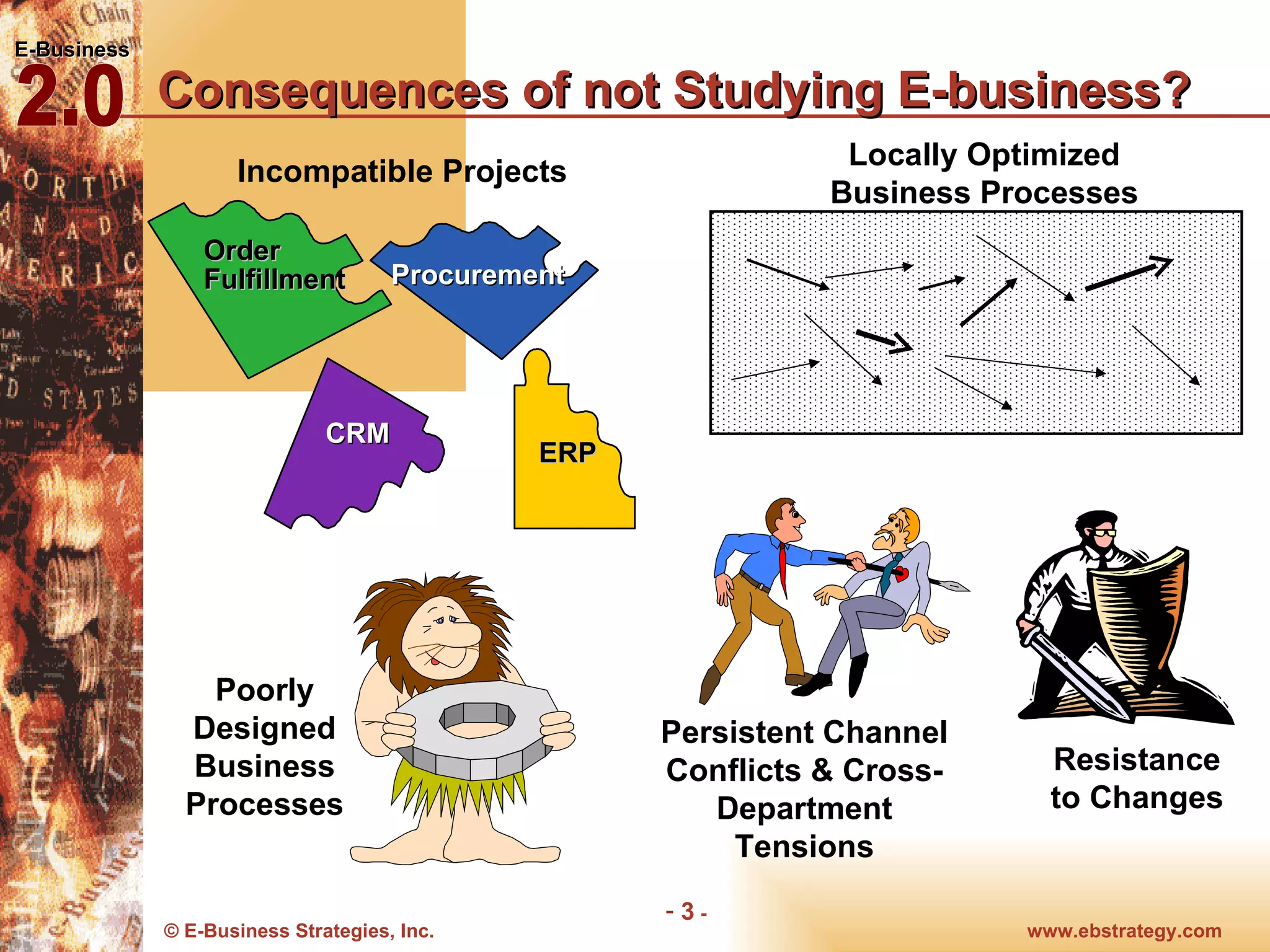
Consequences of not Studying E-business? Poorly Designed Business Processes Persistent Channel Conflicts & Cross-Department Tensions Locally Optimized Business Processes Order  Fulfillment ERP CRM Procurement Incompatible Projects Resistance to Changes
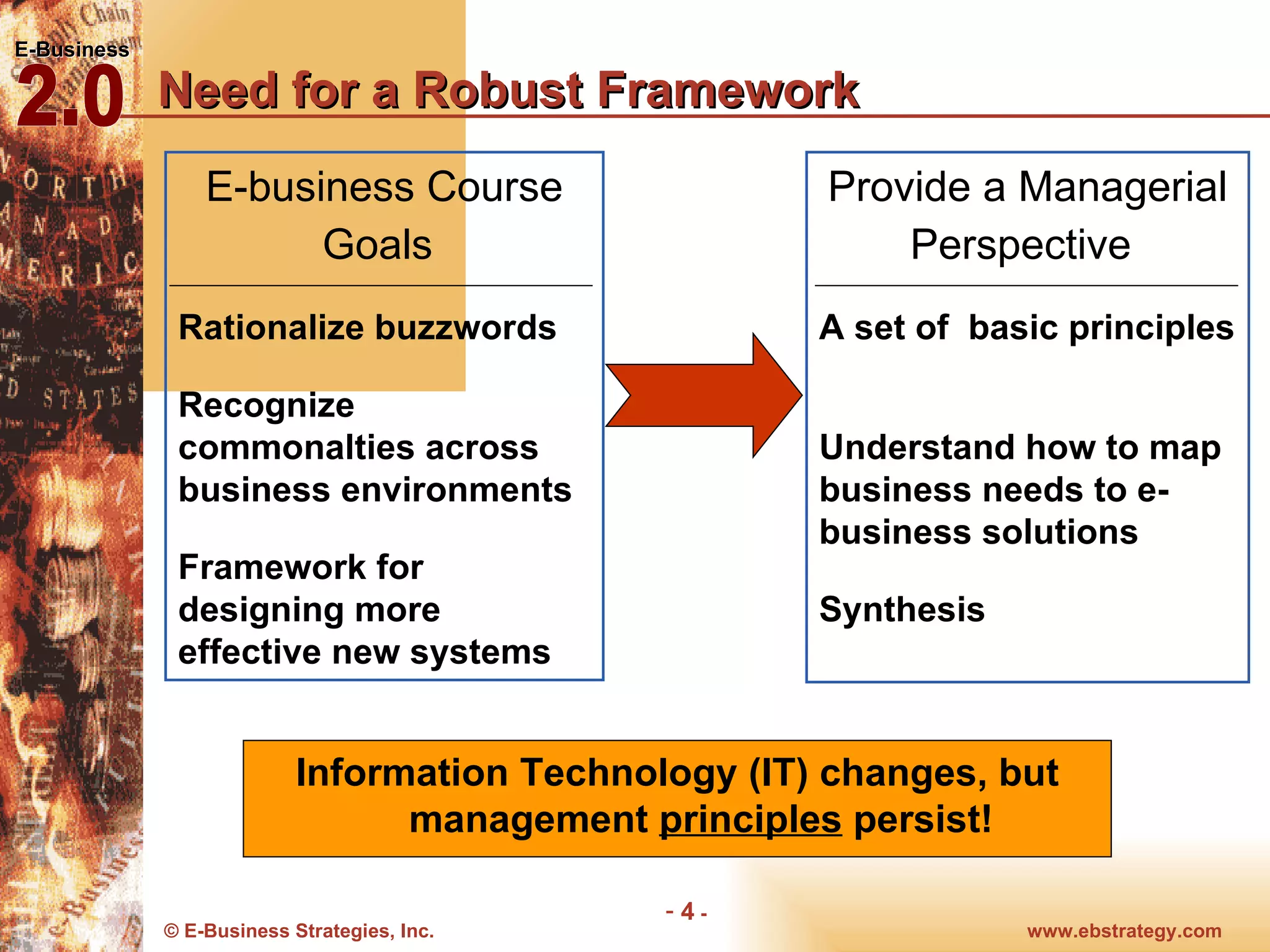
Need for a Robust Framework E-business Course Goals   Rationalize buzzwords  Recognize commonalties across business environments  Framework for designing more effective new systems  Provide a Managerial Perspective   A set of  basic principles  Understand how to map business needs to e-business solutions  Synthesis Information Technology (IT) changes, but management  principles  persist!
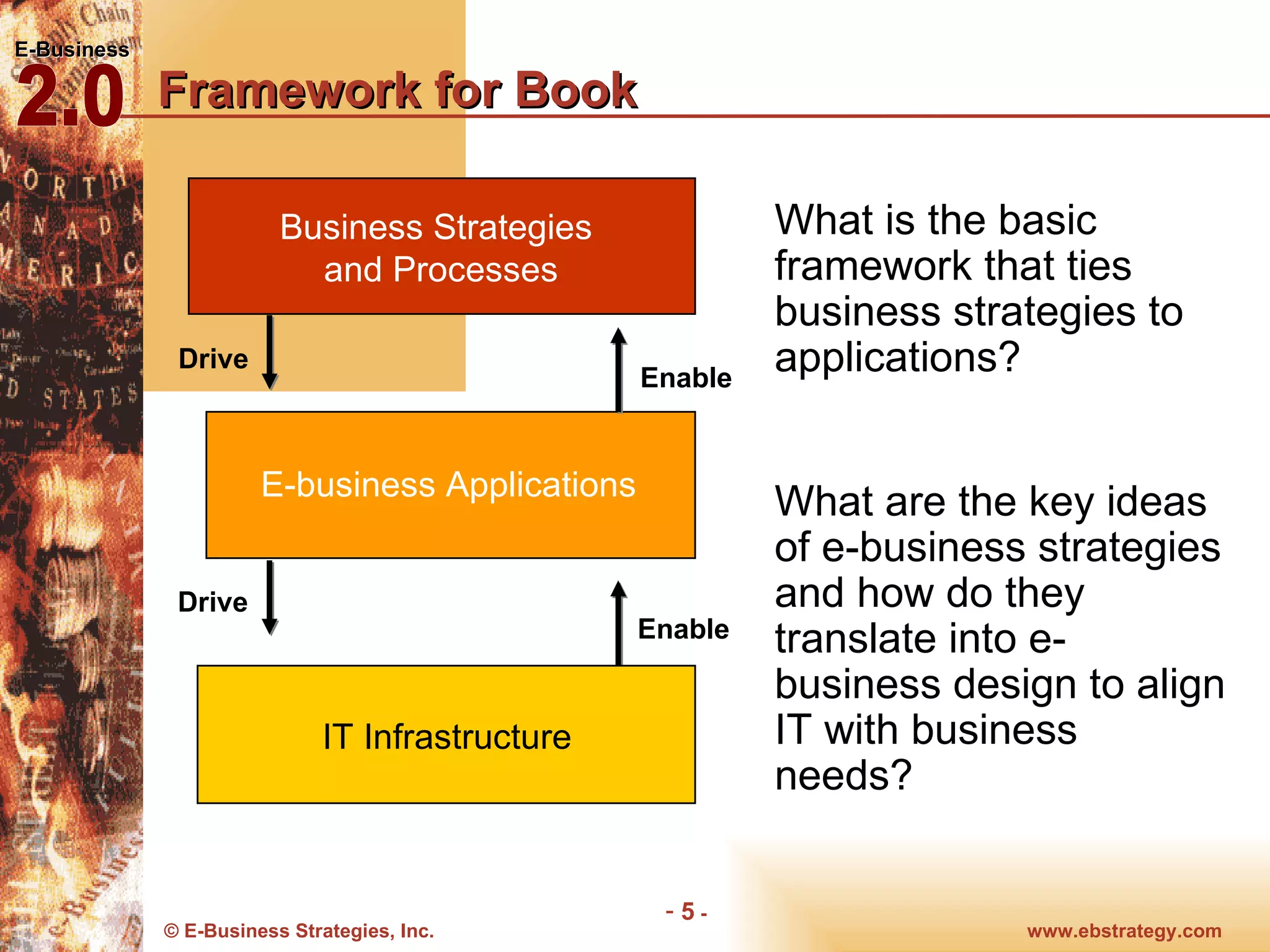
Framework for Book Enable Business Strategies  and Processes E-business Applications IT Infrastructure Drive Drive Enable What is the basic framework that ties business strategies to applications? What are the key ideas of e-business strategies and how do they translate into e-business design to align IT with business needs?
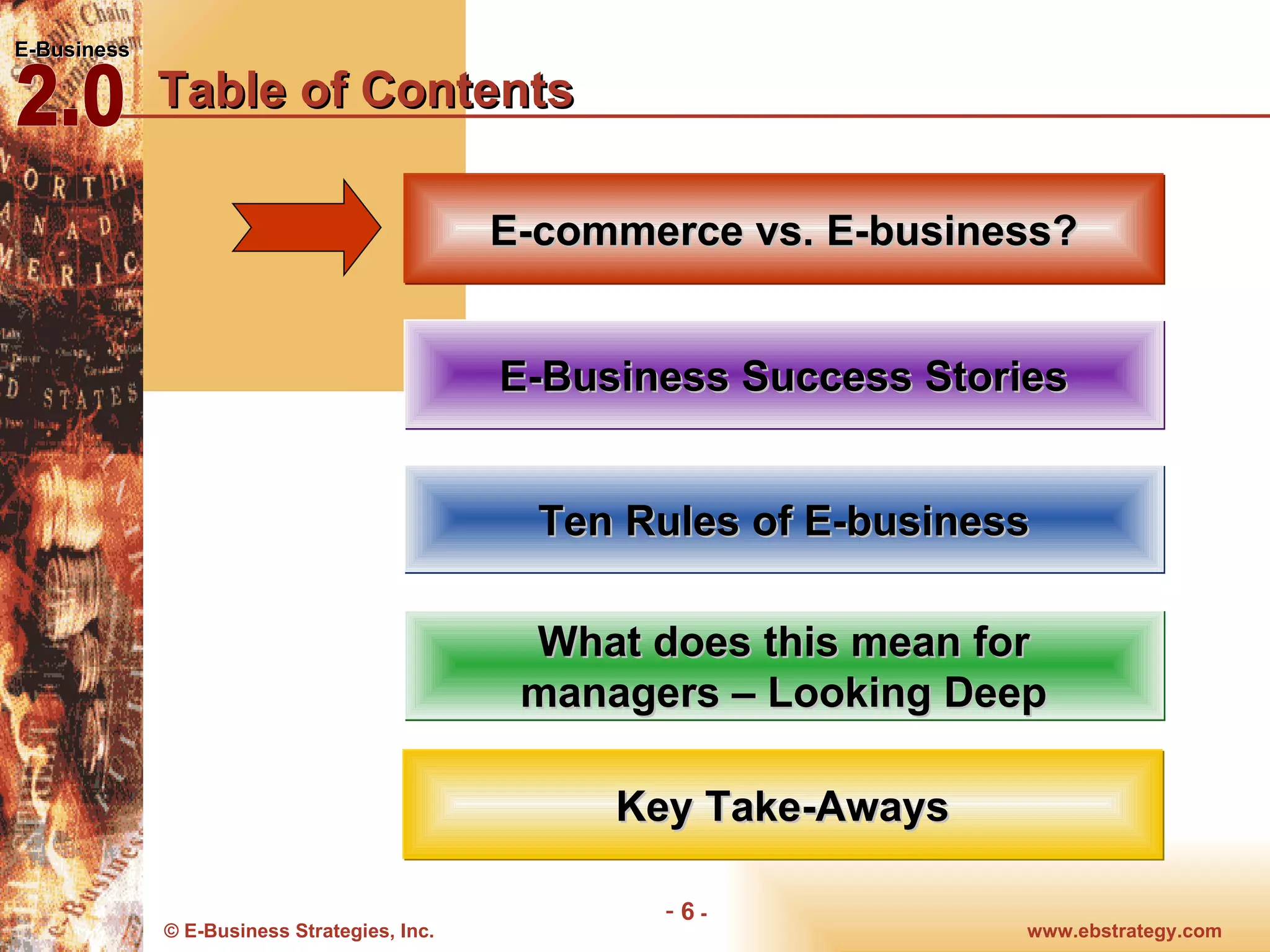
Table of Contents Ten Rules of E-business E-Business Success Stories What does this mean for managers – Looking Deep E-commerce vs. E-business? Key Take-Aways
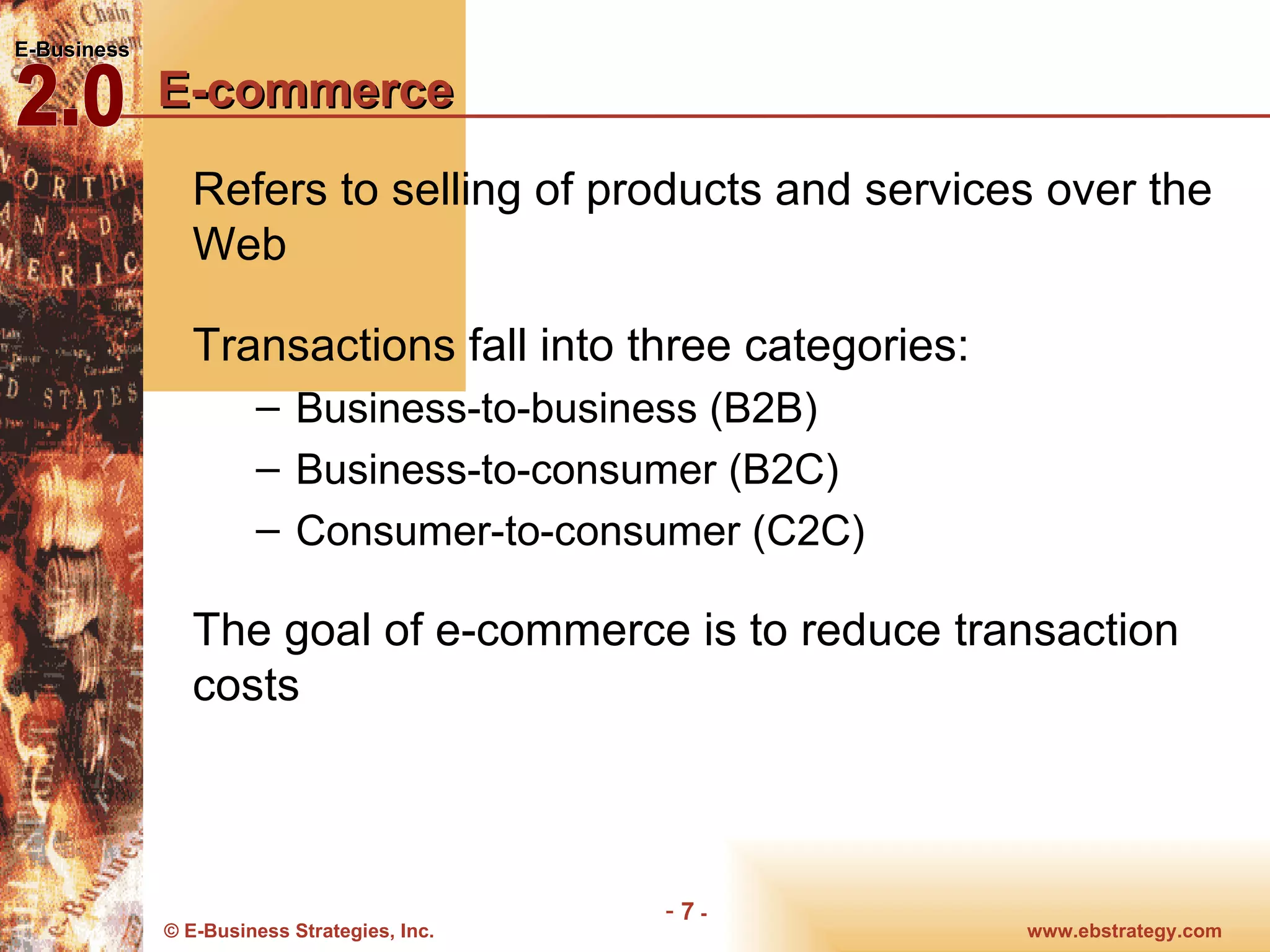
E-commerce Refers to selling of products and services over the Web  Transactions fall into three categories: Business-to-business (B2B) Business-to-consumer (B2C) Consumer-to-consumer (C2C) The goal of e-commerce is to reduce transaction costs
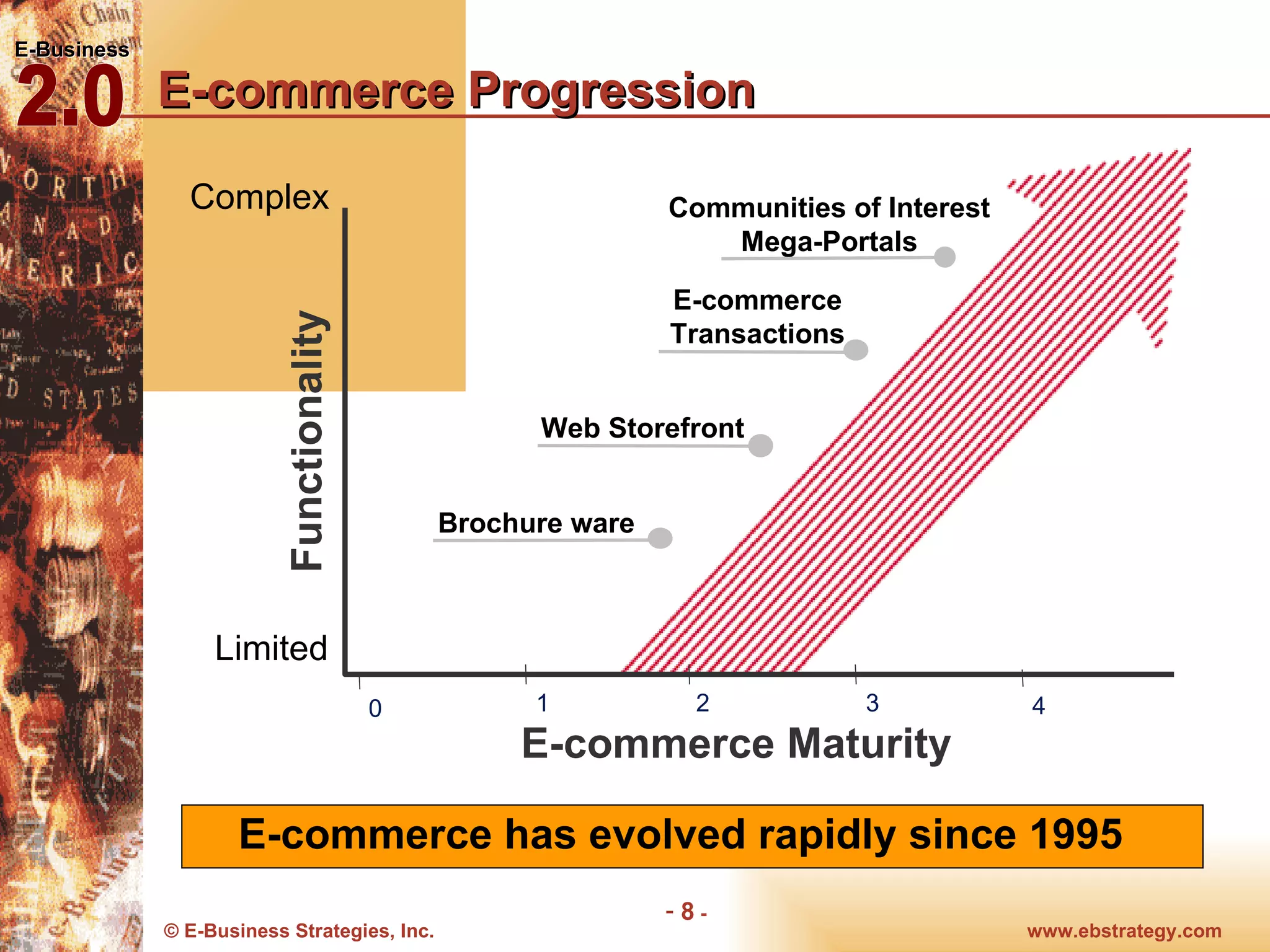
E-commerce Progression E-commerce has evolved rapidly since 1995  E-commerce Maturity Functionality Brochure ware Web Storefront E-commerce Transactions 0 1 2 3 4 Communities of Interest Mega-Portals Complex Limited
E-business The back-office applications, systems or processes that create goods and/or provide services.  E-business includes: Customer Relationship Management Enterprise Resource Planning Supply Chain Management Human Resource Management Systems And more . . .
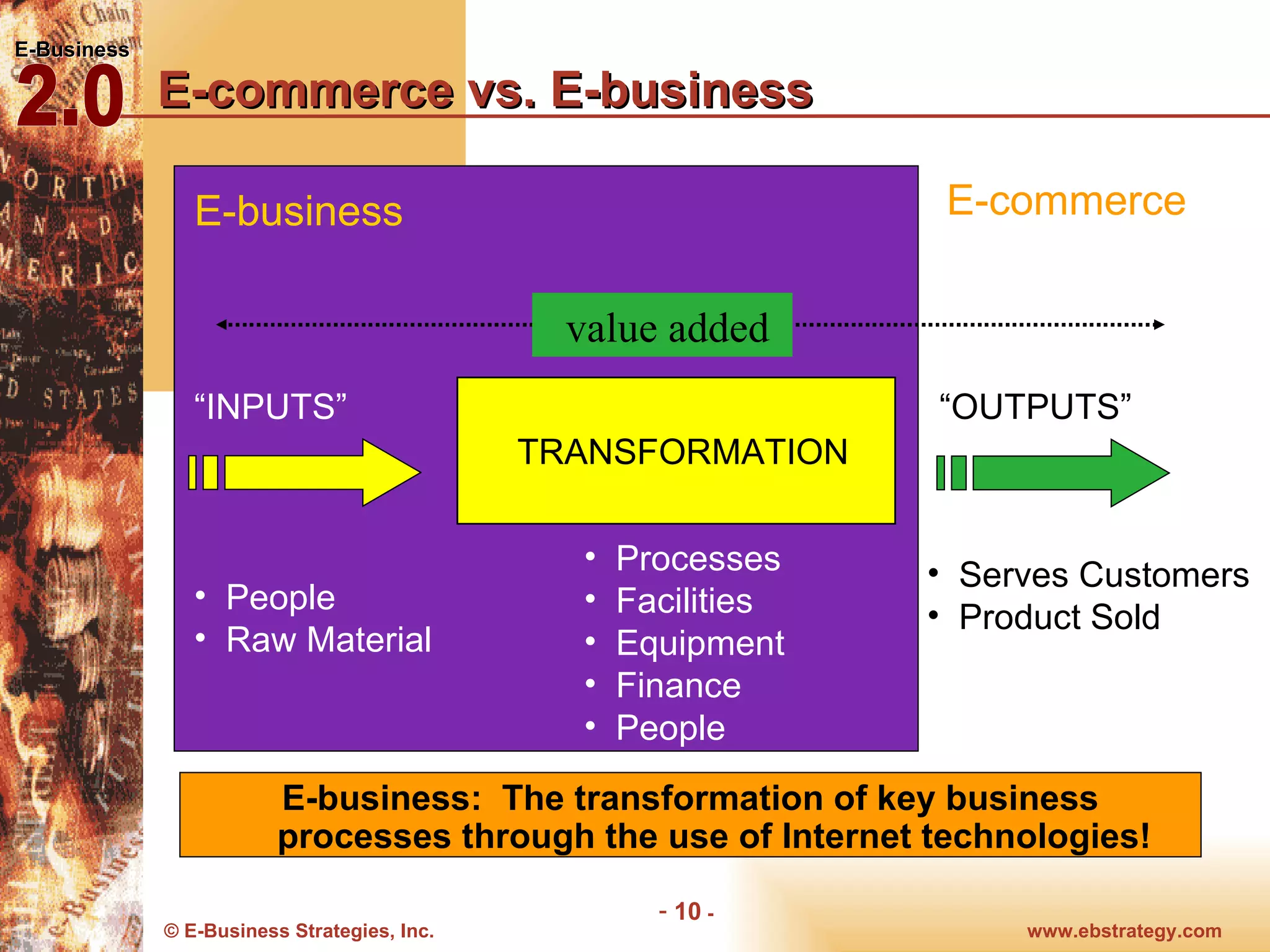
E-commerce vs. E-business “ INPUTS” People Raw Material Serves Customers Product Sold “ OUTPUTS” Processes Facilities Equipment Finance People TRANSFORMATION E-business E-commerce E-business:  The transformation of key business processes through the use of Internet technologies! value added
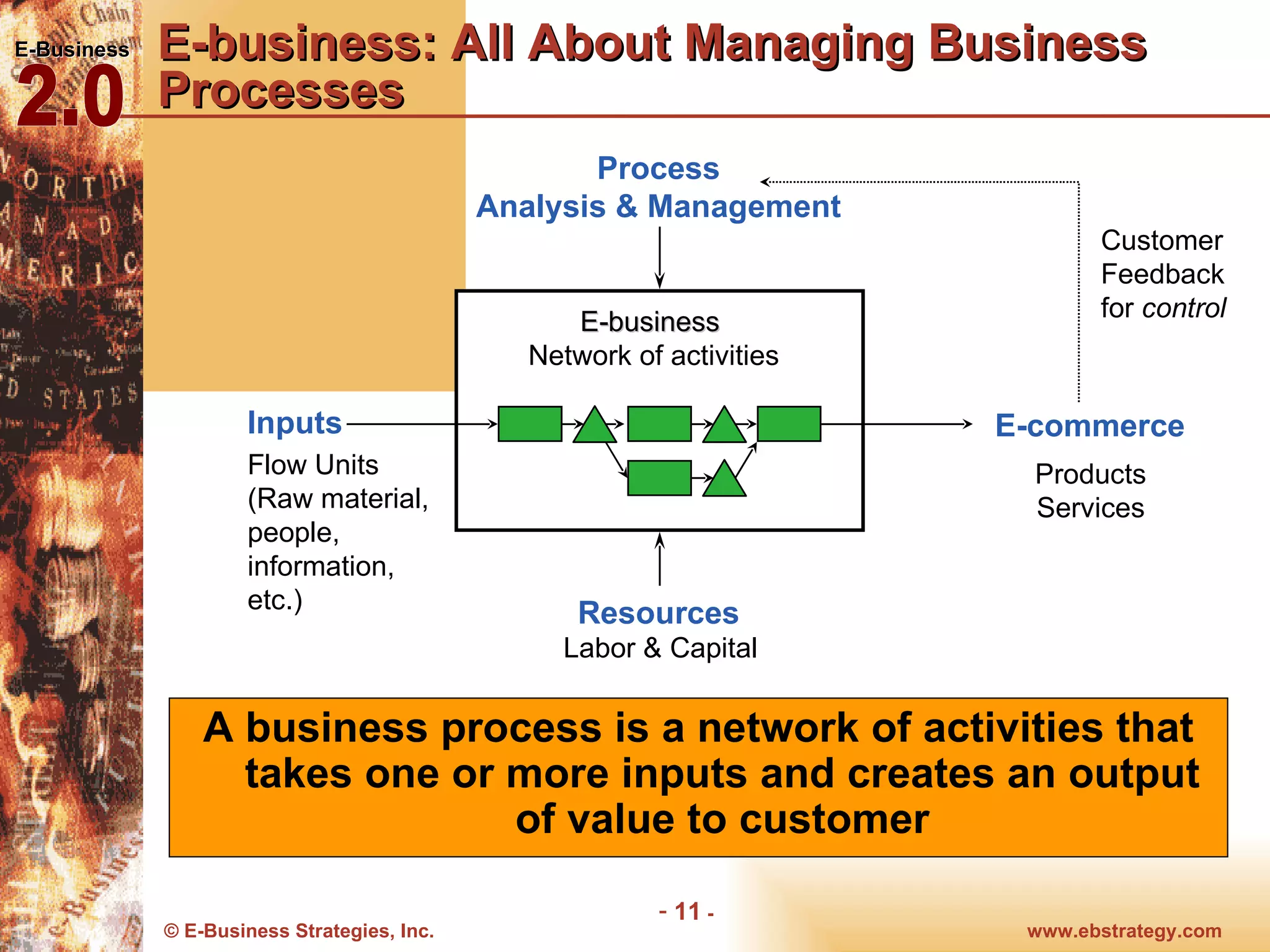
E-business: All About Managing Business Processes A business process is a network of activities that takes one or more inputs and creates an output of value to customer Inputs E-commerce Products Services Labor & Capital Customer Feedback for  control E-business  Network of activities Flow Units (Raw material, people,  information, etc.) Resources Process Analysis & Management
E-business: Linking Today’s Business with Tomorrow’s Technology E-business -- includes all apps and processes enabling a company to service a transaction  E-business Evolution Phase 1: Presence, information-only Phase 2: Transactions Phase 3: Profitability E-business in third phase today:  Psychology of first two phases: technology would trump experience; future would belong to upstarts as eToys Psychology of this phase: experience, distribution, margins are worth something
Table of Contents Ten Rules of E-business E-business Success Stories What does this mean for managers – Looking Deep E-commerce vs. E-business? Key Take-Aways
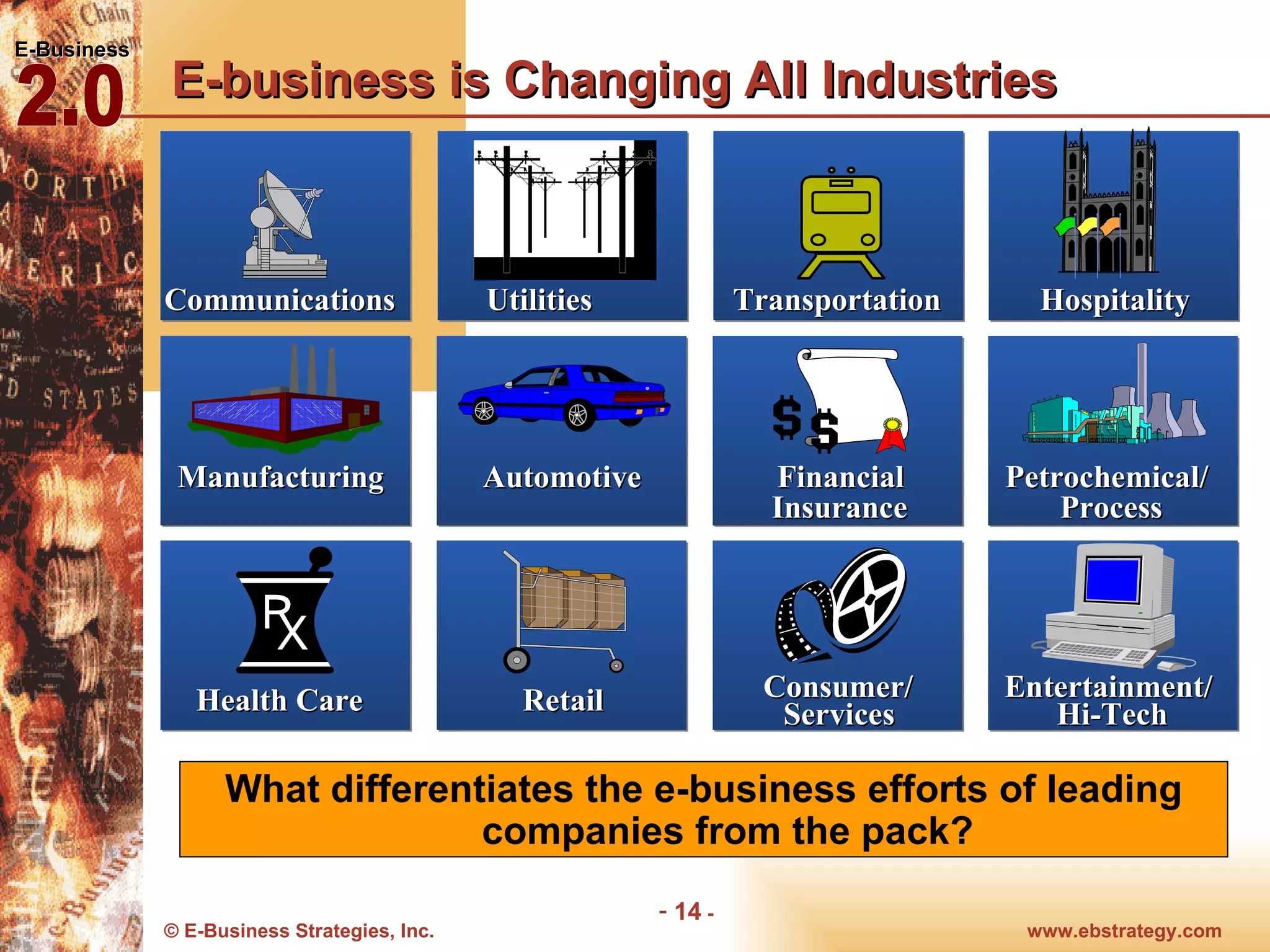
E-business is Changing All Industries Communications Utilities Hospitality Automotive Financial Insurance Petrochemical/ Process Transportation Manufacturing Health Care Entertainment/ Hi-Tech Consumer/ Services Retail What differentiates the e-business efforts of leading companies from the pack?
Visionary Firms and E-business Visionary companies understand current business designs are inadequate for doing business in the e-commerce era Can buy a $999 built-to-order PC from Dell online but not a customized $3000 color copier from Xerox Cisco can overhaul its product line every 2 years, but Kodak cannot seem to deliver rapid innovations to meet changing customer requirements Visionary companies have integrated operations to support changing customer requirements E-customers’ needs, tastes, and expectations transforming shape of the enterprise Necessary: fusion of business designs, processes, apps, and systems on an unprecedented scale
Visionary Firms and E-business Management at leading companies often ask: How will ecommerce change our customer priorities? How can we construct a business design to meet these new customer priorities? What kind of new apps infrastructure  do we need to orchestrate the new business design? What short-term and long-term investments in people, partners, and tech must we make to survive, let alone thrive, in the new economy?
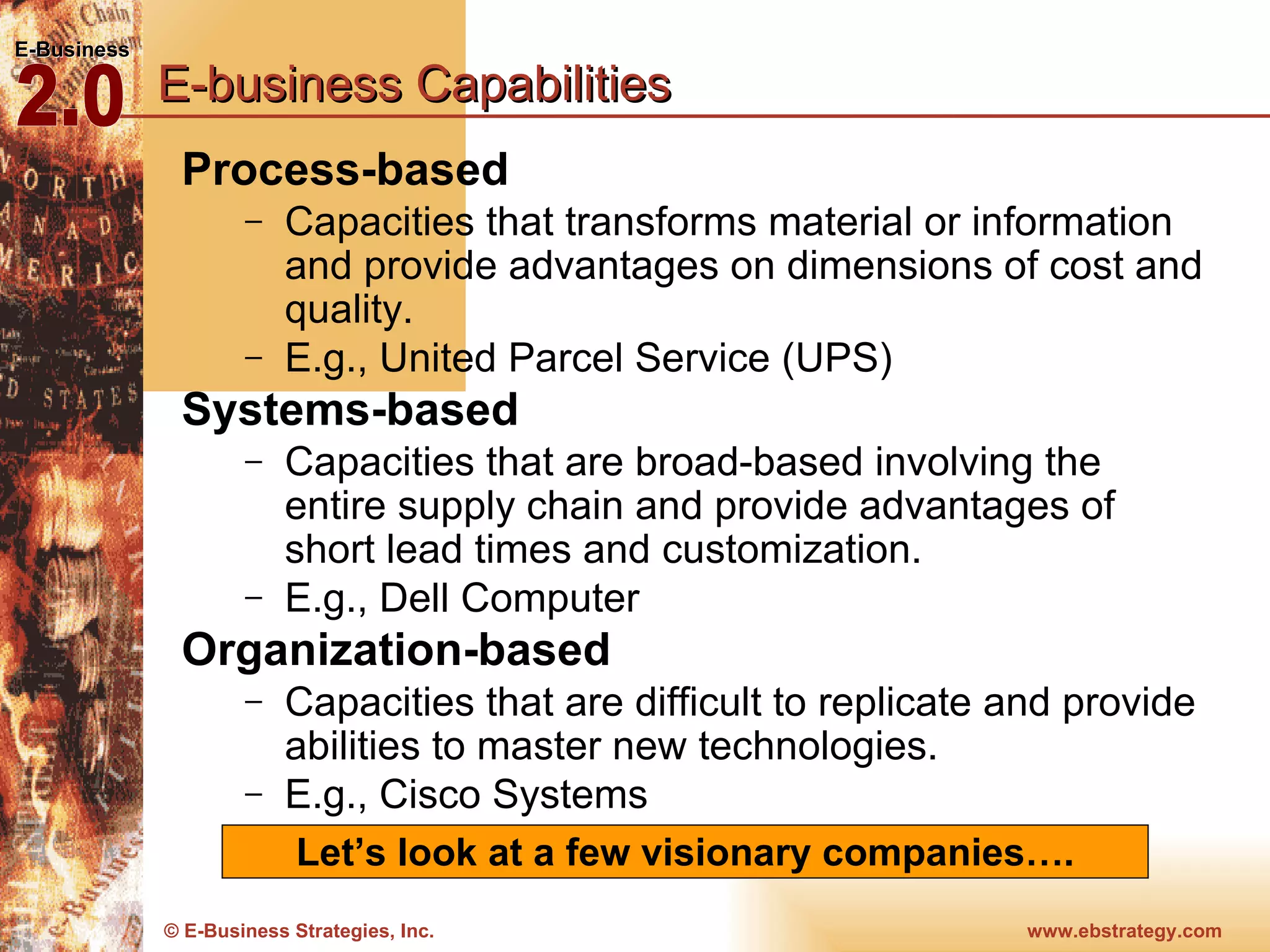
E-business Capabilities Process-based  Capacities that transforms material or information and provide advantages on dimensions of cost and quality. E.g., United Parcel Service (UPS) Systems-based  Capacities that are broad-based involving the entire supply chain and provide advantages of short lead times and customization. E.g., Dell Computer Organization-based Capacities that are difficult to replicate and provide abilities to master new technologies.  E.g., Cisco Systems Let’s look at a few visionary companies….
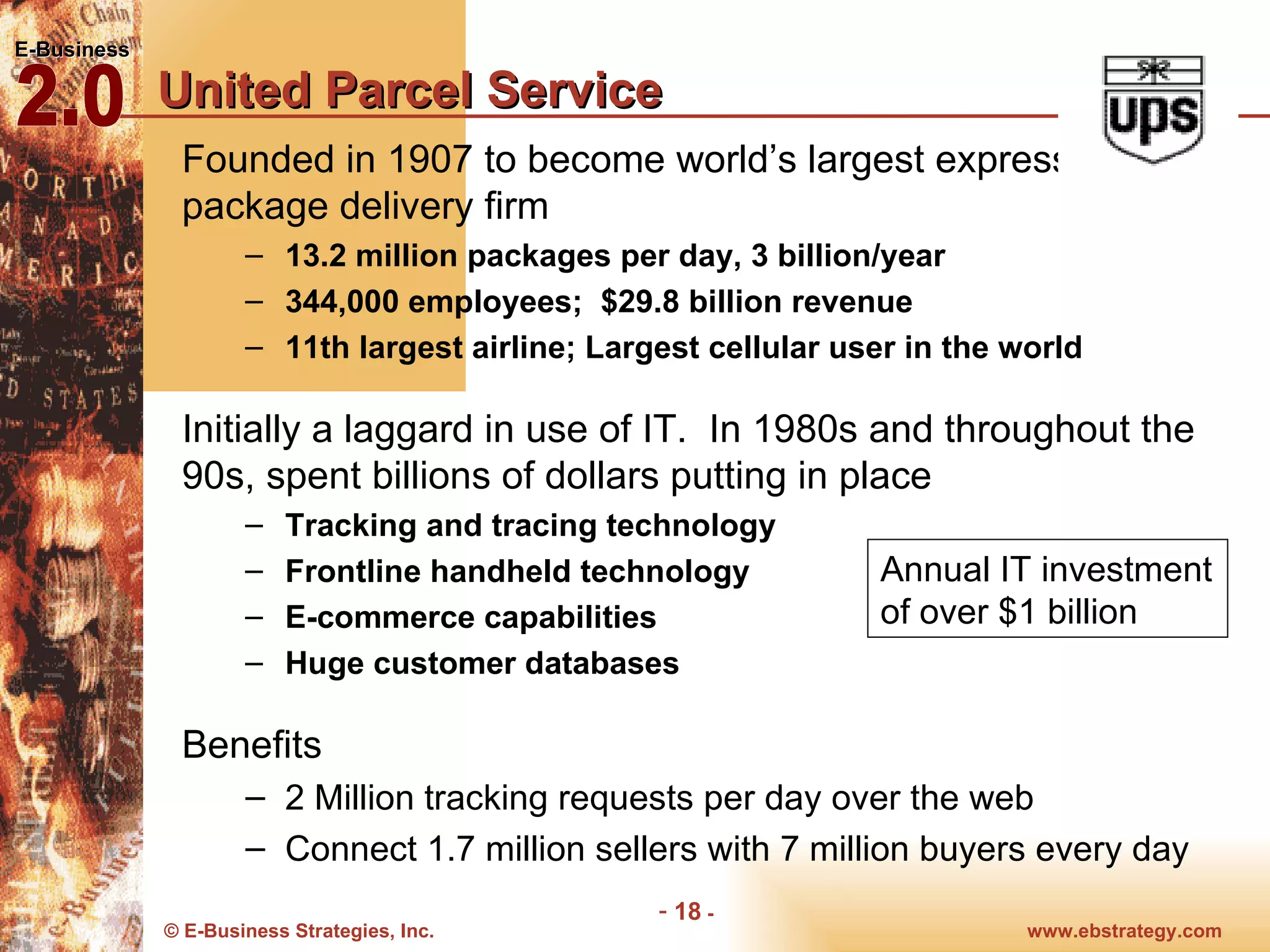
United Parcel Service Founded in 1907 to become world’s largest express and package delivery firm 13.2 million packages per day, 3 billion/year 344,000 employees;  $29.8 billion revenue  11th largest airline; Largest cellular user in the world Initially a laggard in use of IT.  In 1980s and throughout the 90s, spent billions of dollars putting in place Tracking and tracing technology Frontline handheld technology E-commerce capabilities Huge customer databases  Benefits 2 Million tracking requests per day over the web  Connect 1.7 million sellers with 7 million buyers every day Annual IT investment of over $1 billion
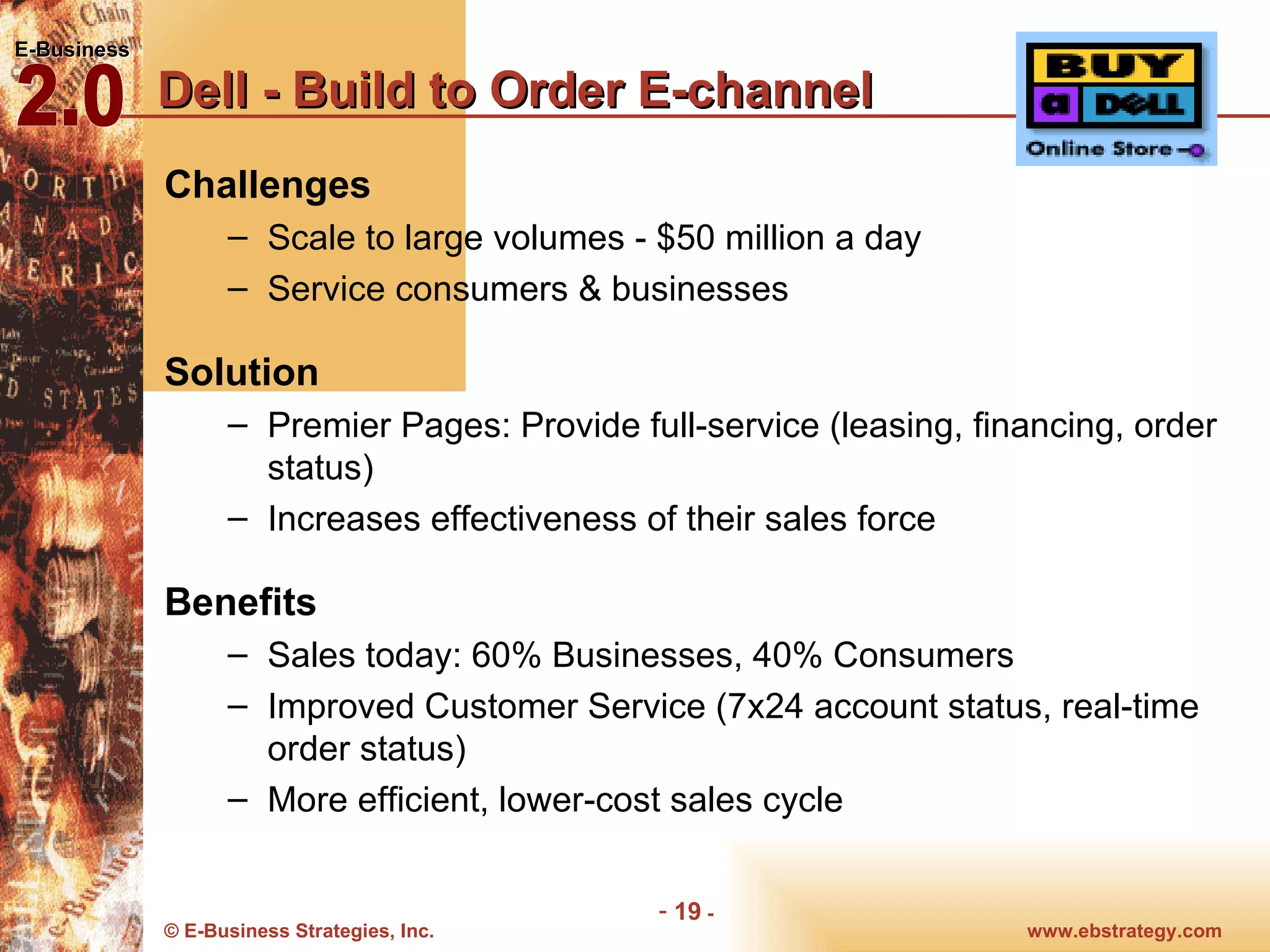
Dell - Build to Order E-channel Challenges Scale to large volumes - $50 million a day Service consumers & businesses  Solution Premier Pages: Provide full-service (leasing, financing, order status) Increases effectiveness of their sales force Benefits Sales today: 60% Businesses, 40% Consumers Improved Customer Service (7x24 account status, real-time order status) More efficient, lower-cost sales cycle
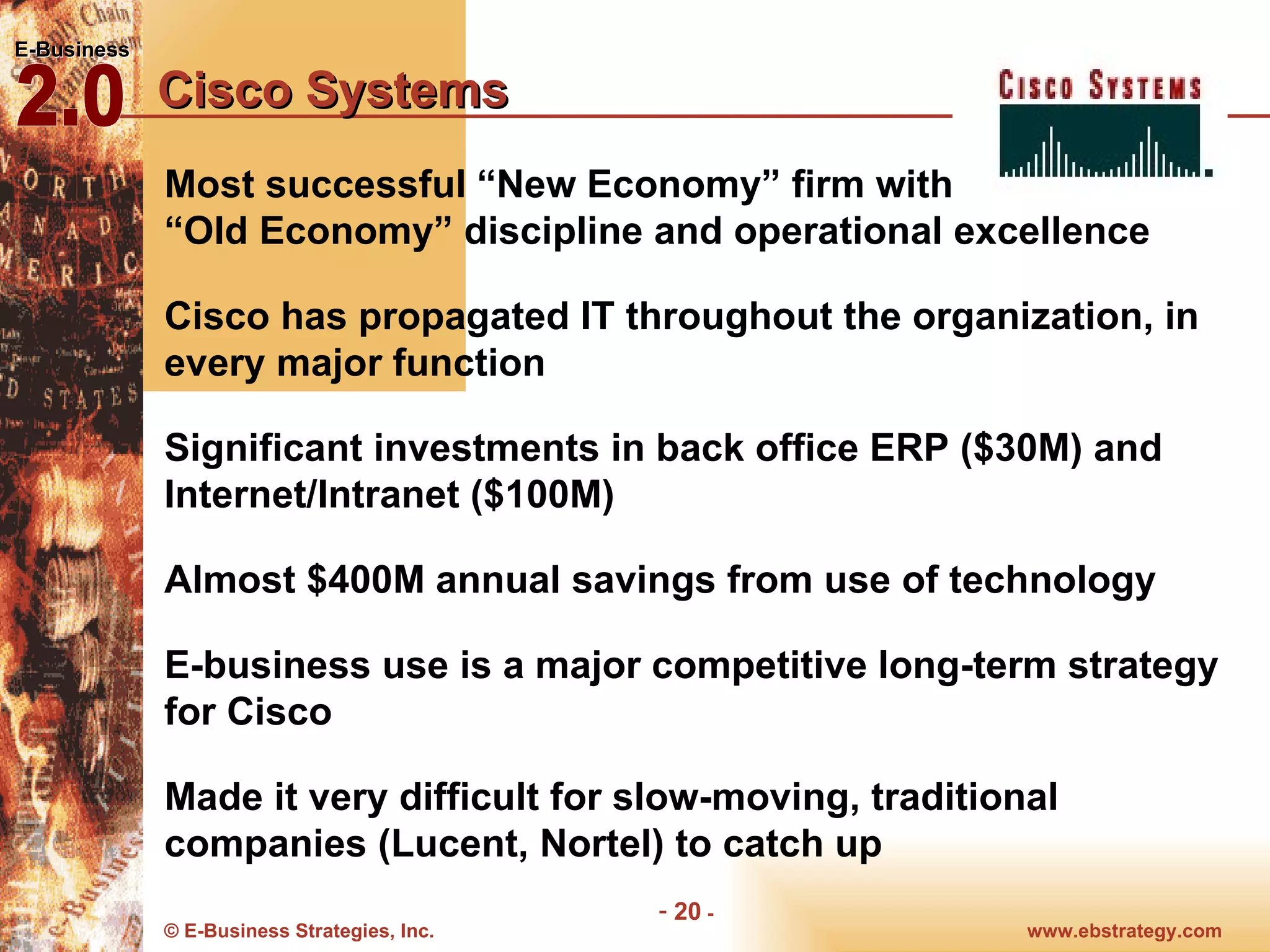
Cisco Systems Most successful “New Economy” firm with  “Old Economy” discipline and operational excellence Cisco has propagated IT throughout the organization, in every major function Significant investments in back office ERP ($30M) and Internet/Intranet ($100M) Almost $400M annual savings from use of technology E-business use is a major competitive long-term strategy for Cisco Made it very difficult for slow-moving, traditional companies (Lucent, Nortel) to catch up
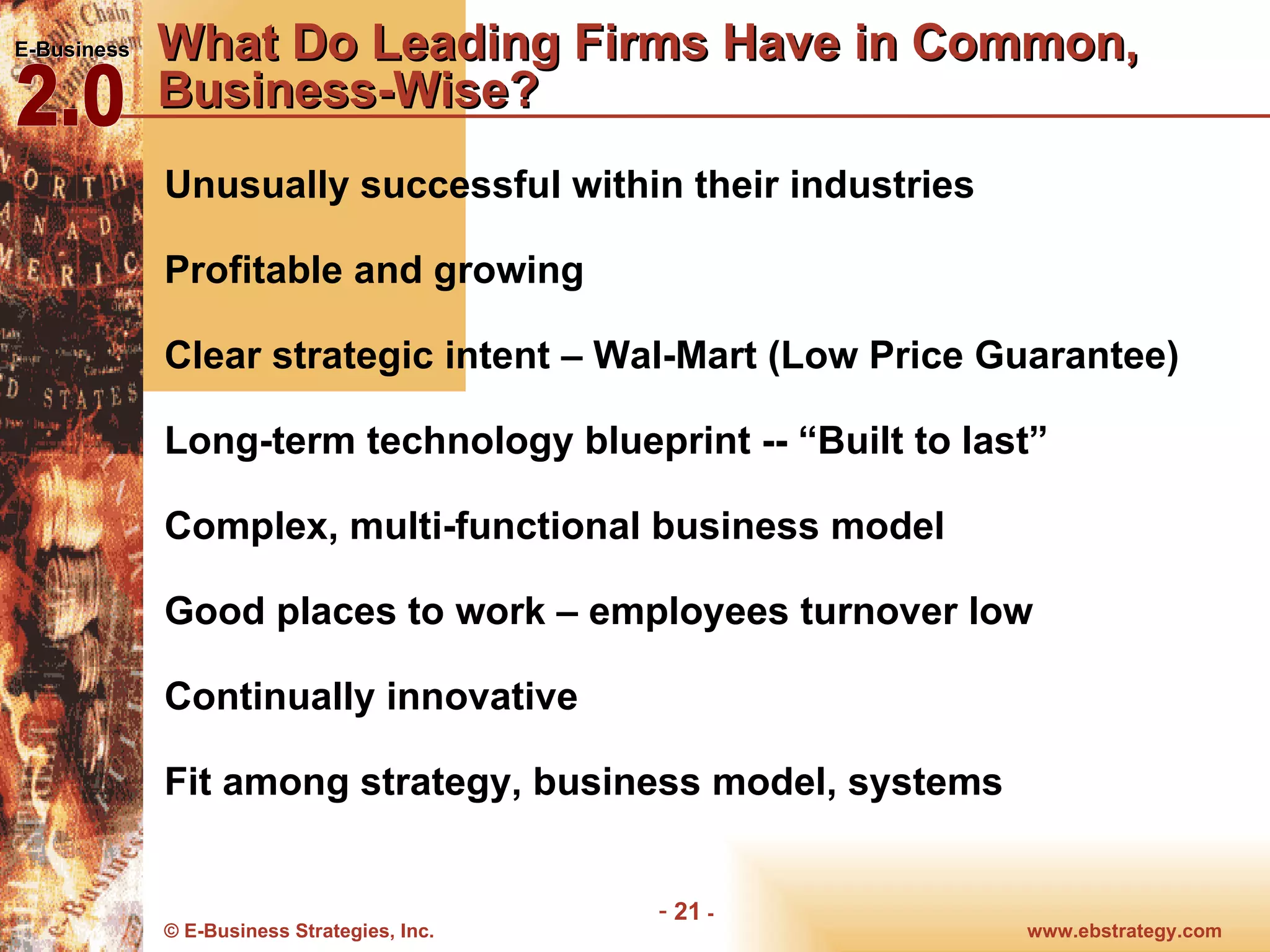
What Do Leading Firms Have in Common, Business-Wise? Unusually successful within their industries Profitable and growing Clear strategic intent – Wal-Mart (Low Price Guarantee) Long-term technology blueprint -- “Built to last” Complex, multi-functional business model Good places to work – employees turnover low  Continually innovative Fit among strategy, business model, systems
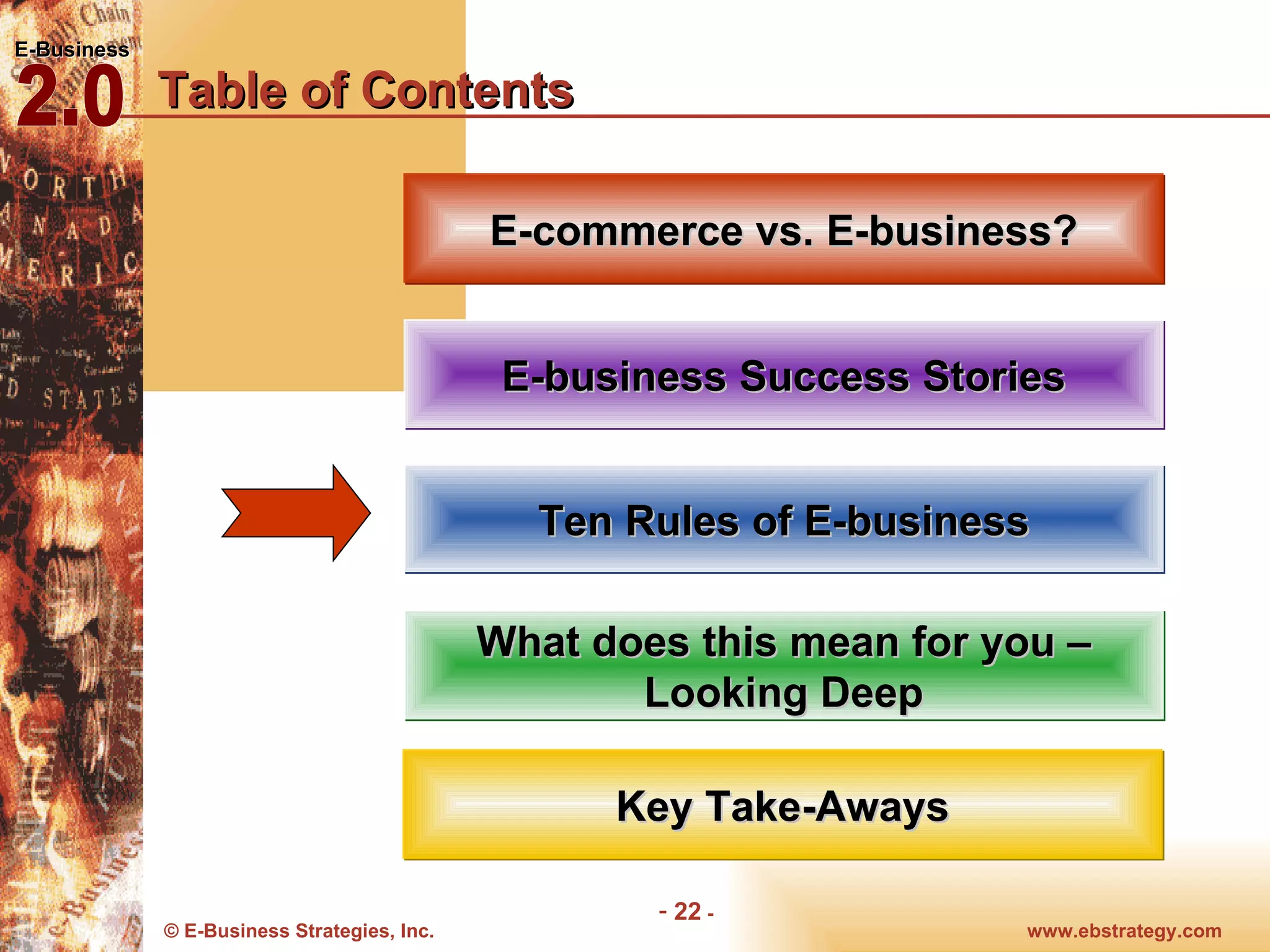
Table of Contents Ten Rules of E-business E-business Success Stories What does this mean for you – Looking Deep E-commerce vs. E-business? Key Take-Aways
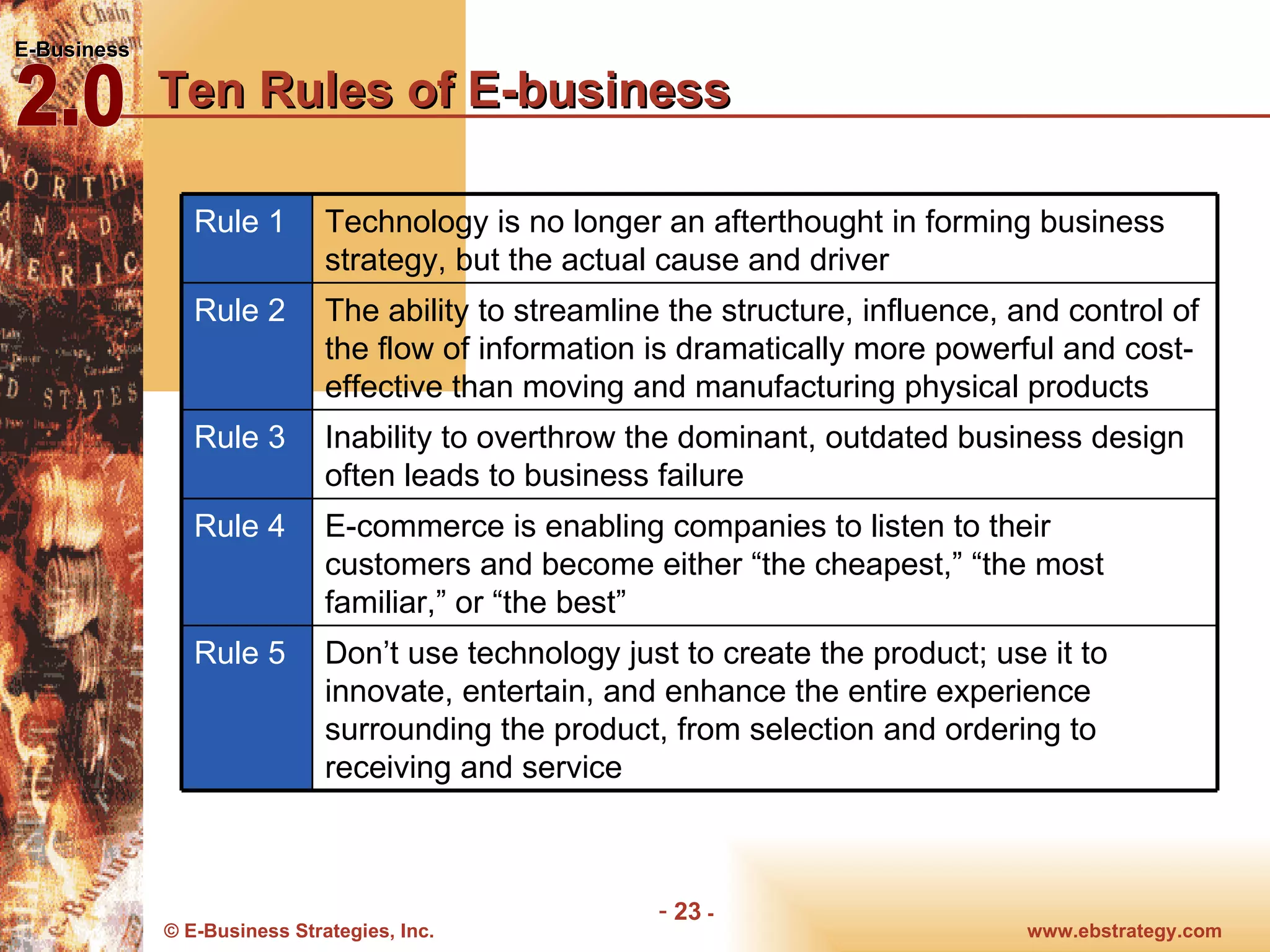
Ten Rules of E-business Don’t use technology just to create the product; use it to innovate, entertain, and enhance the entire experience surrounding the product, from selection and ordering to receiving and service Rule 5 E-commerce is enabling companies to listen to their customers and become either “the cheapest,” “the most familiar,” or “the best” Rule 4 Inability to overthrow the dominant, outdated business design often leads to business failure Rule 3 The ability to streamline the structure, influence, and control of the flow of information is dramatically more powerful and cost-effective than moving and manufacturing physical products Rule 2 Technology is no longer an afterthought in forming business strategy, but the actual cause and driver Rule 1
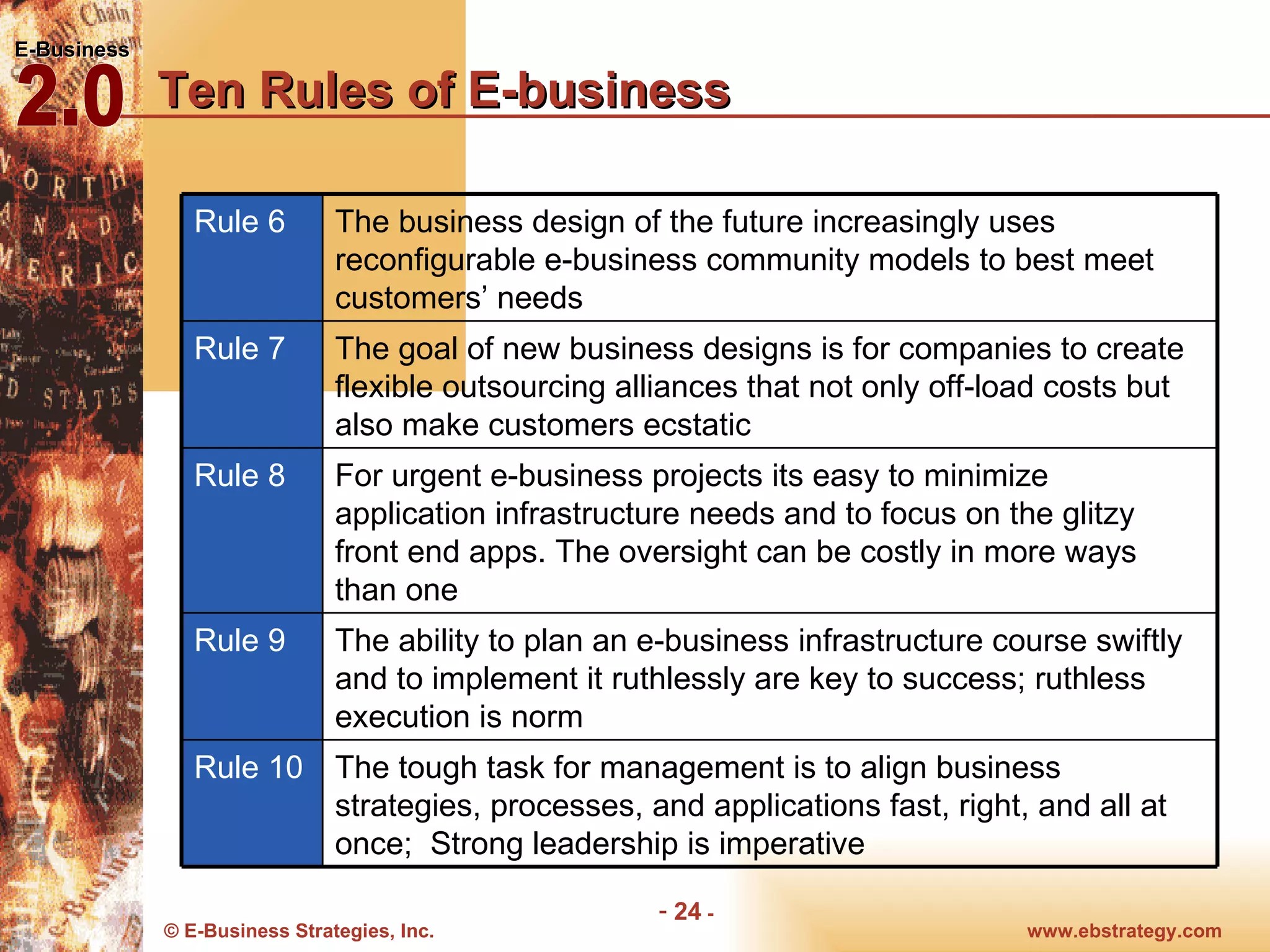
Ten Rules of E-business The tough task for management is to align business strategies, processes, and applications fast, right, and all at once;  Strong leadership is imperative Rule 10 The ability to plan an e-business infrastructure course swiftly and to implement it ruthlessly are key to success; ruthless execution is norm Rule 9 For urgent e-business projects its easy to minimize application infrastructure needs and to focus on the glitzy front end apps. The oversight can be costly in more ways than one Rule 8 The goal of new business designs is for companies to create flexible outsourcing alliances that not only off-load costs but also make customers ecstatic Rule 7 The business design of the future increasingly uses reconfigurable e-business community models to best meet customers’ needs Rule 6
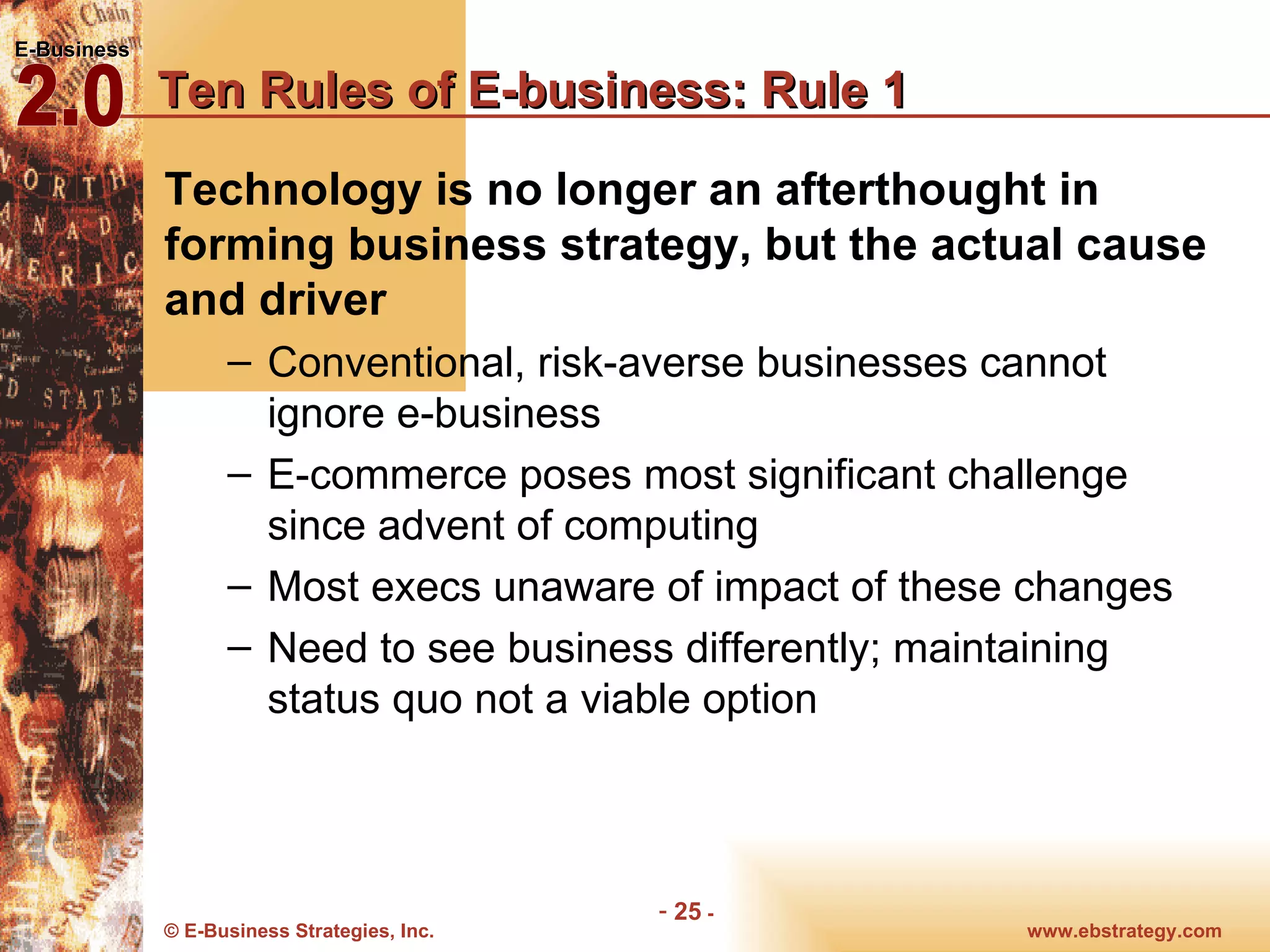
Ten Rules of E-business: Rule 1 Technology is no longer an afterthought in forming business strategy, but the actual cause and driver Conventional, risk-averse businesses cannot ignore e-business E-commerce poses most significant challenge since advent of computing Most execs unaware of impact of these changes Need to see business differently; maintaining status quo not a viable option
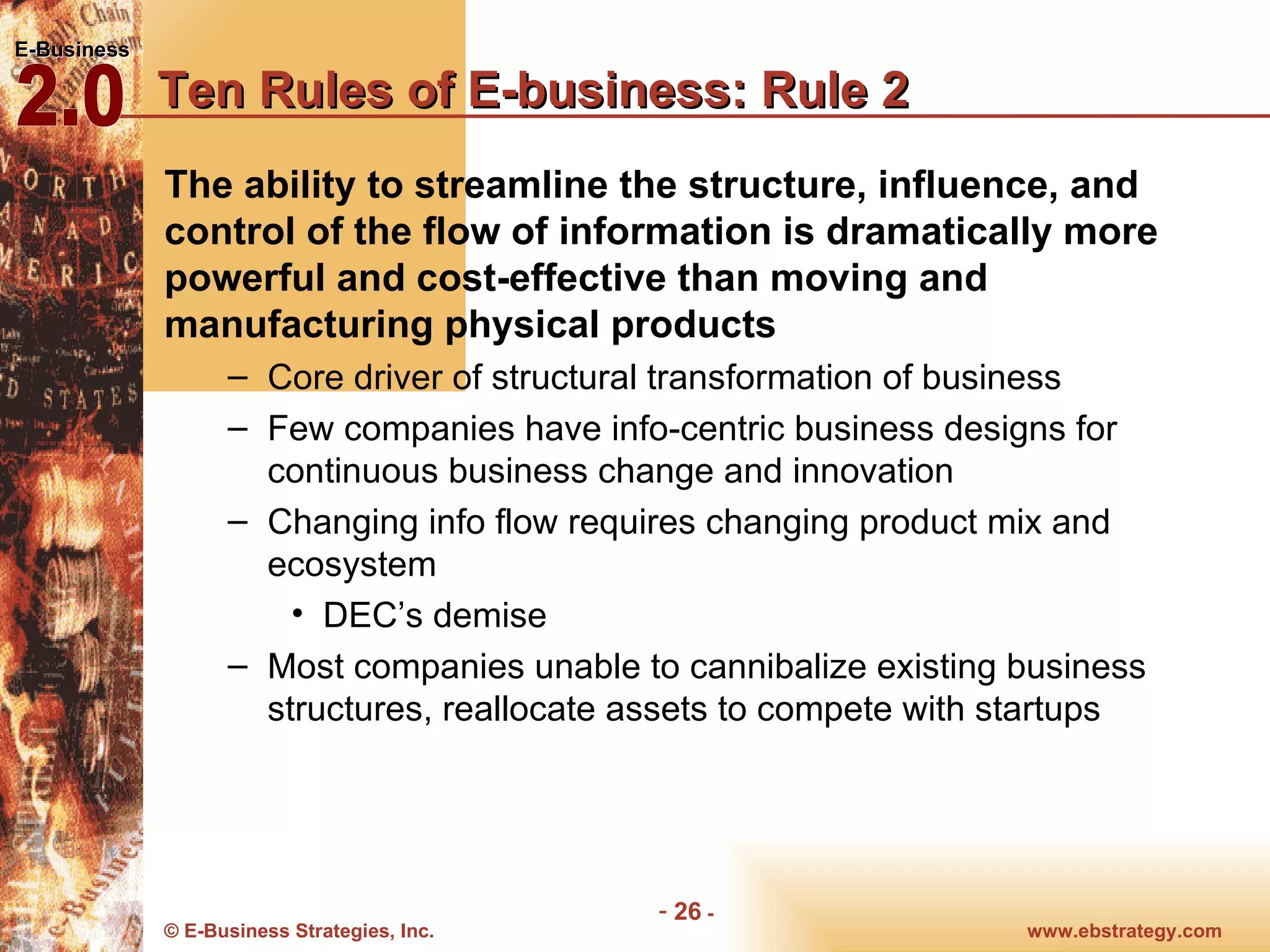
Ten Rules of E-business: Rule 2 The ability to streamline the structure, influence, and control of the flow of information is dramatically more powerful and cost-effective than moving and manufacturing physical products Core driver of structural transformation of business Few companies have info-centric business designs for continuous business change and innovation Changing info flow requires changing product mix and ecosystem DEC’s demise Most companies unable to cannibalize existing business structures, reallocate assets to compete with startups
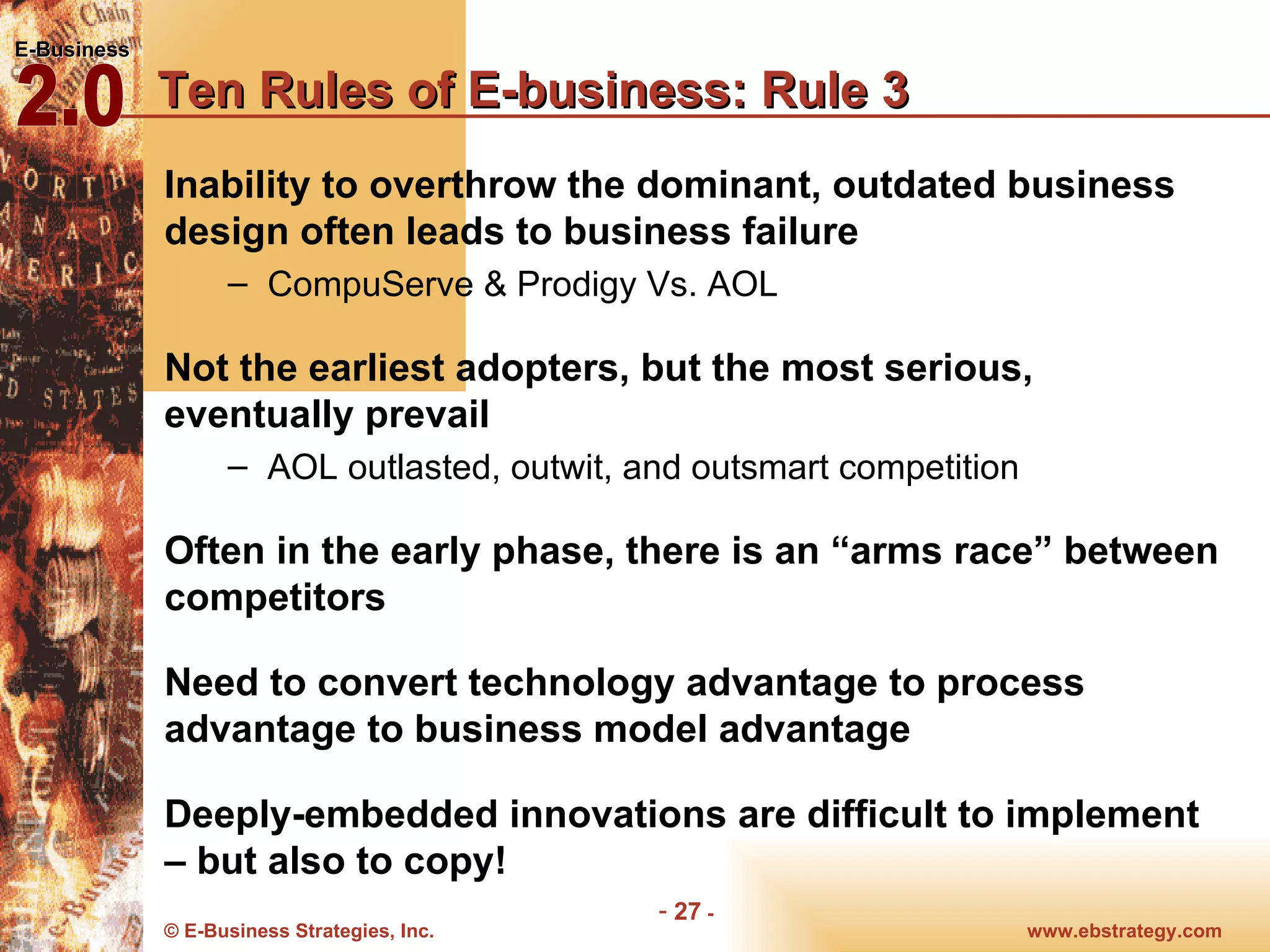
Ten Rules of E-business: Rule 3 Inability to overthrow the dominant, outdated business design often leads to business failure CompuServe & Prodigy Vs. AOL Not the earliest adopters, but the most serious, eventually prevail AOL outlasted, outwit, and outsmart competition Often in the early phase, there is an “arms race” between competitors Need to convert technology advantage to process advantage to business model advantage Deeply-embedded innovations are difficult to implement – but also to copy!
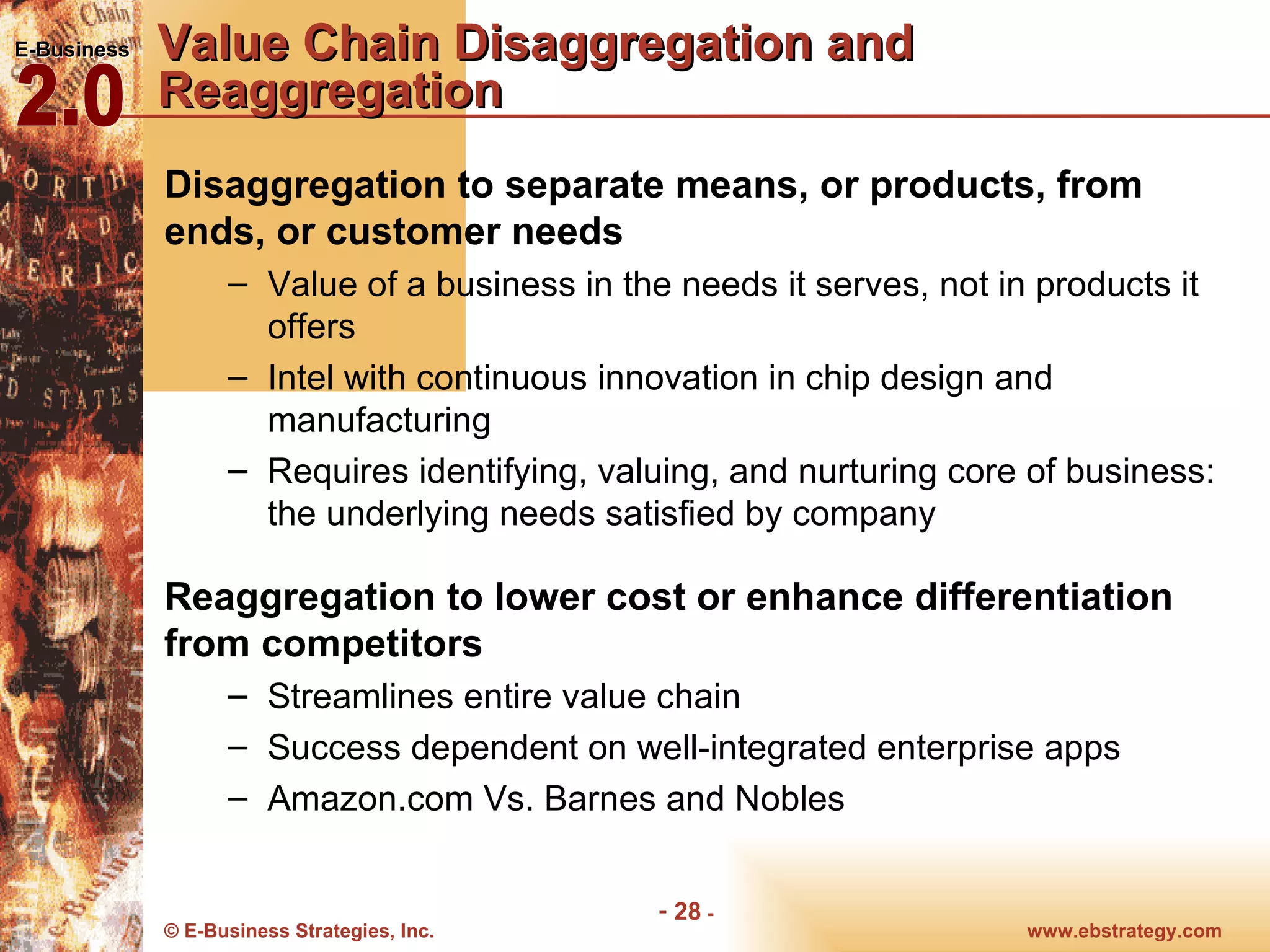
Value Chain Disaggregation and Reaggregation Disaggregation to separate means, or products, from ends, or customer needs Value of a business in the needs it serves, not in products it offers Intel with continuous innovation in chip design and manufacturing Requires identifying, valuing, and nurturing core of business: the underlying needs satisfied by company  Reaggregation to lower cost or enhance differentiation from competitors Streamlines entire value chain Success dependent on well-integrated enterprise apps Amazon.com Vs. Barnes and Nobles
The Road Ahead: Steps to a New Beginning Six steps of disaggregation and reaggregation What is the new industry structure? Configuration What does the digital consumer want? Value in terms of experience and expectations What are the new economics? How to convert value creation into revenue? How do you engineer the end-to-end value stream? How do we reorganize our business? Right partnerships Where is the value? Integration How do we implement change? New generation leaders who understand how to create digital future by design and intent, not by accident
Challenging Traditional Definitions of Value Customers need businesses to improve Speed of service Convenience Personalization Price Managers should ask how they can use technology to create new value proposition for the customer Domino’s Pizza, Dell, Amazon.com Ability to view world from customers’ perspective prevents visionary companies from starting in wrong place and ending up at wrong destination Market segmentation analysis difficult to execute in turbulent environment
Changing the Notion of Value: E-commerce Web and ecommerce have accelerated value innovation in speed, convenience, personalization and price dimensions of a service Changed underlying value proposition Customer’s looking for cheapest, most familiar, or best quality product A product or service that is 98 percent as good, unfamiliar or costs 50 cents more will not survive Companies following such middle-of-the-road strategies will underperform
Ten Rules of E-business: Rule 4 E-commerce is enabling companies to listen to their customers and become either “the cheapest,” “the most familiar,” or “the best” “ The cheapest” not synonymous with inferior quality Southwest’s “No Frills Flying” Wal-Mart’s “Everyday Low Prices” “ The most familiar” means customers know what to expect McDonald’s, Coca-Cola took decades to build brand AOL and Yahoo carved out strong identities in only a few years using technology
Ten Rules of E-business: Rule 4 Being “the best”  Reinventing service processes to enhance quality Turning company on a dime to move in more profitable directions Raising relationships with customers and suppliers to unprecedented levels of cooperation and trust Amercian Express’ Return Protection Plan
Ten Rules of E-business: Rule 5 Don’t use technology just to create the product; use it to innovate, entertain, and enhance the entire experience surrounding the product, from selection and ordering to receiving and service Amazon.com in the book retailing industry identified new source of customer value by streamlining consumers’ buying experience Microsoft anticipated changing customer experiences and reengineered several value chains: Travel (Expedia), Automotive (CarPoint), Real Estate (HomeAdvisor), Finance (Investor)
Ten Rules of E-business: Rule 5 CEOs must understand the threat posed by value migration Is there an Amazon.com that can squeeze margins in your business?  If not, can you create one --  “destroy your business” initiative at GE? Are any new entrants in your industry leveraging Web to rewire customer experience and change service expectations? CEOs must understand how to manage in a fast-moving environment
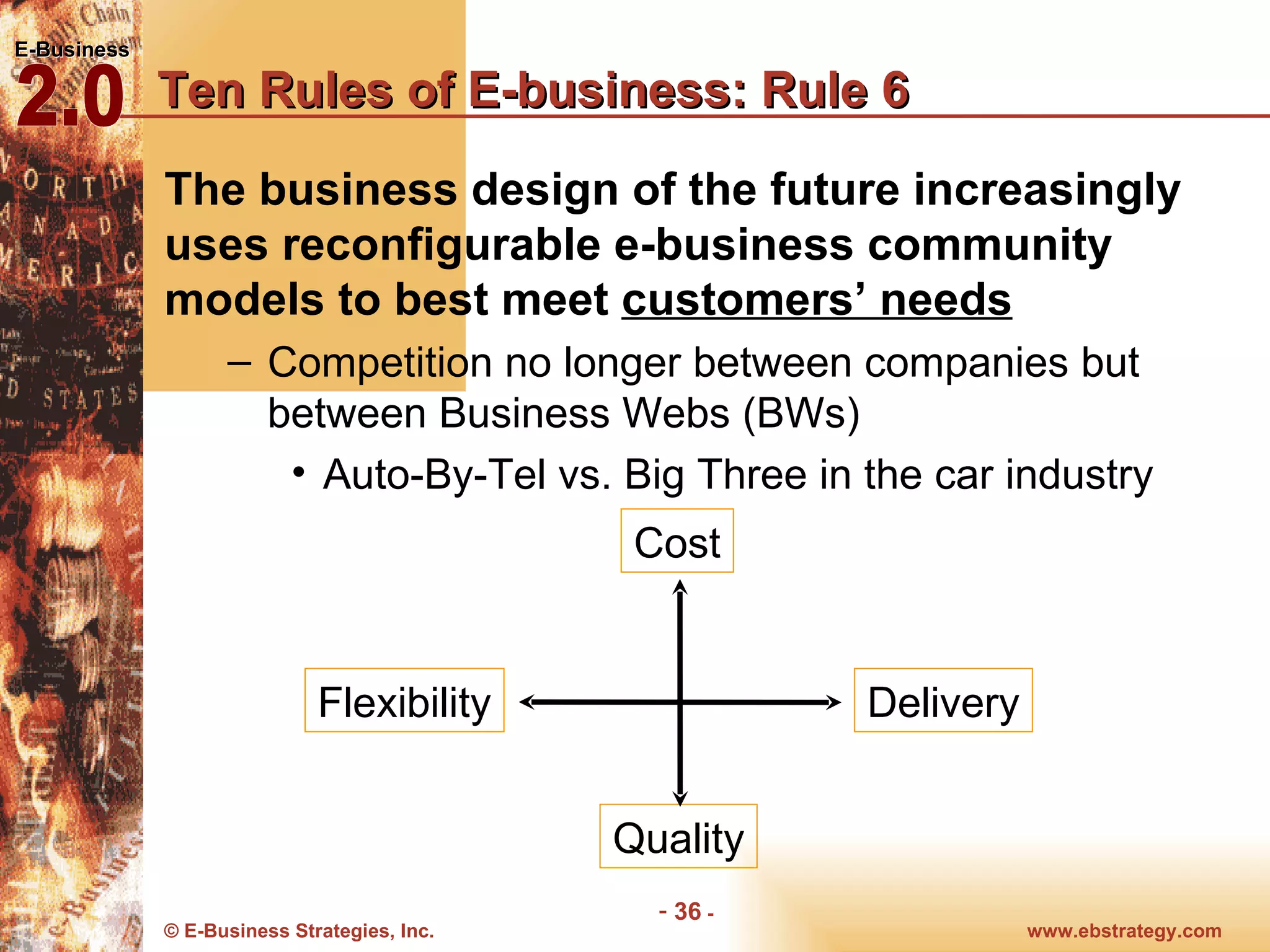
Ten Rules of E-business: Rule 6 The business design of the future increasingly uses reconfigurable e-business community models to best meet  customers’ needs Competition no longer between companies but between Business Webs (BWs) Auto-By-Tel vs. Big Three in the car industry Cost Quality Delivery Flexibility
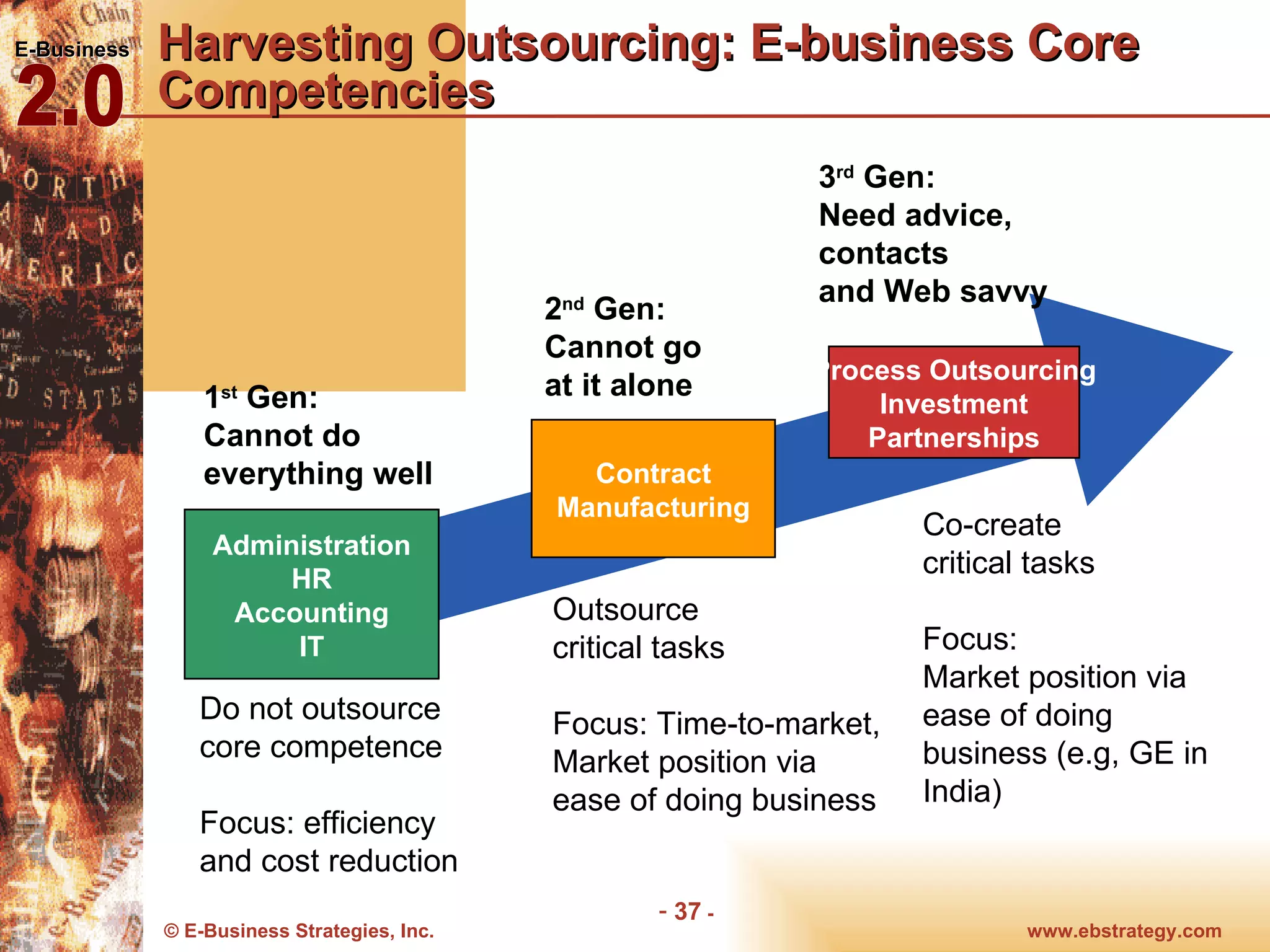
Harvesting Outsourcing: E-business Core Competencies Process Outsourcing Investment Partnerships Contract Manufacturing Administration HR Accounting IT Do not outsource core competence Focus: efficiency and cost reduction Outsource critical tasks Focus: Time-to-market,  Market position via  ease of doing business 1 st  Gen: Cannot do everything well 2 nd  Gen: Cannot go at it alone 3 rd  Gen: Need advice, contacts and Web savvy Co-create  critical tasks Focus:  Market position via  ease of doing business (e.g, GE in India)
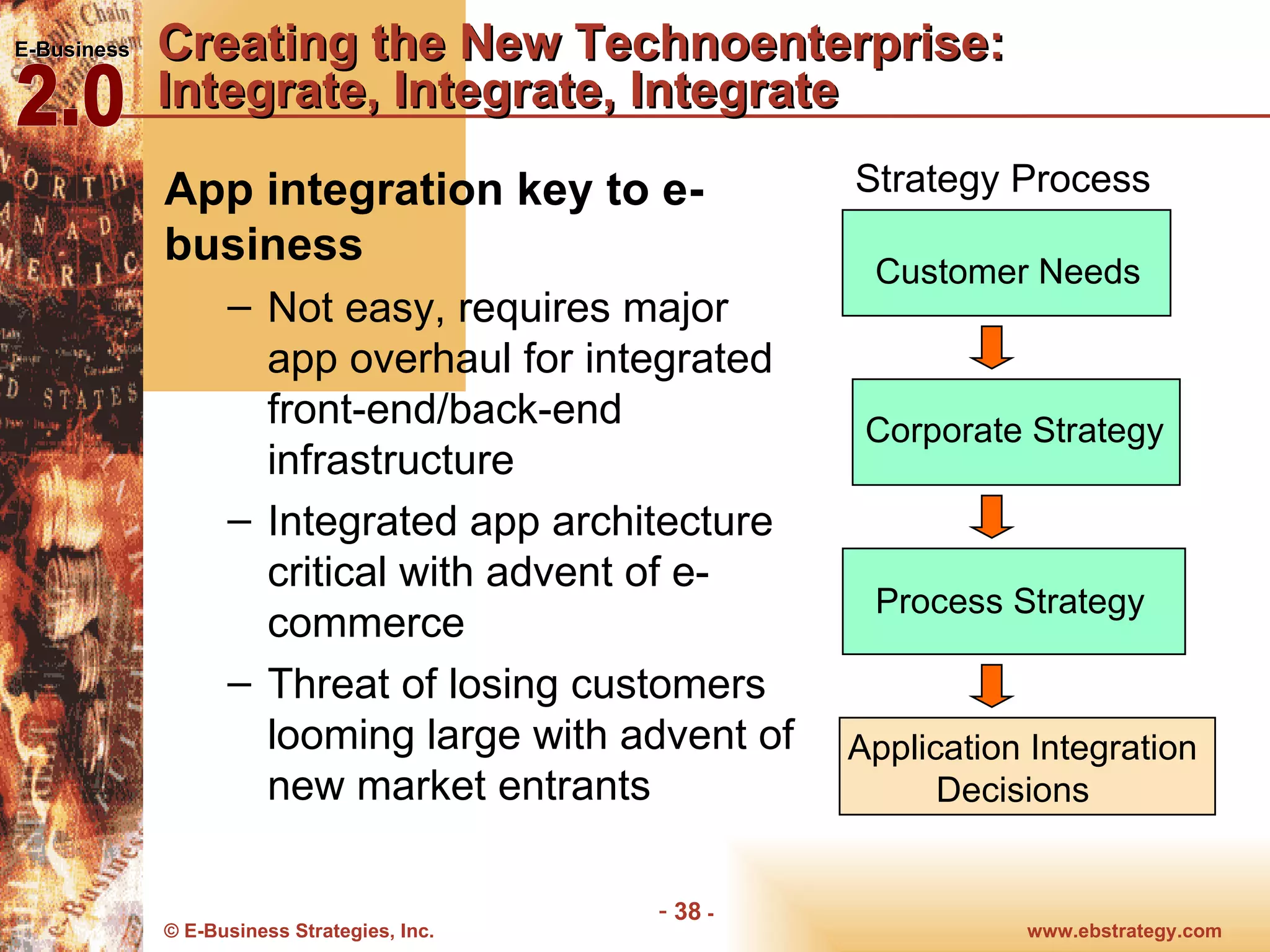
Creating the New Technoenterprise: Integrate, Integrate, Integrate App integration key to e-business Not easy, requires major app overhaul for integrated front-end/back-end infrastructure Integrated app architecture critical with advent of e-commerce Threat of losing customers looming large with advent of new market entrants Strategy Process Customer Needs Corporate Strategy Process Strategy Application Integration Decisions
Ten Rules of E-business: Rule 7 The goal of new business designs is for companies to create flexible outsourcing alliances that not only off-load costs but also make customers ecstatic E-business enabled outsourcing a big deal Pressure by shareholders for double-digit revenue growth CEOs have already reengineered, downsized and cut costs; now looking at technology to transform business model and deliver results
Ten Rules of E-business: Rule 8 For urgent e-business projects its easy to minimize application infrastructure needs and to focus on the glitzy front end apps. The oversight can be costly in more ways than one Decision to adopt e-business architecture is a business, not technical, decision The lack of attention to the back-office systems and process side of E-business is the primary reason for many project failures.
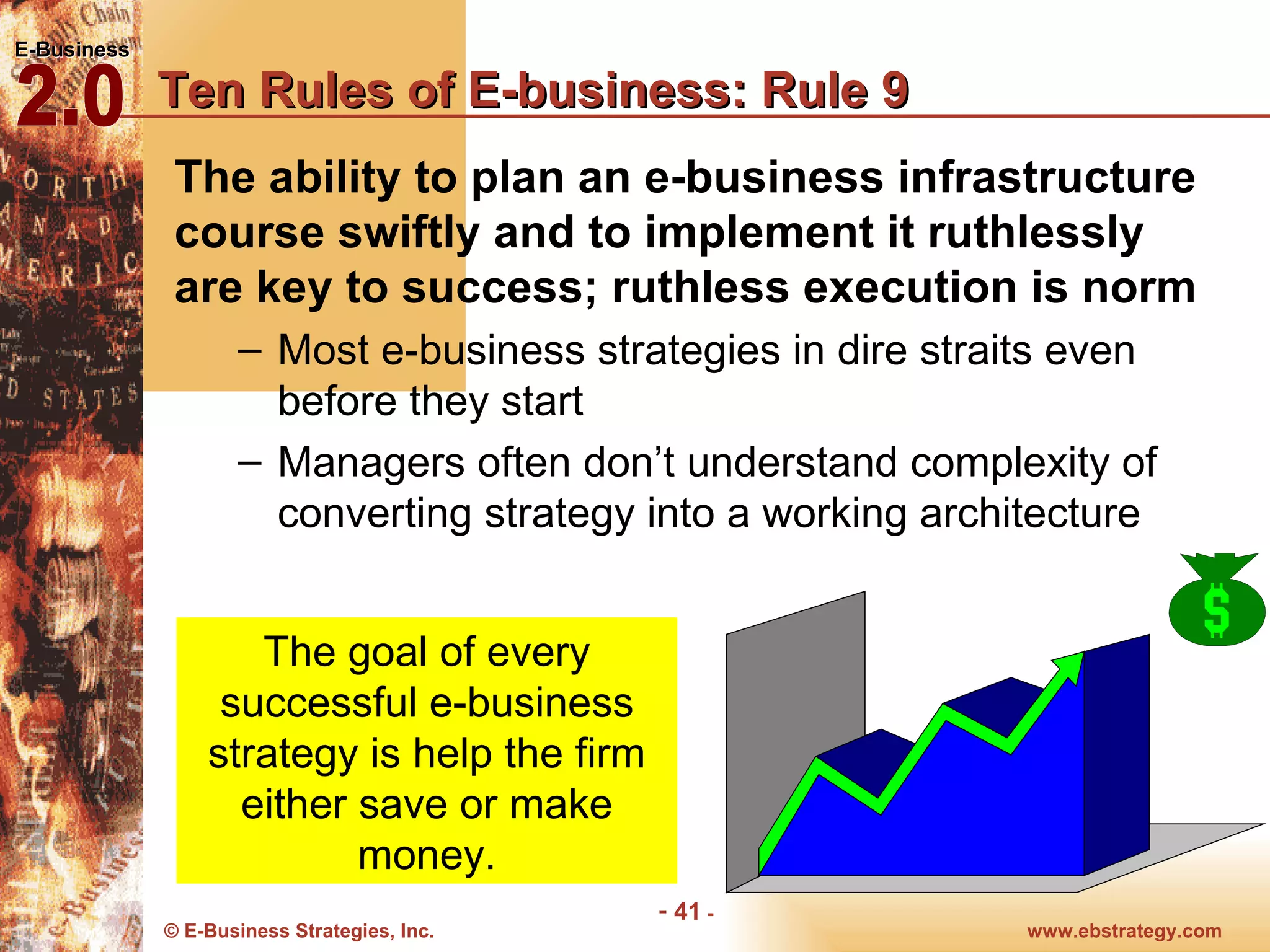
Ten Rules of E-business: Rule 9 The ability to plan an e-business infrastructure course swiftly and to implement it ruthlessly are key to success; ruthless execution is norm Most e-business strategies in dire straits even before they start Managers often don’t understand complexity of converting strategy into a working architecture The goal of every successful e-business strategy is help the firm either save or make money.
Ten Rules of E-business: Rule 10 The tough task for management is to align business strategies, processes, and applications fast, right, and all at once;  Strong leadership is imperative Many managers good at planning strategy and looking at things strategically but not at implementing strategy Implementation takes leadership, commitment and backbone “Creative destruction” or breaking free from habits of past necessary
Table of Contents Ten Rules of E-business E-business Success Stories What does this mean for managers – Looking Deep E-commerce vs. E-business? Key Take-Aways
Current Issues in E-Business Effectively consolidating the processes and IT operations resulting from mergers  Developing flexible supply chains – physical, information and financial -- to enable mass customization of products and services  Managing global supplier, production and distribution networks  The customer oriented integration -- using technology to combat the increased “commoditization” of products/services  Using self-service to cut internal and external operating costs   
Are You Ready?  Does senior management understand? Implementation side of strategy? That entire business platform is being transformed by new technology that tightly integrates internal and external processes? The risks, challenges in integrating and implementing enterprise apps necessary for an e-business enterprise? What it takes to build inter-enterprise, tech-supported processes, such as SCM, that form backbone of ebusiness? Do you have baggage – legacy apps, calcified processes, bureaucratic controls and inflexible business models
Fundamental Questions in Each Phase How will e-commerce change our customer priorities? What new things do our customers want? How can we construct a business design to meet these new customer priorities? What kind of new applications infrastructure do we need to orchestrate the new business design? What short-term and long-term investments in people, partners, and technology must we make to survive, let alone thrive in this new environment?
Are Customers Are Looking for  Internet Business Solutions  Customer attitudes — from tactical to strategic Customers require solutions — not just products and services Internet business solutions are evaluated and selected by the business decision-makers — not the technical staff Business decision-makers are looking for a trusted advisor
Table of Contents Ten Rules of E-business E-business Success Stories What does this mean for managers – Looking Deep E-commerce vs. E-business? Key Take-Aways
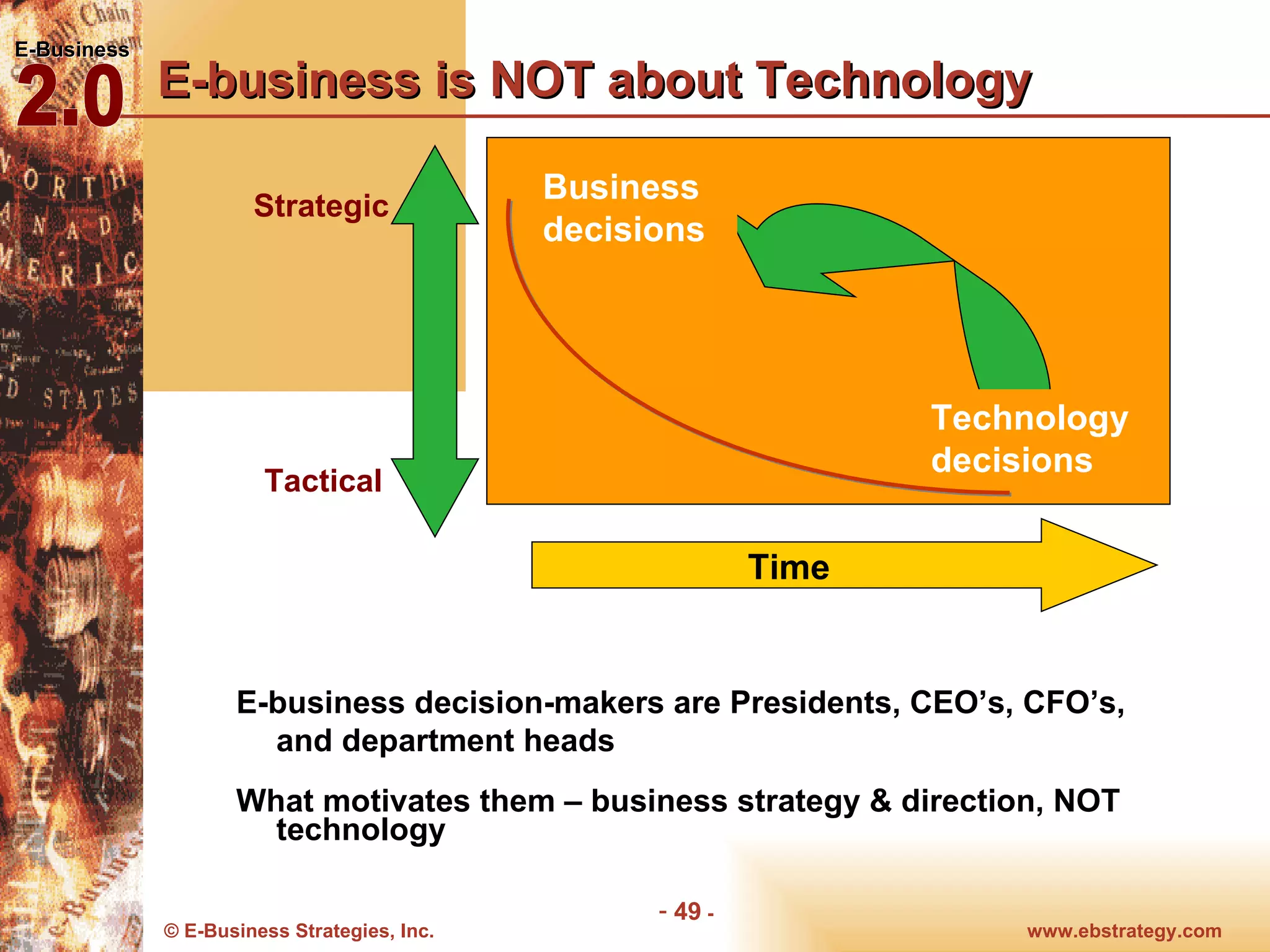
E-business is NOT about Technology E-business decision-makers are Presidents, CEO’s, CFO’s, and department heads What motivates them – business strategy & direction, NOT technology  Time Tactical Strategic Business decisions Technology decisions
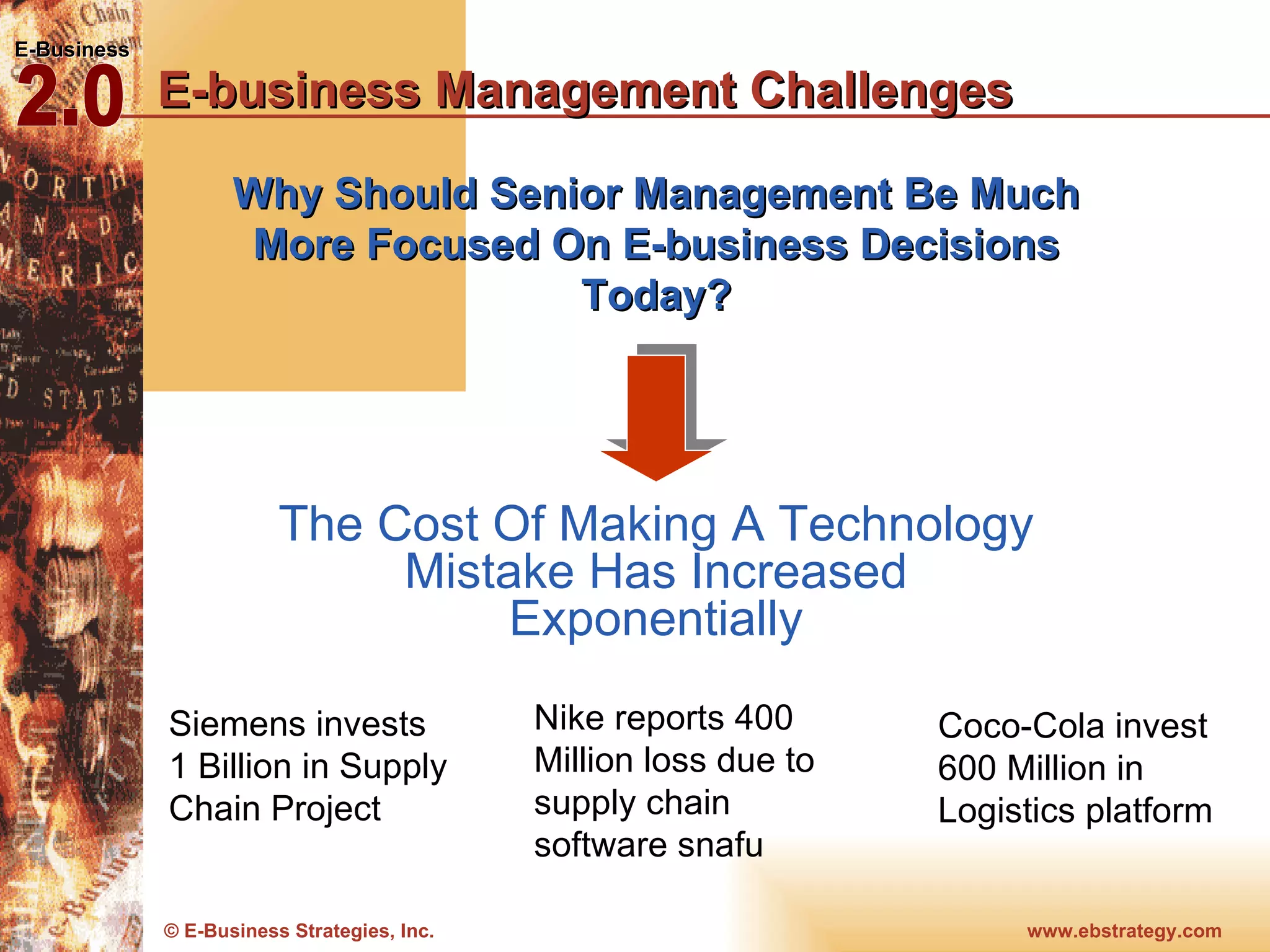
E-business Management Challenges The Cost Of Making A Technology Mistake Has Increased Exponentially Coco-Cola invest 600 Million in Logistics platform Siemens invests  1 Billion in Supply Chain Project Nike reports 400 Million loss due to supply chain software snafu  Why Should Senior Management Be Much More Focused On E-business Decisions Today?
Questions for every E-business manager How will e-business transform business models in my industry? How can e-business help to achieve my business goals and objectives? What is our e-business design that lets us compete effectively? What e-business opportunities are attractive for my company? Based on customer needs, what processes can be streamlined or enhanced by e-business?
E-Business Strategies, Inc. www.ebstrategy.com [email_address] 678-339-1236 x201 Fax - 678-339-9793

Chp01 Moving From Ec To Eb

  • 1.
    Chapter One Movingfrom E-commerce to E-business
  • 2.
    Why Study E-business?Promise: Streamlined Business Lack of Framework Reality: Blizzard of Buzzwords Customers.com CRM ERP Digital Economy SCM Portals Exchanges The scale and scope of modern IT investments requires that managers have a clear understanding of e-business fundamentals! Network Infrastructure Adaptive Supply Chains Process Automation
  • 3.
    Consequences of notStudying E-business? Poorly Designed Business Processes Persistent Channel Conflicts & Cross-Department Tensions Locally Optimized Business Processes Order Fulfillment ERP CRM Procurement Incompatible Projects Resistance to Changes
  • 4.
    Need for aRobust Framework E-business Course Goals Rationalize buzzwords Recognize commonalties across business environments Framework for designing more effective new systems Provide a Managerial Perspective A set of basic principles Understand how to map business needs to e-business solutions Synthesis Information Technology (IT) changes, but management principles persist!
  • 5.
    Framework for BookEnable Business Strategies and Processes E-business Applications IT Infrastructure Drive Drive Enable What is the basic framework that ties business strategies to applications? What are the key ideas of e-business strategies and how do they translate into e-business design to align IT with business needs?
  • 6.
    Table of ContentsTen Rules of E-business E-Business Success Stories What does this mean for managers – Looking Deep E-commerce vs. E-business? Key Take-Aways
  • 7.
    E-commerce Refers toselling of products and services over the Web Transactions fall into three categories: Business-to-business (B2B) Business-to-consumer (B2C) Consumer-to-consumer (C2C) The goal of e-commerce is to reduce transaction costs
  • 8.
    E-commerce Progression E-commercehas evolved rapidly since 1995 E-commerce Maturity Functionality Brochure ware Web Storefront E-commerce Transactions 0 1 2 3 4 Communities of Interest Mega-Portals Complex Limited
  • 9.
    E-business The back-officeapplications, systems or processes that create goods and/or provide services. E-business includes: Customer Relationship Management Enterprise Resource Planning Supply Chain Management Human Resource Management Systems And more . . .
  • 10.
    E-commerce vs. E-business“ INPUTS” People Raw Material Serves Customers Product Sold “ OUTPUTS” Processes Facilities Equipment Finance People TRANSFORMATION E-business E-commerce E-business: The transformation of key business processes through the use of Internet technologies! value added
  • 11.
    E-business: All AboutManaging Business Processes A business process is a network of activities that takes one or more inputs and creates an output of value to customer Inputs E-commerce Products Services Labor & Capital Customer Feedback for control E-business Network of activities Flow Units (Raw material, people, information, etc.) Resources Process Analysis & Management
  • 12.
    E-business: Linking Today’sBusiness with Tomorrow’s Technology E-business -- includes all apps and processes enabling a company to service a transaction E-business Evolution Phase 1: Presence, information-only Phase 2: Transactions Phase 3: Profitability E-business in third phase today: Psychology of first two phases: technology would trump experience; future would belong to upstarts as eToys Psychology of this phase: experience, distribution, margins are worth something
  • 13.
    Table of ContentsTen Rules of E-business E-business Success Stories What does this mean for managers – Looking Deep E-commerce vs. E-business? Key Take-Aways
  • 14.
    E-business is ChangingAll Industries Communications Utilities Hospitality Automotive Financial Insurance Petrochemical/ Process Transportation Manufacturing Health Care Entertainment/ Hi-Tech Consumer/ Services Retail What differentiates the e-business efforts of leading companies from the pack?
  • 15.
    Visionary Firms andE-business Visionary companies understand current business designs are inadequate for doing business in the e-commerce era Can buy a $999 built-to-order PC from Dell online but not a customized $3000 color copier from Xerox Cisco can overhaul its product line every 2 years, but Kodak cannot seem to deliver rapid innovations to meet changing customer requirements Visionary companies have integrated operations to support changing customer requirements E-customers’ needs, tastes, and expectations transforming shape of the enterprise Necessary: fusion of business designs, processes, apps, and systems on an unprecedented scale
  • 16.
    Visionary Firms andE-business Management at leading companies often ask: How will ecommerce change our customer priorities? How can we construct a business design to meet these new customer priorities? What kind of new apps infrastructure do we need to orchestrate the new business design? What short-term and long-term investments in people, partners, and tech must we make to survive, let alone thrive, in the new economy?
  • 17.
    E-business Capabilities Process-based Capacities that transforms material or information and provide advantages on dimensions of cost and quality. E.g., United Parcel Service (UPS) Systems-based Capacities that are broad-based involving the entire supply chain and provide advantages of short lead times and customization. E.g., Dell Computer Organization-based Capacities that are difficult to replicate and provide abilities to master new technologies. E.g., Cisco Systems Let’s look at a few visionary companies….
  • 18.
    United Parcel ServiceFounded in 1907 to become world’s largest express and package delivery firm 13.2 million packages per day, 3 billion/year 344,000 employees; $29.8 billion revenue 11th largest airline; Largest cellular user in the world Initially a laggard in use of IT. In 1980s and throughout the 90s, spent billions of dollars putting in place Tracking and tracing technology Frontline handheld technology E-commerce capabilities Huge customer databases Benefits 2 Million tracking requests per day over the web Connect 1.7 million sellers with 7 million buyers every day Annual IT investment of over $1 billion
  • 19.
    Dell - Buildto Order E-channel Challenges Scale to large volumes - $50 million a day Service consumers & businesses Solution Premier Pages: Provide full-service (leasing, financing, order status) Increases effectiveness of their sales force Benefits Sales today: 60% Businesses, 40% Consumers Improved Customer Service (7x24 account status, real-time order status) More efficient, lower-cost sales cycle
  • 20.
    Cisco Systems Mostsuccessful “New Economy” firm with “Old Economy” discipline and operational excellence Cisco has propagated IT throughout the organization, in every major function Significant investments in back office ERP ($30M) and Internet/Intranet ($100M) Almost $400M annual savings from use of technology E-business use is a major competitive long-term strategy for Cisco Made it very difficult for slow-moving, traditional companies (Lucent, Nortel) to catch up
  • 21.
    What Do LeadingFirms Have in Common, Business-Wise? Unusually successful within their industries Profitable and growing Clear strategic intent – Wal-Mart (Low Price Guarantee) Long-term technology blueprint -- “Built to last” Complex, multi-functional business model Good places to work – employees turnover low Continually innovative Fit among strategy, business model, systems
  • 22.
    Table of ContentsTen Rules of E-business E-business Success Stories What does this mean for you – Looking Deep E-commerce vs. E-business? Key Take-Aways
  • 23.
    Ten Rules ofE-business Don’t use technology just to create the product; use it to innovate, entertain, and enhance the entire experience surrounding the product, from selection and ordering to receiving and service Rule 5 E-commerce is enabling companies to listen to their customers and become either “the cheapest,” “the most familiar,” or “the best” Rule 4 Inability to overthrow the dominant, outdated business design often leads to business failure Rule 3 The ability to streamline the structure, influence, and control of the flow of information is dramatically more powerful and cost-effective than moving and manufacturing physical products Rule 2 Technology is no longer an afterthought in forming business strategy, but the actual cause and driver Rule 1
  • 24.
    Ten Rules ofE-business The tough task for management is to align business strategies, processes, and applications fast, right, and all at once; Strong leadership is imperative Rule 10 The ability to plan an e-business infrastructure course swiftly and to implement it ruthlessly are key to success; ruthless execution is norm Rule 9 For urgent e-business projects its easy to minimize application infrastructure needs and to focus on the glitzy front end apps. The oversight can be costly in more ways than one Rule 8 The goal of new business designs is for companies to create flexible outsourcing alliances that not only off-load costs but also make customers ecstatic Rule 7 The business design of the future increasingly uses reconfigurable e-business community models to best meet customers’ needs Rule 6
  • 25.
    Ten Rules ofE-business: Rule 1 Technology is no longer an afterthought in forming business strategy, but the actual cause and driver Conventional, risk-averse businesses cannot ignore e-business E-commerce poses most significant challenge since advent of computing Most execs unaware of impact of these changes Need to see business differently; maintaining status quo not a viable option
  • 26.
    Ten Rules ofE-business: Rule 2 The ability to streamline the structure, influence, and control of the flow of information is dramatically more powerful and cost-effective than moving and manufacturing physical products Core driver of structural transformation of business Few companies have info-centric business designs for continuous business change and innovation Changing info flow requires changing product mix and ecosystem DEC’s demise Most companies unable to cannibalize existing business structures, reallocate assets to compete with startups
  • 27.
    Ten Rules ofE-business: Rule 3 Inability to overthrow the dominant, outdated business design often leads to business failure CompuServe & Prodigy Vs. AOL Not the earliest adopters, but the most serious, eventually prevail AOL outlasted, outwit, and outsmart competition Often in the early phase, there is an “arms race” between competitors Need to convert technology advantage to process advantage to business model advantage Deeply-embedded innovations are difficult to implement – but also to copy!
  • 28.
    Value Chain Disaggregationand Reaggregation Disaggregation to separate means, or products, from ends, or customer needs Value of a business in the needs it serves, not in products it offers Intel with continuous innovation in chip design and manufacturing Requires identifying, valuing, and nurturing core of business: the underlying needs satisfied by company Reaggregation to lower cost or enhance differentiation from competitors Streamlines entire value chain Success dependent on well-integrated enterprise apps Amazon.com Vs. Barnes and Nobles
  • 29.
    The Road Ahead:Steps to a New Beginning Six steps of disaggregation and reaggregation What is the new industry structure? Configuration What does the digital consumer want? Value in terms of experience and expectations What are the new economics? How to convert value creation into revenue? How do you engineer the end-to-end value stream? How do we reorganize our business? Right partnerships Where is the value? Integration How do we implement change? New generation leaders who understand how to create digital future by design and intent, not by accident
  • 30.
    Challenging Traditional Definitionsof Value Customers need businesses to improve Speed of service Convenience Personalization Price Managers should ask how they can use technology to create new value proposition for the customer Domino’s Pizza, Dell, Amazon.com Ability to view world from customers’ perspective prevents visionary companies from starting in wrong place and ending up at wrong destination Market segmentation analysis difficult to execute in turbulent environment
  • 31.
    Changing the Notionof Value: E-commerce Web and ecommerce have accelerated value innovation in speed, convenience, personalization and price dimensions of a service Changed underlying value proposition Customer’s looking for cheapest, most familiar, or best quality product A product or service that is 98 percent as good, unfamiliar or costs 50 cents more will not survive Companies following such middle-of-the-road strategies will underperform
  • 32.
    Ten Rules ofE-business: Rule 4 E-commerce is enabling companies to listen to their customers and become either “the cheapest,” “the most familiar,” or “the best” “ The cheapest” not synonymous with inferior quality Southwest’s “No Frills Flying” Wal-Mart’s “Everyday Low Prices” “ The most familiar” means customers know what to expect McDonald’s, Coca-Cola took decades to build brand AOL and Yahoo carved out strong identities in only a few years using technology
  • 33.
    Ten Rules ofE-business: Rule 4 Being “the best” Reinventing service processes to enhance quality Turning company on a dime to move in more profitable directions Raising relationships with customers and suppliers to unprecedented levels of cooperation and trust Amercian Express’ Return Protection Plan
  • 34.
    Ten Rules ofE-business: Rule 5 Don’t use technology just to create the product; use it to innovate, entertain, and enhance the entire experience surrounding the product, from selection and ordering to receiving and service Amazon.com in the book retailing industry identified new source of customer value by streamlining consumers’ buying experience Microsoft anticipated changing customer experiences and reengineered several value chains: Travel (Expedia), Automotive (CarPoint), Real Estate (HomeAdvisor), Finance (Investor)
  • 35.
    Ten Rules ofE-business: Rule 5 CEOs must understand the threat posed by value migration Is there an Amazon.com that can squeeze margins in your business? If not, can you create one -- “destroy your business” initiative at GE? Are any new entrants in your industry leveraging Web to rewire customer experience and change service expectations? CEOs must understand how to manage in a fast-moving environment
  • 36.
    Ten Rules ofE-business: Rule 6 The business design of the future increasingly uses reconfigurable e-business community models to best meet customers’ needs Competition no longer between companies but between Business Webs (BWs) Auto-By-Tel vs. Big Three in the car industry Cost Quality Delivery Flexibility
  • 37.
    Harvesting Outsourcing: E-businessCore Competencies Process Outsourcing Investment Partnerships Contract Manufacturing Administration HR Accounting IT Do not outsource core competence Focus: efficiency and cost reduction Outsource critical tasks Focus: Time-to-market, Market position via ease of doing business 1 st Gen: Cannot do everything well 2 nd Gen: Cannot go at it alone 3 rd Gen: Need advice, contacts and Web savvy Co-create critical tasks Focus: Market position via ease of doing business (e.g, GE in India)
  • 38.
    Creating the NewTechnoenterprise: Integrate, Integrate, Integrate App integration key to e-business Not easy, requires major app overhaul for integrated front-end/back-end infrastructure Integrated app architecture critical with advent of e-commerce Threat of losing customers looming large with advent of new market entrants Strategy Process Customer Needs Corporate Strategy Process Strategy Application Integration Decisions
  • 39.
    Ten Rules ofE-business: Rule 7 The goal of new business designs is for companies to create flexible outsourcing alliances that not only off-load costs but also make customers ecstatic E-business enabled outsourcing a big deal Pressure by shareholders for double-digit revenue growth CEOs have already reengineered, downsized and cut costs; now looking at technology to transform business model and deliver results
  • 40.
    Ten Rules ofE-business: Rule 8 For urgent e-business projects its easy to minimize application infrastructure needs and to focus on the glitzy front end apps. The oversight can be costly in more ways than one Decision to adopt e-business architecture is a business, not technical, decision The lack of attention to the back-office systems and process side of E-business is the primary reason for many project failures.
  • 41.
    Ten Rules ofE-business: Rule 9 The ability to plan an e-business infrastructure course swiftly and to implement it ruthlessly are key to success; ruthless execution is norm Most e-business strategies in dire straits even before they start Managers often don’t understand complexity of converting strategy into a working architecture The goal of every successful e-business strategy is help the firm either save or make money.
  • 42.
    Ten Rules ofE-business: Rule 10 The tough task for management is to align business strategies, processes, and applications fast, right, and all at once; Strong leadership is imperative Many managers good at planning strategy and looking at things strategically but not at implementing strategy Implementation takes leadership, commitment and backbone “Creative destruction” or breaking free from habits of past necessary
  • 43.
    Table of ContentsTen Rules of E-business E-business Success Stories What does this mean for managers – Looking Deep E-commerce vs. E-business? Key Take-Aways
  • 44.
    Current Issues inE-Business Effectively consolidating the processes and IT operations resulting from mergers Developing flexible supply chains – physical, information and financial -- to enable mass customization of products and services Managing global supplier, production and distribution networks The customer oriented integration -- using technology to combat the increased “commoditization” of products/services Using self-service to cut internal and external operating costs  
  • 45.
    Are You Ready? Does senior management understand? Implementation side of strategy? That entire business platform is being transformed by new technology that tightly integrates internal and external processes? The risks, challenges in integrating and implementing enterprise apps necessary for an e-business enterprise? What it takes to build inter-enterprise, tech-supported processes, such as SCM, that form backbone of ebusiness? Do you have baggage – legacy apps, calcified processes, bureaucratic controls and inflexible business models
  • 46.
    Fundamental Questions inEach Phase How will e-commerce change our customer priorities? What new things do our customers want? How can we construct a business design to meet these new customer priorities? What kind of new applications infrastructure do we need to orchestrate the new business design? What short-term and long-term investments in people, partners, and technology must we make to survive, let alone thrive in this new environment?
  • 47.
    Are Customers AreLooking for Internet Business Solutions Customer attitudes — from tactical to strategic Customers require solutions — not just products and services Internet business solutions are evaluated and selected by the business decision-makers — not the technical staff Business decision-makers are looking for a trusted advisor
  • 48.
    Table of ContentsTen Rules of E-business E-business Success Stories What does this mean for managers – Looking Deep E-commerce vs. E-business? Key Take-Aways
  • 49.
    E-business is NOTabout Technology E-business decision-makers are Presidents, CEO’s, CFO’s, and department heads What motivates them – business strategy & direction, NOT technology Time Tactical Strategic Business decisions Technology decisions
  • 50.
    E-business Management ChallengesThe Cost Of Making A Technology Mistake Has Increased Exponentially Coco-Cola invest 600 Million in Logistics platform Siemens invests 1 Billion in Supply Chain Project Nike reports 400 Million loss due to supply chain software snafu Why Should Senior Management Be Much More Focused On E-business Decisions Today?
  • 51.
    Questions for everyE-business manager How will e-business transform business models in my industry? How can e-business help to achieve my business goals and objectives? What is our e-business design that lets us compete effectively? What e-business opportunities are attractive for my company? Based on customer needs, what processes can be streamlined or enhanced by e-business?
  • 52.
    E-Business Strategies, Inc.www.ebstrategy.com [email_address] 678-339-1236 x201 Fax - 678-339-9793

Editor's Notes

  • #2 The E-Business material shall at all times remain the property of E-Business Strategies, Inc. No license under any trade secrets, copyrights, or other rights is granted by this Agreement or any disclosure of Confidential Information hereunder. Any such permitted copies will be considered Confidential Information. Confidential Information of E-Business Strategies, Inc. may not be copied or reproduced by the Recipient without E-Business Strategies, Inc. prior written consent. The E-Business material may not be re-sold. It is intended to be used solely for the purpose of accompaniment of the E-Business 2.0 Roadmap for Success book in an instructional manner.
  • #18 11
  • #52 These are some of the key several key questions every manager should ask themselves as they embark on creating a business design for their company. Executives must recognize that before they get to the 21st century, they must leave past practices behind. They recognize that there is a tollbooth at the entrance to the new millennium. Not all firms will be unable to pay the toll because it requires a new type of currency — e-business leadership! Admission will not be grated to firms that continue to use yesterday's assumptions and practices. To proceed, executives need to recognize that new realities call for new mental models, new approaches and new ways to do business.
  • #53 The E-Business material shall at all times remain the property of E-Business Strategies, Inc. No license under any trade secrets, copyrights, or other rights is granted by this Agreement or any disclosure of Confidential Information hereunder. Any such permitted copies will be considered Confidential Information. Confidential Information of E-Business Strategies, Inc. may not be copied or reproduced by the Recipient without E-Business Strategies, Inc. prior written consent. The E-Business material may not be re-sold. It is intended to be used solely for the purpose of accompaniment of the E-Business 2.0 Roadmap for Success book in an instructional manner.