IOSR Journal of Electronics and Communication Engineering (IOSR-JECE)
e-ISSN: 2278-2834,p- ISSN: 2278-8735.Volume 10, Issue 6, Ver. I (Nov - Dec .2015), PP 10-15
www.iosrjournals.org
DOI: 10.9790/2834-10611015 www.iosrjournals.org 10 | Page
An Implementation and Analysis of RTS/CTS Mechanism for
Data Transfer in Wireless Network
Ramandeep Kaur1
, Reecha Sharma2
1
(M.Tech Student, Deptt. Of Electronics and Communication Engineering, Punjabi University, Patiala, India)
2
(Assistant Prof., Deptt. Of Electronics and Communication Engineering, Punjabi University, Patiala, India)
Abstrac : In this paper, the implementation and analysis of RTS/CTS mechanism for data transfer in wireless
network is being studied. The Request-To-Send (RTS) and Clear-To-Send (CTS) mechanism is widely used in
wireless networks to avoid collisions due to hidden nodes by reserving the channel for transmitting data from
source to destination. The collisions caused by the hidden nodes reduce the network throughput and efficiency.
In RTS/CTS mechanism, RTS/CTS packets set the timer for the neighboring nodes so that these nodes defer their
transmission for the entire data packet transmission period. But there may be the case when the intended
transmission completes before the expiration of this timer, so a kind of delay has been developed. To reduce this
delay, the proposed methodology in this paper provides RTR (Ready-To-Receive) packets along with RTS/CTS
packets. The receiving node sends RTR packets to notify all the neighboring nodes that the intended
communication has finished. The results show that this method improves the data transfer rate resulting in
higher throughput and network efficiency and the system will be more efficient. This will reflect in the overall
information transfer time.
Keywords:- RTS/CTS, Collision, Delay, Hidden Nodes, Wireless Network
I. Introduction
Wireless networks are becoming popular day by day and a lot of research is going on in this area.
Wireless networks are of two types: infrastructure based and peer to peer network [1]. In infrastructure based
network, two devices communicate with the help of central access point (AP) and also called wireless local area
network (WLAN). In peer to peer network, any two nodes can communicate when in range without the help of
any control point. It is also called personal area network (PAN) or ad-hoc network. It is a temporary network
that has a collection of mobile nodes connected together without the help of any pre-installed infrastructure and
centralized point [2]. The main advantages of ad-hoc networks are flexibility, low cost and robustness [3]. The
ad-hoc network can be easily set up and can tolerate natural catastrophes and wars.
In wireless network, the mobile nodes share the limited communication bandwidth [4]. The network
makes the use of Medium access control (MAC) protocol to efficiently and fairly share the communication
channels between the mobile nodes. To further enhance the efficiency of operation, carrier sense based MAC
algorithms such as Carrier Sense Multiple Access (CSMA) and CSMA with Collision Avoidance (CSMA/CA)
are used. However these protocols do not solve the problem of hidden nodes. Hidden nodes are those nodes that
are out of range of other nodes or a group of nodes.
The Request-to-send and Clear-to-Send (RTS/CTS) handshaking scheme leading to the Multiple
Access Collision Avoidance (MACA) protocol is proposed to solve the hidden node problem. According to this
scheme, if a node has the data to send to another node, it first requests for a channel by sending a short Request-
To -Send (RTS) packet to the receiving node. If the channel is free, the receiving node replies with a Clear-To-
Send (CTS) packet. Nodes that overhear RTS packet will defer transmission for a time period that is sufficient
for the transmitting node to receive the CTS packet. After receiving CTS packet, the sending node proceeds to
actual data transmission. Nodes that overhear CTS packet will back-off for the period of entire data
transmission.
In RTS/CTS protocol scheme, RTS/CTS packets have a duration field that indicates the remaining time
of the current transmission [5]. Therefore when the neighbouring nodes overhear RTS/CTS packets, they know
how long they have to defer their transmissions. These nodes record this value in a variable called the network
allocation vector (NAV) and set a timer for it so that these nodes do not interfere in communication of the
intended nodes.
However, if the communication between the intended nodes occurs within a time period that is less
than that of the timer, the neighbouring nodes have to wait even when the communication is over. So a kind of
delay has been developed. This degrades the system performance and network efficiency. Hence there is a need
of advancement in the previous technique to reduce the delay time between a RTS and CTS sequence resulting
in higher throughput and network efficiency.
An Implementation and Analysis of RTS/CTS Mechanism for Data Transfer in Wireless Network
DOI: 10.9790/2834-10611015 www.iosrjournals.org 11 | Page
This paper explains the work done for implementing RTS/CTS mechanism for data transfer in wireless
network and to reduce the RTS/CTS delay time. This paper has been organized into four sections, described as:
Section I defining the basic introduction, Section II includes challenges with RTS/CTS mechanism and III
provides the proposed methodology to solve the delay problem in RTS/CTS mechanism. In sections IV & V,
results and conclusions are drawn respectively.
II. Challenges With RTS/CTS Mechanism
In this section, challenges with RTS/CTS mechanism are being discussed.
RTS/CTS mechanism is widely used in wireless networks to solve hidden terminal problem and thus to
reduce packet collisions and increase throughput [7]. However, the present implementation of the RTS/CTS
mechanism could result in interdependencies so that nodes become unable to transmit any packets throughout
long periods of time. In figure 1 (a) [7], RTS/CTS mechanism is implemented between A and B nodes and due
to this nodes C and D get blocked and the lower half depicts the time-line. The dark bars below node C and D
indicates their NAV. In figure 1 (b) [7] false blocking problem is shown and finally false blocking problem may
give rise to dead- lock situations, at least for temporary periods in that case the throughput of the nodes involved
in the deadlock goes down to zero. Node E is unnecessarily blocked because of node D’s RTS. Therefore, node
F does not get any response to its RTS, which in turn blocks node G and so on.
(a) (b)
Figure 1: (a) IEEE 802.11 MAC (b) False blocking problem.
There are different cases of unnecessary waiting of the neighboring nodes even when either the
intended communication is over or the actual data communication does not take place. In this way, a node which
hears RTS and/or CTS sets NAV and defers its new transmission needlessly. In order to cancel the unnecessary
NAV, IEEE802.11DCF+CRTS [6] proposes CRTS (Cancel RTS) mechanism in which a sending node cancels
NAVs by sending CRTS to the neighboring nodes if the sender senses that its RTS/CTS exchange has not
succeeded. Moreover [7, 8] proposes RTS validation method to solve false blocking problem due to unneeded
NAVs set by neighboring nodes. In this method, a node that uses RTS validation assesses the state of the
channel by carrier sensing method after overhearing RTS packet and will defer no longer (i.e. cancels unneeded
NAVs) if it found that the channel is idle, otherwise it continues the deferral period. A new method for avoiding
needless transmission suspension without any new control packet and large modification of MAC protocol is
proposed in [9]. Although these protocols are able to solve unneeded NAV set by RTS, the other unneeded
NAV set by CTS is proposed to be solved in [10].
Directional antennas are used in wireless ad-hoc networks to improve the throughput and to reduce the
radio interference but it creates the deafness problem because of the beam-forming in directional antenna
operations and may result in severe performance degradation by packet drop [3]. In other words, the deafness
problem arises when a node trying to start communication with a neighbor node, but the neighbor node is busy
in communication with another node. A novel CRDMAC protocol is also proposed to solve deafness problem in
the wireless media access control (MAC) by using a sub-transmission channel and RTR (Ready-To-Receive)
packets, which modifies the IEEE 802.11 distributed coordinated function. The CRDMAC protocol uses two
sub-channels (i.e. data channel and control channel) and circular transmission of RTR packets in the control
channel to solve deafness problem. The RTR packets notify the neighboring nodes around the transmitter that
current transmission has finished and thus reduces the binary exponential back-off time of the waiting nodes.
However, this protocol can be enhanced by incorporating various parameters and Quality of Service (QoS)
requirements.
An Implementation and Analysis of RTS/CTS Mechanism for Data Transfer in Wireless Network
DOI: 10.9790/2834-10611015 www.iosrjournals.org 12 | Page
Due to the RTS/CTS mechanism, various problems arise like exposed node, masked nodes, RTS-
induced and CTS-induced problems and these problems degrade the performance of the system [11]. The
proposed method in this paper allows concurrent transmissions by utilizing the information heard from the
neighboring nodes during the exchange of control packets in the presence of hidden and exposed terminals and
the nodes also maintain the status of its own transmitter and receiver as well as that of its neighboring nodes.
III. Proposed Methodology
The proposed methodology solves delay problem in RTS/CTS sequence that is introduced due to the
needless waiting by neighbouring nodes even when the current communication completes. In this method, a
sending node sends RTS to a receiving node for the channel request; if the channel is free the receiving node
replies with CTS and also broadcasts the CTS packet to the neighbouring nodes. If the communication
completes before the expiration of the timer set by CTS packet, the receiving node sends RTR to all the
neighbouring nodes to notify them that now they can communicate with the receiving node. This way saves the
time and solves delay problem in the network. The following flowchart describes the proposed methodology:
Figure 2: Flowchart of the proposed methodology.
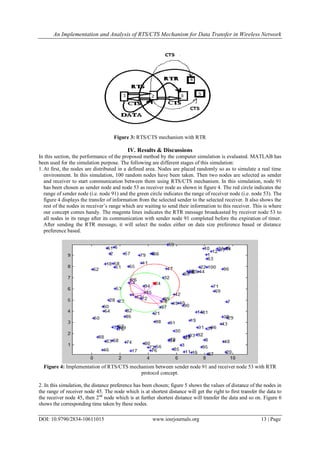
Figure 3 is showing the proposed concept with an example. In this figure, five nodes (i.e. node 1, 2, 3,
4 and 5) are given. If node 1 wants to send data to node 2, it first transmits RTS packet to request the channel to
node 2. If the channel is free, node 2 replies with CTS packet. Node 2 also broadcasts CTS packet to all nodes in
its range (i.e. nodes 3, 4 and 5) and set a timer for these nodes so that they do not interfere in communication of
node 1 and node 2 until the timer expires. But if the communication between node 1 and 2 completes before the
expiration of timer, then the RTR (Ready-To-Receive) protocol will be used to solve the delay problem in the
proposed method. If it is supposed that timer is set for 10 seconds but the communication between node 1 and
node 2 completes in 7 seconds, then node 2 will broadcasts RTR ( Ready-To-Receive) packet to nodes 3, 4 and
5 so that these nodes can start their respective transmissions. In this way, nodes 3, 4 and 5 will not unnecessarily
defer their transmission and the network efficiency and throughput will improve.
An Implementation and Analysis of RTS/CTS Mechanism for Data Transfer in Wireless Network
DOI: 10.9790/2834-10611015 www.iosrjournals.org 13 | Page
Figure 3: RTS/CTS mechanism with RTR
IV. Results & Discussions
In this section, the performance of the proposed method by the computer simulation is evaluated. MATLAB has
been used for the simulation purpose. The following are different stages of this simulation:
1.At first, the nodes are distributed in a defined area. Nodes are placed randomly so as to simulate a real time
environment. In this simulation, 100 random nodes have been taken. Then two nodes are selected as sender
and receiver to start communication between them using RTS/CTS mechanism. In this simulation, node 91
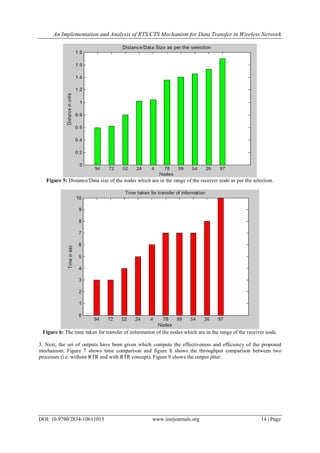
has been chosen as sender node and node 53 as receiver node as shown in figure 4. The red circle indicates the
range of sender node (i.e. node 91) and the green circle indicates the range of receiver node (i.e. node 53). The
figure 4 displays the transfer of information from the selected sender to the selected receiver. It also shows the
rest of the nodes in receiver’s range which are waiting to send their information to this receiver. This is where
our concept comes handy. The magenta lines indicates the RTR message broadcasted by receiver node 53 to
all nodes in its range after its communication with sender node 91 completed before the expiration of timer.
After sending the RTR message, it will select the nodes either on data size preference based or distance
preference based.
Figure 4: Implementation of RTS/CTS mechanism between sender node 91 and receiver node 53 with RTR
protocol concept.
2. In this simulation, the distance preference has been chosen; figure 5 shows the values of distance of the nodes in
the range of receiver node 45. The node which is at shortest distance will get the right to first transfer the data to
the receiver node 45, then 2nd
node which is at further shortest distance will transfer the data and so on. Figure 6
shows the corresponding time taken by these nodes.
An Implementation and Analysis of RTS/CTS Mechanism for Data Transfer in Wireless Network
DOI: 10.9790/2834-10611015 www.iosrjournals.org 14 | Page
Figure 5: Distance/Data size of the nodes which are in the range of the receiver node as per the selection.
Figure 6: The time taken for transfer of information of the nodes which are in the range of the receiver node.
3. Next, the set of outputs have been given which compute the effectiveness and efficiency of the proposed
mechanism. Figure 7 shows time comparison and figure 8 shows the throughput comparison between two
processes (i.e. without RTR and with RTR concept). Figure 9 shows the output jitter.
An Implementation and Analysis of RTS/CTS Mechanism for Data Transfer in Wireless Network
DOI: 10.9790/2834-10611015 www.iosrjournals.org 15 | Page
Figure 7: Time comparison Figure 8: Throughput comparison
Figure 9: Output jitter
V. Conclusion
In this paper, the RTR protocol transmission with RTS/CTS algorithm is proposed to reduce the delay
problem. In the proposed method, the receiving node broadcasts RTR packets to the nodes in its range if its
communication with the current sending node completes before the timer set by CTS packet and avoids the
needless waiting time of the neighboring nodes in its range. The simulation does the comparison of RTS/CTS
algorithm without RTR protocol and with RTR protocol. The results show that the throughput of the network
greatly improves with RTR concept and the output jitter also reduces. Thus with RTR concept, the available
bandwidth of the network can be more efficiently used.
References
[1] Vivek Jain and Dr. Dharma P. Agrawal, Enhancing Throughput of Multihop Wireless Networks using Multiple Beam Smart Antennas,
doctoral diss., University of Cincinnati, USA, 2002
[2] Priyadarshini Sabut, A Mechanism Improve the Performance of IEEE 802.11 MAC Protocol, M.Tech thesis, National Institute of
Technology, Rourkela, 2011
[3] Huang Lu, Jie Li, Zhongping Dong, Yusheng Ji, CRDMAC: An Effective Circular RTR Directional MAC Protocol for Wireless Ad
Hoc Networks, IEEE Conference on Mobile Ad-hoc and Sensor Networks, 2011, 231-237.
[4] Huei-Jiun Ju, Izhak Rubin, and Yen-Cheng Kua, An Adaptive RTS/CTS Control Mechanism for IEEE 802.11 MAC Protocol, IEEE
conference on Vehicular Technology, 2, 2003, 1469-1473.
[5] P.Srivalli, N.Nagakumari, G.Anupama, V.Srujana, Avoidance of Collision and Overhearing in Wireless Sensor Networks,
International Journal of Computer Science and Information Technologies, 2 (5), 2011, 2300-2303.
[6] T. Harada, C. Ohta and M. Morii, Improvement of TCP Throughput for IEEE 802.11DCF in Wireless Multi-hop networks, IEICE
Trans Commun J85-B(12), 2002, 2198–2208.
[7] Saikat Ray, Jeffrey B. Carruthers and David Starobinski, RTS/CTS-Induced Congestion in Ad Hoc Wireless LANs, IEEE Wireless
Communications and Networking (WCNC), 3, 2003,1516 – 1521.
[8] Saikat Ray, David Starobinski, On false Blocking in RTS/CTS Based Multihop Wireless Networks, IEEE Trans. Vehicular
Technology, 56(2), 2007, 849-862.
[9] T. Shigeyasu, T. Hirakawa, H. Matsuno and N. Morinaga, Two simple modifications for improving IEEE802.11DCF throughput
performance, WCNC 2004 IEEE Wireless Communications and Networking Conference 1, 2004, 1445–1450
[10] Tetsuya Shigeyasu, Daishi Inoue, Hiroshi Matsuno and Norihiko Morinaga, A new MAC protocol for reducing effect of needless
transmission deferment induced by missed RTS/CTS handshake, Mobile Information Systems, 5(1), 2009, 21-32
[11] Prachi Srivastava, Dayashankar Singh, A Survey on Modified RTS/CTS Mechanism, International Journal of Computer Networks and
Wireless Communications, 3(1), 2013,13-18.

B010611015

  • 1.
    IOSR Journal ofElectronics and Communication Engineering (IOSR-JECE) e-ISSN: 2278-2834,p- ISSN: 2278-8735.Volume 10, Issue 6, Ver. I (Nov - Dec .2015), PP 10-15 www.iosrjournals.org DOI: 10.9790/2834-10611015 www.iosrjournals.org 10 | Page An Implementation and Analysis of RTS/CTS Mechanism for Data Transfer in Wireless Network Ramandeep Kaur1 , Reecha Sharma2 1 (M.Tech Student, Deptt. Of Electronics and Communication Engineering, Punjabi University, Patiala, India) 2 (Assistant Prof., Deptt. Of Electronics and Communication Engineering, Punjabi University, Patiala, India) Abstrac : In this paper, the implementation and analysis of RTS/CTS mechanism for data transfer in wireless network is being studied. The Request-To-Send (RTS) and Clear-To-Send (CTS) mechanism is widely used in wireless networks to avoid collisions due to hidden nodes by reserving the channel for transmitting data from source to destination. The collisions caused by the hidden nodes reduce the network throughput and efficiency. In RTS/CTS mechanism, RTS/CTS packets set the timer for the neighboring nodes so that these nodes defer their transmission for the entire data packet transmission period. But there may be the case when the intended transmission completes before the expiration of this timer, so a kind of delay has been developed. To reduce this delay, the proposed methodology in this paper provides RTR (Ready-To-Receive) packets along with RTS/CTS packets. The receiving node sends RTR packets to notify all the neighboring nodes that the intended communication has finished. The results show that this method improves the data transfer rate resulting in higher throughput and network efficiency and the system will be more efficient. This will reflect in the overall information transfer time. Keywords:- RTS/CTS, Collision, Delay, Hidden Nodes, Wireless Network I. Introduction Wireless networks are becoming popular day by day and a lot of research is going on in this area. Wireless networks are of two types: infrastructure based and peer to peer network [1]. In infrastructure based network, two devices communicate with the help of central access point (AP) and also called wireless local area network (WLAN). In peer to peer network, any two nodes can communicate when in range without the help of any control point. It is also called personal area network (PAN) or ad-hoc network. It is a temporary network that has a collection of mobile nodes connected together without the help of any pre-installed infrastructure and centralized point [2]. The main advantages of ad-hoc networks are flexibility, low cost and robustness [3]. The ad-hoc network can be easily set up and can tolerate natural catastrophes and wars. In wireless network, the mobile nodes share the limited communication bandwidth [4]. The network makes the use of Medium access control (MAC) protocol to efficiently and fairly share the communication channels between the mobile nodes. To further enhance the efficiency of operation, carrier sense based MAC algorithms such as Carrier Sense Multiple Access (CSMA) and CSMA with Collision Avoidance (CSMA/CA) are used. However these protocols do not solve the problem of hidden nodes. Hidden nodes are those nodes that are out of range of other nodes or a group of nodes. The Request-to-send and Clear-to-Send (RTS/CTS) handshaking scheme leading to the Multiple Access Collision Avoidance (MACA) protocol is proposed to solve the hidden node problem. According to this scheme, if a node has the data to send to another node, it first requests for a channel by sending a short Request- To -Send (RTS) packet to the receiving node. If the channel is free, the receiving node replies with a Clear-To- Send (CTS) packet. Nodes that overhear RTS packet will defer transmission for a time period that is sufficient for the transmitting node to receive the CTS packet. After receiving CTS packet, the sending node proceeds to actual data transmission. Nodes that overhear CTS packet will back-off for the period of entire data transmission. In RTS/CTS protocol scheme, RTS/CTS packets have a duration field that indicates the remaining time of the current transmission [5]. Therefore when the neighbouring nodes overhear RTS/CTS packets, they know how long they have to defer their transmissions. These nodes record this value in a variable called the network allocation vector (NAV) and set a timer for it so that these nodes do not interfere in communication of the intended nodes. However, if the communication between the intended nodes occurs within a time period that is less than that of the timer, the neighbouring nodes have to wait even when the communication is over. So a kind of delay has been developed. This degrades the system performance and network efficiency. Hence there is a need of advancement in the previous technique to reduce the delay time between a RTS and CTS sequence resulting in higher throughput and network efficiency.
  • 2.
    An Implementation andAnalysis of RTS/CTS Mechanism for Data Transfer in Wireless Network DOI: 10.9790/2834-10611015 www.iosrjournals.org 11 | Page This paper explains the work done for implementing RTS/CTS mechanism for data transfer in wireless network and to reduce the RTS/CTS delay time. This paper has been organized into four sections, described as: Section I defining the basic introduction, Section II includes challenges with RTS/CTS mechanism and III provides the proposed methodology to solve the delay problem in RTS/CTS mechanism. In sections IV & V, results and conclusions are drawn respectively. II. Challenges With RTS/CTS Mechanism In this section, challenges with RTS/CTS mechanism are being discussed. RTS/CTS mechanism is widely used in wireless networks to solve hidden terminal problem and thus to reduce packet collisions and increase throughput [7]. However, the present implementation of the RTS/CTS mechanism could result in interdependencies so that nodes become unable to transmit any packets throughout long periods of time. In figure 1 (a) [7], RTS/CTS mechanism is implemented between A and B nodes and due to this nodes C and D get blocked and the lower half depicts the time-line. The dark bars below node C and D indicates their NAV. In figure 1 (b) [7] false blocking problem is shown and finally false blocking problem may give rise to dead- lock situations, at least for temporary periods in that case the throughput of the nodes involved in the deadlock goes down to zero. Node E is unnecessarily blocked because of node D’s RTS. Therefore, node F does not get any response to its RTS, which in turn blocks node G and so on. (a) (b) Figure 1: (a) IEEE 802.11 MAC (b) False blocking problem. There are different cases of unnecessary waiting of the neighboring nodes even when either the intended communication is over or the actual data communication does not take place. In this way, a node which hears RTS and/or CTS sets NAV and defers its new transmission needlessly. In order to cancel the unnecessary NAV, IEEE802.11DCF+CRTS [6] proposes CRTS (Cancel RTS) mechanism in which a sending node cancels NAVs by sending CRTS to the neighboring nodes if the sender senses that its RTS/CTS exchange has not succeeded. Moreover [7, 8] proposes RTS validation method to solve false blocking problem due to unneeded NAVs set by neighboring nodes. In this method, a node that uses RTS validation assesses the state of the channel by carrier sensing method after overhearing RTS packet and will defer no longer (i.e. cancels unneeded NAVs) if it found that the channel is idle, otherwise it continues the deferral period. A new method for avoiding needless transmission suspension without any new control packet and large modification of MAC protocol is proposed in [9]. Although these protocols are able to solve unneeded NAV set by RTS, the other unneeded NAV set by CTS is proposed to be solved in [10]. Directional antennas are used in wireless ad-hoc networks to improve the throughput and to reduce the radio interference but it creates the deafness problem because of the beam-forming in directional antenna operations and may result in severe performance degradation by packet drop [3]. In other words, the deafness problem arises when a node trying to start communication with a neighbor node, but the neighbor node is busy in communication with another node. A novel CRDMAC protocol is also proposed to solve deafness problem in the wireless media access control (MAC) by using a sub-transmission channel and RTR (Ready-To-Receive) packets, which modifies the IEEE 802.11 distributed coordinated function. The CRDMAC protocol uses two sub-channels (i.e. data channel and control channel) and circular transmission of RTR packets in the control channel to solve deafness problem. The RTR packets notify the neighboring nodes around the transmitter that current transmission has finished and thus reduces the binary exponential back-off time of the waiting nodes. However, this protocol can be enhanced by incorporating various parameters and Quality of Service (QoS) requirements.
  • 3.
    An Implementation andAnalysis of RTS/CTS Mechanism for Data Transfer in Wireless Network DOI: 10.9790/2834-10611015 www.iosrjournals.org 12 | Page Due to the RTS/CTS mechanism, various problems arise like exposed node, masked nodes, RTS- induced and CTS-induced problems and these problems degrade the performance of the system [11]. The proposed method in this paper allows concurrent transmissions by utilizing the information heard from the neighboring nodes during the exchange of control packets in the presence of hidden and exposed terminals and the nodes also maintain the status of its own transmitter and receiver as well as that of its neighboring nodes. III. Proposed Methodology The proposed methodology solves delay problem in RTS/CTS sequence that is introduced due to the needless waiting by neighbouring nodes even when the current communication completes. In this method, a sending node sends RTS to a receiving node for the channel request; if the channel is free the receiving node replies with CTS and also broadcasts the CTS packet to the neighbouring nodes. If the communication completes before the expiration of the timer set by CTS packet, the receiving node sends RTR to all the neighbouring nodes to notify them that now they can communicate with the receiving node. This way saves the time and solves delay problem in the network. The following flowchart describes the proposed methodology: Figure 2: Flowchart of the proposed methodology. Figure 3 is showing the proposed concept with an example. In this figure, five nodes (i.e. node 1, 2, 3, 4 and 5) are given. If node 1 wants to send data to node 2, it first transmits RTS packet to request the channel to node 2. If the channel is free, node 2 replies with CTS packet. Node 2 also broadcasts CTS packet to all nodes in its range (i.e. nodes 3, 4 and 5) and set a timer for these nodes so that they do not interfere in communication of node 1 and node 2 until the timer expires. But if the communication between node 1 and 2 completes before the expiration of timer, then the RTR (Ready-To-Receive) protocol will be used to solve the delay problem in the proposed method. If it is supposed that timer is set for 10 seconds but the communication between node 1 and node 2 completes in 7 seconds, then node 2 will broadcasts RTR ( Ready-To-Receive) packet to nodes 3, 4 and 5 so that these nodes can start their respective transmissions. In this way, nodes 3, 4 and 5 will not unnecessarily defer their transmission and the network efficiency and throughput will improve.
  • 4.
    An Implementation andAnalysis of RTS/CTS Mechanism for Data Transfer in Wireless Network DOI: 10.9790/2834-10611015 www.iosrjournals.org 13 | Page Figure 3: RTS/CTS mechanism with RTR IV. Results & Discussions In this section, the performance of the proposed method by the computer simulation is evaluated. MATLAB has been used for the simulation purpose. The following are different stages of this simulation: 1.At first, the nodes are distributed in a defined area. Nodes are placed randomly so as to simulate a real time environment. In this simulation, 100 random nodes have been taken. Then two nodes are selected as sender and receiver to start communication between them using RTS/CTS mechanism. In this simulation, node 91 has been chosen as sender node and node 53 as receiver node as shown in figure 4. The red circle indicates the range of sender node (i.e. node 91) and the green circle indicates the range of receiver node (i.e. node 53). The figure 4 displays the transfer of information from the selected sender to the selected receiver. It also shows the rest of the nodes in receiver’s range which are waiting to send their information to this receiver. This is where our concept comes handy. The magenta lines indicates the RTR message broadcasted by receiver node 53 to all nodes in its range after its communication with sender node 91 completed before the expiration of timer. After sending the RTR message, it will select the nodes either on data size preference based or distance preference based. Figure 4: Implementation of RTS/CTS mechanism between sender node 91 and receiver node 53 with RTR protocol concept. 2. In this simulation, the distance preference has been chosen; figure 5 shows the values of distance of the nodes in the range of receiver node 45. The node which is at shortest distance will get the right to first transfer the data to the receiver node 45, then 2nd node which is at further shortest distance will transfer the data and so on. Figure 6 shows the corresponding time taken by these nodes.
  • 5.
    An Implementation andAnalysis of RTS/CTS Mechanism for Data Transfer in Wireless Network DOI: 10.9790/2834-10611015 www.iosrjournals.org 14 | Page Figure 5: Distance/Data size of the nodes which are in the range of the receiver node as per the selection. Figure 6: The time taken for transfer of information of the nodes which are in the range of the receiver node. 3. Next, the set of outputs have been given which compute the effectiveness and efficiency of the proposed mechanism. Figure 7 shows time comparison and figure 8 shows the throughput comparison between two processes (i.e. without RTR and with RTR concept). Figure 9 shows the output jitter.
  • 6.
    An Implementation andAnalysis of RTS/CTS Mechanism for Data Transfer in Wireless Network DOI: 10.9790/2834-10611015 www.iosrjournals.org 15 | Page Figure 7: Time comparison Figure 8: Throughput comparison Figure 9: Output jitter V. Conclusion In this paper, the RTR protocol transmission with RTS/CTS algorithm is proposed to reduce the delay problem. In the proposed method, the receiving node broadcasts RTR packets to the nodes in its range if its communication with the current sending node completes before the timer set by CTS packet and avoids the needless waiting time of the neighboring nodes in its range. The simulation does the comparison of RTS/CTS algorithm without RTR protocol and with RTR protocol. The results show that the throughput of the network greatly improves with RTR concept and the output jitter also reduces. Thus with RTR concept, the available bandwidth of the network can be more efficiently used. References [1] Vivek Jain and Dr. Dharma P. Agrawal, Enhancing Throughput of Multihop Wireless Networks using Multiple Beam Smart Antennas, doctoral diss., University of Cincinnati, USA, 2002 [2] Priyadarshini Sabut, A Mechanism Improve the Performance of IEEE 802.11 MAC Protocol, M.Tech thesis, National Institute of Technology, Rourkela, 2011 [3] Huang Lu, Jie Li, Zhongping Dong, Yusheng Ji, CRDMAC: An Effective Circular RTR Directional MAC Protocol for Wireless Ad Hoc Networks, IEEE Conference on Mobile Ad-hoc and Sensor Networks, 2011, 231-237. [4] Huei-Jiun Ju, Izhak Rubin, and Yen-Cheng Kua, An Adaptive RTS/CTS Control Mechanism for IEEE 802.11 MAC Protocol, IEEE conference on Vehicular Technology, 2, 2003, 1469-1473. [5] P.Srivalli, N.Nagakumari, G.Anupama, V.Srujana, Avoidance of Collision and Overhearing in Wireless Sensor Networks, International Journal of Computer Science and Information Technologies, 2 (5), 2011, 2300-2303. [6] T. Harada, C. Ohta and M. Morii, Improvement of TCP Throughput for IEEE 802.11DCF in Wireless Multi-hop networks, IEICE Trans Commun J85-B(12), 2002, 2198–2208. [7] Saikat Ray, Jeffrey B. Carruthers and David Starobinski, RTS/CTS-Induced Congestion in Ad Hoc Wireless LANs, IEEE Wireless Communications and Networking (WCNC), 3, 2003,1516 – 1521. [8] Saikat Ray, David Starobinski, On false Blocking in RTS/CTS Based Multihop Wireless Networks, IEEE Trans. Vehicular Technology, 56(2), 2007, 849-862. [9] T. Shigeyasu, T. Hirakawa, H. Matsuno and N. Morinaga, Two simple modifications for improving IEEE802.11DCF throughput performance, WCNC 2004 IEEE Wireless Communications and Networking Conference 1, 2004, 1445–1450 [10] Tetsuya Shigeyasu, Daishi Inoue, Hiroshi Matsuno and Norihiko Morinaga, A new MAC protocol for reducing effect of needless transmission deferment induced by missed RTS/CTS handshake, Mobile Information Systems, 5(1), 2009, 21-32 [11] Prachi Srivastava, Dayashankar Singh, A Survey on Modified RTS/CTS Mechanism, International Journal of Computer Networks and Wireless Communications, 3(1), 2013,13-18.