International Research Journal of Engineering and Technology (IRJET) e-ISSN: 2395 -0056
Volume: 04 Issue: 06 | June -2017 www.irjet.net p-ISSN: 2395-0072
CIVILIZING THE NETWORK LIFESPAN OF MANETS THROUGH
COOPERATIVE MAC PROTOCOL MECHANISM
N.VANDITHA, D.VANDANA
Department of Information Technology, G.Narayanamma Institute of Science &Technology, Hyderabad
Abstract - Our ultimate aim is to implement a high
energy efficient data transmission protocol for Mobile Ad-
hoc network. We have selected our research domain
energy management system in MANET. Cooperative
communication is a hopeful technique for saving the
energy consumption in MANETs. CC is not always energy
efficient compared to direct transmission. To deal with the
tangled medium access interactions induced by relaying
and hold the benefits of such cooperation, an efficient
Cooperative Medium Access Control protocol is needed.
The existing CMAC protocols mainly focus on the
throughput enhancement while fail to investigate the
energy efficiency or network lifetime. We propose DEL-
CMAC that basis on the network lifetime extension, which
is a less transverse aspect in the related work, by
considering the energy consumption on both transmitter
and receiver.
Keywords: MANET, CSMA/CA, CMAC, Energy efficiency.
1. Introduction:
A Mobile Ad-hoc Network (MANET) is a self-
configured network of portable terminals coupled by
wireless links. Portable terminals such as cell phones,
moveable gaming devices, personal digital assistants,
(PDAs) and tablets all include wireless networking
capabilities. By participating in MANETs, these terminals
may attain the Internet when they are not in the array of
Wi-Fi access points or cellular base stations, or correspond
through each other when no network communications is
accessible. One chief issue with unremitting involvement
in MANETs is the network lifetime, since the
aforementioned wireless terminals are string powered,
and energy is a limited reserve. Cooperative
communication (CC) is a capable technique for conserving
the energy utilization in MANETs. The transmit nature of
the wireless medium (the so-called wireless broadcast
advantage) is oppressed in cooperative manner. The
wireless transmission amid a couple of terminals can be
standard and processed at other terminals for
performance gain, rather than be considered as an
interference traditionally. CC can provide gains in terms of
the required transmitting power due to the spatial
diversity achieved via user cooperation. Though, if we
acquire into report the extra dispensation and getting
energy utilization necessary for assistance, CC is not
always energy competent compared to shortest
transmission. There is an exchange among the gains in
transmitting power and the wounded in added energy
utilization overhead.
2. Related work
Space, or multiple-antenna, diversity techniques
are chiefly striking as they can be willingly shared with
other forms of assortment, e.g., time and occurrence
diversity, and quiet offer theatrical performance gains
when other forms of diversity are occupied. We urbanized
and examine little-complexity cooperative diversity
protocols that contest fading induced by multipath
broadcast in wireless networks. The essential techniques
develop space diversity accessible through cooperating
terminals’ relaying signals for an alternative.
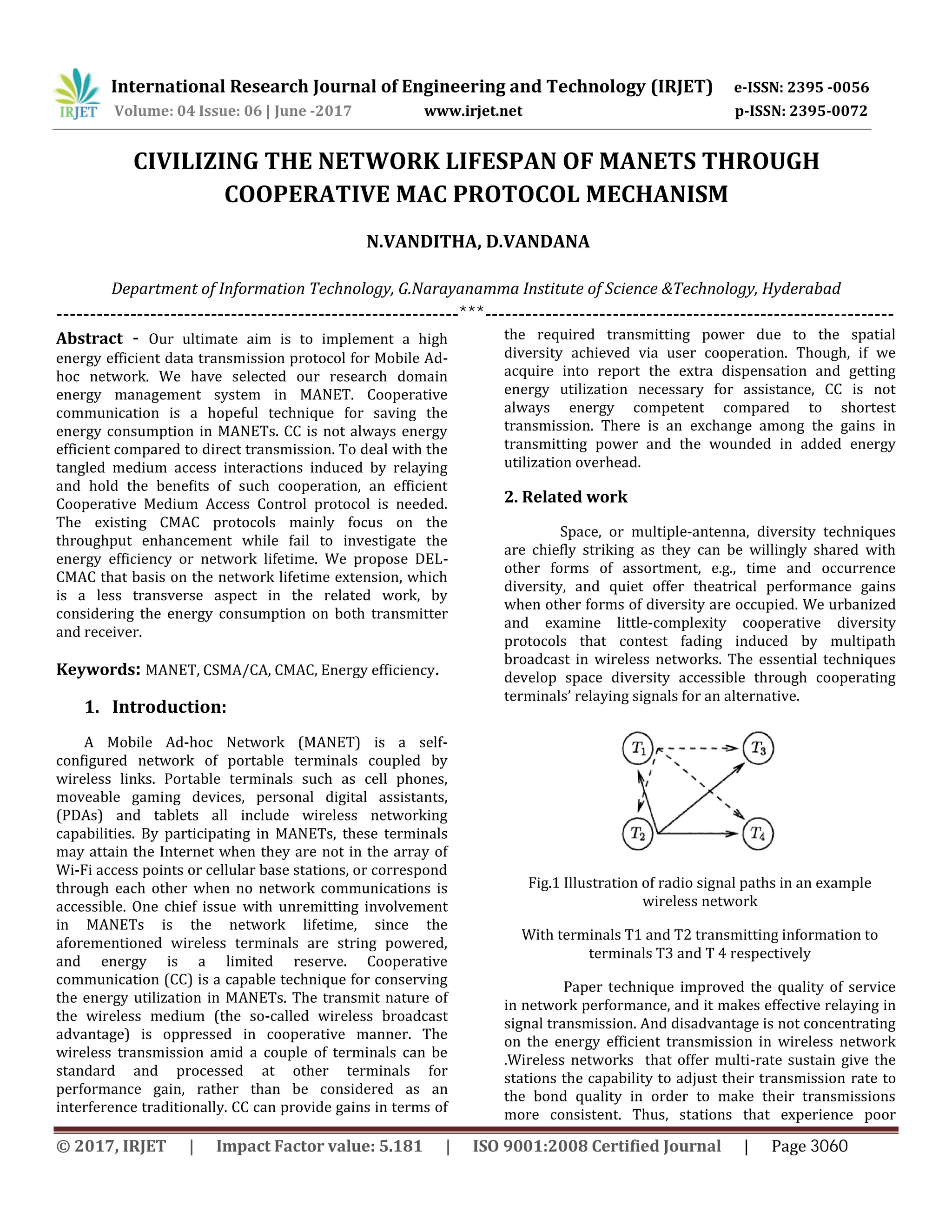
Fig.1 Illustration of radio signal paths in an example
wireless network
With terminals T1 and T2 transmitting information to
terminals T3 and T 4 respectively
Paper technique improved the quality of service
in network performance, and it makes effective relaying in
signal transmission. And disadvantage is not concentrating
on the energy efficient transmission in wireless network
.Wireless networks that offer multi-rate sustain give the
stations the capability to adjust their transmission rate to
the bond quality in order to make their transmissions
more consistent. Thus, stations that experience poor
------------------------------------------------------------***-------------------------------------------------------------
© 2017, IRJET | Impact Factor value: 5.181 | ISO 9001:2008 Certified Journal | Page 3060
International Research Journal of Engineering and Technology (IRJET) e-ISSN: 2395 -0056
Volume: 04 Issue: 06 | June -2017 www.irjet.net p-ISSN: 2395-0072
channel conditions tend to use lower instead of sending its
data directly to the destination using a Cooperative regions
for Cooperative MAC low data rate transmission, transmits
the data in a two-hop manner using the station S h as a
helper. The advantage of the two-hop transmission is that
the two links that are used are fast and thus the overall
time for the transmission from the source to the
destination is reduced. When the helper receives the
casing from the source, it retransmits it to the destination
after a SIFS time, and thus avoids need to compete for the
standard. After the response of the edge transmission rates
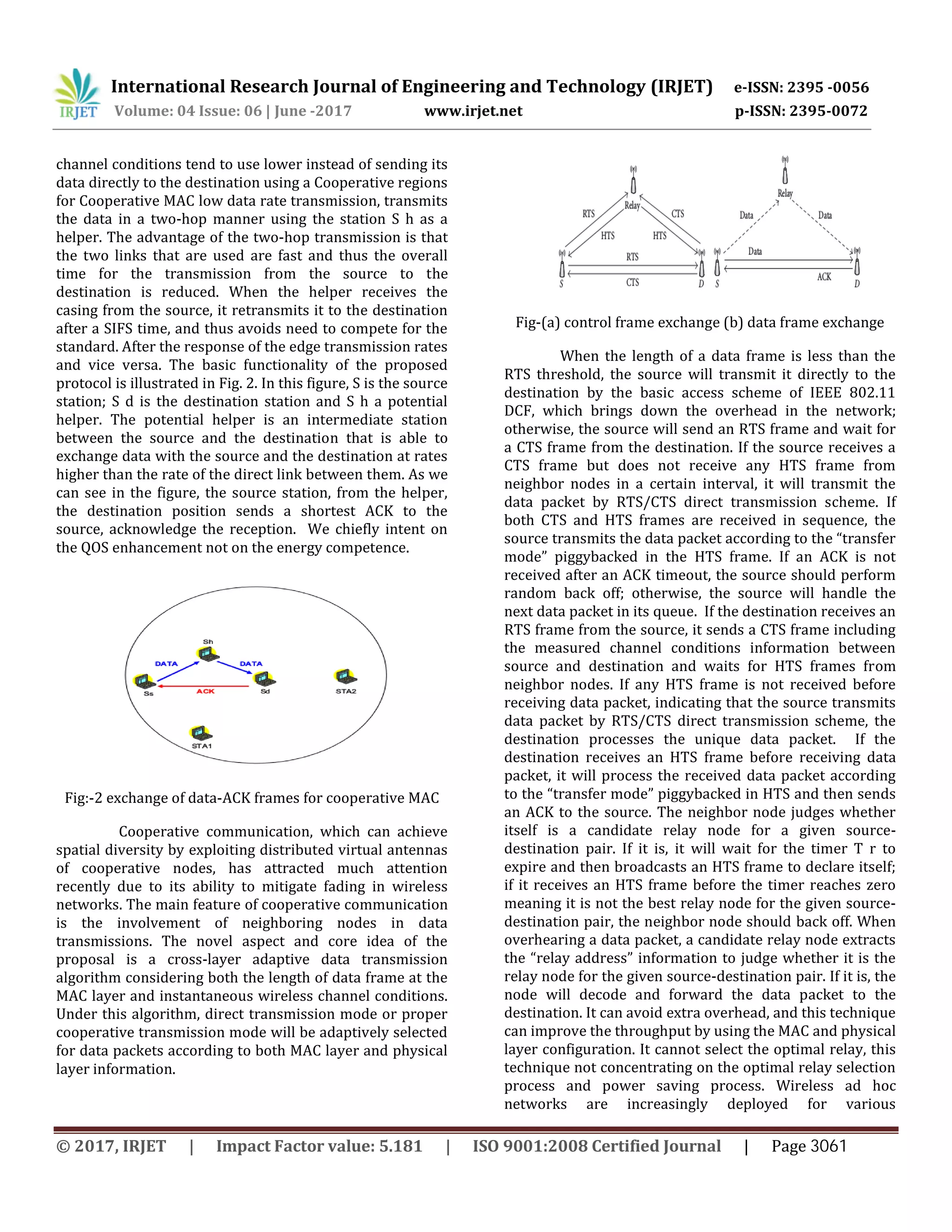
and vice versa. The basic functionality of the proposed
protocol is illustrated in Fig. 2. In this figure, S is the source
station; S d is the destination station and S h a potential
helper. The potential helper is an intermediate station
between the source and the destination that is able to
exchange data with the source and the destination at rates
higher than the rate of the direct link between them. As we
can see in the figure, the source station, from the helper,
the destination position sends a shortest ACK to the
source, acknowledge the reception. We chiefly intent on
the QOS enhancement not on the energy competence.
Fig:-2 exchange of data-ACK frames for cooperative MAC
Cooperative communication, which can achieve
spatial diversity by exploiting distributed virtual antennas
of cooperative nodes, has attracted much attention
recently due to its ability to mitigate fading in wireless
networks. The main feature of cooperative communication
is the involvement of neighboring nodes in data
transmissions. The novel aspect and core idea of the
proposal is a cross-layer adaptive data transmission
algorithm considering both the length of data frame at the
MAC layer and instantaneous wireless channel conditions.
Under this algorithm, direct transmission mode or proper
cooperative transmission mode will be adaptively selected
for data packets according to both MAC layer and physical
layer information.
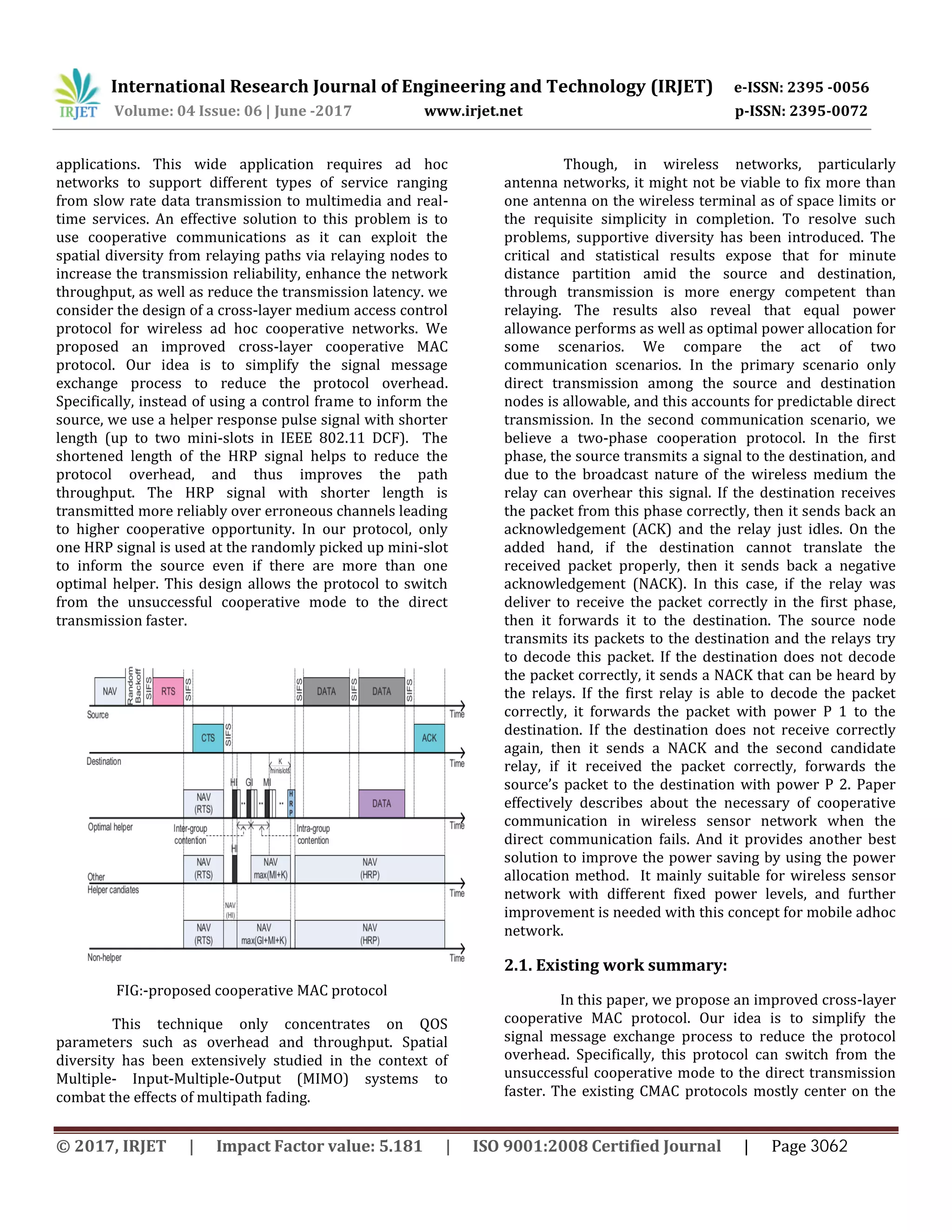
Fig-(a) control frame exchange (b) data frame exchange
When the length of a data frame is less than the
RTS threshold, the source will transmit it directly to the
destination by the basic access scheme of IEEE 802.11
DCF, which brings down the overhead in the network;
otherwise, the source will send an RTS frame and wait for
a CTS frame from the destination. If the source receives a
CTS frame but does not receive any HTS frame from
neighbor nodes in a certain interval, it will transmit the
data packet by RTS/CTS direct transmission scheme. If
both CTS and HTS frames are received in sequence, the
source transmits the data packet according to the “transfer
mode” piggybacked in the HTS frame. If an ACK is not
received after an ACK timeout, the source should perform
random back off; otherwise, the source will handle the
next data packet in its queue. If the destination receives an
RTS frame from the source, it sends a CTS frame including
the measured channel conditions information between
source and destination and waits for HTS frames from
neighbor nodes. If any HTS frame is not received before
receiving data packet, indicating that the source transmits
data packet by RTS/CTS direct transmission scheme, the
destination processes the unique data packet. If the
destination receives an HTS frame before receiving data
packet, it will process the received data packet according
to the “transfer mode” piggybacked in HTS and then sends
an ACK to the source. The neighbor node judges whether
itself is a candidate relay node for a given source-
destination pair. If it is, it will wait for the timer T r to
expire and then broadcasts an HTS frame to declare itself;
if it receives an HTS frame before the timer reaches zero
meaning it is not the best relay node for the given source-
destination pair, the neighbor node should back off. When
overhearing a data packet, a candidate relay node extracts
the “relay address” information to judge whether it is the
relay node for the given source-destination pair. If it is, the
node will decode and forward the data packet to the
destination. It can avoid extra overhead, and this technique
can improve the throughput by using the MAC and physical
layer configuration. It cannot select the optimal relay, this
technique not concentrating on the optimal relay selection
process and power saving process. Wireless ad hoc
networks are increasingly deployed for various
© 2017, IRJET | Impact Factor value: 5.181 | ISO 9001:2008 Certified Journal | Page 3061
International Research Journal of Engineering and Technology (IRJET) e-ISSN: 2395 -0056
Volume: 04 Issue: 06 | June -2017 www.irjet.net p-ISSN: 2395-0072
applications. This wide application requires ad hoc
networks to support different types of service ranging
from slow rate data transmission to multimedia and real-
time services. An effective solution to this problem is to
use cooperative communications as it can exploit the
spatial diversity from relaying paths via relaying nodes to
increase the transmission reliability, enhance the network
throughput, as well as reduce the transmission latency. we
consider the design of a cross-layer medium access control
protocol for wireless ad hoc cooperative networks. We
proposed an improved cross-layer cooperative MAC
protocol. Our idea is to simplify the signal message
exchange process to reduce the protocol overhead.
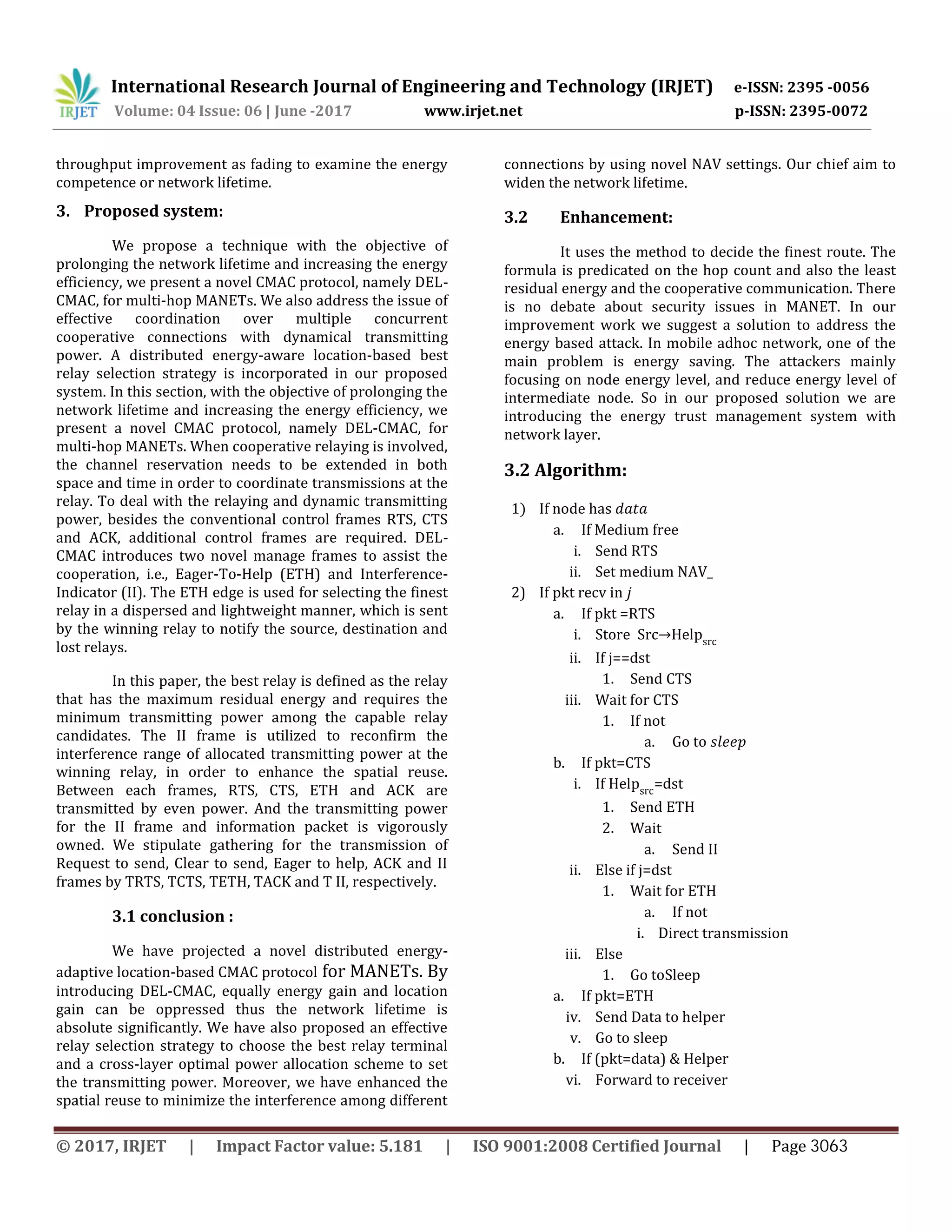
Specifically, instead of using a control frame to inform the
source, we use a helper response pulse signal with shorter
length (up to two mini-slots in IEEE 802.11 DCF). The
shortened length of the HRP signal helps to reduce the
protocol overhead, and thus improves the path
throughput. The HRP signal with shorter length is
transmitted more reliably over erroneous channels leading
to higher cooperative opportunity. In our protocol, only
one HRP signal is used at the randomly picked up mini-slot
to inform the source even if there are more than one
optimal helper. This design allows the protocol to switch
from the unsuccessful cooperative mode to the direct
transmission faster.
FIG:-proposed cooperative MAC protocol
This technique only concentrates on QOS
parameters such as overhead and throughput. Spatial
diversity has been extensively studied in the context of
Multiple- Input-Multiple-Output (MIMO) systems to
combat the effects of multipath fading.
Though, in wireless networks, particularly
antenna networks, it might not be viable to fix more than
one antenna on the wireless terminal as of space limits or
the requisite simplicity in completion. To resolve such
problems, supportive diversity has been introduced. The
critical and statistical results expose that for minute
distance partition amid the source and destination,
through transmission is more energy competent than
relaying. The results also reveal that equal power
allowance performs as well as optimal power allocation for
some scenarios. We compare the act of two
communication scenarios. In the primary scenario only
direct transmission among the source and destination
nodes is allowable, and this accounts for predictable direct
transmission. In the second communication scenario, we
believe a two-phase cooperation protocol. In the first
phase, the source transmits a signal to the destination, and
due to the broadcast nature of the wireless medium the
relay can overhear this signal. If the destination receives
the packet from this phase correctly, then it sends back an
acknowledgement (ACK) and the relay just idles. On the
added hand, if the destination cannot translate the
received packet properly, then it sends back a negative
acknowledgement (NACK). In this case, if the relay was
deliver to receive the packet correctly in the first phase,
then it forwards it to the destination. The source node
transmits its packets to the destination and the relays try
to decode this packet. If the destination does not decode
the packet correctly, it sends a NACK that can be heard by
the relays. If the first relay is able to decode the packet
correctly, it forwards the packet with power P 1 to the
destination. If the destination does not receive correctly
again, then it sends a NACK and the second candidate
relay, if it received the packet correctly, forwards the
source’s packet to the destination with power P 2. Paper
effectively describes about the necessary of cooperative
communication in wireless sensor network when the
direct communication fails. And it provides another best
solution to improve the power saving by using the power
allocation method. It mainly suitable for wireless sensor
network with different fixed power levels, and further
improvement is needed with this concept for mobile adhoc
network.
2.1. Existing work summary:
In this paper, we propose an improved cross-layer
cooperative MAC protocol. Our idea is to simplify the
signal message exchange process to reduce the protocol
overhead. Specifically, this protocol can switch from the
unsuccessful cooperative mode to the direct transmission
faster. The existing CMAC protocols mostly center on the
© 2017, IRJET | Impact Factor value: 5.181 | ISO 9001:2008 Certified Journal | Page 3062
International Research Journal of Engineering and Technology (IRJET) e-ISSN: 2395 -0056
Volume: 04 Issue: 06 | June -2017 www.irjet.net p-ISSN: 2395-0072
throughput improvement as fading to examine the energy
competence or network lifetime.
3. Proposed system:
We propose a technique with the objective of
prolonging the network lifetime and increasing the energy
efficiency, we present a novel CMAC protocol, namely DEL-
CMAC, for multi-hop MANETs. We also address the issue of
effective coordination over multiple concurrent
cooperative connections with dynamical transmitting
power. A distributed energy-aware location-based best
relay selection strategy is incorporated in our proposed
system. In this section, with the objective of prolonging the
network lifetime and increasing the energy efficiency, we
present a novel CMAC protocol, namely DEL-CMAC, for
multi-hop MANETs. When cooperative relaying is involved,
the channel reservation needs to be extended in both
space and time in order to coordinate transmissions at the
relay. To deal with the relaying and dynamic transmitting
power, besides the conventional control frames RTS, CTS
and ACK, additional control frames are required. DEL-
CMAC introduces two novel manage frames to assist the
cooperation, i.e., Eager-To-Help (ETH) and Interference-
Indicator (II). The ETH edge is used for selecting the finest
relay in a dispersed and lightweight manner, which is sent
by the winning relay to notify the source, destination and
lost relays.
In this paper, the best relay is defined as the relay
that has the maximum residual energy and requires the
minimum transmitting power among the capable relay
candidates. The II frame is utilized to reconfirm the
interference range of allocated transmitting power at the
winning relay, in order to enhance the spatial reuse.
Between each frames, RTS, CTS, ETH and ACK are
transmitted by even power. And the transmitting power
for the II frame and information packet is vigorously
owned. We stipulate gathering for the transmission of
Request to send, Clear to send, Eager to help, ACK and II
frames by TRTS, TCTS, TETH, TACK and T II, respectively.
3.1 conclusion :
We have projected a novel distributed energy-
adaptive location-based CMAC protocol for MANETs. By
introducing DEL-CMAC, equally energy gain and location
gain can be oppressed thus the network lifetime is
absolute significantly. We have also proposed an effective
relay selection strategy to choose the best relay terminal
and a cross-layer optimal power allocation scheme to set
the transmitting power. Moreover, we have enhanced the
spatial reuse to minimize the interference among different
connections by using novel NAV settings. Our chief aim to
widen the network lifetime.
3.2 Enhancement:
It uses the method to decide the finest route. The
formula is predicated on the hop count and also the least
residual energy and the cooperative communication. There
is no debate about security issues in MANET. In our
improvement work we suggest a solution to address the
energy based attack. In mobile adhoc network, one of the
main problem is energy saving. The attackers mainly
focusing on node energy level, and reduce energy level of
intermediate node. So in our proposed solution we are
introducing the energy trust management system with
network layer.
3.2 Algorithm:
1) If node has
a. If Medium free
i. Send RTS
ii. Set medium NAV_
2) If pkt recv in
a. If pkt RTS
i. Store Src Helpsrc
ii. If j dst
1. Send CTS
iii. Wait for CTS
1. If not
a. Go to
b. If pkt CTS
i. If Helpsrc
dst
1. Send ETH
2. Wait
a. Send II
ii. Else if j dst
1. Wait for ETH
a. If not
i. Direct transmission
iii. Else
1. Go toSleep
a. If pkt ETH
iv. Send Data to helper
v. Go to sleep
b. If pkt data Helper
vi. Forward to receiver
© 2017, IRJET | Impact Factor value: 5.181 | ISO 9001:2008 Certified Journal | Page 3063
International Research Journal of Engineering and Technology (IRJET) e-ISSN: 2395 -0056
Volume: 04 Issue: 06 | June -2017 www.irjet.net p-ISSN: 2395-0072
Reference:
1) “Cooperative Diversity in Wireless Networks: Efficient
Protocols and Outage Behavior”, J. Nicholas Laneman,
Member, IEEE, David N. C. Tse, Member, IEEE, and
Gregory W. Wornell, Fellow, IEEE, 2004
2) “Implementing a Cooperative MAC Protocol for
Wireless LANs”, Thanasis Korakis + , Sathya
Narayanan α , Abhijit Bagri ∗ , Shivendra Panwar,
Polytechnic University, Brooklyn, New York, 2006
3) “CAC-MAC: A Cross-Layer Adaptive Cooperative MAC
for Wireless Ad Hoc Networks”, Chunguang Shi, Haitao
Zhao, Shan Wang, Jibo Wei, and Linhua Zheng 2012.
4) “Improved Cross-Layer Cooperative MAC Protocol for
Wireless Ad hoc Networks”, Quang Trung Hoang Xuan
Nam Tran, Thai Nguyen University, 2014.
5) “On the Energy Efficiency of Cooperative
Communications in Wireless Sensor Networks”,
AHMED K. SADEK Qualcomm Incorporated, ACM,
2009.
© 2017, IRJET | Impact Factor value: 5.181 | ISO 9001:2008 Certified Journal | Page 3064

Civilizing the Network Lifespan of Manets Through Cooperative Mac Protocol Mechanism

  • 1.
    International Research Journalof Engineering and Technology (IRJET) e-ISSN: 2395 -0056 Volume: 04 Issue: 06 | June -2017 www.irjet.net p-ISSN: 2395-0072 CIVILIZING THE NETWORK LIFESPAN OF MANETS THROUGH COOPERATIVE MAC PROTOCOL MECHANISM N.VANDITHA, D.VANDANA Department of Information Technology, G.Narayanamma Institute of Science &Technology, Hyderabad Abstract - Our ultimate aim is to implement a high energy efficient data transmission protocol for Mobile Ad- hoc network. We have selected our research domain energy management system in MANET. Cooperative communication is a hopeful technique for saving the energy consumption in MANETs. CC is not always energy efficient compared to direct transmission. To deal with the tangled medium access interactions induced by relaying and hold the benefits of such cooperation, an efficient Cooperative Medium Access Control protocol is needed. The existing CMAC protocols mainly focus on the throughput enhancement while fail to investigate the energy efficiency or network lifetime. We propose DEL- CMAC that basis on the network lifetime extension, which is a less transverse aspect in the related work, by considering the energy consumption on both transmitter and receiver. Keywords: MANET, CSMA/CA, CMAC, Energy efficiency. 1. Introduction: A Mobile Ad-hoc Network (MANET) is a self- configured network of portable terminals coupled by wireless links. Portable terminals such as cell phones, moveable gaming devices, personal digital assistants, (PDAs) and tablets all include wireless networking capabilities. By participating in MANETs, these terminals may attain the Internet when they are not in the array of Wi-Fi access points or cellular base stations, or correspond through each other when no network communications is accessible. One chief issue with unremitting involvement in MANETs is the network lifetime, since the aforementioned wireless terminals are string powered, and energy is a limited reserve. Cooperative communication (CC) is a capable technique for conserving the energy utilization in MANETs. The transmit nature of the wireless medium (the so-called wireless broadcast advantage) is oppressed in cooperative manner. The wireless transmission amid a couple of terminals can be standard and processed at other terminals for performance gain, rather than be considered as an interference traditionally. CC can provide gains in terms of the required transmitting power due to the spatial diversity achieved via user cooperation. Though, if we acquire into report the extra dispensation and getting energy utilization necessary for assistance, CC is not always energy competent compared to shortest transmission. There is an exchange among the gains in transmitting power and the wounded in added energy utilization overhead. 2. Related work Space, or multiple-antenna, diversity techniques are chiefly striking as they can be willingly shared with other forms of assortment, e.g., time and occurrence diversity, and quiet offer theatrical performance gains when other forms of diversity are occupied. We urbanized and examine little-complexity cooperative diversity protocols that contest fading induced by multipath broadcast in wireless networks. The essential techniques develop space diversity accessible through cooperating terminals’ relaying signals for an alternative. Fig.1 Illustration of radio signal paths in an example wireless network With terminals T1 and T2 transmitting information to terminals T3 and T 4 respectively Paper technique improved the quality of service in network performance, and it makes effective relaying in signal transmission. And disadvantage is not concentrating on the energy efficient transmission in wireless network .Wireless networks that offer multi-rate sustain give the stations the capability to adjust their transmission rate to the bond quality in order to make their transmissions more consistent. Thus, stations that experience poor ------------------------------------------------------------***------------------------------------------------------------- © 2017, IRJET | Impact Factor value: 5.181 | ISO 9001:2008 Certified Journal | Page 3060
  • 2.
    International Research Journalof Engineering and Technology (IRJET) e-ISSN: 2395 -0056 Volume: 04 Issue: 06 | June -2017 www.irjet.net p-ISSN: 2395-0072 channel conditions tend to use lower instead of sending its data directly to the destination using a Cooperative regions for Cooperative MAC low data rate transmission, transmits the data in a two-hop manner using the station S h as a helper. The advantage of the two-hop transmission is that the two links that are used are fast and thus the overall time for the transmission from the source to the destination is reduced. When the helper receives the casing from the source, it retransmits it to the destination after a SIFS time, and thus avoids need to compete for the standard. After the response of the edge transmission rates and vice versa. The basic functionality of the proposed protocol is illustrated in Fig. 2. In this figure, S is the source station; S d is the destination station and S h a potential helper. The potential helper is an intermediate station between the source and the destination that is able to exchange data with the source and the destination at rates higher than the rate of the direct link between them. As we can see in the figure, the source station, from the helper, the destination position sends a shortest ACK to the source, acknowledge the reception. We chiefly intent on the QOS enhancement not on the energy competence. Fig:-2 exchange of data-ACK frames for cooperative MAC Cooperative communication, which can achieve spatial diversity by exploiting distributed virtual antennas of cooperative nodes, has attracted much attention recently due to its ability to mitigate fading in wireless networks. The main feature of cooperative communication is the involvement of neighboring nodes in data transmissions. The novel aspect and core idea of the proposal is a cross-layer adaptive data transmission algorithm considering both the length of data frame at the MAC layer and instantaneous wireless channel conditions. Under this algorithm, direct transmission mode or proper cooperative transmission mode will be adaptively selected for data packets according to both MAC layer and physical layer information. Fig-(a) control frame exchange (b) data frame exchange When the length of a data frame is less than the RTS threshold, the source will transmit it directly to the destination by the basic access scheme of IEEE 802.11 DCF, which brings down the overhead in the network; otherwise, the source will send an RTS frame and wait for a CTS frame from the destination. If the source receives a CTS frame but does not receive any HTS frame from neighbor nodes in a certain interval, it will transmit the data packet by RTS/CTS direct transmission scheme. If both CTS and HTS frames are received in sequence, the source transmits the data packet according to the “transfer mode” piggybacked in the HTS frame. If an ACK is not received after an ACK timeout, the source should perform random back off; otherwise, the source will handle the next data packet in its queue. If the destination receives an RTS frame from the source, it sends a CTS frame including the measured channel conditions information between source and destination and waits for HTS frames from neighbor nodes. If any HTS frame is not received before receiving data packet, indicating that the source transmits data packet by RTS/CTS direct transmission scheme, the destination processes the unique data packet. If the destination receives an HTS frame before receiving data packet, it will process the received data packet according to the “transfer mode” piggybacked in HTS and then sends an ACK to the source. The neighbor node judges whether itself is a candidate relay node for a given source- destination pair. If it is, it will wait for the timer T r to expire and then broadcasts an HTS frame to declare itself; if it receives an HTS frame before the timer reaches zero meaning it is not the best relay node for the given source- destination pair, the neighbor node should back off. When overhearing a data packet, a candidate relay node extracts the “relay address” information to judge whether it is the relay node for the given source-destination pair. If it is, the node will decode and forward the data packet to the destination. It can avoid extra overhead, and this technique can improve the throughput by using the MAC and physical layer configuration. It cannot select the optimal relay, this technique not concentrating on the optimal relay selection process and power saving process. Wireless ad hoc networks are increasingly deployed for various © 2017, IRJET | Impact Factor value: 5.181 | ISO 9001:2008 Certified Journal | Page 3061
  • 3.
    International Research Journalof Engineering and Technology (IRJET) e-ISSN: 2395 -0056 Volume: 04 Issue: 06 | June -2017 www.irjet.net p-ISSN: 2395-0072 applications. This wide application requires ad hoc networks to support different types of service ranging from slow rate data transmission to multimedia and real- time services. An effective solution to this problem is to use cooperative communications as it can exploit the spatial diversity from relaying paths via relaying nodes to increase the transmission reliability, enhance the network throughput, as well as reduce the transmission latency. we consider the design of a cross-layer medium access control protocol for wireless ad hoc cooperative networks. We proposed an improved cross-layer cooperative MAC protocol. Our idea is to simplify the signal message exchange process to reduce the protocol overhead. Specifically, instead of using a control frame to inform the source, we use a helper response pulse signal with shorter length (up to two mini-slots in IEEE 802.11 DCF). The shortened length of the HRP signal helps to reduce the protocol overhead, and thus improves the path throughput. The HRP signal with shorter length is transmitted more reliably over erroneous channels leading to higher cooperative opportunity. In our protocol, only one HRP signal is used at the randomly picked up mini-slot to inform the source even if there are more than one optimal helper. This design allows the protocol to switch from the unsuccessful cooperative mode to the direct transmission faster. FIG:-proposed cooperative MAC protocol This technique only concentrates on QOS parameters such as overhead and throughput. Spatial diversity has been extensively studied in the context of Multiple- Input-Multiple-Output (MIMO) systems to combat the effects of multipath fading. Though, in wireless networks, particularly antenna networks, it might not be viable to fix more than one antenna on the wireless terminal as of space limits or the requisite simplicity in completion. To resolve such problems, supportive diversity has been introduced. The critical and statistical results expose that for minute distance partition amid the source and destination, through transmission is more energy competent than relaying. The results also reveal that equal power allowance performs as well as optimal power allocation for some scenarios. We compare the act of two communication scenarios. In the primary scenario only direct transmission among the source and destination nodes is allowable, and this accounts for predictable direct transmission. In the second communication scenario, we believe a two-phase cooperation protocol. In the first phase, the source transmits a signal to the destination, and due to the broadcast nature of the wireless medium the relay can overhear this signal. If the destination receives the packet from this phase correctly, then it sends back an acknowledgement (ACK) and the relay just idles. On the added hand, if the destination cannot translate the received packet properly, then it sends back a negative acknowledgement (NACK). In this case, if the relay was deliver to receive the packet correctly in the first phase, then it forwards it to the destination. The source node transmits its packets to the destination and the relays try to decode this packet. If the destination does not decode the packet correctly, it sends a NACK that can be heard by the relays. If the first relay is able to decode the packet correctly, it forwards the packet with power P 1 to the destination. If the destination does not receive correctly again, then it sends a NACK and the second candidate relay, if it received the packet correctly, forwards the source’s packet to the destination with power P 2. Paper effectively describes about the necessary of cooperative communication in wireless sensor network when the direct communication fails. And it provides another best solution to improve the power saving by using the power allocation method. It mainly suitable for wireless sensor network with different fixed power levels, and further improvement is needed with this concept for mobile adhoc network. 2.1. Existing work summary: In this paper, we propose an improved cross-layer cooperative MAC protocol. Our idea is to simplify the signal message exchange process to reduce the protocol overhead. Specifically, this protocol can switch from the unsuccessful cooperative mode to the direct transmission faster. The existing CMAC protocols mostly center on the © 2017, IRJET | Impact Factor value: 5.181 | ISO 9001:2008 Certified Journal | Page 3062
  • 4.
    International Research Journalof Engineering and Technology (IRJET) e-ISSN: 2395 -0056 Volume: 04 Issue: 06 | June -2017 www.irjet.net p-ISSN: 2395-0072 throughput improvement as fading to examine the energy competence or network lifetime. 3. Proposed system: We propose a technique with the objective of prolonging the network lifetime and increasing the energy efficiency, we present a novel CMAC protocol, namely DEL- CMAC, for multi-hop MANETs. We also address the issue of effective coordination over multiple concurrent cooperative connections with dynamical transmitting power. A distributed energy-aware location-based best relay selection strategy is incorporated in our proposed system. In this section, with the objective of prolonging the network lifetime and increasing the energy efficiency, we present a novel CMAC protocol, namely DEL-CMAC, for multi-hop MANETs. When cooperative relaying is involved, the channel reservation needs to be extended in both space and time in order to coordinate transmissions at the relay. To deal with the relaying and dynamic transmitting power, besides the conventional control frames RTS, CTS and ACK, additional control frames are required. DEL- CMAC introduces two novel manage frames to assist the cooperation, i.e., Eager-To-Help (ETH) and Interference- Indicator (II). The ETH edge is used for selecting the finest relay in a dispersed and lightweight manner, which is sent by the winning relay to notify the source, destination and lost relays. In this paper, the best relay is defined as the relay that has the maximum residual energy and requires the minimum transmitting power among the capable relay candidates. The II frame is utilized to reconfirm the interference range of allocated transmitting power at the winning relay, in order to enhance the spatial reuse. Between each frames, RTS, CTS, ETH and ACK are transmitted by even power. And the transmitting power for the II frame and information packet is vigorously owned. We stipulate gathering for the transmission of Request to send, Clear to send, Eager to help, ACK and II frames by TRTS, TCTS, TETH, TACK and T II, respectively. 3.1 conclusion : We have projected a novel distributed energy- adaptive location-based CMAC protocol for MANETs. By introducing DEL-CMAC, equally energy gain and location gain can be oppressed thus the network lifetime is absolute significantly. We have also proposed an effective relay selection strategy to choose the best relay terminal and a cross-layer optimal power allocation scheme to set the transmitting power. Moreover, we have enhanced the spatial reuse to minimize the interference among different connections by using novel NAV settings. Our chief aim to widen the network lifetime. 3.2 Enhancement: It uses the method to decide the finest route. The formula is predicated on the hop count and also the least residual energy and the cooperative communication. There is no debate about security issues in MANET. In our improvement work we suggest a solution to address the energy based attack. In mobile adhoc network, one of the main problem is energy saving. The attackers mainly focusing on node energy level, and reduce energy level of intermediate node. So in our proposed solution we are introducing the energy trust management system with network layer. 3.2 Algorithm: 1) If node has a. If Medium free i. Send RTS ii. Set medium NAV_ 2) If pkt recv in a. If pkt RTS i. Store Src Helpsrc ii. If j dst 1. Send CTS iii. Wait for CTS 1. If not a. Go to b. If pkt CTS i. If Helpsrc dst 1. Send ETH 2. Wait a. Send II ii. Else if j dst 1. Wait for ETH a. If not i. Direct transmission iii. Else 1. Go toSleep a. If pkt ETH iv. Send Data to helper v. Go to sleep b. If pkt data Helper vi. Forward to receiver © 2017, IRJET | Impact Factor value: 5.181 | ISO 9001:2008 Certified Journal | Page 3063
  • 5.
    International Research Journalof Engineering and Technology (IRJET) e-ISSN: 2395 -0056 Volume: 04 Issue: 06 | June -2017 www.irjet.net p-ISSN: 2395-0072 Reference: 1) “Cooperative Diversity in Wireless Networks: Efficient Protocols and Outage Behavior”, J. Nicholas Laneman, Member, IEEE, David N. C. Tse, Member, IEEE, and Gregory W. Wornell, Fellow, IEEE, 2004 2) “Implementing a Cooperative MAC Protocol for Wireless LANs”, Thanasis Korakis + , Sathya Narayanan α , Abhijit Bagri ∗ , Shivendra Panwar, Polytechnic University, Brooklyn, New York, 2006 3) “CAC-MAC: A Cross-Layer Adaptive Cooperative MAC for Wireless Ad Hoc Networks”, Chunguang Shi, Haitao Zhao, Shan Wang, Jibo Wei, and Linhua Zheng 2012. 4) “Improved Cross-Layer Cooperative MAC Protocol for Wireless Ad hoc Networks”, Quang Trung Hoang Xuan Nam Tran, Thai Nguyen University, 2014. 5) “On the Energy Efficiency of Cooperative Communications in Wireless Sensor Networks”, AHMED K. SADEK Qualcomm Incorporated, ACM, 2009. © 2017, IRJET | Impact Factor value: 5.181 | ISO 9001:2008 Certified Journal | Page 3064