An Introduction to Computer 
1 
Networks 
Prof. Dina Katabi 
Some slides are from lectures by Nick Mckeown, Ion Stoica, Frans 
Kaashoek, Hari Balakrishnan, and Sam Madden 
Chapter 7
2 
Chapter Outline 
 Introduction (slides and 7.A) 
 Layered Architecture (slides and 7.B & 
7.D) 
 Routing (slides and 7.D) 
 Reliable Transmission & Flow Control 
(slides and read 7.E) 
 Congestion Control (slides and read 7.F)
3 
This Lecture 
 What is a network? 
 Sharing the infrastructure 
 Circuit switching 
 Packet switching 
 Best Effort Service 
 Analogy: the mail system 
 Internet’s Best Effort Service
8 
This Lecture 
 What is a network? 
 Sharing the infrastructure 
 Circuit switching 
 Packet switching 
 Best Effort Service 
 Analogy: the mail system 
 Internet’s Best Effort Service
Two ways to share 
Circuit switching (isochronous) 
Packet switching (asynchronous) 
9
Internet Traffic Is Bursty 
Daily traffic at an MIT-CSAIL router 
Max In:12.2Mb/s Avg. In: 2.5Mb/s 
Max Out: 12.8Mb/s Avg. Out: 3.4 Mb/s 
13
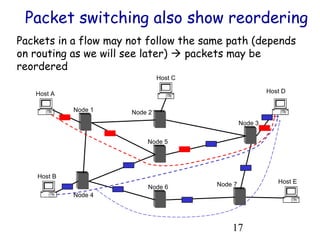
Packet switching also show reordering 
Packets in a flow may not follow the same path (depends 
on routing as we will see later)  packets may be 
reordered 
17 
Host A 
Host B 
Host D 
Host E 
Host C 
Node 1 Node 2 
Node 3 
Node 4 
Node 5 
Node 6 Node 7
18 
This Lecture 
 What is a network? 
 Sharing the Infrastructure 
 Circuit switching 
 Packet switching 
 Best Effort Service 
 Analogy: the mail system 
 Internet’s Best Effort Service
MIT Stanford 
19 
The mail system 
Dina Nick 
Admin Admin
Characteristics of the mail system 
 Each envelope is individually routed 
 No time guarantee for delivery 
 No guarantee of delivery in sequence 
 No guarantee of delivery at all! 
20 
 Things get lost 
 How can we acknowledge delivery? 
 Retransmission 
 How to determine when to retransmit? Timeout? 
 If message is re-sent too soon  duplicates
MIT Stanford 
21 
The mail system 
Dina Nick 
Admin Admin
Nms.csail.mit.edu Leland.Stanford.edu 
22 
The Internet 
Dina Nick 
O.S. Data Header Data Header O.S. 
PPaacckkeett
Characteristics of the Internet 
 Each packet is individually routed 
 No time guarantee for delivery 
 No guarantee of delivery in sequence 
 No guarantee of delivery at all! 
23 
 Things get lost 
 Acknowledgements 
 Retransmission 
 How to determine when to retransmit? Timeout? 
 If packet is re-transmitted too soon  
duplicate
24 
Best Effort 
No Guarantees: 
 Variable Delay (jitter) 
 Variable rate 
 Packet loss 
 Duplicates 
 Reordering 
 (notes also state maximum packet length)
Differences Between Circuit & Packet Switching 
Circuit-switching Packet-Switching 
Guaranteed capacity No guarantees (best effort) 
25 
Capacity is wasted if data is 
bursty 
More efficient 
Before sending data 
establishes a path 
Send data immediately 
All data in a single flow 
follow one path 
Different packets might 
follow different paths 
No reordering; constant 
delay; no pkt drops 
Packets may be reordered, 
delayed, or dropped
26 
This Lecture 
 We learned how to share the network 
infrastructure between many 
connections/flows 
 We also learned about the implications 
of the sharing scheme (circuit or packet 
switching) on the service that the 
traffic receives

Networks 1-intro

  • 1.
    An Introduction toComputer 1 Networks Prof. Dina Katabi Some slides are from lectures by Nick Mckeown, Ion Stoica, Frans Kaashoek, Hari Balakrishnan, and Sam Madden Chapter 7
  • 2.
    2 Chapter Outline  Introduction (slides and 7.A)  Layered Architecture (slides and 7.B & 7.D)  Routing (slides and 7.D)  Reliable Transmission & Flow Control (slides and read 7.E)  Congestion Control (slides and read 7.F)
  • 3.
    3 This Lecture  What is a network?  Sharing the infrastructure  Circuit switching  Packet switching  Best Effort Service  Analogy: the mail system  Internet’s Best Effort Service
  • 4.
    8 This Lecture  What is a network?  Sharing the infrastructure  Circuit switching  Packet switching  Best Effort Service  Analogy: the mail system  Internet’s Best Effort Service
  • 5.
    Two ways toshare Circuit switching (isochronous) Packet switching (asynchronous) 9
  • 6.
    Internet Traffic IsBursty Daily traffic at an MIT-CSAIL router Max In:12.2Mb/s Avg. In: 2.5Mb/s Max Out: 12.8Mb/s Avg. Out: 3.4 Mb/s 13
  • 7.
    Packet switching alsoshow reordering Packets in a flow may not follow the same path (depends on routing as we will see later)  packets may be reordered 17 Host A Host B Host D Host E Host C Node 1 Node 2 Node 3 Node 4 Node 5 Node 6 Node 7
  • 8.
    18 This Lecture  What is a network?  Sharing the Infrastructure  Circuit switching  Packet switching  Best Effort Service  Analogy: the mail system  Internet’s Best Effort Service
  • 9.
    MIT Stanford 19 The mail system Dina Nick Admin Admin
  • 10.
    Characteristics of themail system  Each envelope is individually routed  No time guarantee for delivery  No guarantee of delivery in sequence  No guarantee of delivery at all! 20  Things get lost  How can we acknowledge delivery?  Retransmission  How to determine when to retransmit? Timeout?  If message is re-sent too soon  duplicates
  • 11.
    MIT Stanford 21 The mail system Dina Nick Admin Admin
  • 12.
    Nms.csail.mit.edu Leland.Stanford.edu 22 The Internet Dina Nick O.S. Data Header Data Header O.S. PPaacckkeett
  • 13.
    Characteristics of theInternet  Each packet is individually routed  No time guarantee for delivery  No guarantee of delivery in sequence  No guarantee of delivery at all! 23  Things get lost  Acknowledgements  Retransmission  How to determine when to retransmit? Timeout?  If packet is re-transmitted too soon  duplicate
  • 14.
    24 Best Effort No Guarantees:  Variable Delay (jitter)  Variable rate  Packet loss  Duplicates  Reordering  (notes also state maximum packet length)
  • 15.
    Differences Between Circuit& Packet Switching Circuit-switching Packet-Switching Guaranteed capacity No guarantees (best effort) 25 Capacity is wasted if data is bursty More efficient Before sending data establishes a path Send data immediately All data in a single flow follow one path Different packets might follow different paths No reordering; constant delay; no pkt drops Packets may be reordered, delayed, or dropped
  • 16.
    26 This Lecture  We learned how to share the network infrastructure between many connections/flows  We also learned about the implications of the sharing scheme (circuit or packet switching) on the service that the traffic receives

Editor's Notes

  • #8 <number>
  • #12 <number>