Chapter 4
Frame Relay
Chapter 4 Frame Relay 1
Introduction
• Packet-Switching Networks
– Switching Technique
– Routing
– X.25
• Frame Relay Networks
– Architecture
– User Data Transfer
– Call Control
Chapter 4 Frame Relay 2
Packet-Switching Networks
• Basic technology the same as in the 1970s
• One of the few effective technologies for long
distance data communications
• Frame relay and ATM are variants of packet-
switching
• Advantages:
– flexibility, resource sharing, robust, responsive
• Disadvantages:
– Time delays in distributed network, overhead penalties
– Need for routing and congestion control
Chapter 4 Frame Relay 3
Circuit-Switching
• Long-haul telecom network designed for voice
• Network resources dedicated to one call
• Shortcomings when used for data:
– Inefficient (high idle time)
– Constant data rate
Chapter 4 Frame Relay 4
Packet-Switching
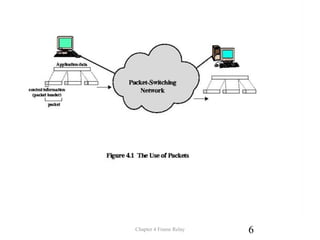
• Data transmitted in short blocks, or packets
• Packet length < 1000 octets
• Each packet contains user data plus control
info (routing)
• Store and forward
Chapter 4 Frame Relay 5
Figure 4.1 The Use of Packets
Chapter 4 Frame Relay 6
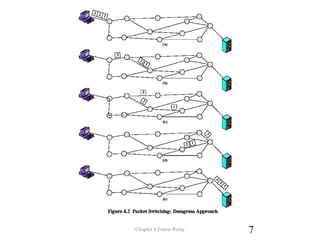
Figure 4.2 Packet
Switching: Datagram
Approach
Chapter 4 Frame Relay 7
Advantages over Circuit-Switching
• Greater line efficiency (many packets can go
over shared link)
• Data rate conversions
• Non-blocking under heavy traffic (but
increased delays)
Chapter 4 Frame Relay 8
Disadvantages relative to Circuit-
Switching
• Packets incur additional delay with every node
they pass through
• Jitter: variation in packet delay
• Data overhead in every packet for routing
information, etc
• Processing overhead for every packet at every
node traversed
Chapter 4 Frame Relay 9
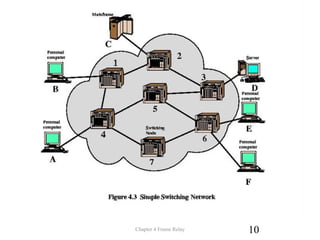
Figure 4.3 Simple Switching Network
Chapter 4 Frame Relay 10
Switching Technique
• Large messages broken up into smaller packets
• Datagram
– Each packet sent independently of the others
– No call setup
– More reliable (can route around failed nodes or
congestion)
• Virtual circuit
– Fixed route established before any packets sent
– No need for routing decision for each packet at each node
Chapter 4 Frame Relay 11
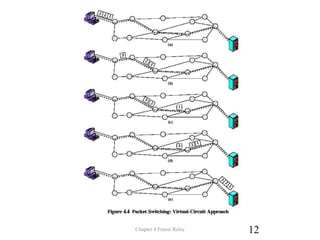
Figure 4.4 Packet
Switching: Virtual-
Circuit Approach
Chapter 4 Frame Relay 12
Routing
• Adaptive routing
• Node/trunk failure
• Congestion
Chapter 4 Frame Relay 13
X.25
• 3 levels
• Physical level (X.21)
• Link level (LAPB, a subset of HDLC)
• Packet level (provides virtual circuit service)
Chapter 4 Frame Relay 14
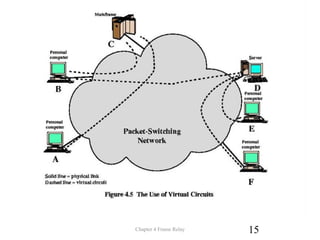
Figure 4.5 The Use of Virtual Circuits
Chapter 4 Frame Relay 15
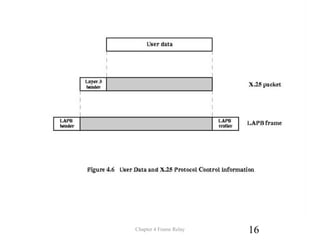
Figure 4.6 User Data and X.25 Protocol
Control Information
Chapter 4 Frame Relay 16
Frame Relay Networks
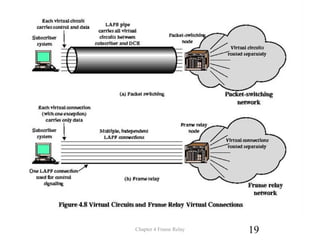
• Designed to eliminate much of the overhead in X.25
• Call control signaling on separate logical connection
from user data
• Multiplexing/switching of logical connections at layer
2 (not layer 3)
• No hop-by-hop flow control and error control
• Throughput an order of magnitude higher than X.25
Chapter 4 Frame Relay 17
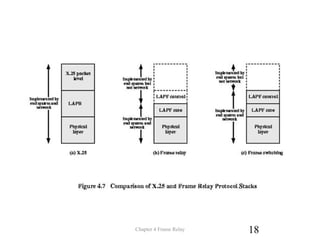
Figure 4.7 Comparison of X.25 and
Frame Relay Protocol Stacks
Chapter 4 Frame Relay 18
Figure 4.8 Virtual Circuits and Frame
Relay Virtual Connections
Chapter 4 Frame Relay 19
Frame Relay Architecture
• X.25 has 3 layers: physical, link, network
• Frame Relay has 2 layers: physical and data
link (or LAPF)
• LAPF core: minimal data link control
– Preservation of order for frames
– Small probability of frame loss
• LAPF control: additional data link or network
layer end-to-end functions
Chapter 4 Frame Relay 20
LAPF Core
• Frame delimiting, alignment and transparency
• Frame multiplexing/demultiplexing
• Inspection of frame for length constraints
• Detection of transmission errors
• Congestion control
Chapter 4 Frame Relay 21
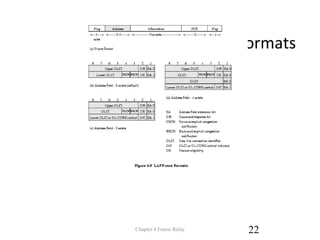
Figure 4.9 LAPF-core Formats
Chapter 4 Frame Relay 22
User Data Transfer
• No control field, which is normally used for:
– Identify frame type (data or control)
– Sequence numbers
• Implication:
– Connection setup/teardown carried on separate
channel
– Cannot do flow and error control
Chapter 4 Frame Relay 23
Frame Relay Call Control
• Frame Relay Call Control
• Data transfer involves:
– Establish logical connection and DLCI
– Exchange data frames
– Release logical connection
Chapter 4 Frame Relay 24
Frame Relay Call Control
4 message types needed
• SETUP
• CONNECT
• RELEASE
• RELEASE COMPLETE
Chapter 4 Frame Relay 25

Frame Relay Chapter 04

  • 1.
  • 2.
    Introduction • Packet-Switching Networks –Switching Technique – Routing – X.25 • Frame Relay Networks – Architecture – User Data Transfer – Call Control Chapter 4 Frame Relay 2
  • 3.
    Packet-Switching Networks • Basictechnology the same as in the 1970s • One of the few effective technologies for long distance data communications • Frame relay and ATM are variants of packet- switching • Advantages: – flexibility, resource sharing, robust, responsive • Disadvantages: – Time delays in distributed network, overhead penalties – Need for routing and congestion control Chapter 4 Frame Relay 3
  • 4.
    Circuit-Switching • Long-haul telecomnetwork designed for voice • Network resources dedicated to one call • Shortcomings when used for data: – Inefficient (high idle time) – Constant data rate Chapter 4 Frame Relay 4
  • 5.
    Packet-Switching • Data transmittedin short blocks, or packets • Packet length < 1000 octets • Each packet contains user data plus control info (routing) • Store and forward Chapter 4 Frame Relay 5
  • 6.
    Figure 4.1 TheUse of Packets Chapter 4 Frame Relay 6
  • 7.
    Figure 4.2 Packet Switching:Datagram Approach Chapter 4 Frame Relay 7
  • 8.
    Advantages over Circuit-Switching •Greater line efficiency (many packets can go over shared link) • Data rate conversions • Non-blocking under heavy traffic (but increased delays) Chapter 4 Frame Relay 8
  • 9.
    Disadvantages relative toCircuit- Switching • Packets incur additional delay with every node they pass through • Jitter: variation in packet delay • Data overhead in every packet for routing information, etc • Processing overhead for every packet at every node traversed Chapter 4 Frame Relay 9
  • 10.
    Figure 4.3 SimpleSwitching Network Chapter 4 Frame Relay 10
  • 11.
    Switching Technique • Largemessages broken up into smaller packets • Datagram – Each packet sent independently of the others – No call setup – More reliable (can route around failed nodes or congestion) • Virtual circuit – Fixed route established before any packets sent – No need for routing decision for each packet at each node Chapter 4 Frame Relay 11
  • 12.
    Figure 4.4 Packet Switching:Virtual- Circuit Approach Chapter 4 Frame Relay 12
  • 13.
    Routing • Adaptive routing •Node/trunk failure • Congestion Chapter 4 Frame Relay 13
  • 14.
    X.25 • 3 levels •Physical level (X.21) • Link level (LAPB, a subset of HDLC) • Packet level (provides virtual circuit service) Chapter 4 Frame Relay 14
  • 15.
    Figure 4.5 TheUse of Virtual Circuits Chapter 4 Frame Relay 15
  • 16.
    Figure 4.6 UserData and X.25 Protocol Control Information Chapter 4 Frame Relay 16
  • 17.
    Frame Relay Networks •Designed to eliminate much of the overhead in X.25 • Call control signaling on separate logical connection from user data • Multiplexing/switching of logical connections at layer 2 (not layer 3) • No hop-by-hop flow control and error control • Throughput an order of magnitude higher than X.25 Chapter 4 Frame Relay 17
  • 18.
    Figure 4.7 Comparisonof X.25 and Frame Relay Protocol Stacks Chapter 4 Frame Relay 18
  • 19.
    Figure 4.8 VirtualCircuits and Frame Relay Virtual Connections Chapter 4 Frame Relay 19
  • 20.
    Frame Relay Architecture •X.25 has 3 layers: physical, link, network • Frame Relay has 2 layers: physical and data link (or LAPF) • LAPF core: minimal data link control – Preservation of order for frames – Small probability of frame loss • LAPF control: additional data link or network layer end-to-end functions Chapter 4 Frame Relay 20
  • 21.
    LAPF Core • Framedelimiting, alignment and transparency • Frame multiplexing/demultiplexing • Inspection of frame for length constraints • Detection of transmission errors • Congestion control Chapter 4 Frame Relay 21
  • 22.
    Figure 4.9 LAPF-coreFormats Chapter 4 Frame Relay 22
  • 23.
    User Data Transfer •No control field, which is normally used for: – Identify frame type (data or control) – Sequence numbers • Implication: – Connection setup/teardown carried on separate channel – Cannot do flow and error control Chapter 4 Frame Relay 23
  • 24.
    Frame Relay CallControl • Frame Relay Call Control • Data transfer involves: – Establish logical connection and DLCI – Exchange data frames – Release logical connection Chapter 4 Frame Relay 24
  • 25.
    Frame Relay CallControl 4 message types needed • SETUP • CONNECT • RELEASE • RELEASE COMPLETE Chapter 4 Frame Relay 25