Course: B.Sc. I
Subject: Chemistry I
Unit: II
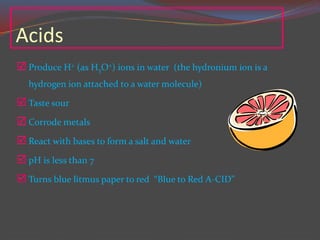
Acids
 Produce H+ (as H3O+) ions in water (the hydronium ion is a
hydrogen ion attached to a water molecule)
 Taste sour
 Corrode metals
 React with bases to form a salt and water
 pH is less than 7
 Turns blue litmus paper to red “Blue to Red A-CID”
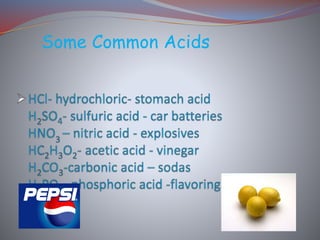
Some Common Acids
Bases
 Produce OH- ions in water
 Taste bitter, chalky
 Feel soapy, slippery
 React with acids to form salts and water
 pH greater than 7
 Turns red litmus paper to blue “Basic Blue”
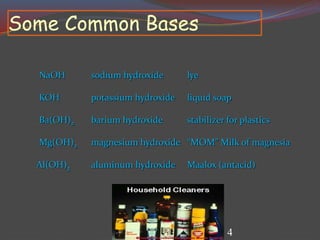
Some Common Bases
NaOH sodium hydroxide lye
KOH potassium hydroxide liquid soap
Ba(OH)2 barium hydroxide stabilizer for plastics
Mg(OH)2 magnesium hydroxide “MOM” Milk of magnesia
Al(OH)3 aluminum hydroxide Maalox (antacid)
4
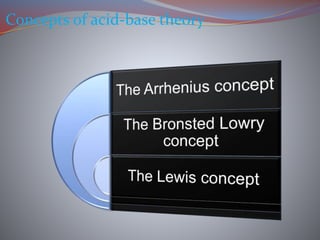
Concepts of acid-base theory
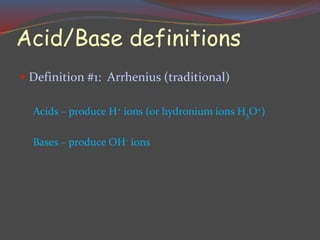
Acid/Base definitions
 Definition #1: Arrhenius (traditional)
Acids – produce H+ ions (or hydronium ions H3O+)
Bases – produce OH- ions
Arrhenius Concept of Acids and
Bases
According to the Arrhenius concept of acids
and bases,
 an Acid is a substance that, when
dissolved in water, increases the
concentration of hydronium ion or H+
ion (H3O+ ).
• the aqueous hydrogen ion is actually chemically
bonded to water, that is, H3O+.
• Chemists often use the notation H+(aq) for the
H3O+(aq) ion.
Arrhenius concept of bases
A base, in the Arrhenius concept, is a
substance that, when dissolved in water,
increases the concentration of
hydroxide ion, OH-(aq).
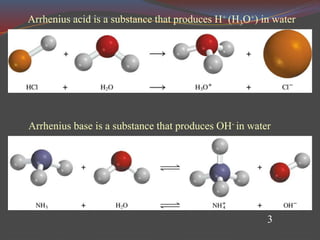
Arrhenius acid is a substance that produces H+ (H3O+) in water
Arrhenius base is a substance that produces OH- in water
3
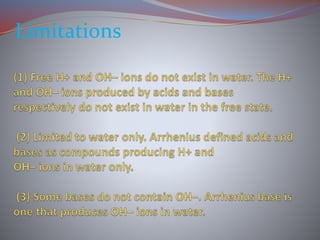
Limitations
Brønsted-Lowry Concept of Acids
and Bases
• According to the Brønsted-Lowry concept,
• An acid is the species donating the proton
in a proton-transfer reaction.
• A base is the species accepting the proton in a
proton-transfer reaction
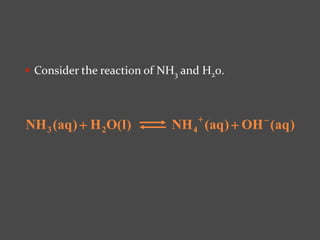
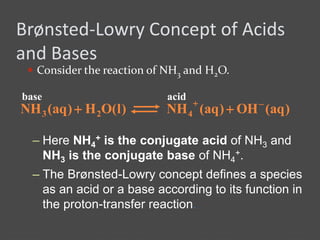
 Consider the reaction of NH3 and H20.
)aq(OH)aq(NH)l(OH)aq(NH 423


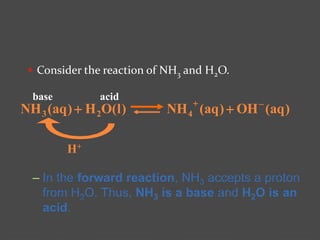
 Consider the reaction of NH3 and H2O.
– In the forward reaction, NH3 accepts a proton
from H2O. Thus, NH3 is a base and H2O is an
acid.
)aq(OH)aq(NH)l(OH)aq(NH 423


H+
base acid
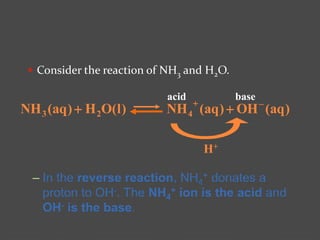
 Consider the reaction of NH3 and H2O.
– In the reverse reaction, NH4
+ donates a
proton to OH-. The NH4
+ ion is the acid and
OH- is the base.
)aq(OH)aq(NH)l(OH)aq(NH 423


H+
baseacid
Brønsted-Lowry Concept of Acids
and Bases
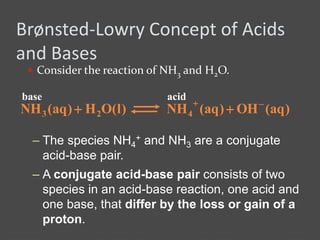
 Consider the reaction of NH3 and H2O.
– A conjugate acid-base pair consists of two
species in an acid-base reaction, one acid and
one base, that differ by the loss or gain of a
proton.
)aq(OH)aq(NH)l(OH)aq(NH 423


base acid
– The species NH4
+ and NH3 are a conjugate
acid-base pair.
Brønsted-Lowry Concept of Acids
and Bases
 Consider the reaction of NH3 and H2O.
– The Brønsted-Lowry concept defines a species
as an acid or a base according to its function in
the proton-transfer reaction.
)aq(OH)aq(NH)l(OH)aq(NH 423


base acid
– Here NH4
+ is the conjugate acid of NH3 and
NH3 is the conjugate base of NH4
+.
Brønsted-Lowry Concept of Acids
and Bases
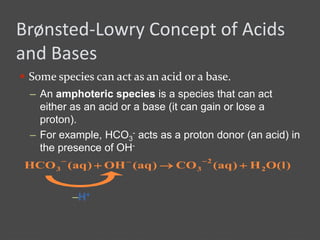
 Some species can act as an acid or a base.
)l(OH)aq(CO)aq(OH)aq(HCO 2
2
33 

–H+
– An amphoteric species is a species that can act
either as an acid or a base (it can gain or lose a
proton).
– For example, HCO3
- acts as a proton donor (an acid) in
the presence of OH-
Brønsted-Lowry Concept of Acids
and Bases
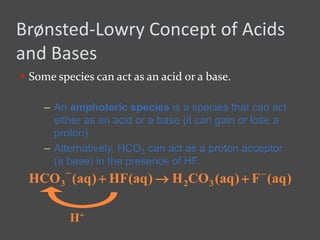
 Some species can act as an acid or a base.
– An amphoteric species is a species that can act
either as an acid or a base (it can gain or lose a
proton).
– Alternatively, HCO3 can act as a proton acceptor
(a base) in the presence of HF.
)aq(F)aq(COH)aq(HF)aq(HCO 323


H+
Brønsted-Lowry Concept of Acids
and Bases
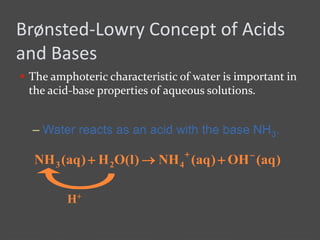
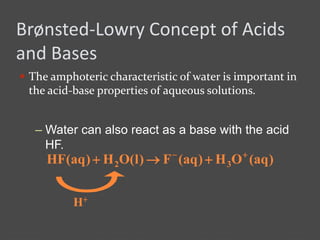
 The amphoteric characteristic of water is important in
the acid-base properties of aqueous solutions.
– Water reacts as an acid with the base NH3.
)aq(OH)aq(NH)l(OH)aq(NH 423


H+
Brønsted-Lowry Concept of Acids
and Bases
 The amphoteric characteristic of water is important in
the acid-base properties of aqueous solutions.
– Water can also react as a base with the acid
HF.
)aq(OH)aq(F)l(OH)aq(HF 32


H+
Brønsted-Lowry Concept of Acids
and Bases
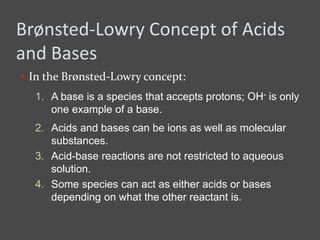
 In the Brønsted-Lowry concept:
2. Acids and bases can be ions as well as molecular
substances.
3. Acid-base reactions are not restricted to aqueous
solution.
4. Some species can act as either acids or bases
depending on what the other reactant is.
1. A base is a species that accepts protons; OH- is only
one example of a base.
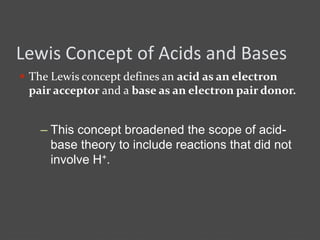
Lewis Concept of Acids and Bases
 The Lewis concept defines an acid as an electron
pair acceptor and a base as an electron pair donor.
– This concept broadened the scope of acid-
base theory to include reactions that did not
involve H+.
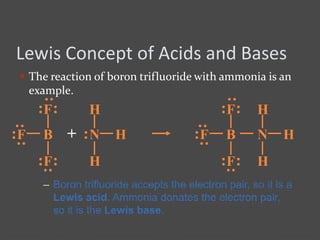
Lewis Concept of Acids and Bases
 The reaction of boron trifluoride with ammonia is an
example.
– Boron trifluoride accepts the electron pair, so it is a
Lewis acid. Ammonia donates the electron pair,
so it is the Lewis base.
+ N
H
H
H:
::
: B
F
F
F
: :
::
::
::
: B
F
F
F
: :
::
::
N
H
H
H
Relative Strength of Acids and
Bases
 The Brønsted-Lowry concept introduced the idea of
conjugate acid-base pairs and proton-transfer
reactions.
– The stronger acids are those that lose their
hydrogen ions more easily than other acids.
– Similarly, the stronger bases are those that hold
onto hydrogen ions more strongly than other
bases.
Relative Strength of Acids and
Bases
 The Brønsted-Lowry concept introduced the idea of
conjugate acid-base pairs and proton-transfer
reactions.
– If an acid loses its H+, the resulting anion is now in
a position to reaccept a proton, making it a
Brønsted-Lowry base.
– It is logical to assume that if an acid is considered
strong, its conjugate base (that is, its anion) would be
weak, since it is unlikely to accept a hydrogen ion.
Relative Strength of Acids and
Bases
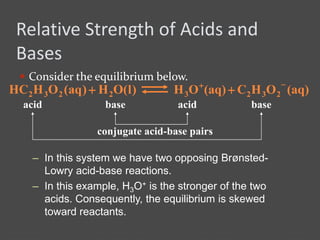
 Consider the equilibrium below.
– In this system we have two opposing Brønsted-
Lowry acid-base reactions.
– In this example, H3O+ is the stronger of the two
acids. Consequently, the equilibrium is skewed
toward reactants.
(aq)OHC(aq)OH 2323

)l(OH)aq(OHHC 2232 
acid acidbase base
conjugate acid-base pairs
Relative Strength of Acids and
Bases
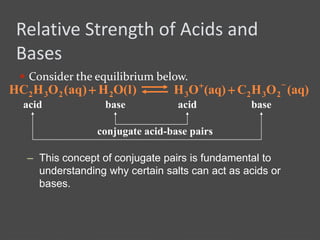
 Consider the equilibrium below.
– This concept of conjugate pairs is fundamental to
understanding why certain salts can act as acids or
bases.
(aq)OHC(aq)OH 2323

)l(OH)aq(OHHC 2232 
acid acidbase base
conjugate acid-base pairs
Self-ionization of Water
 Self-ionization is a reaction in which two like
molecules react to give ions.
In the case of water, the following equilibrium
is established.
)aq(OH)aq(OH)l(OH)l(OH 322


– The equilibrium-constant expression for this
system is:
2
2
3
c
]OH[
]OH][OH[
K


Self-ionization of Water
 Self-ionization is a reaction in which two like
molecules react to give ions.
– The concentration of ions is extremely
small, so the concentration of H2O remains
essentially constant. This gives:
]OH][OH[K]OH[ 3c
2
2


constant
Self-ionization of Water– We call the equilibrium value for the ion product
[H3O+][OH-] the ion-product constant for water,
which is written Kw.
]OH][OH[K 3w


– At 25 oC, the value of Kw is 1.0 x 10⁻¹⁴.
– Like any equilibrium constant, Kw varies with
temperature.
Self-ionization of Water– Because we often write H3O+ as H+, the ion-
product constant expression for water can be
written:
]OH][H[Kw


– Using Kw you can calculate the concentrations of
H+ and OH- ions in pure water.
Self-ionization of Water
 These ions are produced in equal numbers in pure
water, so if we let x = [H+] = [OH-]
– Thus, the concentrations of H+ and OH- in pure
water are both 1.0 x 10⁻⁷ M.
– If you add acid or base to water they are no longer
equal but the Kw expression still holds.
C25at)x)(x(100.1 o14
 
714
100.1100.1x 

The pH of a Solution
 Although we can quantitatively describe the acidity of
a solution by its [H+], it is often more convenient to
give acidity in terms of pH.
– The pH of a solution is defined as the negative
logarithm of the molar hydrogen-ion concentration.
]Hlog[pH 

The pH of a Solution
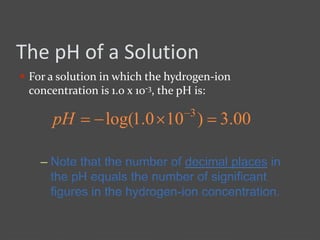
 For a solution in which the hydrogen-ion
concentration is 1.0 x 10⁻³, the pH is:
– Note that the number of decimal places in
the pH equals the number of significant
figures in the hydrogen-ion concentration.
00.3)100.1log( 3
 
pH
The pH of a Solution
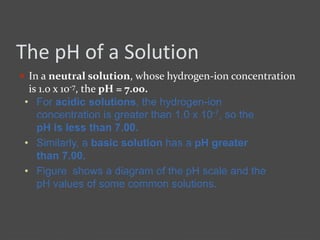
 In a neutral solution, whose hydrogen-ion concentration
is 1.0 x 10⁻⁷, the pH = 7.00.
• For acidic solutions, the hydrogen-ion
concentration is greater than 1.0 x 10⁻⁷, so the
pH is less than 7.00.
• Similarly, a basic solution has a pH greater
than 7.00.
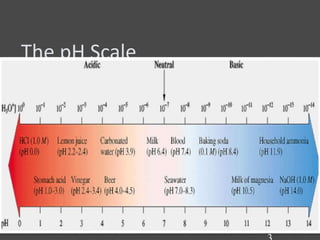
• Figure shows a diagram of the pH scale and the
pH values of some common solutions.
The pH Scale
A Problem to Consider
 A sample of orange juice has a hydrogen-ion
concentration of 2.9 x 10⁻⁴ M. What is the pH?
]Hlog[pH 

)109.2log(pH 4

54.3pH
A Problem to Consider
 The pH of human arterial blood is 7.40. What is the
hydrogen-ion concentration?
)pHlog(anti]H[ 
)40.7log(anti]H[ 
M100.410]H[ 840.7 

The pH of a Solution
 A measurement of the hydroxide ion concentration,
similar to pH, is the pOH.
– The pOH of a solution is defined as the
negative logarithm of the molar hydroxide-
ion concentration.
]OHlog[pOH 

The pH of a Solution
 A measurement of the hydroxide ion concentration,
similar to pH, is the pOH.
– Then because Kw = [H+][OH-] = 1.0 x 10⁻¹⁴
at 25 oC, you can show that
00.14pOHpH 
A Problem to Consider
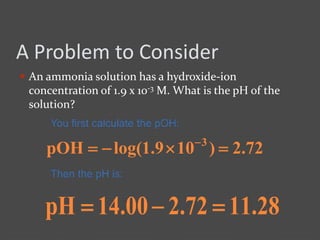
 An ammonia solution has a hydroxide-ion
concentration of 1.9 x 10⁻³ M. What is the pH of the
solution?
You first calculate the pOH:
72.2)109.1log(pOH 3
 
Then the pH is:
28.1172.200.14pH 
The pH of a Solution
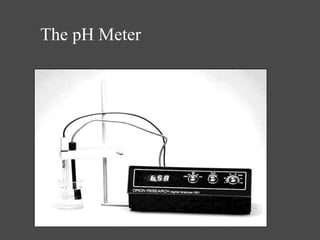
 The pH of a solution can accurately be measured using
a pH meter
– Although less precise, acid-base indicators are
often used to measure pH because they usually
change color within a narrow pH range.
The pH Meter
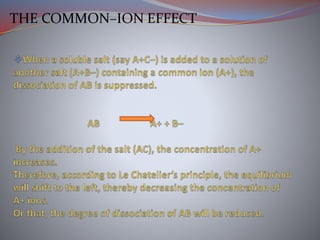
THE COMMON–ION EFFECT
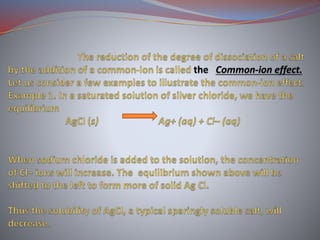
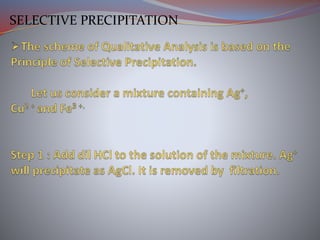
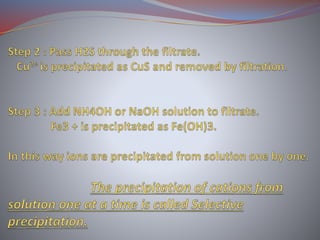
SELECTIVE PRECIPITATION
1. General chemistry by Ebbing Darell,3rd
edition
2. Essentials of physical chemistry by bahl
and tuli ,3 rd edition
3.https:// sites.google.com
4. https://www.mhhe.com
Presentation
of Lecture
Outlines,
16–49

B sc_I_General chemistry U-II Ionic equilibria in aqueous solution

  • 1.
    Course: B.Sc. I Subject:Chemistry I Unit: II
  • 2.
    Acids  Produce H+(as H3O+) ions in water (the hydronium ion is a hydrogen ion attached to a water molecule)  Taste sour  Corrode metals  React with bases to form a salt and water  pH is less than 7  Turns blue litmus paper to red “Blue to Red A-CID”
  • 3.
  • 4.
    Bases  Produce OH-ions in water  Taste bitter, chalky  Feel soapy, slippery  React with acids to form salts and water  pH greater than 7  Turns red litmus paper to blue “Basic Blue”
  • 5.
    Some Common Bases NaOHsodium hydroxide lye KOH potassium hydroxide liquid soap Ba(OH)2 barium hydroxide stabilizer for plastics Mg(OH)2 magnesium hydroxide “MOM” Milk of magnesia Al(OH)3 aluminum hydroxide Maalox (antacid) 4
  • 6.
  • 7.
    Acid/Base definitions  Definition#1: Arrhenius (traditional) Acids – produce H+ ions (or hydronium ions H3O+) Bases – produce OH- ions
  • 8.
    Arrhenius Concept ofAcids and Bases According to the Arrhenius concept of acids and bases,  an Acid is a substance that, when dissolved in water, increases the concentration of hydronium ion or H+ ion (H3O+ ). • the aqueous hydrogen ion is actually chemically bonded to water, that is, H3O+. • Chemists often use the notation H+(aq) for the H3O+(aq) ion.
  • 9.
    Arrhenius concept ofbases A base, in the Arrhenius concept, is a substance that, when dissolved in water, increases the concentration of hydroxide ion, OH-(aq).
  • 10.
    Arrhenius acid isa substance that produces H+ (H3O+) in water Arrhenius base is a substance that produces OH- in water 3
  • 11.
  • 12.
    Brønsted-Lowry Concept ofAcids and Bases • According to the Brønsted-Lowry concept, • An acid is the species donating the proton in a proton-transfer reaction. • A base is the species accepting the proton in a proton-transfer reaction
  • 13.
     Consider thereaction of NH3 and H20. )aq(OH)aq(NH)l(OH)aq(NH 423  
  • 14.
     Consider thereaction of NH3 and H2O. – In the forward reaction, NH3 accepts a proton from H2O. Thus, NH3 is a base and H2O is an acid. )aq(OH)aq(NH)l(OH)aq(NH 423   H+ base acid
  • 15.
     Consider thereaction of NH3 and H2O. – In the reverse reaction, NH4 + donates a proton to OH-. The NH4 + ion is the acid and OH- is the base. )aq(OH)aq(NH)l(OH)aq(NH 423   H+ baseacid
  • 16.
    Brønsted-Lowry Concept ofAcids and Bases  Consider the reaction of NH3 and H2O. – A conjugate acid-base pair consists of two species in an acid-base reaction, one acid and one base, that differ by the loss or gain of a proton. )aq(OH)aq(NH)l(OH)aq(NH 423   base acid – The species NH4 + and NH3 are a conjugate acid-base pair.
  • 17.
    Brønsted-Lowry Concept ofAcids and Bases  Consider the reaction of NH3 and H2O. – The Brønsted-Lowry concept defines a species as an acid or a base according to its function in the proton-transfer reaction. )aq(OH)aq(NH)l(OH)aq(NH 423   base acid – Here NH4 + is the conjugate acid of NH3 and NH3 is the conjugate base of NH4 +.
  • 18.
    Brønsted-Lowry Concept ofAcids and Bases  Some species can act as an acid or a base. )l(OH)aq(CO)aq(OH)aq(HCO 2 2 33   –H+ – An amphoteric species is a species that can act either as an acid or a base (it can gain or lose a proton). – For example, HCO3 - acts as a proton donor (an acid) in the presence of OH-
  • 19.
    Brønsted-Lowry Concept ofAcids and Bases  Some species can act as an acid or a base. – An amphoteric species is a species that can act either as an acid or a base (it can gain or lose a proton). – Alternatively, HCO3 can act as a proton acceptor (a base) in the presence of HF. )aq(F)aq(COH)aq(HF)aq(HCO 323   H+
  • 20.
    Brønsted-Lowry Concept ofAcids and Bases  The amphoteric characteristic of water is important in the acid-base properties of aqueous solutions. – Water reacts as an acid with the base NH3. )aq(OH)aq(NH)l(OH)aq(NH 423   H+
  • 21.
    Brønsted-Lowry Concept ofAcids and Bases  The amphoteric characteristic of water is important in the acid-base properties of aqueous solutions. – Water can also react as a base with the acid HF. )aq(OH)aq(F)l(OH)aq(HF 32   H+
  • 22.
    Brønsted-Lowry Concept ofAcids and Bases  In the Brønsted-Lowry concept: 2. Acids and bases can be ions as well as molecular substances. 3. Acid-base reactions are not restricted to aqueous solution. 4. Some species can act as either acids or bases depending on what the other reactant is. 1. A base is a species that accepts protons; OH- is only one example of a base.
  • 23.
    Lewis Concept ofAcids and Bases  The Lewis concept defines an acid as an electron pair acceptor and a base as an electron pair donor. – This concept broadened the scope of acid- base theory to include reactions that did not involve H+.
  • 24.
    Lewis Concept ofAcids and Bases  The reaction of boron trifluoride with ammonia is an example. – Boron trifluoride accepts the electron pair, so it is a Lewis acid. Ammonia donates the electron pair, so it is the Lewis base. + N H H H: :: : B F F F : : :: :: :: : B F F F : : :: :: N H H H
  • 25.
    Relative Strength ofAcids and Bases  The Brønsted-Lowry concept introduced the idea of conjugate acid-base pairs and proton-transfer reactions. – The stronger acids are those that lose their hydrogen ions more easily than other acids. – Similarly, the stronger bases are those that hold onto hydrogen ions more strongly than other bases.
  • 26.
    Relative Strength ofAcids and Bases  The Brønsted-Lowry concept introduced the idea of conjugate acid-base pairs and proton-transfer reactions. – If an acid loses its H+, the resulting anion is now in a position to reaccept a proton, making it a Brønsted-Lowry base. – It is logical to assume that if an acid is considered strong, its conjugate base (that is, its anion) would be weak, since it is unlikely to accept a hydrogen ion.
  • 27.
    Relative Strength ofAcids and Bases  Consider the equilibrium below. – In this system we have two opposing Brønsted- Lowry acid-base reactions. – In this example, H3O+ is the stronger of the two acids. Consequently, the equilibrium is skewed toward reactants. (aq)OHC(aq)OH 2323  )l(OH)aq(OHHC 2232  acid acidbase base conjugate acid-base pairs
  • 28.
    Relative Strength ofAcids and Bases  Consider the equilibrium below. – This concept of conjugate pairs is fundamental to understanding why certain salts can act as acids or bases. (aq)OHC(aq)OH 2323  )l(OH)aq(OHHC 2232  acid acidbase base conjugate acid-base pairs
  • 29.
    Self-ionization of Water Self-ionization is a reaction in which two like molecules react to give ions. In the case of water, the following equilibrium is established. )aq(OH)aq(OH)l(OH)l(OH 322   – The equilibrium-constant expression for this system is: 2 2 3 c ]OH[ ]OH][OH[ K  
  • 30.
    Self-ionization of Water Self-ionization is a reaction in which two like molecules react to give ions. – The concentration of ions is extremely small, so the concentration of H2O remains essentially constant. This gives: ]OH][OH[K]OH[ 3c 2 2   constant
  • 31.
    Self-ionization of Water–We call the equilibrium value for the ion product [H3O+][OH-] the ion-product constant for water, which is written Kw. ]OH][OH[K 3w   – At 25 oC, the value of Kw is 1.0 x 10⁻¹⁴. – Like any equilibrium constant, Kw varies with temperature.
  • 32.
    Self-ionization of Water–Because we often write H3O+ as H+, the ion- product constant expression for water can be written: ]OH][H[Kw   – Using Kw you can calculate the concentrations of H+ and OH- ions in pure water.
  • 33.
    Self-ionization of Water These ions are produced in equal numbers in pure water, so if we let x = [H+] = [OH-] – Thus, the concentrations of H+ and OH- in pure water are both 1.0 x 10⁻⁷ M. – If you add acid or base to water they are no longer equal but the Kw expression still holds. C25at)x)(x(100.1 o14   714 100.1100.1x  
  • 34.
    The pH ofa Solution  Although we can quantitatively describe the acidity of a solution by its [H+], it is often more convenient to give acidity in terms of pH. – The pH of a solution is defined as the negative logarithm of the molar hydrogen-ion concentration. ]Hlog[pH  
  • 35.
    The pH ofa Solution  For a solution in which the hydrogen-ion concentration is 1.0 x 10⁻³, the pH is: – Note that the number of decimal places in the pH equals the number of significant figures in the hydrogen-ion concentration. 00.3)100.1log( 3   pH
  • 36.
    The pH ofa Solution  In a neutral solution, whose hydrogen-ion concentration is 1.0 x 10⁻⁷, the pH = 7.00. • For acidic solutions, the hydrogen-ion concentration is greater than 1.0 x 10⁻⁷, so the pH is less than 7.00. • Similarly, a basic solution has a pH greater than 7.00. • Figure shows a diagram of the pH scale and the pH values of some common solutions.
  • 37.
  • 38.
    A Problem toConsider  A sample of orange juice has a hydrogen-ion concentration of 2.9 x 10⁻⁴ M. What is the pH? ]Hlog[pH   )109.2log(pH 4  54.3pH
  • 39.
    A Problem toConsider  The pH of human arterial blood is 7.40. What is the hydrogen-ion concentration? )pHlog(anti]H[  )40.7log(anti]H[  M100.410]H[ 840.7  
  • 40.
    The pH ofa Solution  A measurement of the hydroxide ion concentration, similar to pH, is the pOH. – The pOH of a solution is defined as the negative logarithm of the molar hydroxide- ion concentration. ]OHlog[pOH  
  • 41.
    The pH ofa Solution  A measurement of the hydroxide ion concentration, similar to pH, is the pOH. – Then because Kw = [H+][OH-] = 1.0 x 10⁻¹⁴ at 25 oC, you can show that 00.14pOHpH 
  • 42.
    A Problem toConsider  An ammonia solution has a hydroxide-ion concentration of 1.9 x 10⁻³ M. What is the pH of the solution? You first calculate the pOH: 72.2)109.1log(pOH 3   Then the pH is: 28.1172.200.14pH 
  • 43.
    The pH ofa Solution  The pH of a solution can accurately be measured using a pH meter – Although less precise, acid-base indicators are often used to measure pH because they usually change color within a narrow pH range.
  • 44.
  • 45.
  • 47.
  • 49.
    1. General chemistryby Ebbing Darell,3rd edition 2. Essentials of physical chemistry by bahl and tuli ,3 rd edition 3.https:// sites.google.com 4. https://www.mhhe.com Presentation of Lecture Outlines, 16–49