
Made by: Deepanshu Kapoor
Project Guide: Dr. Tanuja Nautiyal
Man is one of the species who inhabit the earth .
he is the only one who has interfered with various natural
processes for use of both biological & physical resources
to meet his multiple demands, man has polluted all the –
lithosphere , hydrosphere & atmosphere. it is essential
for us e realms of to know about environment & its
pollution.
•Primary & secondary pollutants
•Acid rain
•Ozone depletion
•Green house effect
•Noise pollution
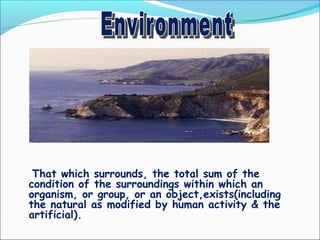
That which surrounds, the total sum of the
condition of the surroundings within which an
organism, or group, or an object,exists(including
the natural as modified by human activity & the
artificial).
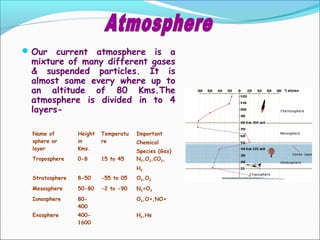
Our current atmosphere is a
mixture of many different gases
& suspended particles. It is
almost same every where up to
an altitude of 80 Kms.The
atmosphere is divided in to 4
layers-
Name of
sphere or
layer
Height
in
Kms.
Temperatu
re
Important
Chemical
Species (Gas)
Troposphere 0-8 15 to 45 N2,O2,CO2,
H2
Stratosphere 8-50 -55 to 05 O3,O2
Mesosphere 50-80 -2 to -90 N2+O2
Ionosphere 80-
400
O2,O+,NO+
Exosphere 400-
1600
H2,He
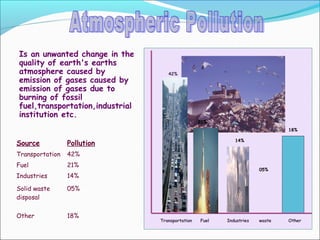
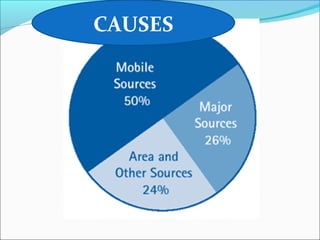
Source Pollution
Transportation 42%
Fuel 21%
Industries 14%
Solid waste
disposal
05%
Other 18%
42%
21%
Transportation Fuel
Is an unwanted change in the
quality of earth's earths
atmosphere caused by
emission of gases caused by
emission of gases due to
burning of fossil
fuel,transportation,industrial
institution etc.
Industries waste Other
21%
14%
05%
18%
Different Pollutants
1. Gaseous waste: Oxides of
nitrogen,SO2,CO2,CO.Cl,Br,I,O3 & smog.
2. Complex organic chemicals: Benzene, ether.
3. Acid prop lets: H2SO4, HNO3
4. Agrochemicals: fertilizers,
pesticides,herbicixles,fungicides,
rematicides,weedicides,bectrecides etc.
5. Fluorides
6. Metals: Mercury,lead,Cd,Zn,Fe,Ni etc.
7. Solid wasre:Garbage,plastic etc.
8. Radioactive waste: Nuclear
reacters,uranium,nuclear explosion.
9. Noise waste
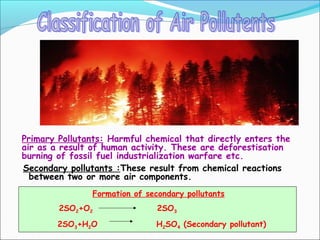
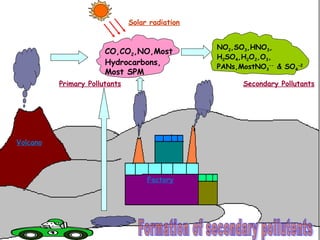
Secondary pollutants :These result from chemical reactions
between two or more air components.
Formation of secondary pollutants
2SO2+O2 2SO3
2SO3+H2O H2SO4 (Secondary pollutant)
Primary Pollutants: Harmful chemical that directly enters the
air as a result of human activity. These are deforestisation
burning of fossil fuel industrialization warfare etc.
Primary Pollutants Secondary Pollutants
Factory
Volcano
NO2,SO3,HNO3,
H2SO4,H2O2,O3,
PANs,MostNO3
--
& SO4
-2
CO,CO2,NO,Most
Hydrocarbons,
Most SPM
Solar radiation
CAUSES
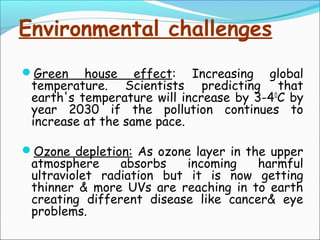
Environmental challenges
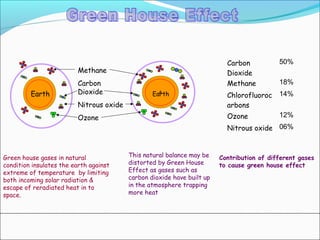
Green house effect: Increasing global
temperature. Scientists predicting that
earth's temperature will increase by 3-40
C by
year 2030 if the pollution continues to
increase at the same pace.
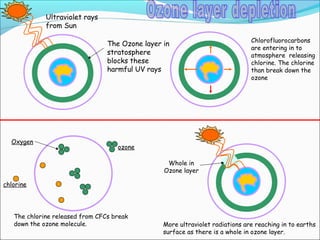
Ozone depletion: As ozone layer in the upper
atmosphere absorbs incoming harmful
ultraviolet radiation but it is now getting
thinner & more UVs are reaching in to earth
creating different disease like cancer& eye
problems.
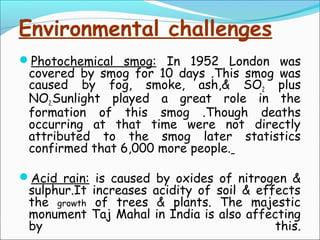
Environmental challenges
Photochemical smog: In 1952 London was
covered by smog for 10 days .This smog was
caused by fog, smoke, ash,& SO2 plus
NO2.Sunlight played a great role in the
formation of this smog .Though deaths
occurring at that time were not directly
attributed to the smog later statistics
confirmed that 6,000 more people.
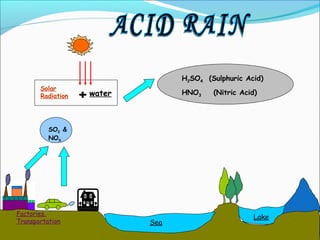
Acid rain: is caused by oxides of nitrogen &
sulphur.It increases acidity of soil & effects
the growth of trees & plants. The majestic
monument Taj Mahal in India is also affecting
by this.
Acid Rain
SO2 &
NOX
+water
SEASea
Lake
Factories,
Transportation
Solar
Radiation
H2SO4 (Sulphuric Acid)
HNO3 (Nitric Acid)
A
Methane
Carbon
Dioxide
Nitrous oxide
Ozone
EarthEarth
Carbon
Dioxide
50%
Methane 18%
Chlorofluoroc
arbons
14%
Ozone 12%
Nitrous oxide 06%
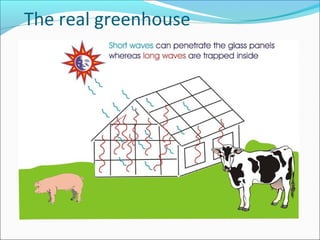
Green house gases in natural
condition insulates the earth against
extreme of temperature by limiting
both incoming solar radiation &
escape of reradiated heat in to
space.
This natural balance may be
distorted by Green House
Effect as gases such as
carbon dioxide have built up
in the atmosphere trapping
more heat
Contribution of different gases
to cause green house effect
The real greenhouse
Ultraviolet rays
from Sun
The Ozone layer in
stratosphere
blocks these
harmful UV rays
Chlorofluorocarbons
are entering in to
atmosphere releasing
chlorine. The chlorine
than break down the
ozone
The chlorine released from CFCs break
down the ozone molecule.
chlorine
ozone
More ultraviolet radiations are reaching in to earths
surface as there is a whole in ozone layer.
Oxygen
Whole in
Ozone layer
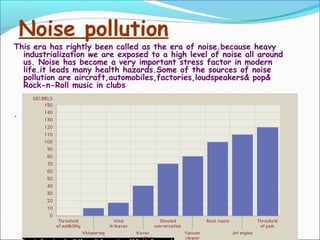
Noise pollution
This era has rightly been called as the era of noise.because heavy
industrialization we are exposed to a high level of noise all around
us. Noise has become a very important stress factor in modern
life.it leads many health hazards.Some of the sources of noise
pollution are aircraft,automobiles,factories,loudspeakers& pop&
Rock-n-Roll music in clubs
. Noise produces following health problems-
1)Auditory fatigue
2)Deafness or impaired vision
3)Rise in blood pressure, pulse
rate
4)Headache
5)Nausea
6)Disturbed sleep
7)Emotional disturbances
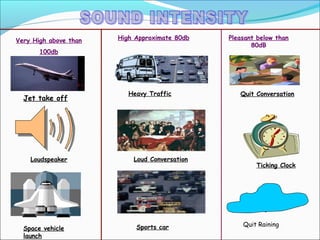
Space vehicle
launch
Loudspeaker
Jet take off
Very High above than
100db
Loud Conversation
Heavy Traffic
High Approximate 80db
Quit Conversation
Ticking Clock
Pleasant below than
80dB
Quit RainingSports car
18
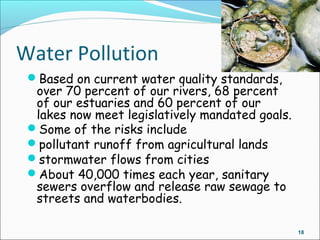
Water Pollution
Based on current water quality standards,
over 70 percent of our rivers, 68 percent
of our estuaries and 60 percent of our
lakes now meet legislatively mandated goals.
Some of the risks include
pollutant runoff from agricultural lands
stormwater flows from cities
About 40,000 times each year, sanitary
sewers overflow and release raw sewage to
streets and waterbodies.
19
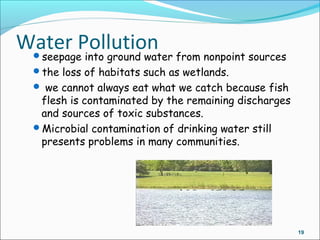
Water Pollutionseepage into ground water from nonpoint sources
the loss of habitats such as wetlands.
 we cannot always eat what we catch because fish
flesh is contaminated by the remaining discharges
and sources of toxic substances.
Microbial contamination of drinking water still
presents problems in many communities.
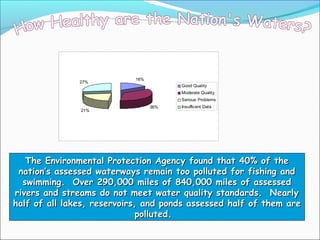
16%
36%
21%
27%
Good Quality
Moderate Quality
Serious Problems
Insufficent Data
The Environmental Protection Agency found that 40% of theThe Environmental Protection Agency found that 40% of the
nation’s assessed waterways remain too polluted for fishing andnation’s assessed waterways remain too polluted for fishing and
swimming. Over 290,000 miles of 840,000 miles of assessedswimming. Over 290,000 miles of 840,000 miles of assessed
rivers and streams do not meet water quality standards. Nearlyrivers and streams do not meet water quality standards. Nearly
half of all lakes, reservoirs, and ponds assessed half of them arehalf of all lakes, reservoirs, and ponds assessed half of them are
polluted.polluted.
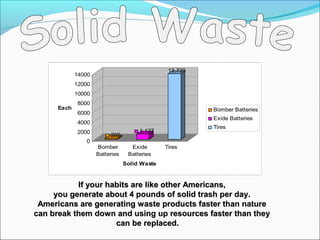
202
1,127
13,739
0
2000
4000
6000
8000
10000
12000
14000
Each
Bomber
Batteries
Exide
Batteries
Tires
Solid Waste
Bomber Batteries
Exide Batteries
Tires
If your habits are like other Americans,If your habits are like other Americans,
you generate about 4 pounds of solid trash per day.you generate about 4 pounds of solid trash per day.
Americans are generating waste products faster than natureAmericans are generating waste products faster than nature
can break them down and using up resources faster than theycan break them down and using up resources faster than they
can be replaced.can be replaced.
SOLID WASTE
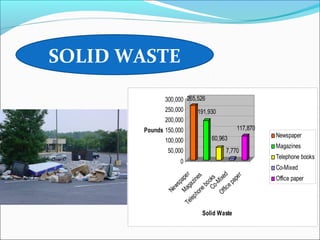
265,526
191,930
60,963
7,770
117,870
0
50,000
100,000
150,000
200,000
250,000
300,000
Pounds
Newspaper
Magazines
TelephonebooksCo-Mixed
Officepaper
Solid Waste
Newspaper
Magazines
Telephone books
Co-Mixed
Office paper
WHAT ARE WE GOING TO DO?
WhatWhat
can wecan we
do?do?
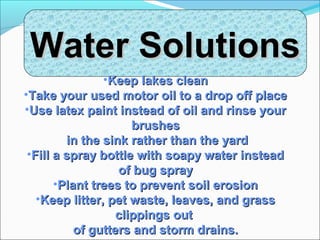
Water SolutionsWater Solutions
•Keep lakes cleanKeep lakes clean
•Take your used motor oil to a drop off placeTake your used motor oil to a drop off place
•Use latex paint instead of oil and rinse yourUse latex paint instead of oil and rinse your
brushesbrushes
in the sink rather than the yardin the sink rather than the yard
•Fill a spray bottle with soapy water insteadFill a spray bottle with soapy water instead
of bug sprayof bug spray
•Plant trees to prevent soil erosionPlant trees to prevent soil erosion
•Keep litter, pet waste, leaves, and grassKeep litter, pet waste, leaves, and grass
clippings outclippings out
of gutters and storm drains.of gutters and storm drains.
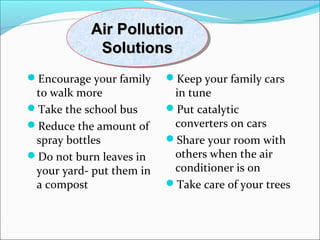
Air PollutionAir Pollution
SolutionsSolutions
Air PollutionAir Pollution
SolutionsSolutions
Encourage your family
to walk more
Take the school bus
Reduce the amount of
spray bottles
Do not burn leaves in
your yard- put them in
a compost
Keep your family cars
in tune
Put catalytic
converters on cars
Share your room with
others when the air
conditioner is on
Take care of your trees
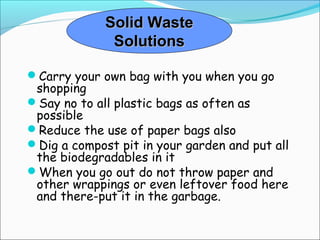
Solid WasteSolid Waste
SolutionsSolutions
Carry your own bag with you when you go
shopping
Say no to all plastic bags as often as
possible
Reduce the use of paper bags also
Dig a compost pit in your garden and put all
the biodegradables in it
When you go out do not throw paper and
other wrappings or even leftover food here
and there-put it in the garbage.
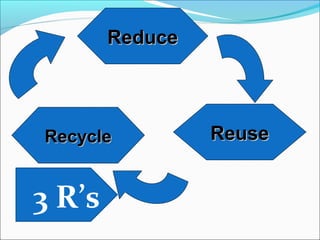
ReduceReduce
ReuseReuseRecycleRecycle
3 R’s
We know that certain environmental conditions like air,water,& food
are essential for man,s survival.apart from their availability their
quality & quantity must be assured according to man,s natural &
acquired capacity for sustenance progress in industrialization has
brought environmental hazards such as air water & noise
pollution.These have caused many health problems & diseases.
As it has been said-
we do not inherit the environment from our
forefathers,we borrow it from future generation.
Stockholm conference of 1972 proclaims that:
The protection & improvement of human environment is a major
issue which affects the well being of people & economic development
throughout the world&it is duty of all governments & people to
common efforts for the preservation & improvement of environment
for the benefit of all people & their prosperity
MADE BY:
DEEPANSHU KAPOOR

Environmental Pollution and prevention

  • 1.
    Made by: DeepanshuKapoor Project Guide: Dr. Tanuja Nautiyal
  • 2.
    Man is oneof the species who inhabit the earth . he is the only one who has interfered with various natural processes for use of both biological & physical resources to meet his multiple demands, man has polluted all the – lithosphere , hydrosphere & atmosphere. it is essential for us e realms of to know about environment & its pollution. •Primary & secondary pollutants •Acid rain •Ozone depletion •Green house effect •Noise pollution
  • 3.
    That which surrounds,the total sum of the condition of the surroundings within which an organism, or group, or an object,exists(including the natural as modified by human activity & the artificial).
  • 4.
    Our current atmosphereis a mixture of many different gases & suspended particles. It is almost same every where up to an altitude of 80 Kms.The atmosphere is divided in to 4 layers- Name of sphere or layer Height in Kms. Temperatu re Important Chemical Species (Gas) Troposphere 0-8 15 to 45 N2,O2,CO2, H2 Stratosphere 8-50 -55 to 05 O3,O2 Mesosphere 50-80 -2 to -90 N2+O2 Ionosphere 80- 400 O2,O+,NO+ Exosphere 400- 1600 H2,He
  • 5.
    Source Pollution Transportation 42% Fuel21% Industries 14% Solid waste disposal 05% Other 18% 42% 21% Transportation Fuel Is an unwanted change in the quality of earth's earths atmosphere caused by emission of gases caused by emission of gases due to burning of fossil fuel,transportation,industrial institution etc. Industries waste Other 21% 14% 05% 18%
  • 6.
    Different Pollutants 1. Gaseouswaste: Oxides of nitrogen,SO2,CO2,CO.Cl,Br,I,O3 & smog. 2. Complex organic chemicals: Benzene, ether. 3. Acid prop lets: H2SO4, HNO3 4. Agrochemicals: fertilizers, pesticides,herbicixles,fungicides, rematicides,weedicides,bectrecides etc. 5. Fluorides 6. Metals: Mercury,lead,Cd,Zn,Fe,Ni etc. 7. Solid wasre:Garbage,plastic etc. 8. Radioactive waste: Nuclear reacters,uranium,nuclear explosion. 9. Noise waste
  • 7.
    Secondary pollutants :Theseresult from chemical reactions between two or more air components. Formation of secondary pollutants 2SO2+O2 2SO3 2SO3+H2O H2SO4 (Secondary pollutant) Primary Pollutants: Harmful chemical that directly enters the air as a result of human activity. These are deforestisation burning of fossil fuel industrialization warfare etc.
  • 8.
    Primary Pollutants SecondaryPollutants Factory Volcano NO2,SO3,HNO3, H2SO4,H2O2,O3, PANs,MostNO3 -- & SO4 -2 CO,CO2,NO,Most Hydrocarbons, Most SPM Solar radiation
  • 9.
  • 10.
    Environmental challenges Green houseeffect: Increasing global temperature. Scientists predicting that earth's temperature will increase by 3-40 C by year 2030 if the pollution continues to increase at the same pace. Ozone depletion: As ozone layer in the upper atmosphere absorbs incoming harmful ultraviolet radiation but it is now getting thinner & more UVs are reaching in to earth creating different disease like cancer& eye problems.
  • 11.
    Environmental challenges Photochemical smog:In 1952 London was covered by smog for 10 days .This smog was caused by fog, smoke, ash,& SO2 plus NO2.Sunlight played a great role in the formation of this smog .Though deaths occurring at that time were not directly attributed to the smog later statistics confirmed that 6,000 more people. Acid rain: is caused by oxides of nitrogen & sulphur.It increases acidity of soil & effects the growth of trees & plants. The majestic monument Taj Mahal in India is also affecting by this.
  • 12.
  • 13.
    A Methane Carbon Dioxide Nitrous oxide Ozone EarthEarth Carbon Dioxide 50% Methane 18% Chlorofluoroc arbons 14% Ozone12% Nitrous oxide 06% Green house gases in natural condition insulates the earth against extreme of temperature by limiting both incoming solar radiation & escape of reradiated heat in to space. This natural balance may be distorted by Green House Effect as gases such as carbon dioxide have built up in the atmosphere trapping more heat Contribution of different gases to cause green house effect
  • 14.
  • 15.
    Ultraviolet rays from Sun TheOzone layer in stratosphere blocks these harmful UV rays Chlorofluorocarbons are entering in to atmosphere releasing chlorine. The chlorine than break down the ozone The chlorine released from CFCs break down the ozone molecule. chlorine ozone More ultraviolet radiations are reaching in to earths surface as there is a whole in ozone layer. Oxygen Whole in Ozone layer
  • 16.
    Noise pollution This erahas rightly been called as the era of noise.because heavy industrialization we are exposed to a high level of noise all around us. Noise has become a very important stress factor in modern life.it leads many health hazards.Some of the sources of noise pollution are aircraft,automobiles,factories,loudspeakers& pop& Rock-n-Roll music in clubs . Noise produces following health problems- 1)Auditory fatigue 2)Deafness or impaired vision 3)Rise in blood pressure, pulse rate 4)Headache 5)Nausea 6)Disturbed sleep 7)Emotional disturbances
  • 17.
    Space vehicle launch Loudspeaker Jet takeoff Very High above than 100db Loud Conversation Heavy Traffic High Approximate 80db Quit Conversation Ticking Clock Pleasant below than 80dB Quit RainingSports car
  • 18.
    18 Water Pollution Based oncurrent water quality standards, over 70 percent of our rivers, 68 percent of our estuaries and 60 percent of our lakes now meet legislatively mandated goals. Some of the risks include pollutant runoff from agricultural lands stormwater flows from cities About 40,000 times each year, sanitary sewers overflow and release raw sewage to streets and waterbodies.
  • 19.
    19 Water Pollutionseepage intoground water from nonpoint sources the loss of habitats such as wetlands.  we cannot always eat what we catch because fish flesh is contaminated by the remaining discharges and sources of toxic substances. Microbial contamination of drinking water still presents problems in many communities.
  • 20.
    16% 36% 21% 27% Good Quality Moderate Quality SeriousProblems Insufficent Data The Environmental Protection Agency found that 40% of theThe Environmental Protection Agency found that 40% of the nation’s assessed waterways remain too polluted for fishing andnation’s assessed waterways remain too polluted for fishing and swimming. Over 290,000 miles of 840,000 miles of assessedswimming. Over 290,000 miles of 840,000 miles of assessed rivers and streams do not meet water quality standards. Nearlyrivers and streams do not meet water quality standards. Nearly half of all lakes, reservoirs, and ponds assessed half of them arehalf of all lakes, reservoirs, and ponds assessed half of them are polluted.polluted.
  • 21.
    202 1,127 13,739 0 2000 4000 6000 8000 10000 12000 14000 Each Bomber Batteries Exide Batteries Tires Solid Waste Bomber Batteries ExideBatteries Tires If your habits are like other Americans,If your habits are like other Americans, you generate about 4 pounds of solid trash per day.you generate about 4 pounds of solid trash per day. Americans are generating waste products faster than natureAmericans are generating waste products faster than nature can break them down and using up resources faster than theycan break them down and using up resources faster than they can be replaced.can be replaced.
  • 22.
  • 23.
    WHAT ARE WEGOING TO DO? WhatWhat can wecan we do?do?
  • 24.
    Water SolutionsWater Solutions •Keeplakes cleanKeep lakes clean •Take your used motor oil to a drop off placeTake your used motor oil to a drop off place •Use latex paint instead of oil and rinse yourUse latex paint instead of oil and rinse your brushesbrushes in the sink rather than the yardin the sink rather than the yard •Fill a spray bottle with soapy water insteadFill a spray bottle with soapy water instead of bug sprayof bug spray •Plant trees to prevent soil erosionPlant trees to prevent soil erosion •Keep litter, pet waste, leaves, and grassKeep litter, pet waste, leaves, and grass clippings outclippings out of gutters and storm drains.of gutters and storm drains.
  • 25.
    Air PollutionAir Pollution SolutionsSolutions AirPollutionAir Pollution SolutionsSolutions Encourage your family to walk more Take the school bus Reduce the amount of spray bottles Do not burn leaves in your yard- put them in a compost Keep your family cars in tune Put catalytic converters on cars Share your room with others when the air conditioner is on Take care of your trees
  • 26.
    Solid WasteSolid Waste SolutionsSolutions Carryyour own bag with you when you go shopping Say no to all plastic bags as often as possible Reduce the use of paper bags also Dig a compost pit in your garden and put all the biodegradables in it When you go out do not throw paper and other wrappings or even leftover food here and there-put it in the garbage.
  • 27.
  • 28.
    We know thatcertain environmental conditions like air,water,& food are essential for man,s survival.apart from their availability their quality & quantity must be assured according to man,s natural & acquired capacity for sustenance progress in industrialization has brought environmental hazards such as air water & noise pollution.These have caused many health problems & diseases. As it has been said- we do not inherit the environment from our forefathers,we borrow it from future generation. Stockholm conference of 1972 proclaims that: The protection & improvement of human environment is a major issue which affects the well being of people & economic development throughout the world&it is duty of all governments & people to common efforts for the preservation & improvement of environment for the benefit of all people & their prosperity
  • 29.