•Take some time to consider the question before
moving to the next slide which offers the correct
answer.
•Write your answer down before you see the actual
answer, this will allow you to test yourself more
effectively.
CHECK YOUR LEARNING
Prokaryotic and Eukaryotic Cells
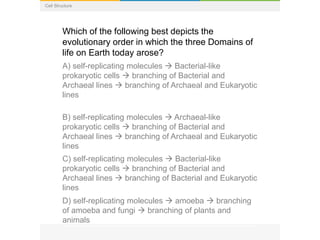
Cell Structure
Which of the following best depicts the
evolutionary order in which the three Domains of
life on Earth today arose?
A) self-replicating molecules  Bacterial-like
prokaryotic cells  branching of Bacterial and
Archaeal lines  branching of Archaeal and Eukaryotic
lines
B) self-replicating molecules  Archaeal-like
prokaryotic cells  branching of Bacterial and
Archaeal lines  branching of Archaeal and Eukaryotic
lines
C) self-replicating molecules  Bacterial-like
prokaryotic cells  branching of Bacterial and
Archaeal lines  branching of Bacterial and Eukaryotic
lines
D) self-replicating molecules  amoeba  branching
of amoeba and fungi  branching of plants and
animals
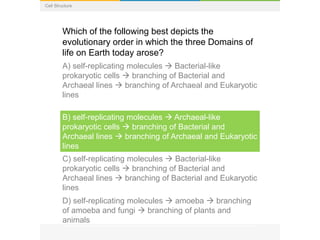
Cell Structure
Which of the following best depicts the
evolutionary order in which the three Domains of
life on Earth today arose?
A) self-replicating molecules  Bacterial-like
prokaryotic cells  branching of Bacterial and
Archaeal lines  branching of Archaeal and Eukaryotic
lines
B) self-replicating molecules  Archaeal-like
prokaryotic cells  branching of Bacterial and
Archaeal lines  branching of Archaeal and Eukaryotic
lines
C) self-replicating molecules  Bacterial-like
prokaryotic cells  branching of Bacterial and
Archaeal lines  branching of Bacterial and Eukaryotic
lines
D) self-replicating molecules  amoeba  branching
of amoeba and fungi  branching of plants and
animals
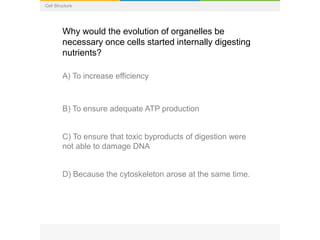
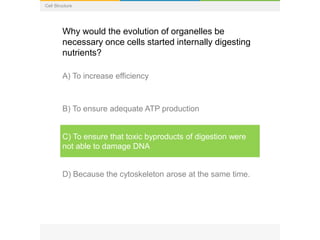
Cell Structure
Why would the evolution of organelles be
necessary once cells started internally digesting
nutrients?
A) To increase efficiency
B) To ensure adequate ATP production
C) To ensure that toxic byproducts of digestion were
not able to damage DNA
D) Because the cytoskeleton arose at the same time.
Cell Structure
Why would the evolution of organelles be
necessary once cells started internally digesting
nutrients?
A) To increase efficiency
B) To ensure adequate ATP production
C) To ensure that toxic byproducts of digestion were
not able to damage DNA
D) Because the cytoskeleton arose at the same time.
Free to share, print, make copies and changes. Get yours at
www.boundless.com
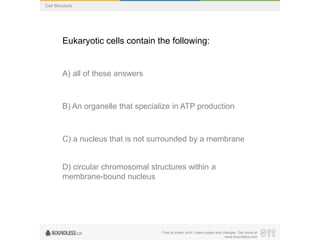
Cell Structure
Eukaryotic cells contain the following:
A) all of these answers
B) An organelle that specialize in ATP production
C) a nucleus that is not surrounded by a membrane
D) circular chromosomal structures within a
membrane-bound nucleus
Free to share, print, make copies and changes. Get yours at
www.boundless.com
Boundless - LO. "Boundless." CC BY-SA 3.0
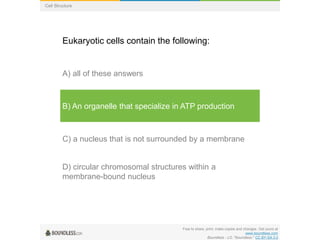
Cell Structure
Eukaryotic cells contain the following:
A) all of these answers
B) An organelle that specialize in ATP production
C) a nucleus that is not surrounded by a membrane
D) circular chromosomal structures within a
membrane-bound nucleus
Free to share, print, make copies and changes. Get yours at
www.boundless.com
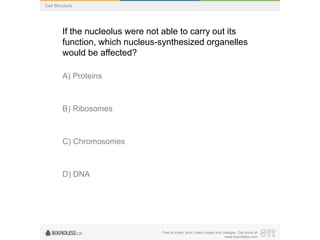
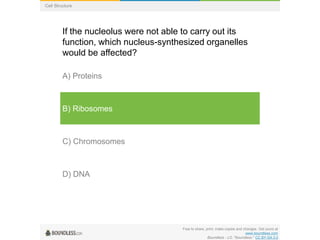
Cell Structure
If the nucleolus were not able to carry out its
function, which nucleus-synthesized organelles
would be affected?
A) Proteins
B) Ribosomes
C) Chromosomes
D) DNA
Free to share, print, make copies and changes. Get yours at
www.boundless.com
Boundless - LO. "Boundless." CC BY-SA 3.0
Cell Structure
If the nucleolus were not able to carry out its
function, which nucleus-synthesized organelles
would be affected?
A) Proteins
B) Ribosomes
C) Chromosomes
D) DNA
Free to share, print, make copies and changes. Get yours at www.boundless.com
Boundless - LO. "Boundless." CC BY-SA 3.0 http://www.boundless.com/
Cell Structure
A primary function of the nucleus in eukaryotic
cells is:
A) to contain the cell's hereditary material.
B) to produce ATP that powers the cell.
C) to synthesize proteins from mRNA.
D) to transport proteins outside of the cell.
Free to share, print, make copies and changes. Get yours at www.boundless.com
Boundless - LO. "Boundless." CC BY-SA 3.0 http://www.boundless.com/
Cell Structure
A primary function of the nucleus in eukaryotic
cells is:
A) to contain the cell's hereditary material.
B) to produce ATP that powers the cell.
C) to synthesize proteins from mRNA.
D) to transport proteins outside of the cell.
Free to share, print, make copies and changes. Get yours at
www.boundless.com
Cell Structure
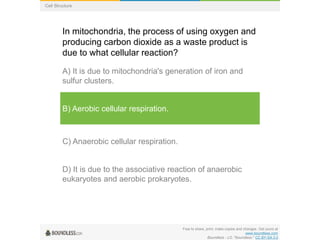
In mitochondria, the process of using oxygen and
producing carbon dioxide as a waste product is
due to what cellular reaction?
A) It is due to mitochondria's generation of iron and
sulfur clusters.
B) Aerobic cellular respiration.
C) Anaerobic cellular respiration
D) It is due to the associative reaction of anaerobic
eukaryotes and aerobic prokaryotes.
Free to share, print, make copies and changes. Get yours at
www.boundless.com
Boundless - LO. "Boundless." CC BY-SA 3.0
Cell Structure
In mitochondria, the process of using oxygen and
producing carbon dioxide as a waste product is
due to what cellular reaction?
A) It is due to mitochondria's generation of iron and
sulfur clusters.
B) Aerobic cellular respiration.
C) Anaerobic cellular respiration.
D) It is due to the associative reaction of anaerobic
eukaryotes and aerobic prokaryotes.
Cell Structure
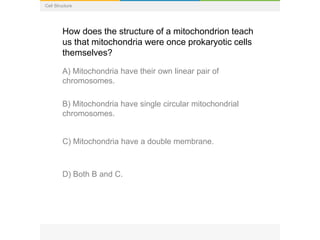
How does the structure of a mitochondrion teach
us that mitochondria were once prokaryotic cells
themselves?
A) Mitochondria have their own linear pair of
chromosomes.
B) Mitochondria have single circular mitochondrial
chromosomes.
C) Mitochondria have a double membrane.
D) Both B and C.
Cell Structure
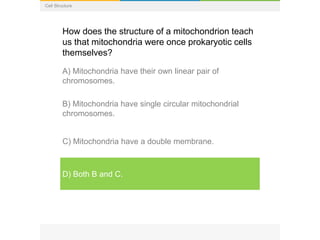
How does the structure of a mitochondrion teach
us that mitochondria were once prokaryotic cells
themselves?
A) Mitochondria have their own linear pair of
chromosomes.
B) Mitochondria have single circular mitochondrial
chromosomes.
C) Mitochondria have a double membrane.
D) Both B and C.
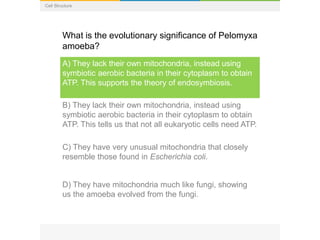
Cell Structure
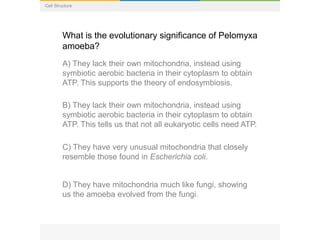
What is the evolutionary significance of Pelomyxa
amoeba?
A) They lack their own mitochondria, instead using
symbiotic aerobic bacteria in their cytoplasm to obtain
ATP. This supports the theory of endosymbiosis.
B) They lack their own mitochondria, instead using
symbiotic aerobic bacteria in their cytoplasm to obtain
ATP. This tells us that not all eukaryotic cells need ATP.
C) They have very unusual mitochondria that closely
resemble those found in Escherichia coli.
D) They have mitochondria much like fungi, showing
us the amoeba evolved from the fungi.
Cell Structure
What is the evolutionary significance of Pelomyxa
amoeba?
A) They lack their own mitochondria, instead using
symbiotic aerobic bacteria in their cytoplasm to obtain
ATP. This supports the theory of endosymbiosis.
B) They lack their own mitochondria, instead using
symbiotic aerobic bacteria in their cytoplasm to obtain
ATP. This tells us that not all eukaryotic cells need ATP.
C) They have very unusual mitochondria that closely
resemble those found in Escherichia coli.
D) They have mitochondria much like fungi, showing
us the amoeba evolved from the fungi.
Free to share, print, make copies and changes. Get yours at
www.boundless.com
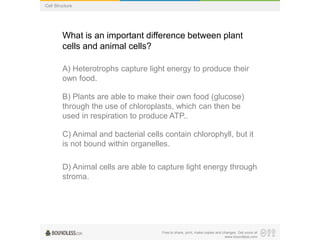
Cell Structure
What is an important difference between plant
cells and animal cells?
A) Heterotrophs capture light energy to produce their
own food.
B) Plants are able to make their own food (glucose)
through the use of chloroplasts, which can then be
used in respiration to produce ATP..
C) Animal and bacterial cells contain chlorophyll, but it
is not bound within organelles.
D) Animal cells are able to capture light energy through
stroma.
Free to share, print, make copies and changes. Get yours at
www.boundless.com
Boundless - LO. "Boundless." CC BY-SA 3.0
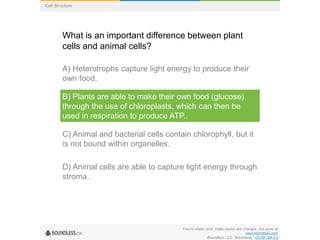
Cell Structure
What is an important difference between plant
cells and animal cells?
A) Heterotrophs capture light energy to produce their
own food.
B) Plants are able to make their own food (glucose)
through the use of chloroplasts, which can then be
used in respiration to produce ATP..
C) Animal and bacterial cells contain chlorophyll, but it
is not bound within organelles.
D) Animal cells are able to capture light energy through
stroma.
Free to share, print, make copies and changes. Get yours at
www.boundless.com
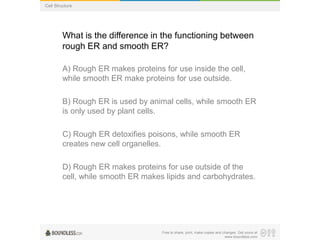
Cell Structure
What is the difference in the functioning between
rough ER and smooth ER?
A) Rough ER makes proteins for use inside the cell,
while smooth ER make proteins for use outside.
B) Rough ER is used by animal cells, while smooth ER
is only used by plant cells.
C) Rough ER detoxifies poisons, while smooth ER
creates new cell organelles.
D) Rough ER makes proteins for use outside of the
cell, while smooth ER makes lipids and carbohydrates.
Free to share, print, make copies and changes. Get yours at www.boundless.com
Boundless - LO. "Boundless." CC BY-SA 3.0 http://www.boundless.com/
Cell Structure
What is the difference in the functioning between
rough ER and smooth ER?
A) Rough ER makes proteins for use inside the cell,
while smooth ER make proteins for use outside.
B) Rough ER is used by animal cells, while smooth ER
is only used by plant cells.
C) Rough ER detoxifies poisons, while smooth ER
creates new cell organelles.
D) Rough ER makes proteins for use outside of the
cell, while smooth ER makes lipids and carbohydrates.

B. pro and eukary cells check your learning

  • 1.
    •Take some timeto consider the question before moving to the next slide which offers the correct answer. •Write your answer down before you see the actual answer, this will allow you to test yourself more effectively. CHECK YOUR LEARNING Prokaryotic and Eukaryotic Cells
  • 2.
    Cell Structure Which ofthe following best depicts the evolutionary order in which the three Domains of life on Earth today arose? A) self-replicating molecules  Bacterial-like prokaryotic cells  branching of Bacterial and Archaeal lines  branching of Archaeal and Eukaryotic lines B) self-replicating molecules  Archaeal-like prokaryotic cells  branching of Bacterial and Archaeal lines  branching of Archaeal and Eukaryotic lines C) self-replicating molecules  Bacterial-like prokaryotic cells  branching of Bacterial and Archaeal lines  branching of Bacterial and Eukaryotic lines D) self-replicating molecules  amoeba  branching of amoeba and fungi  branching of plants and animals
  • 3.
    Cell Structure Which ofthe following best depicts the evolutionary order in which the three Domains of life on Earth today arose? A) self-replicating molecules  Bacterial-like prokaryotic cells  branching of Bacterial and Archaeal lines  branching of Archaeal and Eukaryotic lines B) self-replicating molecules  Archaeal-like prokaryotic cells  branching of Bacterial and Archaeal lines  branching of Archaeal and Eukaryotic lines C) self-replicating molecules  Bacterial-like prokaryotic cells  branching of Bacterial and Archaeal lines  branching of Bacterial and Eukaryotic lines D) self-replicating molecules  amoeba  branching of amoeba and fungi  branching of plants and animals
  • 4.
    Cell Structure Why wouldthe evolution of organelles be necessary once cells started internally digesting nutrients? A) To increase efficiency B) To ensure adequate ATP production C) To ensure that toxic byproducts of digestion were not able to damage DNA D) Because the cytoskeleton arose at the same time.
  • 5.
    Cell Structure Why wouldthe evolution of organelles be necessary once cells started internally digesting nutrients? A) To increase efficiency B) To ensure adequate ATP production C) To ensure that toxic byproducts of digestion were not able to damage DNA D) Because the cytoskeleton arose at the same time.
  • 6.
    Free to share,print, make copies and changes. Get yours at www.boundless.com Cell Structure Eukaryotic cells contain the following: A) all of these answers B) An organelle that specialize in ATP production C) a nucleus that is not surrounded by a membrane D) circular chromosomal structures within a membrane-bound nucleus
  • 7.
    Free to share,print, make copies and changes. Get yours at www.boundless.com Boundless - LO. "Boundless." CC BY-SA 3.0 Cell Structure Eukaryotic cells contain the following: A) all of these answers B) An organelle that specialize in ATP production C) a nucleus that is not surrounded by a membrane D) circular chromosomal structures within a membrane-bound nucleus
  • 8.
    Free to share,print, make copies and changes. Get yours at www.boundless.com Cell Structure If the nucleolus were not able to carry out its function, which nucleus-synthesized organelles would be affected? A) Proteins B) Ribosomes C) Chromosomes D) DNA
  • 9.
    Free to share,print, make copies and changes. Get yours at www.boundless.com Boundless - LO. "Boundless." CC BY-SA 3.0 Cell Structure If the nucleolus were not able to carry out its function, which nucleus-synthesized organelles would be affected? A) Proteins B) Ribosomes C) Chromosomes D) DNA
  • 10.
    Free to share,print, make copies and changes. Get yours at www.boundless.com Boundless - LO. "Boundless." CC BY-SA 3.0 http://www.boundless.com/ Cell Structure A primary function of the nucleus in eukaryotic cells is: A) to contain the cell's hereditary material. B) to produce ATP that powers the cell. C) to synthesize proteins from mRNA. D) to transport proteins outside of the cell.
  • 11.
    Free to share,print, make copies and changes. Get yours at www.boundless.com Boundless - LO. "Boundless." CC BY-SA 3.0 http://www.boundless.com/ Cell Structure A primary function of the nucleus in eukaryotic cells is: A) to contain the cell's hereditary material. B) to produce ATP that powers the cell. C) to synthesize proteins from mRNA. D) to transport proteins outside of the cell.
  • 12.
    Free to share,print, make copies and changes. Get yours at www.boundless.com Cell Structure In mitochondria, the process of using oxygen and producing carbon dioxide as a waste product is due to what cellular reaction? A) It is due to mitochondria's generation of iron and sulfur clusters. B) Aerobic cellular respiration. C) Anaerobic cellular respiration D) It is due to the associative reaction of anaerobic eukaryotes and aerobic prokaryotes.
  • 13.
    Free to share,print, make copies and changes. Get yours at www.boundless.com Boundless - LO. "Boundless." CC BY-SA 3.0 Cell Structure In mitochondria, the process of using oxygen and producing carbon dioxide as a waste product is due to what cellular reaction? A) It is due to mitochondria's generation of iron and sulfur clusters. B) Aerobic cellular respiration. C) Anaerobic cellular respiration. D) It is due to the associative reaction of anaerobic eukaryotes and aerobic prokaryotes.
  • 14.
    Cell Structure How doesthe structure of a mitochondrion teach us that mitochondria were once prokaryotic cells themselves? A) Mitochondria have their own linear pair of chromosomes. B) Mitochondria have single circular mitochondrial chromosomes. C) Mitochondria have a double membrane. D) Both B and C.
  • 15.
    Cell Structure How doesthe structure of a mitochondrion teach us that mitochondria were once prokaryotic cells themselves? A) Mitochondria have their own linear pair of chromosomes. B) Mitochondria have single circular mitochondrial chromosomes. C) Mitochondria have a double membrane. D) Both B and C.
  • 16.
    Cell Structure What isthe evolutionary significance of Pelomyxa amoeba? A) They lack their own mitochondria, instead using symbiotic aerobic bacteria in their cytoplasm to obtain ATP. This supports the theory of endosymbiosis. B) They lack their own mitochondria, instead using symbiotic aerobic bacteria in their cytoplasm to obtain ATP. This tells us that not all eukaryotic cells need ATP. C) They have very unusual mitochondria that closely resemble those found in Escherichia coli. D) They have mitochondria much like fungi, showing us the amoeba evolved from the fungi.
  • 17.
    Cell Structure What isthe evolutionary significance of Pelomyxa amoeba? A) They lack their own mitochondria, instead using symbiotic aerobic bacteria in their cytoplasm to obtain ATP. This supports the theory of endosymbiosis. B) They lack their own mitochondria, instead using symbiotic aerobic bacteria in their cytoplasm to obtain ATP. This tells us that not all eukaryotic cells need ATP. C) They have very unusual mitochondria that closely resemble those found in Escherichia coli. D) They have mitochondria much like fungi, showing us the amoeba evolved from the fungi.
  • 18.
    Free to share,print, make copies and changes. Get yours at www.boundless.com Cell Structure What is an important difference between plant cells and animal cells? A) Heterotrophs capture light energy to produce their own food. B) Plants are able to make their own food (glucose) through the use of chloroplasts, which can then be used in respiration to produce ATP.. C) Animal and bacterial cells contain chlorophyll, but it is not bound within organelles. D) Animal cells are able to capture light energy through stroma.
  • 19.
    Free to share,print, make copies and changes. Get yours at www.boundless.com Boundless - LO. "Boundless." CC BY-SA 3.0 Cell Structure What is an important difference between plant cells and animal cells? A) Heterotrophs capture light energy to produce their own food. B) Plants are able to make their own food (glucose) through the use of chloroplasts, which can then be used in respiration to produce ATP.. C) Animal and bacterial cells contain chlorophyll, but it is not bound within organelles. D) Animal cells are able to capture light energy through stroma.
  • 20.
    Free to share,print, make copies and changes. Get yours at www.boundless.com Cell Structure What is the difference in the functioning between rough ER and smooth ER? A) Rough ER makes proteins for use inside the cell, while smooth ER make proteins for use outside. B) Rough ER is used by animal cells, while smooth ER is only used by plant cells. C) Rough ER detoxifies poisons, while smooth ER creates new cell organelles. D) Rough ER makes proteins for use outside of the cell, while smooth ER makes lipids and carbohydrates.
  • 21.
    Free to share,print, make copies and changes. Get yours at www.boundless.com Boundless - LO. "Boundless." CC BY-SA 3.0 http://www.boundless.com/ Cell Structure What is the difference in the functioning between rough ER and smooth ER? A) Rough ER makes proteins for use inside the cell, while smooth ER make proteins for use outside. B) Rough ER is used by animal cells, while smooth ER is only used by plant cells. C) Rough ER detoxifies poisons, while smooth ER creates new cell organelles. D) Rough ER makes proteins for use outside of the cell, while smooth ER makes lipids and carbohydrates.