11
4 Cell membranes and transport
Click on the correct answer to each question.
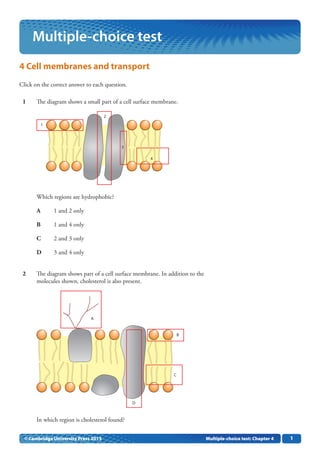
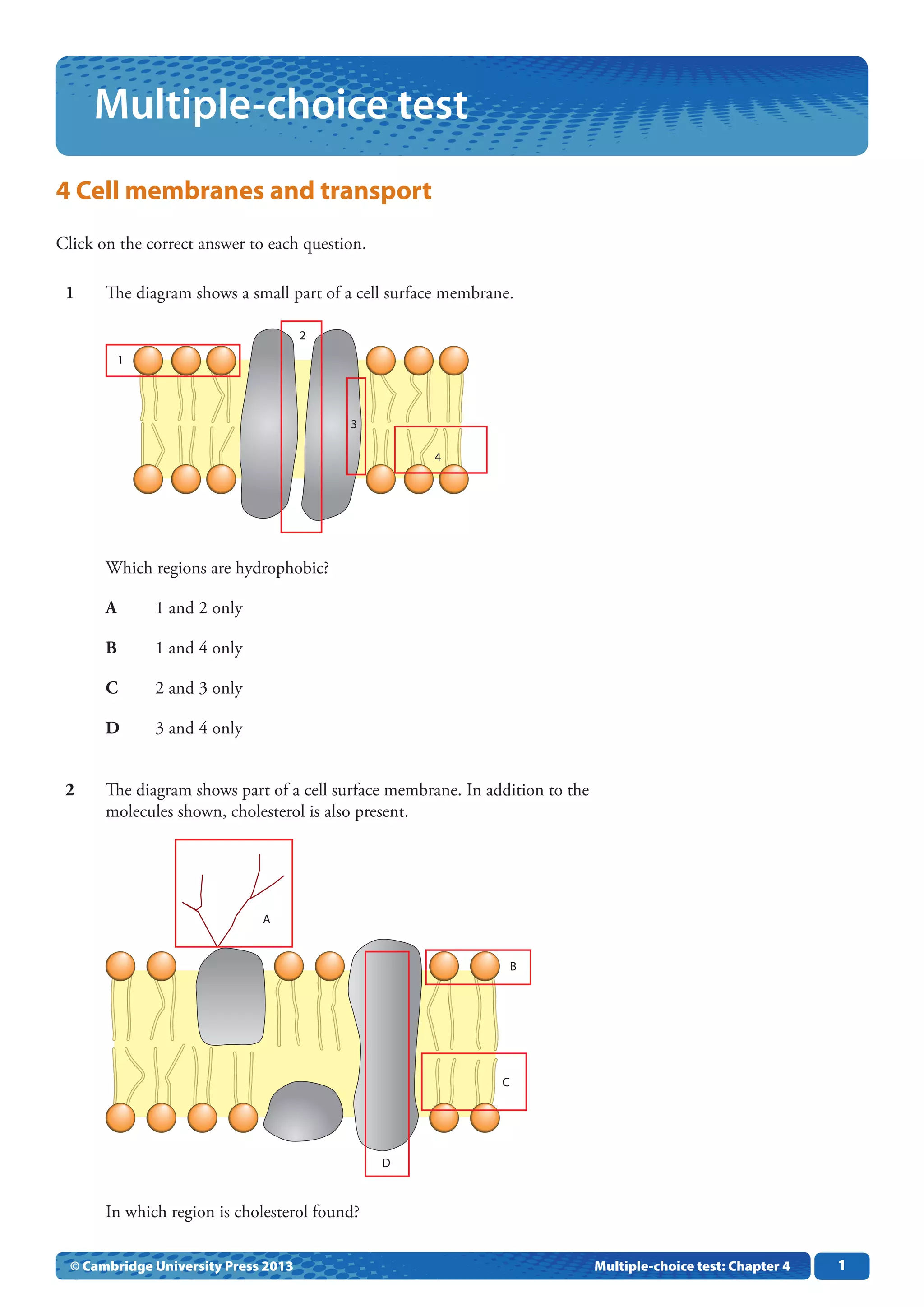
	 1	 The diagram shows a small part of a cell surface membrane.
1
2
3
4
Which regions are hydrophobic?
	 A	 1 and 2 only
	 B	 1 and 4 only
	 C	 2 and 3 only
	 D	 3 and 4 only
	 2	 The diagram shows part of a cell surface membrane. In addition to the
molecules shown, cholesterol is also present.
D
C
B
A
In which region is cholesterol found?
Multiple-choice test
© Cambridge University Press 2013 Multiple-choice test: Chapter 4
22
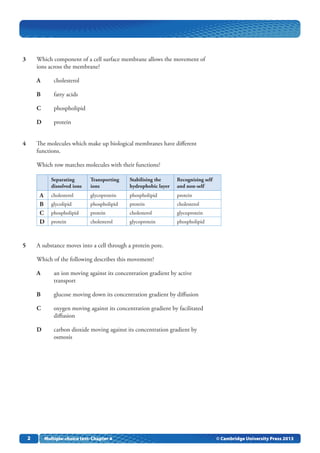
	 3	 Which component of a cell surface membrane allows the movement of
ions across the membrane?
	 A	 cholesterol
	 B	 fatty acids
	 C	 phospholipid
	 D	 protein
	 4	 The molecules which make up biological membranes have different
functions.
Which row matches molecules with their functions?
Separating
dissolved ions
Transporting
ions
Stabilising the
hydrophobic layer
Recognising self
and non-self
A cholesterol glycoprotein phospholipid protein
B glycolipid phospholipid protein cholesterol
C phospholipid protein cholesterol glycoprotein
D protein cholesterol glycoprotein phospholipid
	 5	 A substance moves into a cell through a protein pore.
Which of the following describes this movement?
	 A	 an ion moving against its concentration gradient by active
transport
	 B	 glucose moving down its concentration gradient by diffusion
	 C	 oxygen moving against its concentration gradient by facilitated
diffusion
	 D	 carbon dioxide moving against its concentration gradient by
osmosis
Multiple-choice test: Chapter 4 © Cambridge University Press 2013
33
	 6	 Which of the following correctly describes the movement of water by
osmosis?
	 A	 from a region of higher water potential to a region of lower
water potential through a fully permeable membrane
	 B	 from a region of higher water potential to a region of lower
water potential through a partially permeable membrane
	 C	 from a region of lower water potential to a region of higher
water potential through a fully permeable membrane
	 D	 from a region of lower water potential to a region of higher
water potential through a partially permeable membrane
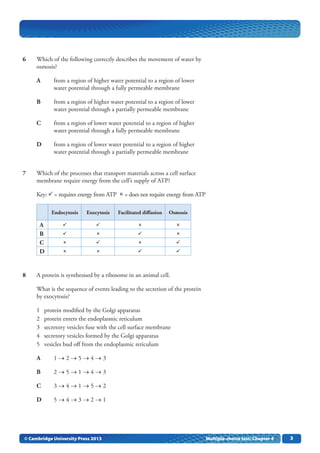
	 7	 Which of the processes that transport materials across a cell surface
membrane require energy from the cell’s supply of ATP?
Key:  = requires energy from ATP   = does not require energy from ATP
Endocytosis Exocytosis Facilitated diffusion Osmosis
A    
B    
C    
D    
	 8	 A protein is synthesised by a ribosome in an animal cell.
What is the sequence of events leading to the secretion of the protein
by exocytosis?
1	 protein modified by the Golgi apparatus
2	 protein enters the endoplasmic reticulum
3	 secretory vesicles fuse with the cell surface membrane
4	 secretory vesicles formed by the Golgi apparatus
5	 vesicles bud off from the endoplasmic reticulum
	 A	 1 → 2 → 5 → 4 → 3
	 B	 2 → 5 → 1 → 4 → 3
	 C	 3 → 4 → 1 → 5 → 2
	 D	 5 → 4 → 3 → 2 → 1
© Cambridge University Press 2013 Multiple-choice test: Chapter 4
44
	 9	 Examples of the bulk transport of materials into or out of cells are listed.
1	 white blood cell engulfing a bacterium
2	 plant cell building up its cell wall
3	 pancreas cell releasing digestive enzymes
4	 ovum taking up liquid nutrients from a follicle cell
Which are examples of exocytosis?
	 A	 1 and 2 only
	 B	 1 and 4 only
	 C	 2 and 3 only
	 D	 3 and 4 only
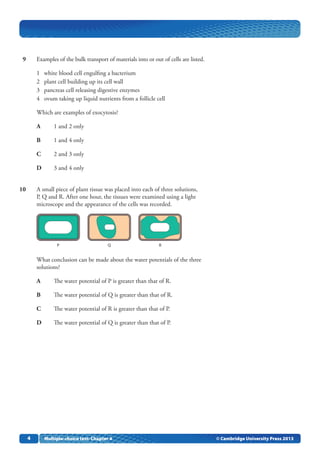
	10	 A small piece of plant tissue was placed into each of three solutions,
P, Q and R. After one hour, the tissues were examined using a light
microscope and the appearance of the cells was recorded.
P Q R
What conclusion can be made about the water potentials of the three
solutions?
	 A	 The water potential of P is greater than that of R.
	 B	 The water potential of Q is greater than that of R.
	 C	 The water potential of R is greater than that of P.
	 D	 The water potential of Q is greater than that of P.
Multiple-choice test: Chapter 4 © Cambridge University Press 2013

Multiple choice Membranes and Transport

  • 1.
    11 4 Cell membranesand transport Click on the correct answer to each question. 1 The diagram shows a small part of a cell surface membrane. 1 2 3 4 Which regions are hydrophobic? A 1 and 2 only B 1 and 4 only C 2 and 3 only D 3 and 4 only 2 The diagram shows part of a cell surface membrane. In addition to the molecules shown, cholesterol is also present. D C B A In which region is cholesterol found? Multiple-choice test © Cambridge University Press 2013 Multiple-choice test: Chapter 4
  • 2.
    22 3 Whichcomponent of a cell surface membrane allows the movement of ions across the membrane? A cholesterol B fatty acids C phospholipid D protein 4 The molecules which make up biological membranes have different functions. Which row matches molecules with their functions? Separating dissolved ions Transporting ions Stabilising the hydrophobic layer Recognising self and non-self A cholesterol glycoprotein phospholipid protein B glycolipid phospholipid protein cholesterol C phospholipid protein cholesterol glycoprotein D protein cholesterol glycoprotein phospholipid 5 A substance moves into a cell through a protein pore. Which of the following describes this movement? A an ion moving against its concentration gradient by active transport B glucose moving down its concentration gradient by diffusion C oxygen moving against its concentration gradient by facilitated diffusion D carbon dioxide moving against its concentration gradient by osmosis Multiple-choice test: Chapter 4 © Cambridge University Press 2013
  • 3.
    33 6 Whichof the following correctly describes the movement of water by osmosis? A from a region of higher water potential to a region of lower water potential through a fully permeable membrane B from a region of higher water potential to a region of lower water potential through a partially permeable membrane C from a region of lower water potential to a region of higher water potential through a fully permeable membrane D from a region of lower water potential to a region of higher water potential through a partially permeable membrane 7 Which of the processes that transport materials across a cell surface membrane require energy from the cell’s supply of ATP? Key:  = requires energy from ATP   = does not require energy from ATP Endocytosis Exocytosis Facilitated diffusion Osmosis A     B     C     D     8 A protein is synthesised by a ribosome in an animal cell. What is the sequence of events leading to the secretion of the protein by exocytosis? 1 protein modified by the Golgi apparatus 2 protein enters the endoplasmic reticulum 3 secretory vesicles fuse with the cell surface membrane 4 secretory vesicles formed by the Golgi apparatus 5 vesicles bud off from the endoplasmic reticulum A 1 → 2 → 5 → 4 → 3 B 2 → 5 → 1 → 4 → 3 C 3 → 4 → 1 → 5 → 2 D 5 → 4 → 3 → 2 → 1 © Cambridge University Press 2013 Multiple-choice test: Chapter 4
  • 4.
    44 9 Examplesof the bulk transport of materials into or out of cells are listed. 1 white blood cell engulfing a bacterium 2 plant cell building up its cell wall 3 pancreas cell releasing digestive enzymes 4 ovum taking up liquid nutrients from a follicle cell Which are examples of exocytosis? A 1 and 2 only B 1 and 4 only C 2 and 3 only D 3 and 4 only 10 A small piece of plant tissue was placed into each of three solutions, P, Q and R. After one hour, the tissues were examined using a light microscope and the appearance of the cells was recorded. P Q R What conclusion can be made about the water potentials of the three solutions? A The water potential of P is greater than that of R. B The water potential of Q is greater than that of R. C The water potential of R is greater than that of P. D The water potential of Q is greater than that of P. Multiple-choice test: Chapter 4 © Cambridge University Press 2013