Name – Malay Gorai
Stream – B.Pharm 3rd year
Under The Guidance Of : Prof. Anandamoy Rudra
Bengal School Of Technology.
Sugandha, Delhi Road, Hooghly.
P
H
A
R
M
A
C
E
U
T
I
C
A
L
E
N
G
I
N
E
E
R
I
N
G
Contents
Introduction
Working Principle
Residue Curve Map
Process Design & Stimulation
Industrial Applications :
i) Alcohol Dehydration
ii) Acetic Acid Dehydration
iii) Production Of Esters
Conclusion
Reference
Introduction
 Azeotropic distillation refers to process whereby a new component
(called the entrainer) is added to the original feed mixture to form
(or nearly form) an azeotrope with one of the feed components.
 The azeotrope is then removed as either the distillate or the bottoms.
 Usually refers to the specific technique of adding another component
to generate a new, lower-boiling azeotrope that is heterogeneous
(e.g. producing two, immiscible liquid phases), such as the example
below with the addition of benzene to water or ethanol.
 Azeotropic distillation also refers to those processes in which a new
component is added to an original feed mixture to break an
azeotrope that otherwise would be formed by the feed components.
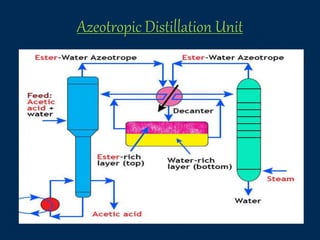
Azeotropic Distillation Unit
Working Principle
AD is typically carried out by adding other light
chemicals to generate a new, lower-boiling
azeotrope that is heterogeneous .
Thus, producing two, immiscible liquid phases
that can be easily separated in a decanter. In an
AD process.
 The light entrainer is evaporated and recycled –
this being in contrast to ED, which makes use of a
high-boiling solvent (not forming azeotropes) that
does not have to be evaporated.
Residue Curve Map
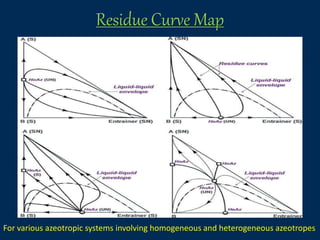
For various azeotropic systems involving homogeneous and heterogeneous azeotropes
Process Design & Stimulation
 After the entrainer selection, plot the RCM with the liquid phase
envelope superimposed, and the binodal plot (showing the liquid
split) at the anticipated condenser conditions.
 Make a conceptual process design using the RCM and considering
that the distillate and bottoms product must lie on the same
residue curve, and also that the feed, distillate, and bottoms
product must be collinear (e.g., all lie on the same straight material
balance line).
 Distillation boundaries in homogeneous mixtures cannot be crossed
by residue curves. Therefore, in order to isolate two pure
components which lie in different distillation regions, two feed
compositions (one from each of the two regions) and two
distillation columns are needed.
 All feed to the AD column (reflux, makeup, and process feed) should
be entered near the top.
 The composition of the vapor leaving the top tray must be near or
at the ternary azeotrope.
i) Alcohol Dehydration
The use of AD technology for alcohol dehydration
has the longest history within the industry, and it
is still used today.
As ethanol is a hydroxyl compound (like water)
and yet an organic chemical, it should exhibit
analogies and also form azeotropes with both
water and organic compounds.
When benzene is used as an azeotropic agent,
the conceptual process design of AD can be
sketched on a ternary diagram showing the liquid
split envelope combined with a RCM.
II) Acetic Acid Dehydration
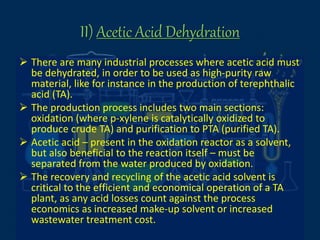
 There are many industrial processes where acetic acid must
be dehydrated, in order to be used as high-purity raw
material, like for instance in the production of terephthalic
acid (TA).
 The production process includes two main sections:
oxidation (where p-xylene is catalytically oxidized to
produce crude TA) and purification to PTA (purified TA).
 Acetic acid – present in the oxidation reactor as a solvent,
but also beneficial to the reaction itself – must be
separated from the water produced by oxidation.
 The recovery and recycling of the acetic acid solvent is
critical to the efficient and economical operation of a TA
plant, as any acid losses count against the process
economics as increased make-up solvent or increased
wastewater treatment cost.
iii) Production Of Esters
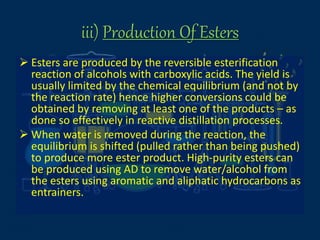
 Esters are produced by the reversible esterification
reaction of alcohols with carboxylic acids. The yield is
usually limited by the chemical equilibrium (and not by
the reaction rate) hence higher conversions could be
obtained by removing at least one of the products – as
done so effectively in reactive distillation processes.
 When water is removed during the reaction, the
equilibrium is shifted (pulled rather than being pushed)
to produce more ester product. High-purity esters can
be produced using AD to remove water/alcohol from
the esters using aromatic and aliphatic hydrocarbons as
entrainers.
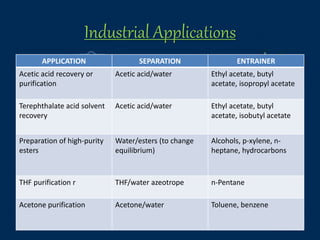
Industrial Applications
APPLICATION SEPARATION ENTRAINER
Acetic acid recovery or
purification
Acetic acid/water Ethyl acetate, butyl
acetate, isopropyl acetate
Terephthalate acid solvent
recovery
Acetic acid/water Ethyl acetate, butyl
acetate, isobutyl acetate
Preparation of high-purity
esters
Water/esters (to change
equilibrium)
Alcohols, p-xylene, n-
heptane, hydrocarbons
THF purification r THF/water azeotrope n-Pentane
Acetone purification Acetone/water Toluene, benzene
Conclusion
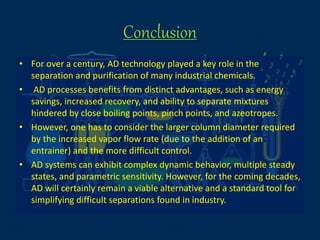
• For over a century, AD technology played a key role in the
separation and purification of many industrial chemicals.
• AD processes benefits from distinct advantages, such as energy
savings, increased recovery, and ability to separate mixtures
hindered by close boiling points, pinch points, and azeotropes.
• However, one has to consider the larger column diameter required
by the increased vapor flow rate (due to the addition of an
entrainer) and the more difficult control.
• AD systems can exhibit complex dynamic behavior, multiple steady
states, and parametric sensitivity. However, for the coming decades,
AD will certainly remain a viable alternative and a standard tool for
simplifying difficult separations found in industry.
Reference
 www.ncbi.com
 www.wikipedia.org
 www.sciencedirect.com
 Resetarits, M. R.; Lockett, M. J. Distillation. In:
Encyclopaedia of Physical Science and Technology, 3rd ed.;
2003; 547–559. http://dx.doi.org/10.1016/B0-12-227410-
5/00182-4; http://science/article/pii/B0-12-227410-
5.00182
 Petlyuk, F. B. Distillation Theory and Its Application to
Optimal Design of Separation. Cambridge University Press:
Cambridge, 2004.
 Fair, J. R. Distillation. In Kirk- Othmer Encyclopaedia of
Chemical Technology; Wiley: New York, 2000.
Thank You

Azeotropic Distillation

  • 1.
    Name – MalayGorai Stream – B.Pharm 3rd year Under The Guidance Of : Prof. Anandamoy Rudra Bengal School Of Technology. Sugandha, Delhi Road, Hooghly. P H A R M A C E U T I C A L E N G I N E E R I N G
  • 2.
    Contents Introduction Working Principle Residue CurveMap Process Design & Stimulation Industrial Applications : i) Alcohol Dehydration ii) Acetic Acid Dehydration iii) Production Of Esters Conclusion Reference
  • 3.
    Introduction  Azeotropic distillationrefers to process whereby a new component (called the entrainer) is added to the original feed mixture to form (or nearly form) an azeotrope with one of the feed components.  The azeotrope is then removed as either the distillate or the bottoms.  Usually refers to the specific technique of adding another component to generate a new, lower-boiling azeotrope that is heterogeneous (e.g. producing two, immiscible liquid phases), such as the example below with the addition of benzene to water or ethanol.  Azeotropic distillation also refers to those processes in which a new component is added to an original feed mixture to break an azeotrope that otherwise would be formed by the feed components.
  • 4.
  • 5.
    Working Principle AD istypically carried out by adding other light chemicals to generate a new, lower-boiling azeotrope that is heterogeneous . Thus, producing two, immiscible liquid phases that can be easily separated in a decanter. In an AD process.  The light entrainer is evaporated and recycled – this being in contrast to ED, which makes use of a high-boiling solvent (not forming azeotropes) that does not have to be evaporated.
  • 6.
    Residue Curve Map Forvarious azeotropic systems involving homogeneous and heterogeneous azeotropes
  • 7.
    Process Design &Stimulation  After the entrainer selection, plot the RCM with the liquid phase envelope superimposed, and the binodal plot (showing the liquid split) at the anticipated condenser conditions.  Make a conceptual process design using the RCM and considering that the distillate and bottoms product must lie on the same residue curve, and also that the feed, distillate, and bottoms product must be collinear (e.g., all lie on the same straight material balance line).  Distillation boundaries in homogeneous mixtures cannot be crossed by residue curves. Therefore, in order to isolate two pure components which lie in different distillation regions, two feed compositions (one from each of the two regions) and two distillation columns are needed.  All feed to the AD column (reflux, makeup, and process feed) should be entered near the top.  The composition of the vapor leaving the top tray must be near or at the ternary azeotrope.
  • 8.
    i) Alcohol Dehydration Theuse of AD technology for alcohol dehydration has the longest history within the industry, and it is still used today. As ethanol is a hydroxyl compound (like water) and yet an organic chemical, it should exhibit analogies and also form azeotropes with both water and organic compounds. When benzene is used as an azeotropic agent, the conceptual process design of AD can be sketched on a ternary diagram showing the liquid split envelope combined with a RCM.
  • 9.
    II) Acetic AcidDehydration  There are many industrial processes where acetic acid must be dehydrated, in order to be used as high-purity raw material, like for instance in the production of terephthalic acid (TA).  The production process includes two main sections: oxidation (where p-xylene is catalytically oxidized to produce crude TA) and purification to PTA (purified TA).  Acetic acid – present in the oxidation reactor as a solvent, but also beneficial to the reaction itself – must be separated from the water produced by oxidation.  The recovery and recycling of the acetic acid solvent is critical to the efficient and economical operation of a TA plant, as any acid losses count against the process economics as increased make-up solvent or increased wastewater treatment cost.
  • 10.
    iii) Production OfEsters  Esters are produced by the reversible esterification reaction of alcohols with carboxylic acids. The yield is usually limited by the chemical equilibrium (and not by the reaction rate) hence higher conversions could be obtained by removing at least one of the products – as done so effectively in reactive distillation processes.  When water is removed during the reaction, the equilibrium is shifted (pulled rather than being pushed) to produce more ester product. High-purity esters can be produced using AD to remove water/alcohol from the esters using aromatic and aliphatic hydrocarbons as entrainers.
  • 11.
    Industrial Applications APPLICATION SEPARATIONENTRAINER Acetic acid recovery or purification Acetic acid/water Ethyl acetate, butyl acetate, isopropyl acetate Terephthalate acid solvent recovery Acetic acid/water Ethyl acetate, butyl acetate, isobutyl acetate Preparation of high-purity esters Water/esters (to change equilibrium) Alcohols, p-xylene, n- heptane, hydrocarbons THF purification r THF/water azeotrope n-Pentane Acetone purification Acetone/water Toluene, benzene
  • 12.
    Conclusion • For overa century, AD technology played a key role in the separation and purification of many industrial chemicals. • AD processes benefits from distinct advantages, such as energy savings, increased recovery, and ability to separate mixtures hindered by close boiling points, pinch points, and azeotropes. • However, one has to consider the larger column diameter required by the increased vapor flow rate (due to the addition of an entrainer) and the more difficult control. • AD systems can exhibit complex dynamic behavior, multiple steady states, and parametric sensitivity. However, for the coming decades, AD will certainly remain a viable alternative and a standard tool for simplifying difficult separations found in industry.
  • 13.
    Reference  www.ncbi.com  www.wikipedia.org www.sciencedirect.com  Resetarits, M. R.; Lockett, M. J. Distillation. In: Encyclopaedia of Physical Science and Technology, 3rd ed.; 2003; 547–559. http://dx.doi.org/10.1016/B0-12-227410- 5/00182-4; http://science/article/pii/B0-12-227410- 5.00182  Petlyuk, F. B. Distillation Theory and Its Application to Optimal Design of Separation. Cambridge University Press: Cambridge, 2004.  Fair, J. R. Distillation. In Kirk- Othmer Encyclopaedia of Chemical Technology; Wiley: New York, 2000.
  • 14.