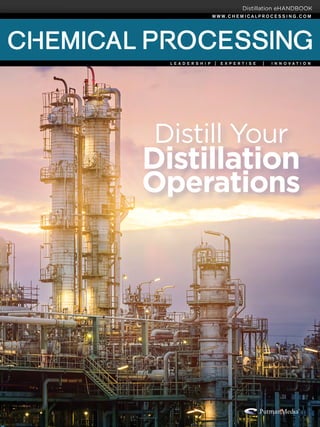
Distill Your
Distillation
Operations
Distillation eHANDBOOKDistillation eHANDBOOK
A
n azeotrope is a complex formed
by two or more chemicals and
has the same composition in the
liquid and the vapor phase. This interest-
ing property means that the compound
mixture distills without separating. Some
common well-known binary azeotropes are
water (95.4%) and ethanol (4.6%) as well as
diethyl ether (33%) and halothane (66%),
formerly used in anesthesia. However, as
sometimes happens in chemical processing,
an azeotrope may be formed unexpectedly
or, even if recognized, may make down-
stream processes additionally challenging.
This article will discuss some methods used
to “break” azeotropes that may exist in
binary or ternary forms and their applica-
tions, with a focus on breaking azeotropes
using various distillation methods. Solvent
recovery often necessitates breaking
azeotropes when substances are required
in a purer form, either downstream or in
other areas of the chemical process. Water
removal may motivate others. Situational
and contextual factors also may impinge
on process optimization. Several basic
types of processes to break azeotropes
using distillation and real-world examples
are described.
DISTILLATION AND DECANTATION
The easiest azeotrope to break is a hetero-
geneous azeotrope. Unlike homogeneous
azeotropes, heterogeneous azeotropes’
two compounds are not totally misci-
ble. The combination of distillation and
decantation works with heterogeneous
azeotropes whereby condensation of the
two liquids results in two phases that then
Effectively Break Azeotropes
Homogenous and heterogeneous varieties require different methods
By Tom Schafer and Alan Erickson, P.E., Koch Modular Process Systems, LLC.
Distillation eHANDBOOK: Distill Your Distillation Operations 17
www.ChemicalProcessing.com
can be decanted. That is, each of the two
phases can be fed to separate stripping
columns. Examples of mixtures typically
separated this way include the minimum
boiling azeotrope of n-butanol and water
or dichloromethane (methylene chloride)
and water.
In the example of n-butanol and water, after
condensation, the water-rich phase goes to
a stripping column where butanol-free water
comes out the bottom and the butanol-rich
phase goes to another column where dry
butanol comes out the bottom and the
distillate of each column approaches the
azeotropic composition. Generally, chlori-
nated hydrocarbons and water or any of the
aromatic or paraffinic solvents and water
can be separated that way.
PRESSURE SWING DISTILLATION
When two substances are totally miscible, as
in homogenous azeotropes, other factors can
come into play. Pressure swing distillation is
effective when the azeotrope’s composition
is a reasonably strong function of pressure.
An azeotrope distilled at a low pressure
subsequently is fed to a second distillation
column operating at a higher pressure where
the azeotropic composition is substantially
different. Acetonitrile and water and tetra-
hydrofuran (THF) and water are two typical
azeotropes broken using this method.
At atmospheric pressure, the azeotrope
formed between THF and water is 95% THF.
However, at 95 psig, the mixture is closer
to 88% THF. By operating two columns
at the different pressures, dry THF can be
retrieved from the bottom of the 95 psig
column and the azeotrope emerging at the
top, recycled to the atmospheric column.
AZEOTROPIC DISTILLATION
This distillation process is used to break
homogeneous azeotropes by introducing an
additional component called an entrainer,
which forms a lower boiling decantable
ternary azeotrope. The ethanol and water
azeotrope (95.6:4.4) mentioned above is
a classic example of this type of process
whereby benzene (or the more commonly
seen cyclohexane) is used as the entrainer.
Similarly, an isopropanol and water azeo-
trope can be broken using di-isopropyl
ether as the entrainer. The lower boiling
azeotrope then is condensed and decants.
Typically, this process requires three sep-
arate distillation columns. The first column
distills the alcohol to the azeotrope with
water removed as the bottom product. The
second column is the azeotropic column, in
which the alcohol is removed at the bottom
and the ternary azeotrope is removed as
the distillate product. This distillate then
is decanted with entrainer-rich phase and
returned to the azeotropic column and the
water-rich phase is sent to the third column
to remove entrainer and alcohol from the
water. Sometimes, columns one and three
can be combined.
www.ChemicalProcessing.com
Distillation eHANDBOOK: Distill Your Distillation Operations 18
Obviously, the use of specific entrainer
substances will not be applicable to all
industries. Introduction of a known toxin
or carcinogen such as benzene, for exam-
ple, is a nonstarter for a pharmaceutical
process.
EXTRACTIVE DISTILLATION
In contrast to azeotropic distillation, in
extractive distillation an additional high
boiling component is introduced. The
added component, which basically is a
diluent, changes the original binary pair’s
behavior such that the azeotrope can
be broken. Azeotropes of ethanol and
water or methanol and acetone can be
broken this way. Azeotropes of refriger-
ants also are amenable to breaking using
this method.
In the case of ethanol and water, ethylene
glycol may be used to change the behavior
of the two substances and allow distillation
to be effective.
ALTERNATE TECHNIQUES FOR
BREAKING AZEOTROPES
Liquid-liquid extraction (LLE) can be used
if the difference in the solubility of a solute
between two liquid phases breaks azeo-
tropes. Pyridine-water and THF-methanol
are examples of azeotropes that can be
broken via LLE.
Newer membrane technologies — in which
the membrane material is robust enough to
withstand attack by the substances being
separated and the pore size can distin-
guish the complexes formed by a mixture’s
different components — also can break
azeotropes. However, membranes also
are subject to clogging. Over time, even
trace amounts of solvents or particles, such
as minute amounts of catalyst, can com-
promise the polymeric material used in
membrane filtration.
DETERMINING THE
BEST APPROACH
Breaking azeotropes or even recogniz-
ing when they are present is not always
straightforward. Most undergraduate chem-
ical engineering curricula do not spend
much time on nonideal separations in their
mass transfer classes. Turning to companies
with expertise in mass transfer and separa-
tions is critical, particularly when there is a
suspicion that azeotropes may be in play.
In the case of ethanol and water,
ethylene glycol may be used to change
the behavior of the two substances and
allow distillation to be effective.
www.ChemicalProcessing.com
Distillation eHANDBOOK: Distill Your Distillation Operations 19
It takes a substantial amount of experience
to develop and conceptualize the proper
approach.
Pilot plant testing often is required to test
the actual feedstock and show that the
conceptual design first offered will meet
required specifications. The drums of actual
feedstock that customers send to com-
panies for pilot scale testing frequently
contain minute amounts of other contami-
nants, which differ from the ideal feedstock
upon which the concept design was devel-
oped. This can affect the path chosen to
break the azeotrope, and pilot testing
can uncover those trace components and
find solutions.
Working with or around nonideal sepa-
rations, such as azeotropes, may require
multiple distillation columns and sev-
eral decades of chemical process design
experience.
TOM SCHAFER and ALAN ERICKSON, P.E., are vice
presidents at Koch Modular Process Systems, LLC. They
can be reached at thomas.schafer@kochmodular.com
and alan.erickson@kochmodular.com.
It takes a substantial amount
of experience to develop and
conceptualize the proper approach.
www.ChemicalProcessing.com
Distillation eHANDBOOK: Distill Your Distillation Operations 20

Effectively Break Azeotropes

  • 1.
  • 3.
    A n azeotrope isa complex formed by two or more chemicals and has the same composition in the liquid and the vapor phase. This interest- ing property means that the compound mixture distills without separating. Some common well-known binary azeotropes are water (95.4%) and ethanol (4.6%) as well as diethyl ether (33%) and halothane (66%), formerly used in anesthesia. However, as sometimes happens in chemical processing, an azeotrope may be formed unexpectedly or, even if recognized, may make down- stream processes additionally challenging. This article will discuss some methods used to “break” azeotropes that may exist in binary or ternary forms and their applica- tions, with a focus on breaking azeotropes using various distillation methods. Solvent recovery often necessitates breaking azeotropes when substances are required in a purer form, either downstream or in other areas of the chemical process. Water removal may motivate others. Situational and contextual factors also may impinge on process optimization. Several basic types of processes to break azeotropes using distillation and real-world examples are described. DISTILLATION AND DECANTATION The easiest azeotrope to break is a hetero- geneous azeotrope. Unlike homogeneous azeotropes, heterogeneous azeotropes’ two compounds are not totally misci- ble. The combination of distillation and decantation works with heterogeneous azeotropes whereby condensation of the two liquids results in two phases that then Effectively Break Azeotropes Homogenous and heterogeneous varieties require different methods By Tom Schafer and Alan Erickson, P.E., Koch Modular Process Systems, LLC. Distillation eHANDBOOK: Distill Your Distillation Operations 17 www.ChemicalProcessing.com
  • 4.
    can be decanted.That is, each of the two phases can be fed to separate stripping columns. Examples of mixtures typically separated this way include the minimum boiling azeotrope of n-butanol and water or dichloromethane (methylene chloride) and water. In the example of n-butanol and water, after condensation, the water-rich phase goes to a stripping column where butanol-free water comes out the bottom and the butanol-rich phase goes to another column where dry butanol comes out the bottom and the distillate of each column approaches the azeotropic composition. Generally, chlori- nated hydrocarbons and water or any of the aromatic or paraffinic solvents and water can be separated that way. PRESSURE SWING DISTILLATION When two substances are totally miscible, as in homogenous azeotropes, other factors can come into play. Pressure swing distillation is effective when the azeotrope’s composition is a reasonably strong function of pressure. An azeotrope distilled at a low pressure subsequently is fed to a second distillation column operating at a higher pressure where the azeotropic composition is substantially different. Acetonitrile and water and tetra- hydrofuran (THF) and water are two typical azeotropes broken using this method. At atmospheric pressure, the azeotrope formed between THF and water is 95% THF. However, at 95 psig, the mixture is closer to 88% THF. By operating two columns at the different pressures, dry THF can be retrieved from the bottom of the 95 psig column and the azeotrope emerging at the top, recycled to the atmospheric column. AZEOTROPIC DISTILLATION This distillation process is used to break homogeneous azeotropes by introducing an additional component called an entrainer, which forms a lower boiling decantable ternary azeotrope. The ethanol and water azeotrope (95.6:4.4) mentioned above is a classic example of this type of process whereby benzene (or the more commonly seen cyclohexane) is used as the entrainer. Similarly, an isopropanol and water azeo- trope can be broken using di-isopropyl ether as the entrainer. The lower boiling azeotrope then is condensed and decants. Typically, this process requires three sep- arate distillation columns. The first column distills the alcohol to the azeotrope with water removed as the bottom product. The second column is the azeotropic column, in which the alcohol is removed at the bottom and the ternary azeotrope is removed as the distillate product. This distillate then is decanted with entrainer-rich phase and returned to the azeotropic column and the water-rich phase is sent to the third column to remove entrainer and alcohol from the water. Sometimes, columns one and three can be combined. www.ChemicalProcessing.com Distillation eHANDBOOK: Distill Your Distillation Operations 18
  • 5.
    Obviously, the useof specific entrainer substances will not be applicable to all industries. Introduction of a known toxin or carcinogen such as benzene, for exam- ple, is a nonstarter for a pharmaceutical process. EXTRACTIVE DISTILLATION In contrast to azeotropic distillation, in extractive distillation an additional high boiling component is introduced. The added component, which basically is a diluent, changes the original binary pair’s behavior such that the azeotrope can be broken. Azeotropes of ethanol and water or methanol and acetone can be broken this way. Azeotropes of refriger- ants also are amenable to breaking using this method. In the case of ethanol and water, ethylene glycol may be used to change the behavior of the two substances and allow distillation to be effective. ALTERNATE TECHNIQUES FOR BREAKING AZEOTROPES Liquid-liquid extraction (LLE) can be used if the difference in the solubility of a solute between two liquid phases breaks azeo- tropes. Pyridine-water and THF-methanol are examples of azeotropes that can be broken via LLE. Newer membrane technologies — in which the membrane material is robust enough to withstand attack by the substances being separated and the pore size can distin- guish the complexes formed by a mixture’s different components — also can break azeotropes. However, membranes also are subject to clogging. Over time, even trace amounts of solvents or particles, such as minute amounts of catalyst, can com- promise the polymeric material used in membrane filtration. DETERMINING THE BEST APPROACH Breaking azeotropes or even recogniz- ing when they are present is not always straightforward. Most undergraduate chem- ical engineering curricula do not spend much time on nonideal separations in their mass transfer classes. Turning to companies with expertise in mass transfer and separa- tions is critical, particularly when there is a suspicion that azeotropes may be in play. In the case of ethanol and water, ethylene glycol may be used to change the behavior of the two substances and allow distillation to be effective. www.ChemicalProcessing.com Distillation eHANDBOOK: Distill Your Distillation Operations 19
  • 6.
    It takes asubstantial amount of experience to develop and conceptualize the proper approach. Pilot plant testing often is required to test the actual feedstock and show that the conceptual design first offered will meet required specifications. The drums of actual feedstock that customers send to com- panies for pilot scale testing frequently contain minute amounts of other contami- nants, which differ from the ideal feedstock upon which the concept design was devel- oped. This can affect the path chosen to break the azeotrope, and pilot testing can uncover those trace components and find solutions. Working with or around nonideal sepa- rations, such as azeotropes, may require multiple distillation columns and sev- eral decades of chemical process design experience. TOM SCHAFER and ALAN ERICKSON, P.E., are vice presidents at Koch Modular Process Systems, LLC. They can be reached at thomas.schafer@kochmodular.com and alan.erickson@kochmodular.com. It takes a substantial amount of experience to develop and conceptualize the proper approach. www.ChemicalProcessing.com Distillation eHANDBOOK: Distill Your Distillation Operations 20