Traffic Alert and Collision
Avoidance System
Presentation By:-
Arvind Kumar Singh
1Traffic Alret and Collision Avoidance System5/14/2016
History
 CAS is known as TCAS and internationally as ACAS
(Airborne Collision Avoidance System)
 Series of midair collisions led to airline and governmental
action to develop airborne devices that function
independent of air traffic control (ATC) for alerting and
collision avoidance
 Early attempts (late 50s-60s) for reliable systems proved
to be impractical
 Mid 70s Beacon Collision Avoidance System (BCAS)
became the basis for TCAS interrogation and tracking
capabilities
 Aircraft must have operating transponder for TCAS to
provide collision avoidance protection
5/14/2016 2Traffic Alret and Collision Avoidance System
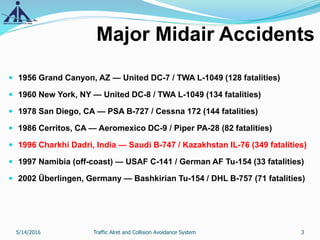
Major Midair Accidents
 1956 Grand Canyon, AZ — United DC-7 / TWA L-1049 (128 fatalities)
 1960 New York, NY — United DC-8 / TWA L-1049 (134 fatalities)
 1978 San Diego, CA — PSA B-727 / Cessna 172 (144 fatalities)
 1986 Cerritos, CA — Aeromexico DC-9 / Piper PA-28 (82 fatalities)
 1996 Charkhi Dadri, India — Saudi B-747 / Kazakhstan IL-76 (349 fatalities)
 1997 Namibia (off-coast) — USAF C-141 / German AF Tu-154 (33 fatalities)
 2002 Überlingen, Germany — Bashkirian Tu-154 / DHL B-757 (71 fatalities)
5/14/2016 3Traffic Alret and Collision Avoidance System
TCAS
• An airborne system that interrogates transponders in other
aircraft.(Independently of Ground based equipment)
• From the replies received, the system analyzes the
intruding
 Aircraft’s altitude (if altitude reporting),
Closure rate,
Projected flight path to predict a penetration
• Displays the other aircraft visually
 To alert any potential threats of airspace conflict.
Report a resolution advisory (RA) only if the other
transponder is transmitting an altitude.
5/14/2016 4Traffic Alret and Collision Avoidance System
Terminology
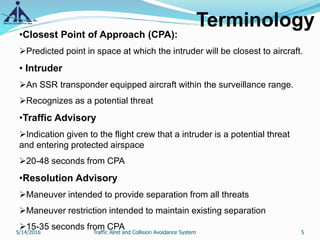
•Closest Point of Approach (CPA):
Predicted point in space at which the intruder will be closest to aircraft.
• Intruder
An SSR transponder equipped aircraft within the surveillance range.
Recognizes as a potential threat
•Traffic Advisory
Indication given to the flight crew that a intruder is a potential threat
and entering protected airspace
20-48 seconds from CPA
•Resolution Advisory
Maneuver intended to provide separation from all threats
Maneuver restriction intended to maintain existing separation
15-35 seconds from CPA
5/14/2016 5Traffic Alret and Collision Avoidance System
TCAS – System Description
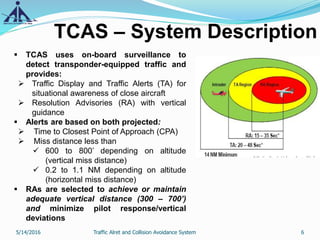
 TCAS uses on-board surveillance to
detect transponder-equipped traffic and
provides:
 Traffic Display and Traffic Alerts (TA) for
situational awareness of close aircraft
 Resolution Advisories (RA) with vertical
guidance
 Alerts are based on both projected:
 Time to Closest Point of Approach (CPA)
 Miss distance less than
 600 to 800’ depending on altitude
(vertical miss distance)
 0.2 to 1.1 NM depending on altitude
(horizontal miss distance)
 RAs are selected to achieve or maintain
adequate vertical distance (300 – 700’)
and minimize pilot response/vertical
deviations
5/14/2016 6Traffic Alret and Collision Avoidance System
Standardized Symbology for
Traffic Display
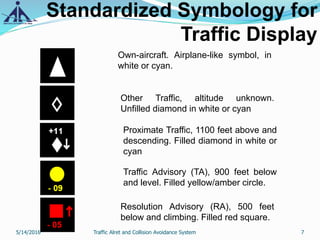
Own-aircraft. Airplane-like symbol, in
white or cyan.
Other Traffic, altitude unknown.
Unfilled diamond in white or cyan
Proximate Traffic, 1100 feet above and
descending. Filled diamond in white or
cyan
Traffic Advisory (TA), 900 feet below
and level. Filled yellow/amber circle.
Resolution Advisory (RA), 500 feet
below and climbing. Filled red square.
5/14/2016 7Traffic Alret and Collision Avoidance System
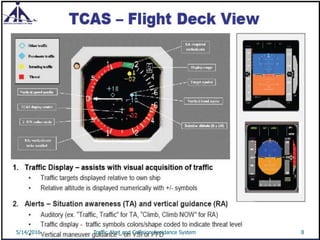
5/14/2016 8Traffic Alret and Collision Avoidance System
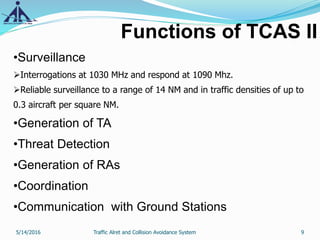
Functions of TCAS II
•Surveillance
Interrogations at 1030 MHz and respond at 1090 Mhz.
Reliable surveillance to a range of 14 NM and in traffic densities of up to
0.3 aircraft per square NM.
•Generation of TA
•Threat Detection
•Generation of RAs
•Coordination
•Communication with Ground Stations
5/14/2016 9Traffic Alret and Collision Avoidance System
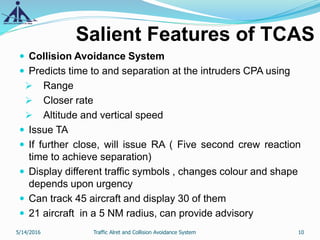
Salient Features of TCAS
 Collision Avoidance System
 Predicts time to and separation at the intruders CPA using
 Range
 Closer rate
 Altitude and vertical speed
 Issue TA
 If further close, will issue RA ( Five second crew reaction
time to achieve separation)
 Display different traffic symbols , changes colour and shape
depends upon urgency
 Can track 45 aircraft and display 30 of them
 21 aircraft in a 5 NM radius, can provide advisory
5/14/2016 10Traffic Alret and Collision Avoidance System
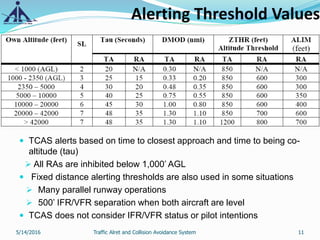
Alerting Threshold Values
 TCAS alerts based on time to closest approach and time to being co-
altitude (tau)
 All RAs are inhibited below 1,000’ AGL
 Fixed distance alerting thresholds are also used in some situations
 Many parallel runway operations
 500’ IFR/VFR separation when both aircraft are level
 TCAS does not consider IFR/VFR status or pilot intentions
5/14/2016 11Traffic Alret and Collision Avoidance System
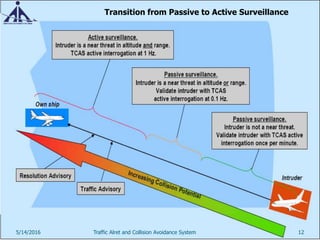
Transition from Passive to Active Surveillance
5/14/2016 12Traffic Alret and Collision Avoidance System
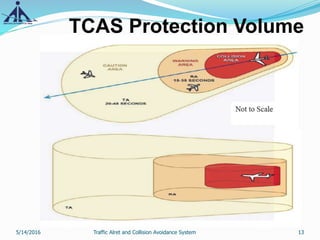
TCAS Protection Volume
5/14/2016 13Traffic Alret and Collision Avoidance System
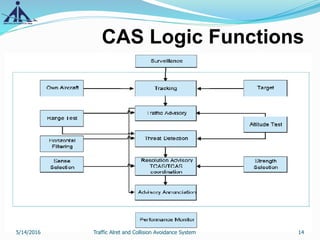
CAS Logic Functions
5/14/2016 14Traffic Alret and Collision Avoidance System
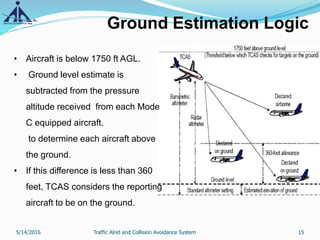
Ground Estimation Logic
• Aircraft is below 1750 ft AGL.
• Ground level estimate is
subtracted from the pressure
altitude received from each Mode
C equipped aircraft.
to determine each aircraft above
the ground.
• If this difference is less than 360
feet, TCAS considers the reporting
aircraft to be on the ground.
5/14/2016 15Traffic Alret and Collision Avoidance System
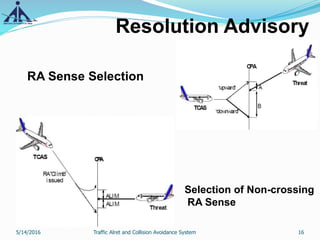
Resolution Advisory
RA Sense Selection
Selection of Non-crossing
RA Sense
5/14/2016 16Traffic Alret and Collision Avoidance System
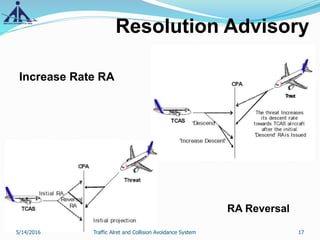
Increase Rate RA
Resolution Advisory
RA Reversal
5/14/2016 17Traffic Alret and Collision Avoidance System
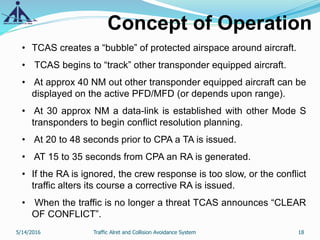
Concept of Operation
• TCAS creates a “bubble” of protected airspace around aircraft.
• TCAS begins to “track” other transponder equipped aircraft.
• At approx 40 NM out other transponder equipped aircraft can be
displayed on the active PFD/MFD (or depends upon range).
• At 30 approx NM a data-link is established with other Mode S
transponders to begin conflict resolution planning.
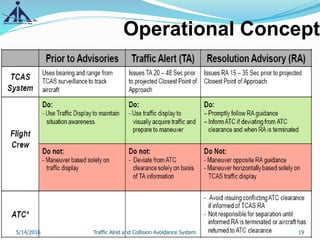
• At 20 to 48 seconds prior to CPA a TA is issued.
• AT 15 to 35 seconds from CPA an RA is generated.
• If the RA is ignored, the crew response is too slow, or the conflict
traffic alters its course a corrective RA is issued.
• When the traffic is no longer a threat TCAS announces “CLEAR
OF CONFLICT”.
5/14/2016 18Traffic Alret and Collision Avoidance System
Operational Concept
5/14/2016 19Traffic Alret and Collision Avoidance System
Carriage of Airborne Collision Avoidance
System(GEN-1.5)
 Unless otherwise authorized by DGCA , no person shall
operate in the Indian airspace , an aeroplane having a
maximum certified passenger seating configuration of
more then 30 or maximum payload capacity of more then
3 tonne.
 After 31st December 1998, if it is not equipped with an
approved TCAS II and
 After 1st Jan 2003, if it is not equipped with an approved
TCAS II with change 7 (equivalent to ACAS`)
 After 1st Jan. 2002 for the purpose of registration and
operation within, to and from India shall be fitted with
TCAS II with change 7
5/14/2016 20Traffic Alret and Collision Avoidance System
Operational Circular 4 of 2002
 All crew must reduce the aircraft rate of climb or
descent as applicable
 500 ft per minute or less when the airplane is 2000 ft
to level off altitude.
5/14/2016 21Traffic Alret and Collision Avoidance System
Controller’s Responsibilities
• If an aircraft responding to a TCAS RA
 Do not issue control instructions that are contrary to the RA,
which crew are executing.
 Provide safety alerts regarding terrain or obstructions and traffic
advisories
• Unless advised by other aircraft to responding to a TCAS RA,
 Do not assume that the other aircraft in proximity involved in the RA
Continue to provide control instructions, safety alerts, and traffic
advisories as appropriate to such aircraft.
5/14/2016 22Traffic Alret and Collision Avoidance System
Controller’s Responsibilities
• Issue traffic advisories
• Except more RAs, when working aircraft that climb descend quickly.
• Controller is not responsible for providing standard separation
between the aircraft that is responding to an RA and any other
aircraft, airspace, terrain, or obstructions.
• Responsibility for standard separation resumes when-
The responding aircraft has returned to its assigned altitude.
The flight crew informs that the TCAS maneuver is completed and
standard separation has been established.
The responding aircraft has executed an alternate clearance and
standard separation has been re-established.
5/14/2016 23Traffic Alret and Collision Avoidance System
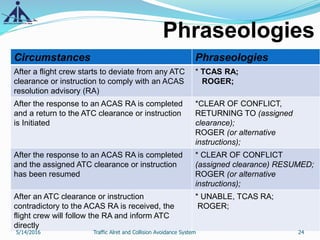
Phraseologies
Circumstances Phraseologies
After a flight crew starts to deviate from any ATC
clearance or instruction to comply with an ACAS
resolution advisory (RA)
* TCAS RA;
ROGER;
After the response to an ACAS RA is completed
and a return to the ATC clearance or instruction
is Initiated
*CLEAR OF CONFLICT,
RETURNING TO (assigned
clearance);
ROGER (or alternative
instructions);
After the response to an ACAS RA is completed
and the assigned ATC clearance or instruction
has been resumed
* CLEAR OF CONFLICT
(assigned clearance) RESUMED;
ROGER (or alternative
instructions);
After an ATC clearance or instruction
contradictory to the ACAS RA is received, the
flight crew will follow the RA and inform ATC
directly
* UNABLE, TCAS RA;
ROGER;
5/14/2016 24Traffic Alret and Collision Avoidance System
Thank You
for your patience
25Traffic Alret and Collision Avoidance System5/14/2016

Traffic Alert and collision avoidance system (TCAS)

  • 1.
    Traffic Alert andCollision Avoidance System Presentation By:- Arvind Kumar Singh 1Traffic Alret and Collision Avoidance System5/14/2016
  • 2.
    History  CAS isknown as TCAS and internationally as ACAS (Airborne Collision Avoidance System)  Series of midair collisions led to airline and governmental action to develop airborne devices that function independent of air traffic control (ATC) for alerting and collision avoidance  Early attempts (late 50s-60s) for reliable systems proved to be impractical  Mid 70s Beacon Collision Avoidance System (BCAS) became the basis for TCAS interrogation and tracking capabilities  Aircraft must have operating transponder for TCAS to provide collision avoidance protection 5/14/2016 2Traffic Alret and Collision Avoidance System
  • 3.
    Major Midair Accidents 1956 Grand Canyon, AZ — United DC-7 / TWA L-1049 (128 fatalities)  1960 New York, NY — United DC-8 / TWA L-1049 (134 fatalities)  1978 San Diego, CA — PSA B-727 / Cessna 172 (144 fatalities)  1986 Cerritos, CA — Aeromexico DC-9 / Piper PA-28 (82 fatalities)  1996 Charkhi Dadri, India — Saudi B-747 / Kazakhstan IL-76 (349 fatalities)  1997 Namibia (off-coast) — USAF C-141 / German AF Tu-154 (33 fatalities)  2002 Überlingen, Germany — Bashkirian Tu-154 / DHL B-757 (71 fatalities) 5/14/2016 3Traffic Alret and Collision Avoidance System
  • 4.
    TCAS • An airbornesystem that interrogates transponders in other aircraft.(Independently of Ground based equipment) • From the replies received, the system analyzes the intruding  Aircraft’s altitude (if altitude reporting), Closure rate, Projected flight path to predict a penetration • Displays the other aircraft visually  To alert any potential threats of airspace conflict. Report a resolution advisory (RA) only if the other transponder is transmitting an altitude. 5/14/2016 4Traffic Alret and Collision Avoidance System
  • 5.
    Terminology •Closest Point ofApproach (CPA): Predicted point in space at which the intruder will be closest to aircraft. • Intruder An SSR transponder equipped aircraft within the surveillance range. Recognizes as a potential threat •Traffic Advisory Indication given to the flight crew that a intruder is a potential threat and entering protected airspace 20-48 seconds from CPA •Resolution Advisory Maneuver intended to provide separation from all threats Maneuver restriction intended to maintain existing separation 15-35 seconds from CPA 5/14/2016 5Traffic Alret and Collision Avoidance System
  • 6.
    TCAS – SystemDescription  TCAS uses on-board surveillance to detect transponder-equipped traffic and provides:  Traffic Display and Traffic Alerts (TA) for situational awareness of close aircraft  Resolution Advisories (RA) with vertical guidance  Alerts are based on both projected:  Time to Closest Point of Approach (CPA)  Miss distance less than  600 to 800’ depending on altitude (vertical miss distance)  0.2 to 1.1 NM depending on altitude (horizontal miss distance)  RAs are selected to achieve or maintain adequate vertical distance (300 – 700’) and minimize pilot response/vertical deviations 5/14/2016 6Traffic Alret and Collision Avoidance System
  • 7.
    Standardized Symbology for TrafficDisplay Own-aircraft. Airplane-like symbol, in white or cyan. Other Traffic, altitude unknown. Unfilled diamond in white or cyan Proximate Traffic, 1100 feet above and descending. Filled diamond in white or cyan Traffic Advisory (TA), 900 feet below and level. Filled yellow/amber circle. Resolution Advisory (RA), 500 feet below and climbing. Filled red square. 5/14/2016 7Traffic Alret and Collision Avoidance System
  • 8.
    5/14/2016 8Traffic Alretand Collision Avoidance System
  • 9.
    Functions of TCASII •Surveillance Interrogations at 1030 MHz and respond at 1090 Mhz. Reliable surveillance to a range of 14 NM and in traffic densities of up to 0.3 aircraft per square NM. •Generation of TA •Threat Detection •Generation of RAs •Coordination •Communication with Ground Stations 5/14/2016 9Traffic Alret and Collision Avoidance System
  • 10.
    Salient Features ofTCAS  Collision Avoidance System  Predicts time to and separation at the intruders CPA using  Range  Closer rate  Altitude and vertical speed  Issue TA  If further close, will issue RA ( Five second crew reaction time to achieve separation)  Display different traffic symbols , changes colour and shape depends upon urgency  Can track 45 aircraft and display 30 of them  21 aircraft in a 5 NM radius, can provide advisory 5/14/2016 10Traffic Alret and Collision Avoidance System
  • 11.
    Alerting Threshold Values TCAS alerts based on time to closest approach and time to being co- altitude (tau)  All RAs are inhibited below 1,000’ AGL  Fixed distance alerting thresholds are also used in some situations  Many parallel runway operations  500’ IFR/VFR separation when both aircraft are level  TCAS does not consider IFR/VFR status or pilot intentions 5/14/2016 11Traffic Alret and Collision Avoidance System
  • 12.
    Transition from Passiveto Active Surveillance 5/14/2016 12Traffic Alret and Collision Avoidance System
  • 13.
    TCAS Protection Volume 5/14/201613Traffic Alret and Collision Avoidance System
  • 14.
    CAS Logic Functions 5/14/201614Traffic Alret and Collision Avoidance System
  • 15.
    Ground Estimation Logic •Aircraft is below 1750 ft AGL. • Ground level estimate is subtracted from the pressure altitude received from each Mode C equipped aircraft. to determine each aircraft above the ground. • If this difference is less than 360 feet, TCAS considers the reporting aircraft to be on the ground. 5/14/2016 15Traffic Alret and Collision Avoidance System
  • 16.
    Resolution Advisory RA SenseSelection Selection of Non-crossing RA Sense 5/14/2016 16Traffic Alret and Collision Avoidance System
  • 17.
    Increase Rate RA ResolutionAdvisory RA Reversal 5/14/2016 17Traffic Alret and Collision Avoidance System
  • 18.
    Concept of Operation •TCAS creates a “bubble” of protected airspace around aircraft. • TCAS begins to “track” other transponder equipped aircraft. • At approx 40 NM out other transponder equipped aircraft can be displayed on the active PFD/MFD (or depends upon range). • At 30 approx NM a data-link is established with other Mode S transponders to begin conflict resolution planning. • At 20 to 48 seconds prior to CPA a TA is issued. • AT 15 to 35 seconds from CPA an RA is generated. • If the RA is ignored, the crew response is too slow, or the conflict traffic alters its course a corrective RA is issued. • When the traffic is no longer a threat TCAS announces “CLEAR OF CONFLICT”. 5/14/2016 18Traffic Alret and Collision Avoidance System
  • 19.
    Operational Concept 5/14/2016 19TrafficAlret and Collision Avoidance System
  • 20.
    Carriage of AirborneCollision Avoidance System(GEN-1.5)  Unless otherwise authorized by DGCA , no person shall operate in the Indian airspace , an aeroplane having a maximum certified passenger seating configuration of more then 30 or maximum payload capacity of more then 3 tonne.  After 31st December 1998, if it is not equipped with an approved TCAS II and  After 1st Jan 2003, if it is not equipped with an approved TCAS II with change 7 (equivalent to ACAS`)  After 1st Jan. 2002 for the purpose of registration and operation within, to and from India shall be fitted with TCAS II with change 7 5/14/2016 20Traffic Alret and Collision Avoidance System
  • 21.
    Operational Circular 4of 2002  All crew must reduce the aircraft rate of climb or descent as applicable  500 ft per minute or less when the airplane is 2000 ft to level off altitude. 5/14/2016 21Traffic Alret and Collision Avoidance System
  • 22.
    Controller’s Responsibilities • Ifan aircraft responding to a TCAS RA  Do not issue control instructions that are contrary to the RA, which crew are executing.  Provide safety alerts regarding terrain or obstructions and traffic advisories • Unless advised by other aircraft to responding to a TCAS RA,  Do not assume that the other aircraft in proximity involved in the RA Continue to provide control instructions, safety alerts, and traffic advisories as appropriate to such aircraft. 5/14/2016 22Traffic Alret and Collision Avoidance System
  • 23.
    Controller’s Responsibilities • Issuetraffic advisories • Except more RAs, when working aircraft that climb descend quickly. • Controller is not responsible for providing standard separation between the aircraft that is responding to an RA and any other aircraft, airspace, terrain, or obstructions. • Responsibility for standard separation resumes when- The responding aircraft has returned to its assigned altitude. The flight crew informs that the TCAS maneuver is completed and standard separation has been established. The responding aircraft has executed an alternate clearance and standard separation has been re-established. 5/14/2016 23Traffic Alret and Collision Avoidance System
  • 24.
    Phraseologies Circumstances Phraseologies After aflight crew starts to deviate from any ATC clearance or instruction to comply with an ACAS resolution advisory (RA) * TCAS RA; ROGER; After the response to an ACAS RA is completed and a return to the ATC clearance or instruction is Initiated *CLEAR OF CONFLICT, RETURNING TO (assigned clearance); ROGER (or alternative instructions); After the response to an ACAS RA is completed and the assigned ATC clearance or instruction has been resumed * CLEAR OF CONFLICT (assigned clearance) RESUMED; ROGER (or alternative instructions); After an ATC clearance or instruction contradictory to the ACAS RA is received, the flight crew will follow the RA and inform ATC directly * UNABLE, TCAS RA; ROGER; 5/14/2016 24Traffic Alret and Collision Avoidance System
  • 25.
    Thank You for yourpatience 25Traffic Alret and Collision Avoidance System5/14/2016