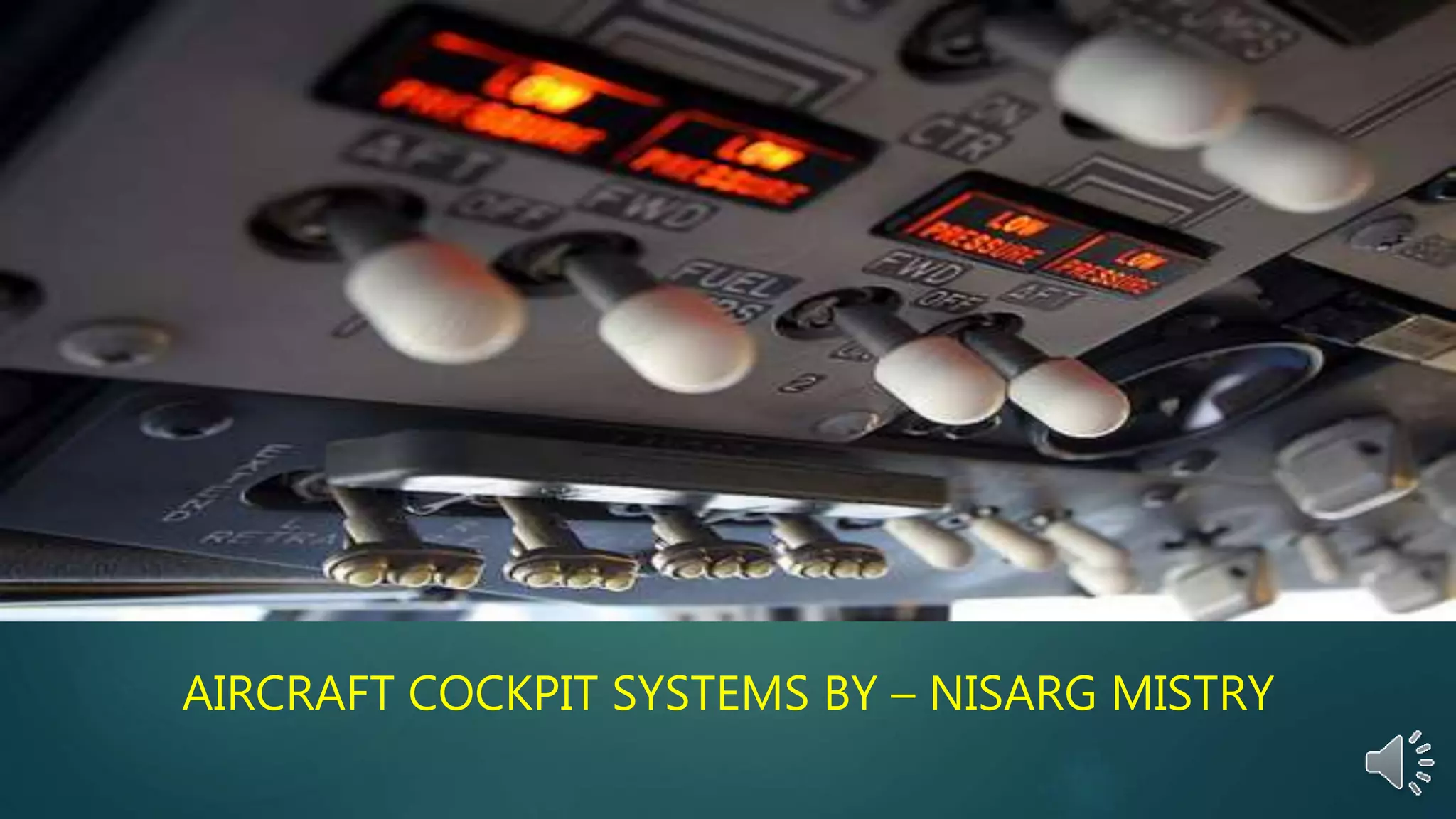
AIRCRAFT COCKPIT SYSTEMS BY – NISARG MISTRY
EFIS(Electronic Flight Instrument System)
BASICS AND INTRODUCTION…
WHAT IS EFIS?
 An Electronic Flight Instrument System (EFIS) is a flight deck
instrument display system in which the display technology
used is electronic rather than electromechanical.
 EFIS Generally Consists of-
1. PFD - Primary Flight Display.
2. Weather Radar .
3. EICAS - Engine Indicating and Crew Alerting System.
4.ECAM - Electronic Centralized Aircraft Monitoring.
5. MFD - Multi Function Display .
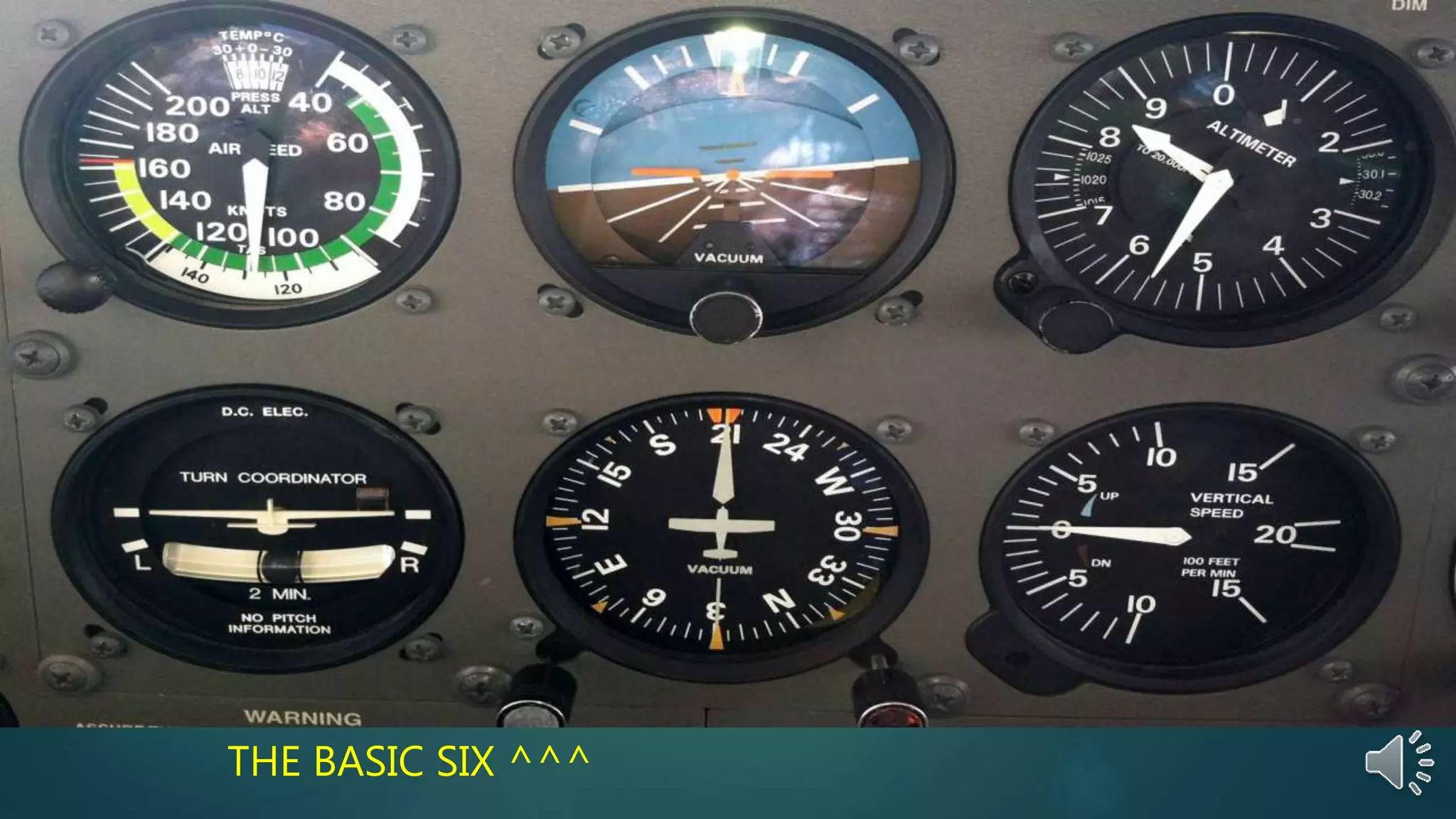
In old Aircraft there were all Analogue Systems , The basic
instruments required to fly an aircraft are the BASIC SIX INSTRUMENTS
which consist of -
1. Airspeed Indicator(ASI).
2. Attitude Indicator.
3.Altimeter.
4. Turn coordinator.
5. Heading Indicator.
6. Vertical Speed Indicator(VSI).
THE BASIC SIX ^^^
• So, these were the basic six , in old aircrafts pilots monitored all the
instruments one by one .In analogue systems some pilots also faced Parallax
Error problems so in order to mix all the instruments in a single display EFIS
was introduced.
• By the Introduction of Weather radar and FMS(Flight Management system) the
analogue gauges were now turned into CRT screens which showed the
information which was electromechanically generated . But the EFIS is fully
digital and the CRTS were replaced by LCD screens.
• The complex electromechanical attitude director indicator (ADI) and
horizontal situation indicator (HSI) were the first candidates for
replacement by EFIS.
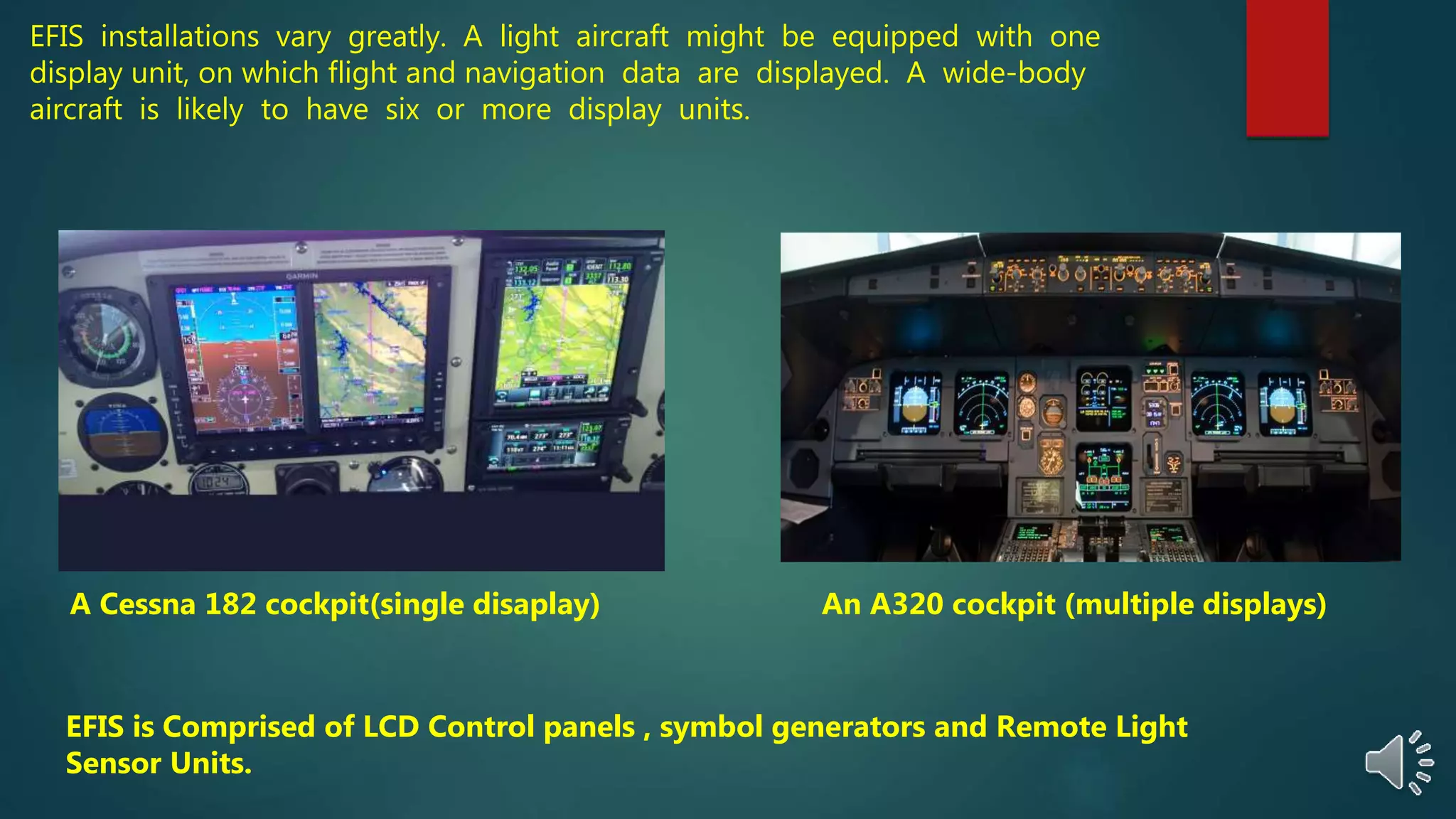
EFIS installations vary greatly. A light aircraft might be equipped with one
display unit, on which flight and navigation data are displayed. A wide-body
aircraft is likely to have six or more display units.
A Cessna 182 cockpit(single disaplay) An A320 cockpit (multiple displays)
EFIS is Comprised of LCD Control panels , symbol generators and Remote Light
Sensor Units.
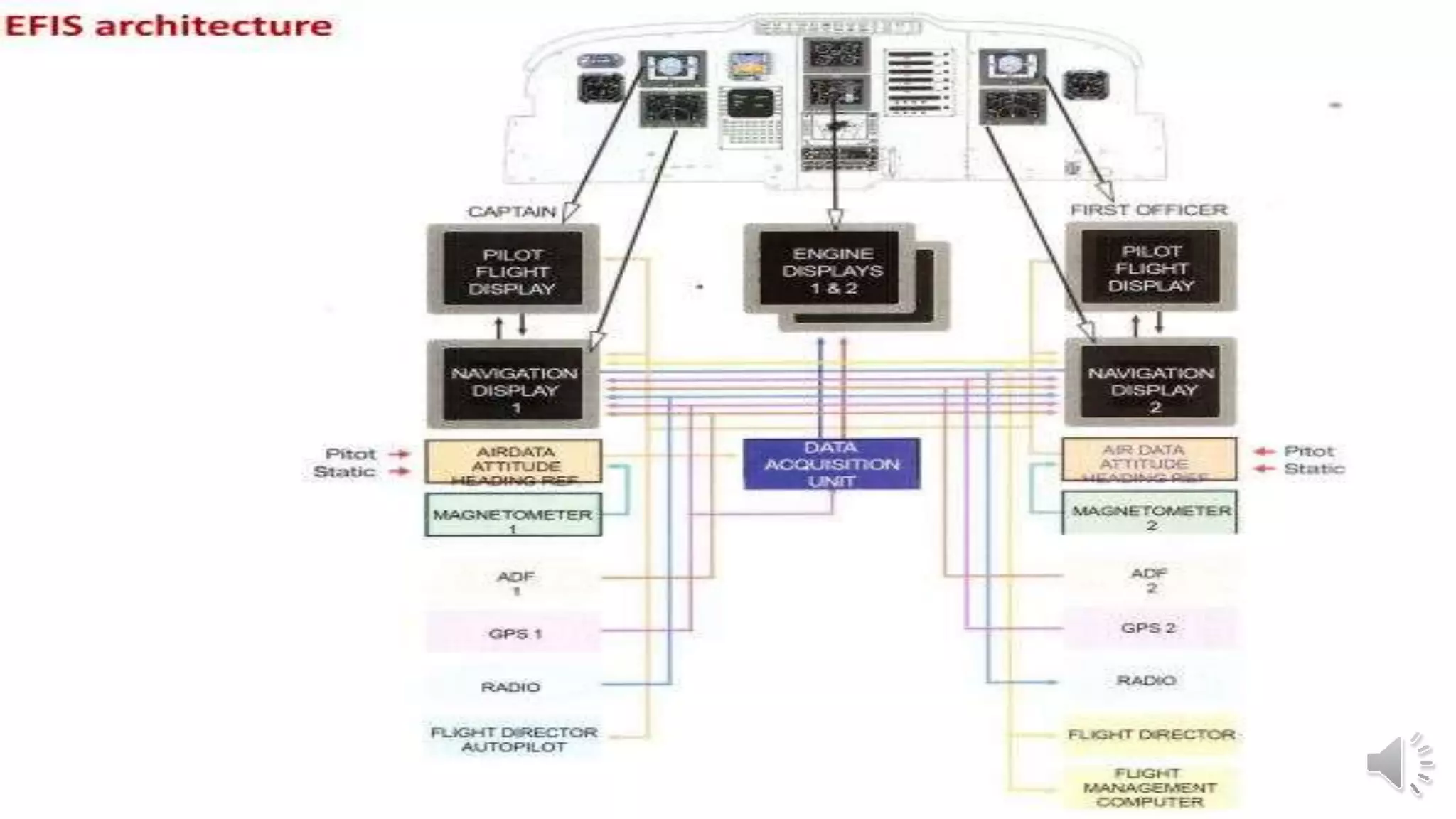
EFIS Architecture
An EFIS installation will follow the sequence:
• Displays
• Controls
• Data processors
A basic EFIS might have all these facilities in the one unit.
*ADVANTAGES OF EFIS-
• All the basic flight instruments were incorporated in a single display . As a
result , it will reduce the overall weight and increase its accuracy .
• This instruments are highly Calibrated and highly Reliable .
• It can reduce the pilot difficulties towards various analogue instruments.
• It reduces all the Parallax Errors from the displays .
• Uniformity could be maintained.
• Free from repeated maintenance Review.
• Low Power consumption .
• High Service Life .
• Moderate Costing .
• Easy Installation .
COCKPIT LAYOUT.
A Cockpit has Basically 6 panels –
• Over Head Panel (OHP)
• Glare Shield Panel
• Captain Review Panel
• F/O Review Panel
• Centre Review Panel
• Pedestal Panel
Over Head Panel
The overhead panel is the nerve center of the aircraft systems and replaces
many of the controls previously located on the flight engineers panel. It is
categorized as -
• Port side overhead Panel (i.e - captain side)
• Centre OHP
• Star board side OHP(F/O Side)
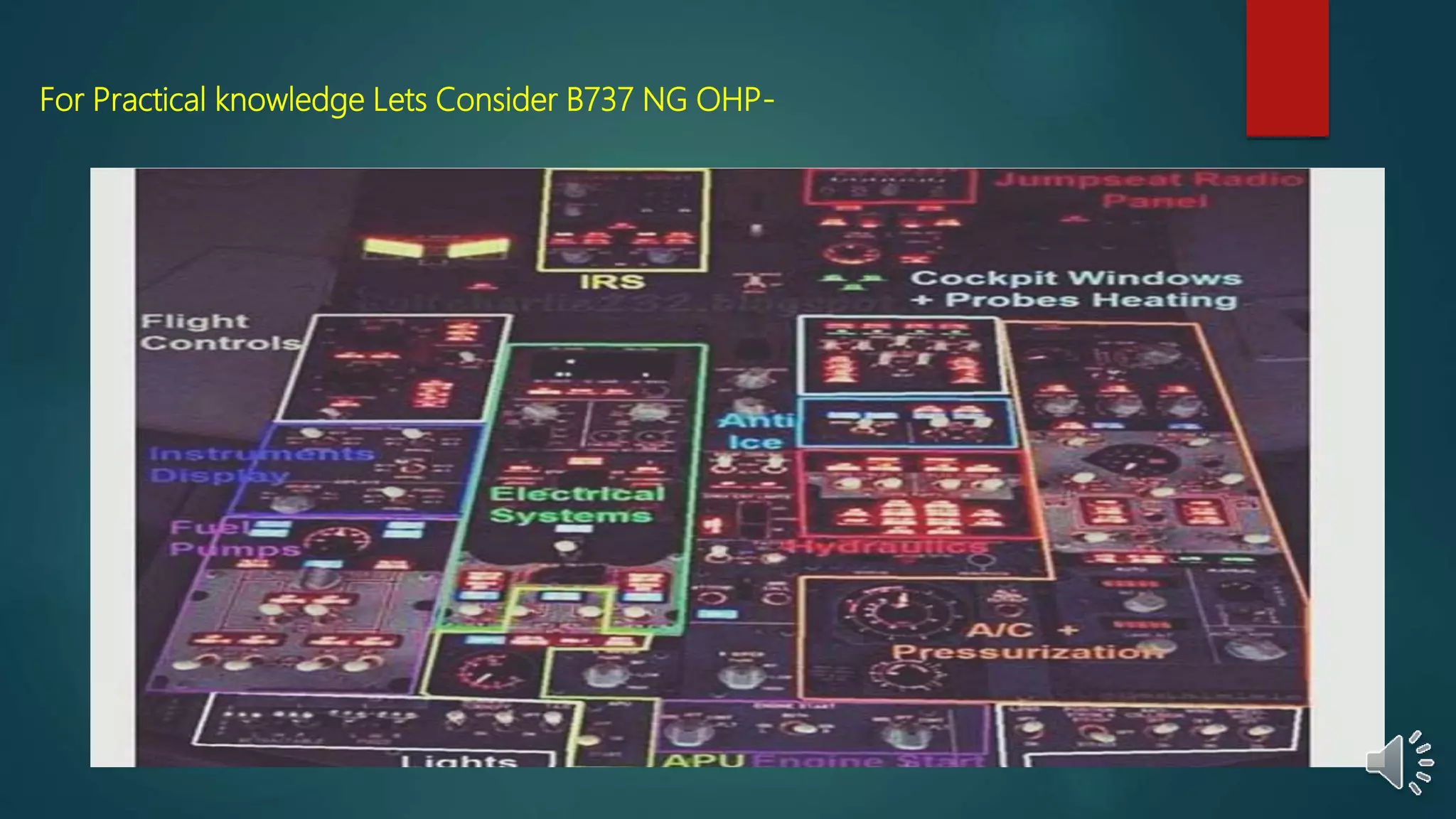
The OHP may comprised of -
• Electrical system switches and monitoring panels.
• Anti- icing / De-icing Systems control panels.
• A/C pressurization System Control Panel.
• Fuel Pumps monitoring control panel.
• IRS (Inertial Reference System).
• Cockpit windows + Probes heating system.
• Leading Edge Devices Indications.
• A/C Lights switches .
• Engines and APU (Auxiliary Power Unit) Starting Switches .
• Hydraulics Monitoring Panels.
For Practical knowledge Lets Consider B737 NG OHP-
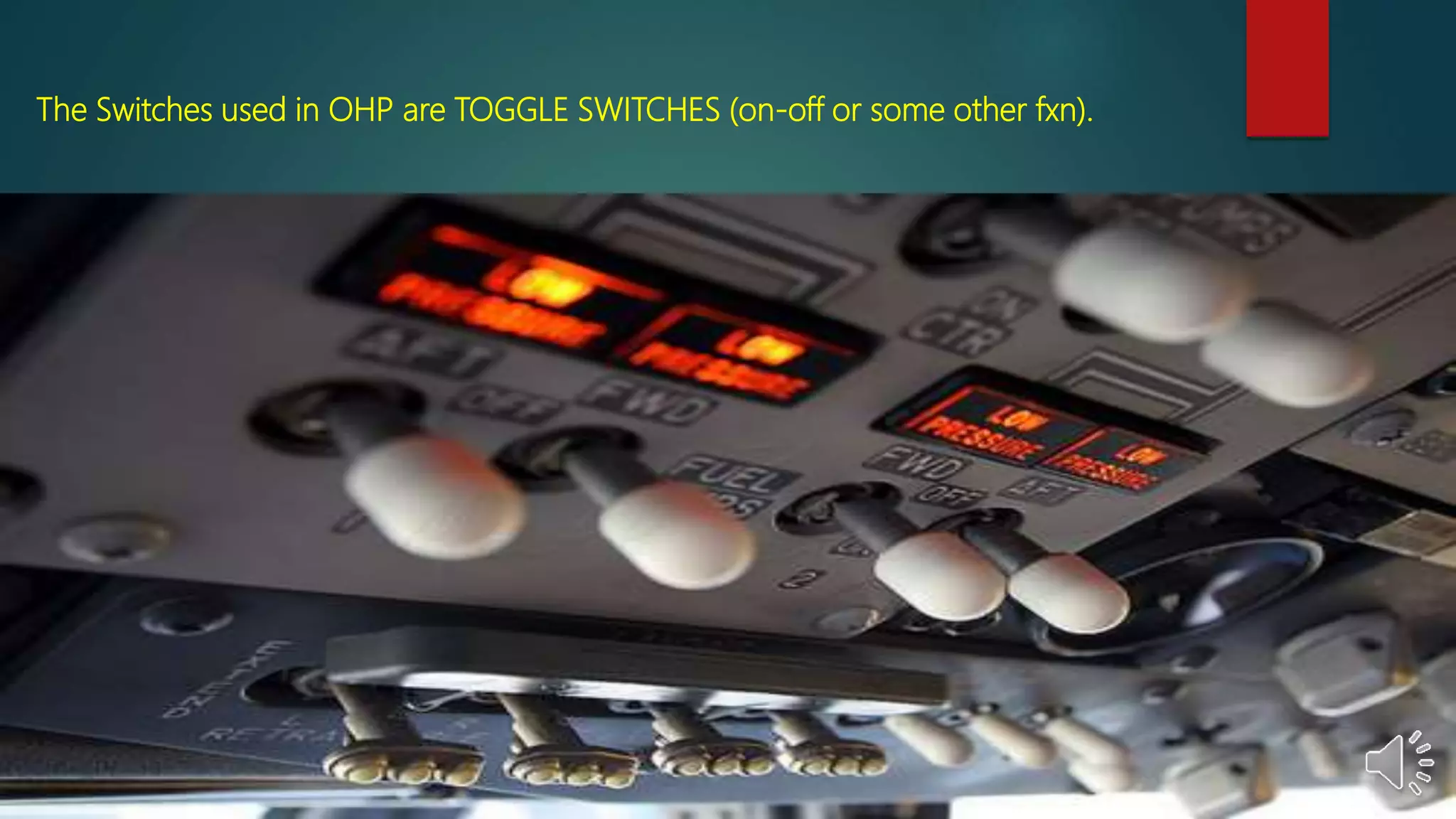
The Switches used in OHP are TOGGLE SWITCHES (on-off or some other fxn).
GLARE SHIELD PANEL -
The glareshield panel, commonly referred to as the MCP, contains not only the
Mode Control Panel, but also the master caution lights & annunciations, fire
warning lights and, on the NG's, the EFIS control panels. Whilst the MCP has
evolved with the autopilot, the master caution and fire warning lights have
remained unchanged through to the present day which is testimony to its good
initial design.
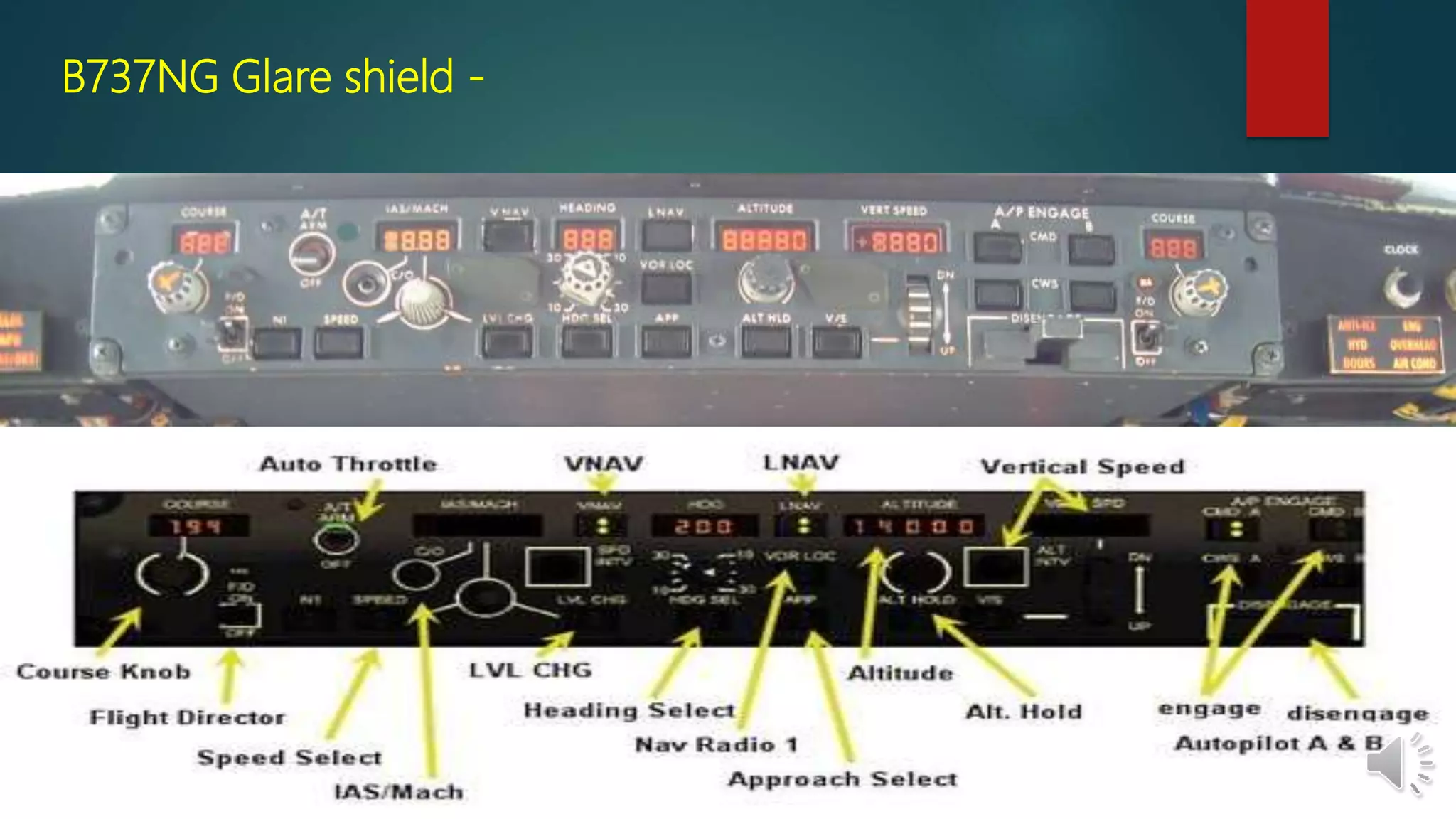
All the autopilot controls are in this panel such as A/p Master switch (Engage/disengage),
Speed selection , Flight Director switch , Altitude , heading and vertical speed selection/hold
Switches etc..
B737NG Glare shield -
MAIN DISPLAY PANEL
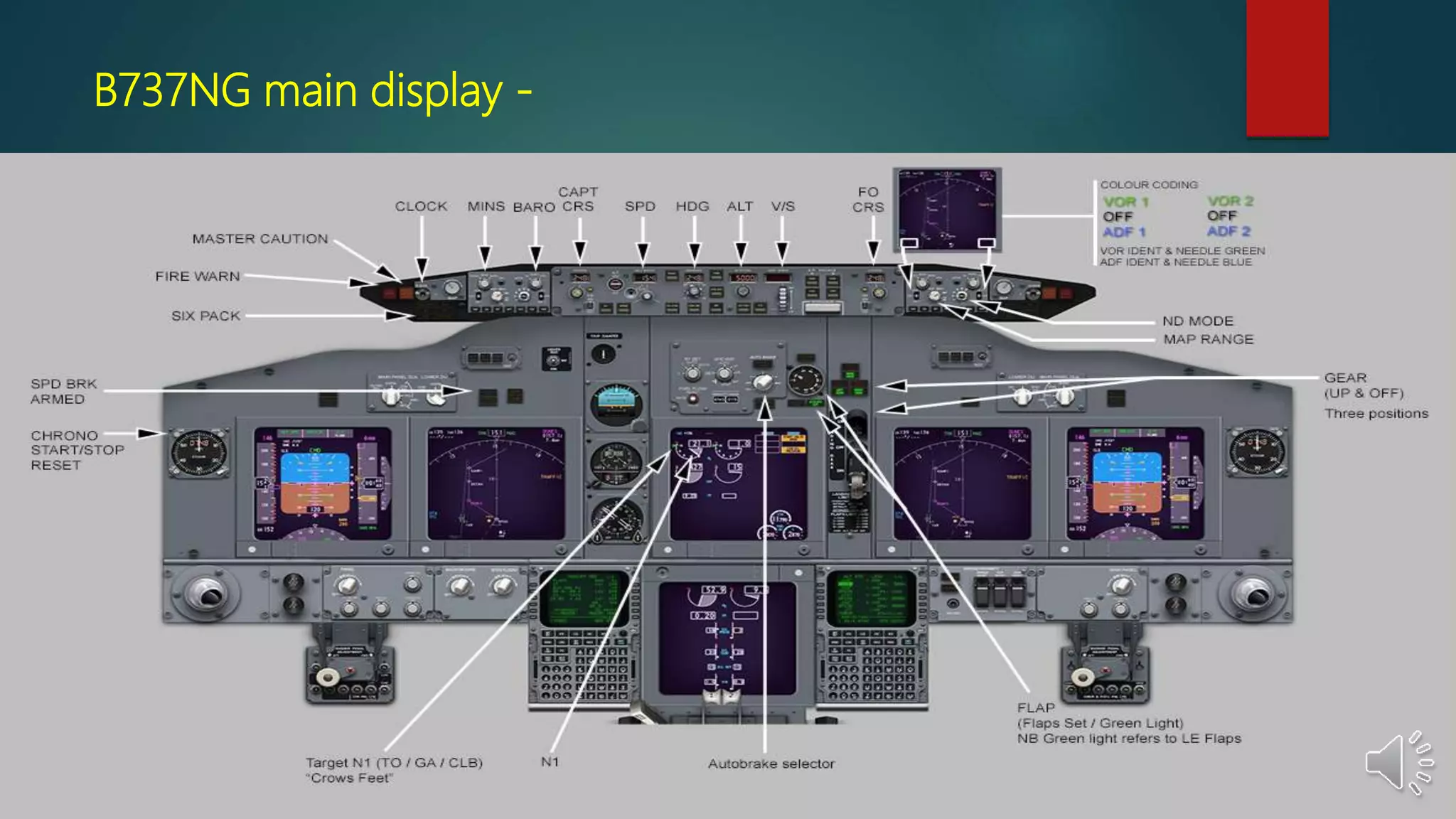
A Main Display panel consist of - Pilot review panel , F/O review panel and
Centre Review Panel .
Pilot and F/o panel has - PFD , Weather radar and ILS displays .
Centre review panel - EICAS , Aux.EICAS , ECAM and CDU (Control Display
unit).
B737NG main display -
PEDESTAL PANEL
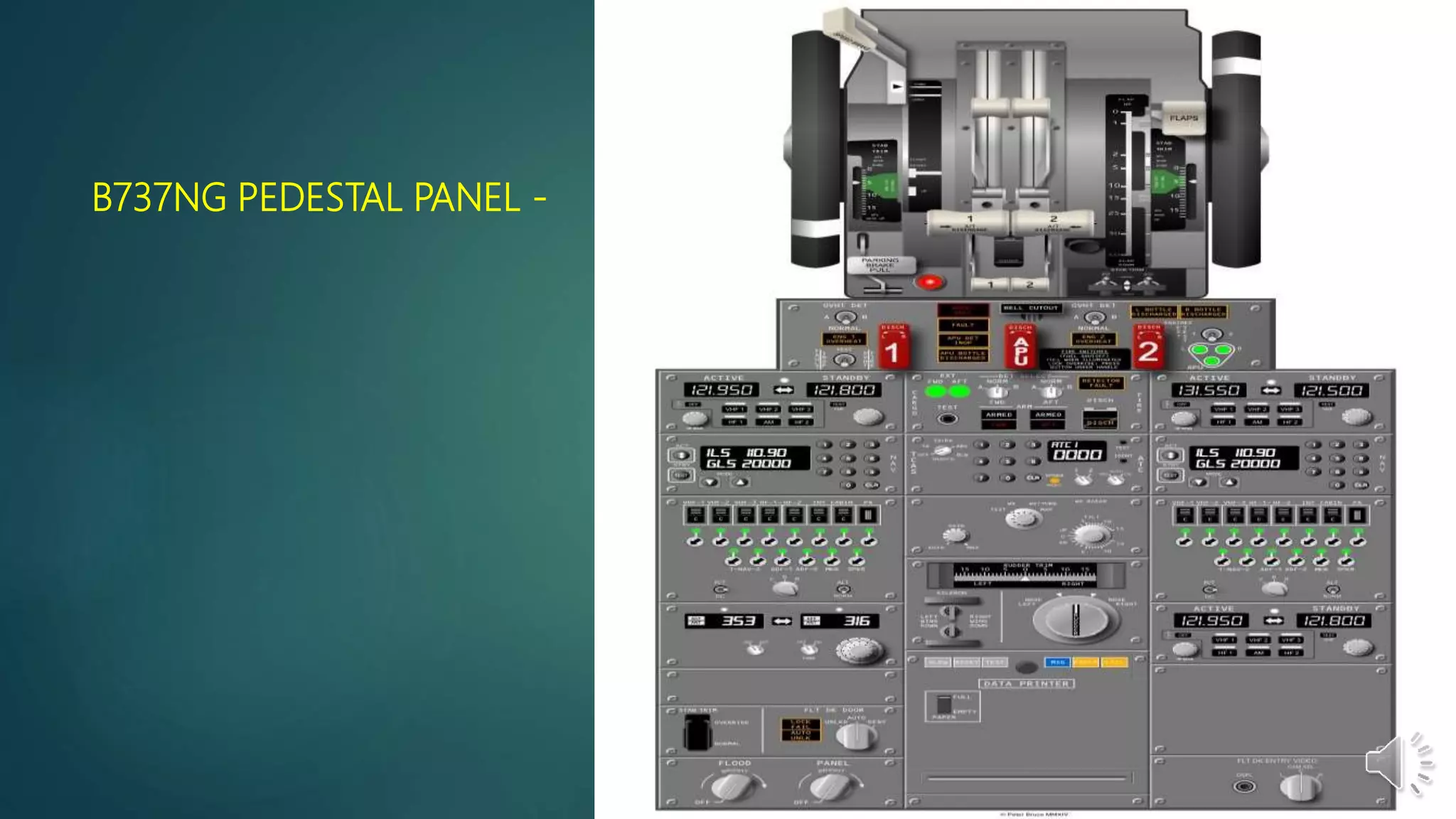
It normally contains the throttle and other engine controls, input keyboards for
the navigational system, etc. also consist of Fire warning and extinguishing
systems, VHF (Very High Frequency )communication controls , Flaps spoilers
Operation , Parking break switch , all the Rudder Aileron and Elevator Trim
Settings and Fuel Switches ( cutoff and Idle – to start/shutdown the engine).
B737NG PEDESTAL PANEL -
So, this was the EFIS System . Now for a detailed study of Working of basic six , EFIS ,
ECAM and EICAS Plz Refer my Next Post coming soon……
For external reference use - Smartcockpit.com, Aircraft Electricity and Electronics by -
Eismin , Aircraft Instruments By EHJ Pallet ,
Pilots hand book of aeronautical knowledge(PHAK - FAA).
-CNAM737
Email- riwan737800@gmail.com
LIKE , COMMENT , SUBSCRIBE AND SHARE IF U LIKE IT…. FEEDBACKS ARE TOO IMPORTANT..

EASA part 66 module exam Module - 5 EFIS(Electronic Flight instrument system)

  • 1.
    AIRCRAFT COCKPIT SYSTEMSBY – NISARG MISTRY
  • 2.
    EFIS(Electronic Flight InstrumentSystem) BASICS AND INTRODUCTION…
  • 3.
    WHAT IS EFIS? An Electronic Flight Instrument System (EFIS) is a flight deck instrument display system in which the display technology used is electronic rather than electromechanical.  EFIS Generally Consists of- 1. PFD - Primary Flight Display. 2. Weather Radar . 3. EICAS - Engine Indicating and Crew Alerting System. 4.ECAM - Electronic Centralized Aircraft Monitoring. 5. MFD - Multi Function Display .
  • 4.
    In old Aircraftthere were all Analogue Systems , The basic instruments required to fly an aircraft are the BASIC SIX INSTRUMENTS which consist of - 1. Airspeed Indicator(ASI). 2. Attitude Indicator. 3.Altimeter. 4. Turn coordinator. 5. Heading Indicator. 6. Vertical Speed Indicator(VSI).
  • 5.
  • 6.
    • So, thesewere the basic six , in old aircrafts pilots monitored all the instruments one by one .In analogue systems some pilots also faced Parallax Error problems so in order to mix all the instruments in a single display EFIS was introduced. • By the Introduction of Weather radar and FMS(Flight Management system) the analogue gauges were now turned into CRT screens which showed the information which was electromechanically generated . But the EFIS is fully digital and the CRTS were replaced by LCD screens. • The complex electromechanical attitude director indicator (ADI) and horizontal situation indicator (HSI) were the first candidates for replacement by EFIS.
  • 7.
    EFIS installations varygreatly. A light aircraft might be equipped with one display unit, on which flight and navigation data are displayed. A wide-body aircraft is likely to have six or more display units. A Cessna 182 cockpit(single disaplay) An A320 cockpit (multiple displays) EFIS is Comprised of LCD Control panels , symbol generators and Remote Light Sensor Units.
  • 8.
    EFIS Architecture An EFISinstallation will follow the sequence: • Displays • Controls • Data processors A basic EFIS might have all these facilities in the one unit.
  • 10.
    *ADVANTAGES OF EFIS- •All the basic flight instruments were incorporated in a single display . As a result , it will reduce the overall weight and increase its accuracy . • This instruments are highly Calibrated and highly Reliable . • It can reduce the pilot difficulties towards various analogue instruments. • It reduces all the Parallax Errors from the displays . • Uniformity could be maintained. • Free from repeated maintenance Review. • Low Power consumption . • High Service Life . • Moderate Costing . • Easy Installation .
  • 11.
    COCKPIT LAYOUT. A Cockpithas Basically 6 panels – • Over Head Panel (OHP) • Glare Shield Panel • Captain Review Panel • F/O Review Panel • Centre Review Panel • Pedestal Panel
  • 12.
    Over Head Panel Theoverhead panel is the nerve center of the aircraft systems and replaces many of the controls previously located on the flight engineers panel. It is categorized as - • Port side overhead Panel (i.e - captain side) • Centre OHP • Star board side OHP(F/O Side) The OHP may comprised of - • Electrical system switches and monitoring panels. • Anti- icing / De-icing Systems control panels. • A/C pressurization System Control Panel. • Fuel Pumps monitoring control panel. • IRS (Inertial Reference System). • Cockpit windows + Probes heating system. • Leading Edge Devices Indications. • A/C Lights switches . • Engines and APU (Auxiliary Power Unit) Starting Switches . • Hydraulics Monitoring Panels.
  • 13.
    For Practical knowledgeLets Consider B737 NG OHP-
  • 14.
    The Switches usedin OHP are TOGGLE SWITCHES (on-off or some other fxn).
  • 15.
    GLARE SHIELD PANEL- The glareshield panel, commonly referred to as the MCP, contains not only the Mode Control Panel, but also the master caution lights & annunciations, fire warning lights and, on the NG's, the EFIS control panels. Whilst the MCP has evolved with the autopilot, the master caution and fire warning lights have remained unchanged through to the present day which is testimony to its good initial design. All the autopilot controls are in this panel such as A/p Master switch (Engage/disengage), Speed selection , Flight Director switch , Altitude , heading and vertical speed selection/hold Switches etc..
  • 16.
  • 17.
    MAIN DISPLAY PANEL AMain Display panel consist of - Pilot review panel , F/O review panel and Centre Review Panel . Pilot and F/o panel has - PFD , Weather radar and ILS displays . Centre review panel - EICAS , Aux.EICAS , ECAM and CDU (Control Display unit).
  • 18.
  • 19.
    PEDESTAL PANEL It normallycontains the throttle and other engine controls, input keyboards for the navigational system, etc. also consist of Fire warning and extinguishing systems, VHF (Very High Frequency )communication controls , Flaps spoilers Operation , Parking break switch , all the Rudder Aileron and Elevator Trim Settings and Fuel Switches ( cutoff and Idle – to start/shutdown the engine).
  • 20.
  • 21.
    So, this wasthe EFIS System . Now for a detailed study of Working of basic six , EFIS , ECAM and EICAS Plz Refer my Next Post coming soon…… For external reference use - Smartcockpit.com, Aircraft Electricity and Electronics by - Eismin , Aircraft Instruments By EHJ Pallet , Pilots hand book of aeronautical knowledge(PHAK - FAA). -CNAM737 Email- riwan737800@gmail.com LIKE , COMMENT , SUBSCRIBE AND SHARE IF U LIKE IT…. FEEDBACKS ARE TOO IMPORTANT..