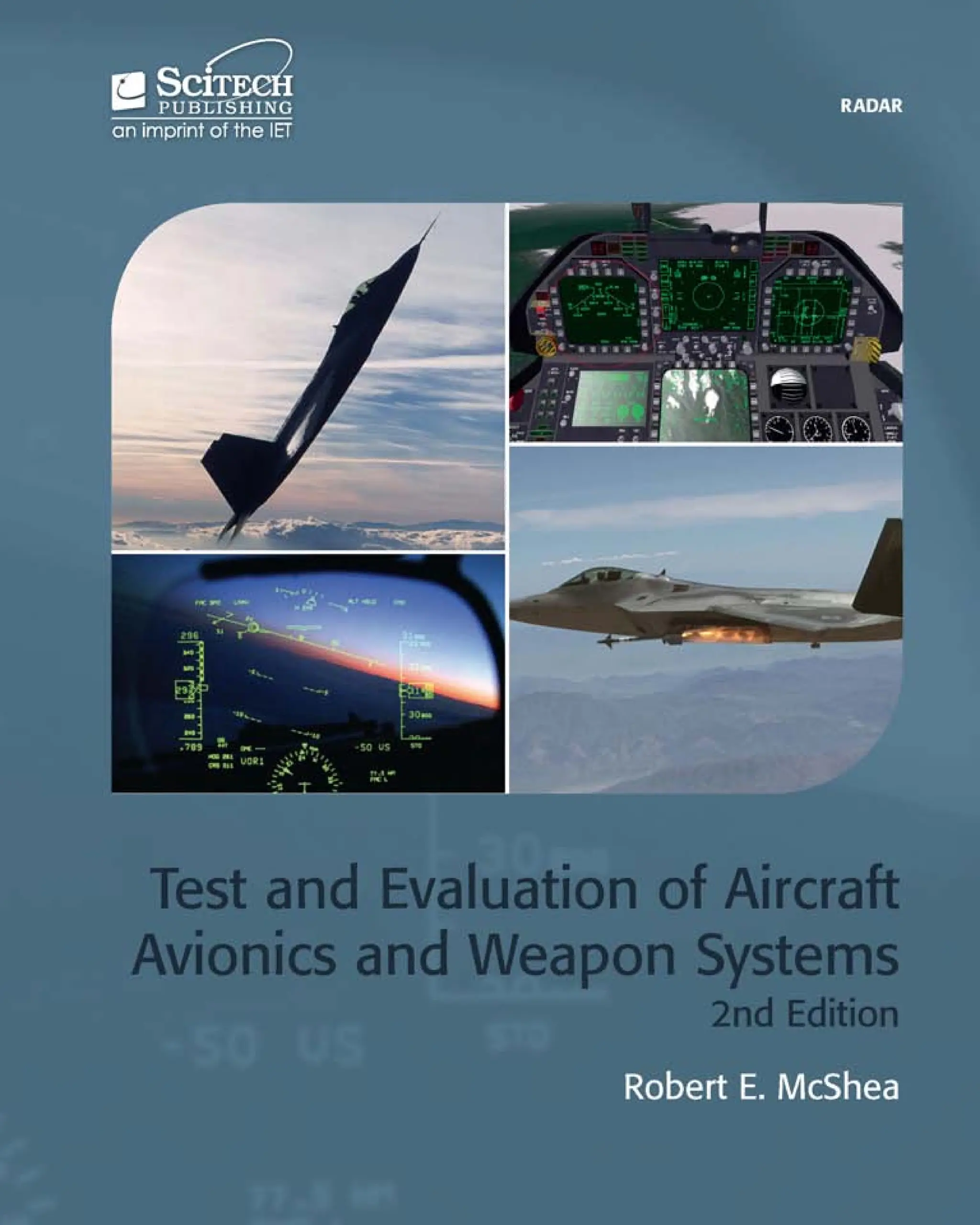
Test and evaluation of aircraft avionics and
weapon systems 2nd Edition Robert B. Mcshea pdf

download
https://ebookfinal.com/download/test-and-evaluation-of-aircraft-
avionics-and-weapon-systems-2nd-edition-robert-b-mcshea/
Explore and download more ebooks or textbooks
at ebookfinal.com
We have selected some products that you may be interested in
Click the link to download now or visit ebookfinal.com
for more options!.
Reaction Mechanisms of Inorganic and Organometallic
Systems 3rd Edition Robert B. Jordan
https://ebookfinal.com/download/reaction-mechanisms-of-inorganic-and-
organometallic-systems-3rd-edition-robert-b-jordan/
Comparative Analysis of Evaluation Methodologies in Weapon
Collection Programmes 1st Edition United Nations
https://ebookfinal.com/download/comparative-analysis-of-evaluation-
methodologies-in-weapon-collection-programmes-1st-edition-united-
nations/
Aircraft electrical and electronic systems principles
operation and maintenance 1st ed Edition Wyatt
https://ebookfinal.com/download/aircraft-electrical-and-electronic-
systems-principles-operation-and-maintenance-1st-ed-edition-wyatt/
Stability and Control of Aircraft Systems Introduction to
Classical Feedback Control 1st Edition Roy Langton
https://ebookfinal.com/download/stability-and-control-of-aircraft-
systems-introduction-to-classical-feedback-control-1st-edition-roy-
langton/
Practical Program Evaluation Theory Driven Evaluation and
the Integrated Evaluation Perspective 2nd Edition Huey T.
Chen
https://ebookfinal.com/download/practical-program-evaluation-theory-
driven-evaluation-and-the-integrated-evaluation-perspective-2nd-
edition-huey-t-chen/
Cost Benefit Analysis of the 2006 Air Force Materiel
Command Test and Evaluation Proposal 1st Edition Michael
R. Thirtle
https://ebookfinal.com/download/cost-benefit-analysis-of-the-2006-air-
force-materiel-command-test-and-evaluation-proposal-1st-edition-
michael-r-thirtle/
Strapdown Inertial Navigation Technology IEE Radar Sonar
Navigation and Avionics Series 2nd Edition David Titterton
https://ebookfinal.com/download/strapdown-inertial-navigation-
technology-iee-radar-sonar-navigation-and-avionics-series-2nd-edition-
david-titterton/
Evaluation of Enzyme Inhibitors in Drug Discovery Robert
A. Copeland
https://ebookfinal.com/download/evaluation-of-enzyme-inhibitors-in-
drug-discovery-robert-a-copeland/
Information Processing and Living Systems Vladimir B.
Bajic
https://ebookfinal.com/download/information-processing-and-living-
systems-vladimir-b-bajic/
Test and evaluation of aircraft avionics and weapon
systems 2nd Edition Robert B. Mcshea Digital Instant

Download
Author(s): Robert B. McShea
ISBN(s): 9781680158342, 1613531761
Edition: 2
File Details: PDF, 50.20 MB
Year: 2014
Language: english
Test and Evaluation of Aircraft
Avionics and Weapon Systems
Test and Evaluation of Aircraft
Avionics and Weapon Systems
2nd Edition
Robert E. McShea
Edison, NJ
theiet.org
Published by SciTech Publishing, an imprint of the IET.
www.scitechpub.com
www.theiet.org
 2010, 2014 by SciTech Publishing, Edison, NJ. All rights reserved.
First edition 2010
Second edition 2014
No part of this publication may be reproduced, stored in a retrieval system or transmitted in any form or by any
means, electronic, mechanical, photocopying, recording, scanning or otherwise, except as permitted under Sections
107 or 108 of the 1976 United States Copyright Act, without either the prior written permission of the Publisher, or
authorization through payment of the appropriate per-copy fee to the Copyright Clearance Center, 222 Rosewood
Drive, Danvers, MA 01923, (978) 750-8400, fax (978) 646-8600, or on the web at copyright.com. Requests to the
Publisher for permission should be addressed to The Institution of Engineering and Technology, Michael Faraday
House, Six Hills Way, Stevenage, Herts, SG1 2AY, United Kingdom.
While the author and publisher believe that the information and guidance given in this work are correct, all parties
must rely upon their own skill and judgement when making use of them. Neither the author nor publisher assumes
any liability to anyone for any loss or damage caused by any error or omission in the work, whether such an error or
omission is the result of negligence or any other cause. Any and all such liability is disclaimed.
Editor: Dudley R. Kay
10 9 8 7 6 5 4 3 2 1
ISBN 978-1-61353-176-1 (hardback)
ISBN 978-1-61353-180-8 (PDF)
Typeset in India by MPS Limited
Printed in the USA by Sheridan Books Inc.
Printed in the UK by CPI Group (UK) Ltd, Croydon
This Book is Dedicated to
Marlenni Belinni
Friends till the end
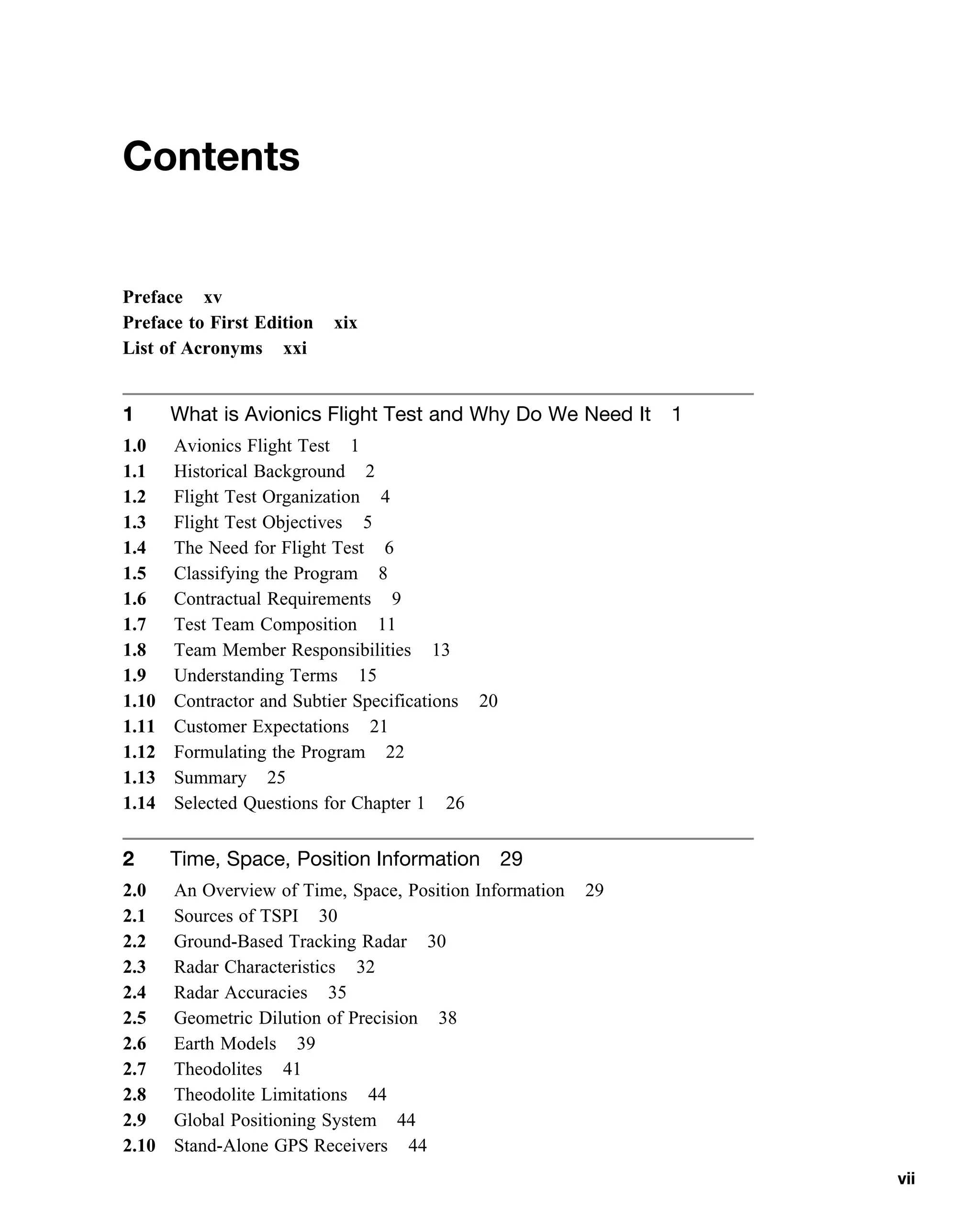
Contents
Preface xv
Preface to First Edition xix
List of Acronyms xxi
1 What is Avionics Flight Test and Why Do We Need It 1
1.0 Avionics Flight Test 1
1.1 Historical Background 2
1.2 Flight Test Organization 4
1.3 Flight Test Objectives 5
1.4 The Need for Flight Test 6
1.5 Classifying the Program 8
1.6 Contractual Requirements 9
1.7 Test Team Composition 11
1.8 Team Member Responsibilities 13
1.9 Understanding Terms 15
1.10 Contractor and Subtier Specifications 20
1.11 Customer Expectations 21
1.12 Formulating the Program 22
1.13 Summary 25
1.14 Selected Questions for Chapter 1 26
2 Time, Space, Position Information 29
2.0 An Overview of Time, Space, Position Information 29
2.1 Sources of TSPI 30
2.2 Ground-Based Tracking Radar 30
2.3 Radar Characteristics 32
2.4 Radar Accuracies 35
2.5 Geometric Dilution of Precision 38
2.6 Earth Models 39
2.7 Theodolites 41
2.8 Theodolite Limitations 44
2.9 Global Positioning System 44
2.10 Stand-Alone GPS Receivers 44
vii
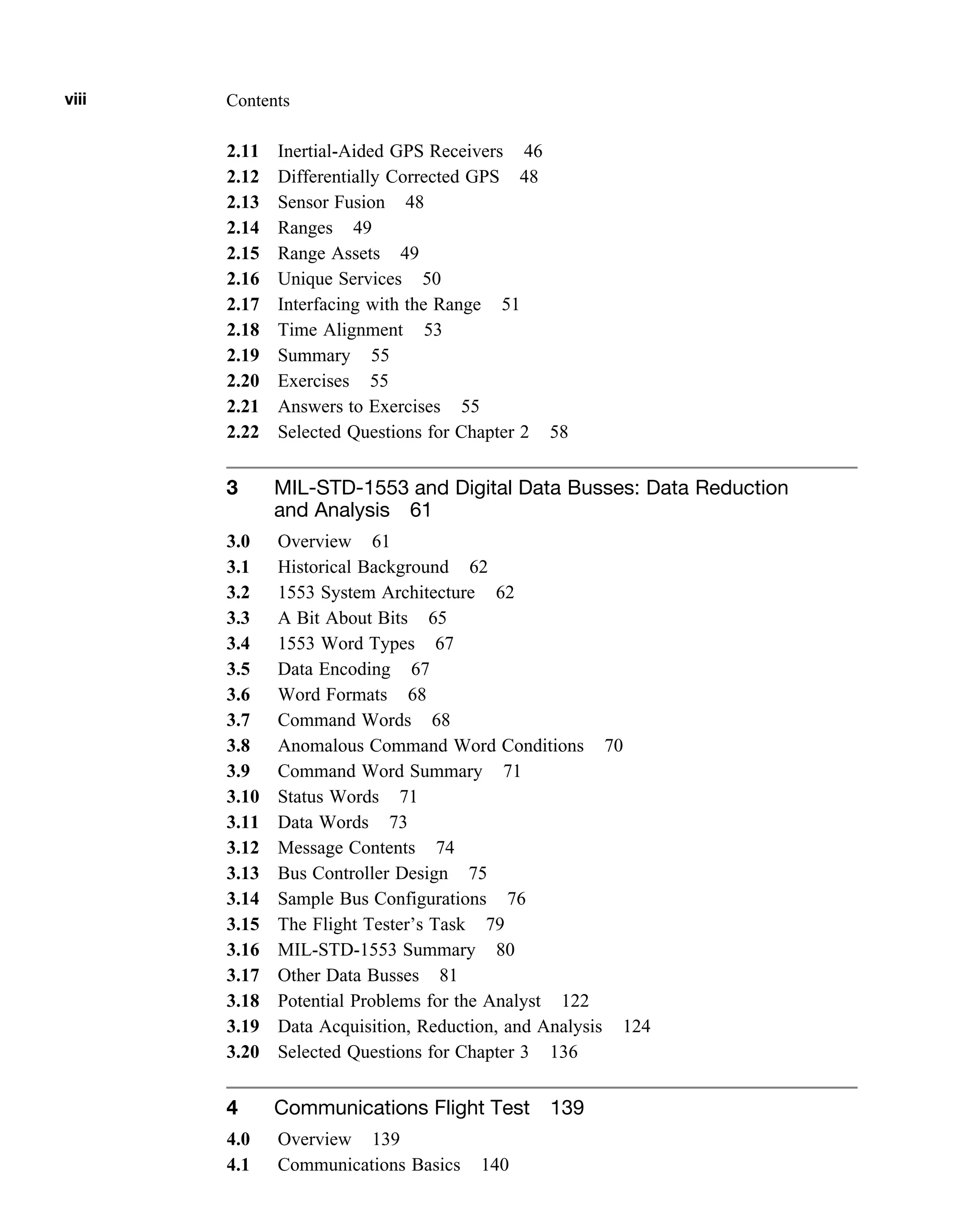
2.11 Inertial-Aided GPS Receivers 46
2.12 Differentially Corrected GPS 48
2.13 Sensor Fusion 48
2.14 Ranges 49
2.15 Range Assets 49
2.16 Unique Services 50
2.17 Interfacing with the Range 51
2.18 Time Alignment 53
2.19 Summary 55
2.20 Exercises 55
2.21 Answers to Exercises 55
2.22 Selected Questions for Chapter 2 58
3 MIL-STD-1553 and Digital Data Busses: Data Reduction
and Analysis 61
3.0 Overview 61
3.1 Historical Background 62
3.2 1553 System Architecture 62
3.3 A Bit About Bits 65
3.4 1553 Word Types 67
3.5 Data Encoding 67
3.6 Word Formats 68
3.7 Command Words 68
3.8 Anomalous Command Word Conditions 70
3.9 Command Word Summary 71
3.10 Status Words 71
3.11 Data Words 73
3.12 Message Contents 74
3.13 Bus Controller Design 75
3.14 Sample Bus Configurations 76
3.15 The Flight Tester’s Task 79
3.16 MIL-STD-1553 Summary 80
3.17 Other Data Busses 81
3.18 Potential Problems for the Analyst 122
3.19 Data Acquisition, Reduction, and Analysis 124
3.20 Selected Questions for Chapter 3 136
4 Communications Flight Test 139
4.0 Overview 139
4.1 Communications Basics 140
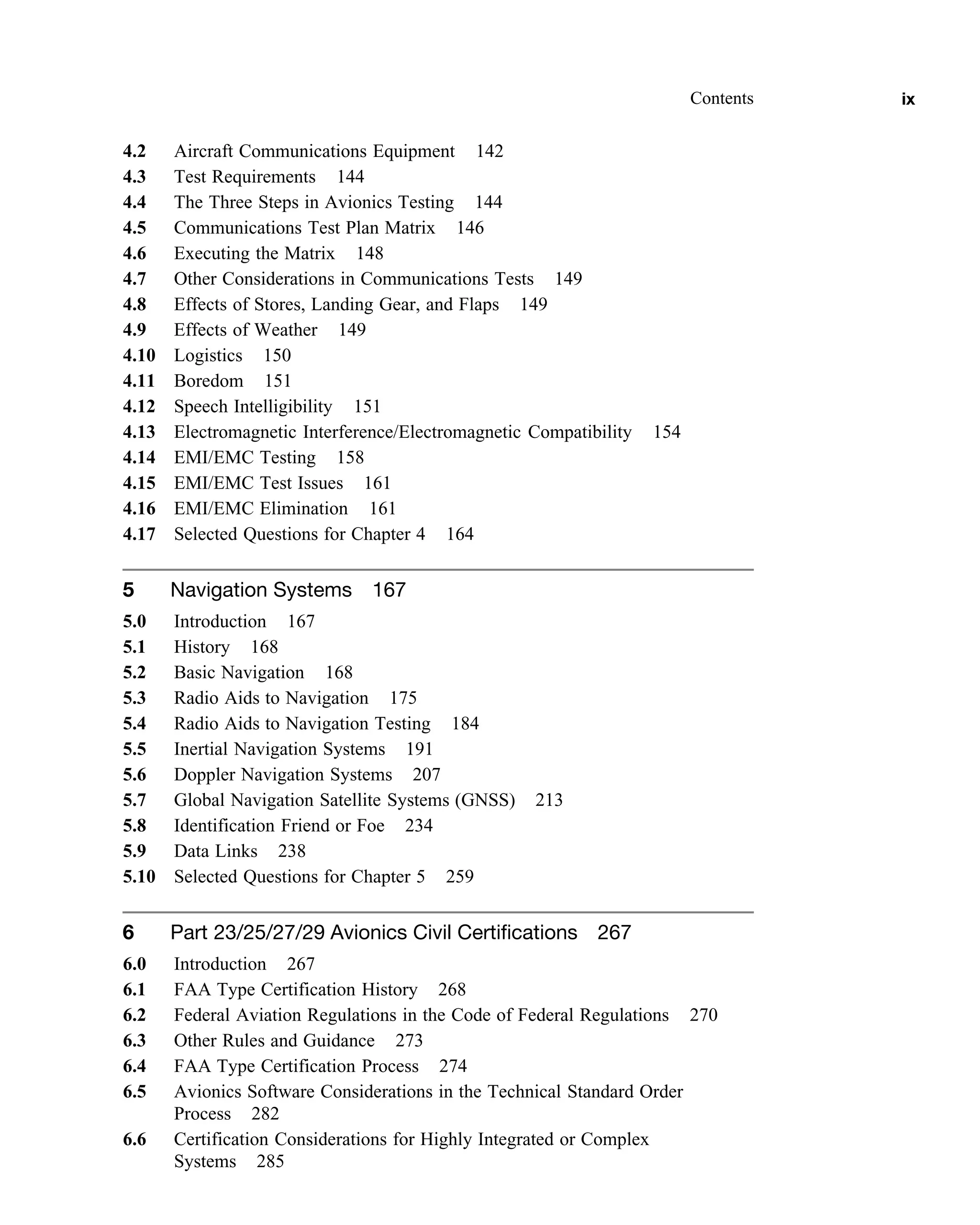
viii Contents
4.2 Aircraft Communications Equipment 142
4.3 Test Requirements 144
4.4 The Three Steps in Avionics Testing 144
4.5 Communications Test Plan Matrix 146
4.6 Executing the Matrix 148
4.7 Other Considerations in Communications Tests 149
4.8 Effects of Stores, Landing Gear, and Flaps 149
4.9 Effects of Weather 149
4.10 Logistics 150
4.11 Boredom 151
4.12 Speech Intelligibility 151
4.13 Electromagnetic Interference/Electromagnetic Compatibility 154
4.14 EMI/EMC Testing 158
4.15 EMI/EMC Test Issues 161
4.16 EMI/EMC Elimination 161
4.17 Selected Questions for Chapter 4 164
5 Navigation Systems 167
5.0 Introduction 167
5.1 History 168
5.2 Basic Navigation 168
5.3 Radio Aids to Navigation 175
5.4 Radio Aids to Navigation Testing 184
5.5 Inertial Navigation Systems 191
5.6 Doppler Navigation Systems 207
5.7 Global Navigation Satellite Systems (GNSS) 213
5.8 Identification Friend or Foe 234
5.9 Data Links 238
5.10 Selected Questions for Chapter 5 259
6 Part 23/25/27/29 Avionics Civil Certifications 267
6.0 Introduction 267
6.1 FAA Type Certification History 268
6.2 Federal Aviation Regulations in the Code of Federal Regulations 270
6.3 Other Rules and Guidance 273
6.4 FAA Type Certification Process 274
6.5 Avionics Software Considerations in the Technical Standard Order
Process 282
6.6 Certification Considerations for Highly Integrated or Complex
Systems 285
Contents ix
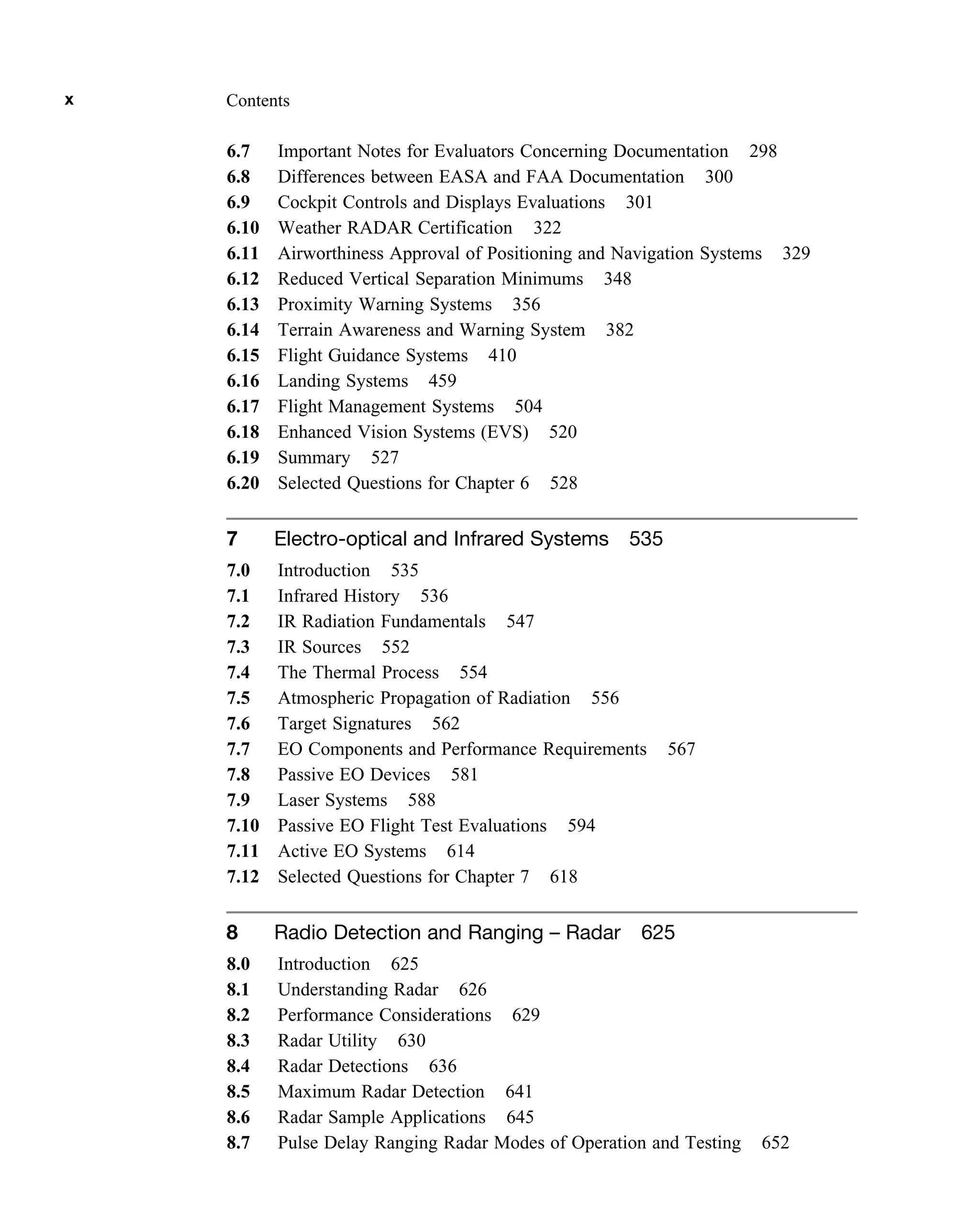
6.7 Important Notes for Evaluators Concerning Documentation 298
6.8 Differences between EASA and FAA Documentation 300
6.9 Cockpit Controls and Displays Evaluations 301
6.10 Weather RADAR Certification 322
6.11 Airworthiness Approval of Positioning and Navigation Systems 329
6.12 Reduced Vertical Separation Minimums 348
6.13 Proximity Warning Systems 356
6.14 Terrain Awareness and Warning System 382
6.15 Flight Guidance Systems 410
6.16 Landing Systems 459
6.17 Flight Management Systems 504
6.18 Enhanced Vision Systems (EVS) 520
6.19 Summary 527
6.20 Selected Questions for Chapter 6 528
7 Electro-optical and Infrared Systems 535
7.0 Introduction 535
7.1 Infrared History 536
7.2 IR Radiation Fundamentals 547
7.3 IR Sources 552
7.4 The Thermal Process 554
7.5 Atmospheric Propagation of Radiation 556
7.6 Target Signatures 562
7.7 EO Components and Performance Requirements 567
7.8 Passive EO Devices 581
7.9 Laser Systems 588
7.10 Passive EO Flight Test Evaluations 594
7.11 Active EO Systems 614
7.12 Selected Questions for Chapter 7 618
8 Radio Detection and Ranging – Radar 625
8.0 Introduction 625
8.1 Understanding Radar 626
8.2 Performance Considerations 629
8.3 Radar Utility 630
8.4 Radar Detections 636
8.5 Maximum Radar Detection 641
8.6 Radar Sample Applications 645
8.7 Pulse Delay Ranging Radar Modes of Operation and Testing 652
x Contents
8.8 Doppler and Pulse Doppler Modes of Operation and Testing 668
8.9 Air-to-Ground Radar 694
8.10 Millimetric Wave Radar 710
8.11 Miscellaneous Modes of Radar 712
8.12 Some Final Considerations in Radar Testing 712
8.13 Selected Questions for Chapter 8 714
9 Electronic Warfare 719
9.0 Introduction 719
9.1 Electronic Warfare Overview 720
9.2 The Threat 724
9.3 Air Defense Systems 728
9.4 Electronic Attack 729
9.5 Noise Jamming 734
9.6 Deception Jamming 738
9.7 Chaff Employment 742
9.8 Flare Employment 743
9.9 Electronic Protection Measures 745
9.10 Electronic Warfare Systems Test and Evaluation 748
9.11 Finally 760
9.12 Selected Questions for Chapter 9 760
10 Air-to-Air/Air-to-Ground Weapons Integration 763
10.0 Introduction 763
10.1 Weapons Overview 764
10.2 Stores Management System 767
10.3 Air-to-Air Missiles 785
10.4 Air-to-Ground Weapons 803
10.5 MIL-HDBK-1763 Test Requirements 812
10.6 AGARD Flight Test Techniques Series, Volume 10 Requirements 820
10.7 Weapons Delivery Considerations for Helicopters 824
10.8 Selected Questions for Chapter 10 828
11 A Typical Avionics Integration Flight Test Program 831
11.0 Introduction 831
11.1 Vehicle Test Requirements 831
11.2 Avionics Test Requirements 833
11.3 Test Planning 835
Contents xi
11.4 Responsibilities of the Test Team 843
11.5 Analysis and Reporting 848
11.6 Selected Questions for Chapter 11 849
12 Unmanned Aerial Vehicles (UAV) 851
12.0 Introduction 851
12.1 UAV Types 852
12.2 Interoperability 856
12.3 The Airworthiness Certificate 857
12.4 UAS Communications Architecture 860
12.5 Navigation 886
12.6 Autopilots 889
12.7 Sense and Avoid Systems 892
12.8 Payload 899
12.9 Optionally Piloted Aircraft (OPA) 901
12.10 Summary 902
12.11 Selected Questions for Chapter 12 902
13 Night Vision Imaging Systems (NVIS) and Helmet
Mounted Displays (HMD) 907
13.0 Introduction 907
13.1 Overview 908
13.2 Image Intensification (I2
) Technology 909
13.3 NVG Human Factors Issues 918
13.4 Lighting Specifications 920
13.5 Interior NVIS Lighting Methods 924
13.6 Exterior Lighting Methods 929
13.7 Test and Evaluation of NVIS Equipment 931
13.8 Some Final Considerations 938
13.9 Helmet Mounted Display Systems (HMD) 939
13.10 HMD Components 942
13.11 Test and Evaluation of HMD Equipment 949
13.12 Selected Questions for Chapter 13 954
14 Acquisition, Test Management, and Operational Test
and Evaluation 957
14.0 Overview 957
14.1 Applicable Documentation 958
xii Contents
14.2 The Acquisition Process 958
14.3 The Operational Requirements Document (ORD) 965
14.4 The Test and Evaluation Master Plan (TEMP) 966
14.5 Operational Test and Evaluation 967
14.6 OTE Test Plan Structure 970
14.7 Reliability, Maintainability, Logistics Supportability,
and Availability (RMLA) 978
14.8 Summary 981
14.9 Selected Questions for Chapter 14 981
Index 983
Contents xiii
Preface
Overview and Goals
The original purpose of this text was to offer the test community, especially the Avionics
and Weapons Systems Test Community, a primer on the basics of Test and Evaluation.
The text is a compilation and refinement of experiences and methods gleaned from a
multitude of programs and test engineers over the past 30 years, and is designed to help
students and readers avoid common mistakes. The text is an invaluable companion to
evaluators of fighter or heavy aircraft systems, military or civilian programs both
manned and unmanned.
A question which is commonly asked is ‘‘Where is the Flight Test Cookbook?’’
Unfortunately, there is no such book, and readers may be disappointed that this text is not
a cookbook either. Each task undertaken in the real world is unique and requires some
rework to the established rules. Avionics Flight Test is no different, and in fact is prob-
ably more dynamic than any other area of test. An engineer, in order to be successful,
must be schooled in the fundamentals of avionics test, understand the ground-rules and
possess a knowledge of similar systems which have been previously tested. This
knowledge, with a little bit of common sense, engineering judgment and luck makes an
Avionics Flight Test Engineer. This text will identify the ground rules and provide
information on systems which were previously tested. Lessons learned (good and bad)
are addressed in each chapter. Exercises to reinforce the instructional material are also
included. Engineering judgment was issued to you when you graduated college (whether
you know it or not) and you must supply the common sense. Luck normally comes to
those who know what they’re doing and is only viewed as luck by those who don’t know
what they’re doing.
The best features of the book are its readability and usability. The author has
received numerous comments and feedback that the text is being used on a daily basis
throughout the industry. The text has been remarkably successful and the author is
honored that it is currently being used as course reference in many short courses and
schools around the world. The revision will keep the format, style and form of the
original text. The intent of this revision is not to change the flavor of the original text,
but rather expand and improve upon it.
Significant Changes to the Original Text
Comments received from readers indicated a desire to include additional material cov-
ering a multitude of systems. The system which generated the most interest was the
unmanned aircraft program as it has gained much attention in the past five years. A new
chapter (Chapter 12) is now devoted to Unmanned Aerial Vehicles (UAV), con-
centrating on the systems aspects of these programs. The chapter builds on previous
sections of the text and then expounds on some of the difficulties encountered when
evaluating these systems. A second request was a natural extension of EO/IR
xv
evaluations: Night Vision Systems and Helmet Mounted Displays found in Chapter 13.
An Operational Test and Evaluation chapter was added to discuss the differences
between development and operational testing in finer detail than previously covered.
Due to significant changes in civilian regulatory and advisory material, Chapter 6,
Civil Certification, has been entirely re-written. Comments from rotary wing readers
requested that helicopter unique certification issues be addressed and they are now
included in the chapter. Other sections throughout the text have been edited and updated
based on the latest advances in technologies. An example is the enhancement of Global
Navigation Satellite Systems (GNSS) and Space Based Augmentation Systems (SBAS)
found in Chapter 5.
Rationale
The author has been working on this book for a number of years with the express
purpose of providing students a reference to fall back on when involved in a multitude of
programs. There are textbooks that describe Avionics Systems, but not how to evaluate
them for their usefulness. There are textbooks available that describe acceptable test
techniques for evaluating an aircraft’s handling and flying qualities but none devoted to
test techniques for evaluating avionics and weapons systems. Many of the modules, and
hence the Chapters, are unique, and to my knowledge, are not taught anywhere else but
at the National Test Pilot School. The text provides these modules to the Test and
Evaluation community in the hopes that it will make life a little simpler.
Audience
The audience for this book will encompass Flight Test Engineers, Program Managers,
military and civilian aerospace workers, Flight Test Range and Instrumentation support.
The book is appropriate for newly hired or assigned personnel at these locations as well
as seasoned veterans in the Test and Evaluation areas. The text is not limited to U.S.
locations as it will find practical applications in the international arena, particularly for
aerospace companies and flight test centers.
Organization of Content
This book is written to accompany a six month course of instruction in Avionics
and Weapons Systems Evaluation which was developed by the author and currently
presented at the National Test Pilot School in Mojave, CA. The book reflects the
culmination of the development of this course as accredited by ABET and approved by
the State of California as a requisite for a Master of Science Degree in Flight Test
Engineering. The chapters of the book are structured to each 40 hour course of curri-
culum taught during this six month period and are sequenced exactly as they are in the
syllabus. The preliminary chapters introduce the student to the fundamentals of Test and
Evaluation and their relationship to aircraft avionics and weapons systems, whereas
subsequent chapters discuss specific aircraft systems such as radar, IR Imaging devices,
navigation systems and weapons. Chapter 6 deals specifically with civil certification
procedures and airworthiness and will prove invaluable to those individuals seeking
to obtain airworthiness certification for avionic systems installed in civilian aircraft.
xvi Preface
Each chapter covers the basic theory of operation of the systems discussed but does not
attempt to re-write the many excellent textbooks available. References used in the
course are cited for the reader when additional information on theory or operation is
required. Formulas are not developed but are included when required to understand the
subject. Each chapter concludes with the methods to successfully evaluate a multitude of
aircraft avionics and weapons systems. Sample questions for each Chapter are used to
reinforce key ideas and concepts.
Acknowledgments
The author would like to first and foremost thank the hundreds of students who have
used draft copies of this text and provided comments, corrections and personal experi-
ences to make it a better reference. The author owes a special debt of gratitude to Chuck
Antonio, Aerospace Medicine/Night Vision Systems Pilot Instructor, National Test Pilot
School, Doctor of Medicine, Medical University of South Carolina, Charleston SC,
Graduate, US Navy Flight Training and Flight Surgeon School, NAS Pensacola FL, and
Edward ‘‘Dick’’ L. Downs, Night Vision Systems Pilot Instructor, National Test Pilot
School, BSc Aeronautical Engineering, Imperial College London, without whose help
the chapter on Night Vision Systems would not have been possible. Also, a sincere thank
you should be given to the numerous community reviewers who gave of their time to
improve the draft manuscript. Finally, thanks to SciTech- IET Editor Dudley Kay and
his colleagues for their work in bringing this title to fruition.
Despite all the reviewing and editing, any errors that remain are my own responsi-
bility. I would very much appreciate being informed of errors found or suggestions for
improvement to subsequent printings and editions.
Bob McShea
Deputy Director for Systems Flight Test Instruction,
Flight Test Engineer Instructor
National Test Pilot School
Mojave, CA
bmcshea@ntps.edu
February 2014
Preface xvii
Preface to First Edition
The purpose of this text is to offer the test community, especially the avionics and
weapons systems flight test community, insight into the differences in avionics testing
from our brethren in the vehicle test world. Whenever flight test is mentioned in
conversation, thoughts are immediately drawn to visions of those magnificent men
in their flying machines, breaking the sound barrier, performing max performance turns,
pressing the ‘‘q’’ limit, or some other glorious adventure. In reality, most of today’s
flight testing involves the upgrading of aircraft with state-of-the-art avionics equipment,
making bombs ‘‘smart,’’ and providing aircrew members with current, correct, and
understandable information. Strain gauges, pressure transducers, and temperature
probes that provide information in hundreds of samples per second have given way to
MIL-STD-1553, ARINC 429, and high-speed data busses that provide information in
megabits per second. Vehicle flight test has not been replaced with avionics flight test,
and the differences between the two are substantial. A newer type of flight test, with its
own set of rules, has evolved over the last 10 to 15 years; this text attempts to explain
those changes and identify what is expected of today’s avionics flight test engineer.
A question that is commonly asked is, ‘‘Where is the flight test cookbook?’’
Unfortunately, there is no such book, and readers may be disappointed that this text is
not a cookbook either. Each task undertaken in the real world is unique and requires
some rework to the established rules. Avionics flight test is no different and, in fact, is
probably more dynamic than any other area of testing. An engineer, in order to be
successful, must be schooled in the fundamentals of avionics testing, understand the
ground rules, and possess a knowledge of similar systems that have been previously
tested. This knowledge, with a little bit of common sense, engineering judgment, and
luck, makes an avionics flight test engineer. This text will identify the ground rules
and provide information on systems that have been tested previously. Lessons learned
(good and bad) are addressed in each chapter. Exercises to reinforce the instructional
material are also included. Engineering judgment was issued to you when you graduated
college (whether you know it or not) and you must supply the common sense. Luck
normally comes to those who know what they’re doing and is only viewed as luck by
those who don’t know what they’re doing.
This text is a compilation of experiences and methods gleaned from a multitude of
programs and test engineers solicited over the past 25 years, and hopefully will prevent
the reader from making some of the same mistakes that were made previously. Humor is
included in the discussions, and the ‘‘war stories’’ are true. The text will prove to be an
invaluable companion to fighter and heavy aircraft, U.S. and foreign national, and
military and contractor testers. Happy testing.
xix
Discovering Diverse Content Through
Random Scribd Documents
The Project Gutenberg eBook of The American
Journal of Dental Science, Vol. XIX. No. 6. Oct.
1885
This ebook is for the use of anyone anywhere in the United States
and most other parts of the world at no cost and with almost no
restrictions whatsoever. You may copy it, give it away or re-use it
under the terms of the Project Gutenberg License included with this
ebook or online at www.gutenberg.org. If you are not located in the
United States, you will have to check the laws of the country where
you are located before using this eBook.
Title: The American Journal of Dental Science, Vol. XIX. No. 6. Oct.
1885
Author: Various
Editor: Ferdinand J. S. Gorgas
Release date: August 26, 2019 [eBook #60187]
Most recently updated: October 17, 2024
Language: English
Credits: Produced by Jwala Kumar Sista and the Online Distributed
Proofreading Team at http://www.pgdp.net (This file was
produced from images generously made available by The
Internet Archive)
*** START OF THE PROJECT GUTENBERG EBOOK THE AMERICAN
JOURNAL OF DENTAL SCIENCE, VOL. XIX. NO. 6. OCT. 1885 ***
Transcriber's Notes
1.Typos were silently corrected.
2.The cover-page is developed and placed in public domain as well Table of
Contents added by the Transcriber.
Table of Contents
ARTICLE I.
ARTICLE II.
ARTICLE III.
ARTICLE IV.
ARTICLE V.
ARTICLE VI.
ARTICLE VII.
ARTICLE VIII.
Editorial, Etc.
Bibliographical.
Monthly Summary.
Footnotes
THE
AMERICAN JOURNAL
OF
DENTAL SCIENCE
Vol. xix. Third Series.—OCTOBER 1885. No. 6.
ARTICLE I.
NERVOUS ENERGY.
BY DR. E. PARSONS, SAVANNAH, GEORGIA.
[Read before the Georgia State Dental Society, May, 1885.]
Gentlemen—The subject I have chosen for your consideration at
this, our Annual Meeting, is Nervous Energy, how Actuated, and its
Varied Phenomena. No one can question the importance of knowing
all that can be known about it.
There is an invariable law by which means mind acts on matter,
and it is my purpose, in this paper, to briefly elucidate what I have
learned by reading, observation and experience on the subject. The
great advantage of meeting in council is an increase in knowledge
on all subjects in any way relating to our profession. We have many
things yet to learn that will be, when known, of great benefit to both
ourselves and the public.
Science demands a full and free investigation of all or any
causative principle by which life is manifested, or death produced.
So long as we draw our conclusions only from appearances, we shall
often be deceived in a correct diagnosis; consequently often fail to
cure diseases that come within the legitimate bounds of our
specialty.
Proper remuneration for our services are absolutely necessary
for the respectable maintainance of ourselves and those dependent
on us; but our best men are laboring unweariedly in their endeavor
to elevate our standard throughout the world, but particularly in our
own country, and this Society can do much to help them in their
onward march, developing all possible improvements in Scientific
Dentistry.
Again, we all have a full consciousness of three things—we love,
we think, we act. But few have a scientific knowledge of the means
employed by which mind acts on matter. There are such varied
forms and circumstances controlling its development, that we need
not marvel at anything that comes within the sphere of our
observation. As we are brought face to face with almost every
possible condition of the nervous system, our opportunities for
investigating the various manifestations of nervous energy, its source
and supply, may we not equal any other specialty in solving the
great problem of cause and effect manifesting nervous energy? As
the brain is the seat of all sensation, I briefly present some of the
best authenticated views of its organization. I think you all will agree
with me that it is wonderfully constructed by Infinite Wisdom for the
development of the finite mind. In the elucidation of my subject, let
us not forget the fact that the blood has much to do with the various
conditions of the nervous system. It holds, or should contain in
solution, all the elements necessary for the growth and sustenance
of every organ in the body; it is both a receiver and a giver; it is fed
from what we eat and drink, without which it cannot perform the
office intended.
THE BRAIN.
The brain is divided by the septum into two lobes, right and left
sides; also, into the cerebrum and the cerebellum, front and back
sides. Phrenologists divide the lobes into about forty convolutions,
assign to each a distinct office, and by careful observation of each as
to their development, profess to know individual character, and point
out what kind of occupation one, by nature, is best fitted for.
In 1840, Dr. Sherwood, of New York, by ingenious experiments,
demonstrated the fact that the brain has four large poles, two in the
cerebrum and two in the cerebellum, and from these proceed not
only the convolutions, but every nerve in the body. By these, and
experiments in animal magnetism, he maintained that animal
magnetism is the motive power of the human system, and without it
there can be no connection between mind and matter.
In the Fall of 1844, I invited several of our most eminent
physicians to meet me at my office to witness some experiments in
magnetism. My subject for demonstration was a young man of
unimpeachable character, twenty-three years of age. My visitors
were very skeptical on the subject of magnetism. There had been
some public exhibitions, but the result did not satisfy them.
I said, as the science of phrenology is ridiculed by some, I
wished first to exhibit each convolution of the brain, in a state of
exaltation, while he is as wide awake as we are. To prevent any
suspicion of collusion, I handed them a chart containing the names
of the different convolutions of the brain, and requested them to
write on paper any question or the name of the organ, for me to
excite.
The first paper had on it mirth. I placed the point of my finger
over the organ, and he immediately broke out into an uncontrollable
fit of laughter. I passed off the influence and he instantly became
calm. They asked him what he laughed at. He said he did not know;
he could not help it.
The second paper had on it veneration. I excited the organ, and
he immediately bowed his head and assumed the attitude of the
most zealous pietist, and appeared to be in earnest prayer.
The next paper had on it music. I excited the organ, and he
immediately commenced singing with as much earnestness as if his
life depended on it.
The next paper had on it combativeness. I excited the organ; he
immediately doubled his fist and pitched into an imaginary enemy in
the most vigorous manner possible.
Not to take up too much space in this paper, I will only add, we
went through with about twenty of the organs with equally marked
results, which both pleased and astonished my friends. They said
they now thought there was much more truth in the science of
phrenology than they had supposed possible. I then said you have
seen the effect of so-called animal magnetism; I will now exhibit a
different phase of it. I magnetized him in the usual way, and said he
is now as oblivious to all external impressions as if his five senses
had no existence. Examine him and satisfy yourselves.
After a thorough examination, Dr. Richardson said he believed
he could cut off his leg and he would not feel it. I demagnetized
him, which restored him to full consciousness. They questioned him
about it. He said he did not remember anything done in that state.
They then said if it was practicable it would be a good thing in
surgical operations. They thanked me for the pleasure of witnessing
the experiments, and retired.
To understand the different nervous conditions of patients is of
vast importance to both dentists and physicians. This cannot be
attained without close observation and experience. If the nervous
temperament of a patient is known, we shall have a key to guide us
in our treatment in every individual case. Temperament is usually
divided into six distinct classes:
1st. Nervous bilious; 2d. Nervous sanguine; 3d. Nervous
lymphatic; 4th. Bilious nervous; 5th. Sanguine nervous; 6th.
Lymphatic nervous.
You have doubtless observed a difference in the quality of
human teeth. We usually find the best in the nervous bilious
temperament, and the poorest in the lymphatic nervous. Viciated
tastes and habits do not change the shape of the teeth when once
formed, but their quality. Science demands discrimination under
varied circumstances; it is not possible to treat all alike, and be
equally successful. I shall refer to this again below.
I now present you with a few incidents in practice which may
serve as a basis for a better elucidation of my subject:
1st. In the Fall of 1835, I was called to see a gentleman at eight
P. M., represented to be suffering greatly, and unable to come to my
office. I was introduced to a large man walking the floor in great
agony. Seating him in a chair, I found the left side of the face
swollen; a purple colored spot over the antrum; the first molar on
the left upper jaw filled with gold; tooth firm, but evidently
devitalized. I diagnosed the trouble to be abscess in the antrum. I
extracted the tooth; he sprung out of the chair and dropped on the
floor, face downwards, and quivered like an ox struck on the head
with an ax. I used cold water freely to his head, and soon brought
him to; placed him back in the chair; made a free passage through
the front labial socket into the antrum, and the pus flowed freely. He
then laid down on the bed much relieved; gave him a half grain of
opium; waited about twenty minutes and injected the antrum with
warm green tea; directed his head to be kept cool with cloths wet
with cold water; left him with a promise to call again in a few hours;
called again about three P. M.; was told he had been sleeping
several hours; I injected the antrum with a weak solution of nitrate
of silver; saw him the next morning and again injected the antrum
with a much stronger solution of nitrate of silver; the swollen cheek
appeared almost natural; said if he needed my service any more to
come to my office. About a week later he called on me; brought me
a sack; said a few hours before that he blowed it out through the
left nostril; it was about one and a fourth-inch long, and about the
size of an ordinary goose-quill; it was soft with a leathery like
appearance; said he was all right; paid his bill; have not seen him
since.
2d. In September, 1836, I was called by a physician to see his
wife. He said she was suffering terribly from facial neuralgia, and
thought it was caused by a tooth. She was in her eighth month of
pregnancy. He had applied the usual remedies, which gave no relief.
I examined her teeth; found both the third-molars on upper jaw
decayed, and on slightly tapping them with the handle of an
instrument, the pain was greatly increased. He said he was afraid of
the consequences, in her state, of having the teeth extracted. I told
him nothing else would give relief. She said take them out, it cannot
be worse than I am now suffering. I parted the gums from the teeth
with a lance; I had barely completed this part of the operation when
she fainted; her mouth was open; I took my forceps and extracted
both teeth; brought her head forward to prevent the blood running
down her throat; we soon brought her back to consciousness, and
the first thing she said was: I cannot have them out. Her husband
said: Darling, they are both out. She said, Are they? I did not feel
it; I am so glad; the pain is all gone. The Doctor said to me—You
are a bold man: I would have stopped you if I could, but you was
too quick for me. I afterwards learned that no serious result
followed the operation.
3d. In August, 1856, a young lady, aged about twenty, came to
my office at eight o'clock A. M. Temperament nervous, lymphatic.
Said she had not slept a wink all night. Her face was pale, hands
cold, pulse feeble. Said she had a mortal dread of having a tooth
extracted. I put my mouth-mirror into her mouth for examination,
and saw the tooth caused the trouble. In an instant she fainted. I
took my forceps and extracted the tooth, used restoratives and soon
brought her to. The first thing she said was—I cannot have it out.
I showed her the tooth. She said: Oh! I am so glad I did not feel
it; and left the office laughing about it.
4th. In the Fall of 1858 a lady called to have the two upper front
incisors filled. She appeared to be middle-aged, and apparently in
good health. On examination, the teeth were very close together—
not badly decayed, but must be separated for sufficient room to
enable me to do the work properly. Our only means, then, was
either wedging or filing them. I filed about one quarter of what was
necessary, and she fainted. I then filed as rapidly as possible while
she was unconscious, and completed this part of the operation, and
used restoratives, and soon brought her to. I gave her a glass of
wine, and completed the operation without further trouble.
5th. In the Fall of 1874, a lady called to have a tooth extracted.
She appeared to be in good health; said she was almost distracted
with toothache; was afraid to take chloroform; was afraid as of
death without it. I said the pain would be only momentary, and
would not kill her. I extracted the tooth, and she fainted. My usual
remedy in such cases was hartshorn and cold water. Through
mistake, I took up a vial of the Essence of Gaultheria, poured a little
on a handkerchief, held it to her nose, and was surprised to see how
quickly she recovered consciousness. This prompted me to
experiment with it. I concluded that if it was a good restorative, it
might be a useful preventative.
I soon had a chance to test it. A lady called to have an ulcerated
tooth extracted. She was in delicate health: face swollen, hands
cold. She said she would like to take chloroform, but her physician
said she must not take it; she knew she would faint without it. I told
her I thought that could be prevented. I took a doily, folded it small,
and poured about a teaspoonful of the essence on it. I told her to
inhale through her nose, and exhale through her mouth. She
continued this until her brain was pretty well stimulated, and the
tooth extracted. She showed no signs of syncopy, and could hold a
glass of water as still as I could. I have not had any one to faint
away in my office since.
In the Spring of 1874, a lady, aged about sixty, came to consult
me. She said that her teeth were so bad she could not eat any
ordinary food; had disease of the lungs; was forbidden to take
chloroform. After an examination, I told her she had eight teeth in
the upper jaw that could not possibly be made useful, and she had
better have them extracted. She said she had never had one
extracted without fainting dead away. She could not think of having
more than one out at a time. Her temperament, nervous sanguine,
emaciated hands cold, pulse very feeble. I told her if she would
follow my directions I would take them all out and she would not
mind it more than one, and guaranteed she could not faint if she
tried. I explained the effect of the wintergreen, and said it would do
no more harm than a glass of good wine. I administered the article,
as before described, until her face flushed, tears ran down her
cheeks, then extracted the eighth teeth without her closing her
mouth. She asked if they were all out, and I said yes. She said, Is it
possible? I gave her a glass of water. It did not show the least
tremor of the nerves. She left, giving me many thanks, saying that
she felt much better than when she came into the office.
I could relate many more similar cases, but do not deem it
necessary. My object is to show what may sometimes be done to
advantage in cases of syncopy, and also the means of preventing it
while performing a painful operation.
As before said, the brain is the seat of all sensation; and our
patients, no matter how nervous they are, if the brain is properly
stimulated, cannot faint—caused by the extraction of teeth. When
my patients are known to be pregnant, I always use the stimulant
above described before performing any painful operation; it always
prevents any severe shock of the nervous system when in this
condition. If any one wishes to know how to prepare the Essence, it
is as follows: To one pint of alcohol add one ounce of the Oil of
Gaultheria, commonly called Wintergreen. Shake it well and it is fit
for use.
In passing from a conscious to an unconscious state, all the
Clairvoyants I have questioned on the subject say it is affected by a
change of polarity of the sensatory organs, and the principle is the
same whether caused by animal magnetism, syncopy or anæsthetic
agents, and if only the voluntary organs are affected thereby, there
is no danger to life, but if polarity in the involuntary is reversed, the
heart ceases to beat and death is instantly the result. I was the first
in this city to administer ether for the purpose of extracting teeth
without pain. In a few cases it developed paroxysms of hysteria;
otherwise no harm was done. I have administered ether, chloroform
and gas to over two thousand persons. With chloroform, I had three
cases that barely escaped death in my chair; with gas, some after
deleterious effects followed in two cases.
Admitting man's physical organization to be a magnetic
machine, the deaths that have occurred are easily explained, when
caused by these powerful drugs. The voluntary organs are under the
control of the will, and during our waking hours there is a constant
draft on our magnetic supply; it is best recuperated by sleep, when
the will is at rest.
The involuntary organs do not sleep until death ends our earth
life. We can readily understand that if by any cause polarity in the
two large poles in the cerebrum are reversed, the gateway by which
we gain a knowledge of things about us is closed so perfectly that
physical sensation is impossible. On the other hand, if the
equilibrium between the two large poles in the cerebellum are not
well balanced, just in this proportion some kind of ailment is the
result. Let us not forget that the will has no control over these poles,
and all medicine that does not beneficially act on them is non-
curative. Now, just in proportion as anæsthetic agents disturb their
equilibrium, they are dangerous, it makes no difference whether
polarity is reversed or destroyed; in either case the principle of life
can no longer act on the nerves by means of its intermediate; the
heart ceases to beat, and restoration is impossible. Chloroform is
more easily administered than ether or gas, and most convenient
when the patient cannot come to the office; but we should
remember that many deaths have occurred when given for the
purpose of extracting teeth, and that, too, when least expected. The
public mind is more horrified at one death in the dentist's office than
twenty caused by a railroad smash-up. We have now the means that
will stimulate the nerves, greatly mitigate the pain and not endanger
either life or health.
I have long desired a perfectly safe anæsthetic that can be
administered no matter what the condition of the patient. I am now
creditably informed that Dr. Mayo, of Boston, some eighteen months
ago, by various experiments, produced a compound article that
satisfied him was harmless. He would not put it on the market until
it had been thoroughly tested by both dentists and surgeons. All
who tested its effect and efficiency testified to its great superiority
over all other known anæsthetics for dental and minor surgical
operations. It is now only a few months since he made
arrangements for its manufacture and appliances, and put it on the
market. He has named it Mayo's Vegetable Vapor Anæsthetic. I have
been using it for extracting teeth very successfully. The nitrous oxide
causes the patient, when fully under its influence, to have very like
the appearance of a corpse. The action of this new anæsthetic does
not act on the vital organs, and the patient appears like one in a
natural sleep, and, in my opinion, is perfectly safe and without
danger to life or health.
Our patients come to us for either a preventative or curative
treatment. As before said, we are brought face to face with almost
every conceivable condition of the nervous system, and the more
true knowledge we have of it the better are we able to satisfactorily
manage them. Some come in a very excitable, and some in a very
depressed state. We need means to quiet the former and stimulate
the latter.
Again. To be fully entitled to the name of Scientific, we must
know something of the laws of life, in order that we may obey them
and fight life's battles manfully—doing justice to others and with
credit to ourselves. Life, in itself, is not creatable, but given to us
with power to properly use or abuse, the end being the creation of
the finite mind. I have explained above the means by which it acts
on matter, but as a further illustration, let me say, you drop an article
on the floor, gravitation holds it there; you desire to pick it up, how
can you do it; if you have sufficient will-power it will act on the
magnetic element, this on the nerves, these on the muscles. You
stoop down and pick it up, and probably not one in ten thousand
have a single thought about the necessary means by which you are
enabled to do so, so little do we reflect about causative principles
involved in what we do.
So far as our voluntary organs are concerned they may be
compared to a locomotive engine. They are both useless if the
motive power is wanting. To make the engine useful, steam must be
generated by means of fire and water; and to make our voluntary
organs useful, animal magnetism must be generated by means of
life and the atmospheres. The engineer controls the steam power,
and human will controls the magnetic power, and when properly
applied, if the machine is in good order, locomotion is the result in
both cases. I will only add, the steam acts on the piston heads and
causes the crank to move and the wheels to rotate. Magnetism acts
on the nerves, then on the muscles, and man moves in any direction
he chooses. A dentist with a strong will, if he uses the proper
means, can more easily and favorably impress his nervous patient
than one with a weak will, and the reason is, he imparts more of his
animal magnetism, which has a stimulating effect on the nerves of
his patient. There is a magnetic sphere emanating from both man
and beast, particularly when in motion. Were it not so, no dog could
follow their tracks successfully. All pain is the result of an obstruction
of a normal flow of the magnetic current, whether caused by disease
or otherwise.
Arsenic, applied to the nerve of a tooth, destroys its polarity,
and applied to any other nerve it is no longer capable of being
actuated by the magnetic current, without which there can be no
sensation, and death is the result. Physical endurance depends
largely on the mind and the state of the nervous system. The
difference in individuals to bear pain is marvelous; some one can
have a tooth extracted and seem to care but little about it, while
others, without the use of a preventative, appear to suffer intensely,
and in some cases the operation causes syncopy.
In conclusion allow me to say, a vast field lies before us, and if
cultivated properly this Society will in due time reap a rich harvest,
the benefits of which cannot now be estimated.
The grand distinction between mind and matter may be seen
thus: If we give any physical object to another, we part with it, but if
we give a new idea on any subject, we do not part with it, but in so
doing its boundaries are enlarged in our minds.
The space occupied in briefly presenting my views on the
subject I have chosen is greater than I at first intended, but the
fundamental principles which underlie everything with which we
have to do, and the importance of fully understanding them, is my
only apology for occupying so much of your time.—Dental Luminary.
ARTICLE II.
PULPLESS TEETH.
BY DR. WILSON, OF BURLINGTON, MEMBER OF THE
FACULTY OF THE DENTAL DEPARTMENT OF THE STATE
UNIVERSITY.
[Extracts of a paper read before the Iowa Dental Association at
its late annual meeting.]
A pulpless tooth is not necessarily a dead tooth, but a dead
tooth is, of course, a pulpless tooth. The adjectives pulpless and
dead are not, therefore, synonymous, although frequently so used,
especially by medical writers. Let us note the marked distinction
between the two. A pulpless tooth may be a part of the living
organism—a dead tooth has its nutritive supply entirely cut off, and
it is in every sense a foreign body—it is dead and inert. The former
may be restored to health and usefulness—the latter should always
be condemned as a nuisance that cannot be abated without the use
of the forceps. * * * *
Having thus briefly called attention to the fact that the dentine
and cementine derive their vitality from independent sources—that
the life of the one is not dependent upon the life of the other—that a
pulpless tooth is not necessarily a dead tooth—we are prepared to
consider, understandingly, the subject of this paper. It may, however,
seem like presumption on the part of the writer, in thus offering the
foregoing to an intelligent body of dentists, when every student of
dentistry at the close of his junior year should fully understand the
facts above stated. But I am led to a consideration of this subject
from articles entitled, Dead Teeth in the Jaws, that have appeared,
from time to time, during the last two years, in the New York
Medical Record, and as those articles come from high sources in the
medical profession, they deserve more than passing notice. The able
editor of that journal, and Dr. Samuel Sexton, a distinguished oculist
and aurist of New York City, being the principal writers referred to.
The Medical Record of October 4, 1884, contains a report from
the aural service of Dr. Sexton, entitled, Pain in the Ears due to
Irritation in the Jaws. He describes a number of cases of otalgia in
which he found the lesion to be in diseased teeth.
He goes on to say that since dentistry had become such a
popular business, and diseased teeth had been so carefully retained
in the jaws, nervous diseases about the head were becoming
alarmingly common.
The same number of the above journal contained an editorial on
Dead Teeth in the Jaws, which read as follows: Perhaps the time
is near at hand when medical men should be themselves better
informed concerning diseases of the jaws and mouth, rather than
refer the ailments of this region to individuals whose limited
knowledge of medicine does not prevent them from 'treating' dead
teeth long after their presence in the jaws has given rise to alveolar
abscesses and neuralgias more or less painful. It would not be
strange if in the course of events, the day would soon come when all
teeth without pulps, and hence in process of more or less rapid
decay, as well as those which the deposit of tartar, or other cause,
had become entirely divested of periosteal nourishment, would be
promptly condemned as unfit to remain in the jaws, regarded in fact
as foreign bodies liable to give rise, not only to cerebral irritation and
disease in the organs of special sense, through the propagation of
local disturbances in the mouth to the regions mentioned, but to
endanger likewise the general health through purulent matter
discharged into the mouth from alveolar abscesses, to be
continuously swallowed for a long time, or, indeed, in some
instances, to be absorbed and thus produce septicæmic poisoning. It
is certainly gratifying to note the establishment of instruction in oral
surgery in some of the medical schools, and it is to be hoped that
this subject will receive the attention its importance demands.
Dr. Sexton cites the readers of the Record to eight cases of
otalgia resulting from diseased teeth. I have no doubt but a majority
of the dentists before me to-day have met with almost that number
of cases in practice every week; nor do you find it a difficult thing to
render prompt relief, and that, too, in a large majority of cases,
without the use of the forceps. And I believe that I am warranted in
saying that in at least three-fourths of the cases met with in our
practice, we find the reflex pain in the ears due to exposed living
pulps, and not to dead teeth in the jaws.
That diseased teeth do cause reflex trouble, not only in the
head, but frequently in more remote parts of the body, is a fact well-
known to every competent dentist. I am glad that Dr. Sexton has at
last discovered the fact, that diseased teeth do frequently cause
reflex pain in the ears, and in other neighboring parts, and that
alveolar abscesses very often cause catarrhal affections of the
maxillary sinus and of the nasal passages, and that diseased teeth
will endanger the general health. It is to be regretted, however, that
the doctor has found it necessary to charge this unfortunate state of
affairs to the ignorance of dental practitioners, who are in no way
responsible for but few of the many cases met with in practice, for
there can be no doubt but a very large majority of the teeth causing
the troubles above referred to have never received any treatment
whatever at the hands of dentists, and because Dr. Sexton has
discovered that in certain cases pulpless teeth (or dead teeth as he
calls them), has caused the ailments above referred to by Dr.
Sexton, there can be no doubt. Every dentist of any considerable
experience can enumerate such experiences by the score, and the
medical profession has only been too slow to recognize the facts
discovered by Dr. Sexton.
The only difficulty with these medical gentlemen is, that they
have drawn very erroneous conclusions from the important
discoveries they have made. Their limited knowledge of the minute
structure of the dental tissue, and the source from which each
derives its life, is manifested by the erroneous statements upon
which they have based their arguments, and then after arguing from
false premises, Dr. Sexton says: In regard to the treatment of
pulpless teeth, the practice in vogue seems the reverse of
procedures founded on well-established surgical principles. And in
an editorial of the same issue we are informed that the treatment of
diseased teeth is carried, to what the medical minds regard as a
dangerous extreme.
That some members of our profession have been over zealous
in their efforts to save all diseased pulps alive, there can be no
doubt. We will occasionally meet with an enthusiast in our profession
who will say, I have no use for forceps, I never extract teeth. I
have heard that statement made on the floor of the Iowa State
Dental Association.
That incurable diseased teeth should not be tolerated in the
jaws does not admit of discussion. Good common sense ought to
settle that question. And again, there are extremists who never
devitalize diseased pulps, no matter how badly exposed, but doctor
them up, and stupify them, and then bury them in a living grave.
Much evil has grown out of this practice.
Some one has said that to cap a badly exposed pulp is to create
a slumbering volcano, and he might well have added that such
volcanoes have but a limited time to slumber. Gentlemen, there are
in our own country ten thousand volcanoes belching forth—not pure
molten lava—but impure gases and putrescent matter of the most
sickening character. The craters to these volcanoes are not found on
the mountain top, but they are found in human mouths—in the
antrum of Highmore, in the nasal passages, and externally on the
face, neck, or even on the chest.
When the pulp of a tooth is dead and confined within its bony
walls an outlet is sought, and must be affected for the escape of
impure gases arising from the decomposing pulp and for the
putrescent matter associated with it. When thus confined its only
way of escape is through the dental foramen, and into tissues
adjacent thereto. The pressure thus brought to bear upon the bony
walls surrounding the apex of the root will in time perforate it at its
weakest point, and the poisonous matter is forced through the
opening thus formed and into the soft tissues, which soon yield to
the pressure, and the imprisoned mass of corruption is liberated.
The pain and swelling now subsides, but a dangerous nuisance has
been created. The channel formed from the apex of the root to an
external opening will not close while it is used for the passage of foul
matter and gases that will flow unceasingly from the pulp canal.
The remedy of course is to remove the cause, and assist nature
in affecting a cure, and to do this the pulp chamber must be opened,
its contents removed, the canals cleansed and disinfected, the
abscess healed, and the roots filled to the exclusion of all fluids and
purulent matter. But how often this is not done. How many
thousands of suffering mortals are to-day dragging out miserable
lives because of these drainage tubes emptying themselves into the
oral cavity—into the maxillary sinus or into the meatus of the nose.
Such an abiding nuisance in the mouth cannot long exist without
ruining health. But how few of the unfortunate sufferers realize the
cause of their nervous irritability, their loss of appetite, their feeling
of lassitude, their lack of energy, and their general prostration. And
here let me say, that but few, in comparison to the number of these
unfortunate sufferers seek relief at the hands of the dental
practitioner. The patient is neither sick nor well, but debilitated and
good for nothing. The family physician is consulted, nervines and
tonics are administered, but to no avail. The septic matter is vitiating
the air that is breathed, and poisoning the food that is eaten. The
saliva that is poured into the mouth from the various glands must
mingle with this poisonous matter and carry it into the stomach.
Sanitary means are being employed in all our cities at the
present time, in view of the cholera scourge that it is feared will
sweep over our land the coming summer. Our physicians wisely talk
and write about the baneful influences of impure water, about
miasma arising from the decomposition of vegetable matter, and
about unwholesome food, and it would be well if the public would
heed their timely warnings. And as dental practitioners, I feel that
we, also have an important duty to perform, in enlightening our
patients, and the public so far as we are able to do so, in the
direction I have above indicated.
The subject is of paramount importance, and as the
opportunities come to us in every day practice, let us not fail to
impress upon the minds of our patient (when we find it necessary to
do so), the fact that a clean mouth is essential to health.
The agitation of this subject, by the medical profession, is a step
forward. Hitherto medical men have not given the matter the
attention its importance demanded.
And now that this new light has dawned upon Dr. Sexton, it is
not strange that, in hastily drawing his conclusions, he should have
mingled much of error with the truths he has discovered. Possibly
some of the cases that have come under his notice may have been
the result of bad practice on the part of incompetent dental
practitioners, but to charge the dental profession with their short-
comings would be a matter of great injustice. Dr. Sexton is too hasty
in his conclusions. First, he discovered that certain pulpless teeth
had caused certain ailments, hence he condemns all pulpless teeth.
He has discovered that certain dentists have failed to treat such
teeth successfully, hence he condemns the dental profession for
attempting to save teeth, it would be equally fair to condemn the
whole medical profession, because of the incompetency of some of
its members. But before dismissing the subject of pulpless teeth, it
may be well for us to examine the subject a little more carefully from
the standpoint of the medical writers above referred to. We cannot
afford to make a mistake with regard to so important a matter. The
higher a man stands in his profession, the more serious the mistakes
he makes, and the more important it is that his practice be sound.
An enthusiast or an extremist may injure a good cause. There are
such men in our ranks.
A few years ago a prominent dentist said, The tooth's pulp is
its soul, and it is criminal to destroy it.
I heard another prominent dentist say, If I find a part of the
pulp dead, I amputate the dead tissues, and save the balance of the
pulp alive.
A dentist has just moved away from Burlington, who has been
in practice there for fifteen years, and during that time he has been
using arsenic for obtunding sensitive dentine, and he has succeeded
in accomplishing his purpose admirably. I have found in one month
half a dozen filled teeth containing dead pulps, and, of course as
many alveolar abscesses in active operation. The evils arising from
such abominable methods of practice are simply appalling.
I have less frequently met with cases where those fistulous
openings were on the neck or chest. In those cases the roots of the
teeth are usually long, and when the abscess breaks through the
lower border of the jaw, and the pus comes in contact with the soft
tissues, it follows the course of the muscles and forms a sinous as it
gravitates to some point on the neck or chest. I have known of a
number of such cases being under medical treatment for years,
where the affection was supposed to be of a strumpous nature, and
the real cause was not suspected, and in every case a rapid recovery
has followed the extraction of the offending tooth.
Gentlemen, I have no doubt but the most of you are
disappointed in the nature of this paper. I have scarcely alluded to
the treatment and filling of pulpless teeth. That had not been my
purpose. But I have wished to call attention to the fact that a large
majority of the ailments above referred to have been due to
diseased teeth that have never received any attention whatever at
the hands of competent dentists.
That pulpless teeth and roots may be treated, filled, and
preserved in health in a majority of cases, is a settled question.
Every well-informed dentist knows that to be a fact, the
distinguished Dr. Sexton and the able editor of the Medical Record to
the contrary notwithstanding.—Iowa State Med. Reporter.
ARTICLE III.
DEAD TEETH IN THE JAWS.
TRUMAN W. BROPHY, M. D., D. D. S.
In reply to Dr. Sexton on this subject, Dr. Brophy makes these
pertinent remarks in the journal of the American Medical
Association:
Dr. Sexton says: The retention in the jaws of teeth which
are diseased, have become irredeemably sensitive to thermal
influences, or deprived of adequate periosteal nourishment
through calcareous formations about the roots, very frequently
gives rise to nervous diseases about the head. I am convinced
that these reflected nerve influences manifest themselves much
oftener since dentistry has come more extensively into practice
during the present generation, and greater efforts are made to
retain defective teeth in the jaw.
That diseases of the teeth are often the center from which pain
is reflected to the eyes, ears and other parts, all experienced clinical
observers must admit. But that these pathological conditions of the
teeth, from which reflected pain has its origin, can be and are
successfully treated and cured with rare exceptions, as effectually as
any other diseases, is a fact too well established to be set aside.
It is not possible to describe in this letter the method by which
the various diseases of the teeth are treated, but suffice it to say
that teeth which are diseased from death of the pulp or from
caries do not become irredeemably sensitive to thermal
Welcome to our website – the ideal destination for book lovers and
knowledge seekers. With a mission to inspire endlessly, we offer a
vast collection of books, ranging from classic literary works to
specialized publications, self-development books, and children's
literature. Each book is a new journey of discovery, expanding
knowledge and enriching the soul of the reade
Our website is not just a platform for buying books, but a bridge
connecting readers to the timeless values of culture and wisdom. With
an elegant, user-friendly interface and an intelligent search system,
we are committed to providing a quick and convenient shopping
experience. Additionally, our special promotions and home delivery
services ensure that you save time and fully enjoy the joy of reading.
Let us accompany you on the journey of exploring knowledge and
personal growth!
ebookfinal.com

Test and evaluation of aircraft avionics and weapon systems 2nd Edition Robert B. Mcshea

  • 1.
    Test and evaluationof aircraft avionics and weapon systems 2nd Edition Robert B. Mcshea pdf download https://ebookfinal.com/download/test-and-evaluation-of-aircraft- avionics-and-weapon-systems-2nd-edition-robert-b-mcshea/ Explore and download more ebooks or textbooks at ebookfinal.com

  • 2.
    We have selectedsome products that you may be interested in Click the link to download now or visit ebookfinal.com for more options!. Reaction Mechanisms of Inorganic and Organometallic Systems 3rd Edition Robert B. Jordan https://ebookfinal.com/download/reaction-mechanisms-of-inorganic-and- organometallic-systems-3rd-edition-robert-b-jordan/ Comparative Analysis of Evaluation Methodologies in Weapon Collection Programmes 1st Edition United Nations https://ebookfinal.com/download/comparative-analysis-of-evaluation- methodologies-in-weapon-collection-programmes-1st-edition-united- nations/ Aircraft electrical and electronic systems principles operation and maintenance 1st ed Edition Wyatt https://ebookfinal.com/download/aircraft-electrical-and-electronic- systems-principles-operation-and-maintenance-1st-ed-edition-wyatt/ Stability and Control of Aircraft Systems Introduction to Classical Feedback Control 1st Edition Roy Langton https://ebookfinal.com/download/stability-and-control-of-aircraft- systems-introduction-to-classical-feedback-control-1st-edition-roy- langton/
  • 3.
    Practical Program EvaluationTheory Driven Evaluation and the Integrated Evaluation Perspective 2nd Edition Huey T. Chen https://ebookfinal.com/download/practical-program-evaluation-theory- driven-evaluation-and-the-integrated-evaluation-perspective-2nd- edition-huey-t-chen/ Cost Benefit Analysis of the 2006 Air Force Materiel Command Test and Evaluation Proposal 1st Edition Michael R. Thirtle https://ebookfinal.com/download/cost-benefit-analysis-of-the-2006-air- force-materiel-command-test-and-evaluation-proposal-1st-edition- michael-r-thirtle/ Strapdown Inertial Navigation Technology IEE Radar Sonar Navigation and Avionics Series 2nd Edition David Titterton https://ebookfinal.com/download/strapdown-inertial-navigation- technology-iee-radar-sonar-navigation-and-avionics-series-2nd-edition- david-titterton/ Evaluation of Enzyme Inhibitors in Drug Discovery Robert A. Copeland https://ebookfinal.com/download/evaluation-of-enzyme-inhibitors-in- drug-discovery-robert-a-copeland/ Information Processing and Living Systems Vladimir B. Bajic https://ebookfinal.com/download/information-processing-and-living- systems-vladimir-b-bajic/
  • 5.
    Test and evaluationof aircraft avionics and weapon systems 2nd Edition Robert B. Mcshea Digital Instant Download Author(s): Robert B. McShea ISBN(s): 9781680158342, 1613531761 Edition: 2 File Details: PDF, 50.20 MB Year: 2014 Language: english

  • 7.
    Test and Evaluationof Aircraft Avionics and Weapon Systems
  • 9.
    Test and Evaluationof Aircraft Avionics and Weapon Systems 2nd Edition Robert E. McShea Edison, NJ theiet.org
  • 10.
    Published by SciTechPublishing, an imprint of the IET. www.scitechpub.com www.theiet.org 2010, 2014 by SciTech Publishing, Edison, NJ. All rights reserved. First edition 2010 Second edition 2014 No part of this publication may be reproduced, stored in a retrieval system or transmitted in any form or by any means, electronic, mechanical, photocopying, recording, scanning or otherwise, except as permitted under Sections 107 or 108 of the 1976 United States Copyright Act, without either the prior written permission of the Publisher, or authorization through payment of the appropriate per-copy fee to the Copyright Clearance Center, 222 Rosewood Drive, Danvers, MA 01923, (978) 750-8400, fax (978) 646-8600, or on the web at copyright.com. Requests to the Publisher for permission should be addressed to The Institution of Engineering and Technology, Michael Faraday House, Six Hills Way, Stevenage, Herts, SG1 2AY, United Kingdom. While the author and publisher believe that the information and guidance given in this work are correct, all parties must rely upon their own skill and judgement when making use of them. Neither the author nor publisher assumes any liability to anyone for any loss or damage caused by any error or omission in the work, whether such an error or omission is the result of negligence or any other cause. Any and all such liability is disclaimed. Editor: Dudley R. Kay 10 9 8 7 6 5 4 3 2 1 ISBN 978-1-61353-176-1 (hardback) ISBN 978-1-61353-180-8 (PDF) Typeset in India by MPS Limited Printed in the USA by Sheridan Books Inc. Printed in the UK by CPI Group (UK) Ltd, Croydon
  • 11.
    This Book isDedicated to Marlenni Belinni Friends till the end
  • 13.
    Contents Preface xv Preface toFirst Edition xix List of Acronyms xxi 1 What is Avionics Flight Test and Why Do We Need It 1 1.0 Avionics Flight Test 1 1.1 Historical Background 2 1.2 Flight Test Organization 4 1.3 Flight Test Objectives 5 1.4 The Need for Flight Test 6 1.5 Classifying the Program 8 1.6 Contractual Requirements 9 1.7 Test Team Composition 11 1.8 Team Member Responsibilities 13 1.9 Understanding Terms 15 1.10 Contractor and Subtier Specifications 20 1.11 Customer Expectations 21 1.12 Formulating the Program 22 1.13 Summary 25 1.14 Selected Questions for Chapter 1 26 2 Time, Space, Position Information 29 2.0 An Overview of Time, Space, Position Information 29 2.1 Sources of TSPI 30 2.2 Ground-Based Tracking Radar 30 2.3 Radar Characteristics 32 2.4 Radar Accuracies 35 2.5 Geometric Dilution of Precision 38 2.6 Earth Models 39 2.7 Theodolites 41 2.8 Theodolite Limitations 44 2.9 Global Positioning System 44 2.10 Stand-Alone GPS Receivers 44 vii
  • 14.
    2.11 Inertial-Aided GPSReceivers 46 2.12 Differentially Corrected GPS 48 2.13 Sensor Fusion 48 2.14 Ranges 49 2.15 Range Assets 49 2.16 Unique Services 50 2.17 Interfacing with the Range 51 2.18 Time Alignment 53 2.19 Summary 55 2.20 Exercises 55 2.21 Answers to Exercises 55 2.22 Selected Questions for Chapter 2 58 3 MIL-STD-1553 and Digital Data Busses: Data Reduction and Analysis 61 3.0 Overview 61 3.1 Historical Background 62 3.2 1553 System Architecture 62 3.3 A Bit About Bits 65 3.4 1553 Word Types 67 3.5 Data Encoding 67 3.6 Word Formats 68 3.7 Command Words 68 3.8 Anomalous Command Word Conditions 70 3.9 Command Word Summary 71 3.10 Status Words 71 3.11 Data Words 73 3.12 Message Contents 74 3.13 Bus Controller Design 75 3.14 Sample Bus Configurations 76 3.15 The Flight Tester’s Task 79 3.16 MIL-STD-1553 Summary 80 3.17 Other Data Busses 81 3.18 Potential Problems for the Analyst 122 3.19 Data Acquisition, Reduction, and Analysis 124 3.20 Selected Questions for Chapter 3 136 4 Communications Flight Test 139 4.0 Overview 139 4.1 Communications Basics 140 viii Contents
  • 15.
    4.2 Aircraft CommunicationsEquipment 142 4.3 Test Requirements 144 4.4 The Three Steps in Avionics Testing 144 4.5 Communications Test Plan Matrix 146 4.6 Executing the Matrix 148 4.7 Other Considerations in Communications Tests 149 4.8 Effects of Stores, Landing Gear, and Flaps 149 4.9 Effects of Weather 149 4.10 Logistics 150 4.11 Boredom 151 4.12 Speech Intelligibility 151 4.13 Electromagnetic Interference/Electromagnetic Compatibility 154 4.14 EMI/EMC Testing 158 4.15 EMI/EMC Test Issues 161 4.16 EMI/EMC Elimination 161 4.17 Selected Questions for Chapter 4 164 5 Navigation Systems 167 5.0 Introduction 167 5.1 History 168 5.2 Basic Navigation 168 5.3 Radio Aids to Navigation 175 5.4 Radio Aids to Navigation Testing 184 5.5 Inertial Navigation Systems 191 5.6 Doppler Navigation Systems 207 5.7 Global Navigation Satellite Systems (GNSS) 213 5.8 Identification Friend or Foe 234 5.9 Data Links 238 5.10 Selected Questions for Chapter 5 259 6 Part 23/25/27/29 Avionics Civil Certifications 267 6.0 Introduction 267 6.1 FAA Type Certification History 268 6.2 Federal Aviation Regulations in the Code of Federal Regulations 270 6.3 Other Rules and Guidance 273 6.4 FAA Type Certification Process 274 6.5 Avionics Software Considerations in the Technical Standard Order Process 282 6.6 Certification Considerations for Highly Integrated or Complex Systems 285 Contents ix
  • 16.
    6.7 Important Notesfor Evaluators Concerning Documentation 298 6.8 Differences between EASA and FAA Documentation 300 6.9 Cockpit Controls and Displays Evaluations 301 6.10 Weather RADAR Certification 322 6.11 Airworthiness Approval of Positioning and Navigation Systems 329 6.12 Reduced Vertical Separation Minimums 348 6.13 Proximity Warning Systems 356 6.14 Terrain Awareness and Warning System 382 6.15 Flight Guidance Systems 410 6.16 Landing Systems 459 6.17 Flight Management Systems 504 6.18 Enhanced Vision Systems (EVS) 520 6.19 Summary 527 6.20 Selected Questions for Chapter 6 528 7 Electro-optical and Infrared Systems 535 7.0 Introduction 535 7.1 Infrared History 536 7.2 IR Radiation Fundamentals 547 7.3 IR Sources 552 7.4 The Thermal Process 554 7.5 Atmospheric Propagation of Radiation 556 7.6 Target Signatures 562 7.7 EO Components and Performance Requirements 567 7.8 Passive EO Devices 581 7.9 Laser Systems 588 7.10 Passive EO Flight Test Evaluations 594 7.11 Active EO Systems 614 7.12 Selected Questions for Chapter 7 618 8 Radio Detection and Ranging – Radar 625 8.0 Introduction 625 8.1 Understanding Radar 626 8.2 Performance Considerations 629 8.3 Radar Utility 630 8.4 Radar Detections 636 8.5 Maximum Radar Detection 641 8.6 Radar Sample Applications 645 8.7 Pulse Delay Ranging Radar Modes of Operation and Testing 652 x Contents
  • 17.
    8.8 Doppler andPulse Doppler Modes of Operation and Testing 668 8.9 Air-to-Ground Radar 694 8.10 Millimetric Wave Radar 710 8.11 Miscellaneous Modes of Radar 712 8.12 Some Final Considerations in Radar Testing 712 8.13 Selected Questions for Chapter 8 714 9 Electronic Warfare 719 9.0 Introduction 719 9.1 Electronic Warfare Overview 720 9.2 The Threat 724 9.3 Air Defense Systems 728 9.4 Electronic Attack 729 9.5 Noise Jamming 734 9.6 Deception Jamming 738 9.7 Chaff Employment 742 9.8 Flare Employment 743 9.9 Electronic Protection Measures 745 9.10 Electronic Warfare Systems Test and Evaluation 748 9.11 Finally 760 9.12 Selected Questions for Chapter 9 760 10 Air-to-Air/Air-to-Ground Weapons Integration 763 10.0 Introduction 763 10.1 Weapons Overview 764 10.2 Stores Management System 767 10.3 Air-to-Air Missiles 785 10.4 Air-to-Ground Weapons 803 10.5 MIL-HDBK-1763 Test Requirements 812 10.6 AGARD Flight Test Techniques Series, Volume 10 Requirements 820 10.7 Weapons Delivery Considerations for Helicopters 824 10.8 Selected Questions for Chapter 10 828 11 A Typical Avionics Integration Flight Test Program 831 11.0 Introduction 831 11.1 Vehicle Test Requirements 831 11.2 Avionics Test Requirements 833 11.3 Test Planning 835 Contents xi
  • 18.
    11.4 Responsibilities ofthe Test Team 843 11.5 Analysis and Reporting 848 11.6 Selected Questions for Chapter 11 849 12 Unmanned Aerial Vehicles (UAV) 851 12.0 Introduction 851 12.1 UAV Types 852 12.2 Interoperability 856 12.3 The Airworthiness Certificate 857 12.4 UAS Communications Architecture 860 12.5 Navigation 886 12.6 Autopilots 889 12.7 Sense and Avoid Systems 892 12.8 Payload 899 12.9 Optionally Piloted Aircraft (OPA) 901 12.10 Summary 902 12.11 Selected Questions for Chapter 12 902 13 Night Vision Imaging Systems (NVIS) and Helmet Mounted Displays (HMD) 907 13.0 Introduction 907 13.1 Overview 908 13.2 Image Intensification (I2 ) Technology 909 13.3 NVG Human Factors Issues 918 13.4 Lighting Specifications 920 13.5 Interior NVIS Lighting Methods 924 13.6 Exterior Lighting Methods 929 13.7 Test and Evaluation of NVIS Equipment 931 13.8 Some Final Considerations 938 13.9 Helmet Mounted Display Systems (HMD) 939 13.10 HMD Components 942 13.11 Test and Evaluation of HMD Equipment 949 13.12 Selected Questions for Chapter 13 954 14 Acquisition, Test Management, and Operational Test and Evaluation 957 14.0 Overview 957 14.1 Applicable Documentation 958 xii Contents
  • 19.
    14.2 The AcquisitionProcess 958 14.3 The Operational Requirements Document (ORD) 965 14.4 The Test and Evaluation Master Plan (TEMP) 966 14.5 Operational Test and Evaluation 967 14.6 OTE Test Plan Structure 970 14.7 Reliability, Maintainability, Logistics Supportability, and Availability (RMLA) 978 14.8 Summary 981 14.9 Selected Questions for Chapter 14 981 Index 983 Contents xiii
  • 21.
    Preface Overview and Goals Theoriginal purpose of this text was to offer the test community, especially the Avionics and Weapons Systems Test Community, a primer on the basics of Test and Evaluation. The text is a compilation and refinement of experiences and methods gleaned from a multitude of programs and test engineers over the past 30 years, and is designed to help students and readers avoid common mistakes. The text is an invaluable companion to evaluators of fighter or heavy aircraft systems, military or civilian programs both manned and unmanned. A question which is commonly asked is ‘‘Where is the Flight Test Cookbook?’’ Unfortunately, there is no such book, and readers may be disappointed that this text is not a cookbook either. Each task undertaken in the real world is unique and requires some rework to the established rules. Avionics Flight Test is no different, and in fact is prob- ably more dynamic than any other area of test. An engineer, in order to be successful, must be schooled in the fundamentals of avionics test, understand the ground-rules and possess a knowledge of similar systems which have been previously tested. This knowledge, with a little bit of common sense, engineering judgment and luck makes an Avionics Flight Test Engineer. This text will identify the ground rules and provide information on systems which were previously tested. Lessons learned (good and bad) are addressed in each chapter. Exercises to reinforce the instructional material are also included. Engineering judgment was issued to you when you graduated college (whether you know it or not) and you must supply the common sense. Luck normally comes to those who know what they’re doing and is only viewed as luck by those who don’t know what they’re doing. The best features of the book are its readability and usability. The author has received numerous comments and feedback that the text is being used on a daily basis throughout the industry. The text has been remarkably successful and the author is honored that it is currently being used as course reference in many short courses and schools around the world. The revision will keep the format, style and form of the original text. The intent of this revision is not to change the flavor of the original text, but rather expand and improve upon it. Significant Changes to the Original Text Comments received from readers indicated a desire to include additional material cov- ering a multitude of systems. The system which generated the most interest was the unmanned aircraft program as it has gained much attention in the past five years. A new chapter (Chapter 12) is now devoted to Unmanned Aerial Vehicles (UAV), con- centrating on the systems aspects of these programs. The chapter builds on previous sections of the text and then expounds on some of the difficulties encountered when evaluating these systems. A second request was a natural extension of EO/IR xv
  • 22.
    evaluations: Night VisionSystems and Helmet Mounted Displays found in Chapter 13. An Operational Test and Evaluation chapter was added to discuss the differences between development and operational testing in finer detail than previously covered. Due to significant changes in civilian regulatory and advisory material, Chapter 6, Civil Certification, has been entirely re-written. Comments from rotary wing readers requested that helicopter unique certification issues be addressed and they are now included in the chapter. Other sections throughout the text have been edited and updated based on the latest advances in technologies. An example is the enhancement of Global Navigation Satellite Systems (GNSS) and Space Based Augmentation Systems (SBAS) found in Chapter 5. Rationale The author has been working on this book for a number of years with the express purpose of providing students a reference to fall back on when involved in a multitude of programs. There are textbooks that describe Avionics Systems, but not how to evaluate them for their usefulness. There are textbooks available that describe acceptable test techniques for evaluating an aircraft’s handling and flying qualities but none devoted to test techniques for evaluating avionics and weapons systems. Many of the modules, and hence the Chapters, are unique, and to my knowledge, are not taught anywhere else but at the National Test Pilot School. The text provides these modules to the Test and Evaluation community in the hopes that it will make life a little simpler. Audience The audience for this book will encompass Flight Test Engineers, Program Managers, military and civilian aerospace workers, Flight Test Range and Instrumentation support. The book is appropriate for newly hired or assigned personnel at these locations as well as seasoned veterans in the Test and Evaluation areas. The text is not limited to U.S. locations as it will find practical applications in the international arena, particularly for aerospace companies and flight test centers. Organization of Content This book is written to accompany a six month course of instruction in Avionics and Weapons Systems Evaluation which was developed by the author and currently presented at the National Test Pilot School in Mojave, CA. The book reflects the culmination of the development of this course as accredited by ABET and approved by the State of California as a requisite for a Master of Science Degree in Flight Test Engineering. The chapters of the book are structured to each 40 hour course of curri- culum taught during this six month period and are sequenced exactly as they are in the syllabus. The preliminary chapters introduce the student to the fundamentals of Test and Evaluation and their relationship to aircraft avionics and weapons systems, whereas subsequent chapters discuss specific aircraft systems such as radar, IR Imaging devices, navigation systems and weapons. Chapter 6 deals specifically with civil certification procedures and airworthiness and will prove invaluable to those individuals seeking to obtain airworthiness certification for avionic systems installed in civilian aircraft. xvi Preface
  • 23.
    Each chapter coversthe basic theory of operation of the systems discussed but does not attempt to re-write the many excellent textbooks available. References used in the course are cited for the reader when additional information on theory or operation is required. Formulas are not developed but are included when required to understand the subject. Each chapter concludes with the methods to successfully evaluate a multitude of aircraft avionics and weapons systems. Sample questions for each Chapter are used to reinforce key ideas and concepts. Acknowledgments The author would like to first and foremost thank the hundreds of students who have used draft copies of this text and provided comments, corrections and personal experi- ences to make it a better reference. The author owes a special debt of gratitude to Chuck Antonio, Aerospace Medicine/Night Vision Systems Pilot Instructor, National Test Pilot School, Doctor of Medicine, Medical University of South Carolina, Charleston SC, Graduate, US Navy Flight Training and Flight Surgeon School, NAS Pensacola FL, and Edward ‘‘Dick’’ L. Downs, Night Vision Systems Pilot Instructor, National Test Pilot School, BSc Aeronautical Engineering, Imperial College London, without whose help the chapter on Night Vision Systems would not have been possible. Also, a sincere thank you should be given to the numerous community reviewers who gave of their time to improve the draft manuscript. Finally, thanks to SciTech- IET Editor Dudley Kay and his colleagues for their work in bringing this title to fruition. Despite all the reviewing and editing, any errors that remain are my own responsi- bility. I would very much appreciate being informed of errors found or suggestions for improvement to subsequent printings and editions. Bob McShea Deputy Director for Systems Flight Test Instruction, Flight Test Engineer Instructor National Test Pilot School Mojave, CA bmcshea@ntps.edu February 2014 Preface xvii
  • 25.
    Preface to FirstEdition The purpose of this text is to offer the test community, especially the avionics and weapons systems flight test community, insight into the differences in avionics testing from our brethren in the vehicle test world. Whenever flight test is mentioned in conversation, thoughts are immediately drawn to visions of those magnificent men in their flying machines, breaking the sound barrier, performing max performance turns, pressing the ‘‘q’’ limit, or some other glorious adventure. In reality, most of today’s flight testing involves the upgrading of aircraft with state-of-the-art avionics equipment, making bombs ‘‘smart,’’ and providing aircrew members with current, correct, and understandable information. Strain gauges, pressure transducers, and temperature probes that provide information in hundreds of samples per second have given way to MIL-STD-1553, ARINC 429, and high-speed data busses that provide information in megabits per second. Vehicle flight test has not been replaced with avionics flight test, and the differences between the two are substantial. A newer type of flight test, with its own set of rules, has evolved over the last 10 to 15 years; this text attempts to explain those changes and identify what is expected of today’s avionics flight test engineer. A question that is commonly asked is, ‘‘Where is the flight test cookbook?’’ Unfortunately, there is no such book, and readers may be disappointed that this text is not a cookbook either. Each task undertaken in the real world is unique and requires some rework to the established rules. Avionics flight test is no different and, in fact, is probably more dynamic than any other area of testing. An engineer, in order to be successful, must be schooled in the fundamentals of avionics testing, understand the ground rules, and possess a knowledge of similar systems that have been previously tested. This knowledge, with a little bit of common sense, engineering judgment, and luck, makes an avionics flight test engineer. This text will identify the ground rules and provide information on systems that have been tested previously. Lessons learned (good and bad) are addressed in each chapter. Exercises to reinforce the instructional material are also included. Engineering judgment was issued to you when you graduated college (whether you know it or not) and you must supply the common sense. Luck normally comes to those who know what they’re doing and is only viewed as luck by those who don’t know what they’re doing. This text is a compilation of experiences and methods gleaned from a multitude of programs and test engineers solicited over the past 25 years, and hopefully will prevent the reader from making some of the same mistakes that were made previously. Humor is included in the discussions, and the ‘‘war stories’’ are true. The text will prove to be an invaluable companion to fighter and heavy aircraft, U.S. and foreign national, and military and contractor testers. Happy testing. xix
  • 26.
    Discovering Diverse ContentThrough Random Scribd Documents
  • 30.
    The Project GutenbergeBook of The American Journal of Dental Science, Vol. XIX. No. 6. Oct. 1885
  • 31.
    This ebook isfor the use of anyone anywhere in the United States and most other parts of the world at no cost and with almost no restrictions whatsoever. You may copy it, give it away or re-use it under the terms of the Project Gutenberg License included with this ebook or online at www.gutenberg.org. If you are not located in the United States, you will have to check the laws of the country where you are located before using this eBook. Title: The American Journal of Dental Science, Vol. XIX. No. 6. Oct. 1885 Author: Various Editor: Ferdinand J. S. Gorgas Release date: August 26, 2019 [eBook #60187] Most recently updated: October 17, 2024 Language: English Credits: Produced by Jwala Kumar Sista and the Online Distributed Proofreading Team at http://www.pgdp.net (This file was produced from images generously made available by The Internet Archive) *** START OF THE PROJECT GUTENBERG EBOOK THE AMERICAN JOURNAL OF DENTAL SCIENCE, VOL. XIX. NO. 6. OCT. 1885 ***
  • 32.
    Transcriber's Notes 1.Typos weresilently corrected. 2.The cover-page is developed and placed in public domain as well Table of Contents added by the Transcriber. Table of Contents ARTICLE I. ARTICLE II. ARTICLE III. ARTICLE IV. ARTICLE V.
  • 33.
    ARTICLE VI. ARTICLE VII. ARTICLEVIII. Editorial, Etc. Bibliographical. Monthly Summary. Footnotes
  • 34.
    THE AMERICAN JOURNAL OF DENTAL SCIENCE Vol.xix. Third Series.—OCTOBER 1885. No. 6.
  • 35.
    ARTICLE I. NERVOUS ENERGY. BYDR. E. PARSONS, SAVANNAH, GEORGIA. [Read before the Georgia State Dental Society, May, 1885.] Gentlemen—The subject I have chosen for your consideration at this, our Annual Meeting, is Nervous Energy, how Actuated, and its Varied Phenomena. No one can question the importance of knowing all that can be known about it. There is an invariable law by which means mind acts on matter, and it is my purpose, in this paper, to briefly elucidate what I have learned by reading, observation and experience on the subject. The great advantage of meeting in council is an increase in knowledge on all subjects in any way relating to our profession. We have many things yet to learn that will be, when known, of great benefit to both ourselves and the public. Science demands a full and free investigation of all or any causative principle by which life is manifested, or death produced. So long as we draw our conclusions only from appearances, we shall often be deceived in a correct diagnosis; consequently often fail to cure diseases that come within the legitimate bounds of our specialty. Proper remuneration for our services are absolutely necessary for the respectable maintainance of ourselves and those dependent on us; but our best men are laboring unweariedly in their endeavor to elevate our standard throughout the world, but particularly in our own country, and this Society can do much to help them in their
  • 36.
    onward march, developingall possible improvements in Scientific Dentistry. Again, we all have a full consciousness of three things—we love, we think, we act. But few have a scientific knowledge of the means employed by which mind acts on matter. There are such varied forms and circumstances controlling its development, that we need not marvel at anything that comes within the sphere of our observation. As we are brought face to face with almost every possible condition of the nervous system, our opportunities for investigating the various manifestations of nervous energy, its source and supply, may we not equal any other specialty in solving the great problem of cause and effect manifesting nervous energy? As the brain is the seat of all sensation, I briefly present some of the best authenticated views of its organization. I think you all will agree with me that it is wonderfully constructed by Infinite Wisdom for the development of the finite mind. In the elucidation of my subject, let us not forget the fact that the blood has much to do with the various conditions of the nervous system. It holds, or should contain in solution, all the elements necessary for the growth and sustenance of every organ in the body; it is both a receiver and a giver; it is fed from what we eat and drink, without which it cannot perform the office intended. THE BRAIN. The brain is divided by the septum into two lobes, right and left sides; also, into the cerebrum and the cerebellum, front and back sides. Phrenologists divide the lobes into about forty convolutions, assign to each a distinct office, and by careful observation of each as to their development, profess to know individual character, and point out what kind of occupation one, by nature, is best fitted for. In 1840, Dr. Sherwood, of New York, by ingenious experiments, demonstrated the fact that the brain has four large poles, two in the cerebrum and two in the cerebellum, and from these proceed not
  • 37.
    only the convolutions,but every nerve in the body. By these, and experiments in animal magnetism, he maintained that animal magnetism is the motive power of the human system, and without it there can be no connection between mind and matter. In the Fall of 1844, I invited several of our most eminent physicians to meet me at my office to witness some experiments in magnetism. My subject for demonstration was a young man of unimpeachable character, twenty-three years of age. My visitors were very skeptical on the subject of magnetism. There had been some public exhibitions, but the result did not satisfy them. I said, as the science of phrenology is ridiculed by some, I wished first to exhibit each convolution of the brain, in a state of exaltation, while he is as wide awake as we are. To prevent any suspicion of collusion, I handed them a chart containing the names of the different convolutions of the brain, and requested them to write on paper any question or the name of the organ, for me to excite. The first paper had on it mirth. I placed the point of my finger over the organ, and he immediately broke out into an uncontrollable fit of laughter. I passed off the influence and he instantly became calm. They asked him what he laughed at. He said he did not know; he could not help it. The second paper had on it veneration. I excited the organ, and he immediately bowed his head and assumed the attitude of the most zealous pietist, and appeared to be in earnest prayer. The next paper had on it music. I excited the organ, and he immediately commenced singing with as much earnestness as if his life depended on it. The next paper had on it combativeness. I excited the organ; he immediately doubled his fist and pitched into an imaginary enemy in the most vigorous manner possible. Not to take up too much space in this paper, I will only add, we went through with about twenty of the organs with equally marked
  • 38.
    results, which bothpleased and astonished my friends. They said they now thought there was much more truth in the science of phrenology than they had supposed possible. I then said you have seen the effect of so-called animal magnetism; I will now exhibit a different phase of it. I magnetized him in the usual way, and said he is now as oblivious to all external impressions as if his five senses had no existence. Examine him and satisfy yourselves. After a thorough examination, Dr. Richardson said he believed he could cut off his leg and he would not feel it. I demagnetized him, which restored him to full consciousness. They questioned him about it. He said he did not remember anything done in that state. They then said if it was practicable it would be a good thing in surgical operations. They thanked me for the pleasure of witnessing the experiments, and retired. To understand the different nervous conditions of patients is of vast importance to both dentists and physicians. This cannot be attained without close observation and experience. If the nervous temperament of a patient is known, we shall have a key to guide us in our treatment in every individual case. Temperament is usually divided into six distinct classes: 1st. Nervous bilious; 2d. Nervous sanguine; 3d. Nervous lymphatic; 4th. Bilious nervous; 5th. Sanguine nervous; 6th. Lymphatic nervous. You have doubtless observed a difference in the quality of human teeth. We usually find the best in the nervous bilious temperament, and the poorest in the lymphatic nervous. Viciated tastes and habits do not change the shape of the teeth when once formed, but their quality. Science demands discrimination under varied circumstances; it is not possible to treat all alike, and be equally successful. I shall refer to this again below. I now present you with a few incidents in practice which may serve as a basis for a better elucidation of my subject:
  • 39.
    1st. In theFall of 1835, I was called to see a gentleman at eight P. M., represented to be suffering greatly, and unable to come to my office. I was introduced to a large man walking the floor in great agony. Seating him in a chair, I found the left side of the face swollen; a purple colored spot over the antrum; the first molar on the left upper jaw filled with gold; tooth firm, but evidently devitalized. I diagnosed the trouble to be abscess in the antrum. I extracted the tooth; he sprung out of the chair and dropped on the floor, face downwards, and quivered like an ox struck on the head with an ax. I used cold water freely to his head, and soon brought him to; placed him back in the chair; made a free passage through the front labial socket into the antrum, and the pus flowed freely. He then laid down on the bed much relieved; gave him a half grain of opium; waited about twenty minutes and injected the antrum with warm green tea; directed his head to be kept cool with cloths wet with cold water; left him with a promise to call again in a few hours; called again about three P. M.; was told he had been sleeping several hours; I injected the antrum with a weak solution of nitrate of silver; saw him the next morning and again injected the antrum with a much stronger solution of nitrate of silver; the swollen cheek appeared almost natural; said if he needed my service any more to come to my office. About a week later he called on me; brought me a sack; said a few hours before that he blowed it out through the left nostril; it was about one and a fourth-inch long, and about the size of an ordinary goose-quill; it was soft with a leathery like appearance; said he was all right; paid his bill; have not seen him since. 2d. In September, 1836, I was called by a physician to see his wife. He said she was suffering terribly from facial neuralgia, and thought it was caused by a tooth. She was in her eighth month of pregnancy. He had applied the usual remedies, which gave no relief. I examined her teeth; found both the third-molars on upper jaw decayed, and on slightly tapping them with the handle of an instrument, the pain was greatly increased. He said he was afraid of the consequences, in her state, of having the teeth extracted. I told
  • 40.
    him nothing elsewould give relief. She said take them out, it cannot be worse than I am now suffering. I parted the gums from the teeth with a lance; I had barely completed this part of the operation when she fainted; her mouth was open; I took my forceps and extracted both teeth; brought her head forward to prevent the blood running down her throat; we soon brought her back to consciousness, and the first thing she said was: I cannot have them out. Her husband said: Darling, they are both out. She said, Are they? I did not feel it; I am so glad; the pain is all gone. The Doctor said to me—You are a bold man: I would have stopped you if I could, but you was too quick for me. I afterwards learned that no serious result followed the operation. 3d. In August, 1856, a young lady, aged about twenty, came to my office at eight o'clock A. M. Temperament nervous, lymphatic. Said she had not slept a wink all night. Her face was pale, hands cold, pulse feeble. Said she had a mortal dread of having a tooth extracted. I put my mouth-mirror into her mouth for examination, and saw the tooth caused the trouble. In an instant she fainted. I took my forceps and extracted the tooth, used restoratives and soon brought her to. The first thing she said was—I cannot have it out. I showed her the tooth. She said: Oh! I am so glad I did not feel it; and left the office laughing about it. 4th. In the Fall of 1858 a lady called to have the two upper front incisors filled. She appeared to be middle-aged, and apparently in good health. On examination, the teeth were very close together— not badly decayed, but must be separated for sufficient room to enable me to do the work properly. Our only means, then, was either wedging or filing them. I filed about one quarter of what was necessary, and she fainted. I then filed as rapidly as possible while she was unconscious, and completed this part of the operation, and used restoratives, and soon brought her to. I gave her a glass of wine, and completed the operation without further trouble. 5th. In the Fall of 1874, a lady called to have a tooth extracted. She appeared to be in good health; said she was almost distracted
  • 41.
    with toothache; wasafraid to take chloroform; was afraid as of death without it. I said the pain would be only momentary, and would not kill her. I extracted the tooth, and she fainted. My usual remedy in such cases was hartshorn and cold water. Through mistake, I took up a vial of the Essence of Gaultheria, poured a little on a handkerchief, held it to her nose, and was surprised to see how quickly she recovered consciousness. This prompted me to experiment with it. I concluded that if it was a good restorative, it might be a useful preventative. I soon had a chance to test it. A lady called to have an ulcerated tooth extracted. She was in delicate health: face swollen, hands cold. She said she would like to take chloroform, but her physician said she must not take it; she knew she would faint without it. I told her I thought that could be prevented. I took a doily, folded it small, and poured about a teaspoonful of the essence on it. I told her to inhale through her nose, and exhale through her mouth. She continued this until her brain was pretty well stimulated, and the tooth extracted. She showed no signs of syncopy, and could hold a glass of water as still as I could. I have not had any one to faint away in my office since. In the Spring of 1874, a lady, aged about sixty, came to consult me. She said that her teeth were so bad she could not eat any ordinary food; had disease of the lungs; was forbidden to take chloroform. After an examination, I told her she had eight teeth in the upper jaw that could not possibly be made useful, and she had better have them extracted. She said she had never had one extracted without fainting dead away. She could not think of having more than one out at a time. Her temperament, nervous sanguine, emaciated hands cold, pulse very feeble. I told her if she would follow my directions I would take them all out and she would not mind it more than one, and guaranteed she could not faint if she tried. I explained the effect of the wintergreen, and said it would do no more harm than a glass of good wine. I administered the article, as before described, until her face flushed, tears ran down her cheeks, then extracted the eighth teeth without her closing her
  • 42.
    mouth. She askedif they were all out, and I said yes. She said, Is it possible? I gave her a glass of water. It did not show the least tremor of the nerves. She left, giving me many thanks, saying that she felt much better than when she came into the office. I could relate many more similar cases, but do not deem it necessary. My object is to show what may sometimes be done to advantage in cases of syncopy, and also the means of preventing it while performing a painful operation. As before said, the brain is the seat of all sensation; and our patients, no matter how nervous they are, if the brain is properly stimulated, cannot faint—caused by the extraction of teeth. When my patients are known to be pregnant, I always use the stimulant above described before performing any painful operation; it always prevents any severe shock of the nervous system when in this condition. If any one wishes to know how to prepare the Essence, it is as follows: To one pint of alcohol add one ounce of the Oil of Gaultheria, commonly called Wintergreen. Shake it well and it is fit for use. In passing from a conscious to an unconscious state, all the Clairvoyants I have questioned on the subject say it is affected by a change of polarity of the sensatory organs, and the principle is the same whether caused by animal magnetism, syncopy or anæsthetic agents, and if only the voluntary organs are affected thereby, there is no danger to life, but if polarity in the involuntary is reversed, the heart ceases to beat and death is instantly the result. I was the first in this city to administer ether for the purpose of extracting teeth without pain. In a few cases it developed paroxysms of hysteria; otherwise no harm was done. I have administered ether, chloroform and gas to over two thousand persons. With chloroform, I had three cases that barely escaped death in my chair; with gas, some after deleterious effects followed in two cases. Admitting man's physical organization to be a magnetic machine, the deaths that have occurred are easily explained, when caused by these powerful drugs. The voluntary organs are under the
  • 43.
    control of thewill, and during our waking hours there is a constant draft on our magnetic supply; it is best recuperated by sleep, when the will is at rest. The involuntary organs do not sleep until death ends our earth life. We can readily understand that if by any cause polarity in the two large poles in the cerebrum are reversed, the gateway by which we gain a knowledge of things about us is closed so perfectly that physical sensation is impossible. On the other hand, if the equilibrium between the two large poles in the cerebellum are not well balanced, just in this proportion some kind of ailment is the result. Let us not forget that the will has no control over these poles, and all medicine that does not beneficially act on them is non- curative. Now, just in proportion as anæsthetic agents disturb their equilibrium, they are dangerous, it makes no difference whether polarity is reversed or destroyed; in either case the principle of life can no longer act on the nerves by means of its intermediate; the heart ceases to beat, and restoration is impossible. Chloroform is more easily administered than ether or gas, and most convenient when the patient cannot come to the office; but we should remember that many deaths have occurred when given for the purpose of extracting teeth, and that, too, when least expected. The public mind is more horrified at one death in the dentist's office than twenty caused by a railroad smash-up. We have now the means that will stimulate the nerves, greatly mitigate the pain and not endanger either life or health. I have long desired a perfectly safe anæsthetic that can be administered no matter what the condition of the patient. I am now creditably informed that Dr. Mayo, of Boston, some eighteen months ago, by various experiments, produced a compound article that satisfied him was harmless. He would not put it on the market until it had been thoroughly tested by both dentists and surgeons. All who tested its effect and efficiency testified to its great superiority over all other known anæsthetics for dental and minor surgical operations. It is now only a few months since he made arrangements for its manufacture and appliances, and put it on the
  • 44.
    market. He hasnamed it Mayo's Vegetable Vapor Anæsthetic. I have been using it for extracting teeth very successfully. The nitrous oxide causes the patient, when fully under its influence, to have very like the appearance of a corpse. The action of this new anæsthetic does not act on the vital organs, and the patient appears like one in a natural sleep, and, in my opinion, is perfectly safe and without danger to life or health. Our patients come to us for either a preventative or curative treatment. As before said, we are brought face to face with almost every conceivable condition of the nervous system, and the more true knowledge we have of it the better are we able to satisfactorily manage them. Some come in a very excitable, and some in a very depressed state. We need means to quiet the former and stimulate the latter. Again. To be fully entitled to the name of Scientific, we must know something of the laws of life, in order that we may obey them and fight life's battles manfully—doing justice to others and with credit to ourselves. Life, in itself, is not creatable, but given to us with power to properly use or abuse, the end being the creation of the finite mind. I have explained above the means by which it acts on matter, but as a further illustration, let me say, you drop an article on the floor, gravitation holds it there; you desire to pick it up, how can you do it; if you have sufficient will-power it will act on the magnetic element, this on the nerves, these on the muscles. You stoop down and pick it up, and probably not one in ten thousand have a single thought about the necessary means by which you are enabled to do so, so little do we reflect about causative principles involved in what we do. So far as our voluntary organs are concerned they may be compared to a locomotive engine. They are both useless if the motive power is wanting. To make the engine useful, steam must be generated by means of fire and water; and to make our voluntary organs useful, animal magnetism must be generated by means of life and the atmospheres. The engineer controls the steam power,
  • 45.
    and human willcontrols the magnetic power, and when properly applied, if the machine is in good order, locomotion is the result in both cases. I will only add, the steam acts on the piston heads and causes the crank to move and the wheels to rotate. Magnetism acts on the nerves, then on the muscles, and man moves in any direction he chooses. A dentist with a strong will, if he uses the proper means, can more easily and favorably impress his nervous patient than one with a weak will, and the reason is, he imparts more of his animal magnetism, which has a stimulating effect on the nerves of his patient. There is a magnetic sphere emanating from both man and beast, particularly when in motion. Were it not so, no dog could follow their tracks successfully. All pain is the result of an obstruction of a normal flow of the magnetic current, whether caused by disease or otherwise. Arsenic, applied to the nerve of a tooth, destroys its polarity, and applied to any other nerve it is no longer capable of being actuated by the magnetic current, without which there can be no sensation, and death is the result. Physical endurance depends largely on the mind and the state of the nervous system. The difference in individuals to bear pain is marvelous; some one can have a tooth extracted and seem to care but little about it, while others, without the use of a preventative, appear to suffer intensely, and in some cases the operation causes syncopy. In conclusion allow me to say, a vast field lies before us, and if cultivated properly this Society will in due time reap a rich harvest, the benefits of which cannot now be estimated. The grand distinction between mind and matter may be seen thus: If we give any physical object to another, we part with it, but if we give a new idea on any subject, we do not part with it, but in so doing its boundaries are enlarged in our minds. The space occupied in briefly presenting my views on the subject I have chosen is greater than I at first intended, but the fundamental principles which underlie everything with which we
  • 46.
    have to do,and the importance of fully understanding them, is my only apology for occupying so much of your time.—Dental Luminary.
  • 47.
    ARTICLE II. PULPLESS TEETH. BYDR. WILSON, OF BURLINGTON, MEMBER OF THE FACULTY OF THE DENTAL DEPARTMENT OF THE STATE UNIVERSITY. [Extracts of a paper read before the Iowa Dental Association at its late annual meeting.] A pulpless tooth is not necessarily a dead tooth, but a dead tooth is, of course, a pulpless tooth. The adjectives pulpless and dead are not, therefore, synonymous, although frequently so used, especially by medical writers. Let us note the marked distinction between the two. A pulpless tooth may be a part of the living organism—a dead tooth has its nutritive supply entirely cut off, and it is in every sense a foreign body—it is dead and inert. The former may be restored to health and usefulness—the latter should always be condemned as a nuisance that cannot be abated without the use of the forceps. * * * * Having thus briefly called attention to the fact that the dentine and cementine derive their vitality from independent sources—that the life of the one is not dependent upon the life of the other—that a pulpless tooth is not necessarily a dead tooth—we are prepared to consider, understandingly, the subject of this paper. It may, however, seem like presumption on the part of the writer, in thus offering the foregoing to an intelligent body of dentists, when every student of dentistry at the close of his junior year should fully understand the facts above stated. But I am led to a consideration of this subject from articles entitled, Dead Teeth in the Jaws, that have appeared,
  • 48.
    from time totime, during the last two years, in the New York Medical Record, and as those articles come from high sources in the medical profession, they deserve more than passing notice. The able editor of that journal, and Dr. Samuel Sexton, a distinguished oculist and aurist of New York City, being the principal writers referred to. The Medical Record of October 4, 1884, contains a report from the aural service of Dr. Sexton, entitled, Pain in the Ears due to Irritation in the Jaws. He describes a number of cases of otalgia in which he found the lesion to be in diseased teeth. He goes on to say that since dentistry had become such a popular business, and diseased teeth had been so carefully retained in the jaws, nervous diseases about the head were becoming alarmingly common. The same number of the above journal contained an editorial on Dead Teeth in the Jaws, which read as follows: Perhaps the time is near at hand when medical men should be themselves better informed concerning diseases of the jaws and mouth, rather than refer the ailments of this region to individuals whose limited knowledge of medicine does not prevent them from 'treating' dead teeth long after their presence in the jaws has given rise to alveolar abscesses and neuralgias more or less painful. It would not be strange if in the course of events, the day would soon come when all teeth without pulps, and hence in process of more or less rapid decay, as well as those which the deposit of tartar, or other cause, had become entirely divested of periosteal nourishment, would be promptly condemned as unfit to remain in the jaws, regarded in fact as foreign bodies liable to give rise, not only to cerebral irritation and disease in the organs of special sense, through the propagation of local disturbances in the mouth to the regions mentioned, but to endanger likewise the general health through purulent matter discharged into the mouth from alveolar abscesses, to be continuously swallowed for a long time, or, indeed, in some instances, to be absorbed and thus produce septicæmic poisoning. It is certainly gratifying to note the establishment of instruction in oral
  • 49.
    surgery in someof the medical schools, and it is to be hoped that this subject will receive the attention its importance demands. Dr. Sexton cites the readers of the Record to eight cases of otalgia resulting from diseased teeth. I have no doubt but a majority of the dentists before me to-day have met with almost that number of cases in practice every week; nor do you find it a difficult thing to render prompt relief, and that, too, in a large majority of cases, without the use of the forceps. And I believe that I am warranted in saying that in at least three-fourths of the cases met with in our practice, we find the reflex pain in the ears due to exposed living pulps, and not to dead teeth in the jaws. That diseased teeth do cause reflex trouble, not only in the head, but frequently in more remote parts of the body, is a fact well- known to every competent dentist. I am glad that Dr. Sexton has at last discovered the fact, that diseased teeth do frequently cause reflex pain in the ears, and in other neighboring parts, and that alveolar abscesses very often cause catarrhal affections of the maxillary sinus and of the nasal passages, and that diseased teeth will endanger the general health. It is to be regretted, however, that the doctor has found it necessary to charge this unfortunate state of affairs to the ignorance of dental practitioners, who are in no way responsible for but few of the many cases met with in practice, for there can be no doubt but a very large majority of the teeth causing the troubles above referred to have never received any treatment whatever at the hands of dentists, and because Dr. Sexton has discovered that in certain cases pulpless teeth (or dead teeth as he calls them), has caused the ailments above referred to by Dr. Sexton, there can be no doubt. Every dentist of any considerable experience can enumerate such experiences by the score, and the medical profession has only been too slow to recognize the facts discovered by Dr. Sexton. The only difficulty with these medical gentlemen is, that they have drawn very erroneous conclusions from the important discoveries they have made. Their limited knowledge of the minute
  • 50.
    structure of thedental tissue, and the source from which each derives its life, is manifested by the erroneous statements upon which they have based their arguments, and then after arguing from false premises, Dr. Sexton says: In regard to the treatment of pulpless teeth, the practice in vogue seems the reverse of procedures founded on well-established surgical principles. And in an editorial of the same issue we are informed that the treatment of diseased teeth is carried, to what the medical minds regard as a dangerous extreme. That some members of our profession have been over zealous in their efforts to save all diseased pulps alive, there can be no doubt. We will occasionally meet with an enthusiast in our profession who will say, I have no use for forceps, I never extract teeth. I have heard that statement made on the floor of the Iowa State Dental Association. That incurable diseased teeth should not be tolerated in the jaws does not admit of discussion. Good common sense ought to settle that question. And again, there are extremists who never devitalize diseased pulps, no matter how badly exposed, but doctor them up, and stupify them, and then bury them in a living grave. Much evil has grown out of this practice. Some one has said that to cap a badly exposed pulp is to create a slumbering volcano, and he might well have added that such volcanoes have but a limited time to slumber. Gentlemen, there are in our own country ten thousand volcanoes belching forth—not pure molten lava—but impure gases and putrescent matter of the most sickening character. The craters to these volcanoes are not found on the mountain top, but they are found in human mouths—in the antrum of Highmore, in the nasal passages, and externally on the face, neck, or even on the chest. When the pulp of a tooth is dead and confined within its bony walls an outlet is sought, and must be affected for the escape of impure gases arising from the decomposing pulp and for the putrescent matter associated with it. When thus confined its only
  • 51.
    way of escapeis through the dental foramen, and into tissues adjacent thereto. The pressure thus brought to bear upon the bony walls surrounding the apex of the root will in time perforate it at its weakest point, and the poisonous matter is forced through the opening thus formed and into the soft tissues, which soon yield to the pressure, and the imprisoned mass of corruption is liberated. The pain and swelling now subsides, but a dangerous nuisance has been created. The channel formed from the apex of the root to an external opening will not close while it is used for the passage of foul matter and gases that will flow unceasingly from the pulp canal. The remedy of course is to remove the cause, and assist nature in affecting a cure, and to do this the pulp chamber must be opened, its contents removed, the canals cleansed and disinfected, the abscess healed, and the roots filled to the exclusion of all fluids and purulent matter. But how often this is not done. How many thousands of suffering mortals are to-day dragging out miserable lives because of these drainage tubes emptying themselves into the oral cavity—into the maxillary sinus or into the meatus of the nose. Such an abiding nuisance in the mouth cannot long exist without ruining health. But how few of the unfortunate sufferers realize the cause of their nervous irritability, their loss of appetite, their feeling of lassitude, their lack of energy, and their general prostration. And here let me say, that but few, in comparison to the number of these unfortunate sufferers seek relief at the hands of the dental practitioner. The patient is neither sick nor well, but debilitated and good for nothing. The family physician is consulted, nervines and tonics are administered, but to no avail. The septic matter is vitiating the air that is breathed, and poisoning the food that is eaten. The saliva that is poured into the mouth from the various glands must mingle with this poisonous matter and carry it into the stomach. Sanitary means are being employed in all our cities at the present time, in view of the cholera scourge that it is feared will sweep over our land the coming summer. Our physicians wisely talk and write about the baneful influences of impure water, about miasma arising from the decomposition of vegetable matter, and
  • 52.
    about unwholesome food,and it would be well if the public would heed their timely warnings. And as dental practitioners, I feel that we, also have an important duty to perform, in enlightening our patients, and the public so far as we are able to do so, in the direction I have above indicated. The subject is of paramount importance, and as the opportunities come to us in every day practice, let us not fail to impress upon the minds of our patient (when we find it necessary to do so), the fact that a clean mouth is essential to health. The agitation of this subject, by the medical profession, is a step forward. Hitherto medical men have not given the matter the attention its importance demanded. And now that this new light has dawned upon Dr. Sexton, it is not strange that, in hastily drawing his conclusions, he should have mingled much of error with the truths he has discovered. Possibly some of the cases that have come under his notice may have been the result of bad practice on the part of incompetent dental practitioners, but to charge the dental profession with their short- comings would be a matter of great injustice. Dr. Sexton is too hasty in his conclusions. First, he discovered that certain pulpless teeth had caused certain ailments, hence he condemns all pulpless teeth. He has discovered that certain dentists have failed to treat such teeth successfully, hence he condemns the dental profession for attempting to save teeth, it would be equally fair to condemn the whole medical profession, because of the incompetency of some of its members. But before dismissing the subject of pulpless teeth, it may be well for us to examine the subject a little more carefully from the standpoint of the medical writers above referred to. We cannot afford to make a mistake with regard to so important a matter. The higher a man stands in his profession, the more serious the mistakes he makes, and the more important it is that his practice be sound. An enthusiast or an extremist may injure a good cause. There are such men in our ranks.
  • 53.
    A few yearsago a prominent dentist said, The tooth's pulp is its soul, and it is criminal to destroy it. I heard another prominent dentist say, If I find a part of the pulp dead, I amputate the dead tissues, and save the balance of the pulp alive. A dentist has just moved away from Burlington, who has been in practice there for fifteen years, and during that time he has been using arsenic for obtunding sensitive dentine, and he has succeeded in accomplishing his purpose admirably. I have found in one month half a dozen filled teeth containing dead pulps, and, of course as many alveolar abscesses in active operation. The evils arising from such abominable methods of practice are simply appalling. I have less frequently met with cases where those fistulous openings were on the neck or chest. In those cases the roots of the teeth are usually long, and when the abscess breaks through the lower border of the jaw, and the pus comes in contact with the soft tissues, it follows the course of the muscles and forms a sinous as it gravitates to some point on the neck or chest. I have known of a number of such cases being under medical treatment for years, where the affection was supposed to be of a strumpous nature, and the real cause was not suspected, and in every case a rapid recovery has followed the extraction of the offending tooth. Gentlemen, I have no doubt but the most of you are disappointed in the nature of this paper. I have scarcely alluded to the treatment and filling of pulpless teeth. That had not been my purpose. But I have wished to call attention to the fact that a large majority of the ailments above referred to have been due to diseased teeth that have never received any attention whatever at the hands of competent dentists. That pulpless teeth and roots may be treated, filled, and preserved in health in a majority of cases, is a settled question. Every well-informed dentist knows that to be a fact, the
  • 54.
    distinguished Dr. Sextonand the able editor of the Medical Record to the contrary notwithstanding.—Iowa State Med. Reporter.
  • 55.
    ARTICLE III. DEAD TEETHIN THE JAWS. TRUMAN W. BROPHY, M. D., D. D. S. In reply to Dr. Sexton on this subject, Dr. Brophy makes these pertinent remarks in the journal of the American Medical Association: Dr. Sexton says: The retention in the jaws of teeth which are diseased, have become irredeemably sensitive to thermal influences, or deprived of adequate periosteal nourishment through calcareous formations about the roots, very frequently gives rise to nervous diseases about the head. I am convinced that these reflected nerve influences manifest themselves much oftener since dentistry has come more extensively into practice during the present generation, and greater efforts are made to retain defective teeth in the jaw. That diseases of the teeth are often the center from which pain is reflected to the eyes, ears and other parts, all experienced clinical observers must admit. But that these pathological conditions of the teeth, from which reflected pain has its origin, can be and are successfully treated and cured with rare exceptions, as effectually as any other diseases, is a fact too well established to be set aside. It is not possible to describe in this letter the method by which the various diseases of the teeth are treated, but suffice it to say that teeth which are diseased from death of the pulp or from caries do not become irredeemably sensitive to thermal
  • 56.
    Welcome to ourwebsite – the ideal destination for book lovers and knowledge seekers. With a mission to inspire endlessly, we offer a vast collection of books, ranging from classic literary works to specialized publications, self-development books, and children's literature. Each book is a new journey of discovery, expanding knowledge and enriching the soul of the reade Our website is not just a platform for buying books, but a bridge connecting readers to the timeless values of culture and wisdom. With an elegant, user-friendly interface and an intelligent search system, we are committed to providing a quick and convenient shopping experience. Additionally, our special promotions and home delivery services ensure that you save time and fully enjoy the joy of reading. Let us accompany you on the journey of exploring knowledge and personal growth! ebookfinal.com