AUTONOMOUS CAR
By:
Maneesh kumar shukla
Introduction
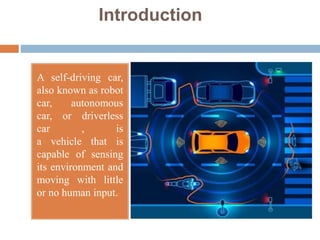
A self-driving car,
also known as robot
car, autonomous
car, or driverless
car , is
a vehicle that is
capable of sensing
its environment and
moving with little
or no human input.
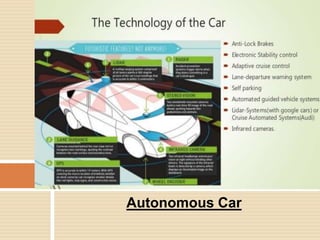
 Autonomous cars combine a variety of sensors to
perceive their surroundings, such
as radar, computer vision, Lidar, Sonar , GPS,
Advanced control systems interpret sensory
information to identify appropriate navigation
paths, as well as obstacles and relevant signage.
Autonomous Car
DIFFERENCES BETWEEN AUTONOMOUS &
AUTOMATED
 Generally, the difference
between automated &
autonomous is the degree of
human intervention.
 So driverless and
autonomous are nearer to
synonyms, as are self-
driving and automated. A
truly autonomous car would
decide on destination and
route as well as control
within the lanes.
 An automated car would
follow orders about
destination and route, and
may only adopt some
lane-keeping or car-
following guidance.
 An automated car does
not have the level of
intelligence or
independence that an
autonomous car has.
Autonomous vehicles Automated vehicles
Classifications
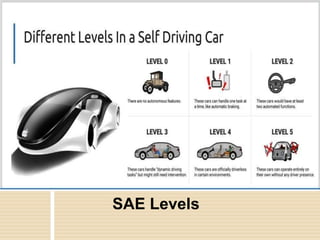
 A classification system based on six different levels (ranging
from fully manual to fully automated systems) was published in
2014 by SAE International.
Levels of driving automation
 Level 0: Automated system issues warnings and may
momentarily intervene but has no sustained vehicle control.
 Level 1 ("hands on"): The driver and the automated system
share control of the vehicle. Examples are Adaptive Cruise
Control (ACC), where the driver controls steering and the
automated system controls speed; and Parking Assistance, where
steering is automated while speed is under manual control. The
driver must be ready to retake full control at any time. Lane
Keeping Assistance (LKA) Type II is a further example of level
1 self-driving.
 Level 2 ("hands off"): The automated system takes full
control of the vehicle (accelerating, braking,
and steering). The driver must monitor the driving and
be prepared to intervene immediately at any time if the
automated system fails to respond properly
 Level 3 ("eyes off"): The driver can safely turn their
attention away from the driving tasks, e.g. the driver
can text or watch a movie. The vehicle will handle
situations that call for an immediate response, like
emergency braking.
 Level 4 ("mind off"): As level 3, but no driver
attention is ever required for safety, e.g. the driver
may safely go to sleep or leave the driver's seat.
Self-driving is supported only in limited spatial
areas or under special circumstances, like traffic
jams.
 Level 5 ("steering wheel optional"): No human
intervention is required at all. An example would
be a robotic taxi.
SAE Levels
Advantage
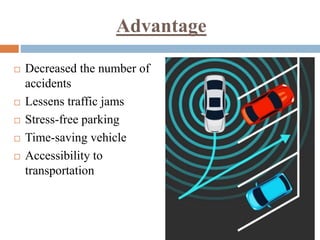
 Decreased the number of
accidents
 Lessens traffic jams
 Stress-free parking
 Time-saving vehicle
 Accessibility to
transportation
Disadvantages
 Expensive
 Safety and security concerns
 Prone to Hacking
 Non-functional sensors
Any Q ?
Thank you

Autonomous car

  • 1.
  • 2.
    Introduction A self-driving car, alsoknown as robot car, autonomous car, or driverless car , is a vehicle that is capable of sensing its environment and moving with little or no human input.
  • 3.
     Autonomous carscombine a variety of sensors to perceive their surroundings, such as radar, computer vision, Lidar, Sonar , GPS, Advanced control systems interpret sensory information to identify appropriate navigation paths, as well as obstacles and relevant signage.
  • 4.
  • 5.
    DIFFERENCES BETWEEN AUTONOMOUS& AUTOMATED  Generally, the difference between automated & autonomous is the degree of human intervention.  So driverless and autonomous are nearer to synonyms, as are self- driving and automated. A truly autonomous car would decide on destination and route as well as control within the lanes.  An automated car would follow orders about destination and route, and may only adopt some lane-keeping or car- following guidance.  An automated car does not have the level of intelligence or independence that an autonomous car has. Autonomous vehicles Automated vehicles
  • 6.
    Classifications  A classificationsystem based on six different levels (ranging from fully manual to fully automated systems) was published in 2014 by SAE International. Levels of driving automation  Level 0: Automated system issues warnings and may momentarily intervene but has no sustained vehicle control.  Level 1 ("hands on"): The driver and the automated system share control of the vehicle. Examples are Adaptive Cruise Control (ACC), where the driver controls steering and the automated system controls speed; and Parking Assistance, where steering is automated while speed is under manual control. The driver must be ready to retake full control at any time. Lane Keeping Assistance (LKA) Type II is a further example of level 1 self-driving.
  • 7.
     Level 2("hands off"): The automated system takes full control of the vehicle (accelerating, braking, and steering). The driver must monitor the driving and be prepared to intervene immediately at any time if the automated system fails to respond properly  Level 3 ("eyes off"): The driver can safely turn their attention away from the driving tasks, e.g. the driver can text or watch a movie. The vehicle will handle situations that call for an immediate response, like emergency braking.
  • 8.
     Level 4("mind off"): As level 3, but no driver attention is ever required for safety, e.g. the driver may safely go to sleep or leave the driver's seat. Self-driving is supported only in limited spatial areas or under special circumstances, like traffic jams.  Level 5 ("steering wheel optional"): No human intervention is required at all. An example would be a robotic taxi.
  • 9.
  • 10.
    Advantage  Decreased thenumber of accidents  Lessens traffic jams  Stress-free parking  Time-saving vehicle  Accessibility to transportation
  • 11.
    Disadvantages  Expensive  Safetyand security concerns  Prone to Hacking  Non-functional sensors
  • 12.