AUTONOMICAUTONOMIC
NERVOUS SYSTEMNERVOUS SYSTEM
SYMPATHETIC ANDSYMPATHETIC AND
PARASYMPATHETIC SYSYTEMPARASYMPATHETIC SYSYTEM
DIVISIONSDIVISIONS
 Two divisionsTwo divisions
CNS (CENTRAL NERVOUS SYSTEM)CNS (CENTRAL NERVOUS SYSTEM)
 PNS (PERIPHERAL NERVOUSPNS (PERIPHERAL NERVOUS
SYSTEM)SYSTEM)
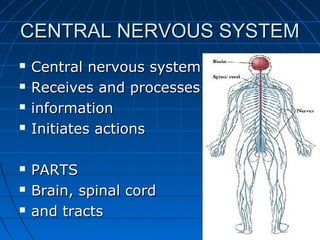
CENTRAL NERVOUS SYSTEMCENTRAL NERVOUS SYSTEM
 Central nervous systemCentral nervous system
 Receives and processesReceives and processes
 informationinformation
 Initiates actionsInitiates actions
 PARTSPARTS
 Brain, spinal cordBrain, spinal cord
 and tractsand tracts
CENTRAL NERVOUS SYSTEMCENTRAL NERVOUS SYSTEM
 Tracts are bundles of axons formingTracts are bundles of axons forming
a pathwaya pathway
 Nerves are bundles of axons ofNerves are bundles of axons of
sensory or motor neurons existingsensory or motor neurons existing
outside of the CNSoutside of the CNS
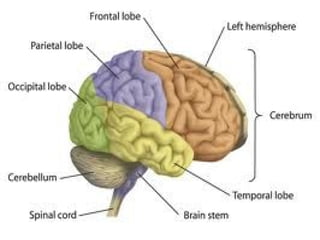
BRAINBRAIN
 Receives andReceives and
 processes sensory informationprocesses sensory information
 Initiates responsesInitiates responses
 Stores memoriesStores memories
 Generates thoughts and emotionsGenerates thoughts and emotions
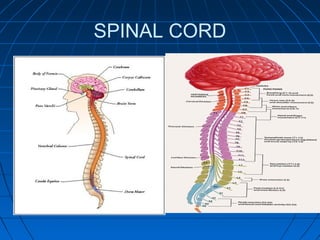
SPINAL CORDSPINAL CORD
 Conducts signals to and from theConducts signals to and from the
brainbrain
 Controls reflex activitiesControls reflex activities
 Generates rhythmic components of
locomotor movements
SPINAL CORD
Peripheral nervous systemPeripheral nervous system
 Sensory neurons, ganglia and nervesSensory neurons, ganglia and nerves
 Transmits signals between CNS andTransmits signals between CNS and
rest of the bodyrest of the body
 Motor neuronsMotor neurons
 Sensory neuronsSensory neurons
MOTOR NEURONSMOTOR NEURONS
 Somatic nervous systemSomatic nervous system
 Controls voluntary movementsControls voluntary movements
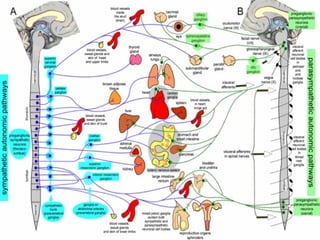
 Autonomic nervous systemAutonomic nervous system
 Controls involuntary responsesControls involuntary responses
AUTONOMOC NERVOUSAUTONOMOC NERVOUS
SYSTEMSYSTEM
 Sympathetic nervous systemSympathetic nervous system
 Parasympathetic nervous systemParasympathetic nervous system
 However, the autonomic motorHowever, the autonomic motor
neuron only modifies the activity ofneuron only modifies the activity of
the visceral muscle that it acts onthe visceral muscle that it acts on
AUTONOMIOC NERVOUSAUTONOMIOC NERVOUS
SYSTEMSYSTEM
 Example:Example:
 Heart continues to beat, muscles of intestinalHeart continues to beat, muscles of intestinal
walls continue to contract even if all nerves towalls continue to contract even if all nerves to
these organs are destroyed.these organs are destroyed.
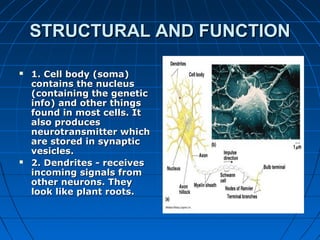
STRUCTURAL AND FUNCTIONSTRUCTURAL AND FUNCTION
 1. Cell body (soma)1. Cell body (soma)
contains the nucleuscontains the nucleus
(containing the genetic(containing the genetic
info) and other thingsinfo) and other things
found in most cells. Itfound in most cells. It
also producesalso produces
neurotransmitter whichneurotransmitter which
are stored in synapticare stored in synaptic
vesicles.vesicles.
 2. Dendrites - receives2. Dendrites - receives
incoming signals fromincoming signals from
other neurons. Theyother neurons. They
look like plant roots.look like plant roots.
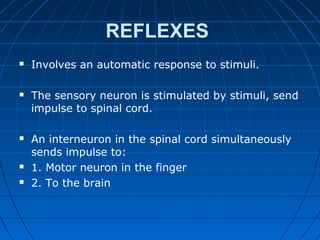
REFLEXES
 Involves an automatic response to stimuli.
 The sensory neuron is stimulated by stimuli, send
impulse to spinal cord.
 An interneuron in the spinal cord simultaneously
sends impulse to:
 1. Motor neuron in the finger
 2. To the brain
REFLEXES
 Consequently, you react before the message
reaches the brain. Thus you feel no pain as you
react, but feel it afterwards.
AXONSAXONS
 A single tube like fiber that is thickerA single tube like fiber that is thicker
and longer than Dendrites.and longer than Dendrites.
 It is used by the neuron to transmitIt is used by the neuron to transmit
an electrical impulse to otheran electrical impulse to other
neurons.neurons.
 They may be tiny or up to a meter inThey may be tiny or up to a meter in
length.length.
BRAINBRAIN
 CraniumCranium
 Part of the skullPart of the skull
 Protects the brain and neural archesProtects the brain and neural arches
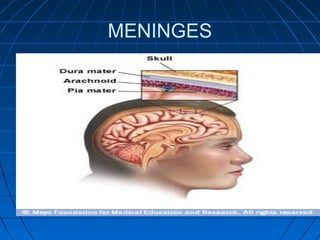
 Triple layer of meningesTriple layer of meninges
 The membranes that cover the brainThe membranes that cover the brain
and spinal cordand spinal cord
MENINGES
MENINGES
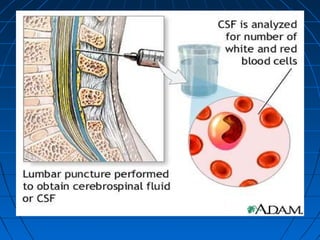
 Meninges are filled with csf
 Primary function of csf and
memninges
 To protect the cns
CSFCSF
 Between these cerebrospinal fluidBetween these cerebrospinal fluid
 Similar ion composition to bloodSimilar ion composition to blood
plasmaplasma
 Bathes the neurons of brain and spinlBathes the neurons of brain and spinl
cordcord
CNSCNS
 Spinal cord has central canalSpinal cord has central canal
 Brain ha many cavitiesBrain ha many cavities
CNSCNS
 Provision of cushion against bumpsProvision of cushion against bumps
and joltand jolt
 Vertebrae of vertebral columnVertebrae of vertebral column
protects the spinal cordprotects the spinal cord
 Brain and spinal cord are hollowBrain and spinal cord are hollow
FORE BRAINFORE BRAIN
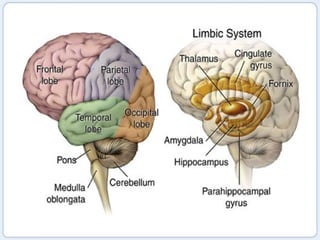
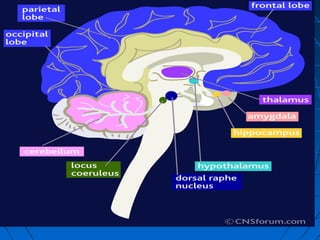
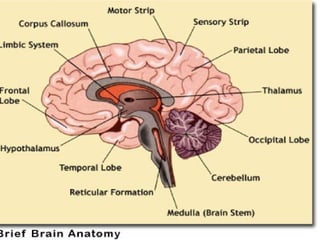
 ThalamusThalamus
 The limbic systemThe limbic system
 CerebrumCerebrum
THALAMUSTHALAMUS
 Carries sensory information to limbicCarries sensory information to limbic
system and cerebrumsystem and cerebrum
 Sensory inputs from auditory andSensory inputs from auditory and
visual pathways from skin and withinvisual pathways from skin and within
the bodythe body
 The relay center of the brainThe relay center of the brain
THE LIMBIC SYSTEMTHE LIMBIC SYSTEM
 Between the thalamus and cerebrumBetween the thalamus and cerebrum
 Drive basic and primitive emotionsDrive basic and primitive emotions
 Drives, behavioursDrives, behaviours
 FearFear
 RageRage
 TranquilityTranquility
 HungerHunger
THE LIMBIC SYSTEMTHE LIMBIC SYSTEM
 ThirstThirst
 PleasurePleasure
 Sexual responsesSexual responses
 Formation of memoriesFormation of memories
THE LIMBIC SYSTEMTHE LIMBIC SYSTEM
 HypothalamusHypothalamus
 AmydalaAmydala
 HippocampusHippocampus
 Nearby regions of cerebrumNearby regions of cerebrum

THE LIMBIC SYSTEMTHE LIMBIC SYSTEM
 Main purpose is to control theMain purpose is to control the
internal environment of the body. Itinternal environment of the body. It
does this bydoes this by
 Influences the pituitary gland - whichInfluences the pituitary gland - which
releases hormonesreleases hormones
 Influences drive states such as thirstInfluences drive states such as thirst
and hungerand hunger
 influences activity of the Autonomicinfluences activity of the Autonomic
NSNS
 Involved in emotionsInvolved in emotions
HYPOTHALAMUSHYPOTHALAMUS
 Production of hormonesProduction of hormones
 Neural connectionsNeural connections
 Major coordinating centerMajor coordinating center
 Body temperatureBody temperature
 HungerHunger
 The menstrual cycleThe menstrual cycle
 Water balanceWater balance
 Sleep awake cyclesSleep awake cycles
AMYDALAAMYDALA
 Cluster of neuronsCluster of neurons
 Sensation of pleasureSensation of pleasure
Sensation of punishmentSensation of punishment
Sensation of sexual arousalSensation of sexual arousal
Feelings of fearFeelings of fear
RageRage
HIPPOCAMPUSHIPPOCAMPUS
 Formation of long term memoryFormation of long term memory
 Required for learningRequired for learning
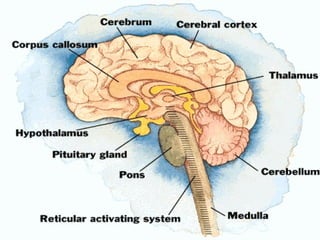
CEREBRUMCEREBRUM
 Largest part of the brainLargest part of the brain
 Divided into two halvesDivided into two halves
 Cerebral hemispheresCerebral hemispheres
 Two halve communicate to eachTwo halve communicate to each
other by means of large band ofother by means of large band of
axonsaxons
 Corpus callosumCorpus callosum
CORPUS CALLOSUMCORPUS CALLOSUM
 Tens of billions of neurons areTens of billions of neurons are
presentpresent
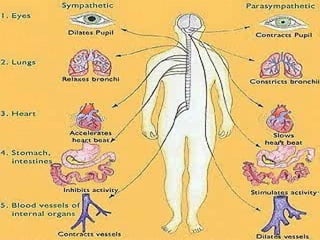
SYMPATHETIC SYSTEMSYMPATHETIC SYSTEM
 This makes you alert and ready forThis makes you alert and ready for
actionaction
Relaxes the bladderRelaxes the bladder
Stimulates adrenal glandsStimulates adrenal glands
Cools the body with perspirationCools the body with perspiration
SYMPATHETIC SYSTEMSYMPATHETIC SYSTEM
Arousal for defensive actionArousal for defensive action
Prepares body for fight or flight),Prepares body for fight or flight),
Increases heart rateIncreases heart rate
Blood pressureBlood pressure
Increases blood sugarIncreases blood sugar
Dilates arteries to increase blood flow toDilates arteries to increase blood flow to
musclesmuscles
Parasympathetic SYSTEMParasympathetic SYSTEM
 When the stressor is over, this takesWhen the stressor is over, this takes
over.over.
 Calming, conserves energyCalming, conserves energy
 Produces the opposite effectProduces the opposite effect
Decreases heart rateDecreases heart rate
Autonomic nervous system

Autonomic nervous system

  • 1.
    AUTONOMICAUTONOMIC NERVOUS SYSTEMNERVOUS SYSTEM SYMPATHETICANDSYMPATHETIC AND PARASYMPATHETIC SYSYTEMPARASYMPATHETIC SYSYTEM
  • 2.
    DIVISIONSDIVISIONS  Two divisionsTwodivisions CNS (CENTRAL NERVOUS SYSTEM)CNS (CENTRAL NERVOUS SYSTEM)  PNS (PERIPHERAL NERVOUSPNS (PERIPHERAL NERVOUS SYSTEM)SYSTEM)
  • 3.
    CENTRAL NERVOUS SYSTEMCENTRALNERVOUS SYSTEM  Central nervous systemCentral nervous system  Receives and processesReceives and processes  informationinformation  Initiates actionsInitiates actions  PARTSPARTS  Brain, spinal cordBrain, spinal cord  and tractsand tracts
  • 4.
    CENTRAL NERVOUS SYSTEMCENTRALNERVOUS SYSTEM  Tracts are bundles of axons formingTracts are bundles of axons forming a pathwaya pathway  Nerves are bundles of axons ofNerves are bundles of axons of sensory or motor neurons existingsensory or motor neurons existing outside of the CNSoutside of the CNS
  • 5.
    BRAINBRAIN  Receives andReceivesand  processes sensory informationprocesses sensory information  Initiates responsesInitiates responses  Stores memoriesStores memories  Generates thoughts and emotionsGenerates thoughts and emotions
  • 7.
    SPINAL CORDSPINAL CORD Conducts signals to and from theConducts signals to and from the brainbrain  Controls reflex activitiesControls reflex activities  Generates rhythmic components of locomotor movements
  • 8.
  • 9.
    Peripheral nervous systemPeripheralnervous system  Sensory neurons, ganglia and nervesSensory neurons, ganglia and nerves  Transmits signals between CNS andTransmits signals between CNS and rest of the bodyrest of the body  Motor neuronsMotor neurons  Sensory neuronsSensory neurons
  • 10.
    MOTOR NEURONSMOTOR NEURONS Somatic nervous systemSomatic nervous system  Controls voluntary movementsControls voluntary movements  Autonomic nervous systemAutonomic nervous system  Controls involuntary responsesControls involuntary responses
  • 11.
    AUTONOMOC NERVOUSAUTONOMOC NERVOUS SYSTEMSYSTEM Sympathetic nervous systemSympathetic nervous system  Parasympathetic nervous systemParasympathetic nervous system  However, the autonomic motorHowever, the autonomic motor neuron only modifies the activity ofneuron only modifies the activity of the visceral muscle that it acts onthe visceral muscle that it acts on
  • 12.
    AUTONOMIOC NERVOUSAUTONOMIOC NERVOUS SYSTEMSYSTEM Example:Example:  Heart continues to beat, muscles of intestinalHeart continues to beat, muscles of intestinal walls continue to contract even if all nerves towalls continue to contract even if all nerves to these organs are destroyed.these organs are destroyed.
  • 13.
    STRUCTURAL AND FUNCTIONSTRUCTURALAND FUNCTION  1. Cell body (soma)1. Cell body (soma) contains the nucleuscontains the nucleus (containing the genetic(containing the genetic info) and other thingsinfo) and other things found in most cells. Itfound in most cells. It also producesalso produces neurotransmitter whichneurotransmitter which are stored in synapticare stored in synaptic vesicles.vesicles.  2. Dendrites - receives2. Dendrites - receives incoming signals fromincoming signals from other neurons. Theyother neurons. They look like plant roots.look like plant roots.
  • 14.
    REFLEXES  Involves anautomatic response to stimuli.  The sensory neuron is stimulated by stimuli, send impulse to spinal cord.  An interneuron in the spinal cord simultaneously sends impulse to:  1. Motor neuron in the finger  2. To the brain
  • 15.
    REFLEXES  Consequently, youreact before the message reaches the brain. Thus you feel no pain as you react, but feel it afterwards.
  • 16.
    AXONSAXONS  A singletube like fiber that is thickerA single tube like fiber that is thicker and longer than Dendrites.and longer than Dendrites.  It is used by the neuron to transmitIt is used by the neuron to transmit an electrical impulse to otheran electrical impulse to other neurons.neurons.  They may be tiny or up to a meter inThey may be tiny or up to a meter in length.length.
  • 17.
    BRAINBRAIN  CraniumCranium  Partof the skullPart of the skull  Protects the brain and neural archesProtects the brain and neural arches  Triple layer of meningesTriple layer of meninges  The membranes that cover the brainThe membranes that cover the brain and spinal cordand spinal cord
  • 18.
  • 19.
    MENINGES  Meninges arefilled with csf  Primary function of csf and memninges  To protect the cns
  • 20.
    CSFCSF  Between thesecerebrospinal fluidBetween these cerebrospinal fluid  Similar ion composition to bloodSimilar ion composition to blood plasmaplasma  Bathes the neurons of brain and spinlBathes the neurons of brain and spinl cordcord
  • 22.
    CNSCNS  Spinal cordhas central canalSpinal cord has central canal  Brain ha many cavitiesBrain ha many cavities
  • 23.
    CNSCNS  Provision ofcushion against bumpsProvision of cushion against bumps and joltand jolt  Vertebrae of vertebral columnVertebrae of vertebral column protects the spinal cordprotects the spinal cord  Brain and spinal cord are hollowBrain and spinal cord are hollow
  • 24.
    FORE BRAINFORE BRAIN ThalamusThalamus  The limbic systemThe limbic system  CerebrumCerebrum
  • 26.
    THALAMUSTHALAMUS  Carries sensoryinformation to limbicCarries sensory information to limbic system and cerebrumsystem and cerebrum  Sensory inputs from auditory andSensory inputs from auditory and visual pathways from skin and withinvisual pathways from skin and within the bodythe body  The relay center of the brainThe relay center of the brain
  • 27.
    THE LIMBIC SYSTEMTHELIMBIC SYSTEM  Between the thalamus and cerebrumBetween the thalamus and cerebrum  Drive basic and primitive emotionsDrive basic and primitive emotions  Drives, behavioursDrives, behaviours  FearFear  RageRage  TranquilityTranquility  HungerHunger
  • 29.
    THE LIMBIC SYSTEMTHELIMBIC SYSTEM  ThirstThirst  PleasurePleasure  Sexual responsesSexual responses  Formation of memoriesFormation of memories
  • 30.
    THE LIMBIC SYSTEMTHELIMBIC SYSTEM  HypothalamusHypothalamus  AmydalaAmydala  HippocampusHippocampus  Nearby regions of cerebrumNearby regions of cerebrum 
  • 31.
    THE LIMBIC SYSTEMTHELIMBIC SYSTEM  Main purpose is to control theMain purpose is to control the internal environment of the body. Itinternal environment of the body. It does this bydoes this by  Influences the pituitary gland - whichInfluences the pituitary gland - which releases hormonesreleases hormones  Influences drive states such as thirstInfluences drive states such as thirst and hungerand hunger  influences activity of the Autonomicinfluences activity of the Autonomic NSNS  Involved in emotionsInvolved in emotions
  • 32.
    HYPOTHALAMUSHYPOTHALAMUS  Production ofhormonesProduction of hormones  Neural connectionsNeural connections  Major coordinating centerMajor coordinating center  Body temperatureBody temperature  HungerHunger  The menstrual cycleThe menstrual cycle  Water balanceWater balance  Sleep awake cyclesSleep awake cycles
  • 33.
    AMYDALAAMYDALA  Cluster ofneuronsCluster of neurons  Sensation of pleasureSensation of pleasure Sensation of punishmentSensation of punishment Sensation of sexual arousalSensation of sexual arousal Feelings of fearFeelings of fear RageRage
  • 34.
    HIPPOCAMPUSHIPPOCAMPUS  Formation oflong term memoryFormation of long term memory  Required for learningRequired for learning
  • 35.
    CEREBRUMCEREBRUM  Largest partof the brainLargest part of the brain  Divided into two halvesDivided into two halves  Cerebral hemispheresCerebral hemispheres  Two halve communicate to eachTwo halve communicate to each other by means of large band ofother by means of large band of axonsaxons  Corpus callosumCorpus callosum
  • 37.
    CORPUS CALLOSUMCORPUS CALLOSUM Tens of billions of neurons areTens of billions of neurons are presentpresent
  • 39.
    SYMPATHETIC SYSTEMSYMPATHETIC SYSTEM This makes you alert and ready forThis makes you alert and ready for actionaction Relaxes the bladderRelaxes the bladder Stimulates adrenal glandsStimulates adrenal glands Cools the body with perspirationCools the body with perspiration
  • 40.
    SYMPATHETIC SYSTEMSYMPATHETIC SYSTEM Arousalfor defensive actionArousal for defensive action Prepares body for fight or flight),Prepares body for fight or flight), Increases heart rateIncreases heart rate Blood pressureBlood pressure Increases blood sugarIncreases blood sugar Dilates arteries to increase blood flow toDilates arteries to increase blood flow to musclesmuscles
  • 42.
    Parasympathetic SYSTEMParasympathetic SYSTEM When the stressor is over, this takesWhen the stressor is over, this takes over.over.  Calming, conserves energyCalming, conserves energy  Produces the opposite effectProduces the opposite effect Decreases heart rateDecreases heart rate