
Artificial Blood
Substitutes
Dr. G.D.A. Samaranayaka
KEY POINTS
Blood substitutes (“artificial blood”), better termed as oxygen therapeutic agents (OTAs), have
been in development for many decades
The development of OTAs has taken two main approaches:
1. perfluorocarbon-based substitutes and
2. hemoglobin-based oxygen carriers
Currently, there are no Food and Drug Administration (FDA)-approved OTAs given the toxicities of
these agents, though some OTAs are used clinically outside of the United States
Side effects and short half-life are the two main reasons that they did not met criteria for being
approved.
It is possible to use OTAs in the United States via the FDA expanded (compassionate use) access
program for selected patients with severe life-threatening anemia
There are promising new developments in the search for a safe and effective OTA
It seems that future studies on artificial blood substitutes would focus on real blood substitutes,
ie, RBCs obtained through differentiation of stem cells.
Introduction
• Blood substitutes, are not really a complete substitute for blood as
their name would imply.
• Such agents are merely designed to support just one therapeutic
function of blood, namely, oxygen transport to the tissues.
• For this reason, blood substitutes are more appropriately termed
“oxygen therapeutic agents” (OTAs)
Need of blood substitutes
• Risk of its transmission by blood transfusion
• higher costs due to the necessary detection tests
• Some can’t detect - vCJD
• emerging of novel infectious agents such as Ebola and H1N1
• Transfusion reactions – TRALI, AHTR, DHTR etc.
• Low blood supplies especially in developing countries
• Seasonal blood shortages
• Difficulty in finding available blood for patients who are highly immunized or rare blood
types
• Lower number of donors due to the aging of population and consequently increased
demand for blood products
• short storage period
• urgent needs for blood supplies during wartime and natural disasters
• Challenges in the management of individuals who refuse blood transfusion on the
grounds of religious beliefs or other reasons
Types of blood substitutes
1. Perfluorocarbon-based blood substitutes.
2. Haemoglobin-based Oxygen Carriers.
3. RBCs Differentiated From Stem Cells.
Perfluorocarbon-based
Blood Substitutes
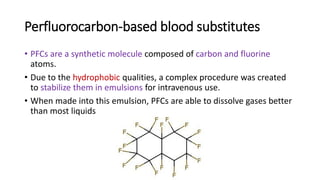
Perfluorocarbon-based blood substitutes
• PFCs are a synthetic molecule composed of carbon and fluorine
atoms.
• Due to the hydrophobic qualities, a complex procedure was created
to stabilize them in emulsions for intravenous use.
• When made into this emulsion, PFCs are able to dissolve gases better
than most liquids
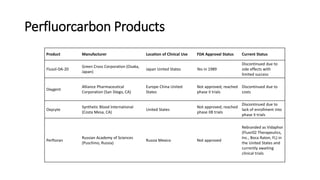
Perfluorcarbon Products
Product Manufacturer Location of Clinical Use FDA Approval Status Current Status
Flusol-DA-20
Green Cross Corporation (Osaka,
Japan)
Japan United States Yes in 1989
Discontinued due to
side effects with
limited success
Oxygent
Alliance Pharmaceutical
Corporation (San Diego, CA)
Europe China United
States
Not approved; reached
phase II trials
Discontinued due to
costs
Oxycyte
Synthetic Blood International
(Costa Mesa, CA)
United States
Not approved; reached
phase IIB trials
Discontinued due to
lack of enrollment into
phase II trials
Perftoran
Russian Academy of Sciences
(Puschino, Russia)
Russia Mexico Not approved
Rebranded as Vidaphor
(Fluor02 Therapeutics,
Inc., Boca Raton, FL) in
the United States and
currently awaiting
clinical trials
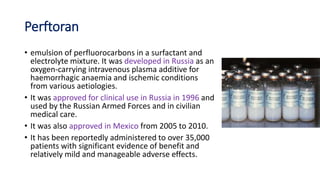
Perftoran
• emulsion of perfluorocarbons in a surfactant and
electrolyte mixture. It was developed in Russia as an
oxygen-carrying intravenous plasma additive for
haemorrhagic anaemia and ischemic conditions
from various aetiologies.
• It was approved for clinical use in Russia in 1996 and
used by the Russian Armed Forces and in civilian
medical care.
• It was also approved in Mexico from 2005 to 2010.
• It has been reportedly administered to over 35,000
patients with significant evidence of benefit and
relatively mild and manageable adverse effects.
Haemoglobin Based
Oxygen Carriers
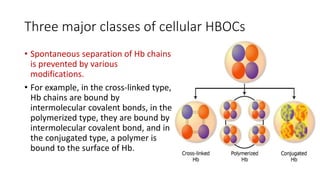
Three major classes of cellular HBOCs
• Spontaneous separation of Hb chains
is prevented by various
modifications.
• For example, in the cross-linked type,
Hb chains are bound by
intermolecular covalent bonds, in the
polymerized type, they are bound by
intermolecular covalent bond, and in
the conjugated type, a polymer is
bound to the surface of Hb.
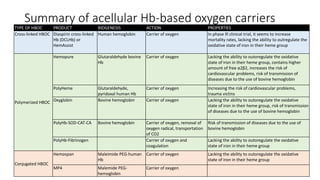
Summary of acellular Hb-based oxygen carriers
TYPE OF HBOC PRODUCT BIOGENESIS ACTION PROPERTIES
Cross-linked HBOC Diaspirin cross-linked
Hb (DCLHb) or
HemAssist
Human hemoglobin Carrier of oxygen In phase lll clinical trial, it seems to increase
mortality rates, lacking the ability to outregulate the
oxidative state of iron in their heme group
Polymerized HBOC
Hemopure Glutaraldehyde bovine
Hb
Carrier of oxygen Lacking the ability to outoregulate the oxidative
state of iron in their heme group, contains higher
amount of free α2β2, increases the risk of
cardiovascular problems, risk of transmission of
diseases due to the use of bovine hemoglobin
PolyHeme Glutaraldehyde,
pyridoxal human Hb
Carrier of oxygen Increasing the risk of cardiovascular problems,
trauma victins
Oxyglobin Bovine hemoglobin Carrier of oxygen Lacking the ability to outoregulate the oxidative
state of iron in their heme group, risk of transmission
of diseases due to the use of bovine hemoglobin
PolyHb-SOD-CAT-CA Bovine hemoglobin Carrier of oxygen, removal of
oxygen radical, transportation
of CO2
Risk of transmission of diseases due to the use of
bovine hemoglobin
PolyHb-Fibrinogen Carrier of oxygen and
coagulation
Lacking the ability to outoregulate the oxidative
state of iron in their heme group
Conjugated HBOC
Hemospan Maleimide PEG-human
Hb
Carrier of oxygen Lacking the ability to outoregulate the oxidative
state of iron in their heme group
MP4 Malemide PEG-
hemoglobin
Carrier of oxygen
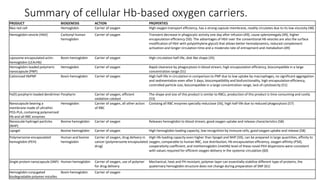
Summary of cellular Hb-based oxygen carriers.
PRODUCT BIOGENESIS ACTION PROPERTIES
Neo red cell Hemoglobin Carrier of oxygen High oxygen transport efficiency, has a strong capsule membrane, readily circulates due to its low viscosity (48)
Hemoglobin vesicle (HbV) Carbonyl human
hemoglobin
Carrier of oxygen Transient decrease in phagocytic activity one day after infusion (49), cause splenomegaly (49), higher
encapsulation efficiency (50). The advantages of HbV over the conventional Hb vesicles are also the surface
modification of HbV with poly(ethylene glycol) that allows better hemodynamics, reduced complement
activation and longer circulation time and a moderate rate of entrapment and metabolism (49)
Liposome encapsulated actin-
hemoglobin (LEAcHb)
Bovin hemoglobin Carrier of oxygen High circulation half-life, disk like shape (35)
Hemoglobin-loaded polymeric
nanocapsule (PNP)
Hemoglobin Carrier of oxygen Rapid clearance by phagocytosis in blood stream, high encapsulation efficiency, biocompatible in a large
concentration range (51)
Cationizad HbPNP Bovin hemoglobin Carrier of oxygen High half-life in circulation in comparison to PNP due to low uptake by macrophages, no significant aggregation
and sedimentation even after 5 days, biocompatibility and biofunctionality, high encapsulation efficiency,
controlled particle size, biocompatible in a large concentration range, lack of cytotoxicity (51)
Fe(ll) porphyrin loaded dendrimer Porphyrin Carrier of oxygen, efficient
oxidation catalyst
The shape and size of this product is similar to RBCs, production of this product is time consuming and costly
(53)
Nanocapsule bearing a
membrane made of ultrathin
PEG-PLA, containing polymerized
Hb and all RBC enzymes
Hemoglobin Carrier of oxygen, all other action
of RBC
Containg all RBC enzymes specially reductase (56), high half-life due to reduced phagocytosis (57)
Nanoscale hydrogel particles
(NHP)
Bovine hemoglobin Carrier of oxygen Releases hemoglobin to blood stream, good oxygen uptake and release characteristics (58)
Lipogel Bovine hemoglobin Carrier of oxygen High hemoglobin loading capacity, low recognition by immune cells, good oxygen uptake and release (58)
Polymersome-encapsulated
hemoglobin (PEH)
Human and bovine
hemoglobin
Carrier of oxygen, drug delivery in
cancer (polymersome encapsulated
drug)
High Hb loading capacity even higher than lipogel and NHP (59), can be prepared in large quantities, affinity to
oxygen, comparable to human RBC, size distribution, Hb encapsulation efficiency, oxygen affinity (P50),
cooperativity coefficient, and methemoglobin (metHb) level of these novel PEH dispersions were consistent
with values required for efficient oxygen delivery in the systemic circulation (60)
Single protein nanocapsule (SNP) Human hemoglobin Carrier of oxygen, use of polymer
for drug delivery
Mechanical, heat and PH resistant, polymer layer can essentially stabilize different type of proteins, the
quaternary hemoglobin structure does not change during preparation of SNP (61)
Hemoglobin conjugated
biodegradable polymer micelles
Bovin hemoglobin Carrier of oxygen
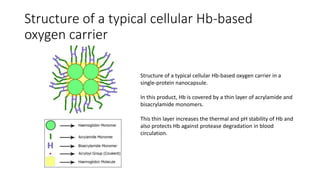
Structure of a typical cellular Hb-based
oxygen carrier
Structure of a typical cellular Hb-based oxygen carrier in a
single-protein nanocapsule.
In this product, Hb is covered by a thin layer of acrylamide and
bisacrylamide monomers.
This thin layer increases the thermal and pH stability of Hb and
also protects Hb against protease degradation in blood
circulation.
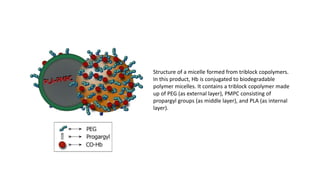
Structure of a micelle formed from triblock copolymers.
In this product, Hb is conjugated to biodegradable
polymer micelles. It contains a triblock copolymer made
up of PEG (as external layer), PMPC consisting of
propargyl groups (as middle layer), and PLA (as internal
layer).
RBCs Differentiated
From Stem Cells
RBCs Differentiated From Stem Cells
• Ideal product for patients requiring chronic blood transfusion & rare
blood groups or autoantibodies.
• Stem cells from bone morrow, cord blood, embryonic stem cells, and
induced pluripotent stem cells (iPSCs) have been used for this
purpose.
• Mass production of RBCs in laboratory performed by adjusting
various production conditions such as providing optimal culture
conditions for cord blood-derived hematopoietic stem cells and
subsequent coculture of erythroid progenitors with human fetal liver
stromal cells.
RBCs Differentiated From Stem Cells
• Immortalized erythrocyte progenitor cells are obtained through the
introduction of C-MYC and BCL-XL into multipotent hematopoietic
progenitor cells derived from pluripotent stem cells.
• Problems
• Mass production and high production costs for clinical applications
• Expected to overcome in near future to make an unlimited source with
maximum similarity and minimum complications to replace RBCs derived
from donated blood
References
Artificial Blood: The History and Current Perspectives of Blood Substitutes
Fahad Khan,1 Kunwar Singh,1 and Mark T. Friedman1,*
Artificial Blood Substitutes: First Steps on the Long Route to Clinical Utility
Samira Moradi,1 Ali Jahanian-Najafabadi,2 and Mehryar Habibi Roudkenar3
Thank You

Artificial Blood Substitutes

  • 1.
  • 2.
    KEY POINTS Blood substitutes(“artificial blood”), better termed as oxygen therapeutic agents (OTAs), have been in development for many decades The development of OTAs has taken two main approaches: 1. perfluorocarbon-based substitutes and 2. hemoglobin-based oxygen carriers Currently, there are no Food and Drug Administration (FDA)-approved OTAs given the toxicities of these agents, though some OTAs are used clinically outside of the United States Side effects and short half-life are the two main reasons that they did not met criteria for being approved. It is possible to use OTAs in the United States via the FDA expanded (compassionate use) access program for selected patients with severe life-threatening anemia There are promising new developments in the search for a safe and effective OTA It seems that future studies on artificial blood substitutes would focus on real blood substitutes, ie, RBCs obtained through differentiation of stem cells.
  • 3.
    Introduction • Blood substitutes,are not really a complete substitute for blood as their name would imply. • Such agents are merely designed to support just one therapeutic function of blood, namely, oxygen transport to the tissues. • For this reason, blood substitutes are more appropriately termed “oxygen therapeutic agents” (OTAs)
  • 4.
    Need of bloodsubstitutes • Risk of its transmission by blood transfusion • higher costs due to the necessary detection tests • Some can’t detect - vCJD • emerging of novel infectious agents such as Ebola and H1N1 • Transfusion reactions – TRALI, AHTR, DHTR etc. • Low blood supplies especially in developing countries • Seasonal blood shortages • Difficulty in finding available blood for patients who are highly immunized or rare blood types • Lower number of donors due to the aging of population and consequently increased demand for blood products • short storage period • urgent needs for blood supplies during wartime and natural disasters • Challenges in the management of individuals who refuse blood transfusion on the grounds of religious beliefs or other reasons
  • 5.
    Types of bloodsubstitutes 1. Perfluorocarbon-based blood substitutes. 2. Haemoglobin-based Oxygen Carriers. 3. RBCs Differentiated From Stem Cells.
  • 6.
  • 7.
    Perfluorocarbon-based blood substitutes •PFCs are a synthetic molecule composed of carbon and fluorine atoms. • Due to the hydrophobic qualities, a complex procedure was created to stabilize them in emulsions for intravenous use. • When made into this emulsion, PFCs are able to dissolve gases better than most liquids
  • 8.
    Perfluorcarbon Products Product ManufacturerLocation of Clinical Use FDA Approval Status Current Status Flusol-DA-20 Green Cross Corporation (Osaka, Japan) Japan United States Yes in 1989 Discontinued due to side effects with limited success Oxygent Alliance Pharmaceutical Corporation (San Diego, CA) Europe China United States Not approved; reached phase II trials Discontinued due to costs Oxycyte Synthetic Blood International (Costa Mesa, CA) United States Not approved; reached phase IIB trials Discontinued due to lack of enrollment into phase II trials Perftoran Russian Academy of Sciences (Puschino, Russia) Russia Mexico Not approved Rebranded as Vidaphor (Fluor02 Therapeutics, Inc., Boca Raton, FL) in the United States and currently awaiting clinical trials
  • 9.
    Perftoran • emulsion ofperfluorocarbons in a surfactant and electrolyte mixture. It was developed in Russia as an oxygen-carrying intravenous plasma additive for haemorrhagic anaemia and ischemic conditions from various aetiologies. • It was approved for clinical use in Russia in 1996 and used by the Russian Armed Forces and in civilian medical care. • It was also approved in Mexico from 2005 to 2010. • It has been reportedly administered to over 35,000 patients with significant evidence of benefit and relatively mild and manageable adverse effects.
  • 10.
  • 11.
    Three major classesof cellular HBOCs • Spontaneous separation of Hb chains is prevented by various modifications. • For example, in the cross-linked type, Hb chains are bound by intermolecular covalent bonds, in the polymerized type, they are bound by intermolecular covalent bond, and in the conjugated type, a polymer is bound to the surface of Hb.
  • 12.
    Summary of acellularHb-based oxygen carriers TYPE OF HBOC PRODUCT BIOGENESIS ACTION PROPERTIES Cross-linked HBOC Diaspirin cross-linked Hb (DCLHb) or HemAssist Human hemoglobin Carrier of oxygen In phase lll clinical trial, it seems to increase mortality rates, lacking the ability to outregulate the oxidative state of iron in their heme group Polymerized HBOC Hemopure Glutaraldehyde bovine Hb Carrier of oxygen Lacking the ability to outoregulate the oxidative state of iron in their heme group, contains higher amount of free α2β2, increases the risk of cardiovascular problems, risk of transmission of diseases due to the use of bovine hemoglobin PolyHeme Glutaraldehyde, pyridoxal human Hb Carrier of oxygen Increasing the risk of cardiovascular problems, trauma victins Oxyglobin Bovine hemoglobin Carrier of oxygen Lacking the ability to outoregulate the oxidative state of iron in their heme group, risk of transmission of diseases due to the use of bovine hemoglobin PolyHb-SOD-CAT-CA Bovine hemoglobin Carrier of oxygen, removal of oxygen radical, transportation of CO2 Risk of transmission of diseases due to the use of bovine hemoglobin PolyHb-Fibrinogen Carrier of oxygen and coagulation Lacking the ability to outoregulate the oxidative state of iron in their heme group Conjugated HBOC Hemospan Maleimide PEG-human Hb Carrier of oxygen Lacking the ability to outoregulate the oxidative state of iron in their heme group MP4 Malemide PEG- hemoglobin Carrier of oxygen
  • 13.
    Summary of cellularHb-based oxygen carriers. PRODUCT BIOGENESIS ACTION PROPERTIES Neo red cell Hemoglobin Carrier of oxygen High oxygen transport efficiency, has a strong capsule membrane, readily circulates due to its low viscosity (48) Hemoglobin vesicle (HbV) Carbonyl human hemoglobin Carrier of oxygen Transient decrease in phagocytic activity one day after infusion (49), cause splenomegaly (49), higher encapsulation efficiency (50). The advantages of HbV over the conventional Hb vesicles are also the surface modification of HbV with poly(ethylene glycol) that allows better hemodynamics, reduced complement activation and longer circulation time and a moderate rate of entrapment and metabolism (49) Liposome encapsulated actin- hemoglobin (LEAcHb) Bovin hemoglobin Carrier of oxygen High circulation half-life, disk like shape (35) Hemoglobin-loaded polymeric nanocapsule (PNP) Hemoglobin Carrier of oxygen Rapid clearance by phagocytosis in blood stream, high encapsulation efficiency, biocompatible in a large concentration range (51) Cationizad HbPNP Bovin hemoglobin Carrier of oxygen High half-life in circulation in comparison to PNP due to low uptake by macrophages, no significant aggregation and sedimentation even after 5 days, biocompatibility and biofunctionality, high encapsulation efficiency, controlled particle size, biocompatible in a large concentration range, lack of cytotoxicity (51) Fe(ll) porphyrin loaded dendrimer Porphyrin Carrier of oxygen, efficient oxidation catalyst The shape and size of this product is similar to RBCs, production of this product is time consuming and costly (53) Nanocapsule bearing a membrane made of ultrathin PEG-PLA, containing polymerized Hb and all RBC enzymes Hemoglobin Carrier of oxygen, all other action of RBC Containg all RBC enzymes specially reductase (56), high half-life due to reduced phagocytosis (57) Nanoscale hydrogel particles (NHP) Bovine hemoglobin Carrier of oxygen Releases hemoglobin to blood stream, good oxygen uptake and release characteristics (58) Lipogel Bovine hemoglobin Carrier of oxygen High hemoglobin loading capacity, low recognition by immune cells, good oxygen uptake and release (58) Polymersome-encapsulated hemoglobin (PEH) Human and bovine hemoglobin Carrier of oxygen, drug delivery in cancer (polymersome encapsulated drug) High Hb loading capacity even higher than lipogel and NHP (59), can be prepared in large quantities, affinity to oxygen, comparable to human RBC, size distribution, Hb encapsulation efficiency, oxygen affinity (P50), cooperativity coefficient, and methemoglobin (metHb) level of these novel PEH dispersions were consistent with values required for efficient oxygen delivery in the systemic circulation (60) Single protein nanocapsule (SNP) Human hemoglobin Carrier of oxygen, use of polymer for drug delivery Mechanical, heat and PH resistant, polymer layer can essentially stabilize different type of proteins, the quaternary hemoglobin structure does not change during preparation of SNP (61) Hemoglobin conjugated biodegradable polymer micelles Bovin hemoglobin Carrier of oxygen
  • 14.
    Structure of atypical cellular Hb-based oxygen carrier Structure of a typical cellular Hb-based oxygen carrier in a single-protein nanocapsule. In this product, Hb is covered by a thin layer of acrylamide and bisacrylamide monomers. This thin layer increases the thermal and pH stability of Hb and also protects Hb against protease degradation in blood circulation.
  • 15.
    Structure of amicelle formed from triblock copolymers. In this product, Hb is conjugated to biodegradable polymer micelles. It contains a triblock copolymer made up of PEG (as external layer), PMPC consisting of propargyl groups (as middle layer), and PLA (as internal layer).
  • 16.
  • 17.
    RBCs Differentiated FromStem Cells • Ideal product for patients requiring chronic blood transfusion & rare blood groups or autoantibodies. • Stem cells from bone morrow, cord blood, embryonic stem cells, and induced pluripotent stem cells (iPSCs) have been used for this purpose. • Mass production of RBCs in laboratory performed by adjusting various production conditions such as providing optimal culture conditions for cord blood-derived hematopoietic stem cells and subsequent coculture of erythroid progenitors with human fetal liver stromal cells.
  • 18.
    RBCs Differentiated FromStem Cells • Immortalized erythrocyte progenitor cells are obtained through the introduction of C-MYC and BCL-XL into multipotent hematopoietic progenitor cells derived from pluripotent stem cells. • Problems • Mass production and high production costs for clinical applications • Expected to overcome in near future to make an unlimited source with maximum similarity and minimum complications to replace RBCs derived from donated blood
  • 19.
    References Artificial Blood: TheHistory and Current Perspectives of Blood Substitutes Fahad Khan,1 Kunwar Singh,1 and Mark T. Friedman1,* Artificial Blood Substitutes: First Steps on the Long Route to Clinical Utility Samira Moradi,1 Ali Jahanian-Najafabadi,2 and Mehryar Habibi Roudkenar3
  • 20.