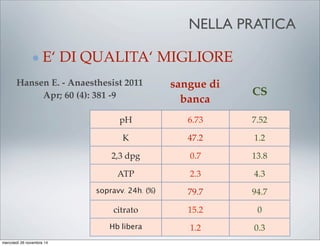
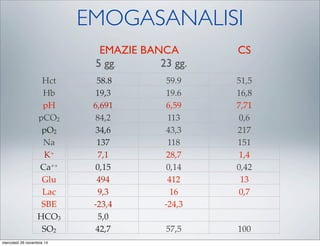
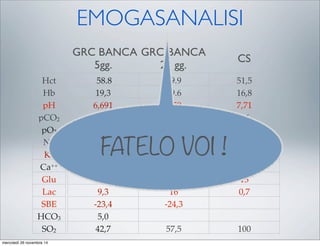
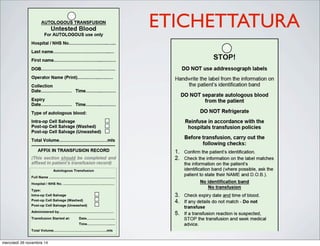
A FRESH LOOK AT CELL SALVAGE
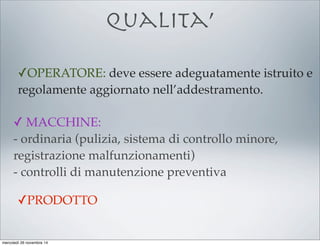
what we should know
SICCH - ROMA 27 . XI . 2014
E.Testa TFPC
Unità operativa di CCH
Direttore dott. E. Polesel
mercoledì 26 novembre 14
INTRODUZIONE
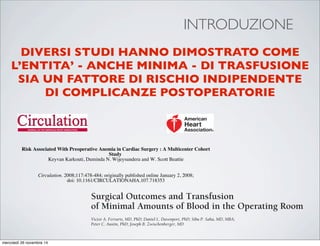
DIVERSI STUDI HANNO DIMOSTRATO COME
L’ENTITA’ - ANCHE MINIMA - DI TRASFUSIONE
SIA UN FATTORE DI RISCHIO INDIPENDENTE
DI COMPLICANZE POSTOPERATORIE
Keyvan Karkouti, Duminda N. Wijeysundera and W. Scott Beattie
Study
Risk Associated With Preoperative Anemia in Cardiac Surgery : A Multicenter Cohort
Print ISSN: 0009-7322. Online ISSN: 1524-4539
Copyright © 2008 American Heart Association, Inc. All rights reserved.
is published by the American Heart Association, 7272 Greenville Avenue, Dallas, TX 75231Circulation
doi: 10.1161/CIRCULATIONAHA.107.718353
2008;117:478-484; originally published online January 2, 2008;Circulation.
http://circ.ahajournals.org/content/117/4/478
World Wide Web at:
The online version of this article, along with updated information and services, is located on the
ORIGINAL ARTICLE
Surgical Outcomes and Transfusion
of Minimal Amounts of Blood in the Operating Room
Victor A. Ferraris, MD, PhD; Daniel L. Davenport, PhD; Sibu P. Saha, MD, MBA;
Peter C. Austin, PhD; Joseph B. Zwischenberger, MD
mercoledì 26 novembre 14
Review Article
Efficacy of red blood cell transfusion in the critically ill:
A systematic review of the literature*
Paul E. Marik, MD, FACP, FCCM, FCCP; Howard L. Corwin, MD, FACP, FCCM, FCCP
In recent years red blood cell
(RBC) transfusion requirements
in western nations has been in-
creasing because of the increasing
burden of chronic disease in an aging
population, improvement in life-support
technology, and blood-intensive surgical
procedures (1, 2). In the United States
alone, nearly 15 million units of blood are
donated and 13 million units are trans-
fused annually (2). For much of the last
(3). On the other hand, it is now becom-
ing clear that there are other important,
less recognized risks of RBC transfusion
related to RBC storage effects and to im-
munomodulating effects of RBC transfu-
sions, which occur in almost all recipi-
ents (4). These immunomodulating*See also p. 2707.
From the Division of Pulmonary and Critical Care
Background: Red blood cell (RBC) transfusions are common in
intensive care unit, trauma, and surgical patients. However, the
hematocrit that should be maintained in any particular patient
because the risks of further transfusion of RBC outweigh the
benefits remains unclear.
Objective: A systematic review of the literature to determine
the association between red blood cell transfusion, and morbidity
and mortality in high-risk hospitalized patients.
Data Sources: MEDLINE, Embase, Cochrane Register of Con-
trolled Trials, and citation review of relevant primary and review
articles.
Study Selection: Cohort studies that assessed the independent
effect of RBC transfusion on patient outcomes. From 571 articles
screened, 45 met inclusion criteria and were included for data
extraction.
Data Extraction: Forty-five studies including 272,596 were
identified (the outcomes from one study were reported in four
separate publications). The outcome measures were mortality,
infections, multiorgan dysfunction syndrome, and acute respira-
tory distress syndrome. The overall risks vs. benefits of RBC
transfusion on patient outcome in each study was classified as (i)
risks outweigh benefits, (ii) neutral risk, and (iii) benefits out-
weigh risks. The odds ratio and 95% confidence interval for each
outcome measure was recorded if available. The pooled odds
ratios were determined using meta-analytic techniques.
Data Synthesis: Forty-five observational studies with a median
of 687 patients/study (range, 63–78,974) were analyzed. In 42 of
the 45 studies the risks of RBC transfusion outweighed the
benefits; the risk was neutral in two studies with the benefits
outweighing the risks in a subgroup of a single study (elderly
patients with an acute myocardial infarction and a hematocrit
<30%). Seventeen of 18 studies, demonstrated that RBC trans-
fusions were an independent predictor of death; the pooled odds
ratio (12 studies) was 1.7 (95% confidence interval, 1.4؊1.9).
Twenty-two studies examined the association between RBC
transfusion and nosocomial infection; in all these studies blood
transfusion was an independent risk factor for infection. The
pooled odds ratio (nine studies) for developing an infectious
complication was 1.8 (95% confidence interval, 1.5–2.2). RBC
transfusions similarly increased the risk of developing multi-
organ dysfunction syndrome (three studies) and acute respiratory
distress syndrome (six studies). The pooled odds ratio for devel-
oping acute respiratory distress syndrome was 2.5 (95% confi-
dence interval, 1.6–3.3).
Conclusions: Despite the inherent limitations in the analysis of
cohort studies, our analysis suggests that in adult, intensive care
unit, trauma, and surgical patients, RBC transfusions are associated
with increased morbidity and mortality and therefore, current trans-
fusion practices may require reevaluation. The risks and benefits of
RBC transfusion should be assessed in every patient before transfu-
sion. (Crit Care Med 2008; 36:2667–2674)
KEY WORDS: blood; blood transfusion; anemia; infections; im-
munomodulation; transfusion-related acute lung injury; acute re-
spiratory distress syndrome; mortality; systematic analysis; meta-
analysis
Morbidity and mortality risk associated with red blood cell
and blood-component transfusion in isolated coronary artery
bypass grafting*
Colleen Gorman Koch, MD, MS; Liang Li, PhD; Andra I. Duncan, MD; Tomislav Mihaljevic, MD;
Delos M. Cosgrove, MD; Floyd D. Loop, MD; Norman J. Starr, MD; Eugene H. Blackstone, MD
A
dministration of packed red
blood cells (PRBCs) has been
associated with morbidity and
mortality for both medical and
surgical patients (1–13). Transfusions are
(2, 8) and long-term mortality (12). Gong
et al. (14) recently demonstrated the as-
sociation between PRBC transfusion and
the development and increased mortality
from acute respiratory distress syndrome.
Our objectives were 1) to exam
whether each unit of PRBC transfu
perioperatively conferred increment
increased risk for mortality and m
morbid outcomes in a large homo
Objective: Our objective was to quantify incremental risk asso-
ciated with transfusion of packed red blood cells and other blood
components on morbidity after coronary artery bypass grafting.
Design: The study design was an observational cohort study.
Setting: This investigation took place at a large tertiary care
referral center.
Patients: A total of 11,963 patients who underwent isolated
coronary artery bypass from January 1, 1995, through July 1,
2002.
Interventions: None.
Measurements and Main Results: Among the 11,963 patients
who underwent isolated coronary artery bypass grafting, 5,814
(48.6%) were transfused. Risk-adjusted probability of developing
in-hospital mortality and morbidity as a function of red blood cell
and blood-component transfusion was modeled using logistic
regression. Transfusion of red blood cells was associated with a
risk-adjusted increased risk for every postoperative morbid ev
mortality (odds ratio [OR], 1.77; 95% confidence interval
1.67–1.87; p < .0001), renal failure (OR, 2.06; 95% CI, 1.87–2
p < .0001), prolonged ventilatory support (OR, 1.79; 95%
1.72–1.86; p < .0001), serious infection (OR, 1.76; 95% CI, 1.68–1
p < .0001), cardiac complications (OR, 1.55; 95% CI, 1.47–1
p < .0001), and neurologic events (OR, 1.37; 95% CI, 1.30–1.44;
.0001).
Conclusions: Perioperative red blood cell transfusion is
single factor most reliably associated with increased risk
postoperative morbid events after isolated coronary artery byp
grafting. Each unit of red cells transfused is associated w
incrementally increased risk for adverse outcome. (Crit Care
2006; 34:1608–1616)
KEY WORDS: blood cells; hemoglobin; complications; cardio
monary bypass; cardiovascular disease; mortality
Transfusion of fresh frozen plasma in critically ill surgical patients
is associated with an increased risk of infection
Babak Sarani, MD, FACS; W. Jonathan Dunkman, BA; Laura Dean; Seema Sonnad, PhD;
Jeffrey I. Rohrbach, RN, MSN; Vicente H. Gracias, MD, FACS
Objective: To determine whether there is an association be-
tween transfusion of fresh frozen plasma and infection in criti-
cally ill surgical patients.
Design: Retrospective study.
Setting: A 24-bed surgical intensive care unit in a university
hospital.
Patients: A total of 380 non-trauma patients who received
fresh frozen plasma from 2004 to 2005 were compared with 2,058
nontrauma patients who did not receive fresh frozen plasma.
Interventions: None.
Measurements and Main Results: We calculated the relative
risk of infectious complication for patients receiving and not
receiving fresh frozen plasma. T-test allowed comparison of av-
erage units of fresh frozen plasma transfused to patients with and
associated pneumonia without shock (relative risk 1.97, 1.03–
3.78), bloodstream infection with shock (relative risk 3.35, 1.69–
6.64), and undifferentiated septic shock (relative risk 3.22, 1.84–
5.61). The relative risk for transfusion of fresh frozen plasma and
all infections was 2.99 (2.28–3.93). The t-test revealed a signifi-
cant dose-response relationship between fresh frozen plasma and
infectious complications (p ‫؍‬ .02). Chi-square analysis showed a
significant association between infection and transfusion of fresh
frozen plasma in patients who did not receive concomitant red
blood cell transfusion (p < .01), but this association was not
significant in those who did receive red blood cells in addition to
fresh frozen plasma. The association between fresh frozen
plasma and infectious complications remained significant in the
multivariate model, with an odds ratio of infection per unit of
Allogeneic Blood Transfusion Increases the Risk of
Postoperative Bacterial Infection: A Meta-analysis
Gary E. Hill, MD, William H. Frawley, PhD, Karl E. Griffith, MD, John E. Forestner, MD, and
Joseph P. Minei, MD
Background: Immunosuppression is
a consequence of allogeneic (homologous)
tions that included only the traumatically
injured patient was included in a separate
subgroup of trauma patien
(range, 5.03–5.43), with all stud
The Journal of TRAUMA௡ Injury, Infection, and C
mercoledì 26 novembre 14
Blood transfusions carry risks. In a previous meta-
analysis of 45 studies evaluating the risks of blood
transfusion, 42 studies showed a significant link to
mortality, infection, or adult respiratory distress
syndrome.3
3 Marik, P. E. and H. L. Corwin (2008). "Efficacy of red blood cell transfusion in the
critically ill: a systematic review of the literature." Crit Care Med 36(9): 2667-74.
New Study Reveals Wide Variation in Blood Transfusion
Practices During Surgery
mercoledì 26 novembre 14
Blood transfusions carry risks. In a previous meta-
analysis of 45 studies evaluating the risks of blood
transfusion, 42 studies showed a significant link to
mortality, infection, or adult respiratory distress
syndrome.3
3. Marik, P. E. and H. L. Corwin (2008). "Efficacy of red blood cell transfusion in the
critically ill: a systematic review of the literature." Crit Care Med 36(9): 2667-74.
COMPLICANZE
mercoledì 26 novembre 14
Blood transfusions are also one of the largest
cost centers in hospitals. While the material
cost of blood ranges from $200 to $300 per
unit, the additional costs from storage, labor,
and waste result in an actual cost per unit
between $522 and $1,183.10 In addition to the
cost of blood itself, each unit of blood
transfused increases the cost of care, with even
higher costs incurred when patients are
transfused at higher hemoglobin levels.11
10 Shander, A.,A. Hofmann, et al. "Activity-based costs of blood transfusions in surgical
patients at four hospitals." Transfusion 50(4): 753-65.
11 Murphy, G. J., B. C. Reeves, et al. (2007). "Increased mortality, postoperative
morbidity, and cost after red blood cell transfusion in patients having cardiac surgery."
Circulation 116(22): 2544-52.
mercoledì 26 novembre 14
Blood transfusions are also one of the largest
cost centers in hospitals. While the material
cost of blood ranges from $200 to $300 per
unit, the additional costs from storage, labor,
and waste result in an actual cost per unit
between $522 and $1,183.10 In addition to the
cost of blood itself, each unit of blood
transfused increases the cost of care, with even
higher costs incurred when patients are
transfused at higher hemoglobin levels.11
10 Shander, A.,A. Hofmann, et al. "Activity-based costs of blood transfusions in surgical
patients at four hospitals." Transfusion 50(4): 753-65.
11 Murphy, G. J., B. C. Reeves, et al. (2007). "Increased mortality, postoperative
morbidity, and cost after red blood cell transfusion in patients having cardiac surgery."
Circulation 116(22): 2544-52.
COSTO REALE
mercoledì 26 novembre 14
A recent systematic evaluation of 494
studies concluded that 59% of transfusions
were "inappropriate" based on their impact
on patient outcomes.12
12 Shander, A., A. Fink, et al. (2011). "Appropriateness of allogeneic
red blood cell transfusion: the international consensus conference on
transfusion outcomes." Transfus Med Rev 25(3): 232-246 e53.
mercoledì 26 novembre 14
A recent systematic evaluation of 494
studies concluded that 59% of transfusions
were "inappropriate" based on their impact
on patient outcomes.12
12 Shander, A., A. Fink, et al. (2011). "Appropriateness of allogeneic
red blood cell transfusion: the international consensus conference on
transfusion outcomes." Transfus Med Rev 25(3): 232-246 e53.
APPROPRIATEZZA
mercoledì 26 novembre 14
Proceedings from the
National Summit on Overuse
September 24, 2012
Organized by The Joint Commission
and the American Medical Association-
Convened Physician Consortium for
Performance Improvement®
(PCPI®
)
Proceedings from the National Summit on Overuse
Embargoed
until July 8, 2013
Appropriate Blood Management
Chair, Aryeh Shander, M.D., Society for the Advancement
of Blood Management
While blood transfusions can be life-saving, they can also be associated
with risks ranging from worse patient outcomes to death. The evidence of
nagement
recommendations on interventions, practices, and methods aimed at
reducing overuse in these clinical areas.
Introduction
Sometimes overlooked or neglected as a leading contributor to problems
with quality and patient safety, overuse of medical interventions affects
millions of patients.1
Overuse has been described as the provision of
treatments that provide zero or negligible benefit to patients, potentially
exposing them to the risk of harm. While many medical procedures are
associated with tradeoffs between benefits and risks, the risks that are
incurred in instances of overuse are not balanced by benefits to patients.
Five subject areas that have triggered concerns about overuse and quality
were addressed by work groups convened for the summit by The Joint
Commission and the American Medical Association-Convened Physician
Consortium for Performance Improvement®
(PCPI®
):
• Antibiotics are often prescribed to treat viral upper respiratory infections
2.
mercoledì 26 novembre 14
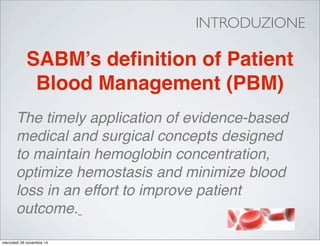
INTRODUZIONE
The timely application of evidence-based
medical and surgical concepts designed
to maintain hemoglobin concentration,
optimize hemostasis and minimize blood
loss in an effort to improve patient
outcome.
SABM’s definition of Patient
Blood Management (PBM)
mercoledì 26 novembre 14
ATTENZIONE AL PAZIENTE,
NON
AL PRODOTTO EMATICO
mercoledì 26 novembre 14
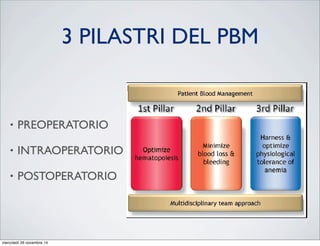
3 PILASTRI DEL PBM
• PREOPERATORIO
• INTRAOPERATORIO
• POSTOPERATORIO
http://www.sabm.org/glossary/patient-blood-management
mercoledì 26 novembre 14
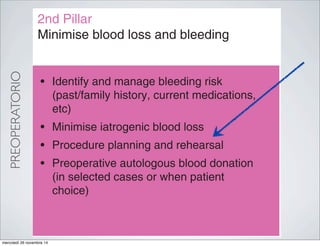
c
• Identify and manage bleeding risk
(past/family history, current medications,
etc)
• Minimise iatrogenic blood loss
• Procedure planning and rehearsal
• Preoperative autologous blood donation
(in selected cases or when patient
choice)
2nd Pillar
Minimise blood loss and bleeding
• As
re
• Co
pa
• Fo
pl
m
re
• Re
st
3rd
Harn
of a
PREOPERATORIO
mercoledì 26 novembre 14
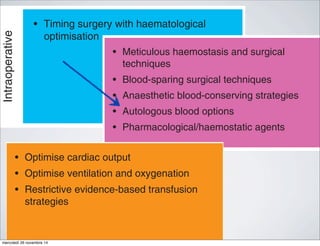
Intraoperativetoperative
• Timing surgery with haematological
optimisation
• Meticulous
techniques
• Blood-spar
• Anaestheti
• Autologous
• Pharmaco
• Treat anaemia/iron deficiency
• Stimulate erythropoiesis
• Be aware of drug interactions that can
cause/increase anaemia
• Vigilant mo
post-opera
• Avoid seco
• Rapid warm
(unless hy
• Autologous
• Minimising
ntraindication for
aematological • Meticulous haemostasis and surgical
techniques
• Blood-sparing surgical techniques
• Anaesthetic blood-conserving strategies
• Autologous blood options
• Pharmacological/haemostatic agents
ficiency
sis
actions that can
mia
• Vigilant monitoring and management of
post-operative bleeding
• Avoid secondary haemorrhage
• Rapid warming – maintain normothermia
(unless hypothermia specifically indicated)
• Autologous blood salvage
• Assess/optimise patient’s physiological
reserve and risk factors
• Compare estimated blood loss with
patient-specific tolerable blood loss
• Formulate patient-specific management
plan using appropriate blood-conservation
modalities to minimise blood loss, optimise
red cell mass and manage anaemia
• Restrictive evidence-based transfusion
strategies
• Optimise cardiac output
• Optimise ventilation and oxygenation
• Restrictive evidence-based transfusion
strategies
Dow
mercoledì 26 novembre 14
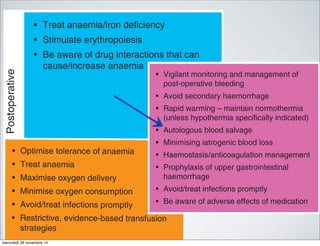
Postoperative
• Treat anaemia/iron deficiency
• Stimulate erythropoiesis
• Be aware of drug interactions that can
cause/increase anaemia
• Vigilant monitorin
post-operative ble
• Avoid secondary
• Rapid warming –
(unless hypotherm
• Autologous blood
• Minimising iatroge
• Haemostasis/anti
• Prophylaxis of up
haemorrhage
• Avoid/treat infecti
• Be aware of adve
Fig 1 A multimodal approach to PBM (or blood conservation). Adapte
stimulating agents.
red cell mass and manage anaemia
• Restrictive evidence-based transfusion
strategies
• Optimise cardiac output
• Optimise ventilation and oxygenation
• Restrictive evidence-based transfusion
strategies
• Optimise tolerance of anaemia
• Treat anaemia
• Maximise oxygen delivery
• Minimise oxygen consumption
• Avoid/treat infections promptly
• Restrictive, evidence-based transfusion
strategies
http://bja.oxfordjDownloadedfrom
• Blood-sparing surgical techniques
• Anaesthetic blood-conserving strategies
• Autologous blood options
• Pharmacological/haemostatic agents
eat anaemia/iron deficiency
imulate erythropoiesis
e aware of drug interactions that can
use/increase anaemia
• Vigilant monitoring and management of
post-operative bleeding
• Avoid secondary haemorrhage
• Rapid warming – maintain normothermia
(unless hypothermia specifically indicated)
• Autologous blood salvage
• Minimising iatrogenic blood loss
• Haemostasis/anticoagulation management
• Prophylaxis of upper gastrointestinal
haemorrhage
• Avoid/treat infections promptly
• Be aware of adverse effects of medication
timodal approach to PBM (or blood conservation). Adapted from Hofmann and coll
mercoledì 26 novembre 14
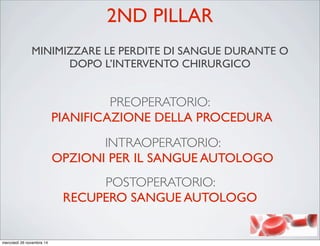
2ND PILLAR
MINIMIZZARE LE PERDITE DI SANGUE DURANTE O
DOPO L’INTERVENTO CHIRURGICO
PREOPERATORIO:
PIANIFICAZIONE DELLA PROCEDURA
INTRAOPERATORIO:
OPZIONI PER IL SANGUE AUTOLOGO
POSTOPERATORIO:
RECUPERO SANGUE AUTOLOGO
mercoledì 26 novembre 14
AGENDA
• TECNICA
• INDICAZIONI / CONTROINDICAZIONI
• RISCHI /BENEFICI
• NELLA PRATICA....
A FRESH LOOK AT CELL SALVAGE
mercoledì 26 novembre 14
FORMAZIONE
USA
• PBMT : Perioperative Blood Management
Technologist
ESAME
K = conoscenza
S = abilità
A = pratica
Perioperative Blood Management Technologist [PBMT]
Job Domain Analysis
Theoretical Hierarchical Construct for K/S/A for Competency Exam
Respond correctly to
critical incidents and
emergencies [4.3]
Follow guideline
indications for use and
record keeping [3.3]
Disposable supplies
and interface with
hardware [2.3]
Inter-team member
communication and
patient privacy [1.3}
Communication with
team during critical
incident and crisis
management [4.4]
Follow guidelines
recognizing
contraindications and
exceptions [3.4]
Follow manufacturer
instructions-for-use
and assembly [2.4]
Integration into surgical
team and participate in
care planning and quality
management [1.4]
Design and practice
team drills for critical
incidents [4.5]
Suggest changes to and
author clinical procedure
guidelines [3.5]
Application and
operation of
equipment [2.5]
Assertiveness, lead team
when required [1.5]
Critical
Incidents
Patient Care
Procedures
Equipment /
Disposables
Environmental
Factors
K/S/A Label Count Percent
K Knowledge 45 0.41
S Skills 31 0.28
A Application 34 0.31
Total 110 1.00
mercoledì 26 novembre 14
FORMAZIONE ITALIA
• NON E’ RICHIESTA UNA FORMAZIONE SPECIFICA!
• IL CORSO DI LAUREA DEL TECNICO DI FISIOPATOLOGIA
CARDIOCIRCOLATORIA E PERFUSIONE
CARDIOVASCOLARE HA TRA GLI OBIETTIVI FORMATIVI:
“ LA GESTIONE DELLE METODICHE DI EMORECUPERO,
PLASMAFERESI INTRAOPERATORIA, GEL PIASTRINICO E
COLLA DI FIBRINA”
mercoledì 26 novembre 14
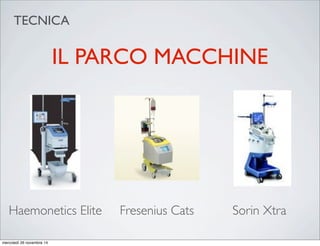
IL PARCO MACCHINE
Haemonetics Elite Fresenius Cats Sorin Xtra
TECNICA
mercoledì 26 novembre 14
LA TECNICA
• TIPOLOGIE DI DEVICES
• A COSA PUO’ SERVIRE (non solo a recuperare GR!!)
• SOLUZIONI ANTICOAGULANTI
• LA TECNICA OPERATIVA (particolarità)
• LA TECNICA NEI CASI PARTICOLARI
mercoledì 26 novembre 14
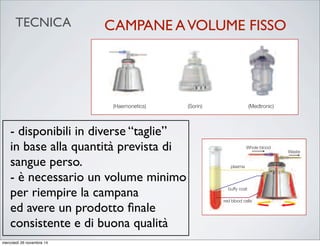
6.1 Fixed Volume Bowl System
Figure 6. Examples of Fixed Volume Bowls*
*Bowls for different machines/processing volumes also exist.
The fixed volume bowl rotates at speeds of up to 6,000rpm, and processes the salvaged
blood in fixed volume batches. As anticoagulated whole blood is pumped into the spinning
bowl, the centrifugal force separates the blood into its components as the bowl fills. As
more blood is pumped into the bowl the RBCs are retained in the bowl while the
supernatant, which is made up of the remaining components plus the anticoagulant, is
expressed through the outlet port and into the waste bag.
When the machine detects an adequate amount of RBCs within the bowl, a wash solution
of IV normal saline (0.9% NaCl) is pumped into the bowl passing through the red cell layer
and displacing most of the remaining non
red cell component into the waste bag.
Excess IV normal saline (0.9% NaCl) is also
expressed through the outlet port and into
the waste bag.
The fixed volume bowl may be available
(Haemonetics) (Sorin) (Medtronic)
Whole blood
Waste
Figure 7. Separation of Red Blood
Cells in a Fixed Volume Bowl
*Bowls for different machines/processing volumes also exist.
The fixed volume bowl rotates at speeds of up to 6,000rpm, and processes the salvaged
blood in fixed volume batches. As anticoagulated whole blood is pumped into the spinning
bowl, the centrifugal force separates the blood into its components as the bowl fills. As
more blood is pumped into the bowl the RBCs are retained in the bowl while the
supernatant, which is made up of the remaining components plus the anticoagulant, is
expressed through the outlet port and into the waste bag.
When the machine detects an adequate amount of RBCs within the bowl, a wash solution
of IV normal saline (0.9% NaCl) is pumped into the bowl passing through the red cell layer
and displacing most of the remaining non
red cell component into the waste bag.
Excess IV normal saline (0.9% NaCl) is also
expressed through the outlet port and into
the waste bag.
The fixed volume bowl may be available
in a range of sizes (depending on the
manufacturer) to suit the anticipated blood
loss. In order to provide a consistent and
high quality end product, fixed volume
bowls require a predetermined volume of
RBCs to be reached within the bowl before
the machine will trip automatically into the
wash stage.
(Haemonetics) (Sorin) (Medtronic)
plasma
Whole blood
Waste
buffy coat
red blood cells
Figure 7. Separation of Red Blood
Cells in a Fixed Volume Bowl- disponibili in diverse “taglie”
in base alla quantità prevista di
sangue perso.
- è necessario un volume minimo
per riempire la campana
ed avere un prodotto finale
consistente e di buona qualità
CAMPANE AVOLUME FISSOTECNICA
mercoledì 26 novembre 14
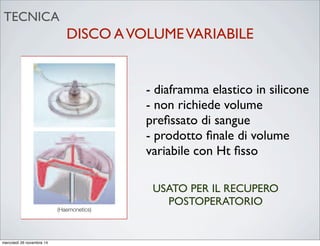
DISCO AVOLUMEVARIABILE6.2 Variable Volume Disk System
Figure 8. Variable Volume Disk System
The variable volume disk (dynamic disk)
system is similar in principle to the fixed
volume bowl in the separation of RBCs
through centrifugation and washing
with IV normal saline (0.9% NaCl).
However, this system has an elastic silicone
diaphragm which permits a variable
volume of RBCs to be processed, i.e. it
does not require a set volume of RBCs for
processing to take place. The elastic
silicone diaphragm changes shape and size
during processing so that the machine
delivers an end product of variable volume
with a fixed haematocrit (Hct). The variable
volume disk system will process 100ml of
reservoir contents at a time. If the volume
of RBCs being drawn into the disk from the
reservoir is under 15mls, the system will
concentrate several batches of blood
before washing. This system is therefore
more advantageous for procedures where
lower volume blood losses occur or during
long procedures where the blood loss is
constant and slow.
(Haemonetics)
CAUTION
remove the safety benefits and will affect the consistent, high
quality end product offered by the automatic mode.
- diaframma elastico in silicone
- non richiede volume
prefissato di sangue
- prodotto finale di volume
variabile con Ht fisso
USATO PER IL RECUPERO
POSTOPERATORIO
TECNICA
mercoledì 26 novembre 14
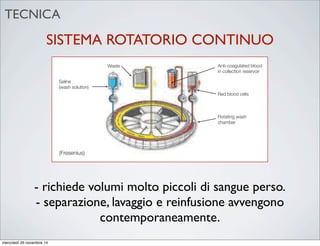
SISTEMA ROTATORIO CONTINUO6.3 Continuous Rotary System
Figure 9. Continuous Rotary System
The continuous rotary system works by continuously removing the supernatant and
concentrating and washing the RBCs. It requires only a very small volume of blood loss
to process, however, this does not automatically mean processing should progress.
The decision to process should always be made on an individual patient basis.
6.4 Stages of the Process
Opposite (Figure 10) is a description of each of the four main processing stages of the ICS
process. The fixed and variable volume systems follow a pattern similar to that described
below. In the continuous rotary system, washing, separation and reinfusion take place
concurrently.
(Fresenius)
Saline
(wash solution)
Anti-coagulated blood
in collection reservoir
Red blood cells
Rotating wash
chamber
Waste
- richiede volumi molto piccoli di sangue perso.
- separazione, lavaggio e reinfusione avvengono
contemporaneamente.
TECNICA
mercoledì 26 novembre 14
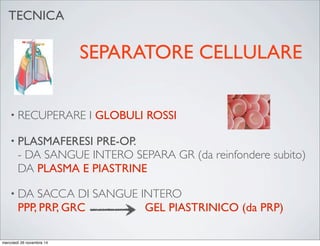
SEPARATORE CELLULARE
• RECUPERARE I GLOBULI ROSSI
• PLASMAFERESI PRE-OP.
- DA SANGUE INTERO SEPARA GR (da reinfondere subito)
DA PLASMA E PIASTRINE
• DA SACCA DI SANGUE INTERO
PPP, PRP, GRC GEL PIASTRINICO (da PRP)
TECNICA
mercoledì 26 novembre 14
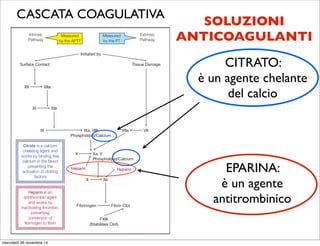
Figure 3. The Coagulation Cascade
(Adapted from the American Association for Clinical Chemistry1
)
Surface Contact
XII XIIa
VIIa VII
XI XIa
X Xa. V
Phospholipid/Calcium
II IIa
Fibrinogen
Heparin Heparin
Fibrin Clot
FXIII
(Stabilises Clot)
IXa. VIII
Phospholipid/Calcium
IX
Heparin is an
antithrombin agent
and works by
inactivating thrombin,
preventing
conversion of
fibrinogen to fibrin
Citrate is a calcium
chelating agent and
works by binding free
calcium in the blood
preventing the
activation of clotting
factors
Initiated by
Intrinsic
Pathway
Extrinsic
Pathway
Measured
by the APTT
Measured
by the PT
Tissue Damage
EPARINA:
è un agente
antitrombinico
CITRATO:
è un agente chelante
del calcio
SOLUZIONI
ANTICOAGULANTI
CASCATA COAGULATIVA
mercoledì 26 novembre 14
www.vetla
PROTEINA C
PROTEINA S
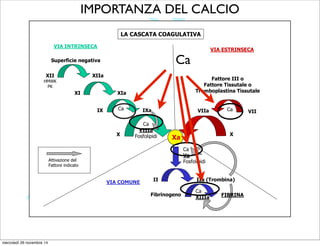
LA CASCATA COAGULATIVA
VIA INTRINSECA
VIA ESTRINSECA
Superficie negativa
XII
HMWK
PK
XIIa
XI XIa
IX IXaCa
X
Xa
X
Ca
VIIIa
Fosfolipidi
Ca
Va
Fosfolipidi
II IIa (Trombina)
VIIa VIICa
Fattore III o
Fattore Tissutale o
Tromboplastina Tissutale
VIA COMUNE
Fibrinogeno FIBRINA
Ca
XIIIa
Attivazione del
Fattore indicato
IMPORTANZA DEL CALCIO
Ca
mercoledì 26 novembre 14
ANTICOAGULANTE
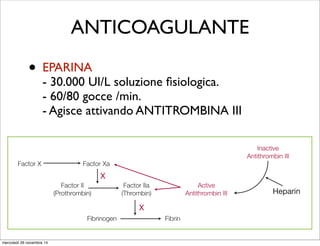
• EPARINA
- 30.000 UI/L soluzione fisiologica.
- 60/80 gocce /min.
- Agisce attivando ANTITROMBINA III
anticoagulated before it enters the collection reservoir. If the rate of flow of the
anticoagulant is insufficient, the salvaged blood will clot. This may result in contamination
of the processed blood and/or may prevent processing. Types of anticoagulant used are:
• Heparin saline:
– 30,000iu heparin/1,000ml intravenous (IV) normal saline (0.9% NaCl)
– Heparin works by activating Antithrombin III which in turn inactivates both Factor
Xa and Factor IIa (Thrombin) in the coagulation cascade (Figure 11). This prevents
the conversion of Fibrinogen to Fibrin and the formation of clots.
– The recommended ratio is approximately 1:5 e.g. 20ml of anticoagulant to 100ml
of blood (check your machine manufacturer recommendations)
Figure 11. Heparin Mechanism of Action
Factor X Factor Xa
Factor II
(Prothrombin)
Factor IIa
(Thrombin)
Active
Antithrombin III Heparin
Inactive
Antithrombin III
Fibrinogen Fibrin
X
X
mercoledì 26 novembre 14
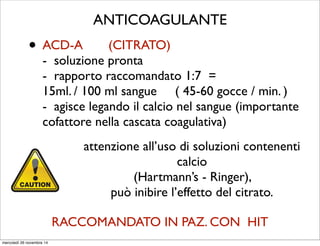
• ACD-A (CITRATO)
- soluzione pronta
- rapporto raccomandato 1:7 =
15ml. / 100 ml sangue ( 45-60 gocce / min. )
- agisce legando il calcio nel sangue (importante
cofattore nella cascata coagulativa)
It is advisable to increase the wash volume for procedures
CAUTION
Most systems have a minimum wash volume recommended by
the manufacturer. It is not advisable to decrease the wash
volume below this level.
attenzione all’uso di soluzioni contenenti
calcio
(Hartmann’s - Ringer),
può inibire l’effetto del citrato.
ANTICOAGULANTE
RACCOMANDATO IN PAZ. CON HIT
mercoledì 26 novembre 14
• Prima di aspirare sangue nel cardiotomo, far
scorrere la soluzione eparinata o l’ ACD-A per
bagnare il filtro ( 150 cc. circa)
It is advisable to increase the wa
where there is a high risk of con
blood, e.g. obstetrics and orthop
further details.
ICS can reduce and sometimes e
transfuse allogeneic (donor) RBC
blood loss occurs, patients receiv
CAUTION
Most systems have a minimum w
the manufacturer. It is not advisa
volume below this level.
mercoledì 26 novembre 14
Key Points
• ICS has four key processing stages:
– Collection
– Separation
– Washing
It is advisable to increase the wash volume for procedures
where there is a high risk of contamination of salvaged
blood, e.g. obstetrics and orthopaedics. See Section 9 for
further details.
ICS can reduce and sometimes eliminate the need to
transfuse allogeneic (donor) RBCs. In cases where large
blood loss occurs, patients receiving ICS may still become
depleted of clotting factors and platelets. In such cases
transfusion of allogeneic (donor) components such as fresh
frozen plasma (FFP), platelets or cryoprecipitate may be
required.
CAUTION
Most systems have a minimum wash volume recommended by
the manufacturer. It is not advisable to decrease the wash
volume below this level.
punta dell’aspiratore: dovrebbe avere un
diametro grande (4mm.) per minimizzare il
danno da suzione
It is advisable to increase the wash volume for procedures
where there is a high risk of contamination of salvaged
blood, e.g. obstetrics and orthopaedics. See Section 9 for
further details.
ICS can reduce and sometimes eliminate the need to
transfuse allogeneic (donor) RBCs. In cases where large
blood loss occurs, patients receiving ICS may still become
depleted of clotting factors and platelets. In such cases
transfusion of allogeneic (donor) components such as fresh
frozen plasma (FFP), platelets or cryoprecipitate may be
required.
CAUTION
Most systems have a minimum wash volume recommended by
the manufacturer. It is not advisable to decrease the wash
volume below this level.
vacuum : causa emolisi!
dovrebbe essere mantenuto a livelli più bassi
possibile. (< -150 mm.Hg )
It is advisable to increase the wash volume for procedures
where there is a high risk of contamination of salvaged
blood, e.g. obstetrics and orthopaedics. See Section 9 for
further details.
CAUTION
Most systems have a minimum wash volume recommended by
the manufacturer. It is not advisable to decrease the wash
volume below this level.
testimoni di Jehovah: la preparazione del set
è particolare e dovrebbe essere discussa prima
LA TECNICA - INDICAZIONI
mercoledì 26 novembre 14
TECNICA DI ASPIRAZIONE
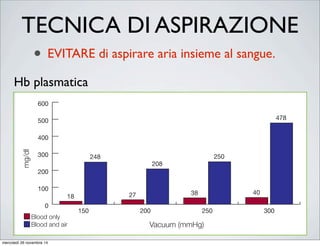
• EVITARE di aspirare aria insieme al sangue.
(i.e. when the suction tip is immersed in a pool of blood), even high vacuum levels do not
result in excessive RBC haemolysis. This supports increasing vacuum levels during excessive
bleeding.
However, when blood and air are aspirated, as occurs naturally during most of the ICS
process, even low vacuum levels result in excessive haemolysis and therefore reduces the
available RBCs for reinfusion.
Graph 1. Changes in Plasma Haemoglobin from Baseline Measurements1
0
100
200
300
400
500
600
Blood only
Blood and air
mg/dl
Vacuum (mmHg)
150
18
248
27
208
38
250
40
478
200 250 300
Hb plasmatica
mercoledì 26 novembre 14
Modification of Suction-Induced Hemolysis During
Cell Salvage
Jonathan H. Waters, MD*
Brandon Williams, BS†
Mark H. Yazer, MD, FRCPC‡§
Marina V. Kameneva, PhD†ʈ
BACKGROUND: The efficiency of red blood cell collection during cell salvag
dictated by multiple variables, including suction pressure. In this study
attempted to determine the influence of suction pressure on the efficiency o
salvage and to identify methods for minimizing the impact of suction on salv
blood.
METHODS: Whole blood was placed in 60-mL aliquots either in a beaker or on
surface and suctioned at 100 and 300 mm Hg. The amount of hemolysis
measured and compared under the varying conditions. The experiments
repeated with the blood diluted with normal saline solution in a 1:1 mix.
RESULTS: Hemolysis ranged from 0.21% to 2.29%. Hemolysis was greatest w
whole blood was suctioned from a flat surface at 300 mm Hg. It was reduced w
the blood was diluted with saline. Blood suctioned from a surgical field during
salvage should be done with minimal suction pressures and with the go
minimizing blood–air interfaces.
CONCLUSIONS: Significant reduction of blood damage can be obtained by dilu
blood with normal saline while suctioning it from the surgical field. Alth
immediate hemolysis due to suctioning was not very high, the red blood
damage from suctioning produced by a dynamic blood–air interface m
adversely affect the efficiency of cell salvage.
(Anesth Analg 2007;104:684–7)
There are many benefits of autologous blood conser-
vation, including reduction of demands for allogeneic
blood (1), avoiding the costs of blood products, avoid-
ing the immunosuppressive effects of allogeneic trans-
fusion (2), reduced incidence of transfusion-related
which is mostly due to air bubbles mixing with
blood in the suction cannulae and the tubing conn
ing the surgical site with the salvage device. Th
aspirated with blood during suctioning produces
moving bubbles, which expand and collide in
Modification of Suction-Induced Hemolysis Du
Cell Salvage
Jonathan H. Waters, MD*
Brandon Williams, BS†
Mark H. Yazer, MD, FRCPC‡§
Marina V. Kameneva, PhD†ʈ
BACKGROUND: The efficiency of red blood cell collectio
dictated by multiple variables, including suction pre
attempted to determine the influence of suction pressur
salvage and to identify methods for minimizing the impa
blood.
METHODS: Whole blood was placed in 60-mL aliquots eith
surface and suctioned at 100 and 300 mm Hg. The a
measured and compared under the varying condition
repeated with the blood diluted with normal saline solu
RESULTS: Hemolysis ranged from 0.21% to 2.29%. Hemo
whole blood was suctioned from a flat surface at 300 mm
the blood was diluted with saline. Blood suctioned from a
salvage should be done with minimal suction pressur
minimizing blood–air interfaces.
CONCLUSIONS: Significant reduction of blood damage can
blood with normal saline while suctioning it from the
immediate hemolysis due to suctioning was not very
damage from suctioning produced by a dynamic b
adversely affect the efficiency of cell salvage.
(Anesth Analg 2007;104:684–7)
D*
†
§
†ʈ
BACKGROUND: The efficiency of red blood cell collection during cell salvage is
dictated by multiple variables, including suction pressure. In this study, we
attempted to determine the influence of suction pressure on the efficiency of cell
salvage and to identify methods for minimizing the impact of suction on salvaged
blood.
METHODS: Whole blood was placed in 60-mL aliquots either in a beaker or on a flat
surface and suctioned at 100 and 300 mm Hg. The amount of hemolysis was
measured and compared under the varying conditions. The experiments were
repeated with the blood diluted with normal saline solution in a 1:1 mix.
RESULTS: Hemolysis ranged from 0.21% to 2.29%. Hemolysis was greatest when
whole blood was suctioned from a flat surface at 300 mm Hg. It was reduced when
the blood was diluted with saline. Blood suctioned from a surgical field during cell
salvage should be done with minimal suction pressures and with the goal of
minimizing blood–air interfaces.
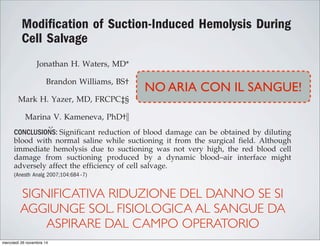
CONCLUSIONS: Significant reduction of blood damage can be obtained by diluting
blood with normal saline while suctioning it from the surgical field. Although
immediate hemolysis due to suctioning was not very high, the red blood cell
damage from suctioning produced by a dynamic blood–air interface might
adversely affect the efficiency of cell salvage.
(Anesth Analg 2007;104:684–7)
ogous blood conser-
mands for allogeneic
ood products, avoid-
which is mostly due to air bubbles mixing with the
blood in the suction cannulae and the tubing connect-
ing the surgical site with the salvage device. The air
aspirated with blood during suctioning produces fast-
SIGNIFICATIVA RIDUZIONE DEL DANNO SE SI
AGGIUNGE SOL. FISIOLOGICA AL SANGUE DA
ASPIRARE DAL CAMPO OPERATORIO
NO ARIA CON IL SANGUE!
mercoledì 26 novembre 14
PER MASSIMIZZARE IL
RECUPERO
• “LAVAGGIO” DELLE GARZE
• “LAVAGGIO” DELL’ OSSIGENATORE /
CARDIOTOMO (se viene recuperato il sangue
della CEC).
• BASSI LIVELLI DI VACUUM
(per evitare l’emolisi)
• TECNICA DI ASPIRAZIONE (evitare aria)
ICSTechnicalFactsheet
SWAB WASHING
AREA of APPLICATION
STAFF
Theatre staff
PROCEDURE:
The efficiency of red cell recovery by cell salvage is very much dependent
on the ability to recover the blood lost in a useable form. During surgery,
blood loss can be removed from the operative site by a combination of
suction and swabs. Blood loss to swabs during surgery has been estimated
at between 30%1
and 50%2
of the total surgical blood loss. By washing
swabs, the blood that is normally discarded can be collected and the overall
efficiency of red cell recovery improved.3
SWAB WASHING
AREA of APPLICATION
STAFF
Theatre staff
The efficiency of red cell recovery by cell salvage is v
on the ability to recover the blood lost in a useable f
blood loss can be removed from the operative site
suction and swabs. Blood loss to swabs during surger
at between 30%1
and 50%2
of the total surgical blo
swabs, the blood that is normally discarded can be col
efficiency of red cell recovery improved.3
mercoledì 26 novembre 14
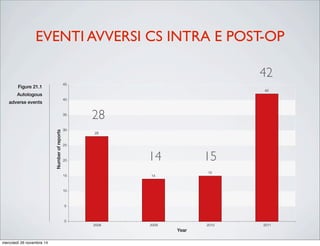
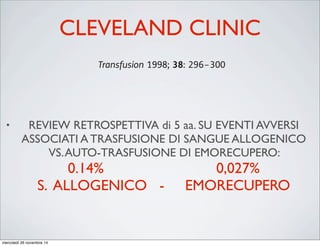
ANNUAL SHOT REPORT 2011 ANALYSIS OF CASES DUE TO PATHOLOGICAL REACTIONS
Figure 21.1
Autologous
adverse events
28
14
15
42
0
5
10
15
20
25
30
35
40
45
2008 2009 2010 2011
Year
Numberofreports
EVENTI AVVERSI CS INTRA E POST-OP
28
14 15
42
mercoledì 26 novembre 14
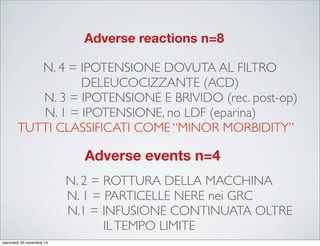
reinfusion of salvaged blood was continued without the LDF and no hypotension occurred. This is a
recognised complication which may be related to elevated levels of interleukin 6 [71], and is reviewed
by Sreelakshmi [72].
Learning points
The use of leucodepletion filters (LDF) with cell salvaged blood can, rarely, cause significant
hypotension
Stopping the infusion and resuscitation with fluids and vasopressors may be necessary although
all reports describe only transient hypotension
In cases where there is brisk haemorrhage and the blood is needed, try infusing without the LDF
Recommendations
Ensure that all cell salvage users in your institution are made aware of this complication and the
simple measures that need to be taken should it occur
Action: Hospital Transfusion Committees (HTC), Hospital Transfusion Teams (HTT)
Ensure all cases of serious reactions are reported to SHOT via the hospital transfusion team
Action: HTTs, Operating Department Practitioners, Cell Salvage Operators
Consider where a machine failure occurs, which is not due to operator error, these are reported
to the Medicines and Healthcare products Regulatory Agency (MHRA) under the Medical Devices
reporting schememercoledì 26 novembre 14
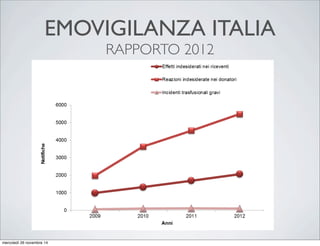
Rapporti ISTISAN 14/5
Figura 1. Numero di segnalazioni di emovigilanza per anno (2009-2012)
EMOVIGILANZA ITALIA
RAPPORTO 2012
mercoledì 26 novembre 14
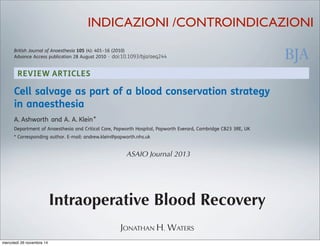
REVIEW ARTICLES
Cell salvage as part of a blood conservation strategy
in anaesthesia
A. Ashworth and A. A. Klein*
Department of Anaesthesia and Critical Care, Papworth Hospital, Papworth Everard, Cambridge CB23 3RE, UK
* Corresponding author. E-mail: andrew.klein@papworth.nhs.uk
Key points
† Cell salvage reduces the
requirement for allogenic
blood transfusion.
† It should be considered
for surgery with an
anticipated blood loss of
.1000 ml.
† It can be used in cancer
surgery, but a leucocyte
depletion filter is
recommended.
Summary. The use of intraoperative cell salvage and autologous blood transfusion has
become an important method of blood conservation. The main aim of autologous
transfusion is to reduce the need for allogeneic blood transfusion and its associated
complications. Allogeneic blood transfusion has been associated with increased risk of
tumour recurrence, postoperative infection, acute lung injury, perioperative myocardial
infarction, postoperative low-output cardiac failure, and increased mortality. We have
reviewed the current evidence for cell salvage in modern surgical practice and examined
the controversial issues, such as the use of cell salvage in obstetrics, and in patients with
malignancy, or intra-abdominal or systemic sepsis. Cell salvage has been demonstrated to
be safe and effective at reducing allogeneic blood transfusion requirements in adult
elective surgery, with stronger evidence in cardiac and orthopaedic surgery. Prolonged use
of cell salvage with large-volume autotransfusion may be associated with dilution of
clotting factors and thrombocytopenia, and regular laboratory or near-patient monitoring
is required, along with appropriate blood product use. Cell salvage should be considered in
British Journal of Anaesthesia 105 (4): 401–16 (2010)
Advance Access publication 28 August 2010 . doi:10.1093/bja/aeq244
ASAIO Journal 2013
Intraoperative Blood Recovery
JONATHAN H. WATERS
INDICAZIONI /CONTROINDICAZIONI
mercoledì 26 novembre 14
REVIEW ARTICLES
Cell salvage as part of a blood conservation strategy
in anaesthesia
A. Ashworth and A. A. Klein*
Department of Anaesthesia and Critical Care, Papworth Hospital, Papworth Everard, Cambridge CB23 3RE, UK
* Corresponding author. E-mail: andrew.klein@papworth.nhs.uk
Key points
† Cell salvage reduces the
requirement for allogenic
blood transfusion.
† It should be considered
for surgery with an
anticipated blood loss of
.1000 ml.
† It can be used in cancer
surgery, but a leucocyte
depletion filter is
recommended.
Summary. The use of intraoperative cell salvage and autologous blood transfusion has
become an important method of blood conservation. The main aim of autologous
transfusion is to reduce the need for allogeneic blood transfusion and its associated
complications. Allogeneic blood transfusion has been associated with increased risk of
tumour recurrence, postoperative infection, acute lung injury, perioperative myocardial
infarction, postoperative low-output cardiac failure, and increased mortality. We have
reviewed the current evidence for cell salvage in modern surgical practice and examined
the controversial issues, such as the use of cell salvage in obstetrics, and in patients with
malignancy, or intra-abdominal or systemic sepsis. Cell salvage has been demonstrated to
be safe and effective at reducing allogeneic blood transfusion requirements in adult
elective surgery, with stronger evidence in cardiac and orthopaedic surgery. Prolonged use
of cell salvage with large-volume autotransfusion may be associated with dilution of
clotting factors and thrombocytopenia, and regular laboratory or near-patient monitoring
is required, along with appropriate blood product use. Cell salvage should be considered in
British Journal of Anaesthesia 105 (4): 401–16 (2010)
Advance Access publication 28 August 2010 . doi:10.1093/bja/aeq244
ASAIO Journal 2013
Intraoperative Blood Recovery
JONATHAN H. WATERS
INDICAZIONI /CONTROINDICAZIONI
tdOxford, UKTRFTransfusion0041-11322004 American Association of Blood BanksDecember 200444Supplement40S44SOriginal ArticleCELL SALVAGE INDICATIONS AND CONTRAINDICATIONSWATERS
Indications and contraindications of cell salvage
Jonathan H. Waters
ultiple strategies can be applied to avoid
allogeneic transfusion. The primary meth-
ods involve erythropoietin and iron supple-
mentation, preoperative autologousM
cardiotomy reservoir, a suction line, and an anticoagula
This collection or “stand-by” setup costs comparably
the reagent costs for typing and crossing 2 units. Thou
a major paradigm shift, hospitals should consider imp
40S TRANSFUSION Volume 44, December 2004 Supplement
ABBREVIATION: CS = cell salvage.
From the Department of General Anesthesiology and Clinical
Pathology, Cleveland Clinic Foundation, Cleveland, Ohio.
Address reprint requests to: Jonathan H. Waters, MD,
Department of General Anesthesiology, Cleveland Clinic
Foundation, 9500 Euclid Avenue, E31, Cleveland, OH 44195;
e-mail: watersj@ccf.org.
TRANSFUSION 2004;44:40S-44S.
blood loss are anticipated.
Accurately predicting the probability of sizable blood
loss and need for allogeneic transfusion is difficult.
Because of this lack of predictability, implementation of
CS should start with a collection system which includes a
light of the
therapy, whic
Relative
range of mat
blood produ
readministra
include anyt
include steri
blood is wash
tion is aspira
will result in
taminants, ly
adequately w
into the CS s
adequate wa
and failure,
mercoledì 26 novembre 14
plasma, and cryoprecipitate. Anticipate coagulation factor
deficiency after more than 2 litres blood loss with continued bleed-
ing and repeat full blood count, prothrombin time, and activated
partial thromboplastin time and fibrinogen levels after the reinfu-
sion of each litre of salvaged blood in order to detect and appropri-
ately treat coagulapathy (Table 1).
General indications for cell salvage
(i) Anticipated intraoperative blood loss .1 litre or .20% of
blood volume.
(ii) Preoperative anaemia or increased risk factors for bleeding.
(iii) Patients with rare blood group or antibodies.
(iv) Patient refusal to receive allogeneic blood transfusion.
(v) The American Association of Blood Banks suggest cell
salvage is indicated in surgery where blood would ordinarily
be cross-matched or where more than 10% of patients under-
going the procedure require transfusion.
allo
fixe
requ
pro
was
cran
plas
Sp
Cel
enc
ord
in p
pro
afte
Hom
safe
Perioperative cell salvage
Lakshminarasimhan Kuppurao MD DA DNB FRCA
Michael Wee BSc (Hons) MBChB FRCA
The National Blood Service for England col-
lects, tests, processes, stores, and issues 2.1
million blood donations each year, and the
optimal use of this scarce resource is of para-
mount importance. Allogeneic red blood cell
(RBC) transfusion is associated with well-
known adverse effects. These include febrile,
anaphylactic, and haemolytic transfusion reac-
Key points
Complications of allogeneic
transfusion are rare but can
be life threatening.
There is a drive to reduce
allogeneic blood transfusion
due to cost and scarcity.
Cell salvage should be used
e cell salvage
purao MD DA DNB FRCA
s) MBChB FRCA
The National Blood Service for England col-
lects, tests, processes, stores, and issues 2.1
million blood donations each year, and the
optimal use of this scarce resource is of para-
mount importance. Allogeneic red blood cell
(RBC) transfusion is associated with well-
known adverse effects. These include febrile,
anaphylactic, and haemolytic transfusion reac-
tions, transfusion-related acute lung injury, and
transfusion-associated circulatory overload. In
addition, although rare, there are infection risks
of viral, bacterial, parasitic, or prion trans-
mission. In the laboratory setting, allogeneic
involves filtering and washing to remove con-
taminants. Red cells are retained, while the
plasma, platelets, heparin, free haemoglobin,
and inflammatory mediators are discarded with
the wash solution. This process may be discon-
tinuous or continuous, and the resulting red
cells are finally resuspended in normal saline at
a haematocrit of 50–70%, and reinfused into
the patient. Once primed, the cell salvage
machine should be used within 8 h to prevent
infective complications.
Benefits of cell salvage
Matrix reference 1A06
evolved since its inception in the 1960s.
Initially, cell salvage was limited to simply fil-
tering blood loss during surgery by gravity.
More modern devices collect blood to which is
added heparinized normal saline or citrate
anticoagulant. Processing the collected blood
activation of intravascular coagulation
increased capillary permeability causing
lung injury and renal failure. This syndr
related to the dilution of salvaged blood
large quantities of saline solution,
creates deposits of cellular aggregates
doi:10.1093/bjaceaccp/mkq017 Advance Access publication 26 M
Continuing Education in Anaesthesia, Critical Care & Pain | Volume 10 Number 4 2010
& The Author [2010]. Published by Oxford University Press on behalf of the British Journal of Anaesthesia.
All rights reserved. For Permissions, please email: journals.permissions@oxfordjournal.org
mercoledì 26 novembre 14
INDICAZIONI
E SELEZIONE DEL PAZIENTE
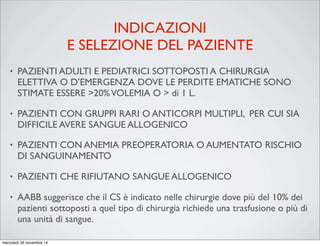
• PAZIENTI ADULTI E PEDIATRICI SOTTOPOSTI A CHIRURGIA
ELETTIVA O D’EMERGENZA DOVE LE PERDITE EMATICHE SONO
STIMATE ESSERE >20%VOLEMIA O > di 1 L.
• PAZIENTI CON GRUPPI RARI O ANTICORPI MULTIPLI, PER CUI SIA
DIFFICILE AVERE SANGUE ALLOGENICO
• PAZIENTI CON ANEMIA PREOPERATORIA O AUMENTATO RISCHIO
DI SANGUINAMENTO
• PAZIENTI CHE RIFIUTANO SANGUE ALLOGENICO
• AABB suggerisce che il CS è indicato nelle chirurgie dove più del 10% dei
pazienti sottoposti a quel tipo di chirurgia richiede una trasfusione o più di
una unità di sangue.
mercoledì 26 novembre 14
Clinical Education Series: Cell Saver®5/5+
Complications of and Contraindications to
Perioperative Autotransfusion
AABB Guidelines for Blood Recovery and Reinfusion in
Surgery and Trauma
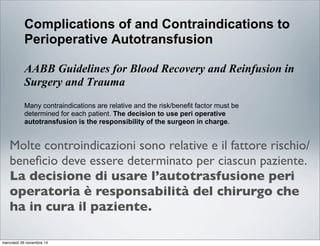
Many contraindications are relative and the risk/benefit factor must be
determined for each patient. The decision to use peri operative
autotransfusion is the responsibility of the surgeon in charge.
Refer to Table 2 for specific substances and their effects.
Table 2: Complications of and Contraindications to Perioperative Blood Recovery*
Substance Effects Recommended Action
Pharmacologic Agents
A. Clotting Agents
1. Microfibrillar Products May cause platelet aggregation Avoid aspiration when product is bein
Examples: and clot formation. used.
Avltene", Helitene® Reported to pass through a Resumption is an option after copious
Oxycel", microaggregate filter into the blood irrigation with 0.9% sodium chloride
Gelfoarn'" Powder, tnstat" stream, causing emboli. solution to an alternate suction sourc
MCH
Molte controindicazioni sono relative e il fattore rischio/
beneficio deve essere determinato per ciascun paziente.
La decisione di usare l’autotrasfusione peri
operatoria è responsabilità del chirurgo che
ha in cura il paziente.
mercoledì 26 novembre 14
CONTROINDICAZIONI
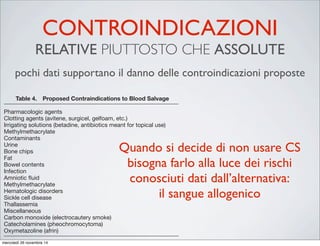
RELATIVE PIUTTOSTO CHE ASSOLUTE
pochi dati supportano il danno delle controindicazioni proposte
Many contraindications to blood salvage are not as defini-
tive as those just described. This would include blood aspi-
rated from contaminated or septic wounds, obstetrics, and
malignancy.
The impact of blood salvage processing on blood that has
been bacterially contaminated was first investigated by Bou-
dreaux,21
who inoculated expired units of blood with bacteria
and found that washing was capable of reducing contamina-
tion to 5–23% of the starting contamination. In a similar study,
Waters et al.22
found an approximately 99% reduction in
be attractive26,27
When applying blood salv
peripartum period, shed blood can be con
bacteria, amniotic fluid, and fetal blood. Am
tamination is feared because of the theoreti
create an iatrogenic amniotic fluid embolus
amniotic fluid embolus rarely occurs (1:8000–
eries), making definitive study impossible. T
to look at surrogate markers, which might be
the syndrome. Waters et al.28
demonstrated
depletion filters along with cell washing w
squamous cells to an extent comparable to
tion of these cells in a maternal blood sampl
separation. From this study it was conclude
bination of blood salvage washing and filt
a blood product comparable to circulating
with the exception of the fetal hemoglobin
Support for the use of blood salvage in obste
now encompasses 390 reported cases where
nated with amniotic fluid has been washed
tered without filtration.29–31
Malignancy
The last area of controversy is blood salvag
gery. Administration of tumor-laden blood from
would also seem to be contradictory to a go
come; however, during tumor surgery, hem
semination of cancer cells is common.32–34
In
demonstrated that a high percentage of patien
cancer surgery have circulating tumor cells b
Table 4. Proposed Contraindications to Blood Salvage
Pharmacologic agents
Clotting agents (avitene, surgicel, gelfoam, etc.)
Irrigating solutions (betadine, antibiotics meant for topical use)
Methylmethacrylate
Contaminants
Urine
Bone chips
Fat
Bowel contents
Infection
Amniotic fluid
Methylmethacrylate
Hematologic disorders
Sickle cell disease
Thallassemia
Miscellaneous
Carbon monoxide (electrocautery smoke)
Catecholamines (pheochromocytoma)
Oxymetazoline (afrin)
Quando si decide di non usare CS
bisogna farlo alla luce dei rischi
conosciuti dati dall’alternativa:
il sangue allogenico
mercoledì 26 novembre 14
AZIONI CORRETTIVE
• EVITARE L’ASPIRAZIONE DIRETTA (sito infetto, liquido
amniotico, disinfettante, colla, grasso.....)
• IRRIGARE IL SITO CHIRURGICO CON FISIOLOGICA
• LAVAGGIO EMAZIE MIGLIORATO
• FILTRO DELEUCOCIZZANTE (chir. tumorale e ostetricia)
mercoledì 26 novembre 14
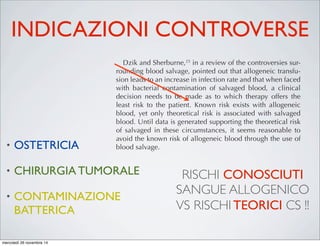
INDICAZIONI CONTROVERSE
• OSTETRICIA
• CHIRURGIA TUMORALE
• CONTAMINAZIONE
BATTERICA
ons to blood salvage is extensive
ontraindications are relative rather
s that little data exist to support the
ontraindications. When a decision
ood salvage, it needs to be consid-
isks associated with the alternative
c blood.
ns to blood salvage encompass a
t, if incorporated into the salvaged
tially injure the patient upon read-
raindications would include any-
ll lysis. This would include sterile
nd alcohol. If blood is washed with
nic solution is aspirated into a col-
result in red cell hemolysis. In the
ants, lysed cells will be washed out
washed but it is best to avoid incor-
vage system. If the blood is admin-
washing, it could result in renal
ecreases in hematocrit, elevations
nase level, increases in total serum
sseminated intravascular coagula-
.19,20
o blood salvage are not as defini-
d. This would include blood aspi-
or septic wounds, obstetrics, and
vage processing on blood that has
ated was first investigated by Bou-
important.
It is important to keep in mind that during the course of
most operations, a bacteremia is present related to the surgical
trauma. Broad-spectrum antibiotics are routinely used to man-
age this routine bacteremia. Several studies have suggested
that these drugs add additional safety when contaminated sal-
vaged blood is readministered.23,24
Dzik and Sherburne,25
in a review of the controversies sur-
rounding blood salvage, pointed out that allogeneic transfu-
sion leads to an increase in infection rate and that when faced
with bacterial contamination of salvaged blood, a clinical
decision needs to be made as to which therapy offers the
least risk to the patient. Known risk exists with allogeneic
blood, yet only theoretical risk is associated with salvaged
blood. Until data is generated supporting the theoretical risk
of salvaged in these circumstances, it seems reasonable to
avoid the known risk of allogeneic blood through the use of
blood salvage.
Obstetrics
One of the leading causes of death during childbirth is
hemorrhage, so the use of blood salvage would naturally
be attractive26,27
When applying blood salvage during the
peripartum period, shed blood can be contaminated with
bacteria, amniotic fluid, and fetal blood. Amniotic fluid con-
tamination is feared because of the theoretical potential to
create an iatrogenic amniotic fluid embolus. Unfortunately,
amniotic fluid embolus rarely occurs (1:8000–1:30,000 deliv-
RISCHI CONOSCIUTI
SANGUE ALLOGENICO
VS RISCHI TEORICI CS !!
mercoledì 26 novembre 14
CONTROINDICAZIONI RELATIVE
• QUALSIASI COSA CHE PROVOCHI LA LISI CELLULARE
• SITO INFETTO
• OSTETRICIA
• CHIRURGIA TUMORALE
mercoledì 26 novembre 14
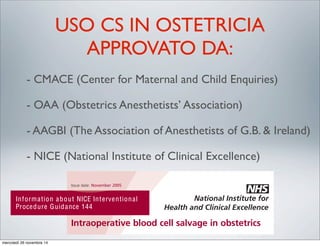
USO CS IN OSTETRICIA
APPROVATO DA:
- CMACE (Center for Maternal and Child Enquiries)
- OAA (Obstetrics Anesthetists’ Association)
- AAGBI (The Association of Anesthetists of G.B. & Ireland)
- NICE (National Institute of Clinical Excellence)
Intraoperative blood cell salvage in obstetrics
Issue date: November 2005
Information about NICE Interventional
Procedure Guidance 144
in obstetrics
Understanding NICE guidance –
information for people considering
the procedure, and for the public
mercoledì 26 novembre 14
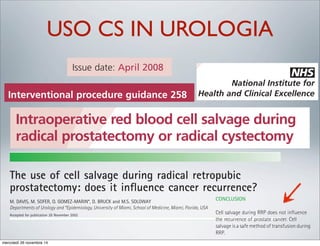
USO CS IN UROLOGIA
Intraoperative red blood cell salvage during
radical prostatectomy or radical cystectomy
1 Guidance
1.1 Intraoperative red blood cell salvage is an
efficacious technique for blood replacement and
its use is well established in other areas of surgery.
The evidence on safety is adequate. The
procedure may be used during radical
prostatectomy or radical cystectomy provided
normal arrangements are in place for clinical
governance and audit.
1.2 Clinicians wishing to undertake intraoperative red
blood cell salvage during radical prostatectomy or
radical cystectomy should ensure that patients
understand the possible risks and benefits of the
procedure compared with those of allogeneic
blood transfusion, and provide them with clear,
written information. In addition, use of the
Institute’s information for patients (‘Understanding
NICE guidance’) is recommended (available from
www.nice.org.uk/IPG258publicinfo).
2.2 Outline of the procedure
2.2.1 Blood lost during radical prostatectomy or radical
cystectomy is aspirated from the surgical field
using a suction catheter. The blood is then filtered
to remove debris. The filtered blood is washed or
spun and the red blood cells are resuspended in
saline, for transfusion during or after the
operation. A leukocyte depletion filter is nearly
always used; this is thought to minimise the risk of
re-infusion of malignant cells that may be present
in the aspirate. A number of different devices are
available for this procedure.
Issue date: April 2008
NHS
National Institute for
Health and Clinical Excellence
Sections 2.3 and 2.4 describe efficacy and safety
outcomes which were available in the published
literature and which the Committee considered
as part of the evidence about this procedure. For
more details, refer to the Sources of evidence.
section 3.2).
2.1.2 Intraoperative red blood cell salvage offers an
alternative to allogeneic or pre-donated
autologous blood transfusion. It may also be
useful in the treatment of patients who object
to allogeneic blood transfusion on religious or
other grounds.
perioperative imm
2.4 Safety
2.4.1 A non-randomise
were treated with
similar rates of bio
recurrence in 265
Interventional procedure guidance 258
Interventional procedures guidance makes recommendations on the safety and efficacy of a proce
does not cover whether or not the NHS should fund a procedure. Decisions about funding are tak
bodies (primary care trusts and hospital trusts) after considering the clinical effectiveness of the p
whether it represents value for money for the NHS.
Interventional procedures guidance is for healthcare professionals and people using the NHS in En
Scotland and Northern Ireland. This guidance is endorsed by NHS QIS for implementation by NHSS
Intraoperative red blood cell salvage during
radical prostatectomy or radical cystectomy
1 Guidance
1.1 Intraoperative red blood cell salvage is an
efficacious technique for blood replacement and
its use is well established in other areas of surgery.
The evidence on safety is adequate. The
procedure may be used during radical
prostatectomy or radical cystectomy provided
normal arrangements are in place for clinical
governance and audit.
1.2 Clinicians wishing to undertake intraoperative red
blood cell salvage during radical prostatectomy or
2.2 Outline of the procedure
2.2.1 Blood lost during radical prostatectomy or radic
cystectomy is aspirated from the surgical field
using a suction catheter. The blood is then filter
to remove debris. The filtered blood is washed o
spun and the red blood cells are resuspended in
saline, for transfusion during or after the
operation. A leukocyte depletion filter is nearly
always used; this is thought to minimise the risk
re-infusion of malignant cells that may be prese
in the aspirate. A number of different devices a
available for this procedure.
Issue date: April 2008
NHS
National Institute fo
Health and Clinical Excellenc
Intraoperative red blood ce
radical prostatectomy or ra
1 Guidance 2.2
Issue date: April 2008
Healtcience, LtdOxford, UKBJUBJU International1464-4096BJU InternationalApril 2003
ticle
AGE DURING RADICAL RETROPUBIC PROSTATECTOMY
The use of cell salvage during radical retropubic
prostatectomy: does it influence cancer recurrence?
M. DAVIS, M. SOFER, O. GOMEZ-MARIN*, D. BRUCK and M.S. SOLOWAY
Departments of Urology and *Epidemiology, University of Miami, School of Medicine, Miami, Florida, USA
Accepted for publication 28 November 2002
blood using a commercial cell saver; 264
receiving only autologous transfusion; and
level and Gleason score. In the multivariate
logistic regression analysis, the initial PSA,
OBJECTIVE
ience, LtdOxford, UKBJUBJU International1464-4096BJU InternationalApril 2003
cle
GE DURING RADICAL RETROPUBIC PROSTATECTOMY
The use of cell salvage during radical retropubic
prostatectomy: does it influence cancer recurrence?
M. DAVIS, M. SOFER, O. GOMEZ-MARIN*, D. BRUCK and M.S. SOLOWAY
Departments of Urology and *Epidemiology, University of Miami, School of Medicine, Miami, Florida, USA
Accepted for publication 28 November 2002
blood using a commercial cell saver; 264
receiving only autologous transfusion; and
57 with no transfusion. Disease recurrence
was defined as a prostate-specific antigen
(PSA) level of >0.2 ng/mL. Bivariate and
multivariate logistic regression analyses were
used to assess and compare the risk of cancer
recurrence in the three groups. Covariates
used in the multivariate analyses included
Gleason score, preoperative PSA level, seminal
vesicle involvement and surgical margins.
RESULTS
level and Gleason score. In the multivariate
logistic regression analysis, the initial PSA,
Gleason score, seminal vesicle involvement
and surgical margins, but not transfusion
group, were independent predictors of
recurrence.
CONCLUSION
Cell salvage during RRP does not influence
the recurrence of prostate cancer. Cell
salvage is a safe method of transfusion during
RRP.
OBJECTIVE
To assess whether there is a difference in the
biochemical recurrence rate in patients who
had radical retropubic prostatectomy (RRP)
with or without cell salvage transfusion.
PATIENTS AND METHODS
The records of 769 consecutive patients
undergoing RRP between 1992 and 1998
were retrospectively reviewed. Patients having
adjuvant hormonal treatment, postoperative
external beam radiotherapy, or a follow-up ofmercoledì 26 novembre 14
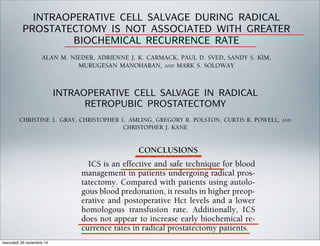
INTRAOPERATIVE CELL SALVAGE DURING RADICAL
PROSTATECTOMY IS NOT ASSOCIATED WITH GREATER
BIOCHEMICAL RECURRENCE RATE
ALAN M. NIEDER, ADRIENNE J. K. CARMACK, PAUL D. SVED, SANDY S. KIM,
MURUGESAN MANOHARAN, AND MARK S. SOLOWAY
ABSTRACT
Objectives. To evaluate the risk of long-term biochemical recurrence for patients who receive cell-salvaged
blood. Radical retropubic prostatectomy (RRP) is historically associated with the potential for significant
blood loss. Different blood management strategies include blood donation, hemodilution, preoperative
erythropoietin, and intraoperative cell salvage (IOCS). Oncologic surgeons have been reluctant to use IOCS
because of the potential risk of tumor dissemination.
Methods. We retrospectively analyzed an RRP database and compared those who did and did not receive
cell-salvaged blood by baseline parameters, pathologic outcomes, and biochemical recurrence. We also
stratified our patients according to the risk of recurrence.
Results. A total of 1038 patients underwent RRP between 1992 and 2003. Of these, 265 (25.5%) received
cell-salvaged blood and 773 (74.5%) did not. The two groups had similar baseline characteristics. No
differences were found between the two groups when compared by risk of seminal vesicle invasion or
positive surgical margins. Those who received cell-salvaged blood had a lower risk of extraprostatic
extension. The median follow-up for all patients was 40.2 months. The overall risk of biochemical recurrence
at 5 years for those who did and did not receive cell-salvaged blood was 15% and 18%, respectively (P ϭ
0.76). No significant differences were found in the risk of biochemical recurrence when patients were
stratified according to low, intermediate, and high risk.
Conclusions. IOCS is a safe and effective blood management strategy for patients undergoing RRP. The risk
of biochemical recurrence was not increased for those who received cell-salvaged blood. Concerns about
spreading tumor cells by way of IOCS would seem unwarranted. UROLOGY 65: 730–734, 2005. © 2005
Elsevier Inc.
INTRAOPERATIVE CELL SALVAGE IN RADICAL
RETROPUBIC PROSTATECTOMY
CHRISTINE L. GRAY, CHRISTOPHER L. AMLING, GREGORY R. POLSTON, CURTIS R. POWELL, AND
CHRISTOPHER J. KANE
ABSTRACT
Objectives. To investigate the efficacy and safety of intraoperative cell salvage with autotransfusion using
leukocyte reduction filters in patients undergoing radical retropubic prostatectomy (RRP).
Methods. Between September 1996 and March 1999, 62 patients (age range 48 to 70 years) with clinically
localized prostate cancer underwent RRP with intraoperative cell salvage as the sole blood management
technique. Salvaged blood was passed through a leukocyte reduction filter before autotransfusion. The 62
cell salvage patients were compared with a cohort who predonated 1 to 3 U autologous blood (n ϭ 101). The
estimated blood loss, preoperative and postoperative hematocrit, need for homologous transfusion, and
biochemical recurrence rates were compared between the two groups. The progression-free survival rates
were compared using the Kaplan-Meier method.
Results. No difference was found in preoperative prostate-specific antigen level, pathologic stage, or
estimated blood loss between the cell salvage and autologous predonation groups. The preoperative and
postoperative hematocrit levels were higher in the cell salvage group (42.7% versus 39.6% and 31.3%
versus 27.9%, respectively; P Ͻ0.001 for each). The homologous transfusion rates were lower in the cell
ADULT UROLOGY
age and autologous
ow-up of these pa-
onclusions about the
but the early recur-
increased with ICS.
ells had occurred in
ssion of tumor bur-
was not observed in
use no clinical recur-
p, PSA was used as a
use of a serum PSA
as a marker for bio-
een supported.27
blood is expensive,
nient for the patient.
iable, depending on
hnical support staff,
he disposables to re-
tion is $100, plus an
than contemporary, the allogeneic transfusion cri-
teria may have differed. Because both cohorts un-
derwent surgery in the 1990s, after the require-
ments for transfusion were made more stringent,
this is unlikely. Our criteria, namely symptomatic
anemia or Hct less than 30% in patients with car-
diac disease, were identical for both groups.
CONCLUSIONS
ICS is an effective and safe technique for blood
management in patients undergoing radical pros-
tatectomy. Compared with patients using autolo-
gous blood predonation, it results in higher preop-
erative and postoperative Hct levels and a lower
homologous transfusion rate. Additionally, ICS
does not appear to increase early biochemical re-
currence rates in radical prostatectomy patients.
mercoledì 26 novembre 14
Intraoperative red cell salvage in metastatic spine surgeryAsian Spine JournalAsian Spine Journal 167
Role of Intraoperative Red Cell Salvage and
Autologus Transfusion in Metastatic Spine Surgery:
A Pilot Study and Review of Literature
Harinder Gakhar, Munzer Bagouri, Rajendranath Bommireddy, Zdenek Klezl
Department of Trauma and Orthopaedics, Royal Derby Hospital, Derby, UK
Clinical Study Asian Spine J 2013;7(3):167-172 • http://dx.doi.org/10.4184/asj.2013.7.3.167
Asian Spine JournalAsian Spine Journal
TATM 2001;3(6):25-28
Use of the Cell Saver
in Oncologic Surgery
TATM Vol 3 n°6 31/01/02 11:21 Page 25
TATM 2001;3(6):25-28
TATM Vol 3 n°6 31/
S U M M A R Y
1
HEAD, DEPARTMENT OF GENERAL CANCER SURGERY
DOMINIQUE ÉLIAS1
,
VALÉRIE BILLARD2
, VALÉRIE LAPIERRE3
TATM 2001;3(6):25-28
Use of the cell saver in oncologic surgery i
reinfusion of cancer cells remaining in the
and clinical studies have indeed confirmed
packed red cells. However, six clinical stud
showed no metastatic spread after process
adjunctive use of a leukocyte depletion fil
Use of the Cell Saver
in Oncologic Surgery
(
TATM Vol 3 n°6 31/01/02 11:21 Page 25
B L O O D M A N A G E M E N T
Blood salvage use in gynecologic oncology_02256 2048..2053
Nimesh P. Nagarsheth, Tarun Sharma, Aryeh Shander, and Ahsan Awan
ND: Blood salvage allows for collection
ng of surgical blood loss with the eventual
washed red blood cells (RBCs) back to the
use of blood salvage in patients undergo-
or malignancy is off-label. Controversy
he risk of potential cancer dissemination
m the reinfusion of the processed blood, but
available to confirm this risk. Recent
demonstrated that filtering the salvaged
a leukoreduction filter (LRF) significantly
e number of cancer cells in the recovered
in a variety of cancer types.
B
lood management optimizes outcomes in
patients undergoing surgical procedures who
wish to avoid allogeneic transfusion.1
Blood
management is the philosophy to improve
patient outcomes by integrating all available techniques
to reduce or eliminate allogeneic blood transfusions. It is a
patient-centered, multidisciplinary, multimodal, planned
approach to patient care.2
Using a series of interventions
and management strategies related to this goal, patients
who were previously considered extremely high risk or
inoperable without a blood transfusion can now undergo
complex surgical procedures with acceptable outcomes.3
Blood salvage (also known as intraoperative autolo-
BBREVIATIONS: CT = computed tomography;
RF(s) = leukoreduction filter(s).
om the Division of Gynecologic Oncology, Department of
bstetrics, Gynecology and Reproductive Science and the
epartment of Anesthesiology and Critical Care Medicine,
nglewood Hospital and Medical Center, Englewood, New
rsey; and the Mount Sinai School of Medicine, New York,
ew York.
Address reprint requests to: Nimesh P. Nagarsheth, Division
Gynecologic Oncology, Department of Obstetrics, Gynecology
d Reproductive Science, Mount Sinai Medical Center, 1176
fth Avenue, Box 1173, New York, NY 10029-6574; e-mail:
mesh.nagarsheth@gmail.com.
Received for publication January 7, 2009; revision received
pril 8, 2009; and accepted April 10, 2009.
doi: 10.1111/j.1537-2995.2009.02256.x
TRANSFUSION 2009;49:2048-2053.
mercoledì 26 novembre 14
OSTETRICIA
CHIRURGIA TUMORALE
• FILTRO DELEUCOCIZZANTE
(J. H.Waters - Pittsburgh, PA)
• IRRADIAZIONE DELLE EMAZIE 50 Gy - 12 Log reduction
probabilità di cellule tumorali residue minore del 99,97%
(E. Hansen - Regensburgh)
mercoledì 26 novembre 14
Intraoperative blood salvage in cancer surgery:
safe and effective?
Ernil Hansen *, Volker Bechmann, Juergen Altmeppen
Department of Anesthesiologie, University of Regensburg, D-93042 Regensburg, Germany
Abstract
To support blood supply in the growing field of cancer surgery and to avoid transfusion induced immunomodulation
caused by the allogeneic barrier and by blood storage leasions we use intraoperative blood salvage with blood irra-
diation. This method is safe as it provides efficient elimination of contaminating cancer cells, and as it does not
compromise the quality of RBC. According to our experience with more than 700 procedures the combination of blood
salvage with blood irradiation also is very effective in saving blood resources. With this autologous, fresh, washed RBC
a blood product of excellent quality is available for optimal hemotherapy in cancer patients.
Ó 2002 Elsevier Science Ltd. All rights reserved.
1. Introduction
The demand for blood in cancer surgery is high
and increasing. Problems with the supply of com-
patible blood are not uncommon in these patients
that previously have seen surgery and transfusions.
Some transfusion risks are especially relevant to
cancer patients like immunomodulation with im-
donations suffers from the poor predictability of
intraoperative blood loss leading to a waste of
autologous blood, or to insufficient supply. Im-
munosuppression is not only caused by the allog-
eneic barrier, but also by cell lesions during blood
storage at low temperature [2], relevant to both
allogeneic and autologous banked blood. In ad-
dition, growth factors are released during storage
www.elsevier.com/locate/transci
Intraoperative blood salvage in cancer surgery
safe and effective?
Ernil Hansen *, Volker Bechmann, Juergen Altmeppen
Department of Anesthesiologie, University of Regensburg, D-93042 Regensburg, Germany
act
support blood supply in the growing field of cancer surgery and to avoid transfusion induced imm
d by the allogeneic barrier and by blood storage leasions we use intraoperative blood salvage w
www.elsevier.
Transfusion and Apheresis Science 27 (2002) 153–157
Fig. 1. Transfusion risks most relevant to cancer patients.
E. Hansen et al. / Transfusion and Apheresis Science 27 (2002) 153–157
più di 700 casi
irradiazione GRC
50Gy
diminuzione cellule
tumorali Log 12
ottima qualità,
sopravvivenza,
funzione
mercoledì 26 novembre 14
2011 Update to The Society of Thoracic Surgeons
and the Society of Cardiovascular Anesthesiologists
Blood Conservation Clinical Practice Guidelines*
The Society of Thoracic Surgeons Blood Conservation Guideline Task Force:
Victor A. Ferraris, MD, PhD (Chair), Jeremiah R. Brown, PhD, George J. Despotis, MD,
John W. Hammon, MD, T. Brett Reece, MD, Sibu P. Saha, MD, MBA,
Howard K. Song, MD, PhD, and Ellen R. Clough, PhD
The Society of Cardiovascular Anesthesiologists Special Task Force on Blood Transfusion:
Linda J. Shore-Lesserson, MD, Lawrence T. Goodnough, MD, C. David Mazer, MD,
Aryeh Shander, MD, Mark Stafford-Smith, MD, and Jonathan Waters, MD
The International Consortium for Evidence Based Perfusion:
Robert A. Baker, PhD, Dip Perf, CCP (Aus), Timothy A. Dickinson, MS,
Daniel J. FitzGerald, CCP, LP, Donald S. Likosky, PhD, and Kenneth G. Shann, CCP
Division of Cardiovascular and Thoracic Surgery, University of Kentucky, Lexington, Kentucky (VAF, SPS), Department of
Anesthesiology, University of Pittsburgh Medical Center, Pittsburgh, Pennsylvania (JW), Departments of Anesthesiology and Critical
Care Medicine, Englewood Hospital and Medical Center, Englewood, New Jersey (AS), Departments of Pathology and Medicine,
Stanford University School of Medicine, Stanford, California (LTG), Departments of Anesthesiology and Cardiothoracic Surgery,
Montefiore Medical Center, Bronx, New York (LJS-L, KGS), Departments of Anesthesiology, Immunology, and Pathology, Washington
University School of Medicine, St. Louis, Missouri (GJD), Dartmouth Institute for Health Policy and Clinical Practice, Section of
Cardiology, Dartmouth Medical School, Lebanon, New Hampshire (JRB), Department of Cardiothoracic Surgery, Wake Forest School of
Medicine, Winston-Salem, North Carolina (JWH), Department of Anesthesia, St. Michael’s Hospital, University of Toronto, Toronto,
Ontario (CDM), Cardiac Surgical Research Group, Flinders Medical Centre, South Australia, Australia (RAB), Department of Surgery,
Medicine, Community and Family Medicine, and the Dartmouth Institute for Health Policy and Clinical Practice, Dartmouth Medical
School, Hanover, New Hampshire (DSL), SpecialtyCare, Nashville, Tennessee (TAD), Department of Cardiac Surgery, Brigham and
Women’s Hospital, Harvard University, Boston, Massachusetts (DJF), Division of Cardiothoracic Surgery, Oregon Health and Science
University Medical Center, Portland, Oregon (HKS), Department of Cardiothoracic Surgery, University of Colorado Health Sciences
Center, Aurora, Colorado (TBR), Department of Anesthesiology, Duke University Medical Center, Durham, North Carolina (MS-S), and
The Society of Thoracic Surgeons, Chicago, Illinois (ERC)
Background. Practice guidelines reflect published liter- Methods. The search methods used in the current
pro-
bolic
ports
with
213].
t re-
lica-
that
om-
g, or
per-
ICU
Two
ship
pa-
volv-
diac
tar-
mbo-
able [227], and addition of factor concentrates augments
multiple other interventions. Fractionated factor concen-
trates, like factor IX concentrates or one of its various
forms (Beriplex or factor VIII inhibitor bypassing activ-
ity), are considered “secondary components” and may be
acceptable to some Jehovah’s Witness patients [222].
Addition of factor IX concentrates may be most useful in
the highest risk Jehovah’s Witness patients.
d) Blood Salvage Interventions
EXPANDED USE OF RED CELL SALVAGE USING CENTRIFUGATION
Class IIb.
1. In high-risk patients with known malignancy who
require CPB, blood salvage using centrifugation of
blood salvaged from the operative field may be
considered since substantial data support benefit in
patients without malignancy, and new evidence
suggests worsened outcome when allogeneic trans-
fusion is required in patients with malignancy.
(Level of evidence B)
In 1986, the American Medical Association Council on
Scientific Affairs issued a statement regarding the safety
of blood salvage during cancer surgery [228]. At that
time, they advised against its use. Since then, 10 obser-
vational studies that included 476 patients who received
blood salvage during resection of multiple different tumor
types involving the liver [229–231], prostate [232–234],
uterus [235, 236], and urologic system [237, 238] support the
use of salvage of red cells using centrifugation in cancer
patients. In seven studies, a control group received no
transfusion, allogeneic transfusion, or preoperative autolo-
end of CPB is reasonable as part of a bl
agement program to minimize blood tr
(Level of evidence C)
2. Centrifugation instead of direct infusion o
pump blood is reasonable for minimizing
allogeneic RBC transfusion. (Level of evi
Most surgical teams reinfuse blood from t
poreal circuit (ECC) back into patients at the
as part of a blood conservation strategy. Cu
blood salvaging techniques exist: (1) direct
post-CPB circuit blood with no processing;
cessing of the circuit blood, either by centrifu
ultrafiltration, to remove either plasma com
water soluble components from blood before
Ann Thorac Surg FERRARIS
2011;91:944–82 STS BLOOD CONSERVATION REVISION
mercoledì 26 novembre 14
2011 Update to The Society of Thoracic Surgeons
and the Society of Cardiovascular Anesthesiologists
Blood Conservation Clinical Practice Guidelines*
The Society of Thoracic Surgeons Blood Conservation Guideline Task Force:
Victor A. Ferraris, MD, PhD (Chair), Jeremiah R. Brown, PhD, George J. Despotis, MD,
John W. Hammon, MD, T. Brett Reece, MD, Sibu P. Saha, MD, MBA,
Howard K. Song, MD, PhD, and Ellen R. Clough, PhD
The Society of Cardiovascular Anesthesiologists Special Task Force on Blood Transfusion:
Linda J. Shore-Lesserson, MD, Lawrence T. Goodnough, MD, C. David Mazer, MD,
Aryeh Shander, MD, Mark Stafford-Smith, MD, and Jonathan Waters, MD
The International Consortium for Evidence Based Perfusion:
Robert A. Baker, PhD, Dip Perf, CCP (Aus), Timothy A. Dickinson, MS,
Daniel J. FitzGerald, CCP, LP, Donald S. Likosky, PhD, and Kenneth G. Shann, CCP
Division of Cardiovascular and Thoracic Surgery, University of Kentucky, Lexington, Kentucky (VAF, SPS), Department of
Anesthesiology, University of Pittsburgh Medical Center, Pittsburgh, Pennsylvania (JW), Departments of Anesthesiology and Critical
Care Medicine, Englewood Hospital and Medical Center, Englewood, New Jersey (AS), Departments of Pathology and Medicine,
Stanford University School of Medicine, Stanford, California (LTG), Departments of Anesthesiology and Cardiothoracic Surgery,
Montefiore Medical Center, Bronx, New York (LJS-L, KGS), Departments of Anesthesiology, Immunology, and Pathology, Washington
University School of Medicine, St. Louis, Missouri (GJD), Dartmouth Institute for Health Policy and Clinical Practice, Section of
Cardiology, Dartmouth Medical School, Lebanon, New Hampshire (JRB), Department of Cardiothoracic Surgery, Wake Forest School of
Medicine, Winston-Salem, North Carolina (JWH), Department of Anesthesia, St. Michael’s Hospital, University of Toronto, Toronto,
Ontario (CDM), Cardiac Surgical Research Group, Flinders Medical Centre, South Australia, Australia (RAB), Department of Surgery,
Medicine, Community and Family Medicine, and the Dartmouth Institute for Health Policy and Clinical Practice, Dartmouth Medical
School, Hanover, New Hampshire (DSL), SpecialtyCare, Nashville, Tennessee (TAD), Department of Cardiac Surgery, Brigham and
Women’s Hospital, Harvard University, Boston, Massachusetts (DJF), Division of Cardiothoracic Surgery, Oregon Health and Science
University Medical Center, Portland, Oregon (HKS), Department of Cardiothoracic Surgery, University of Colorado Health Sciences
Center, Aurora, Colorado (TBR), Department of Anesthesiology, Duke University Medical Center, Durham, North Carolina (MS-S), and
The Society of Thoracic Surgeons, Chicago, Illinois (ERC)
Background. Practice guidelines reflect published liter- Methods. The search methods used in the current
pro-
bolic
ports
with
213].
t re-
lica-
that
om-
g, or
per-
ICU
Two
ship
pa-
volv-
diac
tar-
mbo-
able [227], and addition of factor concentrates augments
multiple other interventions. Fractionated factor concen-
trates, like factor IX concentrates or one of its various
forms (Beriplex or factor VIII inhibitor bypassing activ-
ity), are considered “secondary components” and may be
acceptable to some Jehovah’s Witness patients [222].
Addition of factor IX concentrates may be most useful in
the highest risk Jehovah’s Witness patients.
d) Blood Salvage Interventions
EXPANDED USE OF RED CELL SALVAGE USING CENTRIFUGATION
Class IIb.
1. In high-risk patients with known malignancy who
require CPB, blood salvage using centrifugation of
blood salvaged from the operative field may be
considered since substantial data support benefit in
patients without malignancy, and new evidence
suggests worsened outcome when allogeneic trans-
fusion is required in patients with malignancy.
(Level of evidence B)
In 1986, the American Medical Association Council on
Scientific Affairs issued a statement regarding the safety
of blood salvage during cancer surgery [228]. At that
time, they advised against its use. Since then, 10 obser-
vational studies that included 476 patients who received
blood salvage during resection of multiple different tumor
types involving the liver [229–231], prostate [232–234],
uterus [235, 236], and urologic system [237, 238] support the
use of salvage of red cells using centrifugation in cancer
patients. In seven studies, a control group received no
transfusion, allogeneic transfusion, or preoperative autolo-
end of CPB is reasonable as part of a bl
agement program to minimize blood tr
(Level of evidence C)
2. Centrifugation instead of direct infusion o
pump blood is reasonable for minimizing
allogeneic RBC transfusion. (Level of evi
Most surgical teams reinfuse blood from t
poreal circuit (ECC) back into patients at the
as part of a blood conservation strategy. Cu
blood salvaging techniques exist: (1) direct
post-CPB circuit blood with no processing;
cessing of the circuit blood, either by centrifu
ultrafiltration, to remove either plasma com
water soluble components from blood before
Ann Thorac Surg FERRARIS
2011;91:944–82 STS BLOOD CONSERVATION REVISION
10 studi osservazionali su 476 pazienti
operati per diverse patologie tumorali
supportano l’uso del cell saver
mercoledì 26 novembre 14
2011 Update to The Society of Thoracic Surgeons
and the Society of Cardiovascular Anesthesiologists
Blood Conservation Clinical Practice Guidelines*
The Society of Thoracic Surgeons Blood Conservation Guideline Task Force:
Victor A. Ferraris, MD, PhD (Chair), Jeremiah R. Brown, PhD, George J. Despotis, MD,
John W. Hammon, MD, T. Brett Reece, MD, Sibu P. Saha, MD, MBA,
Howard K. Song, MD, PhD, and Ellen R. Clough, PhD
The Society of Cardiovascular Anesthesiologists Special Task Force on Blood Transfusion:
Linda J. Shore-Lesserson, MD, Lawrence T. Goodnough, MD, C. David Mazer, MD,
Aryeh Shander, MD, Mark Stafford-Smith, MD, and Jonathan Waters, MD
The International Consortium for Evidence Based Perfusion:
Robert A. Baker, PhD, Dip Perf, CCP (Aus), Timothy A. Dickinson, MS,
Daniel J. FitzGerald, CCP, LP, Donald S. Likosky, PhD, and Kenneth G. Shann, CCP
Division of Cardiovascular and Thoracic Surgery, University of Kentucky, Lexington, Kentucky (VAF, SPS), Department of
Anesthesiology, University of Pittsburgh Medical Center, Pittsburgh, Pennsylvania (JW), Departments of Anesthesiology and Critical
Care Medicine, Englewood Hospital and Medical Center, Englewood, New Jersey (AS), Departments of Pathology and Medicine,
Stanford University School of Medicine, Stanford, California (LTG), Departments of Anesthesiology and Cardiothoracic Surgery,
Montefiore Medical Center, Bronx, New York (LJS-L, KGS), Departments of Anesthesiology, Immunology, and Pathology, Washington
University School of Medicine, St. Louis, Missouri (GJD), Dartmouth Institute for Health Policy and Clinical Practice, Section of
Cardiology, Dartmouth Medical School, Lebanon, New Hampshire (JRB), Department of Cardiothoracic Surgery, Wake Forest School of
Medicine, Winston-Salem, North Carolina (JWH), Department of Anesthesia, St. Michael’s Hospital, University of Toronto, Toronto,
Ontario (CDM), Cardiac Surgical Research Group, Flinders Medical Centre, South Australia, Australia (RAB), Department of Surgery,
Medicine, Community and Family Medicine, and the Dartmouth Institute for Health Policy and Clinical Practice, Dartmouth Medical
School, Hanover, New Hampshire (DSL), SpecialtyCare, Nashville, Tennessee (TAD), Department of Cardiac Surgery, Brigham and
Women’s Hospital, Harvard University, Boston, Massachusetts (DJF), Division of Cardiothoracic Surgery, Oregon Health and Science
University Medical Center, Portland, Oregon (HKS), Department of Cardiothoracic Surgery, University of Colorado Health Sciences
Center, Aurora, Colorado (TBR), Department of Anesthesiology, Duke University Medical Center, Durham, North Carolina (MS-S), and
The Society of Thoracic Surgeons, Chicago, Illinois (ERC)
Background. Practice guidelines reflect published liter- Methods. The search methods used in the current
pro-
bolic
ports
with
213].
t re-
lica-
that
om-
g, or
per-
ICU
Two
ship
pa-
volv-
diac
tar-
mbo-
able [227], and addition of factor concentrates augments
multiple other interventions. Fractionated factor concen-
trates, like factor IX concentrates or one of its various
forms (Beriplex or factor VIII inhibitor bypassing activ-
ity), are considered “secondary components” and may be
acceptable to some Jehovah’s Witness patients [222].
Addition of factor IX concentrates may be most useful in
the highest risk Jehovah’s Witness patients.
d) Blood Salvage Interventions
EXPANDED USE OF RED CELL SALVAGE USING CENTRIFUGATION
Class IIb.
1. In high-risk patients with known malignancy who
require CPB, blood salvage using centrifugation of
blood salvaged from the operative field may be
considered since substantial data support benefit in
patients without malignancy, and new evidence
suggests worsened outcome when allogeneic trans-
fusion is required in patients with malignancy.
(Level of evidence B)
In 1986, the American Medical Association Council on
Scientific Affairs issued a statement regarding the safety
of blood salvage during cancer surgery [228]. At that
time, they advised against its use. Since then, 10 obser-
vational studies that included 476 patients who received
blood salvage during resection of multiple different tumor
types involving the liver [229–231], prostate [232–234],
uterus [235, 236], and urologic system [237, 238] support the
use of salvage of red cells using centrifugation in cancer
patients. In seven studies, a control group received no
transfusion, allogeneic transfusion, or preoperative autolo-
end of CPB is reasonable as part of a bl
agement program to minimize blood tr
(Level of evidence C)
2. Centrifugation instead of direct infusion o
pump blood is reasonable for minimizing
allogeneic RBC transfusion. (Level of evi
Most surgical teams reinfuse blood from t
poreal circuit (ECC) back into patients at the
as part of a blood conservation strategy. Cu
blood salvaging techniques exist: (1) direct
post-CPB circuit blood with no processing;
cessing of the circuit blood, either by centrifu
ultrafiltration, to remove either plasma com
water soluble components from blood before
Ann Thorac Surg FERRARIS
2011;91:944–82 STS BLOOD CONSERVATION REVISION
10 studi osservazionali su 476 pazienti
operati per diverse patologie tumorali
supportano l’uso del cell saver
mercoledì 26 novembre 14
2011 Update to The Society of Thoracic Surgeons
and the Society of Cardiovascular Anesthesiologists
Blood Conservation Clinical Practice Guidelines*
The Society of Thoracic Surgeons Blood Conservation Guideline Task Force:
Victor A. Ferraris, MD, PhD (Chair), Jeremiah R. Brown, PhD, George J. Despotis, MD,
John W. Hammon, MD, T. Brett Reece, MD, Sibu P. Saha, MD, MBA,
Howard K. Song, MD, PhD, and Ellen R. Clough, PhD
The Society of Cardiovascular Anesthesiologists Special Task Force on Blood Transfusion:
Linda J. Shore-Lesserson, MD, Lawrence T. Goodnough, MD, C. David Mazer, MD,
Aryeh Shander, MD, Mark Stafford-Smith, MD, and Jonathan Waters, MD
The International Consortium for Evidence Based Perfusion:
Robert A. Baker, PhD, Dip Perf, CCP (Aus), Timothy A. Dickinson, MS,
Daniel J. FitzGerald, CCP, LP, Donald S. Likosky, PhD, and Kenneth G. Shann, CCP
Division of Cardiovascular and Thoracic Surgery, University of Kentucky, Lexington, Kentucky (VAF, SPS), Department of
Anesthesiology, University of Pittsburgh Medical Center, Pittsburgh, Pennsylvania (JW), Departments of Anesthesiology and Critical
Care Medicine, Englewood Hospital and Medical Center, Englewood, New Jersey (AS), Departments of Pathology and Medicine,
Stanford University School of Medicine, Stanford, California (LTG), Departments of Anesthesiology and Cardiothoracic Surgery,
Montefiore Medical Center, Bronx, New York (LJS-L, KGS), Departments of Anesthesiology, Immunology, and Pathology, Washington
University School of Medicine, St. Louis, Missouri (GJD), Dartmouth Institute for Health Policy and Clinical Practice, Section of
Cardiology, Dartmouth Medical School, Lebanon, New Hampshire (JRB), Department of Cardiothoracic Surgery, Wake Forest School of
Medicine, Winston-Salem, North Carolina (JWH), Department of Anesthesia, St. Michael’s Hospital, University of Toronto, Toronto,
Ontario (CDM), Cardiac Surgical Research Group, Flinders Medical Centre, South Australia, Australia (RAB), Department of Surgery,
Medicine, Community and Family Medicine, and the Dartmouth Institute for Health Policy and Clinical Practice, Dartmouth Medical
School, Hanover, New Hampshire (DSL), SpecialtyCare, Nashville, Tennessee (TAD), Department of Cardiac Surgery, Brigham and
Women’s Hospital, Harvard University, Boston, Massachusetts (DJF), Division of Cardiothoracic Surgery, Oregon Health and Science
University Medical Center, Portland, Oregon (HKS), Department of Cardiothoracic Surgery, University of Colorado Health Sciences
Center, Aurora, Colorado (TBR), Department of Anesthesiology, Duke University Medical Center, Durham, North Carolina (MS-S), and
The Society of Thoracic Surgeons, Chicago, Illinois (ERC)
Background. Practice guidelines reflect published liter- Methods. The search methods used in the current
pro-
bolic
ports
with
213].
t re-
lica-
that
om-
g, or
per-
ICU
Two
ship
pa-
volv-
diac
tar-
mbo-
able [227], and addition of factor concentrates augments
multiple other interventions. Fractionated factor concen-
trates, like factor IX concentrates or one of its various
forms (Beriplex or factor VIII inhibitor bypassing activ-
ity), are considered “secondary components” and may be
acceptable to some Jehovah’s Witness patients [222].
Addition of factor IX concentrates may be most useful in
the highest risk Jehovah’s Witness patients.
d) Blood Salvage Interventions
EXPANDED USE OF RED CELL SALVAGE USING CENTRIFUGATION
Class IIb.
1. In high-risk patients with known malignancy who
require CPB, blood salvage using centrifugation of
blood salvaged from the operative field may be
considered since substantial data support benefit in
patients without malignancy, and new evidence
suggests worsened outcome when allogeneic trans-
fusion is required in patients with malignancy.
(Level of evidence B)
In 1986, the American Medical Association Council on
Scientific Affairs issued a statement regarding the safety
of blood salvage during cancer surgery [228]. At that
time, they advised against its use. Since then, 10 obser-
vational studies that included 476 patients who received
blood salvage during resection of multiple different tumor
types involving the liver [229–231], prostate [232–234],
uterus [235, 236], and urologic system [237, 238] support the
use of salvage of red cells using centrifugation in cancer
patients. In seven studies, a control group received no
transfusion, allogeneic transfusion, or preoperative autolo-
end of CPB is reasonable as part of a bl
agement program to minimize blood tr
(Level of evidence C)
2. Centrifugation instead of direct infusion o
pump blood is reasonable for minimizing
allogeneic RBC transfusion. (Level of evi
Most surgical teams reinfuse blood from t
poreal circuit (ECC) back into patients at the
as part of a blood conservation strategy. Cu
blood salvaging techniques exist: (1) direct
post-CPB circuit blood with no processing;
cessing of the circuit blood, either by centrifu
ultrafiltration, to remove either plasma com
water soluble components from blood before
Ann Thorac Surg FERRARIS
2011;91:944–82 STS BLOOD CONSERVATION REVISION
10 studi osservazionali su 476 pazienti
operati per diverse patologie tumorali
supportano l’uso del cell saver
molti reports indicano che i
pazienti che hanno ricevuto
trasfusioni allogeniche hanno un
maggior rischio di recidiva
mercoledì 26 novembre 14
2011 Update to The Society of Thoracic Surgeons
and the Society of Cardiovascular Anesthesiologists
Blood Conservation Clinical Practice Guidelines*
The Society of Thoracic Surgeons Blood Conservation Guideline Task Force:
Victor A. Ferraris, MD, PhD (Chair), Jeremiah R. Brown, PhD, George J. Despotis, MD,
John W. Hammon, MD, T. Brett Reece, MD, Sibu P. Saha, MD, MBA,
Howard K. Song, MD, PhD, and Ellen R. Clough, PhD
The Society of Cardiovascular Anesthesiologists Special Task Force on Blood Transfusion:
Linda J. Shore-Lesserson, MD, Lawrence T. Goodnough, MD, C. David Mazer, MD,
Aryeh Shander, MD, Mark Stafford-Smith, MD, and Jonathan Waters, MD
The International Consortium for Evidence Based Perfusion:
Robert A. Baker, PhD, Dip Perf, CCP (Aus), Timothy A. Dickinson, MS,
Daniel J. FitzGerald, CCP, LP, Donald S. Likosky, PhD, and Kenneth G. Shann, CCP
Division of Cardiovascular and Thoracic Surgery, University of Kentucky, Lexington, Kentucky (VAF, SPS), Department of
Anesthesiology, University of Pittsburgh Medical Center, Pittsburgh, Pennsylvania (JW), Departments of Anesthesiology and Critical
Care Medicine, Englewood Hospital and Medical Center, Englewood, New Jersey (AS), Departments of Pathology and Medicine,
Stanford University School of Medicine, Stanford, California (LTG), Departments of Anesthesiology and Cardiothoracic Surgery,
Montefiore Medical Center, Bronx, New York (LJS-L, KGS), Departments of Anesthesiology, Immunology, and Pathology, Washington
University School of Medicine, St. Louis, Missouri (GJD), Dartmouth Institute for Health Policy and Clinical Practice, Section of
Cardiology, Dartmouth Medical School, Lebanon, New Hampshire (JRB), Department of Cardiothoracic Surgery, Wake Forest School of
Medicine, Winston-Salem, North Carolina (JWH), Department of Anesthesia, St. Michael’s Hospital, University of Toronto, Toronto,
Ontario (CDM), Cardiac Surgical Research Group, Flinders Medical Centre, South Australia, Australia (RAB), Department of Surgery,
Medicine, Community and Family Medicine, and the Dartmouth Institute for Health Policy and Clinical Practice, Dartmouth Medical
School, Hanover, New Hampshire (DSL), SpecialtyCare, Nashville, Tennessee (TAD), Department of Cardiac Surgery, Brigham and
Women’s Hospital, Harvard University, Boston, Massachusetts (DJF), Division of Cardiothoracic Surgery, Oregon Health and Science
University Medical Center, Portland, Oregon (HKS), Department of Cardiothoracic Surgery, University of Colorado Health Sciences
Center, Aurora, Colorado (TBR), Department of Anesthesiology, Duke University Medical Center, Durham, North Carolina (MS-S), and
The Society of Thoracic Surgeons, Chicago, Illinois (ERC)
Background. Practice guidelines reflect published liter- Methods. The search methods used in the current
pro-
bolic
ports
with
213].
t re-
lica-
that
om-
g, or
per-
ICU
Two
ship
pa-
volv-
diac
tar-
mbo-
able [227], and addition of factor concentrates augments
multiple other interventions. Fractionated factor concen-
trates, like factor IX concentrates or one of its various
forms (Beriplex or factor VIII inhibitor bypassing activ-
ity), are considered “secondary components” and may be
acceptable to some Jehovah’s Witness patients [222].
Addition of factor IX concentrates may be most useful in
the highest risk Jehovah’s Witness patients.
d) Blood Salvage Interventions
EXPANDED USE OF RED CELL SALVAGE USING CENTRIFUGATION
Class IIb.
1. In high-risk patients with known malignancy who
require CPB, blood salvage using centrifugation of
blood salvaged from the operative field may be
considered since substantial data support benefit in
patients without malignancy, and new evidence
suggests worsened outcome when allogeneic trans-
fusion is required in patients with malignancy.
(Level of evidence B)
In 1986, the American Medical Association Council on
Scientific Affairs issued a statement regarding the safety
of blood salvage during cancer surgery [228]. At that
time, they advised against its use. Since then, 10 obser-
vational studies that included 476 patients who received
blood salvage during resection of multiple different tumor
types involving the liver [229–231], prostate [232–234],
uterus [235, 236], and urologic system [237, 238] support the
use of salvage of red cells using centrifugation in cancer
patients. In seven studies, a control group received no
transfusion, allogeneic transfusion, or preoperative autolo-
end of CPB is reasonable as part of a bl
agement program to minimize blood tr
(Level of evidence C)
2. Centrifugation instead of direct infusion o
pump blood is reasonable for minimizing
allogeneic RBC transfusion. (Level of evi
Most surgical teams reinfuse blood from t
poreal circuit (ECC) back into patients at the
as part of a blood conservation strategy. Cu
blood salvaging techniques exist: (1) direct
post-CPB circuit blood with no processing;
cessing of the circuit blood, either by centrifu
ultrafiltration, to remove either plasma com
water soluble components from blood before
Ann Thorac Surg FERRARIS
2011;91:944–82 STS BLOOD CONSERVATION REVISION
10 studi osservazionali su 476 pazienti
operati per diverse patologie tumorali
supportano l’uso del cell saver
molti reports indicano che i
pazienti che hanno ricevuto
trasfusioni allogeniche hanno un
maggior rischio di recidiva
mercoledì 26 novembre 14
2011 Update to The Society of Thoracic Surgeons
and the Society of Cardiovascular Anesthesiologists
Blood Conservation Clinical Practice Guidelines*
The Society of Thoracic Surgeons Blood Conservation Guideline Task Force:
Victor A. Ferraris, MD, PhD (Chair), Jeremiah R. Brown, PhD, George J. Despotis, MD,
John W. Hammon, MD, T. Brett Reece, MD, Sibu P. Saha, MD, MBA,
Howard K. Song, MD, PhD, and Ellen R. Clough, PhD
The Society of Cardiovascular Anesthesiologists Special Task Force on Blood Transfusion:
Linda J. Shore-Lesserson, MD, Lawrence T. Goodnough, MD, C. David Mazer, MD,
Aryeh Shander, MD, Mark Stafford-Smith, MD, and Jonathan Waters, MD
The International Consortium for Evidence Based Perfusion:
Robert A. Baker, PhD, Dip Perf, CCP (Aus), Timothy A. Dickinson, MS,
Daniel J. FitzGerald, CCP, LP, Donald S. Likosky, PhD, and Kenneth G. Shann, CCP
Division of Cardiovascular and Thoracic Surgery, University of Kentucky, Lexington, Kentucky (VAF, SPS), Department of
Anesthesiology, University of Pittsburgh Medical Center, Pittsburgh, Pennsylvania (JW), Departments of Anesthesiology and Critical
Care Medicine, Englewood Hospital and Medical Center, Englewood, New Jersey (AS), Departments of Pathology and Medicine,
Stanford University School of Medicine, Stanford, California (LTG), Departments of Anesthesiology and Cardiothoracic Surgery,
Montefiore Medical Center, Bronx, New York (LJS-L, KGS), Departments of Anesthesiology, Immunology, and Pathology, Washington
University School of Medicine, St. Louis, Missouri (GJD), Dartmouth Institute for Health Policy and Clinical Practice, Section of
Cardiology, Dartmouth Medical School, Lebanon, New Hampshire (JRB), Department of Cardiothoracic Surgery, Wake Forest School of
Medicine, Winston-Salem, North Carolina (JWH), Department of Anesthesia, St. Michael’s Hospital, University of Toronto, Toronto,
Ontario (CDM), Cardiac Surgical Research Group, Flinders Medical Centre, South Australia, Australia (RAB), Department of Surgery,
Medicine, Community and Family Medicine, and the Dartmouth Institute for Health Policy and Clinical Practice, Dartmouth Medical
School, Hanover, New Hampshire (DSL), SpecialtyCare, Nashville, Tennessee (TAD), Department of Cardiac Surgery, Brigham and
Women’s Hospital, Harvard University, Boston, Massachusetts (DJF), Division of Cardiothoracic Surgery, Oregon Health and Science
University Medical Center, Portland, Oregon (HKS), Department of Cardiothoracic Surgery, University of Colorado Health Sciences
Center, Aurora, Colorado (TBR), Department of Anesthesiology, Duke University Medical Center, Durham, North Carolina (MS-S), and
The Society of Thoracic Surgeons, Chicago, Illinois (ERC)
Background. Practice guidelines reflect published liter- Methods. The search methods used in the current
pro-
bolic
ports
with
213].
t re-
lica-
that
om-
g, or
per-
ICU
Two
ship
pa-
volv-
diac
tar-
mbo-
able [227], and addition of factor concentrates augments
multiple other interventions. Fractionated factor concen-
trates, like factor IX concentrates or one of its various
forms (Beriplex or factor VIII inhibitor bypassing activ-
ity), are considered “secondary components” and may be
acceptable to some Jehovah’s Witness patients [222].
Addition of factor IX concentrates may be most useful in
the highest risk Jehovah’s Witness patients.
d) Blood Salvage Interventions
EXPANDED USE OF RED CELL SALVAGE USING CENTRIFUGATION
Class IIb.
1. In high-risk patients with known malignancy who
require CPB, blood salvage using centrifugation of
blood salvaged from the operative field may be
considered since substantial data support benefit in
patients without malignancy, and new evidence
suggests worsened outcome when allogeneic trans-
fusion is required in patients with malignancy.
(Level of evidence B)
In 1986, the American Medical Association Council on
Scientific Affairs issued a statement regarding the safety
of blood salvage during cancer surgery [228]. At that
time, they advised against its use. Since then, 10 obser-
vational studies that included 476 patients who received
blood salvage during resection of multiple different tumor
types involving the liver [229–231], prostate [232–234],
uterus [235, 236], and urologic system [237, 238] support the
use of salvage of red cells using centrifugation in cancer
patients. In seven studies, a control group received no
transfusion, allogeneic transfusion, or preoperative autolo-
end of CPB is reasonable as part of a bl
agement program to minimize blood tr
(Level of evidence C)
2. Centrifugation instead of direct infusion o
pump blood is reasonable for minimizing
allogeneic RBC transfusion. (Level of evi
Most surgical teams reinfuse blood from t
poreal circuit (ECC) back into patients at the
as part of a blood conservation strategy. Cu
blood salvaging techniques exist: (1) direct
post-CPB circuit blood with no processing;
cessing of the circuit blood, either by centrifu
ultrafiltration, to remove either plasma com
water soluble components from blood before
Ann Thorac Surg FERRARIS
2011;91:944–82 STS BLOOD CONSERVATION REVISION
10 studi osservazionali su 476 pazienti
operati per diverse patologie tumorali
supportano l’uso del cell saver
molti reports indicano che i
pazienti che hanno ricevuto
trasfusioni allogeniche hanno un
maggior rischio di recidiva
due recenti metanalisi
suggeriscono che questo
rischio è doppio
mercoledì 26 novembre 14
2011 Update to The Society of Thoracic Surgeons
and the Society of Cardiovascular Anesthesiologists
Blood Conservation Clinical Practice Guidelines*
The Society of Thoracic Surgeons Blood Conservation Guideline Task Force:
Victor A. Ferraris, MD, PhD (Chair), Jeremiah R. Brown, PhD, George J. Despotis, MD,
John W. Hammon, MD, T. Brett Reece, MD, Sibu P. Saha, MD, MBA,
Howard K. Song, MD, PhD, and Ellen R. Clough, PhD
The Society of Cardiovascular Anesthesiologists Special Task Force on Blood Transfusion:
Linda J. Shore-Lesserson, MD, Lawrence T. Goodnough, MD, C. David Mazer, MD,
Aryeh Shander, MD, Mark Stafford-Smith, MD, and Jonathan Waters, MD
The International Consortium for Evidence Based Perfusion:
Robert A. Baker, PhD, Dip Perf, CCP (Aus), Timothy A. Dickinson, MS,
Daniel J. FitzGerald, CCP, LP, Donald S. Likosky, PhD, and Kenneth G. Shann, CCP
Division of Cardiovascular and Thoracic Surgery, University of Kentucky, Lexington, Kentucky (VAF, SPS), Department of
Anesthesiology, University of Pittsburgh Medical Center, Pittsburgh, Pennsylvania (JW), Departments of Anesthesiology and Critical
Care Medicine, Englewood Hospital and Medical Center, Englewood, New Jersey (AS), Departments of Pathology and Medicine,
Stanford University School of Medicine, Stanford, California (LTG), Departments of Anesthesiology and Cardiothoracic Surgery,
Montefiore Medical Center, Bronx, New York (LJS-L, KGS), Departments of Anesthesiology, Immunology, and Pathology, Washington
University School of Medicine, St. Louis, Missouri (GJD), Dartmouth Institute for Health Policy and Clinical Practice, Section of
Cardiology, Dartmouth Medical School, Lebanon, New Hampshire (JRB), Department of Cardiothoracic Surgery, Wake Forest School of
Medicine, Winston-Salem, North Carolina (JWH), Department of Anesthesia, St. Michael’s Hospital, University of Toronto, Toronto,
Ontario (CDM), Cardiac Surgical Research Group, Flinders Medical Centre, South Australia, Australia (RAB), Department of Surgery,
Medicine, Community and Family Medicine, and the Dartmouth Institute for Health Policy and Clinical Practice, Dartmouth Medical
School, Hanover, New Hampshire (DSL), SpecialtyCare, Nashville, Tennessee (TAD), Department of Cardiac Surgery, Brigham and
Women’s Hospital, Harvard University, Boston, Massachusetts (DJF), Division of Cardiothoracic Surgery, Oregon Health and Science
University Medical Center, Portland, Oregon (HKS), Department of Cardiothoracic Surgery, University of Colorado Health Sciences
Center, Aurora, Colorado (TBR), Department of Anesthesiology, Duke University Medical Center, Durham, North Carolina (MS-S), and
The Society of Thoracic Surgeons, Chicago, Illinois (ERC)
Background. Practice guidelines reflect published liter- Methods. The search methods used in the current
pro-
bolic
ports
with
213].
t re-
lica-
that
om-
g, or
per-
ICU
Two
ship
pa-
volv-
diac
tar-
mbo-
able [227], and addition of factor concentrates augments
multiple other interventions. Fractionated factor concen-
trates, like factor IX concentrates or one of its various
forms (Beriplex or factor VIII inhibitor bypassing activ-
ity), are considered “secondary components” and may be
acceptable to some Jehovah’s Witness patients [222].
Addition of factor IX concentrates may be most useful in
the highest risk Jehovah’s Witness patients.
d) Blood Salvage Interventions
EXPANDED USE OF RED CELL SALVAGE USING CENTRIFUGATION
Class IIb.
1. In high-risk patients with known malignancy who
require CPB, blood salvage using centrifugation of
blood salvaged from the operative field may be
considered since substantial data support benefit in
patients without malignancy, and new evidence
suggests worsened outcome when allogeneic trans-
fusion is required in patients with malignancy.
(Level of evidence B)
In 1986, the American Medical Association Council on
Scientific Affairs issued a statement regarding the safety
of blood salvage during cancer surgery [228]. At that
time, they advised against its use. Since then, 10 obser-
vational studies that included 476 patients who received
blood salvage during resection of multiple different tumor
types involving the liver [229–231], prostate [232–234],
uterus [235, 236], and urologic system [237, 238] support the
use of salvage of red cells using centrifugation in cancer
patients. In seven studies, a control group received no
transfusion, allogeneic transfusion, or preoperative autolo-
end of CPB is reasonable as part of a bl
agement program to minimize blood tr
(Level of evidence C)
2. Centrifugation instead of direct infusion o
pump blood is reasonable for minimizing
allogeneic RBC transfusion. (Level of evi
Most surgical teams reinfuse blood from t
poreal circuit (ECC) back into patients at the
as part of a blood conservation strategy. Cu
blood salvaging techniques exist: (1) direct
post-CPB circuit blood with no processing;
cessing of the circuit blood, either by centrifu
ultrafiltration, to remove either plasma com
water soluble components from blood before
Ann Thorac Surg FERRARIS
2011;91:944–82 STS BLOOD CONSERVATION REVISION
10 studi osservazionali su 476 pazienti
operati per diverse patologie tumorali
supportano l’uso del cell saver
molti reports indicano che i
pazienti che hanno ricevuto
trasfusioni allogeniche hanno un
maggior rischio di recidiva
due recenti metanalisi
suggeriscono che questo
rischio è doppio
mercoledì 26 novembre 14
RISCHI
http://www.asiageographic.com/primum/view_film.htm
mercoledì 26 novembre 14
Figure 5
Cumulative numbers of cases reviewed 1996–2009 n = 6653
IBCT
2637 (39.6%)
Anti-D
721 (10.8%)
ATR
1234 (18.5%)
HTR
443 (6.7%)
PTP
49 (0.7%)
TRALI
257 (3.9%)
TTI
69 (1%)
TAD
5 (0.1%)
TACO
52 (0.8%)
Autologous
42 (0.6%)
Unclassified
7 (0.1%)
TA-GvHD
13 (0.2%)
HSE
703 (10.6%)
I&U
421 (6.3%)
SHOT report 2009
IBCT = incorrect blood component transfusion
ATR = acute transfusion reaction
Anti D= omiss. or late anti D
HSE = handling and storage errors
I&U = inappropriate and unnecessary
HTR = haemolytic transfus. reactions
mercoledì 26 novembre 14
SHOT REPORT 2013
(SERIOUS HAZARDS OFTRANSFUSION)
ANNUAL SHOT REPORT 2013ANNUAL SHOT REPORT 2013 ANALYSIS OF CASES DUE TO PATHOLOGICAL REACTIONS
Authors: Joan Jones and Dafydd Thomas
Definition:
Any adverse event or reaction associated with autologous transfusion including intraoperative
and postoperative cell salvage (washed or unwashed), acute normovolaemic haemodilution or
preoperative autologous donation.
In addition specific definitions for cell salvage events are as follows:
Adverse events due to operator error, machine failure and availability of trained staff where the
event impacts on the care of the patient
Adverse clinical events during the cell salvage process
reinfused blood
DATA SUMMARY
Total number of cases: n=12
Implicated components Mortality/morbidity
Red cells 12 Deaths definitely due to transfusion 0
Fresh frozen plasma (FFP) 0 Deaths probably/likely due to transfusion 0
Platelets 0 Deaths possibly due to transfusion 0
Cryoprecipitate 0 Major morbidity 0
Granulocytes 0 Potential for major morbidity (Anti-D or K only) 0
Anti-D lg 0
Multiple components 0
Unknown 0
Gender Age
Emergency vs. routine
and core hours vs. out
of core hours
Where transfusion took place
Male 7 18 years 9 Emergency 5 Emergency Department 0
Female 4 16 years to <18 years 0 Urgent 0 Theatre 0
Not known 1 1 year to <16 years 1 Routine 7 ITU/NNU/HDU/Recovery 0
Cell Salvage and Autologous
Transfusion (CS)20
Authors: Joan Jones and Dafydd Thomas
Definition:
Any adverse event or reaction associated with autologous transfusion including intraoperative
and postoperative cell salvage (washed or unwashed), acute normovolaemic haemodilution or
preoperative autologous donation.
In addition specific definitions for cell salvage events are as follows:
Adverse events due to operator error, machine failure and availability of trained staff where the
event impacts on the care of the patient
Adverse clinical events during the cell salvage process
reinfused blood
DATA SUMMARY
Total number of cases: n=12
Implicated components Mortality/morbidity
Red cells 12 Deaths definitely due to transfusion 0
Cell Salvage and Autologous
Transfusion (CS)0
mercoledì 26 novembre 14
12 CASI SEGNALATI NEL 2012ANNUALANALYSIS OF CASES DUE TO PATHOLOGICAL REACTIONS ANNUAL
Specialty involved in the event
The following specialties were involved in the 12 cases reviewed:
5 were orthopaedic
5 were obstetric
1 was neurosurgery
1 was vascular
Type of cell salvage
In 8 cases intraoperative cell salvage was involved
In 3 cases postoperative cell salvage was involved
In 1 case a combined system was used
Adverse reactions n=8mercoledì 26 novembre 14
N. 4 = IPOTENSIONE DOVUTA AL FILTRO
DELEUCOCIZZANTE (ACD)
N. 3 = IPOTENSIONE E BRIVIDO (rec. post-op)
N. 1 = IPOTENSIONE, no LDF (eparina)
TUTTI CLASSIFICATI COME “MINOR MORBIDITY”
N. 2 = ROTTURA DELLA MACCHINA
N. 1 = PARTICELLE NERE nei GRC
N.1 = INFUSIONE CONTINUATA OLTRE
ILTEMPO LIMITE
ANNUAL SHOT REPORT 2013ANNUAL SHOT REPORT 2013 ANALY
Description of these cases has been included to ma
reactions when using leucocyte depleting filters (LD
reporting to SHOT if they occur.
Adverse events n=4
There were four reports in this category. Two were r
could be processed or reinfused. In another case bla
blood. In the fourth case the infusion of postopera
specified time.
In 1 case a combined system was used
Adverse reactions n=8
There were 8 adverse reactions reported this year. Two r
and one in a combined system (postoperative phase) w
minor morbidity. In these three cases the patients displa
occurred where intraoperative cell salvage was being und
reporters class the reaction as major morbidity although al
In the five cases of hypotension reported, four occurred d
leucodepletion filters (LDF) and in all cases the anticoagu
Three of these cases are described in the vignettes below.
where the patient was undergoing a revision hip replacem
the reinfusion of the intraoperatively collected blood follow
LDF was used and the anticoagulant used was heparin.
Case 1: Hypovolaemia related to leucodepletion filte
A young woman was taken to theatre for resuscita
mercoledì 26 novembre 14
CLEVELAND CLINIC
• REVIEW RETROSPETTIVA di 5 aa. SU EVENTI AVVERSI
ASSOCIATI A TRASFUSIONE DI SANGUE ALLOGENICO
VS.AUTO-TRASFUSIONE DI EMORECUPERO:
0.14% 0,027%
S. ALLOGENICO - EMORECUPERO
ognostic
g radical
000; 26:
perative
cinoma.
of allo-
primary
cinoma.
The use
does it
W. Risk
od cell-
hopedic
005; 45:
on rates
total hepatic vascular exclusion for extracapsular resection
giant cavernous hemangioma. Hepatobiliary Pancreat Dis
2007; 6: 43–8
26 Domen RE. Adverse reactions associated with autologous blo
transfusion: evaluation and incidence at a large academic h
pital. Transfusion 1998; 38: 296–300
27 Yazer MH, Kameneva MV. Modification of suction-induced hem
lysis during cell salvage. Anesth Analg 2007; 104: 684–7
28 Yazer MH, Waters JH, Elkin KR, Rohrbaugh ME, Kameneva
A comparison of hemolysis and red cell mechanical fragility
blood collected with different cell salvage suction devic
Transfusion 2008; 48: 1188–91
29 The Association of Anaesthetists of Great Britain and Irela
(AAGBI) Safety Guideline—Blood Transfusion and the Anaesthe
Intra-operative Cell Salvage. 2009. Available from http://aagbi.o
publications/guidelines/docs/cell%20_salvage_2009_amended.p
(accessed August 27, 2009)
30 Bridgens JP, Evans CR, Dobson PMS, Hamer AJ. Intraopera
red blood-cell salvage in revision hip surgery. J Bone Joint S
2007; 89: 270–5mercoledì 26 novembre 14
RISCHI
POTENZIALI COMPLICANZE ASSOCIATE AL CS
• EMBOLIA GASSOSA/SOLIDA
• COAGULOPATIA ( se le perdite sono > 3L.)
• CONTAMINAZIONE DA FARMACI
• SOLUZIONI DI LAVAGGIO SBAGLIATE
• AGENTI INFETTIVI
• CAMPANE INCOMPLETE (contaminazione con leucociti attivati,
citochine ed altri microaggregati)
mercoledì 26 novembre 14
Errors During Intraoperative Cell Salvage Because of
Inappropriate Wash Solutions
Jonathan H. Waters, MD, and Juraj Sprung, MD, PhD*
Department of General Anesthesiology, Cleveland Clinic Foundation, Cleveland, Ohio; and *Mayo Clinic, Mayo Medical
School, Rochester, Minnesota
I
nterest in blood conservation techniques is growing
in the United States. This interest stems from a
shortage of blood components available for trans-
fusion (1). Likewise, a growing awareness of errors in
medicine has attracted attention because of a recent In-
stitute of Medicine (IOM) report on errors (2). This IOM
report documents that from 44,000 to 98,000 deaths a
year result from a broad range of medical errors. The
conclusion of the IOM report was that most medical
errors result from the basic organization of the health
care system. In this case report, a description of two
errors that were made during the course of cell salvage is
reported. In the first case, absence of a quality assurance
system and lack of an organized cell salvage program
contributed to a patient receiving a cell salvaged unit of
blood that was contaminated with glycine. In the second
case report, changes instituted as a result of a quality
improvement process prevented a similar occurrence.
Case Report
Case 1
as needed. During this period of heavy blood loss, the bag of
wash solution was changed. Instead of 0.9% saline solution,
the nurse connected 1.5% glycine solution, which is a solu-
tion normally reserved for bladder irrigation during the
performance of transurethral resection of the prostate
(TURP). One unit of blood was processed and administered
to the patient. On processing of the second unit, the anes-
thesiologist managing the patient noticed the solution error.
Cell salvage was discontinued and the surgery was com-
pleted without other complications. Glycine and ammonia
levels were sent immediately after discovery of the error but
were found to be within normal limits. After the surgery, the
patient was transported to the intensive care unit, where he
had an uneventful recovery.
Case 2
A 74-yr-old patient was undergoing an 8-cm type IV thora-
coabdominal aneurysm repair. Cell salvage was requested
for the surgical procedure. Cell salvage was initiated using a
Medtronic Sequestra (Medtronic, Inc., Minneapolis, MN)
which was managed by a technician dedicated to the cell
salvage equipment. Shed blood was heparinized and scav-
enged into a standard 120-␮m cardiotomy reservoir. Blood
processing used a 225-mL Latham bowl with 0.9% saline
solution as the wash solution. After the processing of five
In conclusion,
vigilant when pe
also illustrative
AABB standards
dition, it demons
important in area
References
1. Wallace EL, Churc
transfusion of bloo
Transfusion 1998;1
2. Kohn LT, Corrigan
building a safer he
emy Press, 2000.
3. Szpisjak DF. Debri
bowls. Anesth Ana
4. Standards for peri
tion. American
www.aabb.org/me
ma_peristdsintro.h
5. Wang BC, Turndor
established for ma
7.0: Incidents, Errors, and Accidents; Nonconforming
Blood or Components and Services, and
Complications
Establishes a program
respond and fix an
adverse event.
8.0: Assessments-Internal and External Periodic external and
should be establish
9.0: Process Improvement through corrective and
preventive action
To establish a proces
10.0: Facilities and Safety Guarantee that the p
its employees.
Figure 2. This figure shows the similar product labeling for the three
solutions. The wording is identically colored in a red/orange color
on all three bags.
SOL. FISIOLOGICA
0,9 % ACQUA STERILE
GLICINA 1,5%
mercoledì 26 novembre 14
ITALIA - SISTRA
• NON RACCOGLIE E
FORNISCE DATI SU
❓EMORECUPERO
Sistema Informativo dei Servizi Trasfusionali
❓❓
❓❓❓
❓❓❓❓
❓
❓❓❓
❓❓❓
❓❓
❓
mercoledì 26 novembre 14
An Economic Analysis of Costs Associated with
Development of a Cell Salvage Program
Janet Robinson Waters, MD,
MBA*
Heidi Hylton Meier, DBA, CPA*
Jonathan H. Waters, MD†
BACKGROUND: The increasing cost of blood products and associated risks o
fusion have lead to a heightened interest in techniques which reduce or
allogeneic blood transfusion. The use of cell salvage is being explored in a
of institutions. We present financial information which may be useful to
tions that are considering the addition of a cell salvage service.
METHODS: A review of the cell salvage data from 2328 patients was used to e
the average cost of a packed red blood cell unit equivalent processed by cell
equipment. In addition, an analysis was performed to assess the break-eve
of establishing a cell salvage service.
RESULTS: Initial capital outlay to establish a cell salvage service at this ins
was $103,551. The annual fixed operating cost was $250,943. The average
transfusion of an allogeneic packed red blood cell unit was $200. For an eq
cell salvage unit, the cost was $89.46. The payback period was 1.9 mo.
CONCLUSION: This analysis suggests that cell salvage can be significan
expensive than allogeneic blood. The cost of cell salvage in other instituti
vary depending upon case volume, expected levels of blood loss per ca
initial investment costs. A step-by-step formula is provided to assist
evaluation of a cell salvage service in hospitals of various sizes.
(Anesth Analg 2007;104:869–75)
Blood transfusion has been a vital element in the The risks of transfusion are a concern to b
An Economic Analysis of Costs Associated with
Development of a Cell Salvage Program
Janet Robinson Waters, MD,
MBA*
Heidi Hylton Meier, DBA, CPA*
Jonathan H. Waters, MD†
BACKGROUND: The increasing cost of blood products and associated risks of
fusion have lead to a heightened interest in techniques which reduce or r
allogeneic blood transfusion. The use of cell salvage is being explored in a n
of institutions. We present financial information which may be useful to i
tions that are considering the addition of a cell salvage service.
METHODS: A review of the cell salvage data from 2328 patients was used to es
the average cost of a packed red blood cell unit equivalent processed by cell s
equipment. In addition, an analysis was performed to assess the break-even
of establishing a cell salvage service.
RESULTS: Initial capital outlay to establish a cell salvage service at this inst
was $103,551. The annual fixed operating cost was $250,943. The average
transfusion of an allogeneic packed red blood cell unit was $200. For an equ
cell salvage unit, the cost was $89.46. The payback period was 1.9 mo.
CONCLUSION: This analysis suggests that cell salvage can be significantl
expensive than allogeneic blood. The cost of cell salvage in other institutio
vary depending upon case volume, expected levels of blood loss per cas
initial investment costs. A step-by-step formula is provided to assist
evaluation of a cell salvage service in hospitals of various sizes.
(Anesth Analg 2007;104:869–75)
Cell Salvage Program
,
*
*
†
BACKGROUND: The increasing cost of blood products and associated risks of trans-
fusion have lead to a heightened interest in techniques which reduce or replace
allogeneic blood transfusion. The use of cell salvage is being explored in a number
of institutions. We present financial information which may be useful to institu-
tions that are considering the addition of a cell salvage service.
METHODS: A review of the cell salvage data from 2328 patients was used to estimate
the average cost of a packed red blood cell unit equivalent processed by cell salvage
equipment. In addition, an analysis was performed to assess the break-even point
of establishing a cell salvage service.
RESULTS: Initial capital outlay to establish a cell salvage service at this institution
was $103,551. The annual fixed operating cost was $250,943. The average cost of
transfusion of an allogeneic packed red blood cell unit was $200. For an equivalent
cell salvage unit, the cost was $89.46. The payback period was 1.9 mo.
CONCLUSION: This analysis suggests that cell salvage can be significantly less
expensive than allogeneic blood. The cost of cell salvage in other institutions will
vary depending upon case volume, expected levels of blood loss per case, and
initial investment costs. A step-by-step formula is provided to assist in the
evaluation of a cell salvage service in hospitals of various sizes.
(Anesth Analg 2007;104:869–75)
was $103,551. The annual fixe
transfusion of an allogeneic pa
cell salvage unit, the cost was
CONCLUSION: This analysis sug
expensive than allogeneic bloo
vary depending upon case vo
initial investment costs. A s
evaluation of a cell salvage se
(Anesth Analg 2007;104:869–75)
sfusion has been a vital element in the
progression of surgical treatment. The
transfusion has soared during the past
n average cost of $90.00 per packed red
The
public
transmi
hepatiti
COSTI
mercoledì 26 novembre 14
Cost-effectiveness of cell salvage and
alternative methods of minimising
perioperative allogeneic blood
transfusion: a systematic review and
economic model
L Davies, TJ Brown, S Haynes, K Payne,
RA Elliott and C McCollums of cell salvage and
ods of minimising
ogeneic blood
Health Technology Assessment 2006; Vol. 10: No. 44
ystematic reviews were
ted randomised controlled
ults scheduled for elective
urce use or cost data
use in populating an
ks or weighted mean
or each intervention were
the number of RCTs
d intervention and the
y. This allowed indirect
ectiveness of each
ention is compared with
A decision analytic model
mic data from several
ive cost-effectiveness of
oing elective surgery with
blood loss. The
patients and a time
d. The economic model
of effectiveness and cost-
erts. Secondary analysis
e results to changes in the
e equipment, surgical
All but two of the transfusion strategies significantly
reduced exposure to allogeneic blood. The relative risk
of exposure to allogeneic blood was 0.59 for the
pooled trials of cell salvage (95% confidence interval:
0.48 to 0.73). This varied by the type and timing of cell
salvage and type of surgical procedure. For cell salvage,
the relative risk of allogeneic blood transfusion was
higher in cardiac surgery than in orthopaedic surgery.
Cell salvage had lower costs and slightly higher quality-
adjusted life years compared with all of the alternative
transfusion strategies except ANH. The likelihood that
cell salvage is cost-effective compared with strategies
other than ANH is over 50%. Most of the secondary
analyses indicated similar results to the primary
analysis. However, the primary and secondary analyses
indicated that ANH may be more cost-effective than
cell salvage.
Conclusions: The available evidence indicates that cell
salvage may be a cost-effective method to reduce
exposure to allogeneic blood transfusion. However,
ANH may be more cost-effective than cell salvage.
The results of this analysis are subject to the low
quality and reliability of the data used and the use of
229 pag.
mercoledì 26 novembre 14
unità
costo
EMORECUPERO
SANGUE BANCA
9
Estimating the cost of blood: past,
present, and future directions
Aryeh Shander* MD, FCCP, FCCM
Chief, Department of Anesthesiology and Critical Care and Hyperbaric Medicine
Medical Director, New Jersey Institute for the Advancement of Bloodless Medicine and Surgery
Englewood Hospital and Medical Center, 350 Engle Street, Englewood, NJ 07631, USA
Axel Hofmann ME
Medical Society for Blood Management, A-2361 Laxenburg, Austria
Hans Gombotz MD
Chief
Department of Anesthesiology and Intensive Care, General Hospital Linz, Krankenhausstrasse
9, A-4021 Linz, Austria
Oliver M. Theusinger MD, PhD
Research Associate
Institute of Anesthesiology, University Hospital Zurich, Switzerland
Donat R. Spahn MD, FRCA
Professor and Chairman
Department of Anesthesiology, University Hospital Lausanne (Chuv), Rue du Bugnon 46,
CH-1011 Lausanne, Switzerland
Understanding the costs associated with blood products requires sophisticated knowledge
about transfusion medicine and is attracting the attention of clinical and administrative health-
care sectors worldwide. To improve outcomes, blood usage must be optimized and expen-
ditures controlled so that resources may be channeled toward other diagnostic, therapeutic,
Where:
ctxn = total cost per unit transfused from a societal perspective
x4 = total number of units transfused
c1x1 = average cost incurred per donor Χ number of donations = total donor cost
c2x2 = average cost per unit produced Χ units produced = total production cost
c3x3 = average cost per unit prepared for transfusion Χ units prepared = total hospital transfusion
preparation cost
c4x4 = average cost of administering per unit transfused Χ units transfused = total hospital cost of
administering transfusion
c5x5 = average cost per adverse transfusion event (short-term) Χ events = total cost of treating
adverse events
c6x6 = average cost per transfusion-transmitted case of illness (long-term) Χ cases = total cost of
transfusion-transmitted illness
c7x7 = average cost of litigation per case Χ cases litigated = total cost of litigation
c8x8 = average cost of lost productivity per day Χ hospital and rehabilitation stay days = total cost
of lost productivity
c9x9 = average cost per haemovigilance case Χ cases = total cost of haemovigilance
x4
c1x1+c2x2+c3x3+c4x4+c5x5+c6x6+c7x7+c8x8+c9x9
=ctxn =
n=1
∑cnxn
9
x4
282 A. Shander et al
• STAND-BY PROCEDURE = COSTO DEI REAGENTI X
TIPIZZARE 2 UNITA’ DI SANGUE
(S.A. Esper, J. H.Waters)
COSTO REALE
TRASFUSIONE
mercoledì 26 novembre 14
E‘ DI QUALITA‘ MIGLIORE
pH 6.73 7.52
K 47.2 1.2
2,3 dpg 0.7 13.8
ATP 2.3 4.3
sopravv. 24h. (%) 79.7 94.7
citrato 15.2 0
Hb libera 1.2 0.3
sangue di
banca
CS
Hansen E. - Anaesthesist 2011
Apr; 60 (4): 381 -9
NELLA PRATICA
mercoledì 26 novembre 14
EMOGASANALISI
58.8 59.9 51,5
19,3 19.6 16,8
6,691 6,59 7,71
84,2 113 0,6
34,6 43,3 217
137 118 151
7,1 28,7 1,4
0,15 0,14 0,42
494 412 13
9,3 16 0,7
-23,4 -24,3
5,0
42,7 57,5 100
EMAZIE BANCA CS
23 gg.
Hct
Hb
pH
pCO2
pO2
Na
K+
Ca++
Glu
Lac
SBE
HCO3
SO2
5 gg.
mercoledì 26 novembre 14
EMOGASANALISI
58.8 59.9 51,5
19,3 19.6 16,8
6,691 6,59 7,71
84,2 113 0,6
34,6 43,3 217
137 118 151
7,1 28,7 1,4
0,15 0,14 0,42
494 412 13
9,3 16 0,7
-23,4 -24,3
5,0
42,7 57,5 100
GRC BANCA
5gg.
CS
GRC BANCA
23 gg.
Hct
Hb
pH
pCO2
pO2
Na
K+
Ca++
Glu
Lac
SBE
HCO3
SO2
FATELO VOI !
mercoledì 26 novembre 14
Cardiff and Vale University Local Health Bo
Reverse of Autologous Transfusion Label
Version currently in use locally at time of policy development
ETICHETTATURA
mercoledì 26 novembre 14
qualita’
✓OPERATORE: deve essere adeguatamente istruito e
regolamente aggiornato nell’addestramento.
✓ MACCHINE:
- ordinaria (pulizia, sistema di controllo minore,
registrazione malfunzionamenti)
- controlli di manutenzione preventiva
✓PRODOTTO
mercoledì 26 novembre 14
QUALITA’ : PRODOTTO
SAREBBE OPPORTUNO MISURARE
DALLA SACCA DI EMAZIE LAVATE
nell’1% casi / ogni mese /ogni 2 mesi ???
- Ht (> 50%)
- K + (< 2)
- Hb libera
- FATTORE ANTI Xa (< 0,05U/ml)
- Esame Colturale
mercoledì 26 novembre 14
All data are summarized in Table 1. Processing with the Cell Saver
device decreased blood volume about 2-fold from 850 mL to 440
mL. As expected, the hematocrit value increased from 0.26 (be-
fore) to 0.55 (after cell salvage; P Ͻ .001). The recovery of the
erythrocytes was almost 100% (P ϭ .161). In contrast, about 89%
of the platelets (P Ͻ .001) and 31% of the leukocytes (P Ͻ .001)
were removed by the Cell Saver device. Small molecules like
heparin and F1ϩ2 were removed efficiently by 100% (P Ͻ .001)
and 98% (P ϭ .003), respectively. The data demonstrating the
efficiency of the Cell Saver device to recover erythrocytes and to
remove platelets, leukocytes, and heparin are all in close agree-
ment with data provided by the manufacturer in the Cell Saver 5
Equivalence Validation Report of September 20, 1993 (95.8%
of Amsterdam, Amsterdam, The Netherlands, and the Department of Bio-
medical Engineering,d
University Medical Center Groningen, Groningen,
The Netherlands.
Received for publication Feb 2, 2007; accepted for publication Feb 8, 2007.
Address for reprints: Jeanette M. van den Goor, MSc, Department of
Cardio-thoracic Surgery, Academic Medical Center of the University of
Amsterdam, Meibergdreef 9, 1105 AZ Amsterdam, The Netherlands
(E-mail: J.M.vandenGoor@amc.nl).
J Thorac Cardiovasc Surg 2007;134:798-9
0022-5223/$32.00
Copyright © 2007 by The American Association for Thoracic Surgery
doi:10.1016/j.jtcvs.2007.02.042
TABLE 1. Cell Saver device data
Cell Saver device
Removal (%) P valueBefore After
Volume (mL) 850 (796-934) 440 (323-481) 53 (46-63) Ͻ.001
Hematocrit (L/L) 0.26 (0.24-0.26) 0.55 (48-0.60) NA Ͻ.001
Erythrocytes (mL) 217 (199-246) 199 (178-253) 3 (Ϫ5-17) .161
Thrombocytes (109
) 140 (85-179) 16 (10-21) 89 (79-91) Ͻ.001
Leukocytes (109
) 4.7 (3.1-6.0) 3.8 (1.5-4.0) 31 (18-45) Ͻ.001
Heparin (103
IU) 1765 (1666-2053) 9 (4-11) 100 (99-100) Ͻ.001
F1ϩ2 (nmol) 2.47 (0.50-7.39) 0.04 (0.03-0.05) 98 (92-99) .003
EryMP (107
) 128 (37-292) 5 (2-5) 97 (86-99) .002
PMP (107
) 147 (93-191) 1 (1-2) 99 (98-99) Ͻ.001
Data are presented as medians (interquartile ranges). NA, Not applicable; F1ϩ2, prothrombin fragment; EryMP, erythrocyte-derived microparticles;
PMP, platelet-derived microparticles.
798 The Journal of Thoracic and Cardiovascular Surgery ● September 2007
on November 24, 2012jtcs.ctsnetjournals.orgDownloaded from
Cell Saver device efficiently removes cell-derived microparticles during
cardiac surgery
Jeanette M. van den Goor, MSc,a
Rienk Nieuwland, PhD,b
Willem van Oeveren, PhD,d
Peter M. Rutten,a
Jan G. Tijssen, MSc, PhD,c
Chi M. Hau, BSc,b
Augueste Sturk, PhD,b
León Eijsman, MD, PhD,a
and Bas A. de Mol, MD, PhD,a
Amsterdam and Groningen, The Netherlands
A
t the end of cardiac procedures assisted by cardiopulmo-
nary bypass (CPB), a large volume of diluted blood
(0.75-1.5 L) remains within the extracorporeal circuit.
To reduce transfusion requirements, this blood can be
used for autotransfusion with or without processing. One of the
options for processing is the use of a Cell Saver device (Haemonetics,
Braintree, Mass) that concentrates erythrocytes and discards plasma.
During CPB, elevated numbers of cell-derived vesicles, micropar-
ticles, are present that promote coagulation and inflammation.1
The
aim of this study was to determine the effects of a Cell Saver device
on microparticle counts during a cardiac operation. Heparin and
prothrombin fragment F1ϩ2 were measured as controls for the effi-
cient removal of low-molecular-weight substances.
Patients and Methods
Patients for elective coronary artery bypass grafting assisted by
CPB (n ϭ 13) were included after signed informed consent. This
study was approved by the Medical Ethics Committee of the
Academic Medical Center (Amsterdam, The Netherlands). Blood
was collected before and after processing with a Cell Saver device
(Cell Saver 5). Cell counts were determined on a CellDyn 4000
hematology analyzer (Abbott, Mijdrecht, The Netherlands). Mi-
croparticles, prothrombin fragment F1ϩ2, and heparin were deter-
mined as described previously.2,3
Concentrations of heparin, mi-
croparticles, and F1ϩ2 were corrected for hematocrit. Data were
analyzed with SPSS version 11.0 (SPSS, Inc, Chicago, Ill) and
presented as medians (interquartile range). The paired-samples
t test or Wilcoxon signed rank test was used whenever appropriate.
Results and Discussion
All data are summarized in Table 1. Processing with the Cell Saver
device decreased blood volume about 2-fold from 850 mL to 440
mL. As expected, the hematocrit value increased from 0.26 (be-
fore) to 0.55 (after cell salvage; P Ͻ .001). The recovery of the
erythrocytes was almost 100% (P ϭ .161). In contrast, about 89%
of the platelets (P Ͻ .001) and 31% of the leukocytes (P Ͻ .001)
From the Departments of Cardio-thoracic Surgery,a
Experimental Clinical
Chemistry,b
and Cardiology,c
Academic Medical Center of the University
of Amsterdam, Amsterdam, The Netherlands, and the Department of Bio-
medical Engineering,d
University Medical Center Groningen, Groningen,
The Netherlands.
Received for publication Feb 2, 2007; accepted for publication Feb 8, 2007.
Address for reprints: Jeanette M. van den Goor, MSc, Department of
Cardio-thoracic Surgery, Academic Medical Center of the University ofmercoledì 26 novembre 14
All data are summarized in Table 1. Processing with the Cell Saver
device decreased blood volume about 2-fold from 850 mL to 440
mL. As expected, the hematocrit value increased from 0.26 (be-
fore) to 0.55 (after cell salvage; P Ͻ .001). The recovery of the
erythrocytes was almost 100% (P ϭ .161). In contrast, about 89%
of the platelets (P Ͻ .001) and 31% of the leukocytes (P Ͻ .001)
were removed by the Cell Saver device. Small molecules like
heparin and F1ϩ2 were removed efficiently by 100% (P Ͻ .001)
and 98% (P ϭ .003), respectively. The data demonstrating the
efficiency of the Cell Saver device to recover erythrocytes and to
remove platelets, leukocytes, and heparin are all in close agree-
ment with data provided by the manufacturer in the Cell Saver 5
Equivalence Validation Report of September 20, 1993 (95.8%
of Amsterdam, Amsterdam, The Netherlands, and the Department of Bio-
medical Engineering,d
University Medical Center Groningen, Groningen,
The Netherlands.
Received for publication Feb 2, 2007; accepted for publication Feb 8, 2007.
Address for reprints: Jeanette M. van den Goor, MSc, Department of
Cardio-thoracic Surgery, Academic Medical Center of the University of
Amsterdam, Meibergdreef 9, 1105 AZ Amsterdam, The Netherlands
(E-mail: J.M.vandenGoor@amc.nl).
J Thorac Cardiovasc Surg 2007;134:798-9
0022-5223/$32.00
Copyright © 2007 by The American Association for Thoracic Surgery
doi:10.1016/j.jtcvs.2007.02.042
TABLE 1. Cell Saver device data
Cell Saver device
Removal (%) P valueBefore After
Volume (mL) 850 (796-934) 440 (323-481) 53 (46-63) Ͻ.001
Hematocrit (L/L) 0.26 (0.24-0.26) 0.55 (48-0.60) NA Ͻ.001
Erythrocytes (mL) 217 (199-246) 199 (178-253) 3 (Ϫ5-17) .161
Thrombocytes (109
) 140 (85-179) 16 (10-21) 89 (79-91) Ͻ.001
Leukocytes (109
) 4.7 (3.1-6.0) 3.8 (1.5-4.0) 31 (18-45) Ͻ.001
Heparin (103
IU) 1765 (1666-2053) 9 (4-11) 100 (99-100) Ͻ.001
F1ϩ2 (nmol) 2.47 (0.50-7.39) 0.04 (0.03-0.05) 98 (92-99) .003
EryMP (107
) 128 (37-292) 5 (2-5) 97 (86-99) .002
PMP (107
) 147 (93-191) 1 (1-2) 99 (98-99) Ͻ.001
Data are presented as medians (interquartile ranges). NA, Not applicable; F1ϩ2, prothrombin fragment; EryMP, erythrocyte-derived microparticles;
PMP, platelet-derived microparticles.
798 The Journal of Thoracic and Cardiovascular Surgery ● September 2007
on November 24, 2012jtcs.ctsnetjournals.orgDownloaded from
Cell Saver device efficiently removes cell-derived microparticles during
cardiac surgery
Jeanette M. van den Goor, MSc,a
Rienk Nieuwland, PhD,b
Willem van Oeveren, PhD,d
Peter M. Rutten,a
Jan G. Tijssen, MSc, PhD,c
Chi M. Hau, BSc,b
Augueste Sturk, PhD,b
León Eijsman, MD, PhD,a
and Bas A. de Mol, MD, PhD,a
Amsterdam and Groningen, The Netherlands
A
t the end of cardiac procedures assisted by cardiopulmo-
nary bypass (CPB), a large volume of diluted blood
(0.75-1.5 L) remains within the extracorporeal circuit.
To reduce transfusion requirements, this blood can be
used for autotransfusion with or without processing. One of the
options for processing is the use of a Cell Saver device (Haemonetics,
Braintree, Mass) that concentrates erythrocytes and discards plasma.
During CPB, elevated numbers of cell-derived vesicles, micropar-
ticles, are present that promote coagulation and inflammation.1
The
aim of this study was to determine the effects of a Cell Saver device
on microparticle counts during a cardiac operation. Heparin and
prothrombin fragment F1ϩ2 were measured as controls for the effi-
cient removal of low-molecular-weight substances.
Patients and Methods
Patients for elective coronary artery bypass grafting assisted by
CPB (n ϭ 13) were included after signed informed consent. This
study was approved by the Medical Ethics Committee of the
Academic Medical Center (Amsterdam, The Netherlands). Blood
was collected before and after processing with a Cell Saver device
(Cell Saver 5). Cell counts were determined on a CellDyn 4000
hematology analyzer (Abbott, Mijdrecht, The Netherlands). Mi-
croparticles, prothrombin fragment F1ϩ2, and heparin were deter-
mined as described previously.2,3
Concentrations of heparin, mi-
croparticles, and F1ϩ2 were corrected for hematocrit. Data were
analyzed with SPSS version 11.0 (SPSS, Inc, Chicago, Ill) and
presented as medians (interquartile range). The paired-samples
t test or Wilcoxon signed rank test was used whenever appropriate.
Results and Discussion
All data are summarized in Table 1. Processing with the Cell Saver
device decreased blood volume about 2-fold from 850 mL to 440
mL. As expected, the hematocrit value increased from 0.26 (be-
fore) to 0.55 (after cell salvage; P Ͻ .001). The recovery of the
erythrocytes was almost 100% (P ϭ .161). In contrast, about 89%
of the platelets (P Ͻ .001) and 31% of the leukocytes (P Ͻ .001)
From the Departments of Cardio-thoracic Surgery,a
Experimental Clinical
Chemistry,b
and Cardiology,c
Academic Medical Center of the University
of Amsterdam, Amsterdam, The Netherlands, and the Department of Bio-
medical Engineering,d
University Medical Center Groningen, Groningen,
The Netherlands.
Received for publication Feb 2, 2007; accepted for publication Feb 8, 2007.
Address for reprints: Jeanette M. van den Goor, MSc, Department of
Cardio-thoracic Surgery, Academic Medical Center of the University of
FALSO MITO !!
EPARINA
RESIDUA
mercoledì 26 novembre 14
TEMPO LIMITE
AABB GUIDELINES
• EMORECUPERO INTRAOPERATORIO:
- 4 ore dalla PROCESSAZIONE
• EMORECUPERO POST-OP:
- 6 ore dall’ INIZIO DELLA RACCOLTA (applicabile quando
la macchina x emorecupero intraop. è usata per il post-op.)
• IL TEMPO DI SCADENZA DEVE ESSERE SCRITTO
CHIARAMENTE SULL’ ETICHETTA
REINFUSIONE DELLE EMAZIE:
mercoledì 26 novembre 14
riassumendo...
mercoledì 26 novembre 14
• L’emorecupero è una procedura sicura in
mano di personale istruito.
• E’ indicato nella maggior parte delle
procedure chirurgiche dove le perdite
ematiche si presumono > 20% volemia.
• E’ approvato dal NICE anche in ostetricia
e chirurgia oncologica - prostatectomia e
cistectomia (con le dovute precauzioni) . ....
mercoledì 26 novembre 14
• Per ottimizzare e massimizzare il
recupero:
- Lavaggio garze
- Lavaggio circuito extracorporeo
- Tecnica di aspirazione (evitare aria)
-Vacuum < -150 mmHg.
- Rallentare il lavaggio e aumentarne il
volume
mercoledì 26 novembre 14
• La sacca di emazie deve essere etichettata
e mantenuta al letto del paziente.
(non in frigorifero)
• La procedura va registrata
• L’unica controindicazione importante è la
contaminazione batterica del sito chirurgico.
- nessun filtro rimuove i batteri.
• Tuttavia in caso di perdite importanti e in
emergenza può essere valutato il rapporto
rischio/beneficio.
mercoledì 26 novembre 14
5. Develop a separate informed consent process for transfusion that
communicates the risks and benefits consistent with current evidence.
6. Identify research priorities to close evidence gaps in what constitutes
optimal transfusion practice.
The work group pointed out that more guidelines are not the answer, since
there are many excellent trials and guidelines available that are not being
followed. To make sustainable progress in the use of blood and blood
components, changing behaviors when supporting data are available is the
best solution.
CONCLUSIONE
RIUSCIRE A CONDIVIDERE LA CONOSCENZA
E
METTERLA IN PRATICA
ATTRAVERSO UN PROCESSO DI CAMBIAMENTO...
mercoledì 26 novembre 14
GRAZIE

A fresh look at cell salvage

  • 1.
    A FRESH LOOKAT CELL SALVAGE what we should know SICCH - ROMA 27 . XI . 2014 E.Testa TFPC Unità operativa di CCH Direttore dott. E. Polesel mercoledì 26 novembre 14
  • 2.
    INTRODUZIONE DIVERSI STUDI HANNODIMOSTRATO COME L’ENTITA’ - ANCHE MINIMA - DI TRASFUSIONE SIA UN FATTORE DI RISCHIO INDIPENDENTE DI COMPLICANZE POSTOPERATORIE Keyvan Karkouti, Duminda N. Wijeysundera and W. Scott Beattie Study Risk Associated With Preoperative Anemia in Cardiac Surgery : A Multicenter Cohort Print ISSN: 0009-7322. Online ISSN: 1524-4539 Copyright © 2008 American Heart Association, Inc. All rights reserved. is published by the American Heart Association, 7272 Greenville Avenue, Dallas, TX 75231Circulation doi: 10.1161/CIRCULATIONAHA.107.718353 2008;117:478-484; originally published online January 2, 2008;Circulation. http://circ.ahajournals.org/content/117/4/478 World Wide Web at: The online version of this article, along with updated information and services, is located on the ORIGINAL ARTICLE Surgical Outcomes and Transfusion of Minimal Amounts of Blood in the Operating Room Victor A. Ferraris, MD, PhD; Daniel L. Davenport, PhD; Sibu P. Saha, MD, MBA; Peter C. Austin, PhD; Joseph B. Zwischenberger, MD mercoledì 26 novembre 14
  • 3.
    Review Article Efficacy ofred blood cell transfusion in the critically ill: A systematic review of the literature* Paul E. Marik, MD, FACP, FCCM, FCCP; Howard L. Corwin, MD, FACP, FCCM, FCCP In recent years red blood cell (RBC) transfusion requirements in western nations has been in- creasing because of the increasing burden of chronic disease in an aging population, improvement in life-support technology, and blood-intensive surgical procedures (1, 2). In the United States alone, nearly 15 million units of blood are donated and 13 million units are trans- fused annually (2). For much of the last (3). On the other hand, it is now becom- ing clear that there are other important, less recognized risks of RBC transfusion related to RBC storage effects and to im- munomodulating effects of RBC transfu- sions, which occur in almost all recipi- ents (4). These immunomodulating*See also p. 2707. From the Division of Pulmonary and Critical Care Background: Red blood cell (RBC) transfusions are common in intensive care unit, trauma, and surgical patients. However, the hematocrit that should be maintained in any particular patient because the risks of further transfusion of RBC outweigh the benefits remains unclear. Objective: A systematic review of the literature to determine the association between red blood cell transfusion, and morbidity and mortality in high-risk hospitalized patients. Data Sources: MEDLINE, Embase, Cochrane Register of Con- trolled Trials, and citation review of relevant primary and review articles. Study Selection: Cohort studies that assessed the independent effect of RBC transfusion on patient outcomes. From 571 articles screened, 45 met inclusion criteria and were included for data extraction. Data Extraction: Forty-five studies including 272,596 were identified (the outcomes from one study were reported in four separate publications). The outcome measures were mortality, infections, multiorgan dysfunction syndrome, and acute respira- tory distress syndrome. The overall risks vs. benefits of RBC transfusion on patient outcome in each study was classified as (i) risks outweigh benefits, (ii) neutral risk, and (iii) benefits out- weigh risks. The odds ratio and 95% confidence interval for each outcome measure was recorded if available. The pooled odds ratios were determined using meta-analytic techniques. Data Synthesis: Forty-five observational studies with a median of 687 patients/study (range, 63–78,974) were analyzed. In 42 of the 45 studies the risks of RBC transfusion outweighed the benefits; the risk was neutral in two studies with the benefits outweighing the risks in a subgroup of a single study (elderly patients with an acute myocardial infarction and a hematocrit <30%). Seventeen of 18 studies, demonstrated that RBC trans- fusions were an independent predictor of death; the pooled odds ratio (12 studies) was 1.7 (95% confidence interval, 1.4؊1.9). Twenty-two studies examined the association between RBC transfusion and nosocomial infection; in all these studies blood transfusion was an independent risk factor for infection. The pooled odds ratio (nine studies) for developing an infectious complication was 1.8 (95% confidence interval, 1.5–2.2). RBC transfusions similarly increased the risk of developing multi- organ dysfunction syndrome (three studies) and acute respiratory distress syndrome (six studies). The pooled odds ratio for devel- oping acute respiratory distress syndrome was 2.5 (95% confi- dence interval, 1.6–3.3). Conclusions: Despite the inherent limitations in the analysis of cohort studies, our analysis suggests that in adult, intensive care unit, trauma, and surgical patients, RBC transfusions are associated with increased morbidity and mortality and therefore, current trans- fusion practices may require reevaluation. The risks and benefits of RBC transfusion should be assessed in every patient before transfu- sion. (Crit Care Med 2008; 36:2667–2674) KEY WORDS: blood; blood transfusion; anemia; infections; im- munomodulation; transfusion-related acute lung injury; acute re- spiratory distress syndrome; mortality; systematic analysis; meta- analysis Morbidity and mortality risk associated with red blood cell and blood-component transfusion in isolated coronary artery bypass grafting* Colleen Gorman Koch, MD, MS; Liang Li, PhD; Andra I. Duncan, MD; Tomislav Mihaljevic, MD; Delos M. Cosgrove, MD; Floyd D. Loop, MD; Norman J. Starr, MD; Eugene H. Blackstone, MD A dministration of packed red blood cells (PRBCs) has been associated with morbidity and mortality for both medical and surgical patients (1–13). Transfusions are (2, 8) and long-term mortality (12). Gong et al. (14) recently demonstrated the as- sociation between PRBC transfusion and the development and increased mortality from acute respiratory distress syndrome. Our objectives were 1) to exam whether each unit of PRBC transfu perioperatively conferred increment increased risk for mortality and m morbid outcomes in a large homo Objective: Our objective was to quantify incremental risk asso- ciated with transfusion of packed red blood cells and other blood components on morbidity after coronary artery bypass grafting. Design: The study design was an observational cohort study. Setting: This investigation took place at a large tertiary care referral center. Patients: A total of 11,963 patients who underwent isolated coronary artery bypass from January 1, 1995, through July 1, 2002. Interventions: None. Measurements and Main Results: Among the 11,963 patients who underwent isolated coronary artery bypass grafting, 5,814 (48.6%) were transfused. Risk-adjusted probability of developing in-hospital mortality and morbidity as a function of red blood cell and blood-component transfusion was modeled using logistic regression. Transfusion of red blood cells was associated with a risk-adjusted increased risk for every postoperative morbid ev mortality (odds ratio [OR], 1.77; 95% confidence interval 1.67–1.87; p < .0001), renal failure (OR, 2.06; 95% CI, 1.87–2 p < .0001), prolonged ventilatory support (OR, 1.79; 95% 1.72–1.86; p < .0001), serious infection (OR, 1.76; 95% CI, 1.68–1 p < .0001), cardiac complications (OR, 1.55; 95% CI, 1.47–1 p < .0001), and neurologic events (OR, 1.37; 95% CI, 1.30–1.44; .0001). Conclusions: Perioperative red blood cell transfusion is single factor most reliably associated with increased risk postoperative morbid events after isolated coronary artery byp grafting. Each unit of red cells transfused is associated w incrementally increased risk for adverse outcome. (Crit Care 2006; 34:1608–1616) KEY WORDS: blood cells; hemoglobin; complications; cardio monary bypass; cardiovascular disease; mortality Transfusion of fresh frozen plasma in critically ill surgical patients is associated with an increased risk of infection Babak Sarani, MD, FACS; W. Jonathan Dunkman, BA; Laura Dean; Seema Sonnad, PhD; Jeffrey I. Rohrbach, RN, MSN; Vicente H. Gracias, MD, FACS Objective: To determine whether there is an association be- tween transfusion of fresh frozen plasma and infection in criti- cally ill surgical patients. Design: Retrospective study. Setting: A 24-bed surgical intensive care unit in a university hospital. Patients: A total of 380 non-trauma patients who received fresh frozen plasma from 2004 to 2005 were compared with 2,058 nontrauma patients who did not receive fresh frozen plasma. Interventions: None. Measurements and Main Results: We calculated the relative risk of infectious complication for patients receiving and not receiving fresh frozen plasma. T-test allowed comparison of av- erage units of fresh frozen plasma transfused to patients with and associated pneumonia without shock (relative risk 1.97, 1.03– 3.78), bloodstream infection with shock (relative risk 3.35, 1.69– 6.64), and undifferentiated septic shock (relative risk 3.22, 1.84– 5.61). The relative risk for transfusion of fresh frozen plasma and all infections was 2.99 (2.28–3.93). The t-test revealed a signifi- cant dose-response relationship between fresh frozen plasma and infectious complications (p ‫؍‬ .02). Chi-square analysis showed a significant association between infection and transfusion of fresh frozen plasma in patients who did not receive concomitant red blood cell transfusion (p < .01), but this association was not significant in those who did receive red blood cells in addition to fresh frozen plasma. The association between fresh frozen plasma and infectious complications remained significant in the multivariate model, with an odds ratio of infection per unit of Allogeneic Blood Transfusion Increases the Risk of Postoperative Bacterial Infection: A Meta-analysis Gary E. Hill, MD, William H. Frawley, PhD, Karl E. Griffith, MD, John E. Forestner, MD, and Joseph P. Minei, MD Background: Immunosuppression is a consequence of allogeneic (homologous) tions that included only the traumatically injured patient was included in a separate subgroup of trauma patien (range, 5.03–5.43), with all stud The Journal of TRAUMA௡ Injury, Infection, and C mercoledì 26 novembre 14
  • 4.
    Blood transfusions carryrisks. In a previous meta- analysis of 45 studies evaluating the risks of blood transfusion, 42 studies showed a significant link to mortality, infection, or adult respiratory distress syndrome.3 3 Marik, P. E. and H. L. Corwin (2008). "Efficacy of red blood cell transfusion in the critically ill: a systematic review of the literature." Crit Care Med 36(9): 2667-74. New Study Reveals Wide Variation in Blood Transfusion Practices During Surgery mercoledì 26 novembre 14
  • 5.
    Blood transfusions carryrisks. In a previous meta- analysis of 45 studies evaluating the risks of blood transfusion, 42 studies showed a significant link to mortality, infection, or adult respiratory distress syndrome.3 3. Marik, P. E. and H. L. Corwin (2008). "Efficacy of red blood cell transfusion in the critically ill: a systematic review of the literature." Crit Care Med 36(9): 2667-74. COMPLICANZE mercoledì 26 novembre 14
  • 6.
    Blood transfusions arealso one of the largest cost centers in hospitals. While the material cost of blood ranges from $200 to $300 per unit, the additional costs from storage, labor, and waste result in an actual cost per unit between $522 and $1,183.10 In addition to the cost of blood itself, each unit of blood transfused increases the cost of care, with even higher costs incurred when patients are transfused at higher hemoglobin levels.11 10 Shander, A.,A. Hofmann, et al. "Activity-based costs of blood transfusions in surgical patients at four hospitals." Transfusion 50(4): 753-65. 11 Murphy, G. J., B. C. Reeves, et al. (2007). "Increased mortality, postoperative morbidity, and cost after red blood cell transfusion in patients having cardiac surgery." Circulation 116(22): 2544-52. mercoledì 26 novembre 14
  • 7.
    Blood transfusions arealso one of the largest cost centers in hospitals. While the material cost of blood ranges from $200 to $300 per unit, the additional costs from storage, labor, and waste result in an actual cost per unit between $522 and $1,183.10 In addition to the cost of blood itself, each unit of blood transfused increases the cost of care, with even higher costs incurred when patients are transfused at higher hemoglobin levels.11 10 Shander, A.,A. Hofmann, et al. "Activity-based costs of blood transfusions in surgical patients at four hospitals." Transfusion 50(4): 753-65. 11 Murphy, G. J., B. C. Reeves, et al. (2007). "Increased mortality, postoperative morbidity, and cost after red blood cell transfusion in patients having cardiac surgery." Circulation 116(22): 2544-52. COSTO REALE mercoledì 26 novembre 14
  • 8.
    A recent systematicevaluation of 494 studies concluded that 59% of transfusions were "inappropriate" based on their impact on patient outcomes.12 12 Shander, A., A. Fink, et al. (2011). "Appropriateness of allogeneic red blood cell transfusion: the international consensus conference on transfusion outcomes." Transfus Med Rev 25(3): 232-246 e53. mercoledì 26 novembre 14
  • 9.
    A recent systematicevaluation of 494 studies concluded that 59% of transfusions were "inappropriate" based on their impact on patient outcomes.12 12 Shander, A., A. Fink, et al. (2011). "Appropriateness of allogeneic red blood cell transfusion: the international consensus conference on transfusion outcomes." Transfus Med Rev 25(3): 232-246 e53. APPROPRIATEZZA mercoledì 26 novembre 14
  • 10.
    Proceedings from the NationalSummit on Overuse September 24, 2012 Organized by The Joint Commission and the American Medical Association- Convened Physician Consortium for Performance Improvement® (PCPI® ) Proceedings from the National Summit on Overuse Embargoed until July 8, 2013 Appropriate Blood Management Chair, Aryeh Shander, M.D., Society for the Advancement of Blood Management While blood transfusions can be life-saving, they can also be associated with risks ranging from worse patient outcomes to death. The evidence of nagement recommendations on interventions, practices, and methods aimed at reducing overuse in these clinical areas. Introduction Sometimes overlooked or neglected as a leading contributor to problems with quality and patient safety, overuse of medical interventions affects millions of patients.1 Overuse has been described as the provision of treatments that provide zero or negligible benefit to patients, potentially exposing them to the risk of harm. While many medical procedures are associated with tradeoffs between benefits and risks, the risks that are incurred in instances of overuse are not balanced by benefits to patients. Five subject areas that have triggered concerns about overuse and quality were addressed by work groups convened for the summit by The Joint Commission and the American Medical Association-Convened Physician Consortium for Performance Improvement® (PCPI® ): • Antibiotics are often prescribed to treat viral upper respiratory infections 2. mercoledì 26 novembre 14
  • 11.
    INTRODUZIONE The timely applicationof evidence-based medical and surgical concepts designed to maintain hemoglobin concentration, optimize hemostasis and minimize blood loss in an effort to improve patient outcome. SABM’s definition of Patient Blood Management (PBM) mercoledì 26 novembre 14
  • 12.
    ATTENZIONE AL PAZIENTE, NON ALPRODOTTO EMATICO mercoledì 26 novembre 14
  • 13.
    3 PILASTRI DELPBM • PREOPERATORIO • INTRAOPERATORIO • POSTOPERATORIO http://www.sabm.org/glossary/patient-blood-management mercoledì 26 novembre 14
  • 14.
    c • Identify andmanage bleeding risk (past/family history, current medications, etc) • Minimise iatrogenic blood loss • Procedure planning and rehearsal • Preoperative autologous blood donation (in selected cases or when patient choice) 2nd Pillar Minimise blood loss and bleeding • As re • Co pa • Fo pl m re • Re st 3rd Harn of a PREOPERATORIO mercoledì 26 novembre 14
  • 15.
    Intraoperativetoperative • Timing surgerywith haematological optimisation • Meticulous techniques • Blood-spar • Anaestheti • Autologous • Pharmaco • Treat anaemia/iron deficiency • Stimulate erythropoiesis • Be aware of drug interactions that can cause/increase anaemia • Vigilant mo post-opera • Avoid seco • Rapid warm (unless hy • Autologous • Minimising ntraindication for aematological • Meticulous haemostasis and surgical techniques • Blood-sparing surgical techniques • Anaesthetic blood-conserving strategies • Autologous blood options • Pharmacological/haemostatic agents ficiency sis actions that can mia • Vigilant monitoring and management of post-operative bleeding • Avoid secondary haemorrhage • Rapid warming – maintain normothermia (unless hypothermia specifically indicated) • Autologous blood salvage • Assess/optimise patient’s physiological reserve and risk factors • Compare estimated blood loss with patient-specific tolerable blood loss • Formulate patient-specific management plan using appropriate blood-conservation modalities to minimise blood loss, optimise red cell mass and manage anaemia • Restrictive evidence-based transfusion strategies • Optimise cardiac output • Optimise ventilation and oxygenation • Restrictive evidence-based transfusion strategies Dow mercoledì 26 novembre 14
  • 16.
    Postoperative • Treat anaemia/irondeficiency • Stimulate erythropoiesis • Be aware of drug interactions that can cause/increase anaemia • Vigilant monitorin post-operative ble • Avoid secondary • Rapid warming – (unless hypotherm • Autologous blood • Minimising iatroge • Haemostasis/anti • Prophylaxis of up haemorrhage • Avoid/treat infecti • Be aware of adve Fig 1 A multimodal approach to PBM (or blood conservation). Adapte stimulating agents. red cell mass and manage anaemia • Restrictive evidence-based transfusion strategies • Optimise cardiac output • Optimise ventilation and oxygenation • Restrictive evidence-based transfusion strategies • Optimise tolerance of anaemia • Treat anaemia • Maximise oxygen delivery • Minimise oxygen consumption • Avoid/treat infections promptly • Restrictive, evidence-based transfusion strategies http://bja.oxfordjDownloadedfrom • Blood-sparing surgical techniques • Anaesthetic blood-conserving strategies • Autologous blood options • Pharmacological/haemostatic agents eat anaemia/iron deficiency imulate erythropoiesis e aware of drug interactions that can use/increase anaemia • Vigilant monitoring and management of post-operative bleeding • Avoid secondary haemorrhage • Rapid warming – maintain normothermia (unless hypothermia specifically indicated) • Autologous blood salvage • Minimising iatrogenic blood loss • Haemostasis/anticoagulation management • Prophylaxis of upper gastrointestinal haemorrhage • Avoid/treat infections promptly • Be aware of adverse effects of medication timodal approach to PBM (or blood conservation). Adapted from Hofmann and coll mercoledì 26 novembre 14
  • 17.
    2ND PILLAR MINIMIZZARE LEPERDITE DI SANGUE DURANTE O DOPO L’INTERVENTO CHIRURGICO PREOPERATORIO: PIANIFICAZIONE DELLA PROCEDURA INTRAOPERATORIO: OPZIONI PER IL SANGUE AUTOLOGO POSTOPERATORIO: RECUPERO SANGUE AUTOLOGO mercoledì 26 novembre 14
  • 18.
    AGENDA • TECNICA • INDICAZIONI/ CONTROINDICAZIONI • RISCHI /BENEFICI • NELLA PRATICA.... A FRESH LOOK AT CELL SALVAGE mercoledì 26 novembre 14
  • 19.
    FORMAZIONE USA • PBMT :Perioperative Blood Management Technologist ESAME K = conoscenza S = abilità A = pratica Perioperative Blood Management Technologist [PBMT] Job Domain Analysis Theoretical Hierarchical Construct for K/S/A for Competency Exam Respond correctly to critical incidents and emergencies [4.3] Follow guideline indications for use and record keeping [3.3] Disposable supplies and interface with hardware [2.3] Inter-team member communication and patient privacy [1.3} Communication with team during critical incident and crisis management [4.4] Follow guidelines recognizing contraindications and exceptions [3.4] Follow manufacturer instructions-for-use and assembly [2.4] Integration into surgical team and participate in care planning and quality management [1.4] Design and practice team drills for critical incidents [4.5] Suggest changes to and author clinical procedure guidelines [3.5] Application and operation of equipment [2.5] Assertiveness, lead team when required [1.5] Critical Incidents Patient Care Procedures Equipment / Disposables Environmental Factors K/S/A Label Count Percent K Knowledge 45 0.41 S Skills 31 0.28 A Application 34 0.31 Total 110 1.00 mercoledì 26 novembre 14
  • 20.
    FORMAZIONE ITALIA • NONE’ RICHIESTA UNA FORMAZIONE SPECIFICA! • IL CORSO DI LAUREA DEL TECNICO DI FISIOPATOLOGIA CARDIOCIRCOLATORIA E PERFUSIONE CARDIOVASCOLARE HA TRA GLI OBIETTIVI FORMATIVI: “ LA GESTIONE DELLE METODICHE DI EMORECUPERO, PLASMAFERESI INTRAOPERATORIA, GEL PIASTRINICO E COLLA DI FIBRINA” mercoledì 26 novembre 14
  • 21.
    IL PARCO MACCHINE HaemoneticsElite Fresenius Cats Sorin Xtra TECNICA mercoledì 26 novembre 14
  • 22.
    LA TECNICA • TIPOLOGIEDI DEVICES • A COSA PUO’ SERVIRE (non solo a recuperare GR!!) • SOLUZIONI ANTICOAGULANTI • LA TECNICA OPERATIVA (particolarità) • LA TECNICA NEI CASI PARTICOLARI mercoledì 26 novembre 14
  • 23.
    6.1 Fixed VolumeBowl System Figure 6. Examples of Fixed Volume Bowls* *Bowls for different machines/processing volumes also exist. The fixed volume bowl rotates at speeds of up to 6,000rpm, and processes the salvaged blood in fixed volume batches. As anticoagulated whole blood is pumped into the spinning bowl, the centrifugal force separates the blood into its components as the bowl fills. As more blood is pumped into the bowl the RBCs are retained in the bowl while the supernatant, which is made up of the remaining components plus the anticoagulant, is expressed through the outlet port and into the waste bag. When the machine detects an adequate amount of RBCs within the bowl, a wash solution of IV normal saline (0.9% NaCl) is pumped into the bowl passing through the red cell layer and displacing most of the remaining non red cell component into the waste bag. Excess IV normal saline (0.9% NaCl) is also expressed through the outlet port and into the waste bag. The fixed volume bowl may be available (Haemonetics) (Sorin) (Medtronic) Whole blood Waste Figure 7. Separation of Red Blood Cells in a Fixed Volume Bowl *Bowls for different machines/processing volumes also exist. The fixed volume bowl rotates at speeds of up to 6,000rpm, and processes the salvaged blood in fixed volume batches. As anticoagulated whole blood is pumped into the spinning bowl, the centrifugal force separates the blood into its components as the bowl fills. As more blood is pumped into the bowl the RBCs are retained in the bowl while the supernatant, which is made up of the remaining components plus the anticoagulant, is expressed through the outlet port and into the waste bag. When the machine detects an adequate amount of RBCs within the bowl, a wash solution of IV normal saline (0.9% NaCl) is pumped into the bowl passing through the red cell layer and displacing most of the remaining non red cell component into the waste bag. Excess IV normal saline (0.9% NaCl) is also expressed through the outlet port and into the waste bag. The fixed volume bowl may be available in a range of sizes (depending on the manufacturer) to suit the anticipated blood loss. In order to provide a consistent and high quality end product, fixed volume bowls require a predetermined volume of RBCs to be reached within the bowl before the machine will trip automatically into the wash stage. (Haemonetics) (Sorin) (Medtronic) plasma Whole blood Waste buffy coat red blood cells Figure 7. Separation of Red Blood Cells in a Fixed Volume Bowl- disponibili in diverse “taglie” in base alla quantità prevista di sangue perso. - è necessario un volume minimo per riempire la campana ed avere un prodotto finale consistente e di buona qualità CAMPANE AVOLUME FISSOTECNICA mercoledì 26 novembre 14
  • 24.
    DISCO AVOLUMEVARIABILE6.2 VariableVolume Disk System Figure 8. Variable Volume Disk System The variable volume disk (dynamic disk) system is similar in principle to the fixed volume bowl in the separation of RBCs through centrifugation and washing with IV normal saline (0.9% NaCl). However, this system has an elastic silicone diaphragm which permits a variable volume of RBCs to be processed, i.e. it does not require a set volume of RBCs for processing to take place. The elastic silicone diaphragm changes shape and size during processing so that the machine delivers an end product of variable volume with a fixed haematocrit (Hct). The variable volume disk system will process 100ml of reservoir contents at a time. If the volume of RBCs being drawn into the disk from the reservoir is under 15mls, the system will concentrate several batches of blood before washing. This system is therefore more advantageous for procedures where lower volume blood losses occur or during long procedures where the blood loss is constant and slow. (Haemonetics) CAUTION remove the safety benefits and will affect the consistent, high quality end product offered by the automatic mode. - diaframma elastico in silicone - non richiede volume prefissato di sangue - prodotto finale di volume variabile con Ht fisso USATO PER IL RECUPERO POSTOPERATORIO TECNICA mercoledì 26 novembre 14
  • 25.
    SISTEMA ROTATORIO CONTINUO6.3Continuous Rotary System Figure 9. Continuous Rotary System The continuous rotary system works by continuously removing the supernatant and concentrating and washing the RBCs. It requires only a very small volume of blood loss to process, however, this does not automatically mean processing should progress. The decision to process should always be made on an individual patient basis. 6.4 Stages of the Process Opposite (Figure 10) is a description of each of the four main processing stages of the ICS process. The fixed and variable volume systems follow a pattern similar to that described below. In the continuous rotary system, washing, separation and reinfusion take place concurrently. (Fresenius) Saline (wash solution) Anti-coagulated blood in collection reservoir Red blood cells Rotating wash chamber Waste - richiede volumi molto piccoli di sangue perso. - separazione, lavaggio e reinfusione avvengono contemporaneamente. TECNICA mercoledì 26 novembre 14
  • 26.
    SEPARATORE CELLULARE • RECUPERAREI GLOBULI ROSSI • PLASMAFERESI PRE-OP. - DA SANGUE INTERO SEPARA GR (da reinfondere subito) DA PLASMA E PIASTRINE • DA SACCA DI SANGUE INTERO PPP, PRP, GRC GEL PIASTRINICO (da PRP) TECNICA mercoledì 26 novembre 14
  • 27.
    Figure 3. TheCoagulation Cascade (Adapted from the American Association for Clinical Chemistry1 ) Surface Contact XII XIIa VIIa VII XI XIa X Xa. V Phospholipid/Calcium II IIa Fibrinogen Heparin Heparin Fibrin Clot FXIII (Stabilises Clot) IXa. VIII Phospholipid/Calcium IX Heparin is an antithrombin agent and works by inactivating thrombin, preventing conversion of fibrinogen to fibrin Citrate is a calcium chelating agent and works by binding free calcium in the blood preventing the activation of clotting factors Initiated by Intrinsic Pathway Extrinsic Pathway Measured by the APTT Measured by the PT Tissue Damage EPARINA: è un agente antitrombinico CITRATO: è un agente chelante del calcio SOLUZIONI ANTICOAGULANTI CASCATA COAGULATIVA mercoledì 26 novembre 14
  • 28.
    www.vetla PROTEINA C PROTEINA S LACASCATA COAGULATIVA VIA INTRINSECA VIA ESTRINSECA Superficie negativa XII HMWK PK XIIa XI XIa IX IXaCa X Xa X Ca VIIIa Fosfolipidi Ca Va Fosfolipidi II IIa (Trombina) VIIa VIICa Fattore III o Fattore Tissutale o Tromboplastina Tissutale VIA COMUNE Fibrinogeno FIBRINA Ca XIIIa Attivazione del Fattore indicato IMPORTANZA DEL CALCIO Ca mercoledì 26 novembre 14
  • 29.
    ANTICOAGULANTE • EPARINA - 30.000UI/L soluzione fisiologica. - 60/80 gocce /min. - Agisce attivando ANTITROMBINA III anticoagulated before it enters the collection reservoir. If the rate of flow of the anticoagulant is insufficient, the salvaged blood will clot. This may result in contamination of the processed blood and/or may prevent processing. Types of anticoagulant used are: • Heparin saline: – 30,000iu heparin/1,000ml intravenous (IV) normal saline (0.9% NaCl) – Heparin works by activating Antithrombin III which in turn inactivates both Factor Xa and Factor IIa (Thrombin) in the coagulation cascade (Figure 11). This prevents the conversion of Fibrinogen to Fibrin and the formation of clots. – The recommended ratio is approximately 1:5 e.g. 20ml of anticoagulant to 100ml of blood (check your machine manufacturer recommendations) Figure 11. Heparin Mechanism of Action Factor X Factor Xa Factor II (Prothrombin) Factor IIa (Thrombin) Active Antithrombin III Heparin Inactive Antithrombin III Fibrinogen Fibrin X X mercoledì 26 novembre 14
  • 30.
    • ACD-A (CITRATO) -soluzione pronta - rapporto raccomandato 1:7 = 15ml. / 100 ml sangue ( 45-60 gocce / min. ) - agisce legando il calcio nel sangue (importante cofattore nella cascata coagulativa) It is advisable to increase the wash volume for procedures CAUTION Most systems have a minimum wash volume recommended by the manufacturer. It is not advisable to decrease the wash volume below this level. attenzione all’uso di soluzioni contenenti calcio (Hartmann’s - Ringer), può inibire l’effetto del citrato. ANTICOAGULANTE RACCOMANDATO IN PAZ. CON HIT mercoledì 26 novembre 14
  • 31.
    • Prima diaspirare sangue nel cardiotomo, far scorrere la soluzione eparinata o l’ ACD-A per bagnare il filtro ( 150 cc. circa) It is advisable to increase the wa where there is a high risk of con blood, e.g. obstetrics and orthop further details. ICS can reduce and sometimes e transfuse allogeneic (donor) RBC blood loss occurs, patients receiv CAUTION Most systems have a minimum w the manufacturer. It is not advisa volume below this level. mercoledì 26 novembre 14
  • 32.
    Key Points • ICShas four key processing stages: – Collection – Separation – Washing It is advisable to increase the wash volume for procedures where there is a high risk of contamination of salvaged blood, e.g. obstetrics and orthopaedics. See Section 9 for further details. ICS can reduce and sometimes eliminate the need to transfuse allogeneic (donor) RBCs. In cases where large blood loss occurs, patients receiving ICS may still become depleted of clotting factors and platelets. In such cases transfusion of allogeneic (donor) components such as fresh frozen plasma (FFP), platelets or cryoprecipitate may be required. CAUTION Most systems have a minimum wash volume recommended by the manufacturer. It is not advisable to decrease the wash volume below this level. punta dell’aspiratore: dovrebbe avere un diametro grande (4mm.) per minimizzare il danno da suzione It is advisable to increase the wash volume for procedures where there is a high risk of contamination of salvaged blood, e.g. obstetrics and orthopaedics. See Section 9 for further details. ICS can reduce and sometimes eliminate the need to transfuse allogeneic (donor) RBCs. In cases where large blood loss occurs, patients receiving ICS may still become depleted of clotting factors and platelets. In such cases transfusion of allogeneic (donor) components such as fresh frozen plasma (FFP), platelets or cryoprecipitate may be required. CAUTION Most systems have a minimum wash volume recommended by the manufacturer. It is not advisable to decrease the wash volume below this level. vacuum : causa emolisi! dovrebbe essere mantenuto a livelli più bassi possibile. (< -150 mm.Hg ) It is advisable to increase the wash volume for procedures where there is a high risk of contamination of salvaged blood, e.g. obstetrics and orthopaedics. See Section 9 for further details. CAUTION Most systems have a minimum wash volume recommended by the manufacturer. It is not advisable to decrease the wash volume below this level. testimoni di Jehovah: la preparazione del set è particolare e dovrebbe essere discussa prima LA TECNICA - INDICAZIONI mercoledì 26 novembre 14
  • 33.
    TECNICA DI ASPIRAZIONE •EVITARE di aspirare aria insieme al sangue. (i.e. when the suction tip is immersed in a pool of blood), even high vacuum levels do not result in excessive RBC haemolysis. This supports increasing vacuum levels during excessive bleeding. However, when blood and air are aspirated, as occurs naturally during most of the ICS process, even low vacuum levels result in excessive haemolysis and therefore reduces the available RBCs for reinfusion. Graph 1. Changes in Plasma Haemoglobin from Baseline Measurements1 0 100 200 300 400 500 600 Blood only Blood and air mg/dl Vacuum (mmHg) 150 18 248 27 208 38 250 40 478 200 250 300 Hb plasmatica mercoledì 26 novembre 14
  • 34.
    Modification of Suction-InducedHemolysis During Cell Salvage Jonathan H. Waters, MD* Brandon Williams, BS† Mark H. Yazer, MD, FRCPC‡§ Marina V. Kameneva, PhD†ʈ BACKGROUND: The efficiency of red blood cell collection during cell salvag dictated by multiple variables, including suction pressure. In this study attempted to determine the influence of suction pressure on the efficiency o salvage and to identify methods for minimizing the impact of suction on salv blood. METHODS: Whole blood was placed in 60-mL aliquots either in a beaker or on surface and suctioned at 100 and 300 mm Hg. The amount of hemolysis measured and compared under the varying conditions. The experiments repeated with the blood diluted with normal saline solution in a 1:1 mix. RESULTS: Hemolysis ranged from 0.21% to 2.29%. Hemolysis was greatest w whole blood was suctioned from a flat surface at 300 mm Hg. It was reduced w the blood was diluted with saline. Blood suctioned from a surgical field during salvage should be done with minimal suction pressures and with the go minimizing blood–air interfaces. CONCLUSIONS: Significant reduction of blood damage can be obtained by dilu blood with normal saline while suctioning it from the surgical field. Alth immediate hemolysis due to suctioning was not very high, the red blood damage from suctioning produced by a dynamic blood–air interface m adversely affect the efficiency of cell salvage. (Anesth Analg 2007;104:684–7) There are many benefits of autologous blood conser- vation, including reduction of demands for allogeneic blood (1), avoiding the costs of blood products, avoid- ing the immunosuppressive effects of allogeneic trans- fusion (2), reduced incidence of transfusion-related which is mostly due to air bubbles mixing with blood in the suction cannulae and the tubing conn ing the surgical site with the salvage device. Th aspirated with blood during suctioning produces moving bubbles, which expand and collide in Modification of Suction-Induced Hemolysis Du Cell Salvage Jonathan H. Waters, MD* Brandon Williams, BS† Mark H. Yazer, MD, FRCPC‡§ Marina V. Kameneva, PhD†ʈ BACKGROUND: The efficiency of red blood cell collectio dictated by multiple variables, including suction pre attempted to determine the influence of suction pressur salvage and to identify methods for minimizing the impa blood. METHODS: Whole blood was placed in 60-mL aliquots eith surface and suctioned at 100 and 300 mm Hg. The a measured and compared under the varying condition repeated with the blood diluted with normal saline solu RESULTS: Hemolysis ranged from 0.21% to 2.29%. Hemo whole blood was suctioned from a flat surface at 300 mm the blood was diluted with saline. Blood suctioned from a salvage should be done with minimal suction pressur minimizing blood–air interfaces. CONCLUSIONS: Significant reduction of blood damage can blood with normal saline while suctioning it from the immediate hemolysis due to suctioning was not very damage from suctioning produced by a dynamic b adversely affect the efficiency of cell salvage. (Anesth Analg 2007;104:684–7) D* † § †ʈ BACKGROUND: The efficiency of red blood cell collection during cell salvage is dictated by multiple variables, including suction pressure. In this study, we attempted to determine the influence of suction pressure on the efficiency of cell salvage and to identify methods for minimizing the impact of suction on salvaged blood. METHODS: Whole blood was placed in 60-mL aliquots either in a beaker or on a flat surface and suctioned at 100 and 300 mm Hg. The amount of hemolysis was measured and compared under the varying conditions. The experiments were repeated with the blood diluted with normal saline solution in a 1:1 mix. RESULTS: Hemolysis ranged from 0.21% to 2.29%. Hemolysis was greatest when whole blood was suctioned from a flat surface at 300 mm Hg. It was reduced when the blood was diluted with saline. Blood suctioned from a surgical field during cell salvage should be done with minimal suction pressures and with the goal of minimizing blood–air interfaces. CONCLUSIONS: Significant reduction of blood damage can be obtained by diluting blood with normal saline while suctioning it from the surgical field. Although immediate hemolysis due to suctioning was not very high, the red blood cell damage from suctioning produced by a dynamic blood–air interface might adversely affect the efficiency of cell salvage. (Anesth Analg 2007;104:684–7) ogous blood conser- mands for allogeneic ood products, avoid- which is mostly due to air bubbles mixing with the blood in the suction cannulae and the tubing connect- ing the surgical site with the salvage device. The air aspirated with blood during suctioning produces fast- SIGNIFICATIVA RIDUZIONE DEL DANNO SE SI AGGIUNGE SOL. FISIOLOGICA AL SANGUE DA ASPIRARE DAL CAMPO OPERATORIO NO ARIA CON IL SANGUE! mercoledì 26 novembre 14
  • 35.
    PER MASSIMIZZARE IL RECUPERO •“LAVAGGIO” DELLE GARZE • “LAVAGGIO” DELL’ OSSIGENATORE / CARDIOTOMO (se viene recuperato il sangue della CEC). • BASSI LIVELLI DI VACUUM (per evitare l’emolisi) • TECNICA DI ASPIRAZIONE (evitare aria) ICSTechnicalFactsheet SWAB WASHING AREA of APPLICATION STAFF Theatre staff PROCEDURE: The efficiency of red cell recovery by cell salvage is very much dependent on the ability to recover the blood lost in a useable form. During surgery, blood loss can be removed from the operative site by a combination of suction and swabs. Blood loss to swabs during surgery has been estimated at between 30%1 and 50%2 of the total surgical blood loss. By washing swabs, the blood that is normally discarded can be collected and the overall efficiency of red cell recovery improved.3 SWAB WASHING AREA of APPLICATION STAFF Theatre staff The efficiency of red cell recovery by cell salvage is v on the ability to recover the blood lost in a useable f blood loss can be removed from the operative site suction and swabs. Blood loss to swabs during surger at between 30%1 and 50%2 of the total surgical blo swabs, the blood that is normally discarded can be col efficiency of red cell recovery improved.3 mercoledì 26 novembre 14
  • 36.
    ANNUAL SHOT REPORT2011 ANALYSIS OF CASES DUE TO PATHOLOGICAL REACTIONS Figure 21.1 Autologous adverse events 28 14 15 42 0 5 10 15 20 25 30 35 40 45 2008 2009 2010 2011 Year Numberofreports EVENTI AVVERSI CS INTRA E POST-OP 28 14 15 42 mercoledì 26 novembre 14
  • 37.
    reinfusion of salvagedblood was continued without the LDF and no hypotension occurred. This is a recognised complication which may be related to elevated levels of interleukin 6 [71], and is reviewed by Sreelakshmi [72]. Learning points The use of leucodepletion filters (LDF) with cell salvaged blood can, rarely, cause significant hypotension Stopping the infusion and resuscitation with fluids and vasopressors may be necessary although all reports describe only transient hypotension In cases where there is brisk haemorrhage and the blood is needed, try infusing without the LDF Recommendations Ensure that all cell salvage users in your institution are made aware of this complication and the simple measures that need to be taken should it occur Action: Hospital Transfusion Committees (HTC), Hospital Transfusion Teams (HTT) Ensure all cases of serious reactions are reported to SHOT via the hospital transfusion team Action: HTTs, Operating Department Practitioners, Cell Salvage Operators Consider where a machine failure occurs, which is not due to operator error, these are reported to the Medicines and Healthcare products Regulatory Agency (MHRA) under the Medical Devices reporting schememercoledì 26 novembre 14
  • 38.
    Rapporti ISTISAN 14/5 Figura1. Numero di segnalazioni di emovigilanza per anno (2009-2012) EMOVIGILANZA ITALIA RAPPORTO 2012 mercoledì 26 novembre 14
  • 39.
    REVIEW ARTICLES Cell salvageas part of a blood conservation strategy in anaesthesia A. Ashworth and A. A. Klein* Department of Anaesthesia and Critical Care, Papworth Hospital, Papworth Everard, Cambridge CB23 3RE, UK * Corresponding author. E-mail: andrew.klein@papworth.nhs.uk Key points † Cell salvage reduces the requirement for allogenic blood transfusion. † It should be considered for surgery with an anticipated blood loss of .1000 ml. † It can be used in cancer surgery, but a leucocyte depletion filter is recommended. Summary. The use of intraoperative cell salvage and autologous blood transfusion has become an important method of blood conservation. The main aim of autologous transfusion is to reduce the need for allogeneic blood transfusion and its associated complications. Allogeneic blood transfusion has been associated with increased risk of tumour recurrence, postoperative infection, acute lung injury, perioperative myocardial infarction, postoperative low-output cardiac failure, and increased mortality. We have reviewed the current evidence for cell salvage in modern surgical practice and examined the controversial issues, such as the use of cell salvage in obstetrics, and in patients with malignancy, or intra-abdominal or systemic sepsis. Cell salvage has been demonstrated to be safe and effective at reducing allogeneic blood transfusion requirements in adult elective surgery, with stronger evidence in cardiac and orthopaedic surgery. Prolonged use of cell salvage with large-volume autotransfusion may be associated with dilution of clotting factors and thrombocytopenia, and regular laboratory or near-patient monitoring is required, along with appropriate blood product use. Cell salvage should be considered in British Journal of Anaesthesia 105 (4): 401–16 (2010) Advance Access publication 28 August 2010 . doi:10.1093/bja/aeq244 ASAIO Journal 2013 Intraoperative Blood Recovery JONATHAN H. WATERS INDICAZIONI /CONTROINDICAZIONI mercoledì 26 novembre 14
  • 40.
    REVIEW ARTICLES Cell salvageas part of a blood conservation strategy in anaesthesia A. Ashworth and A. A. Klein* Department of Anaesthesia and Critical Care, Papworth Hospital, Papworth Everard, Cambridge CB23 3RE, UK * Corresponding author. E-mail: andrew.klein@papworth.nhs.uk Key points † Cell salvage reduces the requirement for allogenic blood transfusion. † It should be considered for surgery with an anticipated blood loss of .1000 ml. † It can be used in cancer surgery, but a leucocyte depletion filter is recommended. Summary. The use of intraoperative cell salvage and autologous blood transfusion has become an important method of blood conservation. The main aim of autologous transfusion is to reduce the need for allogeneic blood transfusion and its associated complications. Allogeneic blood transfusion has been associated with increased risk of tumour recurrence, postoperative infection, acute lung injury, perioperative myocardial infarction, postoperative low-output cardiac failure, and increased mortality. We have reviewed the current evidence for cell salvage in modern surgical practice and examined the controversial issues, such as the use of cell salvage in obstetrics, and in patients with malignancy, or intra-abdominal or systemic sepsis. Cell salvage has been demonstrated to be safe and effective at reducing allogeneic blood transfusion requirements in adult elective surgery, with stronger evidence in cardiac and orthopaedic surgery. Prolonged use of cell salvage with large-volume autotransfusion may be associated with dilution of clotting factors and thrombocytopenia, and regular laboratory or near-patient monitoring is required, along with appropriate blood product use. Cell salvage should be considered in British Journal of Anaesthesia 105 (4): 401–16 (2010) Advance Access publication 28 August 2010 . doi:10.1093/bja/aeq244 ASAIO Journal 2013 Intraoperative Blood Recovery JONATHAN H. WATERS INDICAZIONI /CONTROINDICAZIONI tdOxford, UKTRFTransfusion0041-11322004 American Association of Blood BanksDecember 200444Supplement40S44SOriginal ArticleCELL SALVAGE INDICATIONS AND CONTRAINDICATIONSWATERS Indications and contraindications of cell salvage Jonathan H. Waters ultiple strategies can be applied to avoid allogeneic transfusion. The primary meth- ods involve erythropoietin and iron supple- mentation, preoperative autologousM cardiotomy reservoir, a suction line, and an anticoagula This collection or “stand-by” setup costs comparably the reagent costs for typing and crossing 2 units. Thou a major paradigm shift, hospitals should consider imp 40S TRANSFUSION Volume 44, December 2004 Supplement ABBREVIATION: CS = cell salvage. From the Department of General Anesthesiology and Clinical Pathology, Cleveland Clinic Foundation, Cleveland, Ohio. Address reprint requests to: Jonathan H. Waters, MD, Department of General Anesthesiology, Cleveland Clinic Foundation, 9500 Euclid Avenue, E31, Cleveland, OH 44195; e-mail: watersj@ccf.org. TRANSFUSION 2004;44:40S-44S. blood loss are anticipated. Accurately predicting the probability of sizable blood loss and need for allogeneic transfusion is difficult. Because of this lack of predictability, implementation of CS should start with a collection system which includes a light of the therapy, whic Relative range of mat blood produ readministra include anyt include steri blood is wash tion is aspira will result in taminants, ly adequately w into the CS s adequate wa and failure, mercoledì 26 novembre 14
  • 41.
    plasma, and cryoprecipitate.Anticipate coagulation factor deficiency after more than 2 litres blood loss with continued bleed- ing and repeat full blood count, prothrombin time, and activated partial thromboplastin time and fibrinogen levels after the reinfu- sion of each litre of salvaged blood in order to detect and appropri- ately treat coagulapathy (Table 1). General indications for cell salvage (i) Anticipated intraoperative blood loss .1 litre or .20% of blood volume. (ii) Preoperative anaemia or increased risk factors for bleeding. (iii) Patients with rare blood group or antibodies. (iv) Patient refusal to receive allogeneic blood transfusion. (v) The American Association of Blood Banks suggest cell salvage is indicated in surgery where blood would ordinarily be cross-matched or where more than 10% of patients under- going the procedure require transfusion. allo fixe requ pro was cran plas Sp Cel enc ord in p pro afte Hom safe Perioperative cell salvage Lakshminarasimhan Kuppurao MD DA DNB FRCA Michael Wee BSc (Hons) MBChB FRCA The National Blood Service for England col- lects, tests, processes, stores, and issues 2.1 million blood donations each year, and the optimal use of this scarce resource is of para- mount importance. Allogeneic red blood cell (RBC) transfusion is associated with well- known adverse effects. These include febrile, anaphylactic, and haemolytic transfusion reac- Key points Complications of allogeneic transfusion are rare but can be life threatening. There is a drive to reduce allogeneic blood transfusion due to cost and scarcity. Cell salvage should be used e cell salvage purao MD DA DNB FRCA s) MBChB FRCA The National Blood Service for England col- lects, tests, processes, stores, and issues 2.1 million blood donations each year, and the optimal use of this scarce resource is of para- mount importance. Allogeneic red blood cell (RBC) transfusion is associated with well- known adverse effects. These include febrile, anaphylactic, and haemolytic transfusion reac- tions, transfusion-related acute lung injury, and transfusion-associated circulatory overload. In addition, although rare, there are infection risks of viral, bacterial, parasitic, or prion trans- mission. In the laboratory setting, allogeneic involves filtering and washing to remove con- taminants. Red cells are retained, while the plasma, platelets, heparin, free haemoglobin, and inflammatory mediators are discarded with the wash solution. This process may be discon- tinuous or continuous, and the resulting red cells are finally resuspended in normal saline at a haematocrit of 50–70%, and reinfused into the patient. Once primed, the cell salvage machine should be used within 8 h to prevent infective complications. Benefits of cell salvage Matrix reference 1A06 evolved since its inception in the 1960s. Initially, cell salvage was limited to simply fil- tering blood loss during surgery by gravity. More modern devices collect blood to which is added heparinized normal saline or citrate anticoagulant. Processing the collected blood activation of intravascular coagulation increased capillary permeability causing lung injury and renal failure. This syndr related to the dilution of salvaged blood large quantities of saline solution, creates deposits of cellular aggregates doi:10.1093/bjaceaccp/mkq017 Advance Access publication 26 M Continuing Education in Anaesthesia, Critical Care & Pain | Volume 10 Number 4 2010 & The Author [2010]. Published by Oxford University Press on behalf of the British Journal of Anaesthesia. All rights reserved. For Permissions, please email: journals.permissions@oxfordjournal.org mercoledì 26 novembre 14
  • 42.
    INDICAZIONI E SELEZIONE DELPAZIENTE • PAZIENTI ADULTI E PEDIATRICI SOTTOPOSTI A CHIRURGIA ELETTIVA O D’EMERGENZA DOVE LE PERDITE EMATICHE SONO STIMATE ESSERE >20%VOLEMIA O > di 1 L. • PAZIENTI CON GRUPPI RARI O ANTICORPI MULTIPLI, PER CUI SIA DIFFICILE AVERE SANGUE ALLOGENICO • PAZIENTI CON ANEMIA PREOPERATORIA O AUMENTATO RISCHIO DI SANGUINAMENTO • PAZIENTI CHE RIFIUTANO SANGUE ALLOGENICO • AABB suggerisce che il CS è indicato nelle chirurgie dove più del 10% dei pazienti sottoposti a quel tipo di chirurgia richiede una trasfusione o più di una unità di sangue. mercoledì 26 novembre 14
  • 43.
    Clinical Education Series:Cell Saver®5/5+ Complications of and Contraindications to Perioperative Autotransfusion AABB Guidelines for Blood Recovery and Reinfusion in Surgery and Trauma Many contraindications are relative and the risk/benefit factor must be determined for each patient. The decision to use peri operative autotransfusion is the responsibility of the surgeon in charge. Refer to Table 2 for specific substances and their effects. Table 2: Complications of and Contraindications to Perioperative Blood Recovery* Substance Effects Recommended Action Pharmacologic Agents A. Clotting Agents 1. Microfibrillar Products May cause platelet aggregation Avoid aspiration when product is bein Examples: and clot formation. used. Avltene", Helitene® Reported to pass through a Resumption is an option after copious Oxycel", microaggregate filter into the blood irrigation with 0.9% sodium chloride Gelfoarn'" Powder, tnstat" stream, causing emboli. solution to an alternate suction sourc MCH Molte controindicazioni sono relative e il fattore rischio/ beneficio deve essere determinato per ciascun paziente. La decisione di usare l’autotrasfusione peri operatoria è responsabilità del chirurgo che ha in cura il paziente. mercoledì 26 novembre 14
  • 44.
    CONTROINDICAZIONI RELATIVE PIUTTOSTO CHEASSOLUTE pochi dati supportano il danno delle controindicazioni proposte Many contraindications to blood salvage are not as defini- tive as those just described. This would include blood aspi- rated from contaminated or septic wounds, obstetrics, and malignancy. The impact of blood salvage processing on blood that has been bacterially contaminated was first investigated by Bou- dreaux,21 who inoculated expired units of blood with bacteria and found that washing was capable of reducing contamina- tion to 5–23% of the starting contamination. In a similar study, Waters et al.22 found an approximately 99% reduction in be attractive26,27 When applying blood salv peripartum period, shed blood can be con bacteria, amniotic fluid, and fetal blood. Am tamination is feared because of the theoreti create an iatrogenic amniotic fluid embolus amniotic fluid embolus rarely occurs (1:8000– eries), making definitive study impossible. T to look at surrogate markers, which might be the syndrome. Waters et al.28 demonstrated depletion filters along with cell washing w squamous cells to an extent comparable to tion of these cells in a maternal blood sampl separation. From this study it was conclude bination of blood salvage washing and filt a blood product comparable to circulating with the exception of the fetal hemoglobin Support for the use of blood salvage in obste now encompasses 390 reported cases where nated with amniotic fluid has been washed tered without filtration.29–31 Malignancy The last area of controversy is blood salvag gery. Administration of tumor-laden blood from would also seem to be contradictory to a go come; however, during tumor surgery, hem semination of cancer cells is common.32–34 In demonstrated that a high percentage of patien cancer surgery have circulating tumor cells b Table 4. Proposed Contraindications to Blood Salvage Pharmacologic agents Clotting agents (avitene, surgicel, gelfoam, etc.) Irrigating solutions (betadine, antibiotics meant for topical use) Methylmethacrylate Contaminants Urine Bone chips Fat Bowel contents Infection Amniotic fluid Methylmethacrylate Hematologic disorders Sickle cell disease Thallassemia Miscellaneous Carbon monoxide (electrocautery smoke) Catecholamines (pheochromocytoma) Oxymetazoline (afrin) Quando si decide di non usare CS bisogna farlo alla luce dei rischi conosciuti dati dall’alternativa: il sangue allogenico mercoledì 26 novembre 14
  • 45.
    AZIONI CORRETTIVE • EVITAREL’ASPIRAZIONE DIRETTA (sito infetto, liquido amniotico, disinfettante, colla, grasso.....) • IRRIGARE IL SITO CHIRURGICO CON FISIOLOGICA • LAVAGGIO EMAZIE MIGLIORATO • FILTRO DELEUCOCIZZANTE (chir. tumorale e ostetricia) mercoledì 26 novembre 14
  • 46.
    INDICAZIONI CONTROVERSE • OSTETRICIA •CHIRURGIA TUMORALE • CONTAMINAZIONE BATTERICA ons to blood salvage is extensive ontraindications are relative rather s that little data exist to support the ontraindications. When a decision ood salvage, it needs to be consid- isks associated with the alternative c blood. ns to blood salvage encompass a t, if incorporated into the salvaged tially injure the patient upon read- raindications would include any- ll lysis. This would include sterile nd alcohol. If blood is washed with nic solution is aspirated into a col- result in red cell hemolysis. In the ants, lysed cells will be washed out washed but it is best to avoid incor- vage system. If the blood is admin- washing, it could result in renal ecreases in hematocrit, elevations nase level, increases in total serum sseminated intravascular coagula- .19,20 o blood salvage are not as defini- d. This would include blood aspi- or septic wounds, obstetrics, and vage processing on blood that has ated was first investigated by Bou- important. It is important to keep in mind that during the course of most operations, a bacteremia is present related to the surgical trauma. Broad-spectrum antibiotics are routinely used to man- age this routine bacteremia. Several studies have suggested that these drugs add additional safety when contaminated sal- vaged blood is readministered.23,24 Dzik and Sherburne,25 in a review of the controversies sur- rounding blood salvage, pointed out that allogeneic transfu- sion leads to an increase in infection rate and that when faced with bacterial contamination of salvaged blood, a clinical decision needs to be made as to which therapy offers the least risk to the patient. Known risk exists with allogeneic blood, yet only theoretical risk is associated with salvaged blood. Until data is generated supporting the theoretical risk of salvaged in these circumstances, it seems reasonable to avoid the known risk of allogeneic blood through the use of blood salvage. Obstetrics One of the leading causes of death during childbirth is hemorrhage, so the use of blood salvage would naturally be attractive26,27 When applying blood salvage during the peripartum period, shed blood can be contaminated with bacteria, amniotic fluid, and fetal blood. Amniotic fluid con- tamination is feared because of the theoretical potential to create an iatrogenic amniotic fluid embolus. Unfortunately, amniotic fluid embolus rarely occurs (1:8000–1:30,000 deliv- RISCHI CONOSCIUTI SANGUE ALLOGENICO VS RISCHI TEORICI CS !! mercoledì 26 novembre 14
  • 47.
    CONTROINDICAZIONI RELATIVE • QUALSIASICOSA CHE PROVOCHI LA LISI CELLULARE • SITO INFETTO • OSTETRICIA • CHIRURGIA TUMORALE mercoledì 26 novembre 14
  • 48.
    USO CS INOSTETRICIA APPROVATO DA: - CMACE (Center for Maternal and Child Enquiries) - OAA (Obstetrics Anesthetists’ Association) - AAGBI (The Association of Anesthetists of G.B. & Ireland) - NICE (National Institute of Clinical Excellence) Intraoperative blood cell salvage in obstetrics Issue date: November 2005 Information about NICE Interventional Procedure Guidance 144 in obstetrics Understanding NICE guidance – information for people considering the procedure, and for the public mercoledì 26 novembre 14
  • 49.
    USO CS INUROLOGIA Intraoperative red blood cell salvage during radical prostatectomy or radical cystectomy 1 Guidance 1.1 Intraoperative red blood cell salvage is an efficacious technique for blood replacement and its use is well established in other areas of surgery. The evidence on safety is adequate. The procedure may be used during radical prostatectomy or radical cystectomy provided normal arrangements are in place for clinical governance and audit. 1.2 Clinicians wishing to undertake intraoperative red blood cell salvage during radical prostatectomy or radical cystectomy should ensure that patients understand the possible risks and benefits of the procedure compared with those of allogeneic blood transfusion, and provide them with clear, written information. In addition, use of the Institute’s information for patients (‘Understanding NICE guidance’) is recommended (available from www.nice.org.uk/IPG258publicinfo). 2.2 Outline of the procedure 2.2.1 Blood lost during radical prostatectomy or radical cystectomy is aspirated from the surgical field using a suction catheter. The blood is then filtered to remove debris. The filtered blood is washed or spun and the red blood cells are resuspended in saline, for transfusion during or after the operation. A leukocyte depletion filter is nearly always used; this is thought to minimise the risk of re-infusion of malignant cells that may be present in the aspirate. A number of different devices are available for this procedure. Issue date: April 2008 NHS National Institute for Health and Clinical Excellence Sections 2.3 and 2.4 describe efficacy and safety outcomes which were available in the published literature and which the Committee considered as part of the evidence about this procedure. For more details, refer to the Sources of evidence. section 3.2). 2.1.2 Intraoperative red blood cell salvage offers an alternative to allogeneic or pre-donated autologous blood transfusion. It may also be useful in the treatment of patients who object to allogeneic blood transfusion on religious or other grounds. perioperative imm 2.4 Safety 2.4.1 A non-randomise were treated with similar rates of bio recurrence in 265 Interventional procedure guidance 258 Interventional procedures guidance makes recommendations on the safety and efficacy of a proce does not cover whether or not the NHS should fund a procedure. Decisions about funding are tak bodies (primary care trusts and hospital trusts) after considering the clinical effectiveness of the p whether it represents value for money for the NHS. Interventional procedures guidance is for healthcare professionals and people using the NHS in En Scotland and Northern Ireland. This guidance is endorsed by NHS QIS for implementation by NHSS Intraoperative red blood cell salvage during radical prostatectomy or radical cystectomy 1 Guidance 1.1 Intraoperative red blood cell salvage is an efficacious technique for blood replacement and its use is well established in other areas of surgery. The evidence on safety is adequate. The procedure may be used during radical prostatectomy or radical cystectomy provided normal arrangements are in place for clinical governance and audit. 1.2 Clinicians wishing to undertake intraoperative red blood cell salvage during radical prostatectomy or 2.2 Outline of the procedure 2.2.1 Blood lost during radical prostatectomy or radic cystectomy is aspirated from the surgical field using a suction catheter. The blood is then filter to remove debris. The filtered blood is washed o spun and the red blood cells are resuspended in saline, for transfusion during or after the operation. A leukocyte depletion filter is nearly always used; this is thought to minimise the risk re-infusion of malignant cells that may be prese in the aspirate. A number of different devices a available for this procedure. Issue date: April 2008 NHS National Institute fo Health and Clinical Excellenc Intraoperative red blood ce radical prostatectomy or ra 1 Guidance 2.2 Issue date: April 2008 Healtcience, LtdOxford, UKBJUBJU International1464-4096BJU InternationalApril 2003 ticle AGE DURING RADICAL RETROPUBIC PROSTATECTOMY The use of cell salvage during radical retropubic prostatectomy: does it influence cancer recurrence? M. DAVIS, M. SOFER, O. GOMEZ-MARIN*, D. BRUCK and M.S. SOLOWAY Departments of Urology and *Epidemiology, University of Miami, School of Medicine, Miami, Florida, USA Accepted for publication 28 November 2002 blood using a commercial cell saver; 264 receiving only autologous transfusion; and level and Gleason score. In the multivariate logistic regression analysis, the initial PSA, OBJECTIVE ience, LtdOxford, UKBJUBJU International1464-4096BJU InternationalApril 2003 cle GE DURING RADICAL RETROPUBIC PROSTATECTOMY The use of cell salvage during radical retropubic prostatectomy: does it influence cancer recurrence? M. DAVIS, M. SOFER, O. GOMEZ-MARIN*, D. BRUCK and M.S. SOLOWAY Departments of Urology and *Epidemiology, University of Miami, School of Medicine, Miami, Florida, USA Accepted for publication 28 November 2002 blood using a commercial cell saver; 264 receiving only autologous transfusion; and 57 with no transfusion. Disease recurrence was defined as a prostate-specific antigen (PSA) level of >0.2 ng/mL. Bivariate and multivariate logistic regression analyses were used to assess and compare the risk of cancer recurrence in the three groups. Covariates used in the multivariate analyses included Gleason score, preoperative PSA level, seminal vesicle involvement and surgical margins. RESULTS level and Gleason score. In the multivariate logistic regression analysis, the initial PSA, Gleason score, seminal vesicle involvement and surgical margins, but not transfusion group, were independent predictors of recurrence. CONCLUSION Cell salvage during RRP does not influence the recurrence of prostate cancer. Cell salvage is a safe method of transfusion during RRP. OBJECTIVE To assess whether there is a difference in the biochemical recurrence rate in patients who had radical retropubic prostatectomy (RRP) with or without cell salvage transfusion. PATIENTS AND METHODS The records of 769 consecutive patients undergoing RRP between 1992 and 1998 were retrospectively reviewed. Patients having adjuvant hormonal treatment, postoperative external beam radiotherapy, or a follow-up ofmercoledì 26 novembre 14
  • 50.
    INTRAOPERATIVE CELL SALVAGEDURING RADICAL PROSTATECTOMY IS NOT ASSOCIATED WITH GREATER BIOCHEMICAL RECURRENCE RATE ALAN M. NIEDER, ADRIENNE J. K. CARMACK, PAUL D. SVED, SANDY S. KIM, MURUGESAN MANOHARAN, AND MARK S. SOLOWAY ABSTRACT Objectives. To evaluate the risk of long-term biochemical recurrence for patients who receive cell-salvaged blood. Radical retropubic prostatectomy (RRP) is historically associated with the potential for significant blood loss. Different blood management strategies include blood donation, hemodilution, preoperative erythropoietin, and intraoperative cell salvage (IOCS). Oncologic surgeons have been reluctant to use IOCS because of the potential risk of tumor dissemination. Methods. We retrospectively analyzed an RRP database and compared those who did and did not receive cell-salvaged blood by baseline parameters, pathologic outcomes, and biochemical recurrence. We also stratified our patients according to the risk of recurrence. Results. A total of 1038 patients underwent RRP between 1992 and 2003. Of these, 265 (25.5%) received cell-salvaged blood and 773 (74.5%) did not. The two groups had similar baseline characteristics. No differences were found between the two groups when compared by risk of seminal vesicle invasion or positive surgical margins. Those who received cell-salvaged blood had a lower risk of extraprostatic extension. The median follow-up for all patients was 40.2 months. The overall risk of biochemical recurrence at 5 years for those who did and did not receive cell-salvaged blood was 15% and 18%, respectively (P ϭ 0.76). No significant differences were found in the risk of biochemical recurrence when patients were stratified according to low, intermediate, and high risk. Conclusions. IOCS is a safe and effective blood management strategy for patients undergoing RRP. The risk of biochemical recurrence was not increased for those who received cell-salvaged blood. Concerns about spreading tumor cells by way of IOCS would seem unwarranted. UROLOGY 65: 730–734, 2005. © 2005 Elsevier Inc. INTRAOPERATIVE CELL SALVAGE IN RADICAL RETROPUBIC PROSTATECTOMY CHRISTINE L. GRAY, CHRISTOPHER L. AMLING, GREGORY R. POLSTON, CURTIS R. POWELL, AND CHRISTOPHER J. KANE ABSTRACT Objectives. To investigate the efficacy and safety of intraoperative cell salvage with autotransfusion using leukocyte reduction filters in patients undergoing radical retropubic prostatectomy (RRP). Methods. Between September 1996 and March 1999, 62 patients (age range 48 to 70 years) with clinically localized prostate cancer underwent RRP with intraoperative cell salvage as the sole blood management technique. Salvaged blood was passed through a leukocyte reduction filter before autotransfusion. The 62 cell salvage patients were compared with a cohort who predonated 1 to 3 U autologous blood (n ϭ 101). The estimated blood loss, preoperative and postoperative hematocrit, need for homologous transfusion, and biochemical recurrence rates were compared between the two groups. The progression-free survival rates were compared using the Kaplan-Meier method. Results. No difference was found in preoperative prostate-specific antigen level, pathologic stage, or estimated blood loss between the cell salvage and autologous predonation groups. The preoperative and postoperative hematocrit levels were higher in the cell salvage group (42.7% versus 39.6% and 31.3% versus 27.9%, respectively; P Ͻ0.001 for each). The homologous transfusion rates were lower in the cell ADULT UROLOGY age and autologous ow-up of these pa- onclusions about the but the early recur- increased with ICS. ells had occurred in ssion of tumor bur- was not observed in use no clinical recur- p, PSA was used as a use of a serum PSA as a marker for bio- een supported.27 blood is expensive, nient for the patient. iable, depending on hnical support staff, he disposables to re- tion is $100, plus an than contemporary, the allogeneic transfusion cri- teria may have differed. Because both cohorts un- derwent surgery in the 1990s, after the require- ments for transfusion were made more stringent, this is unlikely. Our criteria, namely symptomatic anemia or Hct less than 30% in patients with car- diac disease, were identical for both groups. CONCLUSIONS ICS is an effective and safe technique for blood management in patients undergoing radical pros- tatectomy. Compared with patients using autolo- gous blood predonation, it results in higher preop- erative and postoperative Hct levels and a lower homologous transfusion rate. Additionally, ICS does not appear to increase early biochemical re- currence rates in radical prostatectomy patients. mercoledì 26 novembre 14
  • 51.
    Intraoperative red cellsalvage in metastatic spine surgeryAsian Spine JournalAsian Spine Journal 167 Role of Intraoperative Red Cell Salvage and Autologus Transfusion in Metastatic Spine Surgery: A Pilot Study and Review of Literature Harinder Gakhar, Munzer Bagouri, Rajendranath Bommireddy, Zdenek Klezl Department of Trauma and Orthopaedics, Royal Derby Hospital, Derby, UK Clinical Study Asian Spine J 2013;7(3):167-172 • http://dx.doi.org/10.4184/asj.2013.7.3.167 Asian Spine JournalAsian Spine Journal TATM 2001;3(6):25-28 Use of the Cell Saver in Oncologic Surgery TATM Vol 3 n°6 31/01/02 11:21 Page 25 TATM 2001;3(6):25-28 TATM Vol 3 n°6 31/ S U M M A R Y 1 HEAD, DEPARTMENT OF GENERAL CANCER SURGERY DOMINIQUE ÉLIAS1 , VALÉRIE BILLARD2 , VALÉRIE LAPIERRE3 TATM 2001;3(6):25-28 Use of the cell saver in oncologic surgery i reinfusion of cancer cells remaining in the and clinical studies have indeed confirmed packed red cells. However, six clinical stud showed no metastatic spread after process adjunctive use of a leukocyte depletion fil Use of the Cell Saver in Oncologic Surgery ( TATM Vol 3 n°6 31/01/02 11:21 Page 25 B L O O D M A N A G E M E N T Blood salvage use in gynecologic oncology_02256 2048..2053 Nimesh P. Nagarsheth, Tarun Sharma, Aryeh Shander, and Ahsan Awan ND: Blood salvage allows for collection ng of surgical blood loss with the eventual washed red blood cells (RBCs) back to the use of blood salvage in patients undergo- or malignancy is off-label. Controversy he risk of potential cancer dissemination m the reinfusion of the processed blood, but available to confirm this risk. Recent demonstrated that filtering the salvaged a leukoreduction filter (LRF) significantly e number of cancer cells in the recovered in a variety of cancer types. B lood management optimizes outcomes in patients undergoing surgical procedures who wish to avoid allogeneic transfusion.1 Blood management is the philosophy to improve patient outcomes by integrating all available techniques to reduce or eliminate allogeneic blood transfusions. It is a patient-centered, multidisciplinary, multimodal, planned approach to patient care.2 Using a series of interventions and management strategies related to this goal, patients who were previously considered extremely high risk or inoperable without a blood transfusion can now undergo complex surgical procedures with acceptable outcomes.3 Blood salvage (also known as intraoperative autolo- BBREVIATIONS: CT = computed tomography; RF(s) = leukoreduction filter(s). om the Division of Gynecologic Oncology, Department of bstetrics, Gynecology and Reproductive Science and the epartment of Anesthesiology and Critical Care Medicine, nglewood Hospital and Medical Center, Englewood, New rsey; and the Mount Sinai School of Medicine, New York, ew York. Address reprint requests to: Nimesh P. Nagarsheth, Division Gynecologic Oncology, Department of Obstetrics, Gynecology d Reproductive Science, Mount Sinai Medical Center, 1176 fth Avenue, Box 1173, New York, NY 10029-6574; e-mail: mesh.nagarsheth@gmail.com. Received for publication January 7, 2009; revision received pril 8, 2009; and accepted April 10, 2009. doi: 10.1111/j.1537-2995.2009.02256.x TRANSFUSION 2009;49:2048-2053. mercoledì 26 novembre 14
  • 52.
    OSTETRICIA CHIRURGIA TUMORALE • FILTRODELEUCOCIZZANTE (J. H.Waters - Pittsburgh, PA) • IRRADIAZIONE DELLE EMAZIE 50 Gy - 12 Log reduction probabilità di cellule tumorali residue minore del 99,97% (E. Hansen - Regensburgh) mercoledì 26 novembre 14
  • 53.
    Intraoperative blood salvagein cancer surgery: safe and effective? Ernil Hansen *, Volker Bechmann, Juergen Altmeppen Department of Anesthesiologie, University of Regensburg, D-93042 Regensburg, Germany Abstract To support blood supply in the growing field of cancer surgery and to avoid transfusion induced immunomodulation caused by the allogeneic barrier and by blood storage leasions we use intraoperative blood salvage with blood irra- diation. This method is safe as it provides efficient elimination of contaminating cancer cells, and as it does not compromise the quality of RBC. According to our experience with more than 700 procedures the combination of blood salvage with blood irradiation also is very effective in saving blood resources. With this autologous, fresh, washed RBC a blood product of excellent quality is available for optimal hemotherapy in cancer patients. Ó 2002 Elsevier Science Ltd. All rights reserved. 1. Introduction The demand for blood in cancer surgery is high and increasing. Problems with the supply of com- patible blood are not uncommon in these patients that previously have seen surgery and transfusions. Some transfusion risks are especially relevant to cancer patients like immunomodulation with im- donations suffers from the poor predictability of intraoperative blood loss leading to a waste of autologous blood, or to insufficient supply. Im- munosuppression is not only caused by the allog- eneic barrier, but also by cell lesions during blood storage at low temperature [2], relevant to both allogeneic and autologous banked blood. In ad- dition, growth factors are released during storage www.elsevier.com/locate/transci Intraoperative blood salvage in cancer surgery safe and effective? Ernil Hansen *, Volker Bechmann, Juergen Altmeppen Department of Anesthesiologie, University of Regensburg, D-93042 Regensburg, Germany act support blood supply in the growing field of cancer surgery and to avoid transfusion induced imm d by the allogeneic barrier and by blood storage leasions we use intraoperative blood salvage w www.elsevier. Transfusion and Apheresis Science 27 (2002) 153–157 Fig. 1. Transfusion risks most relevant to cancer patients. E. Hansen et al. / Transfusion and Apheresis Science 27 (2002) 153–157 più di 700 casi irradiazione GRC 50Gy diminuzione cellule tumorali Log 12 ottima qualità, sopravvivenza, funzione mercoledì 26 novembre 14
  • 54.
    2011 Update toThe Society of Thoracic Surgeons and the Society of Cardiovascular Anesthesiologists Blood Conservation Clinical Practice Guidelines* The Society of Thoracic Surgeons Blood Conservation Guideline Task Force: Victor A. Ferraris, MD, PhD (Chair), Jeremiah R. Brown, PhD, George J. Despotis, MD, John W. Hammon, MD, T. Brett Reece, MD, Sibu P. Saha, MD, MBA, Howard K. Song, MD, PhD, and Ellen R. Clough, PhD The Society of Cardiovascular Anesthesiologists Special Task Force on Blood Transfusion: Linda J. Shore-Lesserson, MD, Lawrence T. Goodnough, MD, C. David Mazer, MD, Aryeh Shander, MD, Mark Stafford-Smith, MD, and Jonathan Waters, MD The International Consortium for Evidence Based Perfusion: Robert A. Baker, PhD, Dip Perf, CCP (Aus), Timothy A. Dickinson, MS, Daniel J. FitzGerald, CCP, LP, Donald S. Likosky, PhD, and Kenneth G. Shann, CCP Division of Cardiovascular and Thoracic Surgery, University of Kentucky, Lexington, Kentucky (VAF, SPS), Department of Anesthesiology, University of Pittsburgh Medical Center, Pittsburgh, Pennsylvania (JW), Departments of Anesthesiology and Critical Care Medicine, Englewood Hospital and Medical Center, Englewood, New Jersey (AS), Departments of Pathology and Medicine, Stanford University School of Medicine, Stanford, California (LTG), Departments of Anesthesiology and Cardiothoracic Surgery, Montefiore Medical Center, Bronx, New York (LJS-L, KGS), Departments of Anesthesiology, Immunology, and Pathology, Washington University School of Medicine, St. Louis, Missouri (GJD), Dartmouth Institute for Health Policy and Clinical Practice, Section of Cardiology, Dartmouth Medical School, Lebanon, New Hampshire (JRB), Department of Cardiothoracic Surgery, Wake Forest School of Medicine, Winston-Salem, North Carolina (JWH), Department of Anesthesia, St. Michael’s Hospital, University of Toronto, Toronto, Ontario (CDM), Cardiac Surgical Research Group, Flinders Medical Centre, South Australia, Australia (RAB), Department of Surgery, Medicine, Community and Family Medicine, and the Dartmouth Institute for Health Policy and Clinical Practice, Dartmouth Medical School, Hanover, New Hampshire (DSL), SpecialtyCare, Nashville, Tennessee (TAD), Department of Cardiac Surgery, Brigham and Women’s Hospital, Harvard University, Boston, Massachusetts (DJF), Division of Cardiothoracic Surgery, Oregon Health and Science University Medical Center, Portland, Oregon (HKS), Department of Cardiothoracic Surgery, University of Colorado Health Sciences Center, Aurora, Colorado (TBR), Department of Anesthesiology, Duke University Medical Center, Durham, North Carolina (MS-S), and The Society of Thoracic Surgeons, Chicago, Illinois (ERC) Background. Practice guidelines reflect published liter- Methods. The search methods used in the current pro- bolic ports with 213]. t re- lica- that om- g, or per- ICU Two ship pa- volv- diac tar- mbo- able [227], and addition of factor concentrates augments multiple other interventions. Fractionated factor concen- trates, like factor IX concentrates or one of its various forms (Beriplex or factor VIII inhibitor bypassing activ- ity), are considered “secondary components” and may be acceptable to some Jehovah’s Witness patients [222]. Addition of factor IX concentrates may be most useful in the highest risk Jehovah’s Witness patients. d) Blood Salvage Interventions EXPANDED USE OF RED CELL SALVAGE USING CENTRIFUGATION Class IIb. 1. In high-risk patients with known malignancy who require CPB, blood salvage using centrifugation of blood salvaged from the operative field may be considered since substantial data support benefit in patients without malignancy, and new evidence suggests worsened outcome when allogeneic trans- fusion is required in patients with malignancy. (Level of evidence B) In 1986, the American Medical Association Council on Scientific Affairs issued a statement regarding the safety of blood salvage during cancer surgery [228]. At that time, they advised against its use. Since then, 10 obser- vational studies that included 476 patients who received blood salvage during resection of multiple different tumor types involving the liver [229–231], prostate [232–234], uterus [235, 236], and urologic system [237, 238] support the use of salvage of red cells using centrifugation in cancer patients. In seven studies, a control group received no transfusion, allogeneic transfusion, or preoperative autolo- end of CPB is reasonable as part of a bl agement program to minimize blood tr (Level of evidence C) 2. Centrifugation instead of direct infusion o pump blood is reasonable for minimizing allogeneic RBC transfusion. (Level of evi Most surgical teams reinfuse blood from t poreal circuit (ECC) back into patients at the as part of a blood conservation strategy. Cu blood salvaging techniques exist: (1) direct post-CPB circuit blood with no processing; cessing of the circuit blood, either by centrifu ultrafiltration, to remove either plasma com water soluble components from blood before Ann Thorac Surg FERRARIS 2011;91:944–82 STS BLOOD CONSERVATION REVISION mercoledì 26 novembre 14
  • 55.
    2011 Update toThe Society of Thoracic Surgeons and the Society of Cardiovascular Anesthesiologists Blood Conservation Clinical Practice Guidelines* The Society of Thoracic Surgeons Blood Conservation Guideline Task Force: Victor A. Ferraris, MD, PhD (Chair), Jeremiah R. Brown, PhD, George J. Despotis, MD, John W. Hammon, MD, T. Brett Reece, MD, Sibu P. Saha, MD, MBA, Howard K. Song, MD, PhD, and Ellen R. Clough, PhD The Society of Cardiovascular Anesthesiologists Special Task Force on Blood Transfusion: Linda J. Shore-Lesserson, MD, Lawrence T. Goodnough, MD, C. David Mazer, MD, Aryeh Shander, MD, Mark Stafford-Smith, MD, and Jonathan Waters, MD The International Consortium for Evidence Based Perfusion: Robert A. Baker, PhD, Dip Perf, CCP (Aus), Timothy A. Dickinson, MS, Daniel J. FitzGerald, CCP, LP, Donald S. Likosky, PhD, and Kenneth G. Shann, CCP Division of Cardiovascular and Thoracic Surgery, University of Kentucky, Lexington, Kentucky (VAF, SPS), Department of Anesthesiology, University of Pittsburgh Medical Center, Pittsburgh, Pennsylvania (JW), Departments of Anesthesiology and Critical Care Medicine, Englewood Hospital and Medical Center, Englewood, New Jersey (AS), Departments of Pathology and Medicine, Stanford University School of Medicine, Stanford, California (LTG), Departments of Anesthesiology and Cardiothoracic Surgery, Montefiore Medical Center, Bronx, New York (LJS-L, KGS), Departments of Anesthesiology, Immunology, and Pathology, Washington University School of Medicine, St. Louis, Missouri (GJD), Dartmouth Institute for Health Policy and Clinical Practice, Section of Cardiology, Dartmouth Medical School, Lebanon, New Hampshire (JRB), Department of Cardiothoracic Surgery, Wake Forest School of Medicine, Winston-Salem, North Carolina (JWH), Department of Anesthesia, St. Michael’s Hospital, University of Toronto, Toronto, Ontario (CDM), Cardiac Surgical Research Group, Flinders Medical Centre, South Australia, Australia (RAB), Department of Surgery, Medicine, Community and Family Medicine, and the Dartmouth Institute for Health Policy and Clinical Practice, Dartmouth Medical School, Hanover, New Hampshire (DSL), SpecialtyCare, Nashville, Tennessee (TAD), Department of Cardiac Surgery, Brigham and Women’s Hospital, Harvard University, Boston, Massachusetts (DJF), Division of Cardiothoracic Surgery, Oregon Health and Science University Medical Center, Portland, Oregon (HKS), Department of Cardiothoracic Surgery, University of Colorado Health Sciences Center, Aurora, Colorado (TBR), Department of Anesthesiology, Duke University Medical Center, Durham, North Carolina (MS-S), and The Society of Thoracic Surgeons, Chicago, Illinois (ERC) Background. Practice guidelines reflect published liter- Methods. The search methods used in the current pro- bolic ports with 213]. t re- lica- that om- g, or per- ICU Two ship pa- volv- diac tar- mbo- able [227], and addition of factor concentrates augments multiple other interventions. Fractionated factor concen- trates, like factor IX concentrates or one of its various forms (Beriplex or factor VIII inhibitor bypassing activ- ity), are considered “secondary components” and may be acceptable to some Jehovah’s Witness patients [222]. Addition of factor IX concentrates may be most useful in the highest risk Jehovah’s Witness patients. d) Blood Salvage Interventions EXPANDED USE OF RED CELL SALVAGE USING CENTRIFUGATION Class IIb. 1. In high-risk patients with known malignancy who require CPB, blood salvage using centrifugation of blood salvaged from the operative field may be considered since substantial data support benefit in patients without malignancy, and new evidence suggests worsened outcome when allogeneic trans- fusion is required in patients with malignancy. (Level of evidence B) In 1986, the American Medical Association Council on Scientific Affairs issued a statement regarding the safety of blood salvage during cancer surgery [228]. At that time, they advised against its use. Since then, 10 obser- vational studies that included 476 patients who received blood salvage during resection of multiple different tumor types involving the liver [229–231], prostate [232–234], uterus [235, 236], and urologic system [237, 238] support the use of salvage of red cells using centrifugation in cancer patients. In seven studies, a control group received no transfusion, allogeneic transfusion, or preoperative autolo- end of CPB is reasonable as part of a bl agement program to minimize blood tr (Level of evidence C) 2. Centrifugation instead of direct infusion o pump blood is reasonable for minimizing allogeneic RBC transfusion. (Level of evi Most surgical teams reinfuse blood from t poreal circuit (ECC) back into patients at the as part of a blood conservation strategy. Cu blood salvaging techniques exist: (1) direct post-CPB circuit blood with no processing; cessing of the circuit blood, either by centrifu ultrafiltration, to remove either plasma com water soluble components from blood before Ann Thorac Surg FERRARIS 2011;91:944–82 STS BLOOD CONSERVATION REVISION 10 studi osservazionali su 476 pazienti operati per diverse patologie tumorali supportano l’uso del cell saver mercoledì 26 novembre 14
  • 56.
    2011 Update toThe Society of Thoracic Surgeons and the Society of Cardiovascular Anesthesiologists Blood Conservation Clinical Practice Guidelines* The Society of Thoracic Surgeons Blood Conservation Guideline Task Force: Victor A. Ferraris, MD, PhD (Chair), Jeremiah R. Brown, PhD, George J. Despotis, MD, John W. Hammon, MD, T. Brett Reece, MD, Sibu P. Saha, MD, MBA, Howard K. Song, MD, PhD, and Ellen R. Clough, PhD The Society of Cardiovascular Anesthesiologists Special Task Force on Blood Transfusion: Linda J. Shore-Lesserson, MD, Lawrence T. Goodnough, MD, C. David Mazer, MD, Aryeh Shander, MD, Mark Stafford-Smith, MD, and Jonathan Waters, MD The International Consortium for Evidence Based Perfusion: Robert A. Baker, PhD, Dip Perf, CCP (Aus), Timothy A. Dickinson, MS, Daniel J. FitzGerald, CCP, LP, Donald S. Likosky, PhD, and Kenneth G. Shann, CCP Division of Cardiovascular and Thoracic Surgery, University of Kentucky, Lexington, Kentucky (VAF, SPS), Department of Anesthesiology, University of Pittsburgh Medical Center, Pittsburgh, Pennsylvania (JW), Departments of Anesthesiology and Critical Care Medicine, Englewood Hospital and Medical Center, Englewood, New Jersey (AS), Departments of Pathology and Medicine, Stanford University School of Medicine, Stanford, California (LTG), Departments of Anesthesiology and Cardiothoracic Surgery, Montefiore Medical Center, Bronx, New York (LJS-L, KGS), Departments of Anesthesiology, Immunology, and Pathology, Washington University School of Medicine, St. Louis, Missouri (GJD), Dartmouth Institute for Health Policy and Clinical Practice, Section of Cardiology, Dartmouth Medical School, Lebanon, New Hampshire (JRB), Department of Cardiothoracic Surgery, Wake Forest School of Medicine, Winston-Salem, North Carolina (JWH), Department of Anesthesia, St. Michael’s Hospital, University of Toronto, Toronto, Ontario (CDM), Cardiac Surgical Research Group, Flinders Medical Centre, South Australia, Australia (RAB), Department of Surgery, Medicine, Community and Family Medicine, and the Dartmouth Institute for Health Policy and Clinical Practice, Dartmouth Medical School, Hanover, New Hampshire (DSL), SpecialtyCare, Nashville, Tennessee (TAD), Department of Cardiac Surgery, Brigham and Women’s Hospital, Harvard University, Boston, Massachusetts (DJF), Division of Cardiothoracic Surgery, Oregon Health and Science University Medical Center, Portland, Oregon (HKS), Department of Cardiothoracic Surgery, University of Colorado Health Sciences Center, Aurora, Colorado (TBR), Department of Anesthesiology, Duke University Medical Center, Durham, North Carolina (MS-S), and The Society of Thoracic Surgeons, Chicago, Illinois (ERC) Background. Practice guidelines reflect published liter- Methods. The search methods used in the current pro- bolic ports with 213]. t re- lica- that om- g, or per- ICU Two ship pa- volv- diac tar- mbo- able [227], and addition of factor concentrates augments multiple other interventions. Fractionated factor concen- trates, like factor IX concentrates or one of its various forms (Beriplex or factor VIII inhibitor bypassing activ- ity), are considered “secondary components” and may be acceptable to some Jehovah’s Witness patients [222]. Addition of factor IX concentrates may be most useful in the highest risk Jehovah’s Witness patients. d) Blood Salvage Interventions EXPANDED USE OF RED CELL SALVAGE USING CENTRIFUGATION Class IIb. 1. In high-risk patients with known malignancy who require CPB, blood salvage using centrifugation of blood salvaged from the operative field may be considered since substantial data support benefit in patients without malignancy, and new evidence suggests worsened outcome when allogeneic trans- fusion is required in patients with malignancy. (Level of evidence B) In 1986, the American Medical Association Council on Scientific Affairs issued a statement regarding the safety of blood salvage during cancer surgery [228]. At that time, they advised against its use. Since then, 10 obser- vational studies that included 476 patients who received blood salvage during resection of multiple different tumor types involving the liver [229–231], prostate [232–234], uterus [235, 236], and urologic system [237, 238] support the use of salvage of red cells using centrifugation in cancer patients. In seven studies, a control group received no transfusion, allogeneic transfusion, or preoperative autolo- end of CPB is reasonable as part of a bl agement program to minimize blood tr (Level of evidence C) 2. Centrifugation instead of direct infusion o pump blood is reasonable for minimizing allogeneic RBC transfusion. (Level of evi Most surgical teams reinfuse blood from t poreal circuit (ECC) back into patients at the as part of a blood conservation strategy. Cu blood salvaging techniques exist: (1) direct post-CPB circuit blood with no processing; cessing of the circuit blood, either by centrifu ultrafiltration, to remove either plasma com water soluble components from blood before Ann Thorac Surg FERRARIS 2011;91:944–82 STS BLOOD CONSERVATION REVISION 10 studi osservazionali su 476 pazienti operati per diverse patologie tumorali supportano l’uso del cell saver mercoledì 26 novembre 14
  • 57.
    2011 Update toThe Society of Thoracic Surgeons and the Society of Cardiovascular Anesthesiologists Blood Conservation Clinical Practice Guidelines* The Society of Thoracic Surgeons Blood Conservation Guideline Task Force: Victor A. Ferraris, MD, PhD (Chair), Jeremiah R. Brown, PhD, George J. Despotis, MD, John W. Hammon, MD, T. Brett Reece, MD, Sibu P. Saha, MD, MBA, Howard K. Song, MD, PhD, and Ellen R. Clough, PhD The Society of Cardiovascular Anesthesiologists Special Task Force on Blood Transfusion: Linda J. Shore-Lesserson, MD, Lawrence T. Goodnough, MD, C. David Mazer, MD, Aryeh Shander, MD, Mark Stafford-Smith, MD, and Jonathan Waters, MD The International Consortium for Evidence Based Perfusion: Robert A. Baker, PhD, Dip Perf, CCP (Aus), Timothy A. Dickinson, MS, Daniel J. FitzGerald, CCP, LP, Donald S. Likosky, PhD, and Kenneth G. Shann, CCP Division of Cardiovascular and Thoracic Surgery, University of Kentucky, Lexington, Kentucky (VAF, SPS), Department of Anesthesiology, University of Pittsburgh Medical Center, Pittsburgh, Pennsylvania (JW), Departments of Anesthesiology and Critical Care Medicine, Englewood Hospital and Medical Center, Englewood, New Jersey (AS), Departments of Pathology and Medicine, Stanford University School of Medicine, Stanford, California (LTG), Departments of Anesthesiology and Cardiothoracic Surgery, Montefiore Medical Center, Bronx, New York (LJS-L, KGS), Departments of Anesthesiology, Immunology, and Pathology, Washington University School of Medicine, St. Louis, Missouri (GJD), Dartmouth Institute for Health Policy and Clinical Practice, Section of Cardiology, Dartmouth Medical School, Lebanon, New Hampshire (JRB), Department of Cardiothoracic Surgery, Wake Forest School of Medicine, Winston-Salem, North Carolina (JWH), Department of Anesthesia, St. Michael’s Hospital, University of Toronto, Toronto, Ontario (CDM), Cardiac Surgical Research Group, Flinders Medical Centre, South Australia, Australia (RAB), Department of Surgery, Medicine, Community and Family Medicine, and the Dartmouth Institute for Health Policy and Clinical Practice, Dartmouth Medical School, Hanover, New Hampshire (DSL), SpecialtyCare, Nashville, Tennessee (TAD), Department of Cardiac Surgery, Brigham and Women’s Hospital, Harvard University, Boston, Massachusetts (DJF), Division of Cardiothoracic Surgery, Oregon Health and Science University Medical Center, Portland, Oregon (HKS), Department of Cardiothoracic Surgery, University of Colorado Health Sciences Center, Aurora, Colorado (TBR), Department of Anesthesiology, Duke University Medical Center, Durham, North Carolina (MS-S), and The Society of Thoracic Surgeons, Chicago, Illinois (ERC) Background. Practice guidelines reflect published liter- Methods. The search methods used in the current pro- bolic ports with 213]. t re- lica- that om- g, or per- ICU Two ship pa- volv- diac tar- mbo- able [227], and addition of factor concentrates augments multiple other interventions. Fractionated factor concen- trates, like factor IX concentrates or one of its various forms (Beriplex or factor VIII inhibitor bypassing activ- ity), are considered “secondary components” and may be acceptable to some Jehovah’s Witness patients [222]. Addition of factor IX concentrates may be most useful in the highest risk Jehovah’s Witness patients. d) Blood Salvage Interventions EXPANDED USE OF RED CELL SALVAGE USING CENTRIFUGATION Class IIb. 1. In high-risk patients with known malignancy who require CPB, blood salvage using centrifugation of blood salvaged from the operative field may be considered since substantial data support benefit in patients without malignancy, and new evidence suggests worsened outcome when allogeneic trans- fusion is required in patients with malignancy. (Level of evidence B) In 1986, the American Medical Association Council on Scientific Affairs issued a statement regarding the safety of blood salvage during cancer surgery [228]. At that time, they advised against its use. Since then, 10 obser- vational studies that included 476 patients who received blood salvage during resection of multiple different tumor types involving the liver [229–231], prostate [232–234], uterus [235, 236], and urologic system [237, 238] support the use of salvage of red cells using centrifugation in cancer patients. In seven studies, a control group received no transfusion, allogeneic transfusion, or preoperative autolo- end of CPB is reasonable as part of a bl agement program to minimize blood tr (Level of evidence C) 2. Centrifugation instead of direct infusion o pump blood is reasonable for minimizing allogeneic RBC transfusion. (Level of evi Most surgical teams reinfuse blood from t poreal circuit (ECC) back into patients at the as part of a blood conservation strategy. Cu blood salvaging techniques exist: (1) direct post-CPB circuit blood with no processing; cessing of the circuit blood, either by centrifu ultrafiltration, to remove either plasma com water soluble components from blood before Ann Thorac Surg FERRARIS 2011;91:944–82 STS BLOOD CONSERVATION REVISION 10 studi osservazionali su 476 pazienti operati per diverse patologie tumorali supportano l’uso del cell saver molti reports indicano che i pazienti che hanno ricevuto trasfusioni allogeniche hanno un maggior rischio di recidiva mercoledì 26 novembre 14
  • 58.
    2011 Update toThe Society of Thoracic Surgeons and the Society of Cardiovascular Anesthesiologists Blood Conservation Clinical Practice Guidelines* The Society of Thoracic Surgeons Blood Conservation Guideline Task Force: Victor A. Ferraris, MD, PhD (Chair), Jeremiah R. Brown, PhD, George J. Despotis, MD, John W. Hammon, MD, T. Brett Reece, MD, Sibu P. Saha, MD, MBA, Howard K. Song, MD, PhD, and Ellen R. Clough, PhD The Society of Cardiovascular Anesthesiologists Special Task Force on Blood Transfusion: Linda J. Shore-Lesserson, MD, Lawrence T. Goodnough, MD, C. David Mazer, MD, Aryeh Shander, MD, Mark Stafford-Smith, MD, and Jonathan Waters, MD The International Consortium for Evidence Based Perfusion: Robert A. Baker, PhD, Dip Perf, CCP (Aus), Timothy A. Dickinson, MS, Daniel J. FitzGerald, CCP, LP, Donald S. Likosky, PhD, and Kenneth G. Shann, CCP Division of Cardiovascular and Thoracic Surgery, University of Kentucky, Lexington, Kentucky (VAF, SPS), Department of Anesthesiology, University of Pittsburgh Medical Center, Pittsburgh, Pennsylvania (JW), Departments of Anesthesiology and Critical Care Medicine, Englewood Hospital and Medical Center, Englewood, New Jersey (AS), Departments of Pathology and Medicine, Stanford University School of Medicine, Stanford, California (LTG), Departments of Anesthesiology and Cardiothoracic Surgery, Montefiore Medical Center, Bronx, New York (LJS-L, KGS), Departments of Anesthesiology, Immunology, and Pathology, Washington University School of Medicine, St. Louis, Missouri (GJD), Dartmouth Institute for Health Policy and Clinical Practice, Section of Cardiology, Dartmouth Medical School, Lebanon, New Hampshire (JRB), Department of Cardiothoracic Surgery, Wake Forest School of Medicine, Winston-Salem, North Carolina (JWH), Department of Anesthesia, St. Michael’s Hospital, University of Toronto, Toronto, Ontario (CDM), Cardiac Surgical Research Group, Flinders Medical Centre, South Australia, Australia (RAB), Department of Surgery, Medicine, Community and Family Medicine, and the Dartmouth Institute for Health Policy and Clinical Practice, Dartmouth Medical School, Hanover, New Hampshire (DSL), SpecialtyCare, Nashville, Tennessee (TAD), Department of Cardiac Surgery, Brigham and Women’s Hospital, Harvard University, Boston, Massachusetts (DJF), Division of Cardiothoracic Surgery, Oregon Health and Science University Medical Center, Portland, Oregon (HKS), Department of Cardiothoracic Surgery, University of Colorado Health Sciences Center, Aurora, Colorado (TBR), Department of Anesthesiology, Duke University Medical Center, Durham, North Carolina (MS-S), and The Society of Thoracic Surgeons, Chicago, Illinois (ERC) Background. Practice guidelines reflect published liter- Methods. The search methods used in the current pro- bolic ports with 213]. t re- lica- that om- g, or per- ICU Two ship pa- volv- diac tar- mbo- able [227], and addition of factor concentrates augments multiple other interventions. Fractionated factor concen- trates, like factor IX concentrates or one of its various forms (Beriplex or factor VIII inhibitor bypassing activ- ity), are considered “secondary components” and may be acceptable to some Jehovah’s Witness patients [222]. Addition of factor IX concentrates may be most useful in the highest risk Jehovah’s Witness patients. d) Blood Salvage Interventions EXPANDED USE OF RED CELL SALVAGE USING CENTRIFUGATION Class IIb. 1. In high-risk patients with known malignancy who require CPB, blood salvage using centrifugation of blood salvaged from the operative field may be considered since substantial data support benefit in patients without malignancy, and new evidence suggests worsened outcome when allogeneic trans- fusion is required in patients with malignancy. (Level of evidence B) In 1986, the American Medical Association Council on Scientific Affairs issued a statement regarding the safety of blood salvage during cancer surgery [228]. At that time, they advised against its use. Since then, 10 obser- vational studies that included 476 patients who received blood salvage during resection of multiple different tumor types involving the liver [229–231], prostate [232–234], uterus [235, 236], and urologic system [237, 238] support the use of salvage of red cells using centrifugation in cancer patients. In seven studies, a control group received no transfusion, allogeneic transfusion, or preoperative autolo- end of CPB is reasonable as part of a bl agement program to minimize blood tr (Level of evidence C) 2. Centrifugation instead of direct infusion o pump blood is reasonable for minimizing allogeneic RBC transfusion. (Level of evi Most surgical teams reinfuse blood from t poreal circuit (ECC) back into patients at the as part of a blood conservation strategy. Cu blood salvaging techniques exist: (1) direct post-CPB circuit blood with no processing; cessing of the circuit blood, either by centrifu ultrafiltration, to remove either plasma com water soluble components from blood before Ann Thorac Surg FERRARIS 2011;91:944–82 STS BLOOD CONSERVATION REVISION 10 studi osservazionali su 476 pazienti operati per diverse patologie tumorali supportano l’uso del cell saver molti reports indicano che i pazienti che hanno ricevuto trasfusioni allogeniche hanno un maggior rischio di recidiva mercoledì 26 novembre 14
  • 59.
    2011 Update toThe Society of Thoracic Surgeons and the Society of Cardiovascular Anesthesiologists Blood Conservation Clinical Practice Guidelines* The Society of Thoracic Surgeons Blood Conservation Guideline Task Force: Victor A. Ferraris, MD, PhD (Chair), Jeremiah R. Brown, PhD, George J. Despotis, MD, John W. Hammon, MD, T. Brett Reece, MD, Sibu P. Saha, MD, MBA, Howard K. Song, MD, PhD, and Ellen R. Clough, PhD The Society of Cardiovascular Anesthesiologists Special Task Force on Blood Transfusion: Linda J. Shore-Lesserson, MD, Lawrence T. Goodnough, MD, C. David Mazer, MD, Aryeh Shander, MD, Mark Stafford-Smith, MD, and Jonathan Waters, MD The International Consortium for Evidence Based Perfusion: Robert A. Baker, PhD, Dip Perf, CCP (Aus), Timothy A. Dickinson, MS, Daniel J. FitzGerald, CCP, LP, Donald S. Likosky, PhD, and Kenneth G. Shann, CCP Division of Cardiovascular and Thoracic Surgery, University of Kentucky, Lexington, Kentucky (VAF, SPS), Department of Anesthesiology, University of Pittsburgh Medical Center, Pittsburgh, Pennsylvania (JW), Departments of Anesthesiology and Critical Care Medicine, Englewood Hospital and Medical Center, Englewood, New Jersey (AS), Departments of Pathology and Medicine, Stanford University School of Medicine, Stanford, California (LTG), Departments of Anesthesiology and Cardiothoracic Surgery, Montefiore Medical Center, Bronx, New York (LJS-L, KGS), Departments of Anesthesiology, Immunology, and Pathology, Washington University School of Medicine, St. Louis, Missouri (GJD), Dartmouth Institute for Health Policy and Clinical Practice, Section of Cardiology, Dartmouth Medical School, Lebanon, New Hampshire (JRB), Department of Cardiothoracic Surgery, Wake Forest School of Medicine, Winston-Salem, North Carolina (JWH), Department of Anesthesia, St. Michael’s Hospital, University of Toronto, Toronto, Ontario (CDM), Cardiac Surgical Research Group, Flinders Medical Centre, South Australia, Australia (RAB), Department of Surgery, Medicine, Community and Family Medicine, and the Dartmouth Institute for Health Policy and Clinical Practice, Dartmouth Medical School, Hanover, New Hampshire (DSL), SpecialtyCare, Nashville, Tennessee (TAD), Department of Cardiac Surgery, Brigham and Women’s Hospital, Harvard University, Boston, Massachusetts (DJF), Division of Cardiothoracic Surgery, Oregon Health and Science University Medical Center, Portland, Oregon (HKS), Department of Cardiothoracic Surgery, University of Colorado Health Sciences Center, Aurora, Colorado (TBR), Department of Anesthesiology, Duke University Medical Center, Durham, North Carolina (MS-S), and The Society of Thoracic Surgeons, Chicago, Illinois (ERC) Background. Practice guidelines reflect published liter- Methods. The search methods used in the current pro- bolic ports with 213]. t re- lica- that om- g, or per- ICU Two ship pa- volv- diac tar- mbo- able [227], and addition of factor concentrates augments multiple other interventions. Fractionated factor concen- trates, like factor IX concentrates or one of its various forms (Beriplex or factor VIII inhibitor bypassing activ- ity), are considered “secondary components” and may be acceptable to some Jehovah’s Witness patients [222]. Addition of factor IX concentrates may be most useful in the highest risk Jehovah’s Witness patients. d) Blood Salvage Interventions EXPANDED USE OF RED CELL SALVAGE USING CENTRIFUGATION Class IIb. 1. In high-risk patients with known malignancy who require CPB, blood salvage using centrifugation of blood salvaged from the operative field may be considered since substantial data support benefit in patients without malignancy, and new evidence suggests worsened outcome when allogeneic trans- fusion is required in patients with malignancy. (Level of evidence B) In 1986, the American Medical Association Council on Scientific Affairs issued a statement regarding the safety of blood salvage during cancer surgery [228]. At that time, they advised against its use. Since then, 10 obser- vational studies that included 476 patients who received blood salvage during resection of multiple different tumor types involving the liver [229–231], prostate [232–234], uterus [235, 236], and urologic system [237, 238] support the use of salvage of red cells using centrifugation in cancer patients. In seven studies, a control group received no transfusion, allogeneic transfusion, or preoperative autolo- end of CPB is reasonable as part of a bl agement program to minimize blood tr (Level of evidence C) 2. Centrifugation instead of direct infusion o pump blood is reasonable for minimizing allogeneic RBC transfusion. (Level of evi Most surgical teams reinfuse blood from t poreal circuit (ECC) back into patients at the as part of a blood conservation strategy. Cu blood salvaging techniques exist: (1) direct post-CPB circuit blood with no processing; cessing of the circuit blood, either by centrifu ultrafiltration, to remove either plasma com water soluble components from blood before Ann Thorac Surg FERRARIS 2011;91:944–82 STS BLOOD CONSERVATION REVISION 10 studi osservazionali su 476 pazienti operati per diverse patologie tumorali supportano l’uso del cell saver molti reports indicano che i pazienti che hanno ricevuto trasfusioni allogeniche hanno un maggior rischio di recidiva due recenti metanalisi suggeriscono che questo rischio è doppio mercoledì 26 novembre 14
  • 60.
    2011 Update toThe Society of Thoracic Surgeons and the Society of Cardiovascular Anesthesiologists Blood Conservation Clinical Practice Guidelines* The Society of Thoracic Surgeons Blood Conservation Guideline Task Force: Victor A. Ferraris, MD, PhD (Chair), Jeremiah R. Brown, PhD, George J. Despotis, MD, John W. Hammon, MD, T. Brett Reece, MD, Sibu P. Saha, MD, MBA, Howard K. Song, MD, PhD, and Ellen R. Clough, PhD The Society of Cardiovascular Anesthesiologists Special Task Force on Blood Transfusion: Linda J. Shore-Lesserson, MD, Lawrence T. Goodnough, MD, C. David Mazer, MD, Aryeh Shander, MD, Mark Stafford-Smith, MD, and Jonathan Waters, MD The International Consortium for Evidence Based Perfusion: Robert A. Baker, PhD, Dip Perf, CCP (Aus), Timothy A. Dickinson, MS, Daniel J. FitzGerald, CCP, LP, Donald S. Likosky, PhD, and Kenneth G. Shann, CCP Division of Cardiovascular and Thoracic Surgery, University of Kentucky, Lexington, Kentucky (VAF, SPS), Department of Anesthesiology, University of Pittsburgh Medical Center, Pittsburgh, Pennsylvania (JW), Departments of Anesthesiology and Critical Care Medicine, Englewood Hospital and Medical Center, Englewood, New Jersey (AS), Departments of Pathology and Medicine, Stanford University School of Medicine, Stanford, California (LTG), Departments of Anesthesiology and Cardiothoracic Surgery, Montefiore Medical Center, Bronx, New York (LJS-L, KGS), Departments of Anesthesiology, Immunology, and Pathology, Washington University School of Medicine, St. Louis, Missouri (GJD), Dartmouth Institute for Health Policy and Clinical Practice, Section of Cardiology, Dartmouth Medical School, Lebanon, New Hampshire (JRB), Department of Cardiothoracic Surgery, Wake Forest School of Medicine, Winston-Salem, North Carolina (JWH), Department of Anesthesia, St. Michael’s Hospital, University of Toronto, Toronto, Ontario (CDM), Cardiac Surgical Research Group, Flinders Medical Centre, South Australia, Australia (RAB), Department of Surgery, Medicine, Community and Family Medicine, and the Dartmouth Institute for Health Policy and Clinical Practice, Dartmouth Medical School, Hanover, New Hampshire (DSL), SpecialtyCare, Nashville, Tennessee (TAD), Department of Cardiac Surgery, Brigham and Women’s Hospital, Harvard University, Boston, Massachusetts (DJF), Division of Cardiothoracic Surgery, Oregon Health and Science University Medical Center, Portland, Oregon (HKS), Department of Cardiothoracic Surgery, University of Colorado Health Sciences Center, Aurora, Colorado (TBR), Department of Anesthesiology, Duke University Medical Center, Durham, North Carolina (MS-S), and The Society of Thoracic Surgeons, Chicago, Illinois (ERC) Background. Practice guidelines reflect published liter- Methods. The search methods used in the current pro- bolic ports with 213]. t re- lica- that om- g, or per- ICU Two ship pa- volv- diac tar- mbo- able [227], and addition of factor concentrates augments multiple other interventions. Fractionated factor concen- trates, like factor IX concentrates or one of its various forms (Beriplex or factor VIII inhibitor bypassing activ- ity), are considered “secondary components” and may be acceptable to some Jehovah’s Witness patients [222]. Addition of factor IX concentrates may be most useful in the highest risk Jehovah’s Witness patients. d) Blood Salvage Interventions EXPANDED USE OF RED CELL SALVAGE USING CENTRIFUGATION Class IIb. 1. In high-risk patients with known malignancy who require CPB, blood salvage using centrifugation of blood salvaged from the operative field may be considered since substantial data support benefit in patients without malignancy, and new evidence suggests worsened outcome when allogeneic trans- fusion is required in patients with malignancy. (Level of evidence B) In 1986, the American Medical Association Council on Scientific Affairs issued a statement regarding the safety of blood salvage during cancer surgery [228]. At that time, they advised against its use. Since then, 10 obser- vational studies that included 476 patients who received blood salvage during resection of multiple different tumor types involving the liver [229–231], prostate [232–234], uterus [235, 236], and urologic system [237, 238] support the use of salvage of red cells using centrifugation in cancer patients. In seven studies, a control group received no transfusion, allogeneic transfusion, or preoperative autolo- end of CPB is reasonable as part of a bl agement program to minimize blood tr (Level of evidence C) 2. Centrifugation instead of direct infusion o pump blood is reasonable for minimizing allogeneic RBC transfusion. (Level of evi Most surgical teams reinfuse blood from t poreal circuit (ECC) back into patients at the as part of a blood conservation strategy. Cu blood salvaging techniques exist: (1) direct post-CPB circuit blood with no processing; cessing of the circuit blood, either by centrifu ultrafiltration, to remove either plasma com water soluble components from blood before Ann Thorac Surg FERRARIS 2011;91:944–82 STS BLOOD CONSERVATION REVISION 10 studi osservazionali su 476 pazienti operati per diverse patologie tumorali supportano l’uso del cell saver molti reports indicano che i pazienti che hanno ricevuto trasfusioni allogeniche hanno un maggior rischio di recidiva due recenti metanalisi suggeriscono che questo rischio è doppio mercoledì 26 novembre 14
  • 61.
  • 62.
    Figure 5 Cumulative numbersof cases reviewed 1996–2009 n = 6653 IBCT 2637 (39.6%) Anti-D 721 (10.8%) ATR 1234 (18.5%) HTR 443 (6.7%) PTP 49 (0.7%) TRALI 257 (3.9%) TTI 69 (1%) TAD 5 (0.1%) TACO 52 (0.8%) Autologous 42 (0.6%) Unclassified 7 (0.1%) TA-GvHD 13 (0.2%) HSE 703 (10.6%) I&U 421 (6.3%) SHOT report 2009 IBCT = incorrect blood component transfusion ATR = acute transfusion reaction Anti D= omiss. or late anti D HSE = handling and storage errors I&U = inappropriate and unnecessary HTR = haemolytic transfus. reactions mercoledì 26 novembre 14
  • 63.
    SHOT REPORT 2013 (SERIOUSHAZARDS OFTRANSFUSION) ANNUAL SHOT REPORT 2013ANNUAL SHOT REPORT 2013 ANALYSIS OF CASES DUE TO PATHOLOGICAL REACTIONS Authors: Joan Jones and Dafydd Thomas Definition: Any adverse event or reaction associated with autologous transfusion including intraoperative and postoperative cell salvage (washed or unwashed), acute normovolaemic haemodilution or preoperative autologous donation. In addition specific definitions for cell salvage events are as follows: Adverse events due to operator error, machine failure and availability of trained staff where the event impacts on the care of the patient Adverse clinical events during the cell salvage process reinfused blood DATA SUMMARY Total number of cases: n=12 Implicated components Mortality/morbidity Red cells 12 Deaths definitely due to transfusion 0 Fresh frozen plasma (FFP) 0 Deaths probably/likely due to transfusion 0 Platelets 0 Deaths possibly due to transfusion 0 Cryoprecipitate 0 Major morbidity 0 Granulocytes 0 Potential for major morbidity (Anti-D or K only) 0 Anti-D lg 0 Multiple components 0 Unknown 0 Gender Age Emergency vs. routine and core hours vs. out of core hours Where transfusion took place Male 7 18 years 9 Emergency 5 Emergency Department 0 Female 4 16 years to <18 years 0 Urgent 0 Theatre 0 Not known 1 1 year to <16 years 1 Routine 7 ITU/NNU/HDU/Recovery 0 Cell Salvage and Autologous Transfusion (CS)20 Authors: Joan Jones and Dafydd Thomas Definition: Any adverse event or reaction associated with autologous transfusion including intraoperative and postoperative cell salvage (washed or unwashed), acute normovolaemic haemodilution or preoperative autologous donation. In addition specific definitions for cell salvage events are as follows: Adverse events due to operator error, machine failure and availability of trained staff where the event impacts on the care of the patient Adverse clinical events during the cell salvage process reinfused blood DATA SUMMARY Total number of cases: n=12 Implicated components Mortality/morbidity Red cells 12 Deaths definitely due to transfusion 0 Cell Salvage and Autologous Transfusion (CS)0 mercoledì 26 novembre 14
  • 64.
    12 CASI SEGNALATINEL 2012ANNUALANALYSIS OF CASES DUE TO PATHOLOGICAL REACTIONS ANNUAL Specialty involved in the event The following specialties were involved in the 12 cases reviewed: 5 were orthopaedic 5 were obstetric 1 was neurosurgery 1 was vascular Type of cell salvage In 8 cases intraoperative cell salvage was involved In 3 cases postoperative cell salvage was involved In 1 case a combined system was used Adverse reactions n=8mercoledì 26 novembre 14
  • 65.
    N. 4 =IPOTENSIONE DOVUTA AL FILTRO DELEUCOCIZZANTE (ACD) N. 3 = IPOTENSIONE E BRIVIDO (rec. post-op) N. 1 = IPOTENSIONE, no LDF (eparina) TUTTI CLASSIFICATI COME “MINOR MORBIDITY” N. 2 = ROTTURA DELLA MACCHINA N. 1 = PARTICELLE NERE nei GRC N.1 = INFUSIONE CONTINUATA OLTRE ILTEMPO LIMITE ANNUAL SHOT REPORT 2013ANNUAL SHOT REPORT 2013 ANALY Description of these cases has been included to ma reactions when using leucocyte depleting filters (LD reporting to SHOT if they occur. Adverse events n=4 There were four reports in this category. Two were r could be processed or reinfused. In another case bla blood. In the fourth case the infusion of postopera specified time. In 1 case a combined system was used Adverse reactions n=8 There were 8 adverse reactions reported this year. Two r and one in a combined system (postoperative phase) w minor morbidity. In these three cases the patients displa occurred where intraoperative cell salvage was being und reporters class the reaction as major morbidity although al In the five cases of hypotension reported, four occurred d leucodepletion filters (LDF) and in all cases the anticoagu Three of these cases are described in the vignettes below. where the patient was undergoing a revision hip replacem the reinfusion of the intraoperatively collected blood follow LDF was used and the anticoagulant used was heparin. Case 1: Hypovolaemia related to leucodepletion filte A young woman was taken to theatre for resuscita mercoledì 26 novembre 14
  • 66.
    CLEVELAND CLINIC • REVIEWRETROSPETTIVA di 5 aa. SU EVENTI AVVERSI ASSOCIATI A TRASFUSIONE DI SANGUE ALLOGENICO VS.AUTO-TRASFUSIONE DI EMORECUPERO: 0.14% 0,027% S. ALLOGENICO - EMORECUPERO ognostic g radical 000; 26: perative cinoma. of allo- primary cinoma. The use does it W. Risk od cell- hopedic 005; 45: on rates total hepatic vascular exclusion for extracapsular resection giant cavernous hemangioma. Hepatobiliary Pancreat Dis 2007; 6: 43–8 26 Domen RE. Adverse reactions associated with autologous blo transfusion: evaluation and incidence at a large academic h pital. Transfusion 1998; 38: 296–300 27 Yazer MH, Kameneva MV. Modification of suction-induced hem lysis during cell salvage. Anesth Analg 2007; 104: 684–7 28 Yazer MH, Waters JH, Elkin KR, Rohrbaugh ME, Kameneva A comparison of hemolysis and red cell mechanical fragility blood collected with different cell salvage suction devic Transfusion 2008; 48: 1188–91 29 The Association of Anaesthetists of Great Britain and Irela (AAGBI) Safety Guideline—Blood Transfusion and the Anaesthe Intra-operative Cell Salvage. 2009. Available from http://aagbi.o publications/guidelines/docs/cell%20_salvage_2009_amended.p (accessed August 27, 2009) 30 Bridgens JP, Evans CR, Dobson PMS, Hamer AJ. Intraopera red blood-cell salvage in revision hip surgery. J Bone Joint S 2007; 89: 270–5mercoledì 26 novembre 14
  • 67.
    RISCHI POTENZIALI COMPLICANZE ASSOCIATEAL CS • EMBOLIA GASSOSA/SOLIDA • COAGULOPATIA ( se le perdite sono > 3L.) • CONTAMINAZIONE DA FARMACI • SOLUZIONI DI LAVAGGIO SBAGLIATE • AGENTI INFETTIVI • CAMPANE INCOMPLETE (contaminazione con leucociti attivati, citochine ed altri microaggregati) mercoledì 26 novembre 14
  • 68.
    Errors During IntraoperativeCell Salvage Because of Inappropriate Wash Solutions Jonathan H. Waters, MD, and Juraj Sprung, MD, PhD* Department of General Anesthesiology, Cleveland Clinic Foundation, Cleveland, Ohio; and *Mayo Clinic, Mayo Medical School, Rochester, Minnesota I nterest in blood conservation techniques is growing in the United States. This interest stems from a shortage of blood components available for trans- fusion (1). Likewise, a growing awareness of errors in medicine has attracted attention because of a recent In- stitute of Medicine (IOM) report on errors (2). This IOM report documents that from 44,000 to 98,000 deaths a year result from a broad range of medical errors. The conclusion of the IOM report was that most medical errors result from the basic organization of the health care system. In this case report, a description of two errors that were made during the course of cell salvage is reported. In the first case, absence of a quality assurance system and lack of an organized cell salvage program contributed to a patient receiving a cell salvaged unit of blood that was contaminated with glycine. In the second case report, changes instituted as a result of a quality improvement process prevented a similar occurrence. Case Report Case 1 as needed. During this period of heavy blood loss, the bag of wash solution was changed. Instead of 0.9% saline solution, the nurse connected 1.5% glycine solution, which is a solu- tion normally reserved for bladder irrigation during the performance of transurethral resection of the prostate (TURP). One unit of blood was processed and administered to the patient. On processing of the second unit, the anes- thesiologist managing the patient noticed the solution error. Cell salvage was discontinued and the surgery was com- pleted without other complications. Glycine and ammonia levels were sent immediately after discovery of the error but were found to be within normal limits. After the surgery, the patient was transported to the intensive care unit, where he had an uneventful recovery. Case 2 A 74-yr-old patient was undergoing an 8-cm type IV thora- coabdominal aneurysm repair. Cell salvage was requested for the surgical procedure. Cell salvage was initiated using a Medtronic Sequestra (Medtronic, Inc., Minneapolis, MN) which was managed by a technician dedicated to the cell salvage equipment. Shed blood was heparinized and scav- enged into a standard 120-␮m cardiotomy reservoir. Blood processing used a 225-mL Latham bowl with 0.9% saline solution as the wash solution. After the processing of five In conclusion, vigilant when pe also illustrative AABB standards dition, it demons important in area References 1. Wallace EL, Churc transfusion of bloo Transfusion 1998;1 2. Kohn LT, Corrigan building a safer he emy Press, 2000. 3. Szpisjak DF. Debri bowls. Anesth Ana 4. Standards for peri tion. American www.aabb.org/me ma_peristdsintro.h 5. Wang BC, Turndor established for ma 7.0: Incidents, Errors, and Accidents; Nonconforming Blood or Components and Services, and Complications Establishes a program respond and fix an adverse event. 8.0: Assessments-Internal and External Periodic external and should be establish 9.0: Process Improvement through corrective and preventive action To establish a proces 10.0: Facilities and Safety Guarantee that the p its employees. Figure 2. This figure shows the similar product labeling for the three solutions. The wording is identically colored in a red/orange color on all three bags. SOL. FISIOLOGICA 0,9 % ACQUA STERILE GLICINA 1,5% mercoledì 26 novembre 14
  • 69.
    ITALIA - SISTRA •NON RACCOGLIE E FORNISCE DATI SU ❓EMORECUPERO Sistema Informativo dei Servizi Trasfusionali ❓❓ ❓❓❓ ❓❓❓❓ ❓ ❓❓❓ ❓❓❓ ❓❓ ❓ mercoledì 26 novembre 14
  • 70.
    An Economic Analysisof Costs Associated with Development of a Cell Salvage Program Janet Robinson Waters, MD, MBA* Heidi Hylton Meier, DBA, CPA* Jonathan H. Waters, MD† BACKGROUND: The increasing cost of blood products and associated risks o fusion have lead to a heightened interest in techniques which reduce or allogeneic blood transfusion. The use of cell salvage is being explored in a of institutions. We present financial information which may be useful to tions that are considering the addition of a cell salvage service. METHODS: A review of the cell salvage data from 2328 patients was used to e the average cost of a packed red blood cell unit equivalent processed by cell equipment. In addition, an analysis was performed to assess the break-eve of establishing a cell salvage service. RESULTS: Initial capital outlay to establish a cell salvage service at this ins was $103,551. The annual fixed operating cost was $250,943. The average transfusion of an allogeneic packed red blood cell unit was $200. For an eq cell salvage unit, the cost was $89.46. The payback period was 1.9 mo. CONCLUSION: This analysis suggests that cell salvage can be significan expensive than allogeneic blood. The cost of cell salvage in other instituti vary depending upon case volume, expected levels of blood loss per ca initial investment costs. A step-by-step formula is provided to assist evaluation of a cell salvage service in hospitals of various sizes. (Anesth Analg 2007;104:869–75) Blood transfusion has been a vital element in the The risks of transfusion are a concern to b An Economic Analysis of Costs Associated with Development of a Cell Salvage Program Janet Robinson Waters, MD, MBA* Heidi Hylton Meier, DBA, CPA* Jonathan H. Waters, MD† BACKGROUND: The increasing cost of blood products and associated risks of fusion have lead to a heightened interest in techniques which reduce or r allogeneic blood transfusion. The use of cell salvage is being explored in a n of institutions. We present financial information which may be useful to i tions that are considering the addition of a cell salvage service. METHODS: A review of the cell salvage data from 2328 patients was used to es the average cost of a packed red blood cell unit equivalent processed by cell s equipment. In addition, an analysis was performed to assess the break-even of establishing a cell salvage service. RESULTS: Initial capital outlay to establish a cell salvage service at this inst was $103,551. The annual fixed operating cost was $250,943. The average transfusion of an allogeneic packed red blood cell unit was $200. For an equ cell salvage unit, the cost was $89.46. The payback period was 1.9 mo. CONCLUSION: This analysis suggests that cell salvage can be significantl expensive than allogeneic blood. The cost of cell salvage in other institutio vary depending upon case volume, expected levels of blood loss per cas initial investment costs. A step-by-step formula is provided to assist evaluation of a cell salvage service in hospitals of various sizes. (Anesth Analg 2007;104:869–75) Cell Salvage Program , * * † BACKGROUND: The increasing cost of blood products and associated risks of trans- fusion have lead to a heightened interest in techniques which reduce or replace allogeneic blood transfusion. The use of cell salvage is being explored in a number of institutions. We present financial information which may be useful to institu- tions that are considering the addition of a cell salvage service. METHODS: A review of the cell salvage data from 2328 patients was used to estimate the average cost of a packed red blood cell unit equivalent processed by cell salvage equipment. In addition, an analysis was performed to assess the break-even point of establishing a cell salvage service. RESULTS: Initial capital outlay to establish a cell salvage service at this institution was $103,551. The annual fixed operating cost was $250,943. The average cost of transfusion of an allogeneic packed red blood cell unit was $200. For an equivalent cell salvage unit, the cost was $89.46. The payback period was 1.9 mo. CONCLUSION: This analysis suggests that cell salvage can be significantly less expensive than allogeneic blood. The cost of cell salvage in other institutions will vary depending upon case volume, expected levels of blood loss per case, and initial investment costs. A step-by-step formula is provided to assist in the evaluation of a cell salvage service in hospitals of various sizes. (Anesth Analg 2007;104:869–75) was $103,551. The annual fixe transfusion of an allogeneic pa cell salvage unit, the cost was CONCLUSION: This analysis sug expensive than allogeneic bloo vary depending upon case vo initial investment costs. A s evaluation of a cell salvage se (Anesth Analg 2007;104:869–75) sfusion has been a vital element in the progression of surgical treatment. The transfusion has soared during the past n average cost of $90.00 per packed red The public transmi hepatiti COSTI mercoledì 26 novembre 14
  • 71.
    Cost-effectiveness of cellsalvage and alternative methods of minimising perioperative allogeneic blood transfusion: a systematic review and economic model L Davies, TJ Brown, S Haynes, K Payne, RA Elliott and C McCollums of cell salvage and ods of minimising ogeneic blood Health Technology Assessment 2006; Vol. 10: No. 44 ystematic reviews were ted randomised controlled ults scheduled for elective urce use or cost data use in populating an ks or weighted mean or each intervention were the number of RCTs d intervention and the y. This allowed indirect ectiveness of each ention is compared with A decision analytic model mic data from several ive cost-effectiveness of oing elective surgery with blood loss. The patients and a time d. The economic model of effectiveness and cost- erts. Secondary analysis e results to changes in the e equipment, surgical All but two of the transfusion strategies significantly reduced exposure to allogeneic blood. The relative risk of exposure to allogeneic blood was 0.59 for the pooled trials of cell salvage (95% confidence interval: 0.48 to 0.73). This varied by the type and timing of cell salvage and type of surgical procedure. For cell salvage, the relative risk of allogeneic blood transfusion was higher in cardiac surgery than in orthopaedic surgery. Cell salvage had lower costs and slightly higher quality- adjusted life years compared with all of the alternative transfusion strategies except ANH. The likelihood that cell salvage is cost-effective compared with strategies other than ANH is over 50%. Most of the secondary analyses indicated similar results to the primary analysis. However, the primary and secondary analyses indicated that ANH may be more cost-effective than cell salvage. Conclusions: The available evidence indicates that cell salvage may be a cost-effective method to reduce exposure to allogeneic blood transfusion. However, ANH may be more cost-effective than cell salvage. The results of this analysis are subject to the low quality and reliability of the data used and the use of 229 pag. mercoledì 26 novembre 14
  • 72.
    unità costo EMORECUPERO SANGUE BANCA 9 Estimating thecost of blood: past, present, and future directions Aryeh Shander* MD, FCCP, FCCM Chief, Department of Anesthesiology and Critical Care and Hyperbaric Medicine Medical Director, New Jersey Institute for the Advancement of Bloodless Medicine and Surgery Englewood Hospital and Medical Center, 350 Engle Street, Englewood, NJ 07631, USA Axel Hofmann ME Medical Society for Blood Management, A-2361 Laxenburg, Austria Hans Gombotz MD Chief Department of Anesthesiology and Intensive Care, General Hospital Linz, Krankenhausstrasse 9, A-4021 Linz, Austria Oliver M. Theusinger MD, PhD Research Associate Institute of Anesthesiology, University Hospital Zurich, Switzerland Donat R. Spahn MD, FRCA Professor and Chairman Department of Anesthesiology, University Hospital Lausanne (Chuv), Rue du Bugnon 46, CH-1011 Lausanne, Switzerland Understanding the costs associated with blood products requires sophisticated knowledge about transfusion medicine and is attracting the attention of clinical and administrative health- care sectors worldwide. To improve outcomes, blood usage must be optimized and expen- ditures controlled so that resources may be channeled toward other diagnostic, therapeutic, Where: ctxn = total cost per unit transfused from a societal perspective x4 = total number of units transfused c1x1 = average cost incurred per donor Χ number of donations = total donor cost c2x2 = average cost per unit produced Χ units produced = total production cost c3x3 = average cost per unit prepared for transfusion Χ units prepared = total hospital transfusion preparation cost c4x4 = average cost of administering per unit transfused Χ units transfused = total hospital cost of administering transfusion c5x5 = average cost per adverse transfusion event (short-term) Χ events = total cost of treating adverse events c6x6 = average cost per transfusion-transmitted case of illness (long-term) Χ cases = total cost of transfusion-transmitted illness c7x7 = average cost of litigation per case Χ cases litigated = total cost of litigation c8x8 = average cost of lost productivity per day Χ hospital and rehabilitation stay days = total cost of lost productivity c9x9 = average cost per haemovigilance case Χ cases = total cost of haemovigilance x4 c1x1+c2x2+c3x3+c4x4+c5x5+c6x6+c7x7+c8x8+c9x9 =ctxn = n=1 ∑cnxn 9 x4 282 A. Shander et al • STAND-BY PROCEDURE = COSTO DEI REAGENTI X TIPIZZARE 2 UNITA’ DI SANGUE (S.A. Esper, J. H.Waters) COSTO REALE TRASFUSIONE mercoledì 26 novembre 14
  • 73.
    E‘ DI QUALITA‘MIGLIORE pH 6.73 7.52 K 47.2 1.2 2,3 dpg 0.7 13.8 ATP 2.3 4.3 sopravv. 24h. (%) 79.7 94.7 citrato 15.2 0 Hb libera 1.2 0.3 sangue di banca CS Hansen E. - Anaesthesist 2011 Apr; 60 (4): 381 -9 NELLA PRATICA mercoledì 26 novembre 14
  • 74.
    EMOGASANALISI 58.8 59.9 51,5 19,319.6 16,8 6,691 6,59 7,71 84,2 113 0,6 34,6 43,3 217 137 118 151 7,1 28,7 1,4 0,15 0,14 0,42 494 412 13 9,3 16 0,7 -23,4 -24,3 5,0 42,7 57,5 100 EMAZIE BANCA CS 23 gg. Hct Hb pH pCO2 pO2 Na K+ Ca++ Glu Lac SBE HCO3 SO2 5 gg. mercoledì 26 novembre 14
  • 75.
    EMOGASANALISI 58.8 59.9 51,5 19,319.6 16,8 6,691 6,59 7,71 84,2 113 0,6 34,6 43,3 217 137 118 151 7,1 28,7 1,4 0,15 0,14 0,42 494 412 13 9,3 16 0,7 -23,4 -24,3 5,0 42,7 57,5 100 GRC BANCA 5gg. CS GRC BANCA 23 gg. Hct Hb pH pCO2 pO2 Na K+ Ca++ Glu Lac SBE HCO3 SO2 FATELO VOI ! mercoledì 26 novembre 14
  • 76.
    Cardiff and ValeUniversity Local Health Bo Reverse of Autologous Transfusion Label Version currently in use locally at time of policy development ETICHETTATURA mercoledì 26 novembre 14
  • 77.
    qualita’ ✓OPERATORE: deve essereadeguatamente istruito e regolamente aggiornato nell’addestramento. ✓ MACCHINE: - ordinaria (pulizia, sistema di controllo minore, registrazione malfunzionamenti) - controlli di manutenzione preventiva ✓PRODOTTO mercoledì 26 novembre 14
  • 78.
    QUALITA’ : PRODOTTO SAREBBEOPPORTUNO MISURARE DALLA SACCA DI EMAZIE LAVATE nell’1% casi / ogni mese /ogni 2 mesi ??? - Ht (> 50%) - K + (< 2) - Hb libera - FATTORE ANTI Xa (< 0,05U/ml) - Esame Colturale mercoledì 26 novembre 14
  • 79.
    All data aresummarized in Table 1. Processing with the Cell Saver device decreased blood volume about 2-fold from 850 mL to 440 mL. As expected, the hematocrit value increased from 0.26 (be- fore) to 0.55 (after cell salvage; P Ͻ .001). The recovery of the erythrocytes was almost 100% (P ϭ .161). In contrast, about 89% of the platelets (P Ͻ .001) and 31% of the leukocytes (P Ͻ .001) were removed by the Cell Saver device. Small molecules like heparin and F1ϩ2 were removed efficiently by 100% (P Ͻ .001) and 98% (P ϭ .003), respectively. The data demonstrating the efficiency of the Cell Saver device to recover erythrocytes and to remove platelets, leukocytes, and heparin are all in close agree- ment with data provided by the manufacturer in the Cell Saver 5 Equivalence Validation Report of September 20, 1993 (95.8% of Amsterdam, Amsterdam, The Netherlands, and the Department of Bio- medical Engineering,d University Medical Center Groningen, Groningen, The Netherlands. Received for publication Feb 2, 2007; accepted for publication Feb 8, 2007. Address for reprints: Jeanette M. van den Goor, MSc, Department of Cardio-thoracic Surgery, Academic Medical Center of the University of Amsterdam, Meibergdreef 9, 1105 AZ Amsterdam, The Netherlands (E-mail: J.M.vandenGoor@amc.nl). J Thorac Cardiovasc Surg 2007;134:798-9 0022-5223/$32.00 Copyright © 2007 by The American Association for Thoracic Surgery doi:10.1016/j.jtcvs.2007.02.042 TABLE 1. Cell Saver device data Cell Saver device Removal (%) P valueBefore After Volume (mL) 850 (796-934) 440 (323-481) 53 (46-63) Ͻ.001 Hematocrit (L/L) 0.26 (0.24-0.26) 0.55 (48-0.60) NA Ͻ.001 Erythrocytes (mL) 217 (199-246) 199 (178-253) 3 (Ϫ5-17) .161 Thrombocytes (109 ) 140 (85-179) 16 (10-21) 89 (79-91) Ͻ.001 Leukocytes (109 ) 4.7 (3.1-6.0) 3.8 (1.5-4.0) 31 (18-45) Ͻ.001 Heparin (103 IU) 1765 (1666-2053) 9 (4-11) 100 (99-100) Ͻ.001 F1ϩ2 (nmol) 2.47 (0.50-7.39) 0.04 (0.03-0.05) 98 (92-99) .003 EryMP (107 ) 128 (37-292) 5 (2-5) 97 (86-99) .002 PMP (107 ) 147 (93-191) 1 (1-2) 99 (98-99) Ͻ.001 Data are presented as medians (interquartile ranges). NA, Not applicable; F1ϩ2, prothrombin fragment; EryMP, erythrocyte-derived microparticles; PMP, platelet-derived microparticles. 798 The Journal of Thoracic and Cardiovascular Surgery ● September 2007 on November 24, 2012jtcs.ctsnetjournals.orgDownloaded from Cell Saver device efficiently removes cell-derived microparticles during cardiac surgery Jeanette M. van den Goor, MSc,a Rienk Nieuwland, PhD,b Willem van Oeveren, PhD,d Peter M. Rutten,a Jan G. Tijssen, MSc, PhD,c Chi M. Hau, BSc,b Augueste Sturk, PhD,b León Eijsman, MD, PhD,a and Bas A. de Mol, MD, PhD,a Amsterdam and Groningen, The Netherlands A t the end of cardiac procedures assisted by cardiopulmo- nary bypass (CPB), a large volume of diluted blood (0.75-1.5 L) remains within the extracorporeal circuit. To reduce transfusion requirements, this blood can be used for autotransfusion with or without processing. One of the options for processing is the use of a Cell Saver device (Haemonetics, Braintree, Mass) that concentrates erythrocytes and discards plasma. During CPB, elevated numbers of cell-derived vesicles, micropar- ticles, are present that promote coagulation and inflammation.1 The aim of this study was to determine the effects of a Cell Saver device on microparticle counts during a cardiac operation. Heparin and prothrombin fragment F1ϩ2 were measured as controls for the effi- cient removal of low-molecular-weight substances. Patients and Methods Patients for elective coronary artery bypass grafting assisted by CPB (n ϭ 13) were included after signed informed consent. This study was approved by the Medical Ethics Committee of the Academic Medical Center (Amsterdam, The Netherlands). Blood was collected before and after processing with a Cell Saver device (Cell Saver 5). Cell counts were determined on a CellDyn 4000 hematology analyzer (Abbott, Mijdrecht, The Netherlands). Mi- croparticles, prothrombin fragment F1ϩ2, and heparin were deter- mined as described previously.2,3 Concentrations of heparin, mi- croparticles, and F1ϩ2 were corrected for hematocrit. Data were analyzed with SPSS version 11.0 (SPSS, Inc, Chicago, Ill) and presented as medians (interquartile range). The paired-samples t test or Wilcoxon signed rank test was used whenever appropriate. Results and Discussion All data are summarized in Table 1. Processing with the Cell Saver device decreased blood volume about 2-fold from 850 mL to 440 mL. As expected, the hematocrit value increased from 0.26 (be- fore) to 0.55 (after cell salvage; P Ͻ .001). The recovery of the erythrocytes was almost 100% (P ϭ .161). In contrast, about 89% of the platelets (P Ͻ .001) and 31% of the leukocytes (P Ͻ .001) From the Departments of Cardio-thoracic Surgery,a Experimental Clinical Chemistry,b and Cardiology,c Academic Medical Center of the University of Amsterdam, Amsterdam, The Netherlands, and the Department of Bio- medical Engineering,d University Medical Center Groningen, Groningen, The Netherlands. Received for publication Feb 2, 2007; accepted for publication Feb 8, 2007. Address for reprints: Jeanette M. van den Goor, MSc, Department of Cardio-thoracic Surgery, Academic Medical Center of the University ofmercoledì 26 novembre 14
  • 80.
    All data aresummarized in Table 1. Processing with the Cell Saver device decreased blood volume about 2-fold from 850 mL to 440 mL. As expected, the hematocrit value increased from 0.26 (be- fore) to 0.55 (after cell salvage; P Ͻ .001). The recovery of the erythrocytes was almost 100% (P ϭ .161). In contrast, about 89% of the platelets (P Ͻ .001) and 31% of the leukocytes (P Ͻ .001) were removed by the Cell Saver device. Small molecules like heparin and F1ϩ2 were removed efficiently by 100% (P Ͻ .001) and 98% (P ϭ .003), respectively. The data demonstrating the efficiency of the Cell Saver device to recover erythrocytes and to remove platelets, leukocytes, and heparin are all in close agree- ment with data provided by the manufacturer in the Cell Saver 5 Equivalence Validation Report of September 20, 1993 (95.8% of Amsterdam, Amsterdam, The Netherlands, and the Department of Bio- medical Engineering,d University Medical Center Groningen, Groningen, The Netherlands. Received for publication Feb 2, 2007; accepted for publication Feb 8, 2007. Address for reprints: Jeanette M. van den Goor, MSc, Department of Cardio-thoracic Surgery, Academic Medical Center of the University of Amsterdam, Meibergdreef 9, 1105 AZ Amsterdam, The Netherlands (E-mail: J.M.vandenGoor@amc.nl). J Thorac Cardiovasc Surg 2007;134:798-9 0022-5223/$32.00 Copyright © 2007 by The American Association for Thoracic Surgery doi:10.1016/j.jtcvs.2007.02.042 TABLE 1. Cell Saver device data Cell Saver device Removal (%) P valueBefore After Volume (mL) 850 (796-934) 440 (323-481) 53 (46-63) Ͻ.001 Hematocrit (L/L) 0.26 (0.24-0.26) 0.55 (48-0.60) NA Ͻ.001 Erythrocytes (mL) 217 (199-246) 199 (178-253) 3 (Ϫ5-17) .161 Thrombocytes (109 ) 140 (85-179) 16 (10-21) 89 (79-91) Ͻ.001 Leukocytes (109 ) 4.7 (3.1-6.0) 3.8 (1.5-4.0) 31 (18-45) Ͻ.001 Heparin (103 IU) 1765 (1666-2053) 9 (4-11) 100 (99-100) Ͻ.001 F1ϩ2 (nmol) 2.47 (0.50-7.39) 0.04 (0.03-0.05) 98 (92-99) .003 EryMP (107 ) 128 (37-292) 5 (2-5) 97 (86-99) .002 PMP (107 ) 147 (93-191) 1 (1-2) 99 (98-99) Ͻ.001 Data are presented as medians (interquartile ranges). NA, Not applicable; F1ϩ2, prothrombin fragment; EryMP, erythrocyte-derived microparticles; PMP, platelet-derived microparticles. 798 The Journal of Thoracic and Cardiovascular Surgery ● September 2007 on November 24, 2012jtcs.ctsnetjournals.orgDownloaded from Cell Saver device efficiently removes cell-derived microparticles during cardiac surgery Jeanette M. van den Goor, MSc,a Rienk Nieuwland, PhD,b Willem van Oeveren, PhD,d Peter M. Rutten,a Jan G. Tijssen, MSc, PhD,c Chi M. Hau, BSc,b Augueste Sturk, PhD,b León Eijsman, MD, PhD,a and Bas A. de Mol, MD, PhD,a Amsterdam and Groningen, The Netherlands A t the end of cardiac procedures assisted by cardiopulmo- nary bypass (CPB), a large volume of diluted blood (0.75-1.5 L) remains within the extracorporeal circuit. To reduce transfusion requirements, this blood can be used for autotransfusion with or without processing. One of the options for processing is the use of a Cell Saver device (Haemonetics, Braintree, Mass) that concentrates erythrocytes and discards plasma. During CPB, elevated numbers of cell-derived vesicles, micropar- ticles, are present that promote coagulation and inflammation.1 The aim of this study was to determine the effects of a Cell Saver device on microparticle counts during a cardiac operation. Heparin and prothrombin fragment F1ϩ2 were measured as controls for the effi- cient removal of low-molecular-weight substances. Patients and Methods Patients for elective coronary artery bypass grafting assisted by CPB (n ϭ 13) were included after signed informed consent. This study was approved by the Medical Ethics Committee of the Academic Medical Center (Amsterdam, The Netherlands). Blood was collected before and after processing with a Cell Saver device (Cell Saver 5). Cell counts were determined on a CellDyn 4000 hematology analyzer (Abbott, Mijdrecht, The Netherlands). Mi- croparticles, prothrombin fragment F1ϩ2, and heparin were deter- mined as described previously.2,3 Concentrations of heparin, mi- croparticles, and F1ϩ2 were corrected for hematocrit. Data were analyzed with SPSS version 11.0 (SPSS, Inc, Chicago, Ill) and presented as medians (interquartile range). The paired-samples t test or Wilcoxon signed rank test was used whenever appropriate. Results and Discussion All data are summarized in Table 1. Processing with the Cell Saver device decreased blood volume about 2-fold from 850 mL to 440 mL. As expected, the hematocrit value increased from 0.26 (be- fore) to 0.55 (after cell salvage; P Ͻ .001). The recovery of the erythrocytes was almost 100% (P ϭ .161). In contrast, about 89% of the platelets (P Ͻ .001) and 31% of the leukocytes (P Ͻ .001) From the Departments of Cardio-thoracic Surgery,a Experimental Clinical Chemistry,b and Cardiology,c Academic Medical Center of the University of Amsterdam, Amsterdam, The Netherlands, and the Department of Bio- medical Engineering,d University Medical Center Groningen, Groningen, The Netherlands. Received for publication Feb 2, 2007; accepted for publication Feb 8, 2007. Address for reprints: Jeanette M. van den Goor, MSc, Department of Cardio-thoracic Surgery, Academic Medical Center of the University of FALSO MITO !! EPARINA RESIDUA mercoledì 26 novembre 14
  • 81.
    TEMPO LIMITE AABB GUIDELINES •EMORECUPERO INTRAOPERATORIO: - 4 ore dalla PROCESSAZIONE • EMORECUPERO POST-OP: - 6 ore dall’ INIZIO DELLA RACCOLTA (applicabile quando la macchina x emorecupero intraop. è usata per il post-op.) • IL TEMPO DI SCADENZA DEVE ESSERE SCRITTO CHIARAMENTE SULL’ ETICHETTA REINFUSIONE DELLE EMAZIE: mercoledì 26 novembre 14
  • 82.
  • 83.
    • L’emorecupero èuna procedura sicura in mano di personale istruito. • E’ indicato nella maggior parte delle procedure chirurgiche dove le perdite ematiche si presumono > 20% volemia. • E’ approvato dal NICE anche in ostetricia e chirurgia oncologica - prostatectomia e cistectomia (con le dovute precauzioni) . .... mercoledì 26 novembre 14
  • 84.
    • Per ottimizzaree massimizzare il recupero: - Lavaggio garze - Lavaggio circuito extracorporeo - Tecnica di aspirazione (evitare aria) -Vacuum < -150 mmHg. - Rallentare il lavaggio e aumentarne il volume mercoledì 26 novembre 14
  • 85.
    • La saccadi emazie deve essere etichettata e mantenuta al letto del paziente. (non in frigorifero) • La procedura va registrata • L’unica controindicazione importante è la contaminazione batterica del sito chirurgico. - nessun filtro rimuove i batteri. • Tuttavia in caso di perdite importanti e in emergenza può essere valutato il rapporto rischio/beneficio. mercoledì 26 novembre 14
  • 86.
    5. Develop aseparate informed consent process for transfusion that communicates the risks and benefits consistent with current evidence. 6. Identify research priorities to close evidence gaps in what constitutes optimal transfusion practice. The work group pointed out that more guidelines are not the answer, since there are many excellent trials and guidelines available that are not being followed. To make sustainable progress in the use of blood and blood components, changing behaviors when supporting data are available is the best solution. CONCLUSIONE RIUSCIRE A CONDIVIDERE LA CONOSCENZA E METTERLA IN PRATICA ATTRAVERSO UN PROCESSO DI CAMBIAMENTO... mercoledì 26 novembre 14
  • 87.