GROUP MEMBER :
UMMI SARAH BINTI ABD KGUPOR
QURATULAINI BINTI HASRI
NOR SHAWAL LEILA BINTI ZAHARUDIN
NURAZARIAH BINTI RAHIMAN
NUR HUZAIFAH BINTI ZULKIFLI
5.1.1 Define the nature of audit
documentation
5.1.2 Describe the purpose of audit
documentation
Audit documentation that meets the requirements of
this ISA and the specific documentation requirements
of other relevant ISAs provides :
a) Evidence of the auditor’s basis for a conclusion about
the achievement of the overall objectives of the
auditor
b) Evidence that the audit was planned and performed
in accordance with ISAs and applicable legal and
regulatory requirements
 Internal Documentation
 Relating to financial transaction that are
prepared & used within the client’s
organisation without ever going to an outside
party such as a customer or vendor
 Eg: Cheque request form, Payroll time card,
adjusting journal entry & receiving report.
 External documentation
 Originate with an outside party or was originally
an internal document that went to an outside
party & is now either in the hands of the client
or is readily accessible.
 Eg: Suppliers invoice, vendors cancelled cheque
or cancelled note & validated deposit slip.
 It also can be independent verified, auditors
usually place more reliance on them than on
internal documents produced within the
organisation.
 Assist the engagement team in planning and
performing the audit
 Assists reviewers in carrying out their
responsibilities in accordance with ISA 220
and professional standards
 Assist the engagement team to demonstrate
that the audit work was performed properly
 Record matters of continuing significance for
future audits of company
5.2.1 Define the audit programme
5.2.2 Provide the sample of audit programme
5.2.3 Construct the advantages and
disadvantages of using the audit programme
 Detailed listing of the steps to be performed
as part of the procedures to complete an
audit
 Provides guidance as to what the audit
personnel involved need to do and set out
the nature, timing, and extent of planned
audit procedures required to implement the
overall audit plan
1. Cash
2. Inventory
3. Account Payable
4. Account Receivable
 Supervision of work
 Systematic uniformity of work
 Basic instrument for training
 Several audit maybe control
 Easy transfer
 Final review
 Audit program increases the chance of fraud
 Possibility of being unsuitable
 Audit program is unsuitable to small concern
 Exclusion of problem of new technology
5.3.1 Discuss the nature of audit working
paper :
a) Purposes
b) functions
c) Contents
d) Format
 The material that auditors prepare or
obtain and retain in connection with the
performance of the audit
 May be in the form of data stored on
paper, film, electronic media and also be
used in court in case of negligent audit
 Assist in the plannig and performance of the audit
 Assist in the supervision and review of audit work
 Record the audit evidence resulting from the audit
work performed to support the auditors opinion
 Constitute a permanent record of the objective and
scope of the audit as well as the work performed
during the audit
 State a clear audit objective
 State the name of client, subject matter, year/period
end
 Reference of linked document
 How sample size were determined
 The conclusion reached should be consistent with
result of the test
 Signed and date by prepared and reviewer
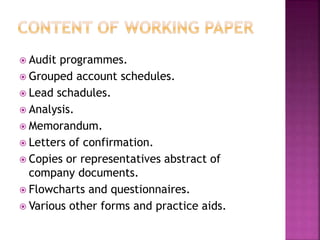
 Audit programmes.
 Grouped account schedules.
 Lead schadules.
 Analysis.
 Memorandum.
 Letters of confirmation.
 Copies or representatives abstract of
company documents.
 Flowcharts and questionnaires.
 Various other forms and practice aids.
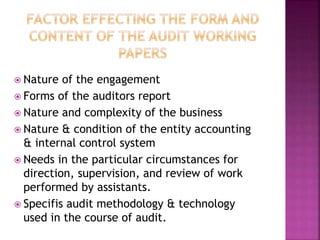
 Nature of the engagement
 Forms of the auditors report
 Nature and complexity of the business
 Nature & condition of the entity accounting
& internal control system
 Needs in the particular circumstances for
direction, supervision, and review of work
performed by assistants.
 Specifis audit methodology & technology
used in the course of audit.
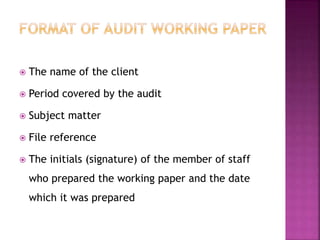
 The name of the client
 Period covered by the audit
 Subject matter
 File reference
 The initials (signature) of the member of staff
who prepared the working paper and the date
which it was prepared
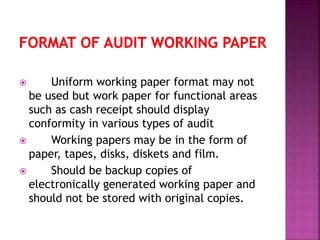
 Uniform working paper format may not
be used but work paper for functional areas
such as cash receipt should display
conformity in various types of audit
 Working papers may be in the form of
paper, tapes, disks, diskets and film.
 Should be backup copies of
electronically generated working paper and
should not be stored with original copies.
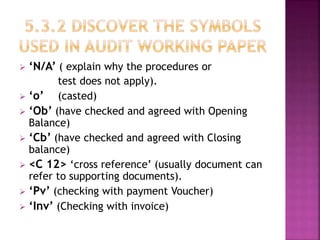
 ‘N/A’ ( explain why the procedures or
test does not apply).
 ‘o’ (casted)
 ‘Ob’ (have checked and agreed with Opening
Balance)
 ‘Cb’ (have checked and agreed with Closing
balance)
 <C 12> ‘cross reference’ (usually document can
refer to supporting documents).
 ‘Pv’ (checking with payment Voucher)
 ‘Inv’ (Checking with invoice)
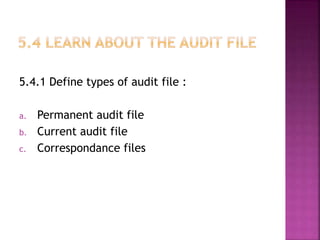
5.4.1 Define types of audit file :
a. Permanent audit file
b. Current audit file
c. Correspondance files
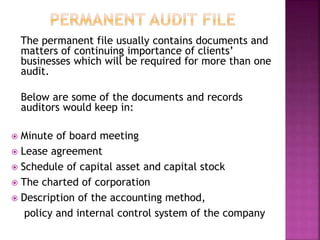
The permanent file usually contains documents and
matters of continuing importance of clients’
businesses which will be required for more than one
audit.
Below are some of the documents and records
auditors would keep in:
 Minute of board meeting
 Lease agreement
 Schedule of capital asset and capital stock
 The charted of corporation
 Description of the accounting method,
policy and internal control system of the company
 Copy of articles of association
 Copy of memorandum of associaton
 Letter of engagement
 Types of Bankers
 Types of Legal adviser
Consist of working papers containing
information primarily related to the purposes
of the current audit
Purpose :
 Evidence of the planning process
 Evidence of the auditor’s understanding of
the accounting and internal control system
 Analysis of transaction and balance
Contain :
> Audit and audit programme’s copies
> Clearance the problem and confusion
during the time of audit work
> Bank reconcilatation statement
> Paper of calculation of tax bonus
> List of lost proofs
> Paper regarding stock revaluation
 Correspondence file should contain all
correspondence and letters with the client
company or with the authorities such as the
Inland Revenue, the Registrar of Companies,
and other matters concerning the client
company’s affairs.

Auditing 4

  • 1.
    GROUP MEMBER : UMMISARAH BINTI ABD KGUPOR QURATULAINI BINTI HASRI NOR SHAWAL LEILA BINTI ZAHARUDIN NURAZARIAH BINTI RAHIMAN NUR HUZAIFAH BINTI ZULKIFLI
  • 2.
    5.1.1 Define thenature of audit documentation 5.1.2 Describe the purpose of audit documentation
  • 3.
    Audit documentation thatmeets the requirements of this ISA and the specific documentation requirements of other relevant ISAs provides : a) Evidence of the auditor’s basis for a conclusion about the achievement of the overall objectives of the auditor b) Evidence that the audit was planned and performed in accordance with ISAs and applicable legal and regulatory requirements
  • 4.
     Internal Documentation Relating to financial transaction that are prepared & used within the client’s organisation without ever going to an outside party such as a customer or vendor  Eg: Cheque request form, Payroll time card, adjusting journal entry & receiving report.
  • 5.
     External documentation Originate with an outside party or was originally an internal document that went to an outside party & is now either in the hands of the client or is readily accessible.  Eg: Suppliers invoice, vendors cancelled cheque or cancelled note & validated deposit slip.  It also can be independent verified, auditors usually place more reliance on them than on internal documents produced within the organisation.
  • 6.
     Assist theengagement team in planning and performing the audit  Assists reviewers in carrying out their responsibilities in accordance with ISA 220 and professional standards  Assist the engagement team to demonstrate that the audit work was performed properly  Record matters of continuing significance for future audits of company
  • 7.
    5.2.1 Define theaudit programme 5.2.2 Provide the sample of audit programme 5.2.3 Construct the advantages and disadvantages of using the audit programme
  • 8.
     Detailed listingof the steps to be performed as part of the procedures to complete an audit  Provides guidance as to what the audit personnel involved need to do and set out the nature, timing, and extent of planned audit procedures required to implement the overall audit plan
  • 9.
    1. Cash 2. Inventory 3.Account Payable 4. Account Receivable
  • 10.
     Supervision ofwork  Systematic uniformity of work  Basic instrument for training  Several audit maybe control  Easy transfer  Final review
  • 11.
     Audit programincreases the chance of fraud  Possibility of being unsuitable  Audit program is unsuitable to small concern  Exclusion of problem of new technology
  • 12.
    5.3.1 Discuss thenature of audit working paper : a) Purposes b) functions c) Contents d) Format
  • 13.
     The materialthat auditors prepare or obtain and retain in connection with the performance of the audit  May be in the form of data stored on paper, film, electronic media and also be used in court in case of negligent audit
  • 14.
     Assist inthe plannig and performance of the audit  Assist in the supervision and review of audit work  Record the audit evidence resulting from the audit work performed to support the auditors opinion  Constitute a permanent record of the objective and scope of the audit as well as the work performed during the audit
  • 15.
     State aclear audit objective  State the name of client, subject matter, year/period end  Reference of linked document  How sample size were determined  The conclusion reached should be consistent with result of the test  Signed and date by prepared and reviewer
  • 16.
     Audit programmes. Grouped account schedules.  Lead schadules.  Analysis.  Memorandum.  Letters of confirmation.  Copies or representatives abstract of company documents.  Flowcharts and questionnaires.  Various other forms and practice aids.
  • 17.
     Nature ofthe engagement  Forms of the auditors report  Nature and complexity of the business  Nature & condition of the entity accounting & internal control system  Needs in the particular circumstances for direction, supervision, and review of work performed by assistants.  Specifis audit methodology & technology used in the course of audit.
  • 18.
     The nameof the client  Period covered by the audit  Subject matter  File reference  The initials (signature) of the member of staff who prepared the working paper and the date which it was prepared
  • 19.
     Uniform workingpaper format may not be used but work paper for functional areas such as cash receipt should display conformity in various types of audit  Working papers may be in the form of paper, tapes, disks, diskets and film.  Should be backup copies of electronically generated working paper and should not be stored with original copies.
  • 20.
     ‘N/A’ (explain why the procedures or test does not apply).  ‘o’ (casted)  ‘Ob’ (have checked and agreed with Opening Balance)  ‘Cb’ (have checked and agreed with Closing balance)  <C 12> ‘cross reference’ (usually document can refer to supporting documents).  ‘Pv’ (checking with payment Voucher)  ‘Inv’ (Checking with invoice)
  • 21.
    5.4.1 Define typesof audit file : a. Permanent audit file b. Current audit file c. Correspondance files
  • 23.
    The permanent fileusually contains documents and matters of continuing importance of clients’ businesses which will be required for more than one audit. Below are some of the documents and records auditors would keep in:  Minute of board meeting  Lease agreement  Schedule of capital asset and capital stock  The charted of corporation  Description of the accounting method, policy and internal control system of the company
  • 24.
     Copy ofarticles of association  Copy of memorandum of associaton  Letter of engagement  Types of Bankers  Types of Legal adviser
  • 25.
    Consist of workingpapers containing information primarily related to the purposes of the current audit Purpose :  Evidence of the planning process  Evidence of the auditor’s understanding of the accounting and internal control system  Analysis of transaction and balance
  • 26.
    Contain : > Auditand audit programme’s copies > Clearance the problem and confusion during the time of audit work > Bank reconcilatation statement > Paper of calculation of tax bonus > List of lost proofs > Paper regarding stock revaluation
  • 27.
     Correspondence fileshould contain all correspondence and letters with the client company or with the authorities such as the Inland Revenue, the Registrar of Companies, and other matters concerning the client company’s affairs.