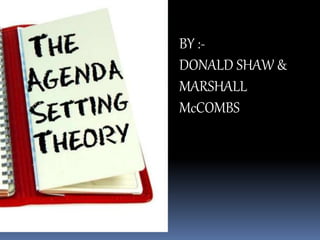

BY :-
DONALD SHAW &
MARSHALL
McCOMBS
CONTENT
ABOUTTHE FOUNDERS
 OVERVIEW OF AGENDA SETTINGTHEORY
CORE ASSUMPTIONS
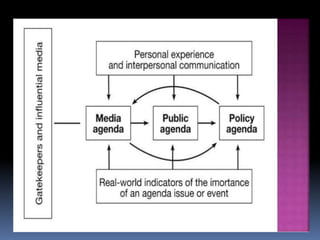
WHO SETSTHE AGENDA FOR MEDIA
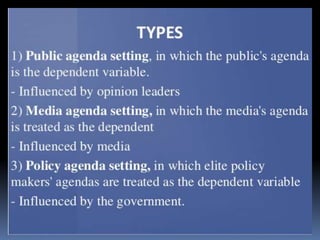
TYPES OF AST
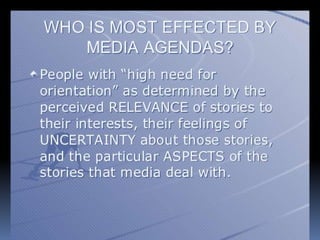
EFFECTS OF MEDIA
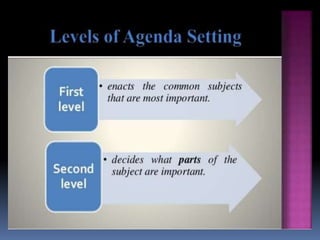
LEVELS OF AST
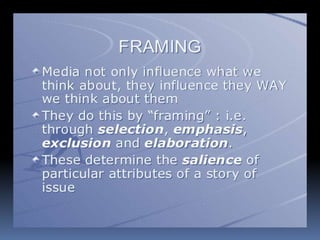
FRAMING
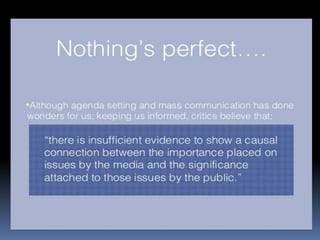
CRITICISM
CONCLUSION
BIBLIOGRAPHY
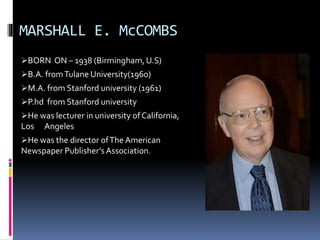
MARSHALL E. McCOMBS
BORN ON – 1938 (Birmingham, U.S)
B.A. fromTulane University(1960)
M.A. from Stanford university (1961)
P.hd from Stanford university
He was lecturer in university of California,
Los Angeles
He was the director ofThe American
Newspaper Publisher’s Association.
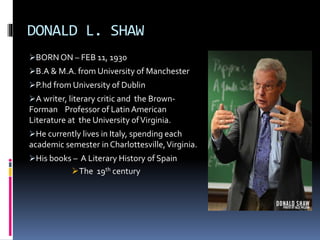
DONALD L. SHAW
BORN ON – FEB 11, 1930
B.A & M.A. from University of Manchester
P.hd from University of Dublin
A writer, literary critic and the Brown-
Forman Professor of LatinAmerican
Literature at the University ofVirginia.
He currently lives in Italy, spending each
academic semester in Charlottesville,Virginia.
His books – A Literary History of Spain
The 19th century
Agenda setting theory:
an overview
 It describes the ability to influence the people
on basis of public agenda.
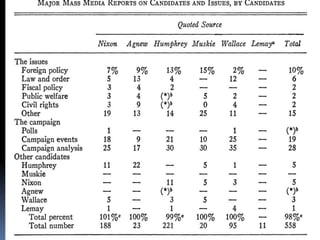
 It was developed by Shaw & McCombs in a
study based on 1968 presidential election
which focused on awareness and information
 It was published in 1972 in Public Opinion
Quarterly
 It’s the ability to tell us what issues are
important.
ASSUMPTIONS:-
Agenda setting theory is based on few
assumptions.They are:-
 The press and the media do not reflect
reality, they only filter and shape it.
 Media concentrates on few issues which leads
the public to believe those issue to be
important.
CRITICISM
 Media users not ideal, people may not pay
attention to details.
 Effect is weakened for people who have
made up their mind.
 Media can’t create problems.They can only
alter the awareness, Priority etc.
CONCLUSION
CITATIONS/BIBLIOGRAPHY
 Communication theory ( Javed Shaikh)
 Mass communication theory (Uma Narula)
 www.wikipedia.in
 https://masscommtheory.com/theory-
overviews/agenda-setting-theory/
 Journalism quarterly ( A study of local agenda
building) by David Weaver & S.N. Elliott
THANK
YOU
PRESENTED BY:-
JOYDEV MAJUMDAR
1703DJMC05
DEPT. OF JOURNALISM AND MASS COMMUNICATION
CENTRAL UNIVERSITY OF ORISSA
GUIDED BY :-
SOURAV GUPTA
ASST. PROFESSOR
DEPT. OF JOURNALISM AND MASS COMMUNICATION
CENTRAL UNIVERSITY OF ORISSA
COMMENTS,
SUGGESTIONS
AND QUESTIONS
????

agenda setting theory

  • 1.
    BY :- DONALD SHAW& MARSHALL McCOMBS
  • 2.
    CONTENT ABOUTTHE FOUNDERS  OVERVIEWOF AGENDA SETTINGTHEORY CORE ASSUMPTIONS WHO SETSTHE AGENDA FOR MEDIA TYPES OF AST EFFECTS OF MEDIA LEVELS OF AST FRAMING CRITICISM CONCLUSION BIBLIOGRAPHY
  • 3.
    MARSHALL E. McCOMBS BORNON – 1938 (Birmingham, U.S) B.A. fromTulane University(1960) M.A. from Stanford university (1961) P.hd from Stanford university He was lecturer in university of California, Los Angeles He was the director ofThe American Newspaper Publisher’s Association.
  • 4.
    DONALD L. SHAW BORNON – FEB 11, 1930 B.A & M.A. from University of Manchester P.hd from University of Dublin A writer, literary critic and the Brown- Forman Professor of LatinAmerican Literature at the University ofVirginia. He currently lives in Italy, spending each academic semester in Charlottesville,Virginia. His books – A Literary History of Spain The 19th century
  • 5.
    Agenda setting theory: anoverview  It describes the ability to influence the people on basis of public agenda.  It was developed by Shaw & McCombs in a study based on 1968 presidential election which focused on awareness and information  It was published in 1972 in Public Opinion Quarterly  It’s the ability to tell us what issues are important.
  • 7.
    ASSUMPTIONS:- Agenda setting theoryis based on few assumptions.They are:-  The press and the media do not reflect reality, they only filter and shape it.  Media concentrates on few issues which leads the public to believe those issue to be important.
  • 17.
    CRITICISM  Media usersnot ideal, people may not pay attention to details.  Effect is weakened for people who have made up their mind.  Media can’t create problems.They can only alter the awareness, Priority etc.
  • 18.
  • 19.
    CITATIONS/BIBLIOGRAPHY  Communication theory( Javed Shaikh)  Mass communication theory (Uma Narula)  www.wikipedia.in  https://masscommtheory.com/theory- overviews/agenda-setting-theory/  Journalism quarterly ( A study of local agenda building) by David Weaver & S.N. Elliott
  • 20.
  • 21.
    PRESENTED BY:- JOYDEV MAJUMDAR 1703DJMC05 DEPT.OF JOURNALISM AND MASS COMMUNICATION CENTRAL UNIVERSITY OF ORISSA GUIDED BY :- SOURAV GUPTA ASST. PROFESSOR DEPT. OF JOURNALISM AND MASS COMMUNICATION CENTRAL UNIVERSITY OF ORISSA
  • 22.