S T A Y P O S I T I V E , A T T I T U D E I S
E V E R Y T H I N G
ATTITUDE
MEASUREMENT
CONTENT SLIDE
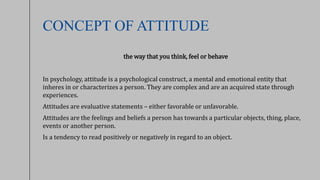
• Concept of Attitude
• Different types of Attitude
• Measurement of Attitude
• Procedure for Measuring Attitude
• Conclusion
CONCEPT OF ATTITUDE
the way that you think, feel or behave
In psychology, attitude is a psychological construct, a mental and emotional entity that
inheres in or characterizes a person. They are complex and are an acquired state through
experiences.
Attitudes are evaluative statements – either favorable or unfavorable.
Attitudes are the feelings and beliefs a person has towards a particular objects, thing, place,
events or another person.
Is a tendency to read positively or negatively in regard to an object.
DIFFERENT TYPES OF ATTITUDES
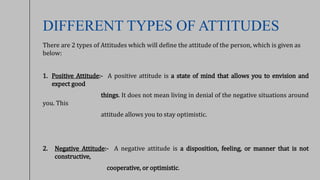
There are 2 types of Attitudes which will define the attitude of the person, which is given as
below:
1. Positive Attitude:- A positive attitude is a state of mind that allows you to envision and
expect good
things. It does not mean living in denial of the negative situations around
you. This
attitude allows you to stay optimistic.
2. Negative Attitude:- A negative attitude is a disposition, feeling, or manner that is not
constructive,
cooperative, or optimistic.
MEASUREMENT OF ATTITUDE
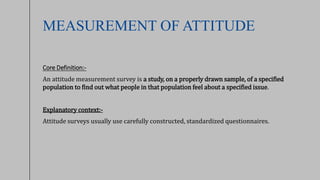
Core Definition:-
An attitude measurement survey is a study, on a properly drawn sample, of a specified
population to find out what people in that population feel about a specified issue.
Explanatory context:-
Attitude surveys usually use carefully constructed, standardized questionnaires.
PROCEDURE OF MEASURING
ATTITUDE
There are three scales which have been developed to measure aptitudes. Each of these scales
is based upon different assumptions and follows different procedures in its construction.
The three scales are as given below:-
1. Likert Scale : Likert scaling is an attitude scaling method in which respondents indicate
the extent of their agreement with each item on a scale (e.g., a five- or-seven point scale).
Their score on the scale is the sum of the scores for each item.
2. Thurstone Scale : A Thurstone scale is an attitude scale consisting of items (in the form of
statements) with which the respondent has either to agree or disagree.
3. Guttman Scale : Guttman attitude scales involve the researcher constructing a set of
hierarchical statements relating to the concept under investigation. These statements
should reflect an increasing intensity of attitude. The point at which the respondent
disagrees with a statement reflects the respondent’s scale position.
LIKERT SCALE
The summated rating scale, more commonly known as the Likert Scale, is based upon the
assumption that each statement on the scale has equal attitudinal value, importance or
weight in terms of reflecting an attitude towards the issue in question.
This assumption is also the main limitation of this scale, as statements on a scale seldom have
equal attitudinal value.
Likert scales may not always be unidimensional but the approach basically assumes a single
dimension. It has been argued that analysis of a Likert scale could identify clusters that are
indicative of a number of dimensions, although this is much weaker than the multi-dimension
identification claimed for Guttman scaling.
Consideration in constructing a likert scale
In developing a Likert Scale, there are a number of things to consider.
Firstly, decide whether the attitude to be measured is to be classified into one-two or three
directional categories (i.e., whether you want to determine positive, negative or neutral
positions in the study population) with respect to their attitude towards the issue under
study.
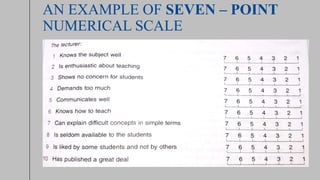
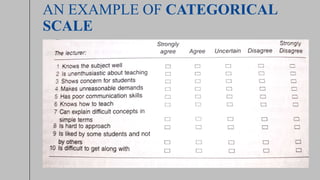
Next, consider whether you want to use categories or a numerical scale.
This should depend upon whether categories. The decision about the number about the
number of points or the number of categories on a categorical scale depends upon how finely
you want to measure the intensity of the attitude in question and on the capacity of the
population to make fine distinction.
AN EXAMPLE OF SEVEN – POINT
NUMERICAL SCALE
AN EXAMPLE OF CATEGORICAL
SCALE
THURSTONE SCALE
The Thurstone scale measures a respondent's attitude by using a series of “agree-disagree”
statements of various weights.
The weight (equivalent to the median value) for each statement is calculated on the basis of
ratings assigned to a statement by a group of judges.
Each statement with which respondents express agreement (or which they respond in the
affirmative) is given an attitudinal score equivalent to the attitudinal value of the statement.
Process of constructing thurstone scale
Step 1: Assemble or construct statements reflective of attitudes towards the issue in question.
Step 2: Select a panel of judges who are experts in the field of the attitudes being explored.
Step 3: Send the statements to these judges with a request to rate of each statement’s
importance in reflecting an attitude towards the issue being studied. Ask them to rate each
statement on an 11 point scale.
Step 4: Calculate the median value of these judges rating for each item.
Step 5: If the judges ratings of any item are scattered over the scale, this indicates that, even
among the experts, there is no agreement as to the degree to which that statement reflects an
attitude towards the issue in question. Discard such statements.
Step 6: From the remaining statements select items that best reflect attitudes towards various
aspects of the issue.
Step 7: Construct a questionnaire/interview schedule comprising the selected items.
GUTTAM SCALE
The Guttman or “cumulative” scale measures how much of a positive or negative attitude a
person has towards a particular topic. The Guttman scale is one of the three major types of
unidimensional measurement scales. The other two are the Likert Scale and the Thurstone
Scale. A unidimensional measurement scale has only one dimension.
Guttman scale is one of the three unidimensional scales, the other two being – Likert
Scale and Thurstone Scale. Guttman scale also called cumulative scaling or Scalo gram
analysis is created with elements that can possibly be ordered in a hierarchical manner. It is
representative of the extreme “attitude” of respondents, i.e. extremely positive or negative,
about the subject in-hand.
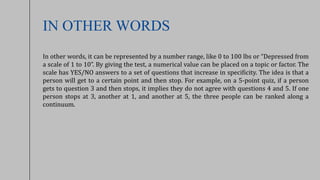
IN OTHER WORDS
In other words, it can be represented by a number range, like 0 to 100 lbs or “Depressed from
a scale of 1 to 10”. By giving the test, a numerical value can be placed on a topic or factor. The
scale has YES/NO answers to a set of questions that increase in specificity. The idea is that a
person will get to a certain point and then stop. For example, on a 5-point quiz, if a person
gets to question 3 and then stops, it implies they do not agree with questions 4 and 5. If one
person stops at 3, another at 1, and another at 5, the three people can be ranked along a
continuum.
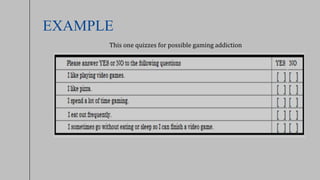
EXAMPLE
This one quizzes for possible gaming addiction
Attitude measurement.pptx

Attitude measurement.pptx

  • 1.
    S T AY P O S I T I V E , A T T I T U D E I S E V E R Y T H I N G ATTITUDE MEASUREMENT
  • 2.
    CONTENT SLIDE • Conceptof Attitude • Different types of Attitude • Measurement of Attitude • Procedure for Measuring Attitude • Conclusion
  • 3.
    CONCEPT OF ATTITUDE theway that you think, feel or behave In psychology, attitude is a psychological construct, a mental and emotional entity that inheres in or characterizes a person. They are complex and are an acquired state through experiences. Attitudes are evaluative statements – either favorable or unfavorable. Attitudes are the feelings and beliefs a person has towards a particular objects, thing, place, events or another person. Is a tendency to read positively or negatively in regard to an object.
  • 4.
    DIFFERENT TYPES OFATTITUDES There are 2 types of Attitudes which will define the attitude of the person, which is given as below: 1. Positive Attitude:- A positive attitude is a state of mind that allows you to envision and expect good things. It does not mean living in denial of the negative situations around you. This attitude allows you to stay optimistic. 2. Negative Attitude:- A negative attitude is a disposition, feeling, or manner that is not constructive, cooperative, or optimistic.
  • 5.
    MEASUREMENT OF ATTITUDE CoreDefinition:- An attitude measurement survey is a study, on a properly drawn sample, of a specified population to find out what people in that population feel about a specified issue. Explanatory context:- Attitude surveys usually use carefully constructed, standardized questionnaires.
  • 6.
    PROCEDURE OF MEASURING ATTITUDE Thereare three scales which have been developed to measure aptitudes. Each of these scales is based upon different assumptions and follows different procedures in its construction. The three scales are as given below:- 1. Likert Scale : Likert scaling is an attitude scaling method in which respondents indicate the extent of their agreement with each item on a scale (e.g., a five- or-seven point scale). Their score on the scale is the sum of the scores for each item. 2. Thurstone Scale : A Thurstone scale is an attitude scale consisting of items (in the form of statements) with which the respondent has either to agree or disagree. 3. Guttman Scale : Guttman attitude scales involve the researcher constructing a set of hierarchical statements relating to the concept under investigation. These statements should reflect an increasing intensity of attitude. The point at which the respondent disagrees with a statement reflects the respondent’s scale position.
  • 7.
    LIKERT SCALE The summatedrating scale, more commonly known as the Likert Scale, is based upon the assumption that each statement on the scale has equal attitudinal value, importance or weight in terms of reflecting an attitude towards the issue in question. This assumption is also the main limitation of this scale, as statements on a scale seldom have equal attitudinal value. Likert scales may not always be unidimensional but the approach basically assumes a single dimension. It has been argued that analysis of a Likert scale could identify clusters that are indicative of a number of dimensions, although this is much weaker than the multi-dimension identification claimed for Guttman scaling.
  • 8.
    Consideration in constructinga likert scale In developing a Likert Scale, there are a number of things to consider. Firstly, decide whether the attitude to be measured is to be classified into one-two or three directional categories (i.e., whether you want to determine positive, negative or neutral positions in the study population) with respect to their attitude towards the issue under study. Next, consider whether you want to use categories or a numerical scale. This should depend upon whether categories. The decision about the number about the number of points or the number of categories on a categorical scale depends upon how finely you want to measure the intensity of the attitude in question and on the capacity of the population to make fine distinction.
  • 9.
    AN EXAMPLE OFSEVEN – POINT NUMERICAL SCALE
  • 10.
    AN EXAMPLE OFCATEGORICAL SCALE
  • 11.
    THURSTONE SCALE The Thurstonescale measures a respondent's attitude by using a series of “agree-disagree” statements of various weights. The weight (equivalent to the median value) for each statement is calculated on the basis of ratings assigned to a statement by a group of judges. Each statement with which respondents express agreement (or which they respond in the affirmative) is given an attitudinal score equivalent to the attitudinal value of the statement.
  • 12.
    Process of constructingthurstone scale Step 1: Assemble or construct statements reflective of attitudes towards the issue in question. Step 2: Select a panel of judges who are experts in the field of the attitudes being explored. Step 3: Send the statements to these judges with a request to rate of each statement’s importance in reflecting an attitude towards the issue being studied. Ask them to rate each statement on an 11 point scale. Step 4: Calculate the median value of these judges rating for each item. Step 5: If the judges ratings of any item are scattered over the scale, this indicates that, even among the experts, there is no agreement as to the degree to which that statement reflects an attitude towards the issue in question. Discard such statements. Step 6: From the remaining statements select items that best reflect attitudes towards various aspects of the issue. Step 7: Construct a questionnaire/interview schedule comprising the selected items.
  • 13.
    GUTTAM SCALE The Guttmanor “cumulative” scale measures how much of a positive or negative attitude a person has towards a particular topic. The Guttman scale is one of the three major types of unidimensional measurement scales. The other two are the Likert Scale and the Thurstone Scale. A unidimensional measurement scale has only one dimension. Guttman scale is one of the three unidimensional scales, the other two being – Likert Scale and Thurstone Scale. Guttman scale also called cumulative scaling or Scalo gram analysis is created with elements that can possibly be ordered in a hierarchical manner. It is representative of the extreme “attitude” of respondents, i.e. extremely positive or negative, about the subject in-hand.
  • 14.
    IN OTHER WORDS Inother words, it can be represented by a number range, like 0 to 100 lbs or “Depressed from a scale of 1 to 10”. By giving the test, a numerical value can be placed on a topic or factor. The scale has YES/NO answers to a set of questions that increase in specificity. The idea is that a person will get to a certain point and then stop. For example, on a 5-point quiz, if a person gets to question 3 and then stops, it implies they do not agree with questions 4 and 5. If one person stops at 3, another at 1, and another at 5, the three people can be ranked along a continuum.
  • 15.
    EXAMPLE This one quizzesfor possible gaming addiction