
Emergency Medical Technician
22 - Abdominal Emergencies
© 2014
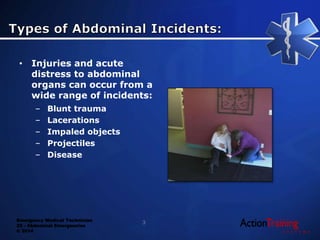
• Injuries and acute
distress to abdominal
organs can occur from a
wide range of incidents:
– Blunt trauma
– Lacerations
– Impaled objects
– Projectiles
– Disease
3
Emergency Medical Technician
22 - Abdominal Emergencies
© 2014
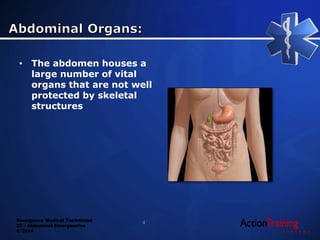
• The abdomen houses a
large number of vital
organs that are not well
protected by skeletal
structures
4
Emergency Medical Technician
22 - Abdominal Emergencies
© 2014
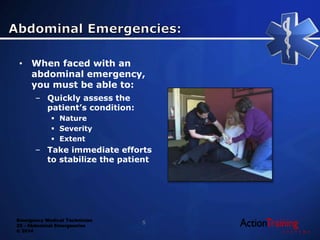
• When faced with an
abdominal emergency,
you must be able to:
– Quickly assess the
patient’s condition:
 Nature
 Severity
 Extent
– Take immediate efforts
to stabilize the patient
5
Emergency Medical Technician
22 - Abdominal Emergencies
© 2014
• Assessment of Acute Abdomen
• Acute Abdominal Emergency Care
• Abdominal Trauma
Emergency Medical Technician
22 - Abdominal Emergencies
© 2014
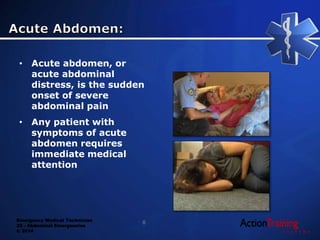
• Acute abdomen, or
acute abdominal
distress, is the sudden
onset of severe
abdominal pain
• Any patient with
symptoms of acute
abdomen requires
immediate medical
attention
8
Emergency Medical Technician
22 - Abdominal Emergencies
© 2014
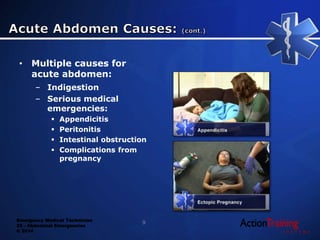
• Multiple causes for
acute abdomen:
– Indigestion
– Serious medical
emergencies:
 Appendicitis
 Peritonitis
 Intestinal obstruction
 Complications from
pregnancy
9
Emergency Medical Technician
22 - Abdominal Emergencies
© 2014
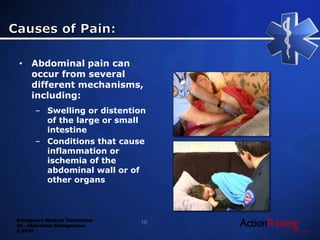
• Abdominal pain can
occur from several
different mechanisms,
including:
– Swelling or distention
of the large or small
intestine
– Conditions that cause
inflammation or
ischemia of the
abdominal wall or of
other organs
10
Emergency Medical Technician
22 - Abdominal Emergencies
© 2014
• Many conditions have similar and
often vague symptoms, making it
difficult to determine the root cause
• You may not be able to diagnose the
root cause of the emergency
• Take ALL complaints of abdominal
pain extremely seriously
11
Emergency Medical Technician
22 - Abdominal Emergencies
© 2014
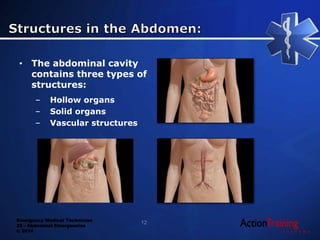
• The abdominal cavity
contains three types of
structures:
– Hollow organs
– Solid organs
– Vascular structures
12
Emergency Medical Technician
22 - Abdominal Emergencies
© 2014
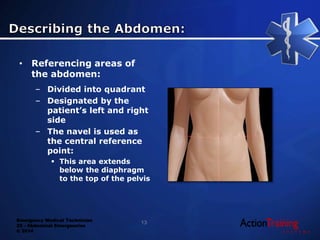
• Referencing areas of
the abdomen:
– Divided into quadrant
– Designated by the
patient’s left and right
side
– The navel is used as
the central reference
point:
 This area extends
below the diaphragm
to the top of the pelvis
13
Emergency Medical Technician
22 - Abdominal Emergencies
© 2014
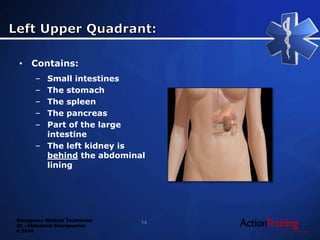
• Contains:
– Small intestines
– The stomach
– The spleen
– The pancreas
– Part of the large
intestine
– The left kidney is
behind the abdominal
lining
14
Emergency Medical Technician
22 - Abdominal Emergencies
© 2014
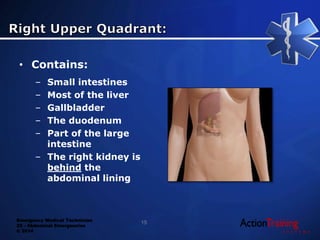
• Contains:
– Small intestines
– Most of the liver
– Gallbladder
– The duodenum
– Part of the large
intestine
– The right kidney is
behind the
abdominal lining
15
Emergency Medical Technician
22 - Abdominal Emergencies
© 2014
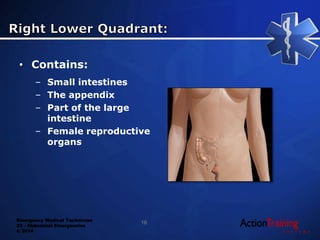
• Contains:
– Small intestines
– The appendix
– Part of the large
intestine
– Female reproductive
organs
16
Emergency Medical Technician
22 - Abdominal Emergencies
© 2014
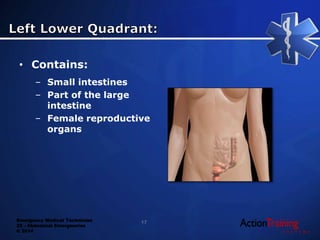
• Contains:
– Small intestines
– Part of the large
intestine
– Female reproductive
organs
17
Emergency Medical Technician
22 - Abdominal Emergencies
© 2014
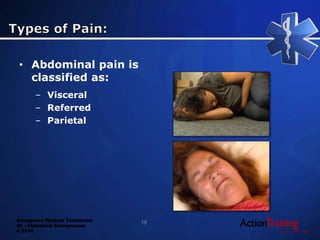
• Abdominal pain is
classified as:
– Visceral
– Referred
– Parietal
18
Emergency Medical Technician
22 - Abdominal Emergencies
© 2014
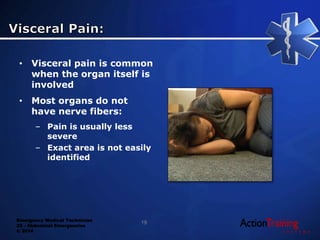
• Visceral pain is common
when the organ itself is
involved
• Most organs do not
have nerve fibers:
– Pain is usually less
severe
– Exact area is not easily
identified
19
Emergency Medical Technician
22 - Abdominal Emergencies
© 2014
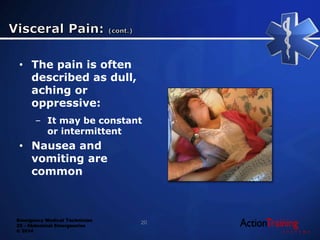
• The pain is often
described as dull,
aching or
oppressive:
– It may be constant
or intermittent
• Nausea and
vomiting are
common
20
Emergency Medical Technician
22 - Abdominal Emergencies
© 2014
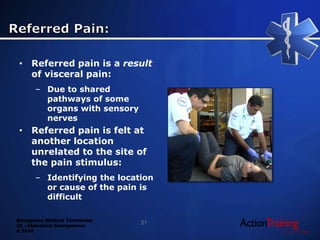
• Referred pain is a result
of visceral pain:
– Due to shared
pathways of some
organs with sensory
nerves
• Referred pain is felt at
another location
unrelated to the site of
the pain stimulus:
– Identifying the location
or cause of the pain is
difficult
21
Emergency Medical Technician
22 - Abdominal Emergencies
© 2014
• Pain in the patient’s back or
shoulders, might actually be a
problem with the liver
• Referred pain results because nerve
pathways leading back to the spinal
cord share pathways with nerves that
signal pain in other areas of the body
22
Emergency Medical Technician
22 - Abdominal Emergencies
© 2014
• Parietal pain is associated with the
peritoneum
• Peritoneum lines the abdominal cavity
and contains several organs
23
Emergency Medical Technician
22 - Abdominal Emergencies
© 2014
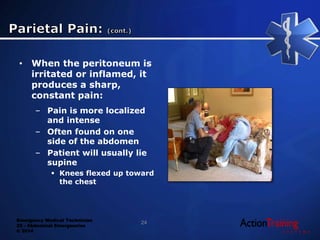
• When the peritoneum is
irritated or inflamed, it
produces a sharp,
constant pain:
– Pain is more localized
and intense
– Often found on one
side of the abdomen
– Patient will usually lie
supine
 Knees flexed up toward
the chest
24
Emergency Medical Technician
22 - Abdominal Emergencies
© 2014
• Common Signs & Symptoms of Acute
Abdomen:
– Abdominal pain
– Nausea and vomiting
– Guarding of the abdomen
– Rigidity of the abdomen
– Distention of the abdomen
25
Emergency Medical Technician
22 - Abdominal Emergencies
© 2014
• After conducting your initial
assessment and SAMPLE history, use
the mnemonic
OPQRST to determine the condition’s:
– Onset
– Provocation/Palliation
– Quality
– Region/Radiating pain
– Severity
– Time
26
Emergency Medical Technician
22 - Abdominal Emergencies
© 2014
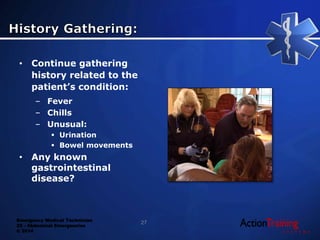
• Continue gathering
history related to the
patient’s condition:
– Fever
– Chills
– Unusual:
 Urination
 Bowel movements
• Any known
gastrointestinal
disease?
27
Emergency Medical Technician
22 - Abdominal Emergencies
© 2014
• GI bleeding can occur anywhere in the
digestive tract from the esophagus to
the rectum
28
Emergency Medical Technician
22 - Abdominal Emergencies
© 2014
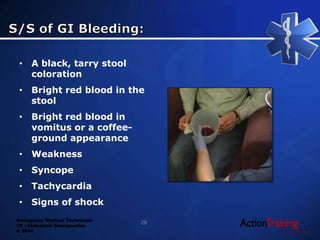
• A black, tarry stool
coloration
• Bright red blood in the
stool
• Bright red blood in
vomitus or a coffee-
ground appearance
• Weakness
• Syncope
• Tachycardia
• Signs of shock
29
Emergency Medical Technician
22 - Abdominal Emergencies
© 2014
• Ask about:
 Menstrual cycle
 Pregnancy
 Childbirth history
• Consider possibility of ectopic
pregnancy
– Patient may not know she is pregnant
 Ruptures often occur 5-9 weeks
30
Emergency Medical Technician
22 - Abdominal Emergencies
© 2014
• A dull aching pain:
– Is poorly localized and becomes
sudden and sharp on one side in one
lower quadrant
• Shoulder pain (referred pain)
• Vaginal bleeding:
– Heavy
– Light
– Absent
31
Emergency Medical Technician
22 - Abdominal Emergencies
© 2014
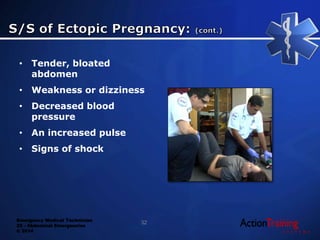
• Tender, bloated
abdomen
• Weakness or dizziness
• Decreased blood
pressure
• An increased pulse
• Signs of shock
32
Emergency Medical Technician
22 - Abdominal Emergencies
© 2014
• Obstruction to and inflammation of
the appendix
• A common cause of acute abdomen
• If untreated, the inflammation may
cause the tissue to die and rupture:
– Causing serious infection in the
peritoneum
• Appendicitis is common in children
and elderly
33
Emergency Medical Technician
22 - Abdominal Emergencies
© 2014
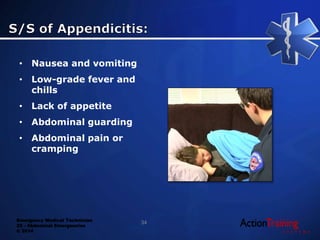
• Nausea and vomiting
• Low-grade fever and
chills
• Lack of appetite
• Abdominal guarding
• Abdominal pain or
cramping
34
Emergency Medical Technician
22 - Abdominal Emergencies
© 2014
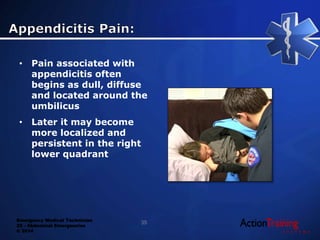
• Pain associated with
appendicitis often
begins as dull, diffuse
and located around the
umbilicus
• Later it may become
more localized and
persistent in the right
lower quadrant
35
Emergency Medical Technician
22 - Abdominal Emergencies
© 2014
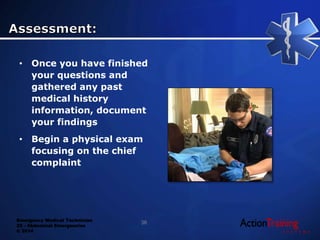
• Once you have finished
your questions and
gathered any past
medical history
information, document
your findings
• Begin a physical exam
focusing on the chief
complaint
36
Emergency Medical Technician
22 - Abdominal Emergencies
© 2014
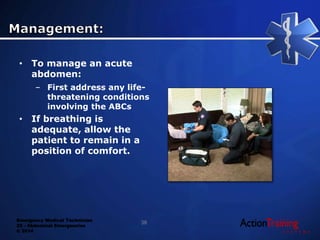
• To manage an acute
abdomen:
– First address any life-
threatening conditions
involving the ABCs
• If breathing is
adequate, allow the
patient to remain in a
position of comfort.
38
Emergency Medical Technician
22 - Abdominal Emergencies
© 2014
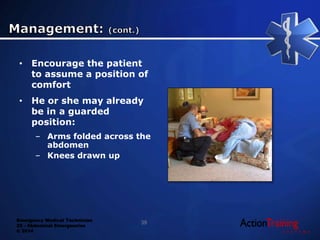
• Encourage the patient
to assume a position of
comfort
• He or she may already
be in a guarded
position:
– Arms folded across the
abdomen
– Knees drawn up
39
Emergency Medical Technician
22 - Abdominal Emergencies
© 2014
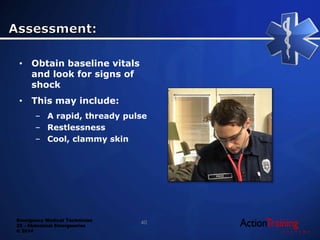
• Obtain baseline vitals
and look for signs of
shock
• This may include:
– A rapid, thready pulse
– Restlessness
– Cool, clammy skin
40
Emergency Medical Technician
22 - Abdominal Emergencies
© 2014
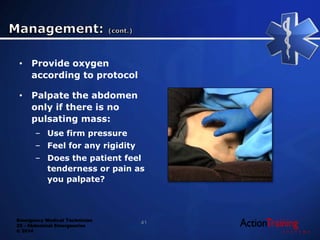
• Provide oxygen
according to protocol
• Palpate the abdomen
only if there is no
pulsating mass:
– Use firm pressure
– Feel for any rigidity
– Does the patient feel
tenderness or pain as
you palpate?
41
Emergency Medical Technician
22 - Abdominal Emergencies
© 2014
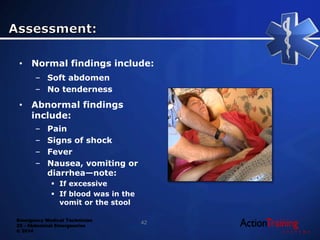
• Normal findings include:
– Soft abdomen
– No tenderness
• Abnormal findings
include:
– Pain
– Signs of shock
– Fever
– Nausea, vomiting or
diarrhea—note:
 If excessive
 If blood was in the
vomit or the stool
42
Emergency Medical Technician
22 - Abdominal Emergencies
© 2014
43
• An a cute abdominal distress patient is
a priority patient if:
– Poor general appearance
– Inability to follow commands
– Unresponsiveness
– Showing signs of shock
– Severe pain
Emergency Medical Technician
22 - Abdominal Emergencies
© 2014
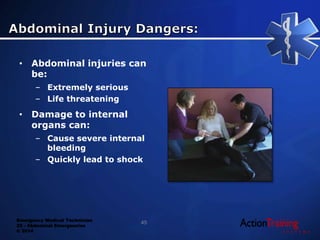
• Abdominal injuries can
be:
– Extremely serious
– Life threatening
• Damage to internal
organs can:
– Cause severe internal
bleeding
– Quickly lead to shock
45
Emergency Medical Technician
22 - Abdominal Emergencies
© 2014
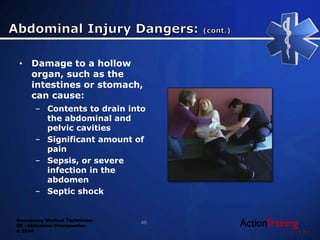
• Damage to a hollow
organ, such as the
intestines or stomach,
can cause:
– Contents to drain into
the abdominal and
pelvic cavities
– Significant amount of
pain
– Sepsis, or severe
infection in the
abdomen
– Septic shock
46
Emergency Medical Technician
22 - Abdominal Emergencies
© 2014
47
• An open wound to the abdomen,
pelvis or lower back
• Indications of blunt trauma to the
abdomen or pelvis
• Pain or cramps in the abdomen or
pelvis
• Guarding of the abdomen
• Rigid, distended or tender abdomen
Emergency Medical Technician
22 - Abdominal Emergencies
© 2014
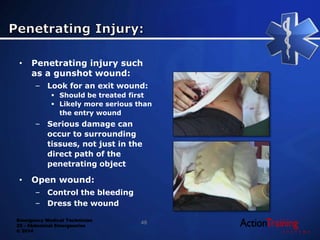
• Penetrating injury such
as a gunshot wound:
– Look for an exit wound:
 Should be treated first
 Likely more serious than
the entry wound
– Serious damage can
occur to surrounding
tissues, not just in the
direct path of the
penetrating object
• Open wound:
– Control the bleeding
– Dress the wound
48
Emergency Medical Technician
22 - Abdominal Emergencies
© 2014
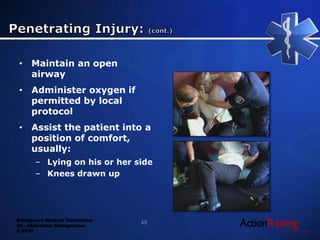
• Maintain an open
airway
• Administer oxygen if
permitted by local
protocol
• Assist the patient into a
position of comfort,
usually:
– Lying on his or her side
– Knees drawn up
49
Emergency Medical Technician
22 - Abdominal Emergencies
© 2014
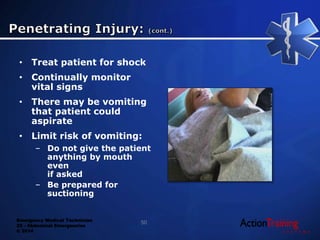
• Treat patient for shock
• Continually monitor
vital signs
• There may be vomiting
that patient could
aspirate
• Limit risk of vomiting:
– Do not give the patient
anything by mouth
even
if asked
– Be prepared for
suctioning
50
Emergency Medical Technician
22 - Abdominal Emergencies
© 2014
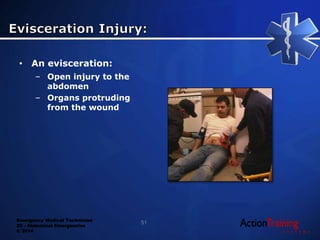
• An evisceration:
– Open injury to the
abdomen
– Organs protruding
from the wound
51
Emergency Medical Technician
22 - Abdominal Emergencies
© 2014
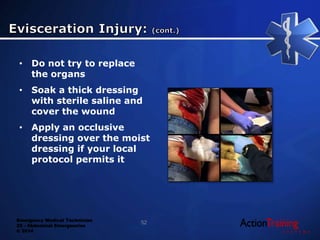
• Do not try to replace
the organs
• Soak a thick dressing
with sterile saline and
cover the wound
• Apply an occlusive
dressing over the moist
dressing if your local
protocol permits it
52
Emergency Medical Technician
22 - Abdominal Emergencies
© 2014
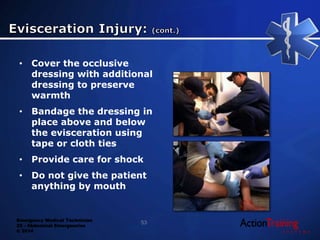
• Cover the occlusive
dressing with additional
dressing to preserve
warmth
• Bandage the dressing in
place above and below
the evisceration using
tape or cloth ties
• Provide care for shock
• Do not give the patient
anything by mouth
53
Emergency Medical Technician
22 - Abdominal Emergencies
© 2014
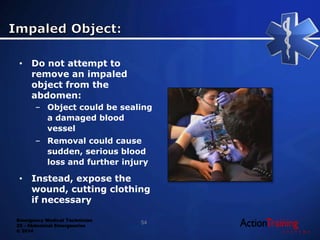
• Do not attempt to
remove an impaled
object from the
abdomen:
– Object could be sealing
a damaged blood
vessel
– Removal could cause
sudden, serious blood
loss and further injury
• Instead, expose the
wound, cutting clothing
if necessary
54
Emergency Medical Technician
22 - Abdominal Emergencies
© 2014
55
• Avoid touching or disturbing the
object if possible
• Control any bleeding by applying
direct pressure around the object
• Be careful not to apply pressure to the
tissues along the edges of the object
Emergency Medical Technician
22 - Abdominal Emergencies
© 2014
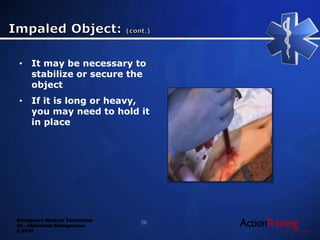
• It may be necessary to
stabilize or secure the
object
• If it is long or heavy,
you may need to hold it
in place
56
Emergency Medical Technician
22 - Abdominal Emergencies
© 2014
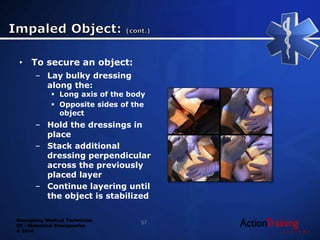
• To secure an object:
– Lay bulky dressing
along the:
 Long axis of the body
 Opposite sides of the
object
– Hold the dressings in
place
– Stack additional
dressing perpendicular
across the previously
placed layer
– Continue layering until
the object is stabilized
57
Emergency Medical Technician
22 - Abdominal Emergencies
© 2014
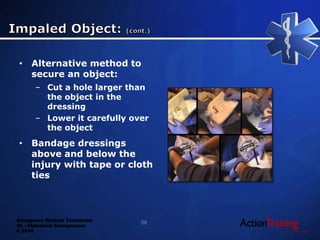
• Alternative method to
secure an object:
– Cut a hole larger than
the object in the
dressing
– Lower it carefully over
the object
• Bandage dressings
above and below the
injury with tape or cloth
ties
58
Emergency Medical Technician
22 - Abdominal Emergencies
© 2014
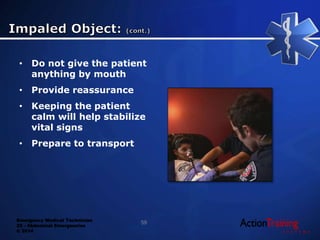
• Do not give the patient
anything by mouth
• Provide reassurance
• Keeping the patient
calm will help stabilize
vital signs
• Prepare to transport
59
Emergency Medical Technician
22 - Abdominal Emergencies
© 2014
• Assessment of Acute Abdomen
• Acute Abdominal Emergency Care
• Abdominal Trauma
Emergency Medical Technician
22 - Abdominal Emergencies
© 2014
• Injuries to the abdomen are among
the most serious you will encounter
• The abdomen can be the location of
multiple life-threatening, traumatic
injuries and diseases that can lead
to significant pain and bleeding
• Without proper emergency care,
these conditions can quickly lead to
shock and death
ATS -  abdominal emergencies

ATS - abdominal emergencies

  • 3.
    Emergency Medical Technician 22- Abdominal Emergencies © 2014 • Injuries and acute distress to abdominal organs can occur from a wide range of incidents: – Blunt trauma – Lacerations – Impaled objects – Projectiles – Disease 3
  • 4.
    Emergency Medical Technician 22- Abdominal Emergencies © 2014 • The abdomen houses a large number of vital organs that are not well protected by skeletal structures 4
  • 5.
    Emergency Medical Technician 22- Abdominal Emergencies © 2014 • When faced with an abdominal emergency, you must be able to: – Quickly assess the patient’s condition:  Nature  Severity  Extent – Take immediate efforts to stabilize the patient 5
  • 7.
    Emergency Medical Technician 22- Abdominal Emergencies © 2014 • Assessment of Acute Abdomen • Acute Abdominal Emergency Care • Abdominal Trauma
  • 8.
    Emergency Medical Technician 22- Abdominal Emergencies © 2014 • Acute abdomen, or acute abdominal distress, is the sudden onset of severe abdominal pain • Any patient with symptoms of acute abdomen requires immediate medical attention 8
  • 9.
    Emergency Medical Technician 22- Abdominal Emergencies © 2014 • Multiple causes for acute abdomen: – Indigestion – Serious medical emergencies:  Appendicitis  Peritonitis  Intestinal obstruction  Complications from pregnancy 9
  • 10.
    Emergency Medical Technician 22- Abdominal Emergencies © 2014 • Abdominal pain can occur from several different mechanisms, including: – Swelling or distention of the large or small intestine – Conditions that cause inflammation or ischemia of the abdominal wall or of other organs 10
  • 11.
    Emergency Medical Technician 22- Abdominal Emergencies © 2014 • Many conditions have similar and often vague symptoms, making it difficult to determine the root cause • You may not be able to diagnose the root cause of the emergency • Take ALL complaints of abdominal pain extremely seriously 11
  • 12.
    Emergency Medical Technician 22- Abdominal Emergencies © 2014 • The abdominal cavity contains three types of structures: – Hollow organs – Solid organs – Vascular structures 12
  • 13.
    Emergency Medical Technician 22- Abdominal Emergencies © 2014 • Referencing areas of the abdomen: – Divided into quadrant – Designated by the patient’s left and right side – The navel is used as the central reference point:  This area extends below the diaphragm to the top of the pelvis 13
  • 14.
    Emergency Medical Technician 22- Abdominal Emergencies © 2014 • Contains: – Small intestines – The stomach – The spleen – The pancreas – Part of the large intestine – The left kidney is behind the abdominal lining 14
  • 15.
    Emergency Medical Technician 22- Abdominal Emergencies © 2014 • Contains: – Small intestines – Most of the liver – Gallbladder – The duodenum – Part of the large intestine – The right kidney is behind the abdominal lining 15
  • 16.
    Emergency Medical Technician 22- Abdominal Emergencies © 2014 • Contains: – Small intestines – The appendix – Part of the large intestine – Female reproductive organs 16
  • 17.
    Emergency Medical Technician 22- Abdominal Emergencies © 2014 • Contains: – Small intestines – Part of the large intestine – Female reproductive organs 17
  • 18.
    Emergency Medical Technician 22- Abdominal Emergencies © 2014 • Abdominal pain is classified as: – Visceral – Referred – Parietal 18
  • 19.
    Emergency Medical Technician 22- Abdominal Emergencies © 2014 • Visceral pain is common when the organ itself is involved • Most organs do not have nerve fibers: – Pain is usually less severe – Exact area is not easily identified 19
  • 20.
    Emergency Medical Technician 22- Abdominal Emergencies © 2014 • The pain is often described as dull, aching or oppressive: – It may be constant or intermittent • Nausea and vomiting are common 20
  • 21.
    Emergency Medical Technician 22- Abdominal Emergencies © 2014 • Referred pain is a result of visceral pain: – Due to shared pathways of some organs with sensory nerves • Referred pain is felt at another location unrelated to the site of the pain stimulus: – Identifying the location or cause of the pain is difficult 21
  • 22.
    Emergency Medical Technician 22- Abdominal Emergencies © 2014 • Pain in the patient’s back or shoulders, might actually be a problem with the liver • Referred pain results because nerve pathways leading back to the spinal cord share pathways with nerves that signal pain in other areas of the body 22
  • 23.
    Emergency Medical Technician 22- Abdominal Emergencies © 2014 • Parietal pain is associated with the peritoneum • Peritoneum lines the abdominal cavity and contains several organs 23
  • 24.
    Emergency Medical Technician 22- Abdominal Emergencies © 2014 • When the peritoneum is irritated or inflamed, it produces a sharp, constant pain: – Pain is more localized and intense – Often found on one side of the abdomen – Patient will usually lie supine  Knees flexed up toward the chest 24
  • 25.
    Emergency Medical Technician 22- Abdominal Emergencies © 2014 • Common Signs & Symptoms of Acute Abdomen: – Abdominal pain – Nausea and vomiting – Guarding of the abdomen – Rigidity of the abdomen – Distention of the abdomen 25
  • 26.
    Emergency Medical Technician 22- Abdominal Emergencies © 2014 • After conducting your initial assessment and SAMPLE history, use the mnemonic OPQRST to determine the condition’s: – Onset – Provocation/Palliation – Quality – Region/Radiating pain – Severity – Time 26
  • 27.
    Emergency Medical Technician 22- Abdominal Emergencies © 2014 • Continue gathering history related to the patient’s condition: – Fever – Chills – Unusual:  Urination  Bowel movements • Any known gastrointestinal disease? 27
  • 28.
    Emergency Medical Technician 22- Abdominal Emergencies © 2014 • GI bleeding can occur anywhere in the digestive tract from the esophagus to the rectum 28
  • 29.
    Emergency Medical Technician 22- Abdominal Emergencies © 2014 • A black, tarry stool coloration • Bright red blood in the stool • Bright red blood in vomitus or a coffee- ground appearance • Weakness • Syncope • Tachycardia • Signs of shock 29
  • 30.
    Emergency Medical Technician 22- Abdominal Emergencies © 2014 • Ask about:  Menstrual cycle  Pregnancy  Childbirth history • Consider possibility of ectopic pregnancy – Patient may not know she is pregnant  Ruptures often occur 5-9 weeks 30
  • 31.
    Emergency Medical Technician 22- Abdominal Emergencies © 2014 • A dull aching pain: – Is poorly localized and becomes sudden and sharp on one side in one lower quadrant • Shoulder pain (referred pain) • Vaginal bleeding: – Heavy – Light – Absent 31
  • 32.
    Emergency Medical Technician 22- Abdominal Emergencies © 2014 • Tender, bloated abdomen • Weakness or dizziness • Decreased blood pressure • An increased pulse • Signs of shock 32
  • 33.
    Emergency Medical Technician 22- Abdominal Emergencies © 2014 • Obstruction to and inflammation of the appendix • A common cause of acute abdomen • If untreated, the inflammation may cause the tissue to die and rupture: – Causing serious infection in the peritoneum • Appendicitis is common in children and elderly 33
  • 34.
    Emergency Medical Technician 22- Abdominal Emergencies © 2014 • Nausea and vomiting • Low-grade fever and chills • Lack of appetite • Abdominal guarding • Abdominal pain or cramping 34
  • 35.
    Emergency Medical Technician 22- Abdominal Emergencies © 2014 • Pain associated with appendicitis often begins as dull, diffuse and located around the umbilicus • Later it may become more localized and persistent in the right lower quadrant 35
  • 36.
    Emergency Medical Technician 22- Abdominal Emergencies © 2014 • Once you have finished your questions and gathered any past medical history information, document your findings • Begin a physical exam focusing on the chief complaint 36
  • 38.
    Emergency Medical Technician 22- Abdominal Emergencies © 2014 • To manage an acute abdomen: – First address any life- threatening conditions involving the ABCs • If breathing is adequate, allow the patient to remain in a position of comfort. 38
  • 39.
    Emergency Medical Technician 22- Abdominal Emergencies © 2014 • Encourage the patient to assume a position of comfort • He or she may already be in a guarded position: – Arms folded across the abdomen – Knees drawn up 39
  • 40.
    Emergency Medical Technician 22- Abdominal Emergencies © 2014 • Obtain baseline vitals and look for signs of shock • This may include: – A rapid, thready pulse – Restlessness – Cool, clammy skin 40
  • 41.
    Emergency Medical Technician 22- Abdominal Emergencies © 2014 • Provide oxygen according to protocol • Palpate the abdomen only if there is no pulsating mass: – Use firm pressure – Feel for any rigidity – Does the patient feel tenderness or pain as you palpate? 41
  • 42.
    Emergency Medical Technician 22- Abdominal Emergencies © 2014 • Normal findings include: – Soft abdomen – No tenderness • Abnormal findings include: – Pain – Signs of shock – Fever – Nausea, vomiting or diarrhea—note:  If excessive  If blood was in the vomit or the stool 42
  • 43.
    Emergency Medical Technician 22- Abdominal Emergencies © 2014 43 • An a cute abdominal distress patient is a priority patient if: – Poor general appearance – Inability to follow commands – Unresponsiveness – Showing signs of shock – Severe pain
  • 45.
    Emergency Medical Technician 22- Abdominal Emergencies © 2014 • Abdominal injuries can be: – Extremely serious – Life threatening • Damage to internal organs can: – Cause severe internal bleeding – Quickly lead to shock 45
  • 46.
    Emergency Medical Technician 22- Abdominal Emergencies © 2014 • Damage to a hollow organ, such as the intestines or stomach, can cause: – Contents to drain into the abdominal and pelvic cavities – Significant amount of pain – Sepsis, or severe infection in the abdomen – Septic shock 46
  • 47.
    Emergency Medical Technician 22- Abdominal Emergencies © 2014 47 • An open wound to the abdomen, pelvis or lower back • Indications of blunt trauma to the abdomen or pelvis • Pain or cramps in the abdomen or pelvis • Guarding of the abdomen • Rigid, distended or tender abdomen
  • 48.
    Emergency Medical Technician 22- Abdominal Emergencies © 2014 • Penetrating injury such as a gunshot wound: – Look for an exit wound:  Should be treated first  Likely more serious than the entry wound – Serious damage can occur to surrounding tissues, not just in the direct path of the penetrating object • Open wound: – Control the bleeding – Dress the wound 48
  • 49.
    Emergency Medical Technician 22- Abdominal Emergencies © 2014 • Maintain an open airway • Administer oxygen if permitted by local protocol • Assist the patient into a position of comfort, usually: – Lying on his or her side – Knees drawn up 49
  • 50.
    Emergency Medical Technician 22- Abdominal Emergencies © 2014 • Treat patient for shock • Continually monitor vital signs • There may be vomiting that patient could aspirate • Limit risk of vomiting: – Do not give the patient anything by mouth even if asked – Be prepared for suctioning 50
  • 51.
    Emergency Medical Technician 22- Abdominal Emergencies © 2014 • An evisceration: – Open injury to the abdomen – Organs protruding from the wound 51
  • 52.
    Emergency Medical Technician 22- Abdominal Emergencies © 2014 • Do not try to replace the organs • Soak a thick dressing with sterile saline and cover the wound • Apply an occlusive dressing over the moist dressing if your local protocol permits it 52
  • 53.
    Emergency Medical Technician 22- Abdominal Emergencies © 2014 • Cover the occlusive dressing with additional dressing to preserve warmth • Bandage the dressing in place above and below the evisceration using tape or cloth ties • Provide care for shock • Do not give the patient anything by mouth 53
  • 54.
    Emergency Medical Technician 22- Abdominal Emergencies © 2014 • Do not attempt to remove an impaled object from the abdomen: – Object could be sealing a damaged blood vessel – Removal could cause sudden, serious blood loss and further injury • Instead, expose the wound, cutting clothing if necessary 54
  • 55.
    Emergency Medical Technician 22- Abdominal Emergencies © 2014 55 • Avoid touching or disturbing the object if possible • Control any bleeding by applying direct pressure around the object • Be careful not to apply pressure to the tissues along the edges of the object
  • 56.
    Emergency Medical Technician 22- Abdominal Emergencies © 2014 • It may be necessary to stabilize or secure the object • If it is long or heavy, you may need to hold it in place 56
  • 57.
    Emergency Medical Technician 22- Abdominal Emergencies © 2014 • To secure an object: – Lay bulky dressing along the:  Long axis of the body  Opposite sides of the object – Hold the dressings in place – Stack additional dressing perpendicular across the previously placed layer – Continue layering until the object is stabilized 57
  • 58.
    Emergency Medical Technician 22- Abdominal Emergencies © 2014 • Alternative method to secure an object: – Cut a hole larger than the object in the dressing – Lower it carefully over the object • Bandage dressings above and below the injury with tape or cloth ties 58
  • 59.
    Emergency Medical Technician 22- Abdominal Emergencies © 2014 • Do not give the patient anything by mouth • Provide reassurance • Keeping the patient calm will help stabilize vital signs • Prepare to transport 59
  • 61.
    Emergency Medical Technician 22- Abdominal Emergencies © 2014 • Assessment of Acute Abdomen • Acute Abdominal Emergency Care • Abdominal Trauma
  • 62.
    Emergency Medical Technician 22- Abdominal Emergencies © 2014 • Injuries to the abdomen are among the most serious you will encounter • The abdomen can be the location of multiple life-threatening, traumatic injuries and diseases that can lead to significant pain and bleeding • Without proper emergency care, these conditions can quickly lead to shock and death

Editor's Notes

  • #16 the duodenum - first section of the small intestine
  • #30 A black, tarry stool coloration, which is an indication of an upper gastrointestinal bleed; or bright red blood in the stool, which normally signifies rapid onset.   Bright red blood in vomitus indicates it is recent bleeding. A coffee-ground appearance indicates it has been altered by partial digestion.