http://cardiologysearch.blogspot.in/


 Atrial fibrillation
  (Classification, Mechanism &

Management)
http://cardiologysearch.blogspot.in/


                    Introduction…
   AF is characterised by wavelets propagating in different
    directions causing disorganized atrial depolarization without
    effective atrial contraction

   Electrical activity of atrium can be detected in ECG as small
    irregular baseline undulations of variable amplitude &
    morphology (f waves) at rate of 350 to 600

   Ventricular response is irregularly irregular, & in untreated
    patients with normal AV conduction, is usually between 100 to
    160

   WPWsyndrome ventricular rate may be rapid >300 due to
    conduction over accessory pathway( short antegrade refractory
    periods)
http://cardiologysearch.blogspot.in/

            Introduction…
 ventricular rate during AF is altered due to
 Autonomic tone
 Property of AV node
 Effect of drugs on AV conduction
http://cardiologysearch.blogspot.in/

                   Introduction
 Atrial fibrillation is the most common arrhythmia & the
    incidence & prevalence increases with the age

 The incidence
 <0.5% below 50Yrs
 2% in age 60-69
 4.6% in age 70-79
 8.8% in age 80-89


   Men were 1.5 times more likely to develop AF than
    women
   Whites were more likely to develop AF than blacks
http://cardiologysearch.blogspot.in/


   Framingham heart study ---cardiac factor
    predicting AF
•   CHF
•   RHD
•   HT
•   Stroke
•   Left atrial enlargement
•   Increased LV wall thickness
•   Decreased LV fractional shortening
http://cardiologysearch.blogspot.in/


 Relative risk of stroke - 6 fold in non
  rheumatic AF
 Relative risk of stroke - 17 fold in
  rheumatic AF
 Annual risk of stroke in pt aged 50-
  59:1.5%
 Annual risk of stroke in aged 80-89:23.5%
http://cardiologysearch.blogspot.in/
                   Underlying causes of AF
   CVS
                                             Tumors
   Rheumatic heart disease                  WPW syndrome
   ASD                                      Systemic
   Cardiac surgery                          Alcohol (holiday heart
   Cardiomyopathy                            syndrome)
   Hypertrophic
                                             CVA
   Idiopathic
   Infiltrative
                                             COPD
   Hypertension                             Defibrillation
   CAD (Acute & chronic)                    Effort
   MVPS                                     Electrocution
   Non rheumatic mitral or tricuspid
    valve disease
                                             Electrolyte abnormalities
   Pericarditis                             Fever
   Tacycardia-bradycardia syndrome          Hypothermia
http://cardiologysearch.blogspot.in/


           Underlying causes of AF…

 Pneumonia               Congenital

 Pulmonary embolism      Multiple sclerosis

 Sudden emotion          Muscular dystrophy

 Thyrotoxicosis          Pheochromocytoma

 Trauma                  Right atrial cold injections

 Rare                    Swallowing

 Acute hypovolemia       Tyramine foods
http://cardiologysearch.blogspot.in/

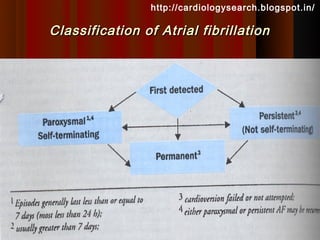
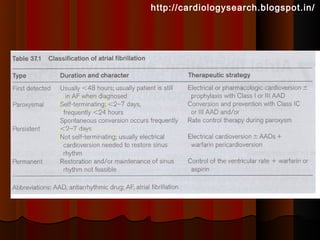
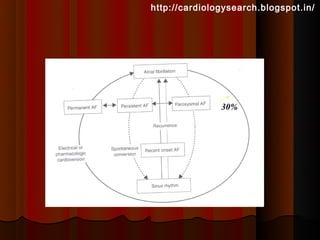
Classification of Atrial fibrillation
http://cardiologysearch.blogspot.in/
     Classification of Atrial
           fibrillation
 First  detected AF -usually <48hr in
  AF during diagnosis
 Paraoxysmal AF - last < 7days
  (most<24hrs) self-terminating episodes
 Persistent AF - last >7days requires
  electrical or pharmacologic
  cardioversion
 Permanent AF - sustained >1yr &
  failed cardioversion
http://cardiologysearch.blogspot.in/


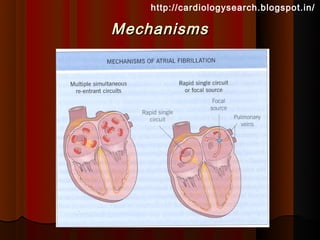
                       Mechanisms
   It was first thought that irregular contractions of the atria are
    caused by either single or multiple foci

   In 1924, Garry had suggested reentry to be the mechanism
    behind the AF

   In 1960, Moe suggested the “multiple wavelet hypothesis ”

   AF is characterized by fragmentation of a wavefront into
    multiple, independent daughter wavelets that move randomly
    throughout the atrium, giving rise to new wavelets that collide
    with each other & mutually annihilate, or that give rise to new
    wavelets in a perpetual activity that resembles Brownian motion
http://cardiologysearch.blogspot.in/
                    Mechanisms
 Stability of AF is a function of several factors
 Non-uniform distribution of refractory periods


 Specially large tissue area


 Either a relatively brief refractory period or a relatively
    slow conduction velocity of the impulse, or both

 Average no. of the wavelets


 Allessie     et al, estimated the critical no. of wavelets
    to sustain AF was approximately 4 - 6
http://cardiologysearch.blogspot.in/

Mechanisms
http://cardiologysearch.blogspot.in/

              Mechanisms
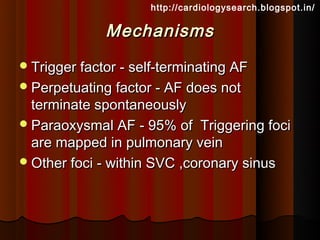
 Trigger factor - self-terminating AF
 Perpetuating factor - AF does not
  terminate spontaneously
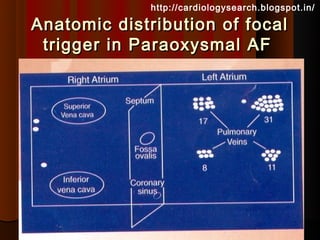
 Paraoxysmal AF - 95% of Triggering foci
  are mapped in pulmonary vein
 Other foci - within SVC ,coronary sinus
http://cardiologysearch.blogspot.in/

Anatomic distribution of focal
 trigger in Paraoxysmal AF
http://cardiologysearch.blogspot.in/
                    Mechanisms
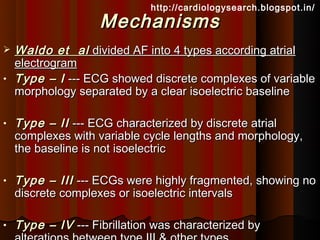
   Waldo et al divided AF into 4 types according atrial
    electrogram
•   Type – I --- ECG showed discrete complexes of variable
    morphology separated by a clear isoelectric baseline

•   Type – II --- ECG characterized by discrete atrial
    complexes with variable cycle lengths and morphology,
    the baseline is not isoelectric

•   Type – III --- ECGs were highly fragmented, showing no
    discrete complexes or isoelectric intervals

•   Type – IV --- Fibrillation was characterized by
http://cardiologysearch.blogspot.in/


                       Mechanisms
   “ f” waves
   They do not represent total atrial activity but depict only the
    larger vectors generated by the multiple wavelets of
    depolarization that occur at any given time

   Why ventricular response is irregularly irregular?
   Large no. of atrial impulses that penetrate the AV node, makes
    it partially refractory to subsequent impulses

   These effect of non conducted atrial impulses to influence the
    response of subsequent atrial impulse is called as “concealed
    conduction”
http://cardiologysearch.blogspot.in/

                      Mechanisms
   Electrical remodelling
   It means long term changes in refractory periods resulting from
    prolonged changes in atrial rate
   EPS --- ↓ERP,↓Action potential, ↓ amplitude of AP plateau
   Mechanisms --- Structural , cellular or ion channels It
    encompasses diverse structural changes in the myocardium
    -interstitial fibrosis

   Alteration in quantity or properties of ion channel proteins in
    sarcolemma

   Microscopic changes in cell size , content & extra cellular matrix
    leads to irreversible macroscopic changes
Mechanisms  http://cardiologysearch.blogspot.in/


   Maladoptations of atrial refractionaries – cause of chronic AF
   Atrial remodelling
   Caused by atrial ischemia & stretch leads to AF due to ↑
    automaticity & reentry

   After AF has continued for a long time, atria are not only
    electrically remodelled, but atrial contractile function is also
    disturbed

   Recovery of atrial transport function may depend upon
    duration of AF

   After sinus rhythm is restored, it may take several weeks
    before atrial contractility fully returns
http://cardiologysearch.blogspot.in/


                   Mechanisms
   Modulating factors
   The onset & persistence of AF may be modulated by
    autonomic nervous system

   Coumel et al distinguished vagal & adrenergic AF
    (distinction is not clear)
   Vagally mediated AF
   Occurs more frequently in men than in women

   Usually younger age group (30 – 50 years)
http://cardiologysearch.blogspot.in/

                      Mechanisms
   Predominantly occurs in the absence of structural heart disease

   Rarely progresses to permanent AF

   Attacks occur at night, end of the morning

   Neither emotional stress nor exertion trigger the arrhythmia

   Rest, postprandial state, & alcohol are other precipitating
    factors

   Mechanism may relate to vagally induced shortening of the
    atrial refractory period
http://cardiologysearch.blogspot.in/


                      Mechanisms
   Adrenergic AF
   More frequently associated with structural heart disease (IHD)

   Occurs during the day time, & it is precipitated by stress,
    exercise, tea, coffee or alcohol

   The underlying mechanism is unknown
http://cardiologysearch.blogspot.in/

         Hemodynamic effect
 Loss of atrial contraction
 Rapid ventricular rate -   ↓duration of
  diastole & ventricular filling
 irregular ventricular rhythm - ↓ CO &
  coronary blood flow
 Loss of AV synchrony - ↓LVEDP - ↓SV
 AF causes hypotension or pulmonary
  oedema in the setting of restrictive
  physiology
http://cardiologysearch.blogspot.in/
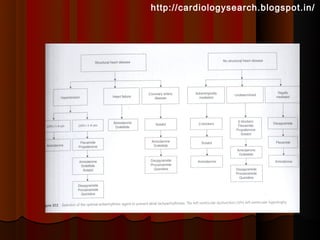
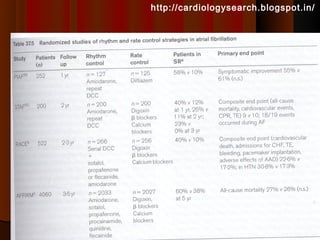
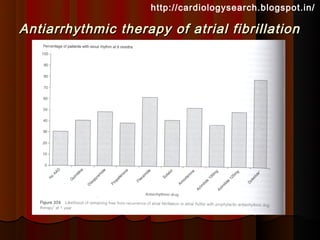
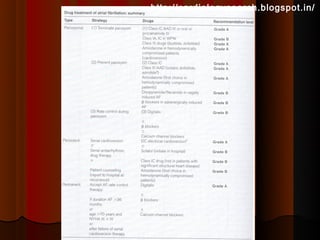
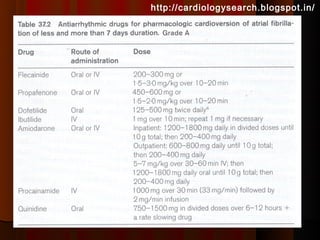
    Antiarrhythmic therapy of atrial fibrillation
 Three      antiarrhythmic strategies
   Acute pharmacologic termination
   Prevention of recurrence after cardioversion
   Control of ventricular rate
   Acute conversion of paroxysmal AF
   Pharmacologic cardioversion
   Most effective if initiated within 7 days after onset of AF
   Restoration of sinus rhythm can be achieved in 70% of the
    patients
   First choice : Propafenone & flecainide (po & iv), ibutilide,
    dofetilide
   Second choice : Amaiodarone (high dose, iv +oral) &
    Qunidine (po)
http://cardiologysearch.blogspot.in/
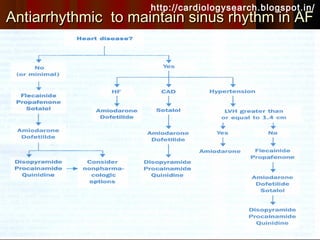
Antiarrhythmic to maintain sinus rhythm in AF
http://cardiologysearch.blogspot.in/
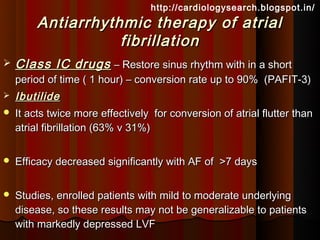
         Antiarrhythmic therapy of atrial
                    fibrillation
   Class IC drugs – Restore sinus rhythm with in a short
    period of time ( 1 hour) – conversion rate up to 90% (PAFIT-3)
   Ibutilide
   It acts twice more effectively for conversion of atrial flutter than
    atrial fibrillation (63% v 31%)


   Efficacy decreased significantly with AF of >7 days


   Studies, enrolled patients with mild to moderate underlying
    disease, so these results may not be generalizable to patients
    with markedly depressed LVF
http://cardiologysearch.blogspot.in/
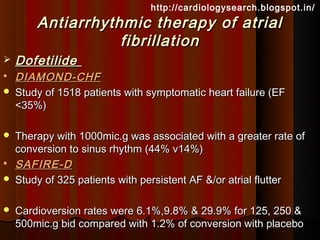
        Antiarrhythmic therapy of atrial
                   fibrillation
   Dofetilide
   DIAMOND-CHF
   Study of 1518 patients with symptomatic heart failure (EF
    <35%)

   Therapy with 1000mic.g was associated with a greater rate of
    conversion to sinus rhythm (44% v14%)
   SAFIRE-D
   Study of 325 patients with persistent AF &/or atrial flutter

   Cardioversion rates were 6.1%,9.8% & 29.9% for 125, 250 &
    500mic.g bid compared with 1.2% of conversion with placebo
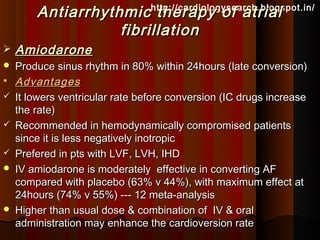
Antiarrhythmic therapy of atrial
                                 http://cardiologysearch.blogspot.in/

                   fibrillation
   Amiodarone
   Produce sinus rhythm in 80% within 24hours (late conversion)
   Advantages
   It lowers ventricular rate before conversion (IC drugs increase
    the rate)
   Recommended in hemodynamically compromised patients
    since it is less negatively inotropic
   Prefered in pts with LVF, LVH, IHD
   IV amiodarone is moderately effective in converting AF
    compared with placebo (63% v 44%), with maximum effect at
    24hours (74% v 55%) --- 12 meta-analysis
   Higher than usual dose & combination of IV & oral
    administration may enhance the cardioversion rate
Antiarrhythmic therapy of atrial
                                   http://cardiologysearch.blogspot.in/

                    fibrillation
   Quinidine
   Usually administered in conjunction with B-Blocker

   Cumulative dose of up to 1350mg has shown to cardiovert 50-
    77% of patients with recent onset AF
   Sotalol
   It is ineffective in acute conversion

   It is effective for the prevention of AF

   This discrepancy relates to its property to prolong the refractory
    period predominantly at lower atrial rates, but not during rapid
    AF
http://cardiologysearch.blogspot.in/
        Antiarrhythmic therapy of atrial
                   fibrillation
   Availability of studies on the efficacy of procainamide &
    disopyramide is limited, precluding definite conclusions

   Digitalis, B-Blockers, & CCBs are ineffective for acute conversion
    of AF
   DAAF study (Digoxin in acute AF)
   There was no difference in cardioversion rates at 16 hours
    between IV digoxin & placebo (51% v 46%)

   Digoxin can facilitate AF due to its cholinergic effects which may
    cause a non-uniform reduction in conduction velocity & effective
    refractory periods of the atria, and to delay the reversal of
    remodelling after restoration of sinus rhythm
http://cardiologysearch.blogspot.in/

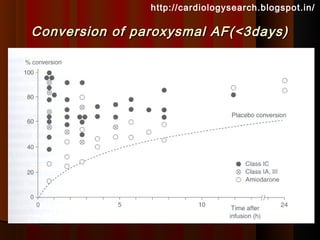
Conversion of paroxysmal AF(<3days)
http://cardiologysearch.blogspot.in/
        Antiarrhythmic therapy of atrial
                   fibrillation
   Prevention of paroxysmal AF
   No need for prophylactic AAD
   After first episode of AF which may self terminate or require
    electrical or pharmacologic cardioversion

   Patients with infrequent, self limiting & well tolerated paroxysms
    of AF
   Prophylactic AAD are recommended if
   Occurs frequently (1 episode per 3 months)

   Associated with significant symptoms
http://cardiologysearch.blogspot.in/
      Antiarrhythmic therapy of atrial
                 fibrillation
   Prophylactic AAD are recommended if…
   Worsening of LV function

   In the presence of left atrial enlargement, LVD, underlying
    CVS pathology, long duration of AF, advanced age
   B-blockers
   Effective in adrenergic dependent AF (class IA & IC are
    ineffective)

   It prevents the recurrence of persistent AF after
    cardioversion
http://cardiologysearch.blogspot.in/
        Antiarrhythmic therapy of atrial
                   fibrillation
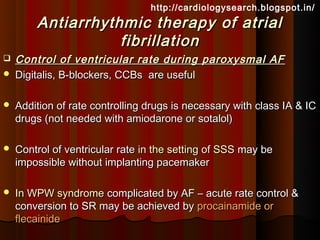
   Control of ventricular rate during paroxysmal AF
   Digitalis, B-blockers, CCBs are useful

   Addition of rate controlling drugs is necessary with class IA & IC
    drugs (not needed with amiodarone or sotalol)

   Control of ventricular rate in the setting of SSS may be
    impossible without implanting pacemaker

   In WPW syndrome complicated by AF – acute rate control &
    conversion to SR may be achieved by procainamide or
    flecainide
http://cardiologysearch.blogspot.in/
              Antithrombotic therapy
 Whether AF is persistent or intermittent ---
  Predisposes to stroke
 Non   valvular AF
 Most common cardiac     disease associated with
  cerebral embolism
 The risk of stroke is 5-7 times greater when
  compared to control group
 Risk factors that predicts stroke
 Previous stroke or TIA
 Diabetes mellitus
 Systemic hypertension
 Increasing age
 CAD
 CHF
http://cardiologysearch.blogspot.in/
                Antithrombotic therapy
   LV dysfunction & left atrial size > 2.5cm/sq.m --- associated
    with thromboembolism

   Age - 60-65, normal echo, no risk factors --- Extremely low
    risk for stroke (1% per year)
   Results from 5 large anticoagulation trails
   Annual rate of stroke in control group --- 4.5%

   Annual rate of stroke in warfarin-treated group --- 1.4%
    (68% risk reduction)

   Aspirin 325mg/d produced a risk reduction of 44%
http://cardiologysearch.blogspot.in/
                Antithrombotic therapy
   Annual rate of major hemorrhage
   Control group --- 1%

   Aspirin group --- 1%

   Warfarin group --- 1.3%

   No difference was noted in stroke risk, when patients with
    paroxysmal (intermittent) AF were compared with chronic AF

   Anticoagulation was 50% more effective than aspirin in
    preventing ischemic stroke
http://cardiologysearch.blogspot.in/


           Antithrombotic therapy
   Risk factors for stroke
   Prior stroke or TIA
   Significant valvular heart disease
   Hypertension
   Diabetes mellitus
   Age >65 years
   Left atrial enlargement
   CAD
   Congestive heart failure
http://cardiologysearch.blogspot.in/
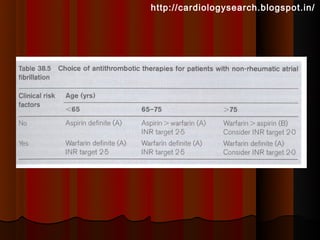
                   Antithrombotic therapy

   Lone AF
   Age <60years, no risk factors ---No antithrombotic therapy

   Age - 60-75 years (risk-2%per year) ---Aspirin

   Age > 75 years --- Anticoagulation (INR – 2.0)

   Any patients with AF + Risk factors for stroke --- Treated with
    warfarin anticoagulation (INR – 2 to 3)

   Patients with contraindication to anticoagulation (or) unreliable
    individual (or) no risk factors --- Aspirin
http://cardiologysearch.blogspot.in/
               Antithrombotic therapy
   Risk of embolism after cardioversion
   Risk --- 0 -7%

   Risk is independent of mode of cardioversion
   High risk patients are
   Prior embolism, Mechanical valve prosthesis, Mitral stenosis

   In AF (>2d) --- Warfarin for 3 weeks before cardioversion + 3-4
    weeks after reversion to sinus rhythm

   Alternate strategy --- TEE (to exclude LA thrombus) + heparin
    before cardioversion + followed by warfarin for 4weeks
Antithrombotic therapy
                      http://cardiologysearch.blogspot.in/

   Risk of embolism after cardioversion…
   For emergency cardioversion (TEE cannot be obtained) ---
    heparin before cardioversion + followed by warfarin for
    4weeks
   Low risk patients
   Age <65 years without risk factor for stroke in nonvalvular AF

   Anticoagulation may not be necessary before cardioversion
    but aspirin is indicated

   It is important to emphasize that suggestions must be
    individualized for a given patient
 Absolute contraindication for anticoagulation -
    ICH,SDH,GI bleed
http://cardiologysearch.blogspot.in/

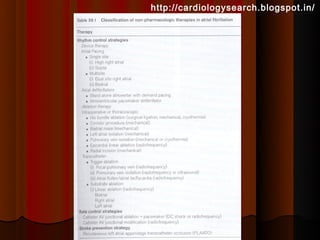
            Non – pharmacologic therapies

 Rhythm       control strategies
   Device therapy
   Single site pacing --- High right atrial & septal
   In many patients with SSS, atrial pacmaker allows higher dose
    of AAD since sinus node dysfunction is treated

   In patients with paroxysmal AF, there is evidence for intraatrial
    conduction delay

   Atrial pacing may decrease the frequency of recurrent AF in
    patients who have SSS
http://cardiologysearch.blogspot.in/
      Non – pharmacologic therapies
 Incidence of AF is lower in patients treated by atrial
  pacing than ventricular pacing (prospective studies)
 Multisite pacing --- Biatrial synchronous & Dual site
  atrial pacing
 In addition to the high RA lead, another atrial lead is
  placed just outside the CS ostium for stability & LA
  synchronization

 These pacing cause resynchronization of      atrial
  depolarisation & helpful in patients with intra atrial
  conduction delay
http://cardiologysearch.blogspot.in/
        Non – pharmacologic therapies
 Usually performed in patients with recurrent,
    symptomatic & drug refractory AF

 ECG showed biphasic ‘p’ wave in inferior leads with
    abbreviation of ‘P’ wave duration

 Implantable       atrial defibrillator

   Automatic atrial defibrillator
•   It detect AF by means of implanted RA, CS & RV
    leads
http://cardiologysearch.blogspot.in/
      Non – pharmacologic therapies
•   It delivers ‘R’ wave synchronization shock of 6J after
    a minimal preceding R-R interval of 500 ms

•   Unfortunately this device in its current form is not in
    use
   Atrial-ventricular defibrillator/pacemaker
•   It has dual chamber algorithm-based arrhythmia
    detection

•   Pacing & defibrillation therapies for treatment of AF
    & atrial tachycardias
http://cardiologysearch.blogspot.in/
       Non – pharmacologic therapies

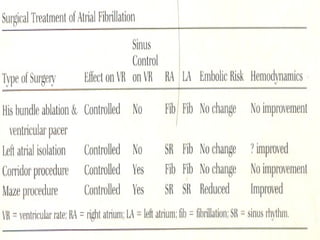
   Ablation therapy --- surgical
   His bundle ablation (surgical ligation, mechanical,
    cryothermia) + Pace maker implantation

   Corridor surgery
   Creating an isolated strip of muscle to isolate the SA & AV
    nodes, thus driving ventricular rate via AV node-His bundle
    complex

   But, atrial areas outside of narrow RA corridor continued to
    fibrillate with persistent loss of atrial transport function &
    persistent risk of thromboembolism
http://cardiologysearch.blogspot.in/
      Non – pharmacologic therapies
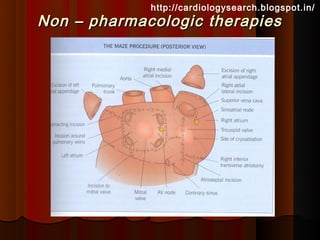
   Maze procedure
 The principle is compartmentalize both atria so that AF
    cannot be maintained


 Right & left atrial appendages were resected,
    pulmonary vein ostia are isolated, linear RA & LA
    lesions are connected to anatomic structures to form
    an “electrical maze” --- “Maze 3”


 Appropriately placed atrial incisions not only interrupt
    the conduction routes of reentrant circuits, but they
    also direct the sinus impulse from SA to AV along a
http://cardiologysearch.blogspot.in/

  Indication for maze procedure
 Symptomatic AF
 Refractory to AAD
 Recurrent systemic embolism despite
 anticoagulation
http://cardiologysearch.blogspot.in/
            Maze procedure
 90% pt cured of AF with operative mortality <1


 <10% requires PPI due to sinus node dysfunction


 Transient fluid retention due to
                                 ↓atrial natriuretic
  peptide must be treated with diuretics

 The entire atrial myocardium was electrically
  activated & atrial transport function is preserved
http://cardiologysearch.blogspot.in/
Non – pharmacologic therapies
http://cardiologysearch.blogspot.in/
        Non – pharmacologic therapies
   Tans catheter ablation therapy
   Linear atrial ablation (Radiofrequency)
   It is employed in LA & RA for substrate compartmentalization

   Trigger ablation (Radiofrequency)
   Focal pulmonary vein
   Pulmonary vein isolation - transseptal puncture followed by
    pulmonary venography to define anatomy

   Adverse effect
   Stroke
   Phrenic nerve injury
   Pericardial effusion & tamponade
   Pulmonary vein stenosis
http://cardiologysearch.blogspot.in/

        Indication for ablation
 Symptomatic AF
 Refractory to AAD
 Without structural heart disease
http://cardiologysearch.blogspot.in/


        Non – pharmacologic therapies
 Rate     control strategy
   Catheter AV junctional modification (radiofrequency)
   Principle --- Posterior inputs of AV node have shorter ERP, their
    ablation slows the ventricular response during AF

   Patient who becomes symptomatic due rapid ventricular
    response will benefit

   Currently, AV node modification is usually reserved for patients
    who require non-pharmacologic control but are opposed to
    pacemaker implantation
http://cardiologysearch.blogspot.in/
      Non – pharmacologic therapies
   Catheter ablation (DC shock or radiofrequency) +
    Pacemaker
   It is performed in patients with unmanageable symptoms
    related to rapid ventricular response

   DC current ablation is highly dangerous --- produce electrical
    arcing & barotrauma ( cardiac perforation, tamponade, acute
    depression of LV, proarrhythmia & sudden death

   Radiofrequency ablation ---avoid complications
   Disadvantages
   Dependence on pacemaker

   Atria will continue to fibrillate --- need long term
http://cardiologysearch.blogspot.in/
        Non – pharmacologic therapies
   Choice of pace maker type --- determined by the current phase
    of AF

   Chronic AF --- VVIR + AV nodal ablation

   Paroxysmal AF ( usually in sinus rhythm between episodes) ---
    Dual-chamber pacemaker with mode switching
 Stroke      prevention strategy
   Percutaneous LA appendage transcatheter occlusion
    (PLAATO)

   Involves insertion of an occlusion device by catheter into the LA
    appendage via trans septal puncture
http://cardiologysearch.blogspot.in/
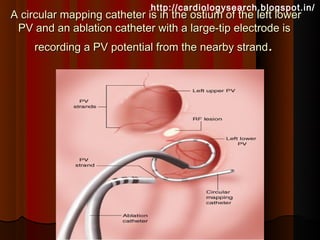
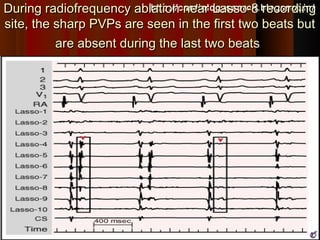
A circular mapping catheter is in the ostium of the left lower
 PV and an ablation catheter with a large-tip electrode is
     recording a PV potential from the nearby strand.
During radiofrequency ablation near Lasso-8 recording
                          http://cardiologysearch.blogspot.in/
site, the sharp PVPs are seen in the first two beats but
          are absent during the last two beats
http://cardiologysearch.blogspot.in/


Thank you
http://cardiologysearch.blogspot.in/


                 http://cardiologysearch.blogspot.in/
http://cardiologysearch.blogspot.in/


 Kindly send your suggestions to improve                    this
  site


 Visit    us regularly for updates


 Send your articles/ ppt/pdf    to publish in this
  site .
                                          http://cardiologysearch.blogspot.in/
http://cardiologysearch.blogspot.in/
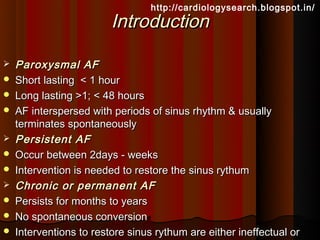
                         Introduction

   Paroxysmal AF
   Short lasting < 1 hour
   Long lasting >1; < 48 hours
   AF interspersed with periods of sinus rhythm & usually
    terminates spontaneously
   Persistent AF
   Occur between 2days - weeks
   Intervention is needed to restore the sinus rythum
   Chronic or permanent AF
   Persists for months to years
   No spontaneous conversion
   Interventions to restore sinus rythum are either ineffectual or
http://cardiologysearch.blogspot.in/
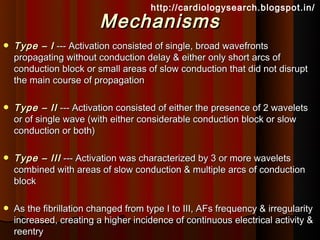
                         Mechanisms
   Type – I --- Activation consisted of single, broad wavefronts
    propagating without conduction delay & either only short arcs of
    conduction block or small areas of slow conduction that did not disrupt
    the main course of propagation

   Type – II --- Activation consisted of either the presence of 2 wavelets
    or of single wave (with either considerable conduction block or slow
    conduction or both)

   Type – III --- Activation was characterized by 3 or more wavelets
    combined with areas of slow conduction & multiple arcs of conduction
    block

   As the fibrillation changed from type I to III, AFs frequency & irregularity
    increased, creating a higher incidence of continuous electrical activity &
    reentry
http://cardiologysearch.blogspot.in/

                      Mechanisms
   Familial AF
•   Genetic predisposition – is a hypothesis

•   Defect linked to chromosome 10q (21 of 49 members from 3
    spanish families presented with AF)

•   Missense mutation in the lamin A/C gene (In DCM – associated
    with AF)

•   Missense mutation Arg663His ( In specific phenotype of HCM –
    associated with 47% of AF)
http://cardiologysearch.blogspot.in/


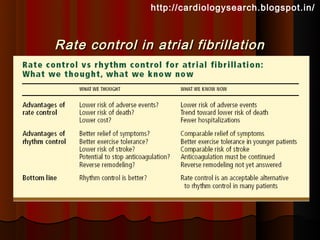
Rate control in atrial fibrillation
http://cardiologysearch.blogspot.in/


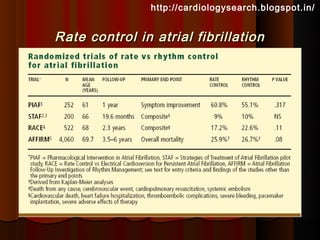
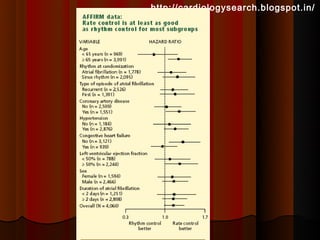
Rate control in atrial fibrillation
http://cardiologysearch.blogspot.in/

Antiarrhythmic therapy of atrial fibrillation
http://cardiologysearch.blogspot.in/


               30%

Atrial fibrilation

  • 1.
    http://cardiologysearch.blogspot.in/ Atrial fibrillation (Classification, Mechanism & Management)
  • 2.
    http://cardiologysearch.blogspot.in/ Introduction…  AF is characterised by wavelets propagating in different directions causing disorganized atrial depolarization without effective atrial contraction  Electrical activity of atrium can be detected in ECG as small irregular baseline undulations of variable amplitude & morphology (f waves) at rate of 350 to 600  Ventricular response is irregularly irregular, & in untreated patients with normal AV conduction, is usually between 100 to 160  WPWsyndrome ventricular rate may be rapid >300 due to conduction over accessory pathway( short antegrade refractory periods)
  • 3.
    http://cardiologysearch.blogspot.in/ Introduction…  ventricular rate during AF is altered due to  Autonomic tone  Property of AV node  Effect of drugs on AV conduction
  • 4.
    http://cardiologysearch.blogspot.in/ Introduction  Atrial fibrillation is the most common arrhythmia & the incidence & prevalence increases with the age  The incidence  <0.5% below 50Yrs  2% in age 60-69  4.6% in age 70-79  8.8% in age 80-89  Men were 1.5 times more likely to develop AF than women  Whites were more likely to develop AF than blacks
  • 5.
    http://cardiologysearch.blogspot.in/  Framingham heart study ---cardiac factor predicting AF • CHF • RHD • HT • Stroke • Left atrial enlargement • Increased LV wall thickness • Decreased LV fractional shortening
  • 6.
    http://cardiologysearch.blogspot.in/  Relative riskof stroke - 6 fold in non rheumatic AF  Relative risk of stroke - 17 fold in rheumatic AF  Annual risk of stroke in pt aged 50- 59:1.5%  Annual risk of stroke in aged 80-89:23.5%
  • 7.
    http://cardiologysearch.blogspot.in/ Underlying causes of AF  CVS  Tumors  Rheumatic heart disease  WPW syndrome  ASD  Systemic  Cardiac surgery  Alcohol (holiday heart  Cardiomyopathy syndrome)  Hypertrophic  CVA  Idiopathic  Infiltrative  COPD  Hypertension  Defibrillation  CAD (Acute & chronic)  Effort  MVPS  Electrocution  Non rheumatic mitral or tricuspid valve disease  Electrolyte abnormalities  Pericarditis  Fever  Tacycardia-bradycardia syndrome  Hypothermia
  • 8.
    http://cardiologysearch.blogspot.in/ Underlying causes of AF…  Pneumonia  Congenital  Pulmonary embolism  Multiple sclerosis  Sudden emotion  Muscular dystrophy  Thyrotoxicosis  Pheochromocytoma  Trauma  Right atrial cold injections  Rare  Swallowing  Acute hypovolemia  Tyramine foods
  • 9.
  • 10.
    http://cardiologysearch.blogspot.in/ Classification of Atrial fibrillation  First detected AF -usually <48hr in AF during diagnosis  Paraoxysmal AF - last < 7days (most<24hrs) self-terminating episodes  Persistent AF - last >7days requires electrical or pharmacologic cardioversion  Permanent AF - sustained >1yr & failed cardioversion
  • 11.
    http://cardiologysearch.blogspot.in/ Mechanisms  It was first thought that irregular contractions of the atria are caused by either single or multiple foci  In 1924, Garry had suggested reentry to be the mechanism behind the AF  In 1960, Moe suggested the “multiple wavelet hypothesis ”  AF is characterized by fragmentation of a wavefront into multiple, independent daughter wavelets that move randomly throughout the atrium, giving rise to new wavelets that collide with each other & mutually annihilate, or that give rise to new wavelets in a perpetual activity that resembles Brownian motion
  • 12.
    http://cardiologysearch.blogspot.in/ Mechanisms  Stability of AF is a function of several factors  Non-uniform distribution of refractory periods  Specially large tissue area  Either a relatively brief refractory period or a relatively slow conduction velocity of the impulse, or both  Average no. of the wavelets  Allessie et al, estimated the critical no. of wavelets to sustain AF was approximately 4 - 6
  • 13.
  • 14.
    http://cardiologysearch.blogspot.in/ Mechanisms  Trigger factor - self-terminating AF  Perpetuating factor - AF does not terminate spontaneously  Paraoxysmal AF - 95% of Triggering foci are mapped in pulmonary vein  Other foci - within SVC ,coronary sinus
  • 15.
  • 16.
    http://cardiologysearch.blogspot.in/ Mechanisms  Waldo et al divided AF into 4 types according atrial electrogram • Type – I --- ECG showed discrete complexes of variable morphology separated by a clear isoelectric baseline • Type – II --- ECG characterized by discrete atrial complexes with variable cycle lengths and morphology, the baseline is not isoelectric • Type – III --- ECGs were highly fragmented, showing no discrete complexes or isoelectric intervals • Type – IV --- Fibrillation was characterized by
  • 17.
    http://cardiologysearch.blogspot.in/ Mechanisms  “ f” waves  They do not represent total atrial activity but depict only the larger vectors generated by the multiple wavelets of depolarization that occur at any given time  Why ventricular response is irregularly irregular?  Large no. of atrial impulses that penetrate the AV node, makes it partially refractory to subsequent impulses  These effect of non conducted atrial impulses to influence the response of subsequent atrial impulse is called as “concealed conduction”
  • 18.
    http://cardiologysearch.blogspot.in/ Mechanisms  Electrical remodelling  It means long term changes in refractory periods resulting from prolonged changes in atrial rate  EPS --- ↓ERP,↓Action potential, ↓ amplitude of AP plateau  Mechanisms --- Structural , cellular or ion channels It encompasses diverse structural changes in the myocardium -interstitial fibrosis  Alteration in quantity or properties of ion channel proteins in sarcolemma  Microscopic changes in cell size , content & extra cellular matrix leads to irreversible macroscopic changes
  • 19.
    Mechanisms http://cardiologysearch.blogspot.in/  Maladoptations of atrial refractionaries – cause of chronic AF  Atrial remodelling  Caused by atrial ischemia & stretch leads to AF due to ↑ automaticity & reentry  After AF has continued for a long time, atria are not only electrically remodelled, but atrial contractile function is also disturbed  Recovery of atrial transport function may depend upon duration of AF  After sinus rhythm is restored, it may take several weeks before atrial contractility fully returns
  • 20.
    http://cardiologysearch.blogspot.in/ Mechanisms  Modulating factors  The onset & persistence of AF may be modulated by autonomic nervous system  Coumel et al distinguished vagal & adrenergic AF (distinction is not clear)  Vagally mediated AF  Occurs more frequently in men than in women  Usually younger age group (30 – 50 years)
  • 21.
    http://cardiologysearch.blogspot.in/ Mechanisms  Predominantly occurs in the absence of structural heart disease  Rarely progresses to permanent AF  Attacks occur at night, end of the morning  Neither emotional stress nor exertion trigger the arrhythmia  Rest, postprandial state, & alcohol are other precipitating factors  Mechanism may relate to vagally induced shortening of the atrial refractory period
  • 22.
    http://cardiologysearch.blogspot.in/ Mechanisms  Adrenergic AF  More frequently associated with structural heart disease (IHD)  Occurs during the day time, & it is precipitated by stress, exercise, tea, coffee or alcohol  The underlying mechanism is unknown
  • 23.
    http://cardiologysearch.blogspot.in/ Hemodynamic effect  Loss of atrial contraction  Rapid ventricular rate - ↓duration of diastole & ventricular filling  irregular ventricular rhythm - ↓ CO & coronary blood flow  Loss of AV synchrony - ↓LVEDP - ↓SV  AF causes hypotension or pulmonary oedema in the setting of restrictive physiology
  • 24.
    http://cardiologysearch.blogspot.in/ Antiarrhythmic therapy of atrial fibrillation  Three antiarrhythmic strategies  Acute pharmacologic termination  Prevention of recurrence after cardioversion  Control of ventricular rate  Acute conversion of paroxysmal AF  Pharmacologic cardioversion  Most effective if initiated within 7 days after onset of AF  Restoration of sinus rhythm can be achieved in 70% of the patients  First choice : Propafenone & flecainide (po & iv), ibutilide, dofetilide  Second choice : Amaiodarone (high dose, iv +oral) & Qunidine (po)
  • 25.
  • 26.
    http://cardiologysearch.blogspot.in/ Antiarrhythmic therapy of atrial fibrillation  Class IC drugs – Restore sinus rhythm with in a short period of time ( 1 hour) – conversion rate up to 90% (PAFIT-3)  Ibutilide  It acts twice more effectively for conversion of atrial flutter than atrial fibrillation (63% v 31%)  Efficacy decreased significantly with AF of >7 days  Studies, enrolled patients with mild to moderate underlying disease, so these results may not be generalizable to patients with markedly depressed LVF
  • 27.
    http://cardiologysearch.blogspot.in/ Antiarrhythmic therapy of atrial fibrillation  Dofetilide  DIAMOND-CHF  Study of 1518 patients with symptomatic heart failure (EF <35%)  Therapy with 1000mic.g was associated with a greater rate of conversion to sinus rhythm (44% v14%)  SAFIRE-D  Study of 325 patients with persistent AF &/or atrial flutter  Cardioversion rates were 6.1%,9.8% & 29.9% for 125, 250 & 500mic.g bid compared with 1.2% of conversion with placebo
  • 28.
    Antiarrhythmic therapy ofatrial http://cardiologysearch.blogspot.in/ fibrillation  Amiodarone  Produce sinus rhythm in 80% within 24hours (late conversion)  Advantages  It lowers ventricular rate before conversion (IC drugs increase the rate)  Recommended in hemodynamically compromised patients since it is less negatively inotropic  Prefered in pts with LVF, LVH, IHD  IV amiodarone is moderately effective in converting AF compared with placebo (63% v 44%), with maximum effect at 24hours (74% v 55%) --- 12 meta-analysis  Higher than usual dose & combination of IV & oral administration may enhance the cardioversion rate
  • 29.
    Antiarrhythmic therapy ofatrial http://cardiologysearch.blogspot.in/ fibrillation  Quinidine  Usually administered in conjunction with B-Blocker  Cumulative dose of up to 1350mg has shown to cardiovert 50- 77% of patients with recent onset AF  Sotalol  It is ineffective in acute conversion  It is effective for the prevention of AF  This discrepancy relates to its property to prolong the refractory period predominantly at lower atrial rates, but not during rapid AF
  • 30.
    http://cardiologysearch.blogspot.in/ Antiarrhythmic therapy of atrial fibrillation  Availability of studies on the efficacy of procainamide & disopyramide is limited, precluding definite conclusions  Digitalis, B-Blockers, & CCBs are ineffective for acute conversion of AF  DAAF study (Digoxin in acute AF)  There was no difference in cardioversion rates at 16 hours between IV digoxin & placebo (51% v 46%)  Digoxin can facilitate AF due to its cholinergic effects which may cause a non-uniform reduction in conduction velocity & effective refractory periods of the atria, and to delay the reversal of remodelling after restoration of sinus rhythm
  • 31.
  • 32.
    http://cardiologysearch.blogspot.in/ Antiarrhythmic therapy of atrial fibrillation  Prevention of paroxysmal AF  No need for prophylactic AAD  After first episode of AF which may self terminate or require electrical or pharmacologic cardioversion  Patients with infrequent, self limiting & well tolerated paroxysms of AF  Prophylactic AAD are recommended if  Occurs frequently (1 episode per 3 months)  Associated with significant symptoms
  • 33.
    http://cardiologysearch.blogspot.in/ Antiarrhythmic therapy of atrial fibrillation  Prophylactic AAD are recommended if…  Worsening of LV function  In the presence of left atrial enlargement, LVD, underlying CVS pathology, long duration of AF, advanced age  B-blockers  Effective in adrenergic dependent AF (class IA & IC are ineffective)  It prevents the recurrence of persistent AF after cardioversion
  • 34.
    http://cardiologysearch.blogspot.in/ Antiarrhythmic therapy of atrial fibrillation  Control of ventricular rate during paroxysmal AF  Digitalis, B-blockers, CCBs are useful  Addition of rate controlling drugs is necessary with class IA & IC drugs (not needed with amiodarone or sotalol)  Control of ventricular rate in the setting of SSS may be impossible without implanting pacemaker  In WPW syndrome complicated by AF – acute rate control & conversion to SR may be achieved by procainamide or flecainide
  • 35.
  • 36.
    http://cardiologysearch.blogspot.in/ Antithrombotic therapy  Whether AF is persistent or intermittent --- Predisposes to stroke  Non valvular AF  Most common cardiac disease associated with cerebral embolism  The risk of stroke is 5-7 times greater when compared to control group  Risk factors that predicts stroke  Previous stroke or TIA  Diabetes mellitus  Systemic hypertension  Increasing age  CAD  CHF
  • 37.
    http://cardiologysearch.blogspot.in/ Antithrombotic therapy  LV dysfunction & left atrial size > 2.5cm/sq.m --- associated with thromboembolism  Age - 60-65, normal echo, no risk factors --- Extremely low risk for stroke (1% per year)  Results from 5 large anticoagulation trails  Annual rate of stroke in control group --- 4.5%  Annual rate of stroke in warfarin-treated group --- 1.4% (68% risk reduction)  Aspirin 325mg/d produced a risk reduction of 44%
  • 38.
    http://cardiologysearch.blogspot.in/ Antithrombotic therapy  Annual rate of major hemorrhage  Control group --- 1%  Aspirin group --- 1%  Warfarin group --- 1.3%  No difference was noted in stroke risk, when patients with paroxysmal (intermittent) AF were compared with chronic AF  Anticoagulation was 50% more effective than aspirin in preventing ischemic stroke
  • 39.
    http://cardiologysearch.blogspot.in/ Antithrombotic therapy  Risk factors for stroke  Prior stroke or TIA  Significant valvular heart disease  Hypertension  Diabetes mellitus  Age >65 years  Left atrial enlargement  CAD  Congestive heart failure
  • 40.
    http://cardiologysearch.blogspot.in/ Antithrombotic therapy  Lone AF  Age <60years, no risk factors ---No antithrombotic therapy  Age - 60-75 years (risk-2%per year) ---Aspirin  Age > 75 years --- Anticoagulation (INR – 2.0)  Any patients with AF + Risk factors for stroke --- Treated with warfarin anticoagulation (INR – 2 to 3)  Patients with contraindication to anticoagulation (or) unreliable individual (or) no risk factors --- Aspirin
  • 41.
    http://cardiologysearch.blogspot.in/ Antithrombotic therapy  Risk of embolism after cardioversion  Risk --- 0 -7%  Risk is independent of mode of cardioversion  High risk patients are  Prior embolism, Mechanical valve prosthesis, Mitral stenosis  In AF (>2d) --- Warfarin for 3 weeks before cardioversion + 3-4 weeks after reversion to sinus rhythm  Alternate strategy --- TEE (to exclude LA thrombus) + heparin before cardioversion + followed by warfarin for 4weeks
  • 42.
    Antithrombotic therapy http://cardiologysearch.blogspot.in/  Risk of embolism after cardioversion…  For emergency cardioversion (TEE cannot be obtained) --- heparin before cardioversion + followed by warfarin for 4weeks  Low risk patients  Age <65 years without risk factor for stroke in nonvalvular AF  Anticoagulation may not be necessary before cardioversion but aspirin is indicated  It is important to emphasize that suggestions must be individualized for a given patient  Absolute contraindication for anticoagulation - ICH,SDH,GI bleed
  • 43.
    http://cardiologysearch.blogspot.in/ Non – pharmacologic therapies  Rhythm control strategies  Device therapy  Single site pacing --- High right atrial & septal  In many patients with SSS, atrial pacmaker allows higher dose of AAD since sinus node dysfunction is treated  In patients with paroxysmal AF, there is evidence for intraatrial conduction delay  Atrial pacing may decrease the frequency of recurrent AF in patients who have SSS
  • 44.
    http://cardiologysearch.blogspot.in/ Non – pharmacologic therapies  Incidence of AF is lower in patients treated by atrial pacing than ventricular pacing (prospective studies)  Multisite pacing --- Biatrial synchronous & Dual site atrial pacing  In addition to the high RA lead, another atrial lead is placed just outside the CS ostium for stability & LA synchronization  These pacing cause resynchronization of atrial depolarisation & helpful in patients with intra atrial conduction delay
  • 45.
    http://cardiologysearch.blogspot.in/ Non – pharmacologic therapies  Usually performed in patients with recurrent, symptomatic & drug refractory AF  ECG showed biphasic ‘p’ wave in inferior leads with abbreviation of ‘P’ wave duration  Implantable atrial defibrillator  Automatic atrial defibrillator • It detect AF by means of implanted RA, CS & RV leads
  • 46.
    http://cardiologysearch.blogspot.in/ Non – pharmacologic therapies • It delivers ‘R’ wave synchronization shock of 6J after a minimal preceding R-R interval of 500 ms • Unfortunately this device in its current form is not in use  Atrial-ventricular defibrillator/pacemaker • It has dual chamber algorithm-based arrhythmia detection • Pacing & defibrillation therapies for treatment of AF & atrial tachycardias
  • 47.
    http://cardiologysearch.blogspot.in/ Non – pharmacologic therapies  Ablation therapy --- surgical  His bundle ablation (surgical ligation, mechanical, cryothermia) + Pace maker implantation  Corridor surgery  Creating an isolated strip of muscle to isolate the SA & AV nodes, thus driving ventricular rate via AV node-His bundle complex  But, atrial areas outside of narrow RA corridor continued to fibrillate with persistent loss of atrial transport function & persistent risk of thromboembolism
  • 48.
  • 49.
    http://cardiologysearch.blogspot.in/ Non – pharmacologic therapies  Maze procedure  The principle is compartmentalize both atria so that AF cannot be maintained  Right & left atrial appendages were resected, pulmonary vein ostia are isolated, linear RA & LA lesions are connected to anatomic structures to form an “electrical maze” --- “Maze 3”  Appropriately placed atrial incisions not only interrupt the conduction routes of reentrant circuits, but they also direct the sinus impulse from SA to AV along a
  • 50.
    http://cardiologysearch.blogspot.in/ Indicationfor maze procedure  Symptomatic AF  Refractory to AAD  Recurrent systemic embolism despite anticoagulation
  • 51.
    http://cardiologysearch.blogspot.in/ Maze procedure  90% pt cured of AF with operative mortality <1  <10% requires PPI due to sinus node dysfunction  Transient fluid retention due to ↓atrial natriuretic peptide must be treated with diuretics  The entire atrial myocardium was electrically activated & atrial transport function is preserved
  • 52.
  • 53.
    http://cardiologysearch.blogspot.in/ Non – pharmacologic therapies  Tans catheter ablation therapy  Linear atrial ablation (Radiofrequency)  It is employed in LA & RA for substrate compartmentalization  Trigger ablation (Radiofrequency)  Focal pulmonary vein  Pulmonary vein isolation - transseptal puncture followed by pulmonary venography to define anatomy  Adverse effect  Stroke  Phrenic nerve injury  Pericardial effusion & tamponade  Pulmonary vein stenosis
  • 54.
    http://cardiologysearch.blogspot.in/ Indication for ablation  Symptomatic AF  Refractory to AAD  Without structural heart disease
  • 55.
    http://cardiologysearch.blogspot.in/ Non – pharmacologic therapies  Rate control strategy  Catheter AV junctional modification (radiofrequency)  Principle --- Posterior inputs of AV node have shorter ERP, their ablation slows the ventricular response during AF  Patient who becomes symptomatic due rapid ventricular response will benefit  Currently, AV node modification is usually reserved for patients who require non-pharmacologic control but are opposed to pacemaker implantation
  • 56.
    http://cardiologysearch.blogspot.in/ Non – pharmacologic therapies  Catheter ablation (DC shock or radiofrequency) + Pacemaker  It is performed in patients with unmanageable symptoms related to rapid ventricular response  DC current ablation is highly dangerous --- produce electrical arcing & barotrauma ( cardiac perforation, tamponade, acute depression of LV, proarrhythmia & sudden death  Radiofrequency ablation ---avoid complications  Disadvantages  Dependence on pacemaker  Atria will continue to fibrillate --- need long term
  • 57.
    http://cardiologysearch.blogspot.in/ Non – pharmacologic therapies  Choice of pace maker type --- determined by the current phase of AF  Chronic AF --- VVIR + AV nodal ablation  Paroxysmal AF ( usually in sinus rhythm between episodes) --- Dual-chamber pacemaker with mode switching  Stroke prevention strategy  Percutaneous LA appendage transcatheter occlusion (PLAATO)  Involves insertion of an occlusion device by catheter into the LA appendage via trans septal puncture
  • 58.
    http://cardiologysearch.blogspot.in/ A circular mappingcatheter is in the ostium of the left lower PV and an ablation catheter with a large-tip electrode is recording a PV potential from the nearby strand.
  • 59.
    During radiofrequency ablationnear Lasso-8 recording http://cardiologysearch.blogspot.in/ site, the sharp PVPs are seen in the first two beats but are absent during the last two beats
  • 60.
  • 61.
  • 62.
    http://cardiologysearch.blogspot.in/ http://cardiologysearch.blogspot.in/
  • 63.
    http://cardiologysearch.blogspot.in/  Kindly sendyour suggestions to improve this site  Visit us regularly for updates  Send your articles/ ppt/pdf to publish in this site . http://cardiologysearch.blogspot.in/
  • 64.
  • 65.
  • 66.
  • 67.
  • 68.
    http://cardiologysearch.blogspot.in/ Introduction  Paroxysmal AF  Short lasting < 1 hour  Long lasting >1; < 48 hours  AF interspersed with periods of sinus rhythm & usually terminates spontaneously  Persistent AF  Occur between 2days - weeks  Intervention is needed to restore the sinus rythum  Chronic or permanent AF  Persists for months to years  No spontaneous conversion  Interventions to restore sinus rythum are either ineffectual or
  • 69.
  • 70.
    http://cardiologysearch.blogspot.in/ Mechanisms  Type – I --- Activation consisted of single, broad wavefronts propagating without conduction delay & either only short arcs of conduction block or small areas of slow conduction that did not disrupt the main course of propagation  Type – II --- Activation consisted of either the presence of 2 wavelets or of single wave (with either considerable conduction block or slow conduction or both)  Type – III --- Activation was characterized by 3 or more wavelets combined with areas of slow conduction & multiple arcs of conduction block  As the fibrillation changed from type I to III, AFs frequency & irregularity increased, creating a higher incidence of continuous electrical activity & reentry
  • 71.
    http://cardiologysearch.blogspot.in/ Mechanisms  Familial AF • Genetic predisposition – is a hypothesis • Defect linked to chromosome 10q (21 of 49 members from 3 spanish families presented with AF) • Missense mutation in the lamin A/C gene (In DCM – associated with AF) • Missense mutation Arg663His ( In specific phenotype of HCM – associated with 47% of AF)
  • 72.
  • 73.
  • 74.
  • 75.
  • 76.
  • 77.