CHAPTER 2:
ATOMIC STRUCTURE AND BONDING
 Matter is anything that takes up space
and has mass.
 All matter is made of atoms
 Atoms are the building blocks of matter,
sort of how bricks are the building
blocks of houses.
What are elements?
 Elements are the alphabet to the
language of molecules.
 To make molecules, you must have
elements.
 Elements are made of atoms. While the
atoms may have different weights and
organization, they are all built in the
same way.
Subatomic Particles
 Atoms composed of smaller subatomic
particles
 charged (+ or –)
 uncharged (neutral)
 electrical nature of the atom was crucial to
discovering its subatomic structure
 Law of electrostatic attraction
 like charges repel
 unlike charges attract
A Coulomb (C) is an amount just like “a
dozen” is an amount.
1C = 6.24x10¹⁸ the charge of electrons
Comparison of Subatomic Particles
Particle Location Charge(C) Mass (g) Mass
(amu)
Proton Inside
nucleus
1.602 x 10⁻¹⁹ 1.67x10⁻²⁴
1.0073=
1
Neutron Inside
nucleus
0 1.68x10⁻²⁴ 1.0087=
1
Electron Outside
nucleus
-1.602 x 10⁻¹⁹ 9.11x10⁻²⁸
0.0006=
0
Atomic structure
 Atoms are neutral
 numbers of protons and electrons must be
equal
 Atomic mass = p + n
 don’t have to worry about mass of e since
they have such a small mass (negligible)
 numbers of neutrons are determined from
atomic mass
Atomic Composition
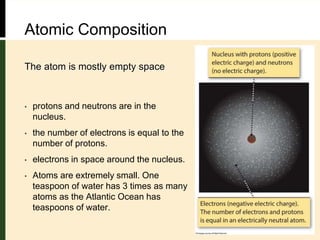
• protons and neutrons are in the
nucleus.
• the number of electrons is equal to the
number of protons.
• electrons in space around the nucleus.
• Atoms are extremely small. One
teaspoon of water has 3 times as many
atoms as the Atlantic Ocean has
teaspoons of water.
The atom is mostly empty space
Atomic Number, Z
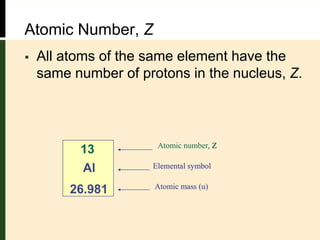
 All atoms of the same element have the
same number of protons in the nucleus, Z.
13
Al
26.981
Atomic number, Z
Elemental symbol
Atomic mass (u)
 The average mass of one atom of an element
expressed in amu.
Atomic Weight
Mass Number
A = mass number = number of protons + number of
neutrons
The following notation is often used
X
A
Z
Elemental Symbol
Mass number
Atomic number
 C-12 atom has 6 protons and 6 neutrons
 Mass Number (A) = # protons + # neutrons
 Elements with different number of neutrons
are called “Isotopes”. (Note: isotopes are
CHEMICALLY identical!)
Mass Number, A
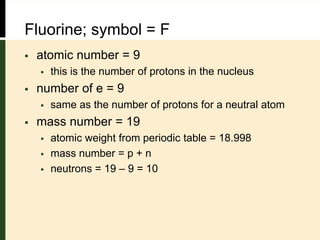
Fluorine; symbol = F
 atomic number = 9
 this is the number of protons in the nucleus
 number of e = 9
 same as the number of protons for a neutral atom
 mass number = 19
 atomic weight from periodic table = 18.998
 mass number = p + n
 neutrons = 19 – 9 = 10
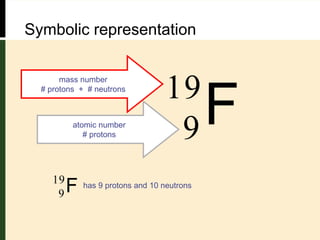
Symbolic representation
F
19
9
mass number
# protons + # neutrons
atomic number
# protons
F
19
9
has 9 protons and 10 neutrons
Ions (Atoms with charge)
 An atom that has either lost or gained one or more
electrons.
 Gaining electrons means more negative than positive
charges, so the ion is (-)
 Loosing electrons means more positive than negative
charges, so the ion is (+)
Atomic Mass Units (amu):
roughly equal to the mass of a proton or neutron.
**the mass of an atom is measured in amu’s
1 amu = 1.66x10⁻²⁴g
Atomic Mass
• The mass of an atom is determined using the number
of protons and neutrons in it. (electrons are ignored)
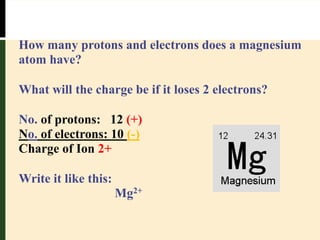
How many protons and electrons does a magnesium
atom have?
What will the charge be if it loses 2 electrons?
No. of protons: 12 (+)
No. of electrons: 10 (-)
Charge of Ion 2+
Write it like this:
Mg2+
Isotopes
 Existence of isotopes means all atoms of an
element are not exactly the same
 all atoms of the same element have the same
number of protons in the nucleus
 atoms of the same element can have different
numbers of neutrons in the nucleus
Isotopes
 For a given element “X”, an isotope is written by:
 Atomic number (Z) = number of protons in the
nucleus.
 Mass number (A) = total number of protons and
neutrons in the nucleus.
X
Z
A
One proton or neutron
has a mass of 1 amu
(Atomic Mass Unit)
a.k.a “Dalton” or u
Isotopes have the
same Z but different
total number of
nucleons (A).
Hydrogen has 3 isotopes
1 proton and 0 neutrons, protium
1 proton and 1 neutron, deuterium
1 proton and 2 neutrons, tritium
1
1H
3
1H
2
1H
Hydrogen Isotopes
Periodic Properties
 Elements were first arranged by increasing
atomic number.
 Periodic table was arranged before e–
configurations of elements was known.
 Dmitri Mendeleev (Russia)
 Lothar Meyer (Germany)
The Periodic Table
 Dmitri Mendeleev
(1834-1907)
developed the
modern periodic
table.
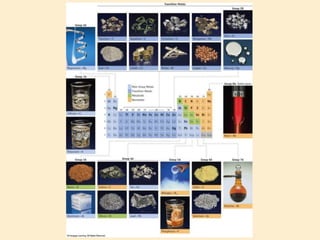
Periodic Table Essentials
 Periods
 Metals
 Nonmetals
 Metalloids
 Halogens
 Noble Gases
 Alkali metals
 s,p,d, and f
 Lanthanide and Actinide series
Periodic Table Features
Regions in the Periodic Table
Compounds and Molecules
 COMPOUNDS are a combination of 2
or more elements in definite ratios by
mass.
 MOLECULES are the smallest unit of a
compound that retains the
characteristics of the compound. (non-
metal combined with a non-metal)
Mole
 The counting unit for atoms, molecules
ions, etc.
 1 mole of things = 6.02 x 10²³ things
The Mole…
 The mole is the unit we use to COUNT
“things”
 It’s a really BIG number, so we use it to
count really SMALL “things”…atoms,
molecules…
Avogadro’s Number
602,000 million  million  million
A BIGnumber
602,000,000,000,000,000,000,000
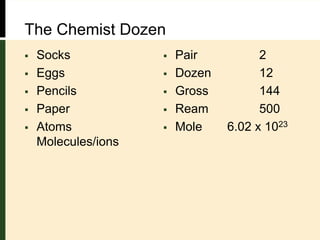
The Chemist Dozen
 Socks
 Eggs
 Pencils
 Paper
 Atoms
Molecules/ions
 Pair 2
 Dozen 12
 Gross 144
 Ream 500
 Mole 6.02 x 10²³
6.0221415  1023
“Avogadro’s Number”
Named for Amedeo Avogadro
1776-1856
There is Avogadro’s number of particles in a
mole of any substance.
Particles and the Mole
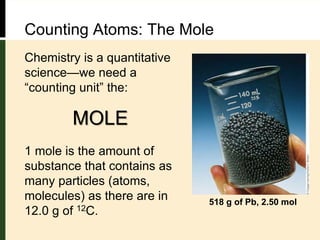
Counting Atoms: The Mole
Chemistry is a quantitative
science—we need a
“counting unit” the:
1 mole is the amount of
substance that contains as
many particles (atoms,
molecules) as there are in
12.0 g of 12C.
MOLE
518 g of Pb, 2.50 mol
One-Mole Amounts
Molecular mass vs Molar mass
 Molecular mass is a number equal to
the sum of the atomic masses of the
atoms in a molecule.
 mass of 1 molecule in amu
 Molar mass
 mass of 1 mole in grams

Chapt-2-PPT-1-.pptx

  • 1.
  • 2.
     Matter isanything that takes up space and has mass.  All matter is made of atoms  Atoms are the building blocks of matter, sort of how bricks are the building blocks of houses.
  • 3.
    What are elements? Elements are the alphabet to the language of molecules.  To make molecules, you must have elements.  Elements are made of atoms. While the atoms may have different weights and organization, they are all built in the same way.
  • 4.
    Subatomic Particles  Atomscomposed of smaller subatomic particles  charged (+ or –)  uncharged (neutral)  electrical nature of the atom was crucial to discovering its subatomic structure  Law of electrostatic attraction  like charges repel  unlike charges attract
  • 5.
    A Coulomb (C)is an amount just like “a dozen” is an amount. 1C = 6.24x10¹⁸ the charge of electrons
  • 6.
    Comparison of SubatomicParticles Particle Location Charge(C) Mass (g) Mass (amu) Proton Inside nucleus 1.602 x 10⁻¹⁹ 1.67x10⁻²⁴ 1.0073= 1 Neutron Inside nucleus 0 1.68x10⁻²⁴ 1.0087= 1 Electron Outside nucleus -1.602 x 10⁻¹⁹ 9.11x10⁻²⁸ 0.0006= 0
  • 7.
    Atomic structure  Atomsare neutral  numbers of protons and electrons must be equal  Atomic mass = p + n  don’t have to worry about mass of e since they have such a small mass (negligible)  numbers of neutrons are determined from atomic mass
  • 8.
    Atomic Composition • protonsand neutrons are in the nucleus. • the number of electrons is equal to the number of protons. • electrons in space around the nucleus. • Atoms are extremely small. One teaspoon of water has 3 times as many atoms as the Atlantic Ocean has teaspoons of water. The atom is mostly empty space
  • 9.
    Atomic Number, Z All atoms of the same element have the same number of protons in the nucleus, Z. 13 Al 26.981 Atomic number, Z Elemental symbol Atomic mass (u)
  • 10.
     The averagemass of one atom of an element expressed in amu. Atomic Weight
  • 11.
    Mass Number A =mass number = number of protons + number of neutrons The following notation is often used X A Z Elemental Symbol Mass number Atomic number
  • 12.
     C-12 atomhas 6 protons and 6 neutrons  Mass Number (A) = # protons + # neutrons  Elements with different number of neutrons are called “Isotopes”. (Note: isotopes are CHEMICALLY identical!) Mass Number, A
  • 13.
    Fluorine; symbol =F  atomic number = 9  this is the number of protons in the nucleus  number of e = 9  same as the number of protons for a neutral atom  mass number = 19  atomic weight from periodic table = 18.998  mass number = p + n  neutrons = 19 – 9 = 10
  • 14.
    Symbolic representation F 19 9 mass number #protons + # neutrons atomic number # protons F 19 9 has 9 protons and 10 neutrons
  • 15.
    Ions (Atoms withcharge)  An atom that has either lost or gained one or more electrons.  Gaining electrons means more negative than positive charges, so the ion is (-)  Loosing electrons means more positive than negative charges, so the ion is (+)
  • 16.
    Atomic Mass Units(amu): roughly equal to the mass of a proton or neutron. **the mass of an atom is measured in amu’s 1 amu = 1.66x10⁻²⁴g Atomic Mass • The mass of an atom is determined using the number of protons and neutrons in it. (electrons are ignored)
  • 17.
    How many protonsand electrons does a magnesium atom have? What will the charge be if it loses 2 electrons? No. of protons: 12 (+) No. of electrons: 10 (-) Charge of Ion 2+ Write it like this: Mg2+
  • 18.
    Isotopes  Existence ofisotopes means all atoms of an element are not exactly the same  all atoms of the same element have the same number of protons in the nucleus  atoms of the same element can have different numbers of neutrons in the nucleus
  • 19.
    Isotopes  For agiven element “X”, an isotope is written by:  Atomic number (Z) = number of protons in the nucleus.  Mass number (A) = total number of protons and neutrons in the nucleus. X Z A One proton or neutron has a mass of 1 amu (Atomic Mass Unit) a.k.a “Dalton” or u Isotopes have the same Z but different total number of nucleons (A).
  • 20.
    Hydrogen has 3isotopes 1 proton and 0 neutrons, protium 1 proton and 1 neutron, deuterium 1 proton and 2 neutrons, tritium 1 1H 3 1H 2 1H Hydrogen Isotopes
  • 21.
    Periodic Properties  Elementswere first arranged by increasing atomic number.  Periodic table was arranged before e– configurations of elements was known.  Dmitri Mendeleev (Russia)  Lothar Meyer (Germany)
  • 22.
    The Periodic Table Dmitri Mendeleev (1834-1907) developed the modern periodic table.
  • 23.
    Periodic Table Essentials Periods  Metals  Nonmetals  Metalloids  Halogens  Noble Gases  Alkali metals  s,p,d, and f  Lanthanide and Actinide series
  • 24.
  • 25.
    Regions in thePeriodic Table
  • 27.
    Compounds and Molecules COMPOUNDS are a combination of 2 or more elements in definite ratios by mass.  MOLECULES are the smallest unit of a compound that retains the characteristics of the compound. (non- metal combined with a non-metal)
  • 28.
    Mole  The countingunit for atoms, molecules ions, etc.  1 mole of things = 6.02 x 10²³ things
  • 29.
    The Mole…  Themole is the unit we use to COUNT “things”  It’s a really BIG number, so we use it to count really SMALL “things”…atoms, molecules…
  • 30.
    Avogadro’s Number 602,000 million million  million A BIGnumber 602,000,000,000,000,000,000,000
  • 31.
    The Chemist Dozen Socks  Eggs  Pencils  Paper  Atoms Molecules/ions  Pair 2  Dozen 12  Gross 144  Ream 500  Mole 6.02 x 10²³
  • 32.
    6.0221415  1023 “Avogadro’sNumber” Named for Amedeo Avogadro 1776-1856 There is Avogadro’s number of particles in a mole of any substance. Particles and the Mole
  • 33.
    Counting Atoms: TheMole Chemistry is a quantitative science—we need a “counting unit” the: 1 mole is the amount of substance that contains as many particles (atoms, molecules) as there are in 12.0 g of 12C. MOLE 518 g of Pb, 2.50 mol
  • 34.
  • 35.
    Molecular mass vsMolar mass  Molecular mass is a number equal to the sum of the atomic masses of the atoms in a molecule.  mass of 1 molecule in amu  Molar mass  mass of 1 mole in grams