



www.chemzonechemistryclasses.in
Multiple Choice Questions for IIT – JEE/NEET/KVPY/SAT
Contact No : +91-9872291712
(a) 325 nm
(b) 743 nm
(c) 518 nm
(d) 1035 nm
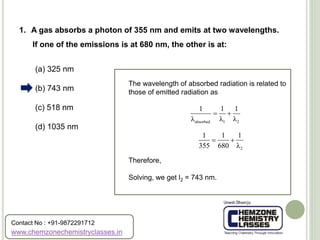
1. A gas absorbs a photon of 355 nm and emits at two wavelengths.
If one of the emissions is at 680 nm, the other is at:
The wavelength of absorbed radiation is related to
those of emitted radiation as
Therefore,
Solving, we get l2 = 743 nm.
absorbed 1 2
1 1 1
λ λ λ
 
2
1 1 1
355 680 λ
 
www.chemzonechemistryclasses.in
Contact No : +91-9872291712
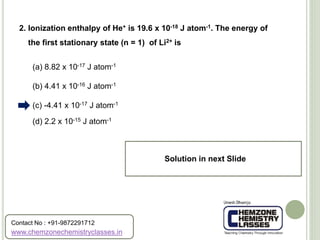
(a) 8.82 x 10⁻¹⁷ J atom-1
(b) 4.41 x 10⁻¹⁶ J atom-1
(c) -4.41 x 10⁻¹⁷ J atom-1
(d) 2.2 x 10⁻¹⁵ J atom-1
2. Ionization enthalpy of He+ is 19.6 x 10⁻¹⁸ J atom-1. The energy of
the first stationary state (n = 1) of Li2+ is
Solution in next Slide
www.chemzonechemistryclasses.in
Contact No : +91-9872291712
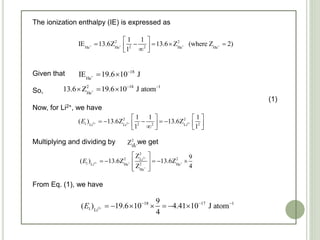
The ionization enthalpy (IE) is expressed as
Given that
So,
(1)
Now, for Li2+, we have
Multiplying and dividing by , we get
From Eq. (1), we have
+ + + +
2 2
2 2He He He He
1 1
IE 13.6Z 13.6 Z (where Z 2)
1
 
      
+
18
He
IE 19.6 10 J
 
+
2 18 1
He
13.6 Z 19.6 10 J atom 
  
2+ 2+ 2+
2 2
1 2 2 2Li Li Li
1 1 1
( ) 13.6Z 13.6Z
1 1
E
   
          
+
2
He
Z
2+
2+ + +
+
2
2 2Li
1 2Li He He
He
Z 9
( ) 13.6Z 13.6Z
Z 4
E
 
     
  
2+
18 17 1
1 Li
9
( ) 19.6 10 4.41 10 J atom
4
E   
      
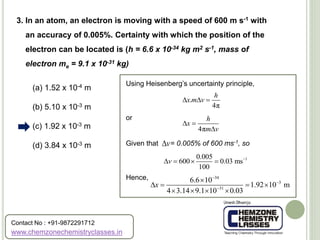
(a) 1.52 x 10⁻⁴ m
(b) 5.10 x 10⁻³ m
(c) 1.92 x 10⁻³ m
(d) 3.84 x 10⁻³ m
3. In an atom, an electron is moving with a speed of 600 m s-1 with
an accuracy of 0.005%. Certainty with which the position of the
electron can be located is (h = 6.6 x 10⁻³⁴ kg m2 s-1, mass of
electron me = 9.1 x 10⁻³¹ kg)
Using Heisenberg’s uncertainty principle,
or
Given that = 0.005% of 600 ms-1, so
Hence,
.
4π
h
x m v  
4π
h
x
m v
 

v
10.005
600 0.03 ms
100
v 
   
34
3
31
6.6 10
1.92 10 m
4 3.14 9.1 10 0.03
x




   
   
www.chemzonechemistryclasses.in
Contact No : +91-9872291712
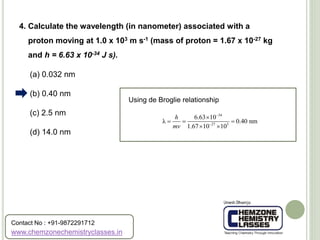
(a) 0.032 nm
(b) 0.40 nm
(c) 2.5 nm
(d) 14.0 nm
4. Calculate the wavelength (in nanometer) associated with a
proton moving at 1.0 x 10³ m s-1 (mass of proton = 1.67 x 10⁻²⁷ kg
and h = 6.63 x 10⁻³⁴ J s).
Using de Broglie relationship
34
27 3
6.63 10
λ 0.40 nm
1.67 10 10
h
mv



  
 
www.chemzonechemistryclasses.in
Contact No : +91-9872291712
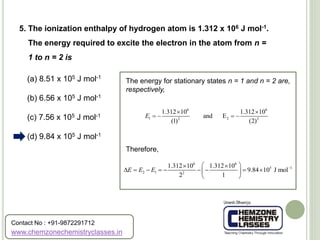
(a) 8.51 x 10⁵ J mol-1
(b) 6.56 x 10⁵ J mol-1
(c) 7.56 x 10⁵ J mol-1
(d) 9.84 x 10⁵ J mol-1
5. The ionization enthalpy of hydrogen atom is 1.312 x 10⁶ J mol-1.
The energy required to excite the electron in the atom from n =
1 to n = 2 is
The energy for stationary states n = 1 and n = 2 are,
respectively,
Therefore,
6 6
1 22 2
1.312 10 1.312 10
and E
(1) (2)
E
 
   
6 6
5 1
2 1 2
1.312 10 1.312 10
9.84 10 J mol
2 1
E E E   
         
 
www.chemzonechemistryclasses.in
Contact No : +91-9872291712
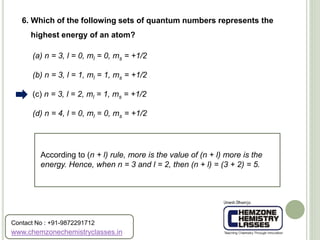
(a) n = 3, l = 0, ml = 0, ms = +1/2
(b) n = 3, l = 1, ml = 1, ms = +1/2
(c) n = 3, l = 2, ml = 1, ms = +1/2
(d) n = 4, l = 0, ml = 0, ms = +1/2
6. Which of the following sets of quantum numbers represents the
highest energy of an atom?
According to (n + l) rule, more is the value of (n + l) more is the
energy. Hence, when n = 3 and l = 2, then (n + l) = (3 + 2) = 5.
www.chemzonechemistryclasses.in
Contact No : +91-9872291712
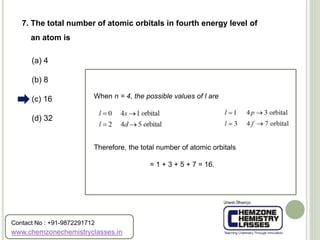
(a) 4
(b) 8
(c) 16
(d) 32
7. The total number of atomic orbitals in fourth energy level of
an atom is
When n = 4, the possible values of l are
Therefore, the total number of atomic orbitals
= 1 + 3 + 5 + 7 = 16.
www.chemzonechemistryclasses.in
Contact No : +91-9872291712
(a)
(b)
(c)
(d)
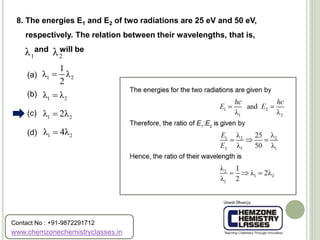
8. The energies E1 and E2 of two radiations are 25 eV and 50 eV,
respectively. The relation between their wavelengths, that is,
and will be
1λ 2λ
1 2
1
λ λ
2

1 2λ λ
1 2λ 2λ
1 2λ 4λ
www.chemzonechemistryclasses.in
Contact No : +91-9872291712
(a)
(b)
(c)
(d)
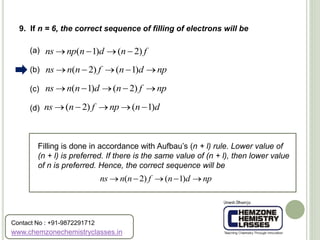
9. If n = 6, the correct sequence of filling of electrons will be
( 1) ( 2)ns np n d n f   
( 2) ( 1)ns n n f n d np    
( 1) ( 2)ns n n d n f np    
( 2) ( 1)ns n f np n d    
Filling is done in accordance with Aufbau’s (n + l) rule. Lower value of
(n + l) is preferred. If there is the same value of (n + l), then lower value
of n is preferred. Hence, the correct sequence will be
( 2) ( 1)ns n n f n d np    
www.chemzonechemistryclasses.in
Contact No : +91-9872291712
(a) Mn3+
(b) Fe3+
(c) Co3+
(d) Ni3+
10. Which one of the following ions has electronic configuration
[Ar] 3d 6 ?
The atomic number of Co is 27. Now, for Co3+ (24),
the electronic configuration is
1s2 2s2 2p6 3s2 3p6 4s0 3d6 = [Ar]3d6
www.chemzonechemistryclasses.in
Contact No : +91-9872291712
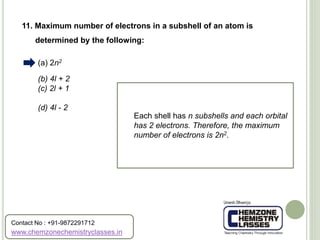
(a) 2n2
(b) 4l + 2
(c) 2l + 1
(d) 4l - 2
11. Maximum number of electrons in a subshell of an atom is
determined by the following:
Each shell has n subshells and each orbital
has 2 electrons. Therefore, the maximum
number of electrons is 2n2.
www.chemzonechemistryclasses.in
Contact No : +91-9872291712
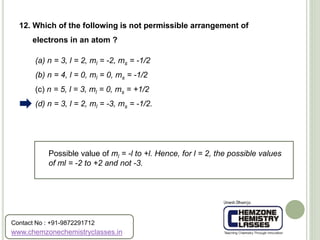
(a) n = 3, l = 2, ml = -2, ms = -1/2
(b) n = 4, l = 0, ml = 0, ms = -1/2
(c) n = 5, l = 3, ml = 0, ms = +1/2
(d) n = 3, l = 2, ml = -3, ms = -1/2.
12. Which of the following is not permissible arrangement of
electrons in an atom ?
Possible value of ml = -l to +l. Hence, for l = 2, the possible values
of ml = -2 to +2 and not -3.
www.chemzonechemistryclasses.in
Contact No : +91-9872291712
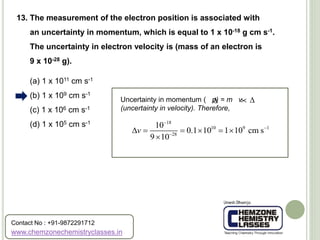
(a) 1 x 1011 cm s-1
(b) 1 x 109 cm s-1
(c) 1 x 106 cm s-1
(d) 1 x 105 cm s-1
13. The measurement of the electron position is associated with
an uncertainty in momentum, which is equal to 1 x 10-18 g cm s-1.
The uncertainty in electron velocity is (mass of an electron is
9 x 10-28 g).
Uncertainty in momentum ( p) = m v
(uncertainty in velocity). Therefore,
 
18
10 9 1
28
10
0.1 10 1 10 cm s
9 10
v



     

www.chemzonechemistryclasses.in
Contact No : +91-9872291712
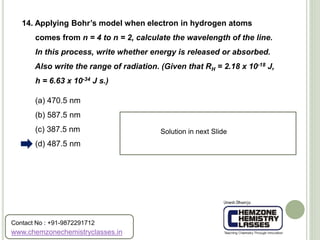
(a) 470.5 nm
(b) 587.5 nm
(c) 387.5 nm
(d) 487.5 nm
14. Applying Bohr’s model when electron in hydrogen atoms
comes from n = 4 to n = 2, calculate the wavelength of the line.
In this process, write whether energy is released or absorbed.
Also write the range of radiation. (Given that RH = 2.18 x 10⁻¹⁸ J,
h = 6.63 x 10⁻³⁴ J s.)
Solution in next Slide
www.chemzonechemistryclasses.in
Contact No : +91-9872291712
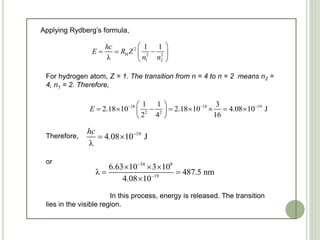
Applying Rydberg’s formula,
2
H 2 2
1 2
1 1
λ
hc
E R Z
n n
 
   
 
For hydrogen atom, Z = 1. The transition from n = 4 to n = 2 means n2 =
4, n1 = 2. Therefore,
Therefore,
or
In this process, energy is released. The transition
lies in the visible region.
18 18 19
2 2
1 1 3
2.18 10 2.18 10 4.08 10 J
2 4 16
E    
        
 
19
4.08 10 J
λ
hc 
 
34 8
19
6.63 10 3 10
λ 487.5 nm
4.08 10


  
 

Solution in next Slide
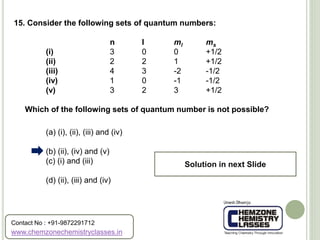
15. Consider the following sets of quantum numbers:
n l ml ms
(i) 3 0 0 +1/2
(ii) 2 2 1 +1/2
(iii) 4 3 -2 -1/2
(iv) 1 0 -1 -1/2
(v) 3 2 3 +1/2
Which of the following sets of quantum number is not possible?
(a) (i), (ii), (iii) and (iv)
(b) (ii), (iv) and (v)
(c) (i) and (iii)
(d) (ii), (iii) and (iv)
www.chemzonechemistryclasses.in
Contact No : +91-9872291712
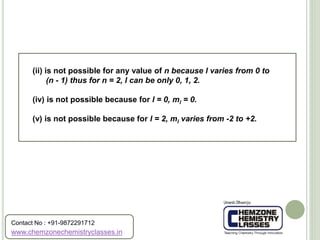
(ii) is not possible for any value of n because l varies from 0 to
(n - 1) thus for n = 2, l can be only 0, 1, 2.
(iv) is not possible because for l = 0, ml = 0.
(v) is not possible because for l = 2, ml varies from -2 to +2.
www.chemzonechemistryclasses.in
Contact No : +91-9872291712
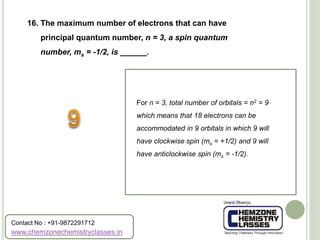
16. The maximum number of electrons that can have
principal quantum number, n = 3, a spin quantum
number, ms = -1/2, is ______.
For n = 3, total number of orbitals = n2 = 9
which means that 18 electrons can be
accommodated in 9 orbitals in which 9 will
have clockwise spin (ms = +1/2) and 9 will
have anticlockwise spin (ms = -1/2).
www.chemzonechemistryclasses.in
Contact No : +91-9872291712
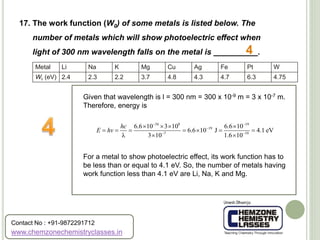
17. The work function (W0) of some metals is listed below. The
number of metals which will show photoelectric effect when
light of 300 nm wavelength falls on the metal is __________.
Metal
W0 (eV)
Li
2.4
Na
2.3
K
2.2
Mg
3.7
Cu
4.8
Ag
4.3
Fe
4.7
Pt
6.3
W
4.75
Given that wavelength is l = 300 nm = 300 x 10-9 m = 3 x 10⁻⁷ m.
Therefore, energy is
For a metal to show photoelectric effect, its work function has to
be less than or equal to 4.1 eV. So, the number of metals having
work function less than 4.1 eV are Li, Na, K and Mg.
4
34 8 19
19
7 19
6.6 10 3 10 6.6 10
6.6 10 J 4.1 eV
λ 3 10 1.6 10
hc
E hv
 

 
   
      
 
www.chemzonechemistryclasses.in
Contact No : +91-9872291712
(a) 1 and diamagnetic.
(b) 0 and diamagnetic.
(c) 1 and paramagnetic.
(d) 0 and paramagnetic.
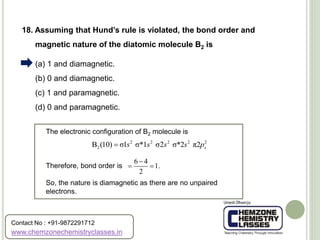
18. Assuming that Hund’s rule is violated, the bond order and
magnetic nature of the diatomic molecule B2 is
The electronic configuration of B2 molecule is
Therefore, bond order is
So, the nature is diamagnetic as there are no unpaired
electrons.
2 2 2 2 2
2B (10) σ1 σ*1 σ2 σ*2 π2 xs s s s p
6 4
1.
2

 
www.chemzonechemistryclasses.in
Contact No : +91-9872291712
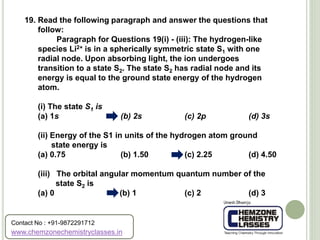
19. Read the following paragraph and answer the questions that
follow:
Paragraph for Questions 19(i) - (iii): The hydrogen-like
species Li2+ is in a spherically symmetric state S1 with one
radial node. Upon absorbing light, the ion undergoes
transition to a state S2. The state S2 has radial node and its
energy is equal to the ground state energy of the hydrogen
atom.
(i) The state S1 is
(a) 1s (b) 2s (c) 2p (d) 3s
(ii) Energy of the S1 in units of the hydrogen atom ground
state energy is
(a) 0.75 (b) 1.50 (c) 2.25 (d) 4.50
(iii) The orbital angular momentum quantum number of the
state S2 is
(a) 0 (b) 1 (c) 2 (d) 3
www.chemzonechemistryclasses.in
Contact No : +91-9872291712
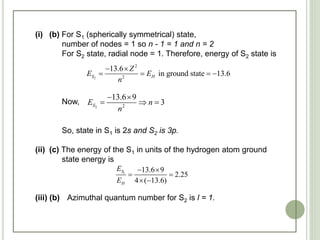
(i) (b) For S1 (spherically symmetrical) state,
number of nodes = 1 so n - 1 = 1 and n = 2
For S2 state, radial node = 1. Therefore, energy of S2 state is
Now,
So, state in S1 is 2s and S2 is 3p.
(ii) (c) The energy of the S1 in units of the hydrogen atom ground
state energy is
(iii) (b) Azimuthal quantum number for S2 is l = 1.
2
2
2
13.6
in ground state 13.6S H
Z
E E
n
 
   
2 2
13.6 9
3SE n
n
 
  
1
13.6 9
2.25
4 ( 13.6)
S
H
E
E
 
 
 
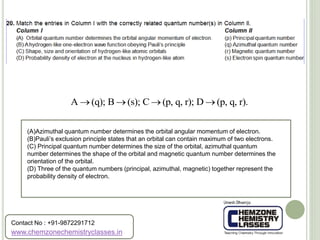
(A)Azimuthal quantum number determines the orbital angular momentum of electron.
(B)Pauli’s exclusion principle states that an orbital can contain maximum of two electrons.
(C) Principal quantum number determines the size of the orbital, azimuthal quantum
number determines the shape of the orbital and magnetic quantum number determines the
orientation of the orbital.
(D) Three of the quantum numbers (principal, azimuthal, magnetic) together represent the
probability density of electron.
A (q); B (s); C (p, q, r); D (p, q, r).   
www.chemzonechemistryclasses.in
Contact No : +91-9872291712
Atomic structure - Multiple Choice Questions For IIT-JEE, NEET, SAT,KVPY

Atomic structure - Multiple Choice Questions For IIT-JEE, NEET, SAT,KVPY

  • 1.
    www.chemzonechemistryclasses.in Multiple Choice Questionsfor IIT – JEE/NEET/KVPY/SAT Contact No : +91-9872291712
  • 3.
    (a) 325 nm (b)743 nm (c) 518 nm (d) 1035 nm 1. A gas absorbs a photon of 355 nm and emits at two wavelengths. If one of the emissions is at 680 nm, the other is at: The wavelength of absorbed radiation is related to those of emitted radiation as Therefore, Solving, we get l2 = 743 nm. absorbed 1 2 1 1 1 λ λ λ   2 1 1 1 355 680 λ   www.chemzonechemistryclasses.in Contact No : +91-9872291712
  • 4.
    (a) 8.82 x10⁻¹⁷ J atom-1 (b) 4.41 x 10⁻¹⁶ J atom-1 (c) -4.41 x 10⁻¹⁷ J atom-1 (d) 2.2 x 10⁻¹⁵ J atom-1 2. Ionization enthalpy of He+ is 19.6 x 10⁻¹⁸ J atom-1. The energy of the first stationary state (n = 1) of Li2+ is Solution in next Slide www.chemzonechemistryclasses.in Contact No : +91-9872291712
  • 5.
    The ionization enthalpy(IE) is expressed as Given that So, (1) Now, for Li2+, we have Multiplying and dividing by , we get From Eq. (1), we have + + + + 2 2 2 2He He He He 1 1 IE 13.6Z 13.6 Z (where Z 2) 1          + 18 He IE 19.6 10 J   + 2 18 1 He 13.6 Z 19.6 10 J atom     2+ 2+ 2+ 2 2 1 2 2 2Li Li Li 1 1 1 ( ) 13.6Z 13.6Z 1 1 E                + 2 He Z 2+ 2+ + + + 2 2 2Li 1 2Li He He He Z 9 ( ) 13.6Z 13.6Z Z 4 E            2+ 18 17 1 1 Li 9 ( ) 19.6 10 4.41 10 J atom 4 E          
  • 6.
    (a) 1.52 x10⁻⁴ m (b) 5.10 x 10⁻³ m (c) 1.92 x 10⁻³ m (d) 3.84 x 10⁻³ m 3. In an atom, an electron is moving with a speed of 600 m s-1 with an accuracy of 0.005%. Certainty with which the position of the electron can be located is (h = 6.6 x 10⁻³⁴ kg m2 s-1, mass of electron me = 9.1 x 10⁻³¹ kg) Using Heisenberg’s uncertainty principle, or Given that = 0.005% of 600 ms-1, so Hence, . 4π h x m v   4π h x m v    v 10.005 600 0.03 ms 100 v      34 3 31 6.6 10 1.92 10 m 4 3.14 9.1 10 0.03 x             www.chemzonechemistryclasses.in Contact No : +91-9872291712
  • 8.
    (a) 0.032 nm (b)0.40 nm (c) 2.5 nm (d) 14.0 nm 4. Calculate the wavelength (in nanometer) associated with a proton moving at 1.0 x 10³ m s-1 (mass of proton = 1.67 x 10⁻²⁷ kg and h = 6.63 x 10⁻³⁴ J s). Using de Broglie relationship 34 27 3 6.63 10 λ 0.40 nm 1.67 10 10 h mv         www.chemzonechemistryclasses.in Contact No : +91-9872291712
  • 9.
    (a) 8.51 x10⁵ J mol-1 (b) 6.56 x 10⁵ J mol-1 (c) 7.56 x 10⁵ J mol-1 (d) 9.84 x 10⁵ J mol-1 5. The ionization enthalpy of hydrogen atom is 1.312 x 10⁶ J mol-1. The energy required to excite the electron in the atom from n = 1 to n = 2 is The energy for stationary states n = 1 and n = 2 are, respectively, Therefore, 6 6 1 22 2 1.312 10 1.312 10 and E (1) (2) E       6 6 5 1 2 1 2 1.312 10 1.312 10 9.84 10 J mol 2 1 E E E                www.chemzonechemistryclasses.in Contact No : +91-9872291712
  • 10.
    (a) n =3, l = 0, ml = 0, ms = +1/2 (b) n = 3, l = 1, ml = 1, ms = +1/2 (c) n = 3, l = 2, ml = 1, ms = +1/2 (d) n = 4, l = 0, ml = 0, ms = +1/2 6. Which of the following sets of quantum numbers represents the highest energy of an atom? According to (n + l) rule, more is the value of (n + l) more is the energy. Hence, when n = 3 and l = 2, then (n + l) = (3 + 2) = 5. www.chemzonechemistryclasses.in Contact No : +91-9872291712
  • 12.
    (a) 4 (b) 8 (c)16 (d) 32 7. The total number of atomic orbitals in fourth energy level of an atom is When n = 4, the possible values of l are Therefore, the total number of atomic orbitals = 1 + 3 + 5 + 7 = 16. www.chemzonechemistryclasses.in Contact No : +91-9872291712
  • 13.
    (a) (b) (c) (d) 8. The energiesE1 and E2 of two radiations are 25 eV and 50 eV, respectively. The relation between their wavelengths, that is, and will be 1λ 2λ 1 2 1 λ λ 2  1 2λ λ 1 2λ 2λ 1 2λ 4λ www.chemzonechemistryclasses.in Contact No : +91-9872291712
  • 14.
    (a) (b) (c) (d) 9. If n= 6, the correct sequence of filling of electrons will be ( 1) ( 2)ns np n d n f    ( 2) ( 1)ns n n f n d np     ( 1) ( 2)ns n n d n f np     ( 2) ( 1)ns n f np n d     Filling is done in accordance with Aufbau’s (n + l) rule. Lower value of (n + l) is preferred. If there is the same value of (n + l), then lower value of n is preferred. Hence, the correct sequence will be ( 2) ( 1)ns n n f n d np     www.chemzonechemistryclasses.in Contact No : +91-9872291712
  • 15.
    (a) Mn3+ (b) Fe3+ (c)Co3+ (d) Ni3+ 10. Which one of the following ions has electronic configuration [Ar] 3d 6 ? The atomic number of Co is 27. Now, for Co3+ (24), the electronic configuration is 1s2 2s2 2p6 3s2 3p6 4s0 3d6 = [Ar]3d6 www.chemzonechemistryclasses.in Contact No : +91-9872291712
  • 16.
    (a) 2n2 (b) 4l+ 2 (c) 2l + 1 (d) 4l - 2 11. Maximum number of electrons in a subshell of an atom is determined by the following: Each shell has n subshells and each orbital has 2 electrons. Therefore, the maximum number of electrons is 2n2. www.chemzonechemistryclasses.in Contact No : +91-9872291712
  • 18.
    (a) n =3, l = 2, ml = -2, ms = -1/2 (b) n = 4, l = 0, ml = 0, ms = -1/2 (c) n = 5, l = 3, ml = 0, ms = +1/2 (d) n = 3, l = 2, ml = -3, ms = -1/2. 12. Which of the following is not permissible arrangement of electrons in an atom ? Possible value of ml = -l to +l. Hence, for l = 2, the possible values of ml = -2 to +2 and not -3. www.chemzonechemistryclasses.in Contact No : +91-9872291712
  • 19.
    (a) 1 x1011 cm s-1 (b) 1 x 109 cm s-1 (c) 1 x 106 cm s-1 (d) 1 x 105 cm s-1 13. The measurement of the electron position is associated with an uncertainty in momentum, which is equal to 1 x 10-18 g cm s-1. The uncertainty in electron velocity is (mass of an electron is 9 x 10-28 g). Uncertainty in momentum ( p) = m v (uncertainty in velocity). Therefore,   18 10 9 1 28 10 0.1 10 1 10 cm s 9 10 v           www.chemzonechemistryclasses.in Contact No : +91-9872291712
  • 20.
    (a) 470.5 nm (b)587.5 nm (c) 387.5 nm (d) 487.5 nm 14. Applying Bohr’s model when electron in hydrogen atoms comes from n = 4 to n = 2, calculate the wavelength of the line. In this process, write whether energy is released or absorbed. Also write the range of radiation. (Given that RH = 2.18 x 10⁻¹⁸ J, h = 6.63 x 10⁻³⁴ J s.) Solution in next Slide www.chemzonechemistryclasses.in Contact No : +91-9872291712
  • 21.
    Applying Rydberg’s formula, 2 H2 2 1 2 1 1 λ hc E R Z n n         For hydrogen atom, Z = 1. The transition from n = 4 to n = 2 means n2 = 4, n1 = 2. Therefore, Therefore, or In this process, energy is released. The transition lies in the visible region. 18 18 19 2 2 1 1 3 2.18 10 2.18 10 4.08 10 J 2 4 16 E                19 4.08 10 J λ hc    34 8 19 6.63 10 3 10 λ 487.5 nm 4.08 10        
  • 23.
    Solution in nextSlide 15. Consider the following sets of quantum numbers: n l ml ms (i) 3 0 0 +1/2 (ii) 2 2 1 +1/2 (iii) 4 3 -2 -1/2 (iv) 1 0 -1 -1/2 (v) 3 2 3 +1/2 Which of the following sets of quantum number is not possible? (a) (i), (ii), (iii) and (iv) (b) (ii), (iv) and (v) (c) (i) and (iii) (d) (ii), (iii) and (iv) www.chemzonechemistryclasses.in Contact No : +91-9872291712
  • 24.
    (ii) is notpossible for any value of n because l varies from 0 to (n - 1) thus for n = 2, l can be only 0, 1, 2. (iv) is not possible because for l = 0, ml = 0. (v) is not possible because for l = 2, ml varies from -2 to +2. www.chemzonechemistryclasses.in Contact No : +91-9872291712
  • 26.
    16. The maximumnumber of electrons that can have principal quantum number, n = 3, a spin quantum number, ms = -1/2, is ______. For n = 3, total number of orbitals = n2 = 9 which means that 18 electrons can be accommodated in 9 orbitals in which 9 will have clockwise spin (ms = +1/2) and 9 will have anticlockwise spin (ms = -1/2). www.chemzonechemistryclasses.in Contact No : +91-9872291712
  • 27.
    17. The workfunction (W0) of some metals is listed below. The number of metals which will show photoelectric effect when light of 300 nm wavelength falls on the metal is __________. Metal W0 (eV) Li 2.4 Na 2.3 K 2.2 Mg 3.7 Cu 4.8 Ag 4.3 Fe 4.7 Pt 6.3 W 4.75 Given that wavelength is l = 300 nm = 300 x 10-9 m = 3 x 10⁻⁷ m. Therefore, energy is For a metal to show photoelectric effect, its work function has to be less than or equal to 4.1 eV. So, the number of metals having work function less than 4.1 eV are Li, Na, K and Mg. 4 34 8 19 19 7 19 6.6 10 3 10 6.6 10 6.6 10 J 4.1 eV λ 3 10 1.6 10 hc E hv                   www.chemzonechemistryclasses.in Contact No : +91-9872291712
  • 28.
    (a) 1 anddiamagnetic. (b) 0 and diamagnetic. (c) 1 and paramagnetic. (d) 0 and paramagnetic. 18. Assuming that Hund’s rule is violated, the bond order and magnetic nature of the diatomic molecule B2 is The electronic configuration of B2 molecule is Therefore, bond order is So, the nature is diamagnetic as there are no unpaired electrons. 2 2 2 2 2 2B (10) σ1 σ*1 σ2 σ*2 π2 xs s s s p 6 4 1. 2    www.chemzonechemistryclasses.in Contact No : +91-9872291712
  • 29.
    19. Read thefollowing paragraph and answer the questions that follow: Paragraph for Questions 19(i) - (iii): The hydrogen-like species Li2+ is in a spherically symmetric state S1 with one radial node. Upon absorbing light, the ion undergoes transition to a state S2. The state S2 has radial node and its energy is equal to the ground state energy of the hydrogen atom. (i) The state S1 is (a) 1s (b) 2s (c) 2p (d) 3s (ii) Energy of the S1 in units of the hydrogen atom ground state energy is (a) 0.75 (b) 1.50 (c) 2.25 (d) 4.50 (iii) The orbital angular momentum quantum number of the state S2 is (a) 0 (b) 1 (c) 2 (d) 3 www.chemzonechemistryclasses.in Contact No : +91-9872291712
  • 31.
    (i) (b) ForS1 (spherically symmetrical) state, number of nodes = 1 so n - 1 = 1 and n = 2 For S2 state, radial node = 1. Therefore, energy of S2 state is Now, So, state in S1 is 2s and S2 is 3p. (ii) (c) The energy of the S1 in units of the hydrogen atom ground state energy is (iii) (b) Azimuthal quantum number for S2 is l = 1. 2 2 2 13.6 in ground state 13.6S H Z E E n       2 2 13.6 9 3SE n n      1 13.6 9 2.25 4 ( 13.6) S H E E      
  • 32.
    (A)Azimuthal quantum numberdetermines the orbital angular momentum of electron. (B)Pauli’s exclusion principle states that an orbital can contain maximum of two electrons. (C) Principal quantum number determines the size of the orbital, azimuthal quantum number determines the shape of the orbital and magnetic quantum number determines the orientation of the orbital. (D) Three of the quantum numbers (principal, azimuthal, magnetic) together represent the probability density of electron. A (q); B (s); C (p, q, r); D (p, q, r).    www.chemzonechemistryclasses.in Contact No : +91-9872291712