1.6 IONISATION ENERGY
OBJECTIVES:
To define the term ‘ionisation energy’
To describe and explain the trends in ionisation energy
across period 3 and down group 2
FIRST THOUGHTS…
What do you think we might
mean by ionisation energy?
KEY WORDS:
IONISATION ENERGY
NUCLEAR CHARGE
TREND
WHAT IS IONISATION ENERGY?
“The energy required to remove 1 electron from each atom
in 1 mole of gaseous atoms to form 1 mole of gaseous 1+
ions”
Energy required to remove electrons
 Measured in kJmol-1
 Given the abbreviation IE
 Values tell us a lot about the electronic configuration
of elements
1.6 IONISATION ENERGY
SUCCESSIVE IONISATION ENERGIES
We can measure the energies required to remove each
electron in turn, from outer electrons to inner electrons
Values increase
with each
successive
ionisation event
Why might this
be?
1.6 IONISATION ENERGY
Successive Ionisation Energies of Na
SUCCESSIVE IONISATION ENERGIES
1.6 IONISATION ENERGY
To form a positive ion, need energy to overcome attraction
from nucleus.
As each electron is removed from an atom, the remaining
ion becomes more positively charged.
Removing the next electron
away from an increasing
positive charge is more
difficult and the ionisation
energy is even larger.
SUCCESSIVE IONISATION ENERGIES
Na (g)  Na+
(g) + e-
1st
IE = + 496 kJmol-1
Na+ (g)  Na2+
(g) + e-
2nd
IE = + 4563 kJmol-1
Na2+
(g)  Na3+
(g) + e-
3rd
IE = + 6913 kJmol-1
1.6 IONISATION ENERGY
Notice how successive ionisation
energies are written
Start with the end product of
previous ionisation event
MUST include the gaseous state!
SUCCESSIVE IONISATION ENERGIES
From this graph we can see evidence for electron shells
Na looks to have 1 electron that’s easy to remove
 furthest from nucleus
8 nearer to the nucleus
 bit harder to remove
2 very close to the nucleus
 nearest to +ve charge
and hardest to remove
1.6 IONISATION ENERGY
FACTORS AFFECTING IONISATION ENERGY
As electrons are negatively charged and protons in the
nucleus are positively charged, there will be an attraction
between them. The greater the pull of the nucleus, the
harder it will be to pull an electron away from an atom.
Nuclear attraction of an electron depends on:
• Atomic radius
• Nuclear Charge
• Electron shielding or screening
1.6 IONISATION ENERGY
ATOMIC RADIUS:
Greater the atomic radius, the smaller the nuclear
attraction experienced by the outer electrons
NUCLEAR CHARGE:
The greater the nuclear charge, the greater the
attractive force on the outer electrons
Hydrogen Helium Lithium
519 kJ mol-1
1310 kJ mol-1
2370 kJ mol-1
1.6 IONISATION ENERGY
ELECTRON SHIELDING
Inner shells of electrons repel the outer-shell electrons
Known as ‘Electron shielding’ or ‘screening’
More inner shells  larger the screening and smaller the
nuclear attraction of outer electrons
Hydrogen Helium Lithium
519 kJ mol-1
1310 kJ mol-1
2370 kJ mol-1
1.6 IONISATION ENERGY
TRENDS ACROSS PERIODS
Look at the
graph
1) Describe
the patterns
you see
2) Can you
suggest an
explanation
for them
1.6 IONISATION ENERGY
TRENDS ACROSS PERIODS
0
500
1000
1500
2000
2500
He
Ne
Ar
Kr
Xe
There is a ‘general increase’ across a period
before the value drops dramatically for the
start of another period.
This is because nuclear charge is increasing
ATOMIC NUMBER
1st
IONISATION
ENERGY
/
kJmol
-1
EXPLANATION
Despite having a
nuclear charge of
only 1+, Hydrogen
has a relatively
high 1st Ionisation
Energy as its
electron is closest
to the nucleus and
has no shielding.
HYDROGEN
1
1s
1.6 IONISATION ENERGY
1s
1s
ATOMIC NUMBER
1st
IONISATION
ENERGY
/
kJmol
-1
EXPLANATION
Helium has a much
higher value
because of the
extra proton in the
nucleus. The
additional charge
provides a stronger
attraction for the
electrons making
them harder to
remove.
HELIUM
2
1.6 IONISATION ENERGY
1s 2s
1s
1s
ATOMIC NUMBER
1st
IONISATION
ENERGY
/
kJmol
-1
EXPLANATION
There is a
substantial drop in
the value for
Lithium.
Despite the
increased nuclear
charge, there is
electron shielding
from the 1s orbital.
The 2s electron is
also further away
from the nucleus.
It is held less
strongly and needs
less energy for
removal.
LITHIUM
3
1.6 IONISATION ENERGY
1s 2s
1s 2s
1s
1s
ATOMIC NUMBER
1st
IONISATION
ENERGY
/
kJmol
-1
EXPLANATION
The value for
Beryllium is higher
than for Lithium due
to the increased
nuclear charge.
There is no extra
shielding.
BERYLLIUM
4
1.6 IONISATION ENERGY
1s 2s 2p
1s 2s
1s 2s
1s
1s
ATOMIC NUMBER
1st
IONISATION
ENERGY
/
kJmol
-1
EXPLANATION
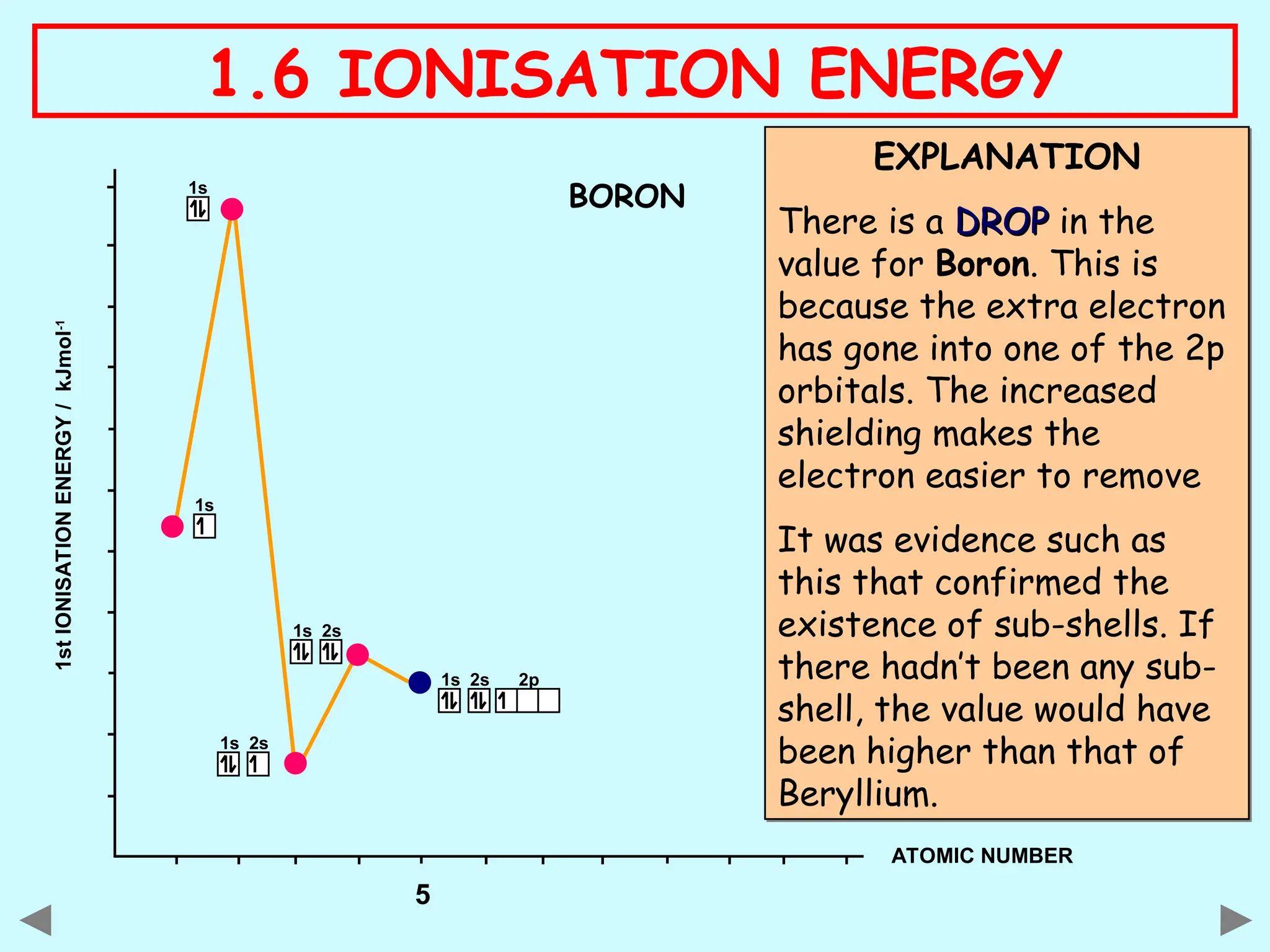
There is a DROP
DROP in the
value for Boron. This is
because the extra electron
has gone into one of the 2p
orbitals. The increased
shielding makes the
electron easier to remove
It was evidence such as
this that confirmed the
existence of sub-shells. If
there hadn’t been any sub-
shell, the value would have
been higher than that of
Beryllium.
BORON
5
1.6 IONISATION ENERGY
1s 2s 2p
1s 2s 2p
1s 2s
1s 2s
1s
1s
ATOMIC NUMBER
1st
IONISATION
ENERGY
/
kJmol
-1
EXPLANATION
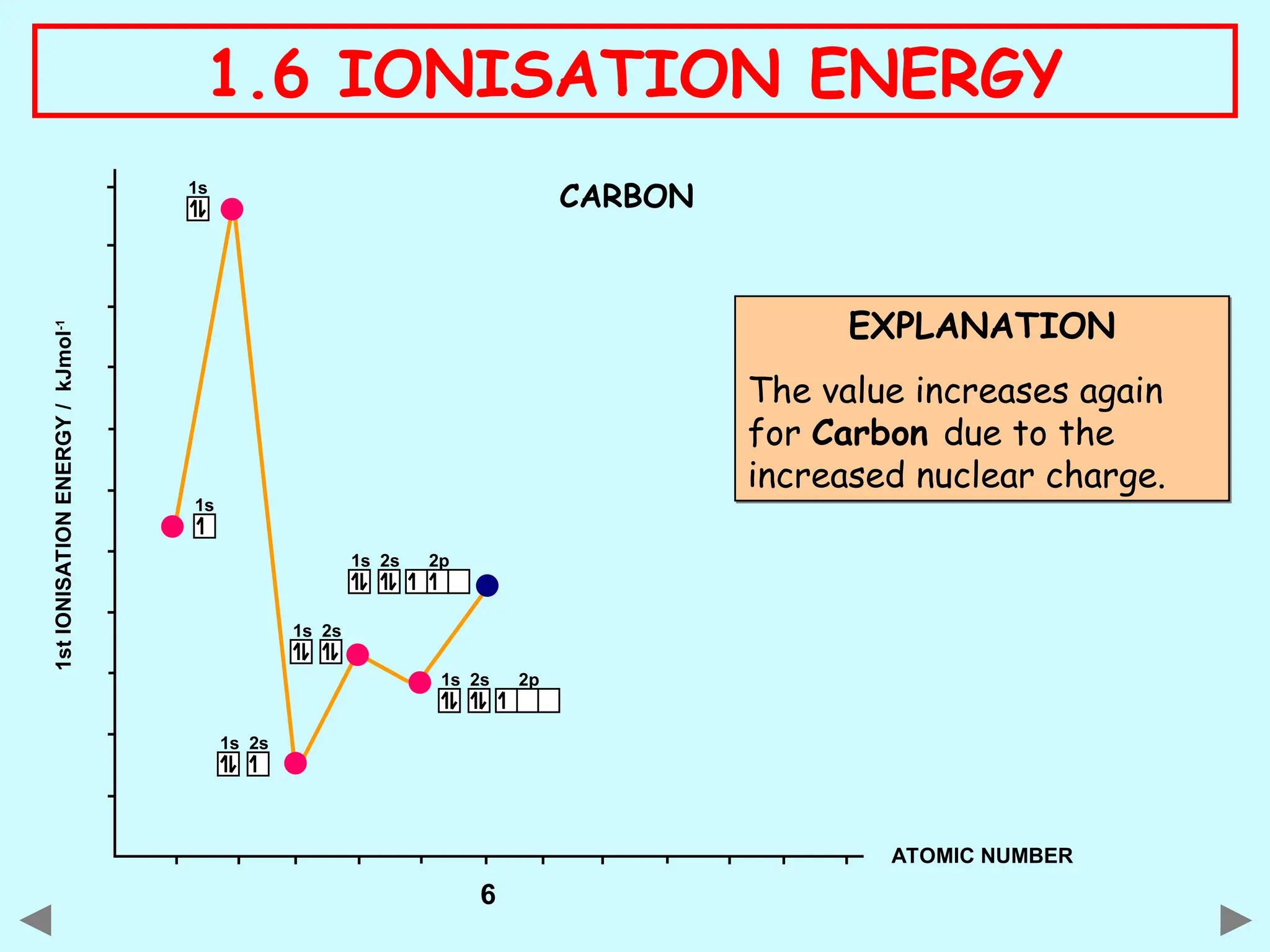
The value increases again
for Carbon due to the
increased nuclear charge.
CARBON
6
1.6 IONISATION ENERGY
1s 2s 2p
1s 2s 2p
1s 2s 2p
1s 2s
1s 2s
1s
1s
ATOMIC NUMBER
1st
IONISATION
ENERGY
/
kJmol
-1
EXPLANATION
The value increases
again for Nitrogen
due to the increased
nuclear charge.
As before, the
extra electron goes
into the vacant 2p
orbital. There are
now three unpaired
electrons.
NITROGEN
7
1.6 IONISATION ENERGY
1s 2s 2p
1s 2s 2p
1s 2s 2p
1s 2s 2p
1s 2s
1s 2s
1s
1s
ATOMIC NUMBER
1st
IONISATION
ENERGY
/
kJmol
-1
EXPLANATION
There is a DROP
DROP in
the value for
Oxygen. The extra
electron has paired
up with one of the
electrons already in
one of the 2p
orbitals. The
repulsive force
between the two
paired-up electrons
means that less
energy is required to
remove one of them.
OXYGEN
8
1.6 IONISATION ENERGY
1s 2s 2p
1s 2s 2p
1s 2s 2p
1s 2s 2p
1s 2s 2p
1s 2s
1s 2s
1s
1s
ATOMIC NUMBER
1st
IONISATION
ENERGY
/
kJmol
-1
EXPLANATION
The value increases
again for Fluorine
due to the increased
nuclear charge.
The 2p orbitals are
almost full.
FLUORINE
9
1.6 IONISATION ENERGY
1s 2s 2p
1s 2s 2p
1s 2s 2p
1s 2s 2p
1s 2s 2p
1s 2s 2p
1s 2s
1s 2s
1s
1s
ATOMIC NUMBER
1st
IONISATION
ENERGY
/
kJmol
-1
EXPLANATION
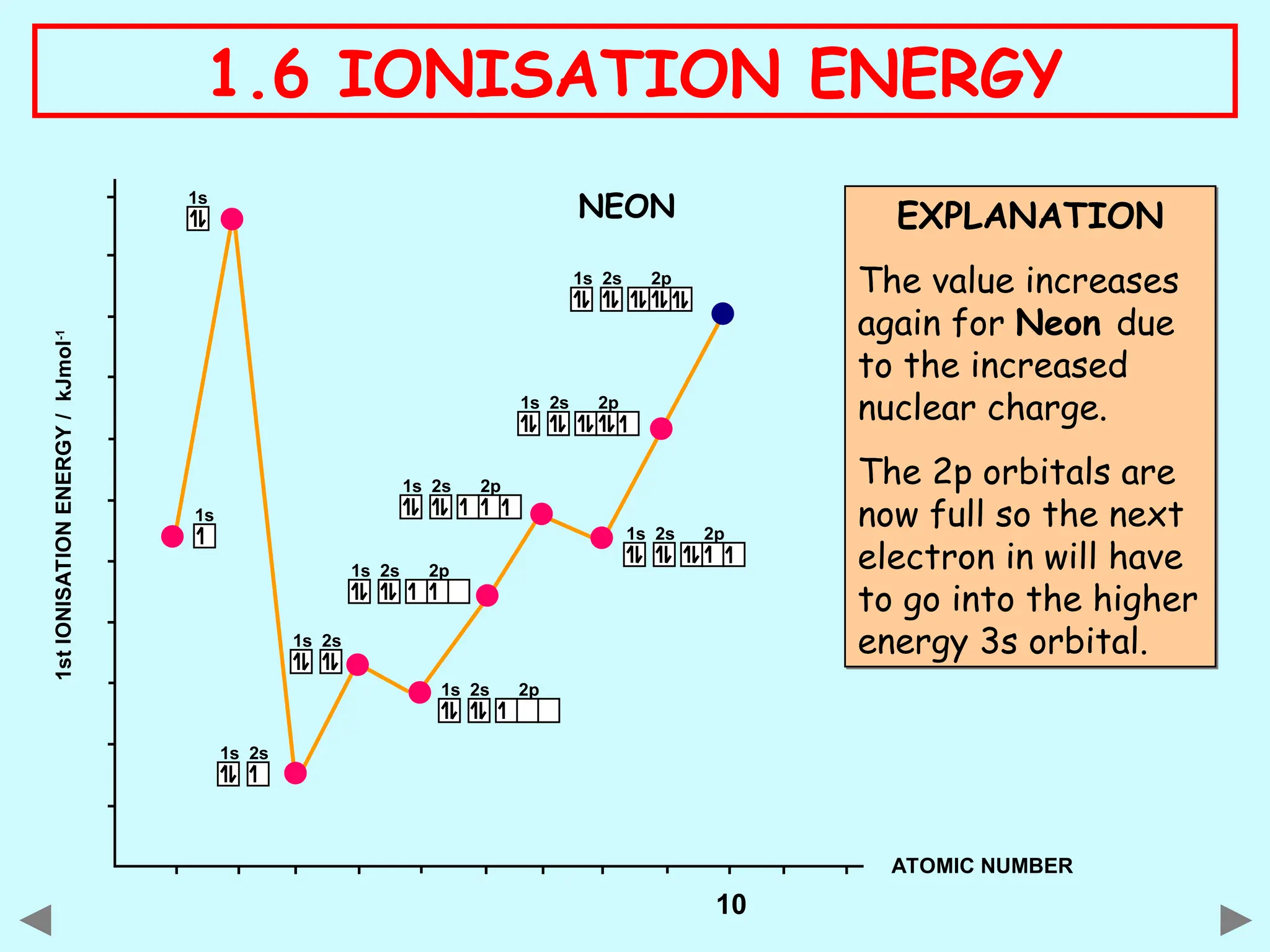
The value increases
again for Neon due
to the increased
nuclear charge.
The 2p orbitals are
now full so the next
electron in will have
to go into the higher
energy 3s orbital.
NEON
10
1.6 IONISATION ENERGY
1s 2s 2p
1s 2s 2p
1s 2s 2p
1s 2s 2p
1s 2s 2p
1s 2s 2p
1s 2s
1s 2s
1s
1s
ATOMIC NUMBER
1st
IONISATION
ENERGY
/
kJmol
-1
1s 2s 2p 3s
EXPLANATION
There is a
substantial drop in
the value for
Sodium. This is
because the extra
electron has gone
into an orbital in the
next energy level.
This means there is
an extra shielding
effect of filled
inner 1s, 2s and 2p
energy levels.
SODIUM
11
1.6 IONISATION ENERGY
1s 2s 2p
1s 2s 2p
1s 2s 2p
1s 2s 2p
1s 2s 2p
1s 2s 2p
1s 2s
1s 2s
1s
1s
ATOMIC NUMBER
1st
IONISATION
ENERGY
/
kJmol
-1
1s 2s 2p 3s
1s 2s 2p 3s
EXPLANATION
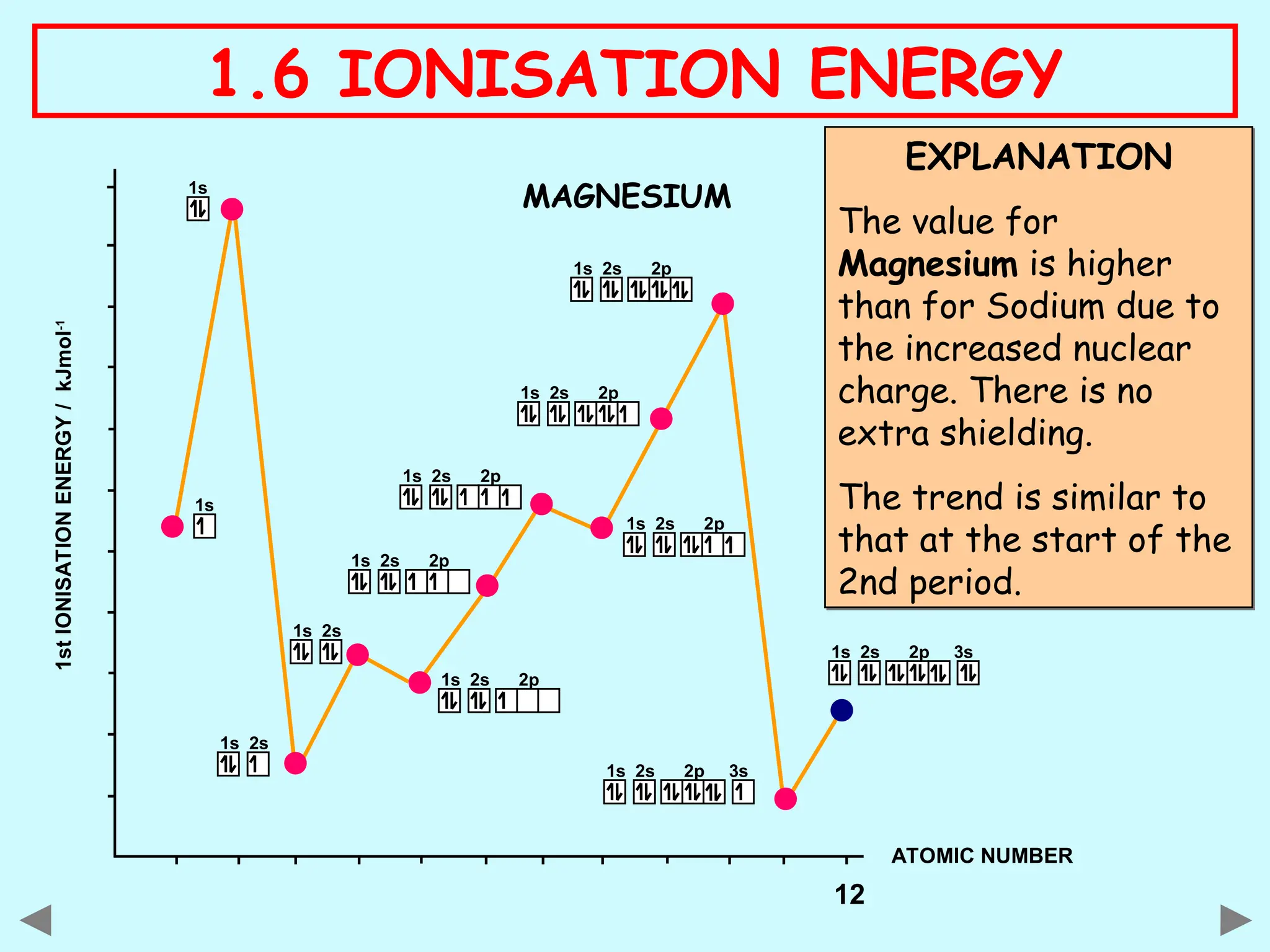
The value for
Magnesium is higher
than for Sodium due to
the increased nuclear
charge. There is no
extra shielding.
The trend is similar to
that at the start of the
2nd period.
MAGNESIUM
12
1.6 IONISATION ENERGY
TREND IN PERIOD 3
Draw a graph for the first ionisation energy of elements in
period 3
For each point draw the box and arrow electron
configuration
For each point explain why the first ionisation energy
either increases or decreases
Na Mg Al Si P S Cl Ar
496 738 578 789 1012 1000 1251 1521
1.6 IONISATION ENERGY
TREND IN PERIOD 3
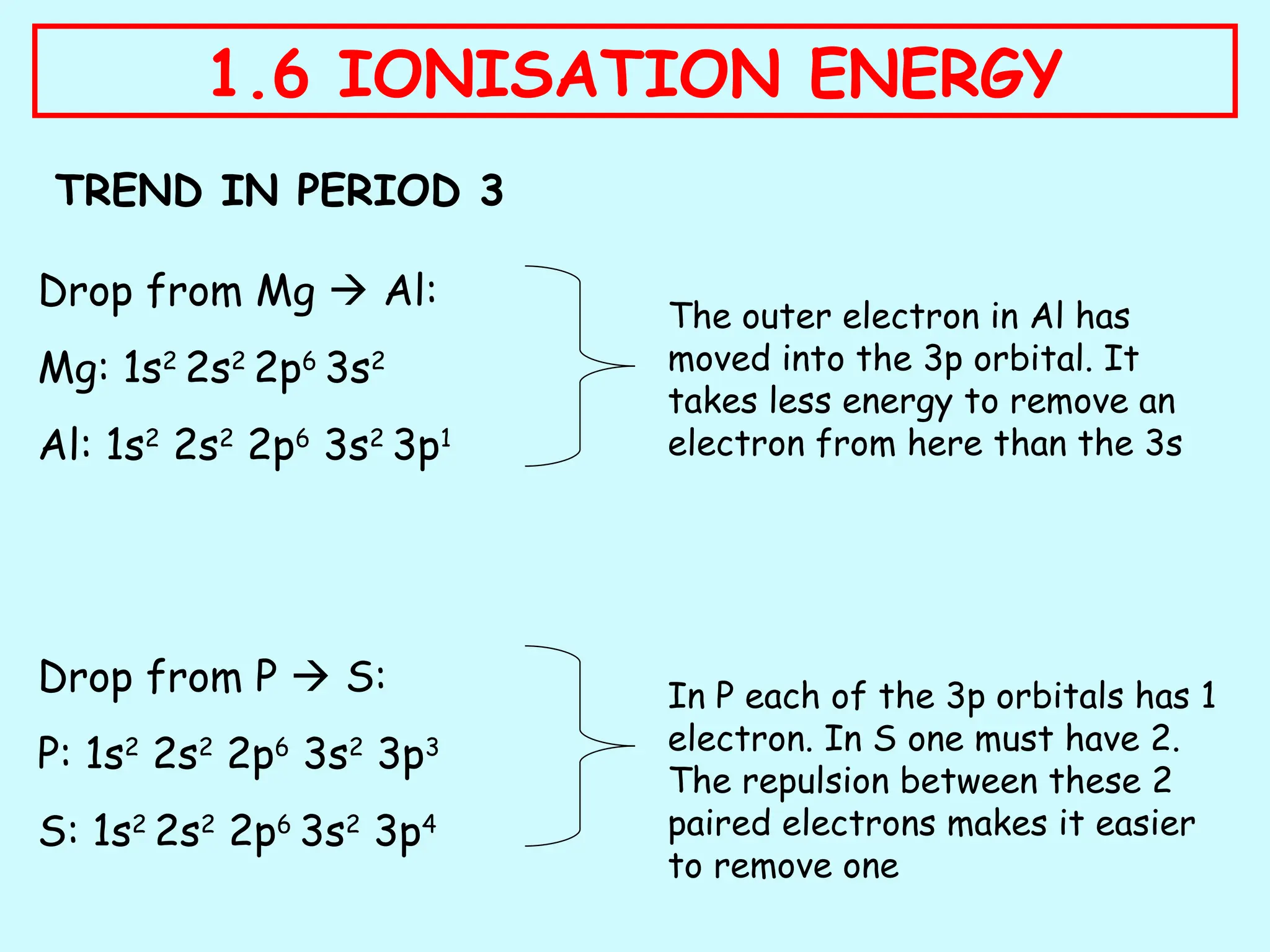
Drop from Mg  Al:
Mg: 1s2
2s2
2p6
3s2
Al: 1s2
2s2
2p6
3s2
3p1
Drop from P  S:
P: 1s2
2s2
2p6
3s2
3p3
S: 1s2
2s2
2p6
3s2
3p4
The outer electron in Al has
moved into the 3p orbital. It
takes less energy to remove an
electron from here than the 3s
In P each of the 3p orbitals has 1
electron. In S one must have 2.
The repulsion between these 2
paired electrons makes it easier
to remove one
1.6 IONISATION ENERGY
TREND DOWN GROUPS
General trend is a decrease as we go down a group
The outer electron is
in a level that gets
further from the
nucleus
Nuclear charge
increases however
this is more than
cancelled out by the
electron shielding
from lower energy
shells
1.6 IONISATION ENERGY
A: The 2nd I.E. of magnesium
The 1st I.E. of sodium involves the following change
Na(g) Na+
(g)
1s2
2s2
2p6
3s1
1s2
2s2
2p6
The 2nd I.E. of magnesium involves the same change in electron
configuration…
Mg+
(g) Mg2+
(g)
1s2
2s2
2p6
3s1
1s2
2s2
2p6
However, magnesium has 12 protons in its nucleus, whereas sodium only
has 11. The greater nuclear charge means that the electron being
removed is held more strongly and more energy must be put in to
remove it.
EXTENSION QUES: Which has the higher value, the 1st I.E. of
sodium or the 2nd I.E. of magnesium?
1.6 IONISATION ENERGY
HOMEWORK:
Revise for an end of chapter test next lesson
There are revision materials on the VLE
 Exam questions and mark scheme
How low can you go?? Write what you can do and what
grade this is  show some proof you can do this!
I CAN… I AM…
State what is meant by ionisation energy C
Describe the trend across period 3 and down
group 2
B
Explain why this trend occurs A
Suggest how these trends provide evidence for
the existence of electron levels and sub-levels
A*
1.6 IONISATION ENERGY

1.6 Ionisation Energy - TES.ppt IB Chemistry

  • 1.
    1.6 IONISATION ENERGY OBJECTIVES: Todefine the term ‘ionisation energy’ To describe and explain the trends in ionisation energy across period 3 and down group 2 FIRST THOUGHTS… What do you think we might mean by ionisation energy? KEY WORDS: IONISATION ENERGY NUCLEAR CHARGE TREND
  • 2.
    WHAT IS IONISATIONENERGY? “The energy required to remove 1 electron from each atom in 1 mole of gaseous atoms to form 1 mole of gaseous 1+ ions” Energy required to remove electrons  Measured in kJmol-1  Given the abbreviation IE  Values tell us a lot about the electronic configuration of elements 1.6 IONISATION ENERGY
  • 3.
    SUCCESSIVE IONISATION ENERGIES Wecan measure the energies required to remove each electron in turn, from outer electrons to inner electrons Values increase with each successive ionisation event Why might this be? 1.6 IONISATION ENERGY Successive Ionisation Energies of Na
  • 4.
    SUCCESSIVE IONISATION ENERGIES 1.6IONISATION ENERGY To form a positive ion, need energy to overcome attraction from nucleus. As each electron is removed from an atom, the remaining ion becomes more positively charged. Removing the next electron away from an increasing positive charge is more difficult and the ionisation energy is even larger.
  • 5.
    SUCCESSIVE IONISATION ENERGIES Na(g)  Na+ (g) + e- 1st IE = + 496 kJmol-1 Na+ (g)  Na2+ (g) + e- 2nd IE = + 4563 kJmol-1 Na2+ (g)  Na3+ (g) + e- 3rd IE = + 6913 kJmol-1 1.6 IONISATION ENERGY Notice how successive ionisation energies are written Start with the end product of previous ionisation event MUST include the gaseous state!
  • 6.
    SUCCESSIVE IONISATION ENERGIES Fromthis graph we can see evidence for electron shells Na looks to have 1 electron that’s easy to remove  furthest from nucleus 8 nearer to the nucleus  bit harder to remove 2 very close to the nucleus  nearest to +ve charge and hardest to remove 1.6 IONISATION ENERGY
  • 7.
    1.6 IONISATION ENERGY FACTORSAFFECTING IONISATION ENERGY As electrons are negatively charged and protons in the nucleus are positively charged, there will be an attraction between them. The greater the pull of the nucleus, the harder it will be to pull an electron away from an atom. Nuclear attraction of an electron depends on: • Atomic radius • Nuclear Charge • Electron shielding or screening
  • 8.
    1.6 IONISATION ENERGY ATOMICRADIUS: Greater the atomic radius, the smaller the nuclear attraction experienced by the outer electrons NUCLEAR CHARGE: The greater the nuclear charge, the greater the attractive force on the outer electrons Hydrogen Helium Lithium 519 kJ mol-1 1310 kJ mol-1 2370 kJ mol-1
  • 9.
    1.6 IONISATION ENERGY ELECTRONSHIELDING Inner shells of electrons repel the outer-shell electrons Known as ‘Electron shielding’ or ‘screening’ More inner shells  larger the screening and smaller the nuclear attraction of outer electrons Hydrogen Helium Lithium 519 kJ mol-1 1310 kJ mol-1 2370 kJ mol-1
  • 10.
    1.6 IONISATION ENERGY TRENDSACROSS PERIODS Look at the graph 1) Describe the patterns you see 2) Can you suggest an explanation for them
  • 11.
    1.6 IONISATION ENERGY TRENDSACROSS PERIODS 0 500 1000 1500 2000 2500 He Ne Ar Kr Xe There is a ‘general increase’ across a period before the value drops dramatically for the start of another period. This is because nuclear charge is increasing
  • 12.
    ATOMIC NUMBER 1st IONISATION ENERGY / kJmol -1 EXPLANATION Despite havinga nuclear charge of only 1+, Hydrogen has a relatively high 1st Ionisation Energy as its electron is closest to the nucleus and has no shielding. HYDROGEN 1 1s 1.6 IONISATION ENERGY
  • 13.
    1s 1s ATOMIC NUMBER 1st IONISATION ENERGY / kJmol -1 EXPLANATION Helium hasa much higher value because of the extra proton in the nucleus. The additional charge provides a stronger attraction for the electrons making them harder to remove. HELIUM 2 1.6 IONISATION ENERGY
  • 14.
    1s 2s 1s 1s ATOMIC NUMBER 1st IONISATION ENERGY / kJmol -1 EXPLANATION Thereis a substantial drop in the value for Lithium. Despite the increased nuclear charge, there is electron shielding from the 1s orbital. The 2s electron is also further away from the nucleus. It is held less strongly and needs less energy for removal. LITHIUM 3 1.6 IONISATION ENERGY
  • 15.
    1s 2s 1s 2s 1s 1s ATOMICNUMBER 1st IONISATION ENERGY / kJmol -1 EXPLANATION The value for Beryllium is higher than for Lithium due to the increased nuclear charge. There is no extra shielding. BERYLLIUM 4 1.6 IONISATION ENERGY
  • 16.
    1s 2s 2p 1s2s 1s 2s 1s 1s ATOMIC NUMBER 1st IONISATION ENERGY / kJmol -1 EXPLANATION There is a DROP DROP in the value for Boron. This is because the extra electron has gone into one of the 2p orbitals. The increased shielding makes the electron easier to remove It was evidence such as this that confirmed the existence of sub-shells. If there hadn’t been any sub- shell, the value would have been higher than that of Beryllium. BORON 5 1.6 IONISATION ENERGY
  • 17.
    1s 2s 2p 1s2s 2p 1s 2s 1s 2s 1s 1s ATOMIC NUMBER 1st IONISATION ENERGY / kJmol -1 EXPLANATION The value increases again for Carbon due to the increased nuclear charge. CARBON 6 1.6 IONISATION ENERGY
  • 18.
    1s 2s 2p 1s2s 2p 1s 2s 2p 1s 2s 1s 2s 1s 1s ATOMIC NUMBER 1st IONISATION ENERGY / kJmol -1 EXPLANATION The value increases again for Nitrogen due to the increased nuclear charge. As before, the extra electron goes into the vacant 2p orbital. There are now three unpaired electrons. NITROGEN 7 1.6 IONISATION ENERGY
  • 19.
    1s 2s 2p 1s2s 2p 1s 2s 2p 1s 2s 2p 1s 2s 1s 2s 1s 1s ATOMIC NUMBER 1st IONISATION ENERGY / kJmol -1 EXPLANATION There is a DROP DROP in the value for Oxygen. The extra electron has paired up with one of the electrons already in one of the 2p orbitals. The repulsive force between the two paired-up electrons means that less energy is required to remove one of them. OXYGEN 8 1.6 IONISATION ENERGY
  • 20.
    1s 2s 2p 1s2s 2p 1s 2s 2p 1s 2s 2p 1s 2s 2p 1s 2s 1s 2s 1s 1s ATOMIC NUMBER 1st IONISATION ENERGY / kJmol -1 EXPLANATION The value increases again for Fluorine due to the increased nuclear charge. The 2p orbitals are almost full. FLUORINE 9 1.6 IONISATION ENERGY
  • 21.
    1s 2s 2p 1s2s 2p 1s 2s 2p 1s 2s 2p 1s 2s 2p 1s 2s 2p 1s 2s 1s 2s 1s 1s ATOMIC NUMBER 1st IONISATION ENERGY / kJmol -1 EXPLANATION The value increases again for Neon due to the increased nuclear charge. The 2p orbitals are now full so the next electron in will have to go into the higher energy 3s orbital. NEON 10 1.6 IONISATION ENERGY
  • 22.
    1s 2s 2p 1s2s 2p 1s 2s 2p 1s 2s 2p 1s 2s 2p 1s 2s 2p 1s 2s 1s 2s 1s 1s ATOMIC NUMBER 1st IONISATION ENERGY / kJmol -1 1s 2s 2p 3s EXPLANATION There is a substantial drop in the value for Sodium. This is because the extra electron has gone into an orbital in the next energy level. This means there is an extra shielding effect of filled inner 1s, 2s and 2p energy levels. SODIUM 11 1.6 IONISATION ENERGY
  • 23.
    1s 2s 2p 1s2s 2p 1s 2s 2p 1s 2s 2p 1s 2s 2p 1s 2s 2p 1s 2s 1s 2s 1s 1s ATOMIC NUMBER 1st IONISATION ENERGY / kJmol -1 1s 2s 2p 3s 1s 2s 2p 3s EXPLANATION The value for Magnesium is higher than for Sodium due to the increased nuclear charge. There is no extra shielding. The trend is similar to that at the start of the 2nd period. MAGNESIUM 12 1.6 IONISATION ENERGY
  • 24.
    1.6 IONISATION ENERGY TRENDIN PERIOD 3 Draw a graph for the first ionisation energy of elements in period 3 For each point draw the box and arrow electron configuration For each point explain why the first ionisation energy either increases or decreases Na Mg Al Si P S Cl Ar 496 738 578 789 1012 1000 1251 1521
  • 25.
    1.6 IONISATION ENERGY TRENDIN PERIOD 3 Drop from Mg  Al: Mg: 1s2 2s2 2p6 3s2 Al: 1s2 2s2 2p6 3s2 3p1 Drop from P  S: P: 1s2 2s2 2p6 3s2 3p3 S: 1s2 2s2 2p6 3s2 3p4 The outer electron in Al has moved into the 3p orbital. It takes less energy to remove an electron from here than the 3s In P each of the 3p orbitals has 1 electron. In S one must have 2. The repulsion between these 2 paired electrons makes it easier to remove one
  • 26.
    1.6 IONISATION ENERGY TRENDDOWN GROUPS General trend is a decrease as we go down a group The outer electron is in a level that gets further from the nucleus Nuclear charge increases however this is more than cancelled out by the electron shielding from lower energy shells
  • 27.
    1.6 IONISATION ENERGY A:The 2nd I.E. of magnesium The 1st I.E. of sodium involves the following change Na(g) Na+ (g) 1s2 2s2 2p6 3s1 1s2 2s2 2p6 The 2nd I.E. of magnesium involves the same change in electron configuration… Mg+ (g) Mg2+ (g) 1s2 2s2 2p6 3s1 1s2 2s2 2p6 However, magnesium has 12 protons in its nucleus, whereas sodium only has 11. The greater nuclear charge means that the electron being removed is held more strongly and more energy must be put in to remove it. EXTENSION QUES: Which has the higher value, the 1st I.E. of sodium or the 2nd I.E. of magnesium?
  • 28.
    1.6 IONISATION ENERGY HOMEWORK: Revisefor an end of chapter test next lesson There are revision materials on the VLE  Exam questions and mark scheme
  • 29.
    How low canyou go?? Write what you can do and what grade this is  show some proof you can do this! I CAN… I AM… State what is meant by ionisation energy C Describe the trend across period 3 and down group 2 B Explain why this trend occurs A Suggest how these trends provide evidence for the existence of electron levels and sub-levels A* 1.6 IONISATION ENERGY

Editor's Notes

  • #8 Lithium has a greater nuclear charge so you may expect it to have a higher ionisation energy. However it is affected to a greater extent by the atomic radius and the electron shielding