MANASY JAYASURYA
Dept. of Computer Science & Applications
St.Mary’s College,Thrissur
Why Do We Preserve The Dependency?
We would like to check easily that updates to the database
do not result in illegal relations being created.
It would be nice if our design allowed us to check updates
without having to compute natural joins.
Definition
A decomposition D = {R1, R2, ..., Rn} of R is
dependency-preserving with respect to F if the union
of the projections of F on each Ri in D is equivalent to
F; that is
if (F1 ∪ F2∪ … ∪ Fn)+
= F +
In Layman’s Term
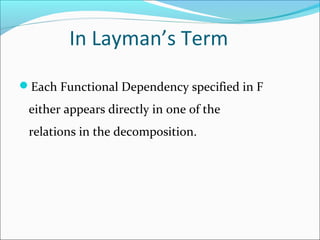
Each Functional Dependency specified in F
either appears directly in one of the
relations in the decomposition.
Continue…
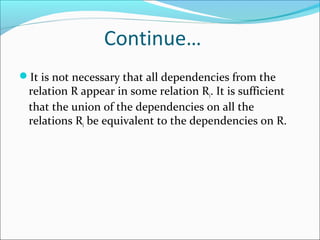
It is not necessary that all dependencies from the
relation R appear in some relation Ri. It is sufficient
that the union of the dependencies on all the
relations Ri be equivalent to the dependencies on R.
Property of Dependency-Preservation
If a decomposition is not dependency-preserving,
therefore, that dependency is lost in the
decomposition.
FD1
FD2
FD3
FD4
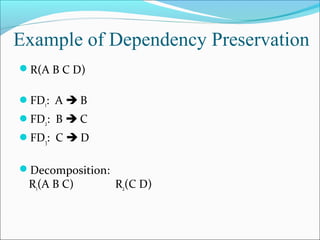
Example of Dependency Preservation
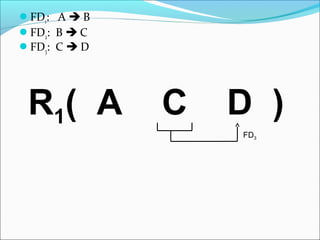
R(A B C D)
FD1: A  B
FD2: B  C
FD3: C  D
Decomposition:
R1(A B C) R2(C D)
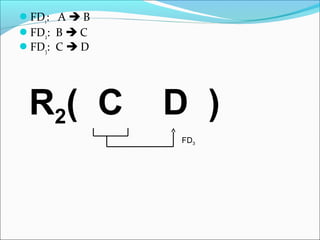
FD1: A  B
FD2: B  C
FD3: C  D
FD1
FD2
R1( A B C )
FD1: A  B
FD2: B  C
FD3: C  D
FD3
R2( C D )
FD1: A  B
FD2: B  C
FD3: C  D
R1( A B C ) R2( C D )
Has all 3 functional dependencies!
Therefore, it’s preserving the
dependencies
FD1
FD2
FD3
Example of Non-Dependency Preservation
R(A B C D)
FD1: A  B
FD2: B  C
FD3: C  D
Decomposition:
R1(A C D) R2(B C)
FD1: A  B
FD2: B  C
FD3: C  D
FD3
R1( A C D )
FD1: A  B
FD2: B  C
FD3: C  D
FD2
R2( B C )
FD1: A  B
FD2: B  C
FD3: C  D
R1( A C D ) R2( B C )
Does not support FD1: A => B
Therefore, it does not preserve the
dependencies
FD3
FD2
More Example
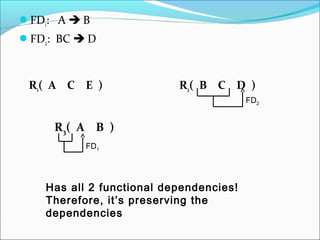
R(A B C D E)
FD1: A  B
FD2: BC  D
Decomposition:
R1(A C E) R2(B C D) R3(A B)
FD1: A  B
FD2: BC  D
R1( A C E )
No Dependencies
FD1: A  B
FD2: BC  D
FD2
R2( B C D )
FD1: A  B
FD2: BC  D
FD1
R3( A B )
FD1: A  B
FD2: BC  D
R1( A C E ) R2( B C D )
Has all 2 functional dependencies!
Therefore, it’s preserving the
dependencies
FD1
FD2
R3( A B )
Exercise Problem
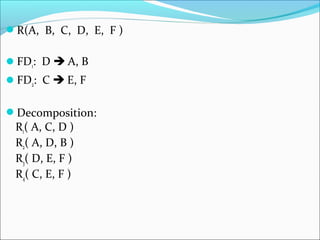
R(A, B, C, D, E, F )
FD1: D  A, B
FD2: C  E, F
Decomposition:
R1( A, C, D )
R2( A, D, B )
R3( D, E, F )
R4( C, E, F )
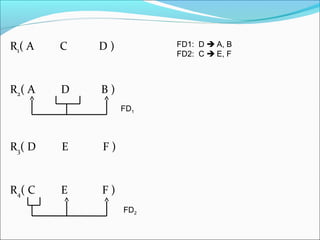
R1( A C D )
R2( A D B )
R3( D E F )
R4( C E F )
FD1
FD2
FD1: D  A, B
FD2: C  E, F
Answer
Yes!
This is a dependency-preservation
Dependency preservation

Dependency preservation

  • 1.
    MANASY JAYASURYA Dept. ofComputer Science & Applications St.Mary’s College,Thrissur
  • 2.
    Why Do WePreserve The Dependency? We would like to check easily that updates to the database do not result in illegal relations being created. It would be nice if our design allowed us to check updates without having to compute natural joins.
  • 3.
    Definition A decomposition D= {R1, R2, ..., Rn} of R is dependency-preserving with respect to F if the union of the projections of F on each Ri in D is equivalent to F; that is if (F1 ∪ F2∪ … ∪ Fn)+ = F +
  • 4.
    In Layman’s Term EachFunctional Dependency specified in F either appears directly in one of the relations in the decomposition.
  • 5.
    Continue… It is notnecessary that all dependencies from the relation R appear in some relation Ri. It is sufficient that the union of the dependencies on all the relations Ri be equivalent to the dependencies on R.
  • 6.
    Property of Dependency-Preservation Ifa decomposition is not dependency-preserving, therefore, that dependency is lost in the decomposition. FD1 FD2 FD3 FD4
  • 7.
    Example of DependencyPreservation R(A B C D) FD1: A  B FD2: B  C FD3: C  D Decomposition: R1(A B C) R2(C D)
  • 8.
    FD1: A B FD2: B  C FD3: C  D FD1 FD2 R1( A B C )
  • 9.
    FD1: A B FD2: B  C FD3: C  D FD3 R2( C D )
  • 10.
    FD1: A B FD2: B  C FD3: C  D R1( A B C ) R2( C D ) Has all 3 functional dependencies! Therefore, it’s preserving the dependencies FD1 FD2 FD3
  • 11.
    Example of Non-DependencyPreservation R(A B C D) FD1: A  B FD2: B  C FD3: C  D Decomposition: R1(A C D) R2(B C)
  • 12.
    FD1: A B FD2: B  C FD3: C  D FD3 R1( A C D )
  • 13.
    FD1: A B FD2: B  C FD3: C  D FD2 R2( B C )
  • 14.
    FD1: A B FD2: B  C FD3: C  D R1( A C D ) R2( B C ) Does not support FD1: A => B Therefore, it does not preserve the dependencies FD3 FD2
  • 15.
    More Example R(A BC D E) FD1: A  B FD2: BC  D Decomposition: R1(A C E) R2(B C D) R3(A B)
  • 16.
    FD1: A B FD2: BC  D R1( A C E ) No Dependencies
  • 17.
    FD1: A B FD2: BC  D FD2 R2( B C D )
  • 18.
    FD1: A B FD2: BC  D FD1 R3( A B )
  • 19.
    FD1: A B FD2: BC  D R1( A C E ) R2( B C D ) Has all 2 functional dependencies! Therefore, it’s preserving the dependencies FD1 FD2 R3( A B )
  • 20.
  • 21.
    R(A, B, C,D, E, F ) FD1: D  A, B FD2: C  E, F Decomposition: R1( A, C, D ) R2( A, D, B ) R3( D, E, F ) R4( C, E, F )
  • 22.
    R1( A CD ) R2( A D B ) R3( D E F ) R4( C E F ) FD1 FD2 FD1: D  A, B FD2: C  E, F
  • 23.
    Answer Yes! This is adependency-preservation