Association Rule Mining
Contents
• Market Basket Analysis
• Association Rule Mining
• Apriori Algorithm
• FP- Growth Algorithm
Association
• Association rule learning is a popular and well researched method for
discovering interesting relations between variables in large databases.
• Association is a data mining function that discovers the probability of the co-
occurrence of items in a collection. The relationships between co-occurring items
are expressed as association rules.
• Association rules are often used to analyze sales transactions. For example, it
might be noted that customers who buy cereal at the grocery store often buy
milk at the same time. In fact, association analysis might find that 85% of the
checkout sessions that include cereal also include milk. This relationship could be
formulated as the following rule.
• Cereal implies milk with 85% confidence
Market Basket Analysis
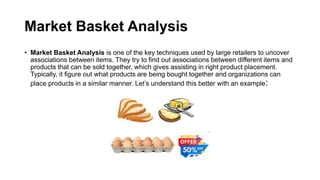
• Market Basket Analysis is one of the key techniques used by large retailers to uncover
associations between items. They try to find out associations between different items and
products that can be sold together, which gives assisting in right product placement.
Typically, it figure out what products are being bought together and organizations can
place products in a similar manner. Let’s understand this better with an example:
Association Rule Mining
• Association rules can be thought of as an IF-THEN relationship. Suppose
item A is being bought by the customer, then the chances of item B being
picked by the customer too under the same Transaction ID is found out.
• There are two elements of these rules:
• Antecedent (IF): This is an item/group of items that are typically found in the Itemsets or
Datasets.
• Consequent (THEN): This comes along as an item with an Antecedent/group of
Antecedents.
Measures
There are 3 ways to measure association:
• Support
• Confidence
• Lift
Support
• Support: It gives the fraction of transactions which contains
item A and B. Basically Support tells us about the frequently
bought items or the combination of items bought frequently.
• So with this, we can filter out the items that have a low
frequency.
Confidence
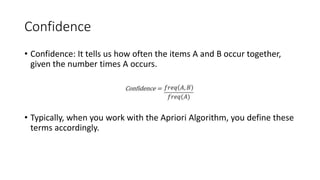
• Confidence: It tells us how often the items A and B occur together,
given the number times A occurs.
• Typically, when you work with the Apriori Algorithm, you define these
terms accordingly.
Lift
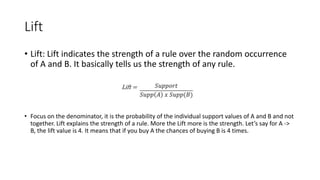
• Lift: Lift indicates the strength of a rule over the random occurrence
of A and B. It basically tells us the strength of any rule.
• Focus on the denominator, it is the probability of the individual support values of A and B and not
together. Lift explains the strength of a rule. More the Lift more is the strength. Let’s say for A ->
B, the lift value is 4. It means that if you buy A the chances of buying B is 4 times.
Apriori Algorithm
• Apriori algorithm uses frequent itemsets to generate association
rules. It is based on the concept that a subset of a frequent itemset
must also be a frequent itemset. Frequent Itemset is an itemset
whose support value is greater than a threshold value(support).
• Let’s say we have the following data of a store.
• Iteration 1: Let’s assume the support value is 2 and create the item
sets of the size of 1 and calculate their support values.
• As you can see here, item 4 has a support value of 1 which is less than
the min support value. So we are going to discard {4} in the upcoming
iterations. We have the final Table F1.
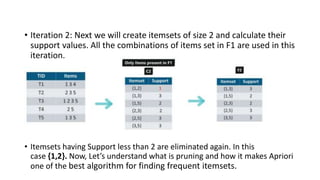
• Iteration 2: Next we will create itemsets of size 2 and calculate their
support values. All the combinations of items set in F1 are used in this
iteration.
• Itemsets having Support less than 2 are eliminated again. In this
case {1,2}. Now, Let’s understand what is pruning and how it makes Apriori
one of the best algorithm for finding frequent itemsets.
• Pruning: We are going to divide the itemsets in C3 into subsets and
eliminate the subsets that are having a support value less than 2.
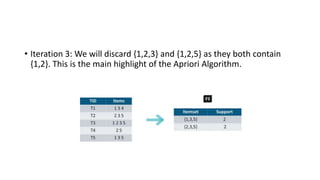
• Iteration 3: We will discard {1,2,3} and {1,2,5} as they both contain
{1,2}. This is the main highlight of the Apriori Algorithm.
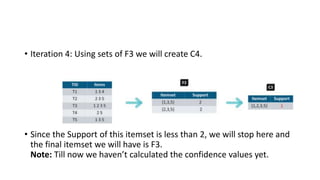
• Iteration 4: Using sets of F3 we will create C4.
• Since the Support of this itemset is less than 2, we will stop here and
the final itemset we will have is F3.
Note: Till now we haven’t calculated the confidence values yet.
• With F3 we get the following itemsets:
• For I = {1,3,5}, subsets are {1,3}, {1,5}, {3,5}, {1}, {3}, {5}
For I = {2,3,5}, subsets are {2,3}, {2,5}, {3,5}, {2}, {3}, {5}
• Applying Rules: We will create rules and apply them on
itemset F3. Now let’s assume a minimum confidence value
is 60%.
• For every subsets S of I, you output the rule
• S -> (I-S) (means S recommends I-S)
• if support(I) / support(S) >= min_conf value
• {1,3,5}
• Rule 1: {1,3} -> ({1,3,5} — {1,3}) means 1 & 3 -> 5
• Confidence = support(1,3,5)/support(1,3) = 2/3 = 66.66% > 60%
• Hence Rule 1 is Selected
• Rule 2: {1,5} -> ({1,3,5} — {1,5}) means 1 & 5 -> 3
• Confidence = support(1,3,5)/support(1,5) = 2/2 = 100% > 60%
• Rule 2 is Selected
• Rule 3: {3,5} -> ({1,3,5} — {3,5}) means 3 & 5 -> 1
• Confidence = support(1,3,5)/support(3,5) = 2/3 = 66.66% > 60%
• Rule 3 is Selected
• Rule 4: {1} -> ({1,3,5} — {1}) means 1 -> 3 & 5
• Confidence = support(1,3,5)/support(1) = 2/3 = 66.66% > 60%
• Rule 4 is Selected
• Rule 5: {3} -> ({1,3,5} — {3}) means 3 -> 1 & 5
• Confidence = support(1,3,5)/support(3) = 2/4 = 50% <60%
• Rule 5 is Rejected
• Rule 6: {5} -> ({1,3,5} — {5}) means 5 -> 1 & 3
• Confidence = support(1,3,5)/support(5) = 2/4 = 50% < 60%
• Rule 6 is Rejected
One more example
Step-1: K=1
• (I) Create a table containing support count of each item present in
dataset – Called C1(candidate set)
• compare candidate set item’s support count with minimum support count(here min_support=2 if
support_count of candidate set items is less than min_support then remove those items). This
gives us itemset L1.
Step-2: K=2
• Generate candidate set C2 using L1 (this is called join step). Condition of joining Lk-1 and Lk-1 is that it
should have (K-2) elements in common.
• Check all subsets of an itemset are frequent or not and if not frequent remove that itemset.(Example subset
of{I1, I2} are {I1}, {I2} they are frequent.Check for each itemset)
• Now find support count of these itemsets by searching in dataset.
Filter min support
count
Step-3:
• Generate candidate set C3 using L2 (join step). Condition of joining Lk-1 and Lk-1 is that it should
have (K-2) elements in common. So here, for L2, first element should match.
• So itemset generated by joining L2 is {I1, I2, I3}{I1, I2, I5}{I1, I3, i5}{I2, I3, I4}{I2, I4, I5}{I2, I3, I5}
• Check if all subsets of these itemsets are frequent or not and if not, then remove that
itemset.(Here subset of {I1, I2, I3} are {I1, I2},{I2, I3},{I1, I3} which are frequent. For {I2, I3, I4},
subset {I3, I4} is not frequent so remove it. Similarly check for every itemset)
• find support count of these remaining itemset by searching in dataset.
Step-4:
• Generate candidate set C4 using L3 (join step). Condition of joining
Lk-1 and Lk-1 (K=4) is that, they should have (K-2) elements in
common. So here, for L3, first 2 elements (items) should match.
• Check all subsets of these itemsets are frequent or not (Here itemset
formed by joining L3 is {I1, I2, I3, I5} so its subset contains {I1, I3, I5},
which is not frequent). So no itemset in C4
• We stop here because no frequent itemsets are found further
Rules
• Confidence –
• A confidence of 60% means that 60% of the customers, who purchased milk and bread also bought butter.
• Confidence(A->B)=Support_count(A∪B)/Support_count(A)
• So here, by taking an example of any frequent itemset, we will show the rule generation.
• Itemset {I1, I2, I3} //from L3
• SO rules can be
• [I1^I2]=>[I3] //confidence = sup(I1^I2^I3)/sup(I1^I2) = 2/4*100=50%
• [I1^I3]=>[I2] //confidence = sup(I1^I2^I3)/sup(I1^I3) = 2/4*100=50%
• [I2^I3]=>[I1] //confidence = sup(I1^I2^I3)/sup(I2^I3) = 2/4*100=50%
• [I1]=>[I2^I3] //confidence = sup(I1^I2^I3)/sup(I1) = 2/6*100=33%
• [I2]=>[I1^I3] //confidence = sup(I1^I2^I3)/sup(I2) = 2/7*100=28%
• [I3]=>[I1^I2] //confidence = sup(I1^I2^I3)/sup(I3) = 2/6*100=33%
• So if minimum confidence is 50%, then first 3 rules can be considered as strong association rules.
FP-growth
• The two primary drawbacks of the Apriori Algorithm are:-
• At each step, candidate sets have to be built.
• To build the candidate sets, the algorithm has to repeatedly scan the
database.
• FP-Growth (frequent-pattern growth) algorithm is an improved
algorithm of the Apriori algorithm put forward by Jiawei Han and so
forth. It compresses data sets to a FP-tree, scans the database twice,
does not produce the candidate item sets in mining process, and
greatly improves the mining efficiency.
• The above-given data is a hypothetical dataset of transactions with
each letter representing an item. The frequency of each individual
item is computed:-
• Let the minimum support be 3. A Frequent Pattern set is built which
will contain all the elements whose frequency is greater than or equal
to the minimum support. These elements are stored in descending
order of their respective frequencies. After insertion of the relevant
items, the set L looks like this:-
• L = {K : 5, E : 4, M : 3, O : 3, Y : 3}
• Arrange in the decreasing order of support.
• Now, for each transaction, the respective Ordered-Item set is built. It is done by
iterating the Frequent Pattern set and checking if the current item is contained in
the transaction in question. If the current item is contained, the item is inserted
in the Ordered-Item set for the current transaction. The following table is built for
all the transactions:-
• Now, all the Ordered-Item sets are inserted into a Trie Data Structure.
• Inserting the set {K, E, M, O, Y}
• Here, all the items are simply linked one after the other in the order of occurrence in the set and
initialize the support count for each item as 1.
Null
K:1
E : 1
M : 1
O : 1
Y : 1
• Inserting the set {K, E, O, Y}:
• Till the insertion of the elements K and E, simply the support count is increased by 1. On inserting O we can
see that there is no direct link between E and O, therefore a new node for the item O is initialized with the
support count as 1 and item E is linked to this new node. On inserting Y, we first initialize a new node for the
item Y with support count as 1 and link the new node of O with the new node of Y.
Null
K : 1
E : 1
M : 1
O : 1
Y : 1
O : 1
K : 2
E : 2
Y : 1
• Inserting the set {K, E, M}:
• Here simply the support count of each element is increased by 1.
• Inserting the set {K, M, Y}:
• Similar to step b), first the support count of K is increased, then new nodes for M and Y are
initialized and linked accordingly.
• Inserting the set {K, E, O}:
• Here simply the support counts of the respective elements are increased. Note that the support count of the
new node of item O is increased.
Items Conditional Pattern Base
Y {K,E,M,O:1}, {K,E,O:1},{K,M:1}
O {K,E,M:1}, {K,E:2}
M {K,E:2}, {K:1}
E {K:4}
K
• Now for each item the Conditional Frequent Pattern Tree is built. It is done by taking the set of
elements which is common in all the paths in the Conditional Pattern Base of that item and
calculating it’s support count by summing the support counts of all the paths in the Conditional
Pattern Base.
Items Conditional Pattern Base Conditional
Frequent
pattern tree
Y {K,E,M,O:1}, {K,E,O:1},{K,M:1} {K:3}
O {K,E,M:1}, {K,E:2} {K,E:3}
M {K,E:2}, {K:1} {K:3}
E {K:4} {K:4}
K
From the Conditional Frequent Pattern tree, the Frequent Pattern rules are generated by pairing the items of
the Conditional Frequent Pattern Tree set to the corresponding to the item as given in the below table.
For each row, two types of association rules can be inferred for example for the first row which contains the
element, the rules K -> Y and Y -> K can be inferred. To determine the valid rule, the confidence of both the
rules is calculated and the one with confidence greater than or equal to the minimum confidence value is
retained.
References
• https://youtu.be/guVvtZ7ZClw
• https://www.geeksforgeeks.org/ml-frequent-pattern-growth-
algorithm/

Association rule mining

  • 1.
  • 2.
    Contents • Market BasketAnalysis • Association Rule Mining • Apriori Algorithm • FP- Growth Algorithm
  • 3.
    Association • Association rulelearning is a popular and well researched method for discovering interesting relations between variables in large databases. • Association is a data mining function that discovers the probability of the co- occurrence of items in a collection. The relationships between co-occurring items are expressed as association rules. • Association rules are often used to analyze sales transactions. For example, it might be noted that customers who buy cereal at the grocery store often buy milk at the same time. In fact, association analysis might find that 85% of the checkout sessions that include cereal also include milk. This relationship could be formulated as the following rule. • Cereal implies milk with 85% confidence
  • 4.
    Market Basket Analysis •Market Basket Analysis is one of the key techniques used by large retailers to uncover associations between items. They try to find out associations between different items and products that can be sold together, which gives assisting in right product placement. Typically, it figure out what products are being bought together and organizations can place products in a similar manner. Let’s understand this better with an example:
  • 5.
    Association Rule Mining •Association rules can be thought of as an IF-THEN relationship. Suppose item A is being bought by the customer, then the chances of item B being picked by the customer too under the same Transaction ID is found out. • There are two elements of these rules: • Antecedent (IF): This is an item/group of items that are typically found in the Itemsets or Datasets. • Consequent (THEN): This comes along as an item with an Antecedent/group of Antecedents.
  • 6.
    Measures There are 3ways to measure association: • Support • Confidence • Lift
  • 7.
    Support • Support: Itgives the fraction of transactions which contains item A and B. Basically Support tells us about the frequently bought items or the combination of items bought frequently. • So with this, we can filter out the items that have a low frequency.
  • 8.
    Confidence • Confidence: Ittells us how often the items A and B occur together, given the number times A occurs. • Typically, when you work with the Apriori Algorithm, you define these terms accordingly.
  • 9.
    Lift • Lift: Liftindicates the strength of a rule over the random occurrence of A and B. It basically tells us the strength of any rule. • Focus on the denominator, it is the probability of the individual support values of A and B and not together. Lift explains the strength of a rule. More the Lift more is the strength. Let’s say for A -> B, the lift value is 4. It means that if you buy A the chances of buying B is 4 times.
  • 10.
    Apriori Algorithm • Apriorialgorithm uses frequent itemsets to generate association rules. It is based on the concept that a subset of a frequent itemset must also be a frequent itemset. Frequent Itemset is an itemset whose support value is greater than a threshold value(support).
  • 11.
    • Let’s saywe have the following data of a store.
  • 12.
    • Iteration 1:Let’s assume the support value is 2 and create the item sets of the size of 1 and calculate their support values.
  • 13.
    • As youcan see here, item 4 has a support value of 1 which is less than the min support value. So we are going to discard {4} in the upcoming iterations. We have the final Table F1.
  • 14.
    • Iteration 2:Next we will create itemsets of size 2 and calculate their support values. All the combinations of items set in F1 are used in this iteration. • Itemsets having Support less than 2 are eliminated again. In this case {1,2}. Now, Let’s understand what is pruning and how it makes Apriori one of the best algorithm for finding frequent itemsets.
  • 15.
    • Pruning: Weare going to divide the itemsets in C3 into subsets and eliminate the subsets that are having a support value less than 2.
  • 16.
    • Iteration 3:We will discard {1,2,3} and {1,2,5} as they both contain {1,2}. This is the main highlight of the Apriori Algorithm.
  • 17.
    • Iteration 4:Using sets of F3 we will create C4. • Since the Support of this itemset is less than 2, we will stop here and the final itemset we will have is F3. Note: Till now we haven’t calculated the confidence values yet.
  • 18.
    • With F3we get the following itemsets: • For I = {1,3,5}, subsets are {1,3}, {1,5}, {3,5}, {1}, {3}, {5} For I = {2,3,5}, subsets are {2,3}, {2,5}, {3,5}, {2}, {3}, {5} • Applying Rules: We will create rules and apply them on itemset F3. Now let’s assume a minimum confidence value is 60%. • For every subsets S of I, you output the rule • S -> (I-S) (means S recommends I-S) • if support(I) / support(S) >= min_conf value
  • 19.
    • {1,3,5} • Rule1: {1,3} -> ({1,3,5} — {1,3}) means 1 & 3 -> 5 • Confidence = support(1,3,5)/support(1,3) = 2/3 = 66.66% > 60% • Hence Rule 1 is Selected • Rule 2: {1,5} -> ({1,3,5} — {1,5}) means 1 & 5 -> 3 • Confidence = support(1,3,5)/support(1,5) = 2/2 = 100% > 60% • Rule 2 is Selected • Rule 3: {3,5} -> ({1,3,5} — {3,5}) means 3 & 5 -> 1 • Confidence = support(1,3,5)/support(3,5) = 2/3 = 66.66% > 60% • Rule 3 is Selected
  • 20.
    • Rule 4:{1} -> ({1,3,5} — {1}) means 1 -> 3 & 5 • Confidence = support(1,3,5)/support(1) = 2/3 = 66.66% > 60% • Rule 4 is Selected • Rule 5: {3} -> ({1,3,5} — {3}) means 3 -> 1 & 5 • Confidence = support(1,3,5)/support(3) = 2/4 = 50% <60% • Rule 5 is Rejected • Rule 6: {5} -> ({1,3,5} — {5}) means 5 -> 1 & 3 • Confidence = support(1,3,5)/support(5) = 2/4 = 50% < 60% • Rule 6 is Rejected
  • 21.
  • 22.
    Step-1: K=1 • (I)Create a table containing support count of each item present in dataset – Called C1(candidate set) • compare candidate set item’s support count with minimum support count(here min_support=2 if support_count of candidate set items is less than min_support then remove those items). This gives us itemset L1.
  • 23.
    Step-2: K=2 • Generatecandidate set C2 using L1 (this is called join step). Condition of joining Lk-1 and Lk-1 is that it should have (K-2) elements in common. • Check all subsets of an itemset are frequent or not and if not frequent remove that itemset.(Example subset of{I1, I2} are {I1}, {I2} they are frequent.Check for each itemset) • Now find support count of these itemsets by searching in dataset. Filter min support count
  • 24.
    Step-3: • Generate candidateset C3 using L2 (join step). Condition of joining Lk-1 and Lk-1 is that it should have (K-2) elements in common. So here, for L2, first element should match. • So itemset generated by joining L2 is {I1, I2, I3}{I1, I2, I5}{I1, I3, i5}{I2, I3, I4}{I2, I4, I5}{I2, I3, I5} • Check if all subsets of these itemsets are frequent or not and if not, then remove that itemset.(Here subset of {I1, I2, I3} are {I1, I2},{I2, I3},{I1, I3} which are frequent. For {I2, I3, I4}, subset {I3, I4} is not frequent so remove it. Similarly check for every itemset) • find support count of these remaining itemset by searching in dataset.
  • 25.
    Step-4: • Generate candidateset C4 using L3 (join step). Condition of joining Lk-1 and Lk-1 (K=4) is that, they should have (K-2) elements in common. So here, for L3, first 2 elements (items) should match. • Check all subsets of these itemsets are frequent or not (Here itemset formed by joining L3 is {I1, I2, I3, I5} so its subset contains {I1, I3, I5}, which is not frequent). So no itemset in C4 • We stop here because no frequent itemsets are found further
  • 26.
    Rules • Confidence – •A confidence of 60% means that 60% of the customers, who purchased milk and bread also bought butter. • Confidence(A->B)=Support_count(A∪B)/Support_count(A) • So here, by taking an example of any frequent itemset, we will show the rule generation. • Itemset {I1, I2, I3} //from L3 • SO rules can be • [I1^I2]=>[I3] //confidence = sup(I1^I2^I3)/sup(I1^I2) = 2/4*100=50% • [I1^I3]=>[I2] //confidence = sup(I1^I2^I3)/sup(I1^I3) = 2/4*100=50% • [I2^I3]=>[I1] //confidence = sup(I1^I2^I3)/sup(I2^I3) = 2/4*100=50% • [I1]=>[I2^I3] //confidence = sup(I1^I2^I3)/sup(I1) = 2/6*100=33% • [I2]=>[I1^I3] //confidence = sup(I1^I2^I3)/sup(I2) = 2/7*100=28% • [I3]=>[I1^I2] //confidence = sup(I1^I2^I3)/sup(I3) = 2/6*100=33% • So if minimum confidence is 50%, then first 3 rules can be considered as strong association rules.
  • 27.
    FP-growth • The twoprimary drawbacks of the Apriori Algorithm are:- • At each step, candidate sets have to be built. • To build the candidate sets, the algorithm has to repeatedly scan the database. • FP-Growth (frequent-pattern growth) algorithm is an improved algorithm of the Apriori algorithm put forward by Jiawei Han and so forth. It compresses data sets to a FP-tree, scans the database twice, does not produce the candidate item sets in mining process, and greatly improves the mining efficiency.
  • 29.
    • The above-givendata is a hypothetical dataset of transactions with each letter representing an item. The frequency of each individual item is computed:-
  • 30.
    • Let theminimum support be 3. A Frequent Pattern set is built which will contain all the elements whose frequency is greater than or equal to the minimum support. These elements are stored in descending order of their respective frequencies. After insertion of the relevant items, the set L looks like this:- • L = {K : 5, E : 4, M : 3, O : 3, Y : 3} • Arrange in the decreasing order of support.
  • 31.
    • Now, foreach transaction, the respective Ordered-Item set is built. It is done by iterating the Frequent Pattern set and checking if the current item is contained in the transaction in question. If the current item is contained, the item is inserted in the Ordered-Item set for the current transaction. The following table is built for all the transactions:-
  • 32.
    • Now, allthe Ordered-Item sets are inserted into a Trie Data Structure. • Inserting the set {K, E, M, O, Y} • Here, all the items are simply linked one after the other in the order of occurrence in the set and initialize the support count for each item as 1. Null K:1 E : 1 M : 1 O : 1 Y : 1
  • 33.
    • Inserting theset {K, E, O, Y}: • Till the insertion of the elements K and E, simply the support count is increased by 1. On inserting O we can see that there is no direct link between E and O, therefore a new node for the item O is initialized with the support count as 1 and item E is linked to this new node. On inserting Y, we first initialize a new node for the item Y with support count as 1 and link the new node of O with the new node of Y. Null K : 1 E : 1 M : 1 O : 1 Y : 1 O : 1 K : 2 E : 2 Y : 1
  • 34.
    • Inserting theset {K, E, M}: • Here simply the support count of each element is increased by 1.
  • 35.
    • Inserting theset {K, M, Y}: • Similar to step b), first the support count of K is increased, then new nodes for M and Y are initialized and linked accordingly.
  • 36.
    • Inserting theset {K, E, O}: • Here simply the support counts of the respective elements are increased. Note that the support count of the new node of item O is increased.
  • 37.
    Items Conditional PatternBase Y {K,E,M,O:1}, {K,E,O:1},{K,M:1} O {K,E,M:1}, {K,E:2} M {K,E:2}, {K:1} E {K:4} K
  • 38.
    • Now foreach item the Conditional Frequent Pattern Tree is built. It is done by taking the set of elements which is common in all the paths in the Conditional Pattern Base of that item and calculating it’s support count by summing the support counts of all the paths in the Conditional Pattern Base. Items Conditional Pattern Base Conditional Frequent pattern tree Y {K,E,M,O:1}, {K,E,O:1},{K,M:1} {K:3} O {K,E,M:1}, {K,E:2} {K,E:3} M {K,E:2}, {K:1} {K:3} E {K:4} {K:4} K
  • 39.
    From the ConditionalFrequent Pattern tree, the Frequent Pattern rules are generated by pairing the items of the Conditional Frequent Pattern Tree set to the corresponding to the item as given in the below table. For each row, two types of association rules can be inferred for example for the first row which contains the element, the rules K -> Y and Y -> K can be inferred. To determine the valid rule, the confidence of both the rules is calculated and the one with confidence greater than or equal to the minimum confidence value is retained.
  • 40.