Client - Server Networks
A presentation by group 3 on COS 441
(Advanced Computer Networks)
Presented by:
Definition
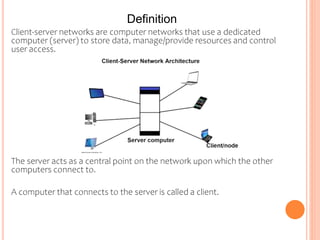
Client-server networks are computer networks that use a dedicated
computer (server) to store data, manage/provide resources and control
user access.
The server acts as a central point on the network upon which the other
computers connect to.
A computer that connects to the server is called a client.
Importance
Client-server networks enable efficient resource sharing,
scalability, security, data management, and collaboration.
Research Objectives & Questions
 To understand the client-server architecture.
 Client-server networks as an improvement to peer-to-peer
(P2P) computer networks.
 See the advantages and disadvantages as well as types and
characteristics of client-server architecture.
 Case studies.
 Why Client-server architecture over other types of
computer networks?
Components
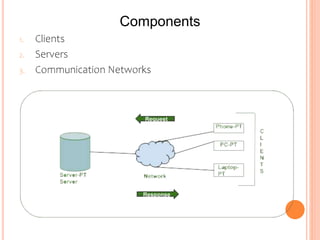
1. Clients
2. Servers
3. Communication Networks
Clients
 Applications that run on computers
 Rely on Servers for:
- Files
- Devices
- Processing Power
 Example: Email Client
- An application that enables you to send and receive email
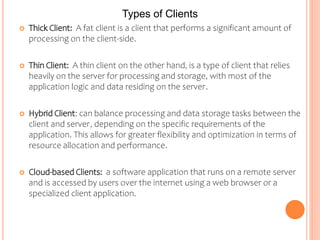
Types of Clients
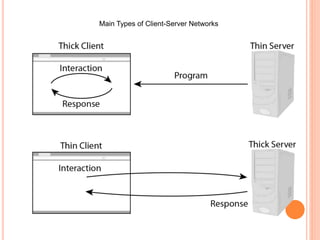
 Thick Client: A fat client is a client that performs a significant amount of
processing on the client-side.
 Thin Client: A thin client on the other hand, is a type of client that relies
heavily on the server for processing and storage, with most of the
application logic and data residing on the server.
 Hybrid Client: can balance processing and data storage tasks between the
client and server, depending on the specific requirements of the
application. This allows for greater flexibility and optimization in terms of
resource allocation and performance.
 Cloud-based Clients: a software application that runs on a remote server
and is accessed by users over the internet using a web browser or a
specialized client application.
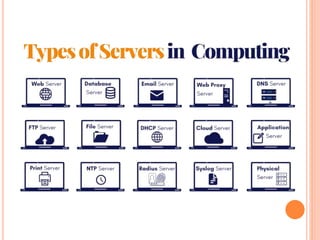
Main Types of Client-Server Networks
Server
 Computers or processes that manage network
resources
- File Servers
- Game Servers
- Web Servers
- Database Servers
 Example: Microsoft SQL Server
- A database server; controls data storage,
processing and security.
 Has the capability to perform large operations, handle
resources and network management.
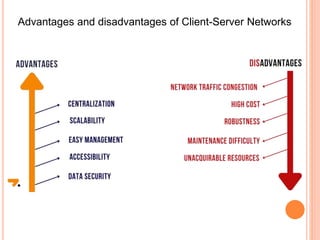
Advantages and disadvantages of Client-Server Networks
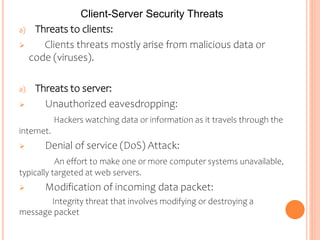
Client-Server Security Threats
a) Threats to clients:
 Clients threats mostly arise from malicious data or
code (viruses).
a) Threats to server:
 Unauthorized eavesdropping:
Hackers watching data or information as it travels through the
internet.
 Denial of service (DoS) Attack:
An effort to make one or more computer systems unavailable,
typically targeted at web servers.
 Modification of incoming data packet:
Integrity threat that involves modifying or destroying a
message packet
Scalability
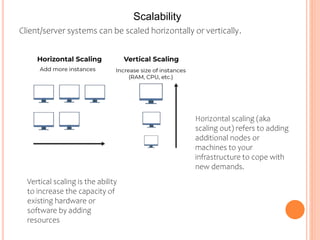
Client/server systems can be scaled horizontally or vertically.
Horizontal scaling (aka
scaling out) refers to adding
additional nodes or
machines to your
infrastructure to cope with
new demands.
Vertical scaling is the ability
to increase the capacity of
existing hardware or
software by adding
resources
Centralization (the use of client-
server networks) can cause
problems when it comes to
scalability: a single user or even a
group of servers will limit the
number of resources or clients it
can serve.
Scalability Problems
There are many different causes
of scalability issues, but the
most common issues arise
from application code, hardware
resources, and database
limitations.
Solutions to Scalability Issues
 Determine current and projected network requirements
being data-driven helps to optimize costs and enable efficient network
performance scaling.
 Have one comprehensive network management tool
To set up a scalable network, implementation of an all-in-one network
management solution is necessary.
Conclusion
The online CBT exams system is an example of a client-server
architecture. In this system, the admin/examiner can load a
number of questions on different topics with their right answers.
After taking the exam, the result of every student is saved in the
database. This saves manpower and time.
In conclusion, the client-server network covers both areas of
management and structure due to its flexibility and structure. It
is therefore necessary for us to know the usefulness of this
technology as well as its various applications in order for us to
take advantage of the benefits it provides us.
References
Riya Sander (2021, MARCH 8). Server Security Tips – Secure Your Server with
These Best Practices, accessed 20th March, 2023,
<https://www.freecodecamp.org/news/server-security-tips/>
Client-Server Network: Definition, Advantages, and Disadvantages,
accessed 19th March 2016, <https://www.sunnyvalley.io/docs/network-
basics/what-is-client-server-network>.
Horizontal Vs. Vertical Scaling: How Do They Compare?, accessed 19th March
2016, <https://www.cloudzero.com/blog/horizontal-vs-vertical-
scaling#:~:text=Horizontal%20scaling%20(aka%20scaling%20out,server%20ma
y%20be%20your%20solution.>
Vaidehi Joshi(2019, Feb 27). Scalability Problems: Hidden Challenges of
Growing a System, accessed 20th March, 2023,
<https://medium.com/baseds/scalability-problems-hidden-challenges-of-
growing-a-system-f74313b063c3>

client-server.pptx

  • 1.
    Client - ServerNetworks A presentation by group 3 on COS 441 (Advanced Computer Networks) Presented by:
  • 2.
    Definition Client-server networks arecomputer networks that use a dedicated computer (server) to store data, manage/provide resources and control user access. The server acts as a central point on the network upon which the other computers connect to. A computer that connects to the server is called a client.
  • 3.
    Importance Client-server networks enableefficient resource sharing, scalability, security, data management, and collaboration. Research Objectives & Questions  To understand the client-server architecture.  Client-server networks as an improvement to peer-to-peer (P2P) computer networks.  See the advantages and disadvantages as well as types and characteristics of client-server architecture.  Case studies.  Why Client-server architecture over other types of computer networks?
  • 4.
  • 5.
    Clients  Applications thatrun on computers  Rely on Servers for: - Files - Devices - Processing Power  Example: Email Client - An application that enables you to send and receive email
  • 6.
    Types of Clients Thick Client: A fat client is a client that performs a significant amount of processing on the client-side.  Thin Client: A thin client on the other hand, is a type of client that relies heavily on the server for processing and storage, with most of the application logic and data residing on the server.  Hybrid Client: can balance processing and data storage tasks between the client and server, depending on the specific requirements of the application. This allows for greater flexibility and optimization in terms of resource allocation and performance.  Cloud-based Clients: a software application that runs on a remote server and is accessed by users over the internet using a web browser or a specialized client application.
  • 7.
    Main Types ofClient-Server Networks
  • 8.
    Server  Computers orprocesses that manage network resources - File Servers - Game Servers - Web Servers - Database Servers  Example: Microsoft SQL Server - A database server; controls data storage, processing and security.  Has the capability to perform large operations, handle resources and network management.
  • 10.
    Advantages and disadvantagesof Client-Server Networks
  • 11.
    Client-Server Security Threats a)Threats to clients:  Clients threats mostly arise from malicious data or code (viruses). a) Threats to server:  Unauthorized eavesdropping: Hackers watching data or information as it travels through the internet.  Denial of service (DoS) Attack: An effort to make one or more computer systems unavailable, typically targeted at web servers.  Modification of incoming data packet: Integrity threat that involves modifying or destroying a message packet
  • 12.
    Scalability Client/server systems canbe scaled horizontally or vertically. Horizontal scaling (aka scaling out) refers to adding additional nodes or machines to your infrastructure to cope with new demands. Vertical scaling is the ability to increase the capacity of existing hardware or software by adding resources
  • 13.
    Centralization (the useof client- server networks) can cause problems when it comes to scalability: a single user or even a group of servers will limit the number of resources or clients it can serve. Scalability Problems There are many different causes of scalability issues, but the most common issues arise from application code, hardware resources, and database limitations.
  • 14.
    Solutions to ScalabilityIssues  Determine current and projected network requirements being data-driven helps to optimize costs and enable efficient network performance scaling.  Have one comprehensive network management tool To set up a scalable network, implementation of an all-in-one network management solution is necessary.
  • 15.
    Conclusion The online CBTexams system is an example of a client-server architecture. In this system, the admin/examiner can load a number of questions on different topics with their right answers. After taking the exam, the result of every student is saved in the database. This saves manpower and time. In conclusion, the client-server network covers both areas of management and structure due to its flexibility and structure. It is therefore necessary for us to know the usefulness of this technology as well as its various applications in order for us to take advantage of the benefits it provides us.
  • 16.
    References Riya Sander (2021,MARCH 8). Server Security Tips – Secure Your Server with These Best Practices, accessed 20th March, 2023, <https://www.freecodecamp.org/news/server-security-tips/> Client-Server Network: Definition, Advantages, and Disadvantages, accessed 19th March 2016, <https://www.sunnyvalley.io/docs/network- basics/what-is-client-server-network>. Horizontal Vs. Vertical Scaling: How Do They Compare?, accessed 19th March 2016, <https://www.cloudzero.com/blog/horizontal-vs-vertical- scaling#:~:text=Horizontal%20scaling%20(aka%20scaling%20out,server%20ma y%20be%20your%20solution.> Vaidehi Joshi(2019, Feb 27). Scalability Problems: Hidden Challenges of Growing a System, accessed 20th March, 2023, <https://medium.com/baseds/scalability-problems-hidden-challenges-of- growing-a-system-f74313b063c3>