WELCOME
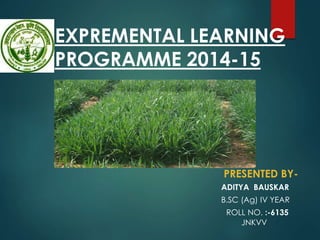
EXPREMENTAL LEARNING
PROGRAMME 2014-15
PRESENTED BY-
ADITYA BAUSKAR
B.SC (Ag) IV YEAR
ROLL NO. :-6135
JNKVV
INTRODUCTION
> It is most important human food
grain and stable crop.
> Wheat provides nourishment to 35%
of world population.
> Today , India is exporting sufficient
quantities of all type of wheat
extensive research efforts are under for
improving its cereals and grain output
in the year to come
HISTORY OF WHEAT CULTIVATION
IN INDIA
The Country used to import Wheat in large
quantities for fulfilling the needs of our people
from many countries like USA.
The production and productivity of Wheat
crop were quite low, when India became
independent in 1947.
The production of Wheat was only 6.46 million
tones and productivity was merely 663 kg per
hectare during 1950-51, which was not sufficient
to feed the Indian population.
Several policy decisions and actions were taken by
Government of India from time to time to increase
production and productivity in the country.
The Government of India appointed a commission
in 1961 to assess the feasibility of increasing the crop
productivity under prevailing Indian ecological
conditions.
The Ministry of Agriculture, Govt. of India launched
and implemented various Centrally Sponsored/
Central Sector Schemes, namely, IADP (1960-61),
IAAP (1964-65), High Yielding Varieties Programme
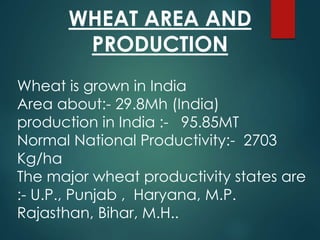
Wheat is grown in India
Area about:- 29.8Mh (India)
production in India :- 95.85MT
Normal National Productivity:- 2703
Kg/ha
The major wheat productivity states are
:- U.P., Punjab , Haryana, M.P.
Rajasthan, Bihar, M.H..
WHEAT AREA AND
PRODUCTION
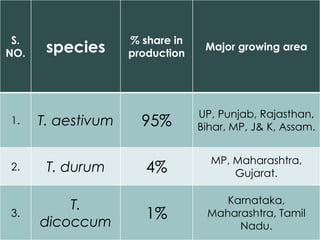
S.
NO. species
% share in
production
Major growing area
1. T. aestivum 95%
UP, Punjab, Rajasthan,
Bihar, MP, J& K, Assam.
2. T. durum 4%
MP, Maharashtra,
Gujarat.
3.
T.
dicoccum
1%
Karnataka,
Maharashtra, Tamil
Nadu.
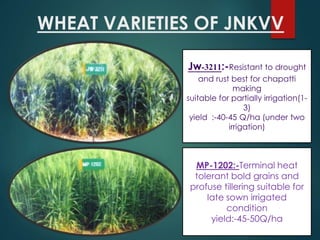
WHEAT VARIETIES OF JNKVV
MP-1202:-Terminal heat
tolerant bold grains and
profuse tillering suitable for
late sown irrigated
condition
yield:-45-50Q/ha
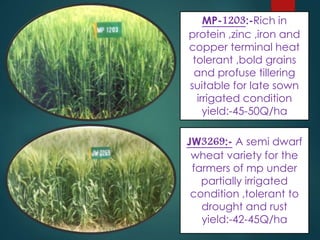
MP-1203:-Rich in
protein ,zinc ,iron and
copper terminal heat
tolerant ,bold grains
and profuse tillering
suitable for late sown
irrigated condition
yield:-45-50Q/ha
JW3269:- A semi dwarf
wheat variety for the
farmers of mp under
partially irrigated
condition ,tolerant to
drought and rust
yield:-42-45Q/ha
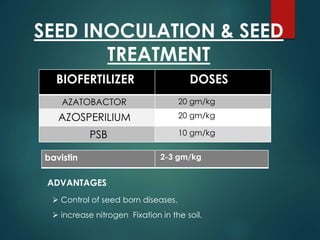
SEED INOCULATION & SEED
TREATMENT
BIOFERTILIZER DOSES
AZATOBACTOR 20 gm/kg
AZOSPERILIUM 20 gm/kg
PSB 10 gm/kg
bavistin 2-3 gm/kg
ADVANTAGES
 Control of seed born diseases.
 increase nitrogen Fixation in the soil.
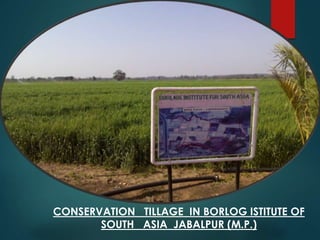
CONSERVATION TILLAGE IN BORLOG ISTITUTE OF
SOUTH ASIA JABALPUR (M.P.)
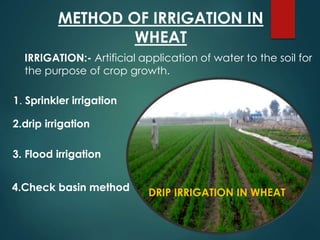
METHOD OF IRRIGATION IN
WHEAT
1. Sprinkler irrigation
3. Flood irrigation
4.Check basin method
IRRIGATION:- Artificial application of water to the soil for
the purpose of crop growth.
DRIP IRRIGATION IN WHEAT
2.drip irrigation
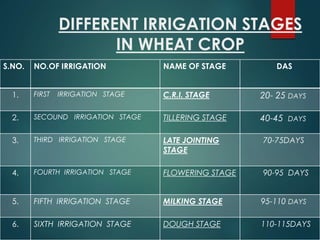
DIFFERENT IRRIGATION STAGES
IN WHEAT CROP
S.NO. NO.OF IRRIGATION NAME OF STAGE DAS
1. FIRST IRRIGATION STAGE C.R.I. STAGE 20- 25 DAYS
2. SECOUND IRRIGATION STAGE TILLERING STAGE 40-45 DAYS
3. THIRD IRRIGATION STAGE LATE JOINTING
STAGE
70-75DAYS
4. FOURTH IRRIGATION STAGE FLOWERING STAGE 90-95 DAYS
5. FIFTH IRRIGATION STAGE MILKING STAGE 95-110 DAYS
6. SIXTH IRRIGATION STAGE DOUGH STAGE 110-115DAYS
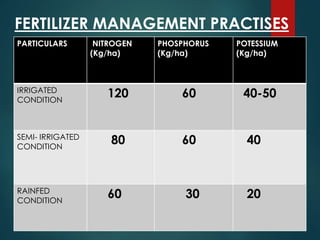
PARTICULARS NITROGEN
(Kg/ha)
PHOSPHORUS
(Kg/ha)
POTESSIUM
(Kg/ha)
IRRIGATED
CONDITION
120 60 40-50
SEMI- IRRIGATED
CONDITION
80 60 40
RAINFED
CONDITION
60 30 20
FERTILIZER MANAGEMENT PRACTISES
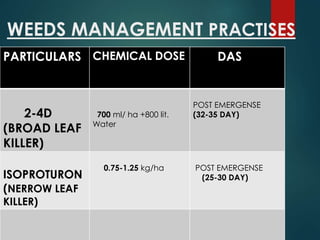
WEEDS MANAGEMENT PRACTISES
PARTICULARS CHEMICAL DOSE DAS
2-4D
(BROAD LEAF
KILLER)
700 ml/ ha +800 lit.
Water
POST EMERGENSE
(32-35 DAY)
ISOPROTURON
(NERROW LEAF
KILLER)
0.75-1.25 kg/ha POST EMERGENSE
(25-30 DAY)
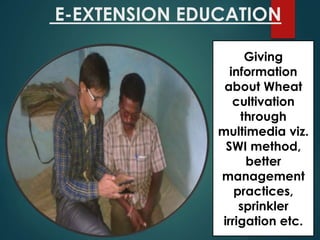
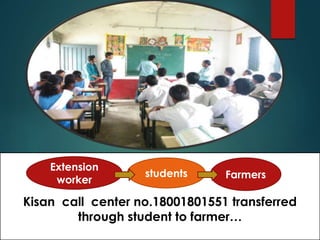
E-EXTENSION EDUCATION
Giving
information
about Wheat
cultivation
through
multimedia viz.
SWI method,
better
management
practices,
sprinkler
irrigation etc.
Kisan call center no.18001801551 transferred
through student to farmer…
Extension
worker
students Farmers
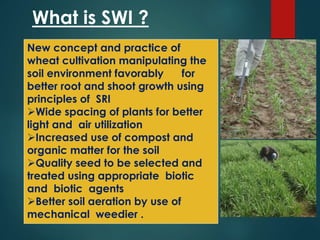
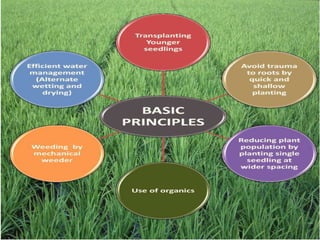
What is SWI ?
New concept and practice of
wheat cultivation manipulating the
soil environment favorably for
better root and shoot growth using
principles of SRI
Wide spacing of plants for better
light and air utilization
Increased use of compost and
organic matter for the soil
Quality seed to be selected and
treated using appropriate biotic
and biotic agents
Better soil aeration by use of
mechanical weedier .
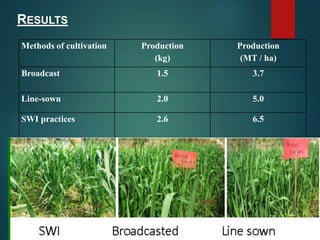
RESULTS
Methods of cultivation Production
(kg)
Production
(MT / ha)
Broadcast 1.5 3.7
Line-sown 2.0 5.0
SWI practices 2.6 6.5
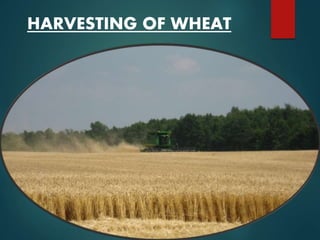
HARVESTING OF WHEAT
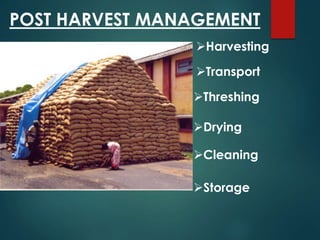
Harvesting
Transport
Threshing
Drying
Cleaning
Storage
POST HARVEST MANAGEMENT
wheat cultivation

wheat cultivation

  • 1.
  • 2.
    EXPREMENTAL LEARNING PROGRAMME 2014-15 PRESENTEDBY- ADITYA BAUSKAR B.SC (Ag) IV YEAR ROLL NO. :-6135 JNKVV
  • 3.
    INTRODUCTION > It ismost important human food grain and stable crop. > Wheat provides nourishment to 35% of world population. > Today , India is exporting sufficient quantities of all type of wheat extensive research efforts are under for improving its cereals and grain output in the year to come
  • 4.
    HISTORY OF WHEATCULTIVATION IN INDIA The Country used to import Wheat in large quantities for fulfilling the needs of our people from many countries like USA. The production and productivity of Wheat crop were quite low, when India became independent in 1947. The production of Wheat was only 6.46 million tones and productivity was merely 663 kg per hectare during 1950-51, which was not sufficient to feed the Indian population.
  • 5.
    Several policy decisionsand actions were taken by Government of India from time to time to increase production and productivity in the country. The Government of India appointed a commission in 1961 to assess the feasibility of increasing the crop productivity under prevailing Indian ecological conditions. The Ministry of Agriculture, Govt. of India launched and implemented various Centrally Sponsored/ Central Sector Schemes, namely, IADP (1960-61), IAAP (1964-65), High Yielding Varieties Programme
  • 6.
    Wheat is grownin India Area about:- 29.8Mh (India) production in India :- 95.85MT Normal National Productivity:- 2703 Kg/ha The major wheat productivity states are :- U.P., Punjab , Haryana, M.P. Rajasthan, Bihar, M.H.. WHEAT AREA AND PRODUCTION
  • 7.
    S. NO. species % sharein production Major growing area 1. T. aestivum 95% UP, Punjab, Rajasthan, Bihar, MP, J& K, Assam. 2. T. durum 4% MP, Maharashtra, Gujarat. 3. T. dicoccum 1% Karnataka, Maharashtra, Tamil Nadu.
  • 8.
    WHEAT VARIETIES OFJNKVV MP-1202:-Terminal heat tolerant bold grains and profuse tillering suitable for late sown irrigated condition yield:-45-50Q/ha
  • 9.
    MP-1203:-Rich in protein ,zinc,iron and copper terminal heat tolerant ,bold grains and profuse tillering suitable for late sown irrigated condition yield:-45-50Q/ha JW3269:- A semi dwarf wheat variety for the farmers of mp under partially irrigated condition ,tolerant to drought and rust yield:-42-45Q/ha
  • 10.
    SEED INOCULATION &SEED TREATMENT BIOFERTILIZER DOSES AZATOBACTOR 20 gm/kg AZOSPERILIUM 20 gm/kg PSB 10 gm/kg bavistin 2-3 gm/kg ADVANTAGES  Control of seed born diseases.  increase nitrogen Fixation in the soil.
  • 12.
    CONSERVATION TILLAGE INBORLOG ISTITUTE OF SOUTH ASIA JABALPUR (M.P.)
  • 13.
    METHOD OF IRRIGATIONIN WHEAT 1. Sprinkler irrigation 3. Flood irrigation 4.Check basin method IRRIGATION:- Artificial application of water to the soil for the purpose of crop growth. DRIP IRRIGATION IN WHEAT 2.drip irrigation
  • 14.
    DIFFERENT IRRIGATION STAGES INWHEAT CROP S.NO. NO.OF IRRIGATION NAME OF STAGE DAS 1. FIRST IRRIGATION STAGE C.R.I. STAGE 20- 25 DAYS 2. SECOUND IRRIGATION STAGE TILLERING STAGE 40-45 DAYS 3. THIRD IRRIGATION STAGE LATE JOINTING STAGE 70-75DAYS 4. FOURTH IRRIGATION STAGE FLOWERING STAGE 90-95 DAYS 5. FIFTH IRRIGATION STAGE MILKING STAGE 95-110 DAYS 6. SIXTH IRRIGATION STAGE DOUGH STAGE 110-115DAYS
  • 15.
    PARTICULARS NITROGEN (Kg/ha) PHOSPHORUS (Kg/ha) POTESSIUM (Kg/ha) IRRIGATED CONDITION 120 6040-50 SEMI- IRRIGATED CONDITION 80 60 40 RAINFED CONDITION 60 30 20 FERTILIZER MANAGEMENT PRACTISES
  • 16.
    WEEDS MANAGEMENT PRACTISES PARTICULARSCHEMICAL DOSE DAS 2-4D (BROAD LEAF KILLER) 700 ml/ ha +800 lit. Water POST EMERGENSE (32-35 DAY) ISOPROTURON (NERROW LEAF KILLER) 0.75-1.25 kg/ha POST EMERGENSE (25-30 DAY)
  • 17.
    E-EXTENSION EDUCATION Giving information about Wheat cultivation through multimediaviz. SWI method, better management practices, sprinkler irrigation etc.
  • 18.
    Kisan call centerno.18001801551 transferred through student to farmer… Extension worker students Farmers
  • 19.
    What is SWI? New concept and practice of wheat cultivation manipulating the soil environment favorably for better root and shoot growth using principles of SRI Wide spacing of plants for better light and air utilization Increased use of compost and organic matter for the soil Quality seed to be selected and treated using appropriate biotic and biotic agents Better soil aeration by use of mechanical weedier .
  • 20.
    RESULTS Methods of cultivationProduction (kg) Production (MT / ha) Broadcast 1.5 3.7 Line-sown 2.0 5.0 SWI practices 2.6 6.5
  • 22.
  • 23.