NAME: ADIL ZIA
CLASS NO: 618
SEMESTER: 5th
DEPARTMENT: AGRONOMY
TOPIC: OAT
INTRODUCTION:
The oat (Avena sativa), sometimes called the
common oat, is a species of cereal grain grown
for its seed are suitable for human
consumption as oatmeal, one of the most
common uses is as livestock feed. Oats are a
nutrient-rich food associated with lower blood
cholesterol when consumed.
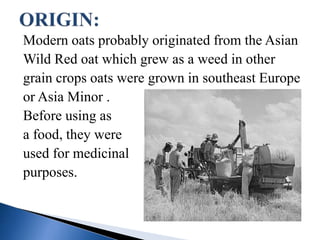
Modern oats probably originated from the Asian
Wild Red oat which grew as a weed in other
grain crops oats were grown in southeast Europe
or Asia Minor .
Before using as
a food, they were
used for medicinal
purposes.
 Fodder oats were introduced during the early
British era, but it was only in the 1970s that
400 cultivars were acquired from Australia,
Canada, Europe, New Zealand and USA to
form the basis of Pakistan’s oat improvement
programme.
 In Pakistan, they are an important winter
fodder, in both irrigated and rainfed areas.
 Oat as food:
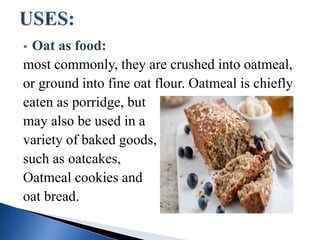
most commonly, they are crushed into oatmeal,
or ground into fine oat flour. Oatmeal is chiefly
eaten as porridge, but
may also be used in a
variety of baked goods,
such as oatcakes,
Oatmeal cookies and
oat bread.
 Oat as feed:
Oats are also commonly used as feed for
horses when extra carbohydrates and the
subsequent boost in energy are required. Cattle
are also fed oats.
 Use in drinks:
Oats are also occasionally used in several
different drinks. A cold, sweet drink called
avena made of ground oats and milk is a
popular refreshment throughout America.
The property of their cholesterol Lowering
Effects has led the acceptance of oats as a health
food. Oats are generally considered healthy due
to their rich Content of essential nutrients.
In a 100 gram serving, oats provide 389
kilocalories and are an excellent source of
protein, dietary fiber and other dietary minerals.
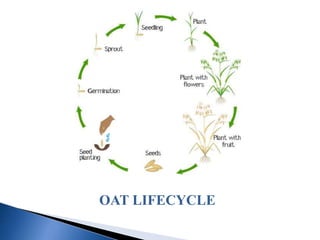
 The life cycle of an oat plant is similar to that
of any other annual grass.
 Oats are sown in the spring or early summer in
colder areas, as soon as the soil can be worked.
An early start is crucial to good fields, as oats
go dormant in summer heat. In warmer areas,
oats are sown in late summer or early fall.
OAT LIFECYCLE
 DN-8
 Avena Fatua
 NARC-Oat
SOIL:
It can be cultivated on all kinds of soil. Well
drained loamy soil rich in organic matter is
suitable for cultivation. pH range of 5 - 6.6 is
optimum for oats.
Land should be properly prepared to form a
weed free field. Ploughing should be done 6-8
times to gain higher yields. Oat crop can tolerate
higher pH levels than barley and wheat.
Propagation in Oats is done through seeds.
SOWING:
 Time of sowing:
21st September to December is optimum time
for sowing seeds.
 Spacing:
Spacing of 25-30 cm should be kept between
rows.
 Sowing Depth:
Depth should be 3-4 cm.
 Method of sowing:
Sowing is done through drilling method, zero
tillage drill.
 Seed Rate:
 Typically, about 75 to 100 kg/ha are sown,
either broadcast or drilled
 Seed Treatment:
Seed should be treated with Captan or Thiram
@ 3gm/kg of seeds to protect seeds from
various fungal and pathogenic diseases.
FERTILIZER:
Fertilizer kg/ha
Nitrogen 75
Phosphorous 50
Potassium 00
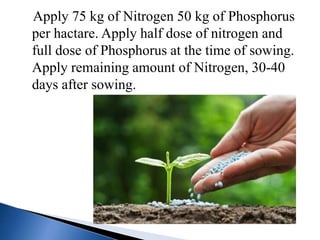
Apply 75 kg of Nitrogen 50 kg of Phosphorus
per hactare. Apply half dose of nitrogen and
full dose of Phosphorus at the time of sowing.
Apply remaining amount of Nitrogen, 30-40
days after sowing.
GERMINATION:
Oat seeds germinate in spring, Depending on
temperatures, germination can take one to
three weeks. Optimum germination
temperature ranges from 16 to 22 degrees
Celsius.
GROWTH:
Immediately following germination, root and
shoot growth is slow. Two weeks after
germination, growth accelerates. plants take
one month to fully tiller.
WEED CONTROL:
 Weeds are less likely to occur in oats. 1-2 hoeing
can be given as intercultural operations.
 A few tall broadleaf weeds, such goosegrass, wild
mustard, and buttonweed, occasionally create a
problem, as they complicate harvest and reduce
yields. These can be controlled with a modest
application of a broadleaf herbicide.
PEST AND DESEASES:
Oats are relatively free from diseases and
pestswith the exception being leaf diseases,
such as leaf rust and stem rust. However,
Puccinia coronata.
avenae is a pathogen
that can greatly
reduce crop yields.
Oats are mainly cultivated as rain-fed crop.
But if they are grown as irrigated crop, two
irrigations should be given at 25-28 days
interval from sowing.
FLOWERING:
Oats flower in early July, and last for up to six
weeks. Each of the plant's spikelets produce
three to seven small flowers.
SEEDING:
Seeds can ripen progressively from the top of
the plant to the bottom, or simultaneously.
Upon ripening, seeds split open, or shatter.
HARVESTING:
 Dec. to end of April.
 Oats are fully mature and ready to harvest after
4-5 months of sowing. To avoid grain
shedding, Crop should be harvested in early
April month.
Harvest techniques are a matter of available
equipment, local tradition, and priorities. Oat
are harvest by swathing, cutting the plants at
about 10 cm above ground. They leave the
windrows to dry in
the sun for several
daysbefore
combining them
using a pickup
header.
Storage:
Oats can be safely stored at 12-14% moisture.
Yield:
Cultivars Fodder yield (t h-1) Dry matter yield (t h-1)
DN-8 73.14 23.121
Avena Fatua 72.22 21.871
OAT

OAT

  • 2.
    NAME: ADIL ZIA CLASSNO: 618 SEMESTER: 5th DEPARTMENT: AGRONOMY TOPIC: OAT
  • 4.
    INTRODUCTION: The oat (Avenasativa), sometimes called the common oat, is a species of cereal grain grown for its seed are suitable for human consumption as oatmeal, one of the most common uses is as livestock feed. Oats are a nutrient-rich food associated with lower blood cholesterol when consumed.
  • 5.
    Modern oats probablyoriginated from the Asian Wild Red oat which grew as a weed in other grain crops oats were grown in southeast Europe or Asia Minor . Before using as a food, they were used for medicinal purposes.
  • 6.
     Fodder oatswere introduced during the early British era, but it was only in the 1970s that 400 cultivars were acquired from Australia, Canada, Europe, New Zealand and USA to form the basis of Pakistan’s oat improvement programme.  In Pakistan, they are an important winter fodder, in both irrigated and rainfed areas.
  • 7.
     Oat asfood: most commonly, they are crushed into oatmeal, or ground into fine oat flour. Oatmeal is chiefly eaten as porridge, but may also be used in a variety of baked goods, such as oatcakes, Oatmeal cookies and oat bread.
  • 8.
     Oat asfeed: Oats are also commonly used as feed for horses when extra carbohydrates and the subsequent boost in energy are required. Cattle are also fed oats.  Use in drinks: Oats are also occasionally used in several different drinks. A cold, sweet drink called avena made of ground oats and milk is a popular refreshment throughout America.
  • 9.
    The property oftheir cholesterol Lowering Effects has led the acceptance of oats as a health food. Oats are generally considered healthy due to their rich Content of essential nutrients. In a 100 gram serving, oats provide 389 kilocalories and are an excellent source of protein, dietary fiber and other dietary minerals.
  • 10.
     The lifecycle of an oat plant is similar to that of any other annual grass.  Oats are sown in the spring or early summer in colder areas, as soon as the soil can be worked. An early start is crucial to good fields, as oats go dormant in summer heat. In warmer areas, oats are sown in late summer or early fall.
  • 11.
  • 12.
     DN-8  AvenaFatua  NARC-Oat SOIL: It can be cultivated on all kinds of soil. Well drained loamy soil rich in organic matter is suitable for cultivation. pH range of 5 - 6.6 is optimum for oats.
  • 13.
    Land should beproperly prepared to form a weed free field. Ploughing should be done 6-8 times to gain higher yields. Oat crop can tolerate higher pH levels than barley and wheat. Propagation in Oats is done through seeds. SOWING:  Time of sowing: 21st September to December is optimum time for sowing seeds.
  • 14.
     Spacing: Spacing of25-30 cm should be kept between rows.  Sowing Depth: Depth should be 3-4 cm.  Method of sowing: Sowing is done through drilling method, zero tillage drill.  Seed Rate:  Typically, about 75 to 100 kg/ha are sown, either broadcast or drilled
  • 15.
     Seed Treatment: Seedshould be treated with Captan or Thiram @ 3gm/kg of seeds to protect seeds from various fungal and pathogenic diseases. FERTILIZER: Fertilizer kg/ha Nitrogen 75 Phosphorous 50 Potassium 00
  • 16.
    Apply 75 kgof Nitrogen 50 kg of Phosphorus per hactare. Apply half dose of nitrogen and full dose of Phosphorus at the time of sowing. Apply remaining amount of Nitrogen, 30-40 days after sowing.
  • 17.
    GERMINATION: Oat seeds germinatein spring, Depending on temperatures, germination can take one to three weeks. Optimum germination temperature ranges from 16 to 22 degrees Celsius. GROWTH: Immediately following germination, root and shoot growth is slow. Two weeks after germination, growth accelerates. plants take one month to fully tiller.
  • 18.
    WEED CONTROL:  Weedsare less likely to occur in oats. 1-2 hoeing can be given as intercultural operations.  A few tall broadleaf weeds, such goosegrass, wild mustard, and buttonweed, occasionally create a problem, as they complicate harvest and reduce yields. These can be controlled with a modest application of a broadleaf herbicide.
  • 19.
    PEST AND DESEASES: Oatsare relatively free from diseases and pestswith the exception being leaf diseases, such as leaf rust and stem rust. However, Puccinia coronata. avenae is a pathogen that can greatly reduce crop yields.
  • 20.
    Oats are mainlycultivated as rain-fed crop. But if they are grown as irrigated crop, two irrigations should be given at 25-28 days interval from sowing. FLOWERING: Oats flower in early July, and last for up to six weeks. Each of the plant's spikelets produce three to seven small flowers.
  • 21.
    SEEDING: Seeds can ripenprogressively from the top of the plant to the bottom, or simultaneously. Upon ripening, seeds split open, or shatter. HARVESTING:  Dec. to end of April.  Oats are fully mature and ready to harvest after 4-5 months of sowing. To avoid grain shedding, Crop should be harvested in early April month.
  • 22.
    Harvest techniques area matter of available equipment, local tradition, and priorities. Oat are harvest by swathing, cutting the plants at about 10 cm above ground. They leave the windrows to dry in the sun for several daysbefore combining them using a pickup header.
  • 23.
    Storage: Oats can besafely stored at 12-14% moisture. Yield: Cultivars Fodder yield (t h-1) Dry matter yield (t h-1) DN-8 73.14 23.121 Avena Fatua 72.22 21.871