Literature of
the World
21st Century Literature
What is World
Literature?
Literature of
the World
World literature
refers to writings and
stories that come
from various parts of
the world,
representing
different cultures,
perspectives, and
experiences.
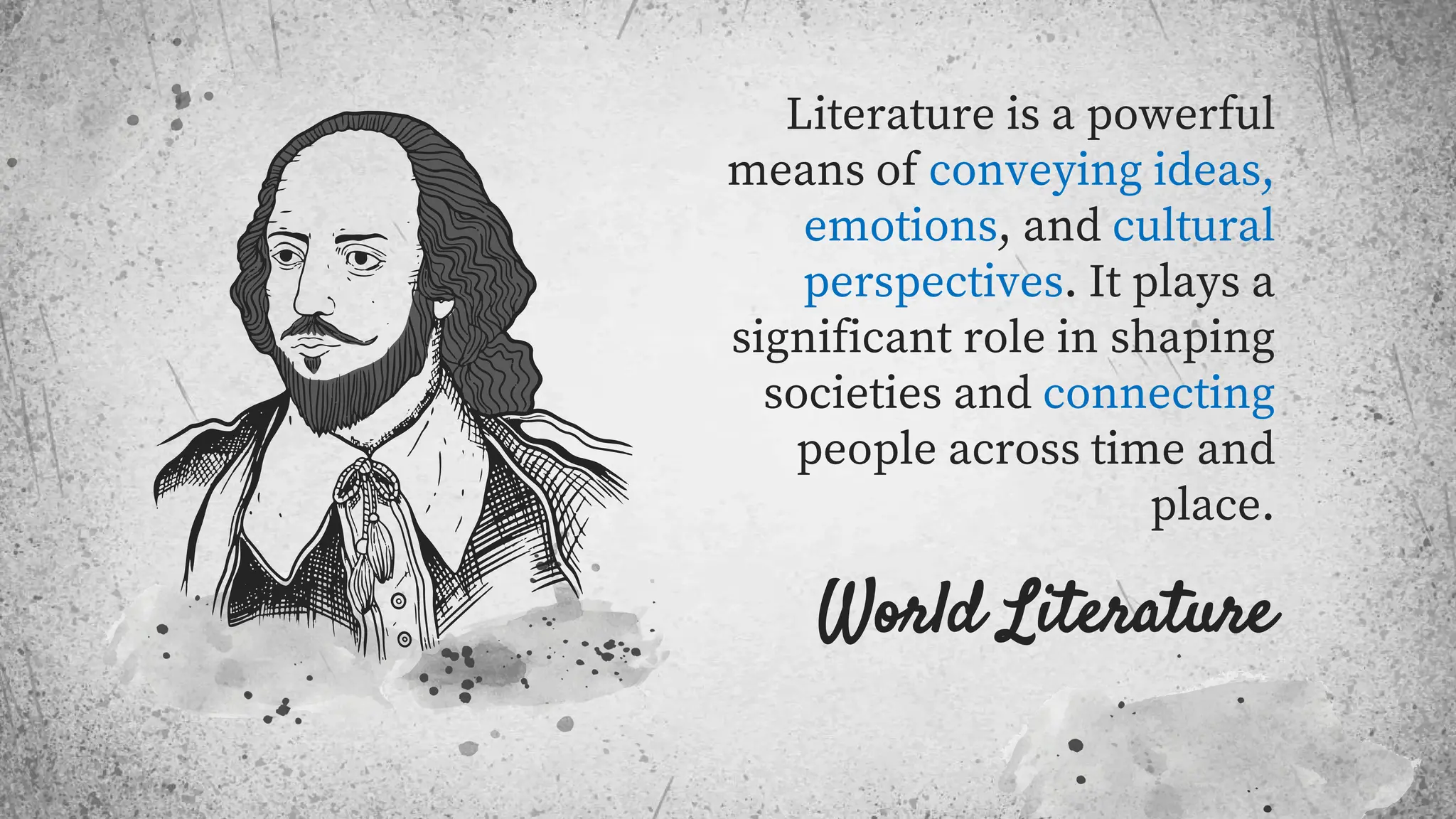
Literature is a powerful
means of conveying ideas,
emotions, and cultural
perspectives. It plays a
significant role in shaping
societies and connecting
people across time and
place.
World Literature
Historical Roots of Literature
Ancient Civilization
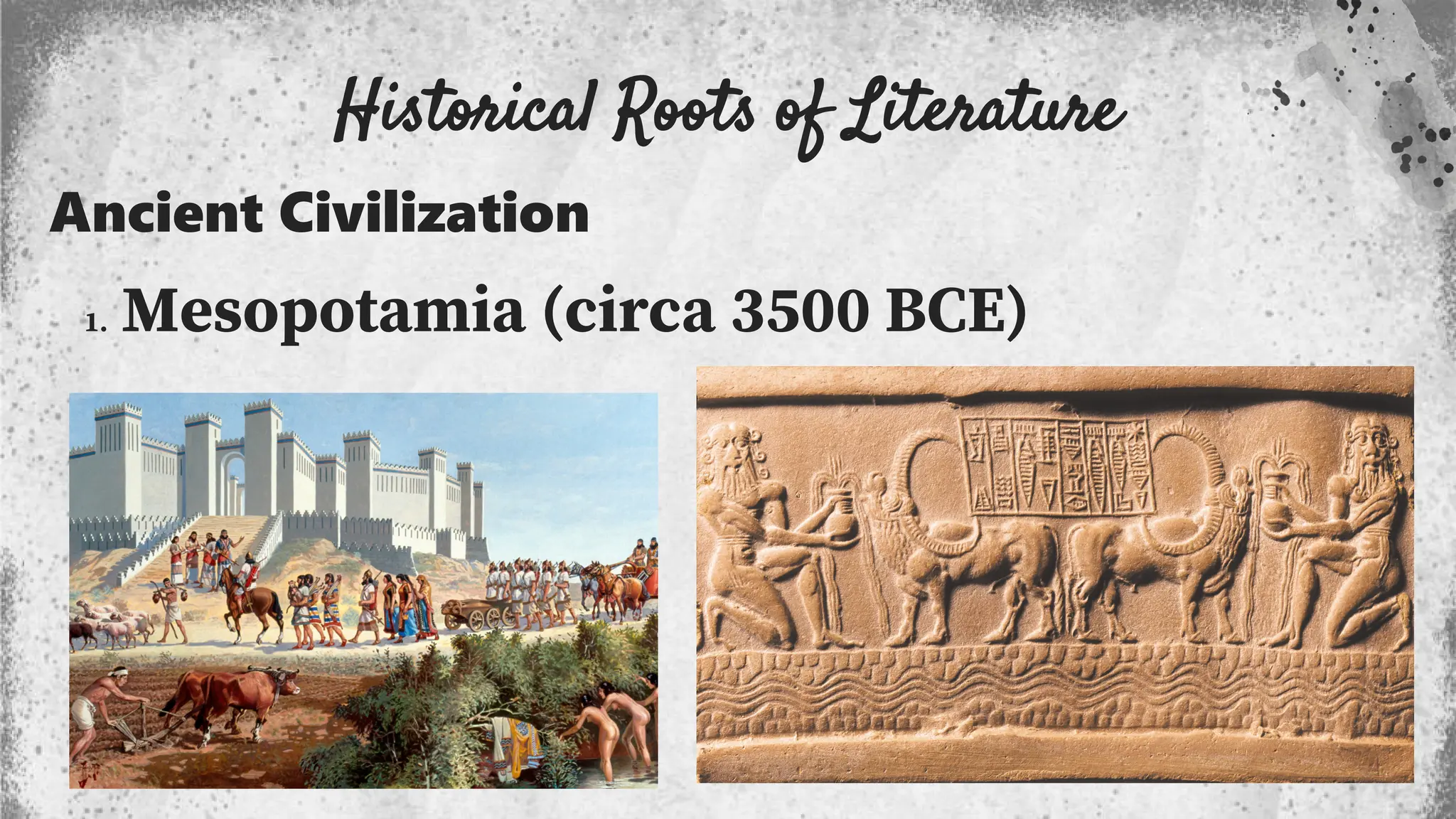
1. Mesopotamia (circa 3500 BCE)
Ancient Civilization
1. Mesopotamia (circa 3500 BCE)
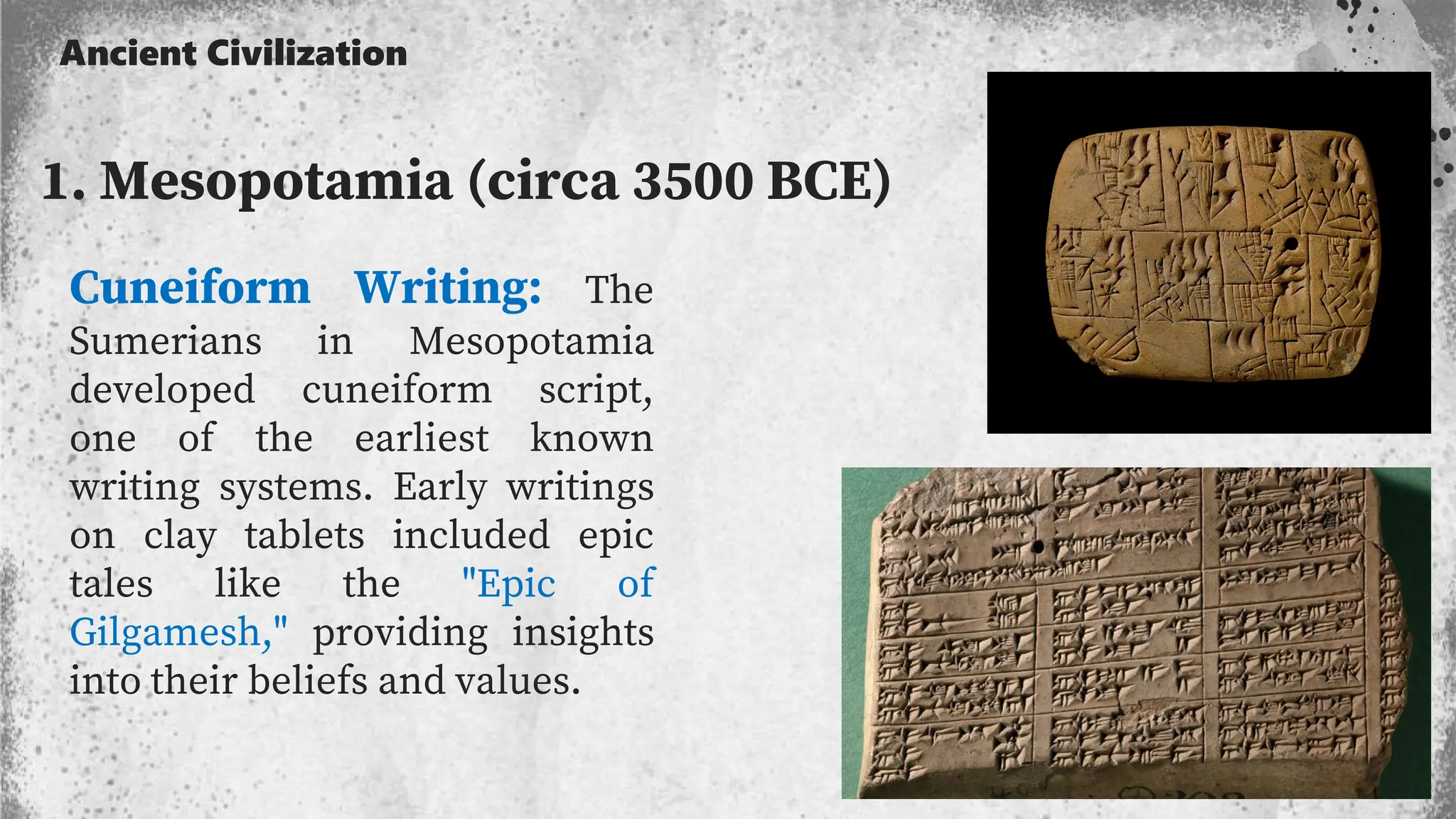
Cuneiform Writing: The
Sumerians in Mesopotamia
developed cuneiform script,
one of the earliest known
writing systems. Early writings
on clay tablets included epic
tales like the "Epic of
Gilgamesh," providing insights
into their beliefs and values.
Historical Roots of Literature
Ancient Civilization
2. Ancient Egypt (circa 3100 BCE):
Ancient Civilization
2. Ancient Egypt (circa 3100 BCE):
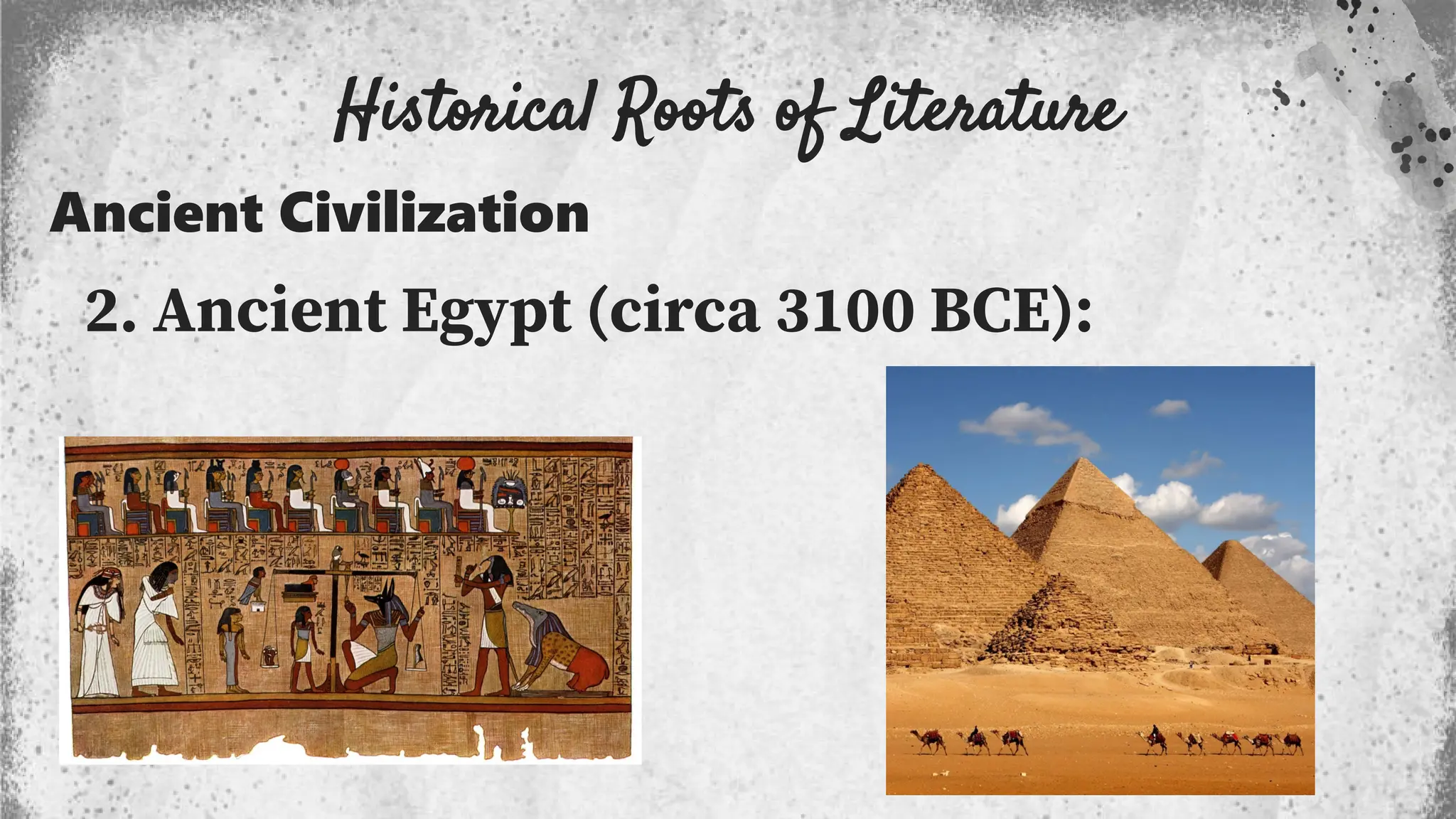
Hieroglyphics: Egyptians
used hieroglyphics to record
religious texts, administrative
information, and stories. The
"Book of the Dead" is a notable
example, reflecting beliefs
about the afterlife.
Historical Roots of Literature
Classic Antiquity:
Ancient Greece (8th to 4th century BCE):
Classic Antiquity
Ancient Greece (8th to 4th century BCE):
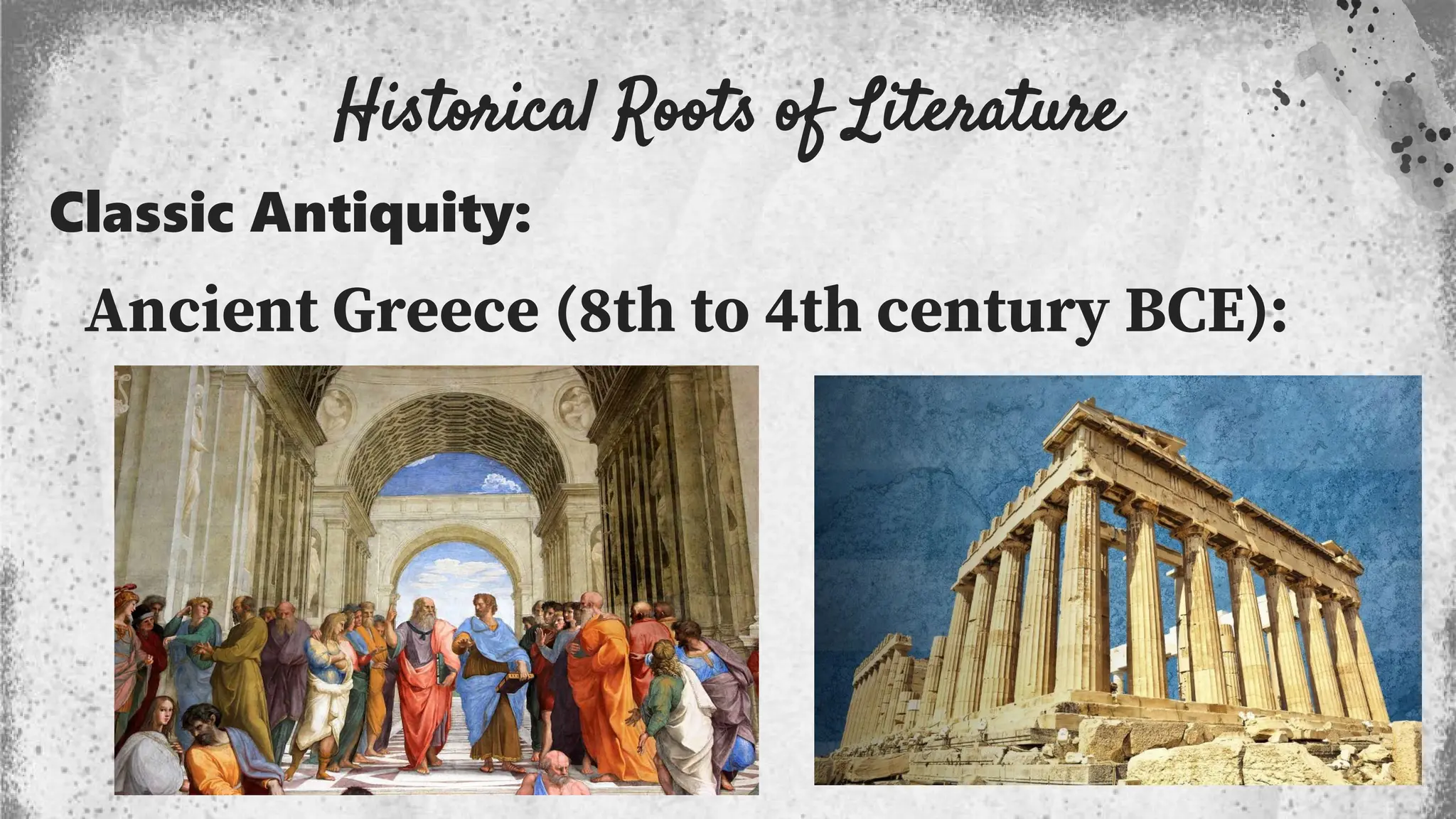
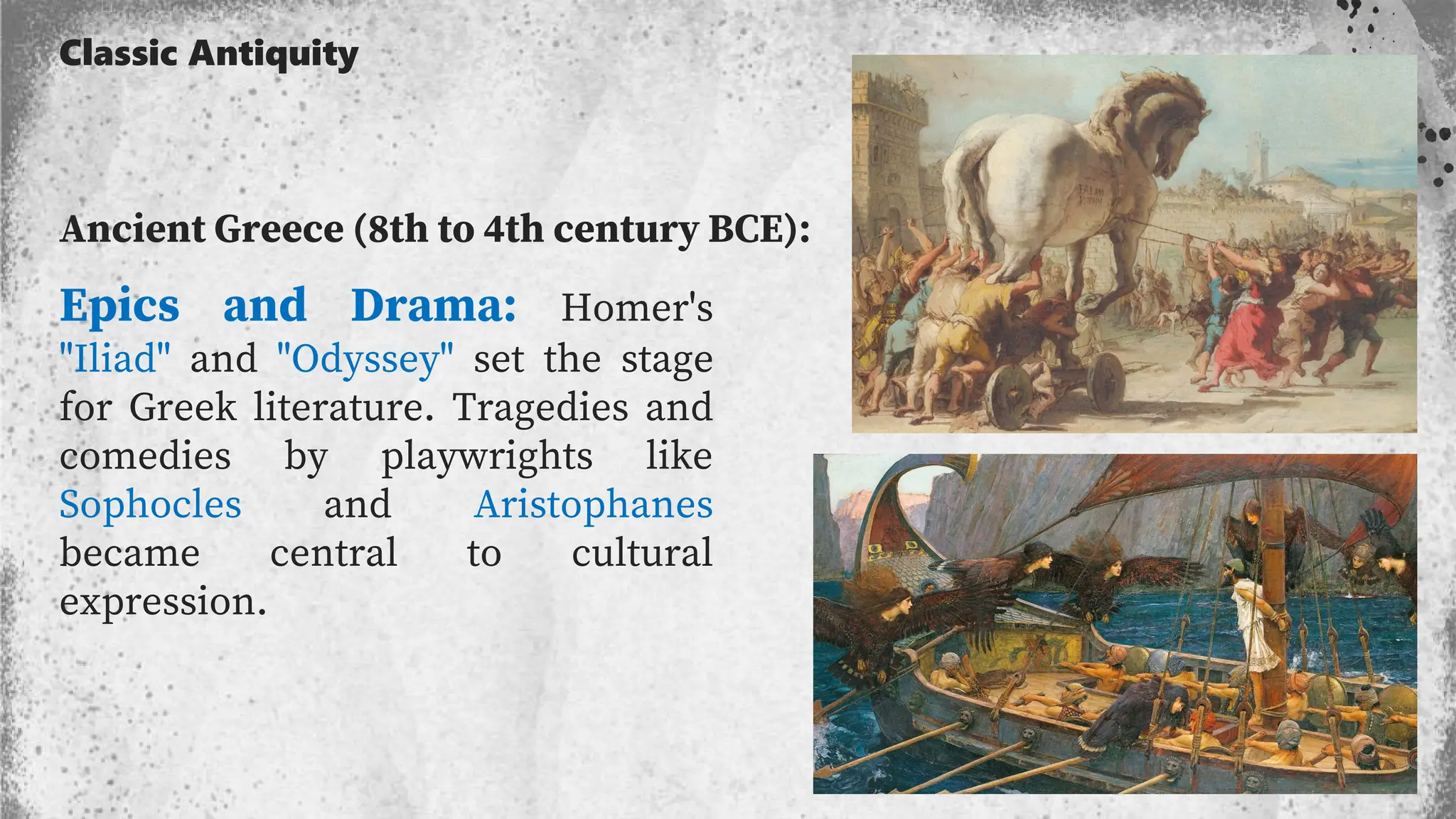
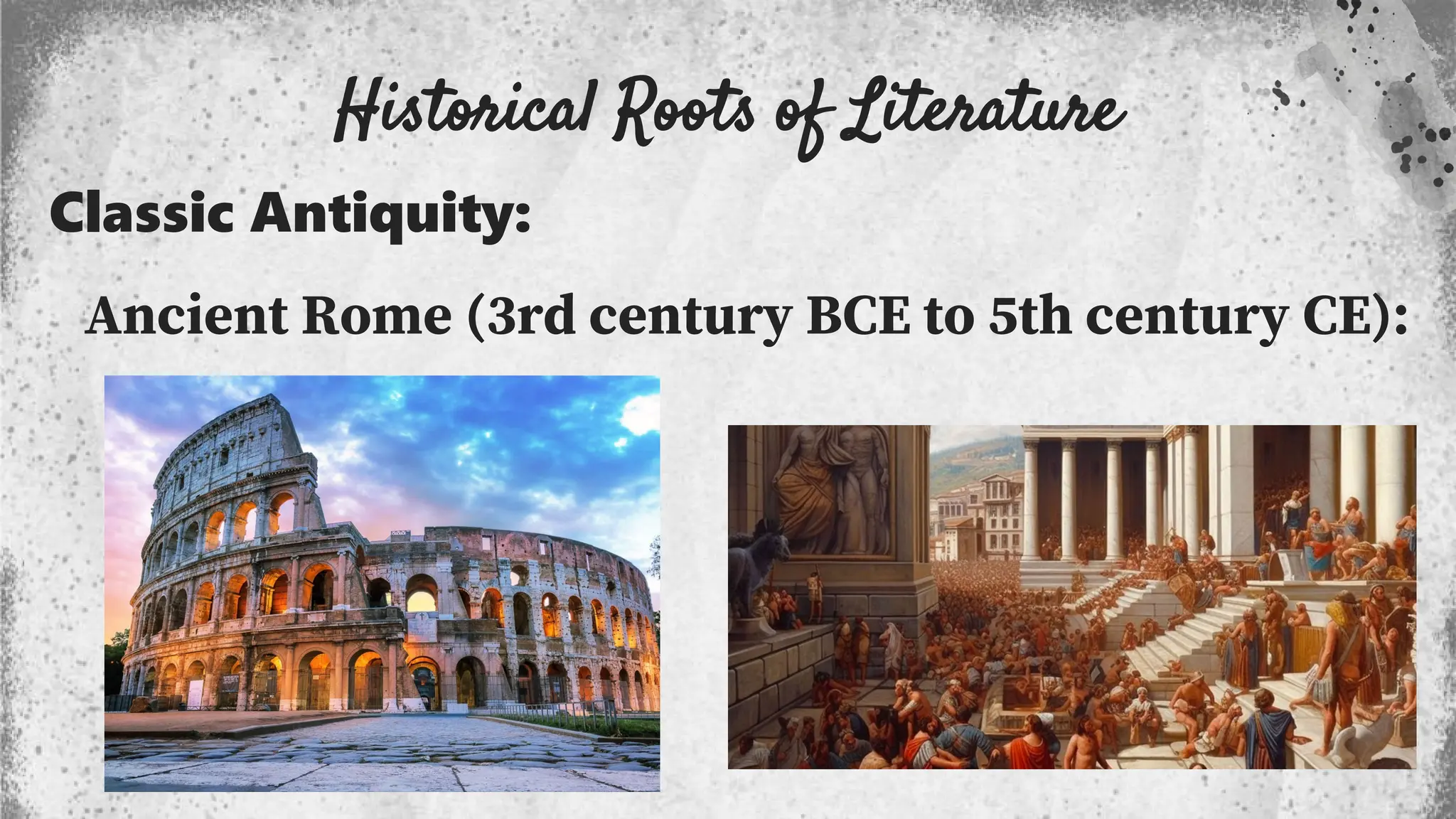
Epics and Drama: Homer's
"Iliad" and "Odyssey" set the stage
for Greek literature. Tragedies and
comedies by playwrights like
Sophocles and Aristophanes
became central to cultural
expression.
Historical Roots of Literature
Classic Antiquity:
Ancient Rome (3rd century BCE to 5th century CE):
Classic Antiquity
Ancient Rome (3rd century
BCE to 5th century CE):
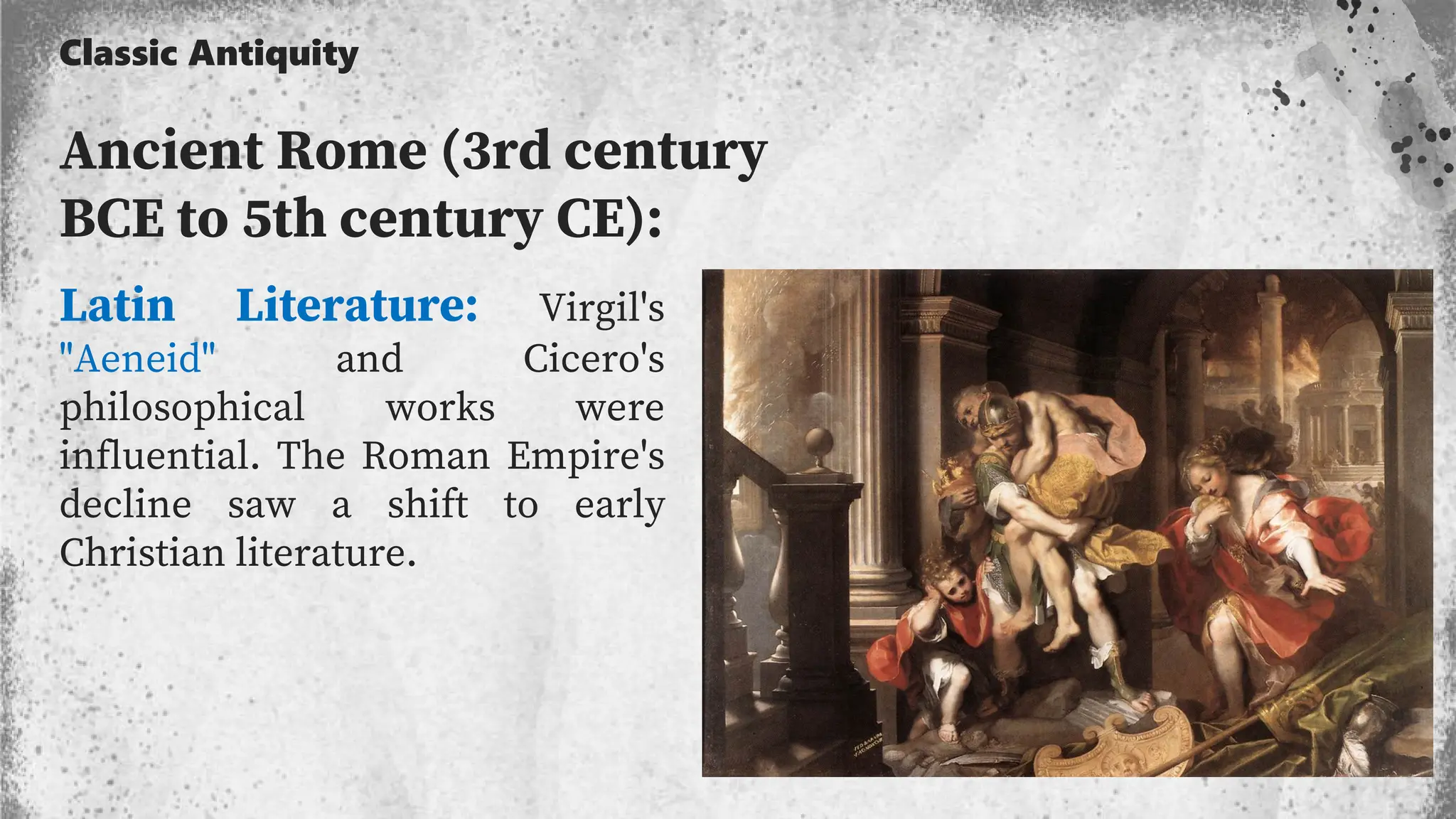
Latin Literature: Virgil's
"Aeneid" and Cicero's
philosophical works were
influential. The Roman Empire's
decline saw a shift to early
Christian literature.
Historical Roots of Literature
Medieval Literature (5th to 15th century):
Early Christian Literature (3rd to 7th century):
Medieval Literature
Early Christian Literature
(3rd to 7th century):
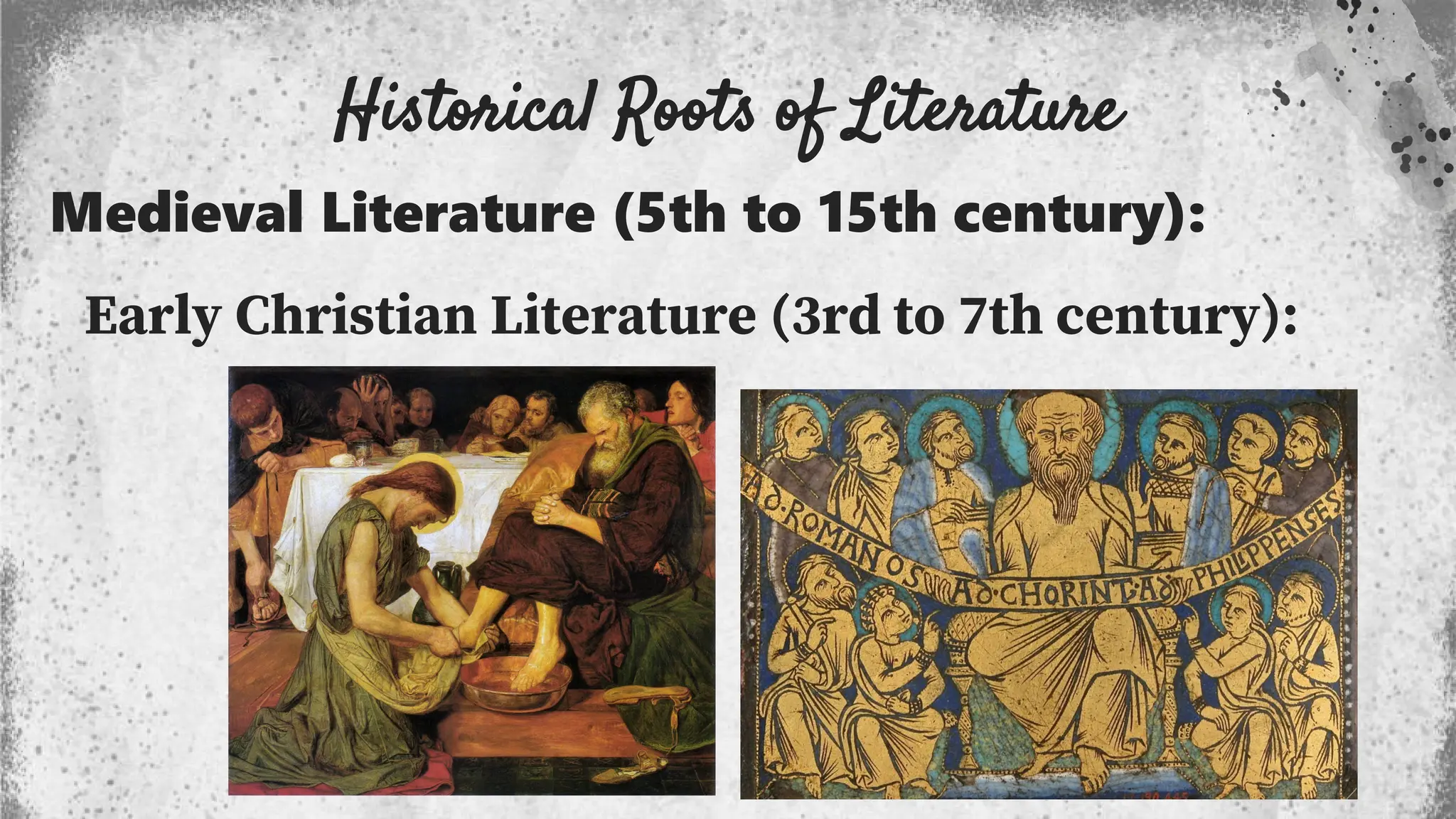
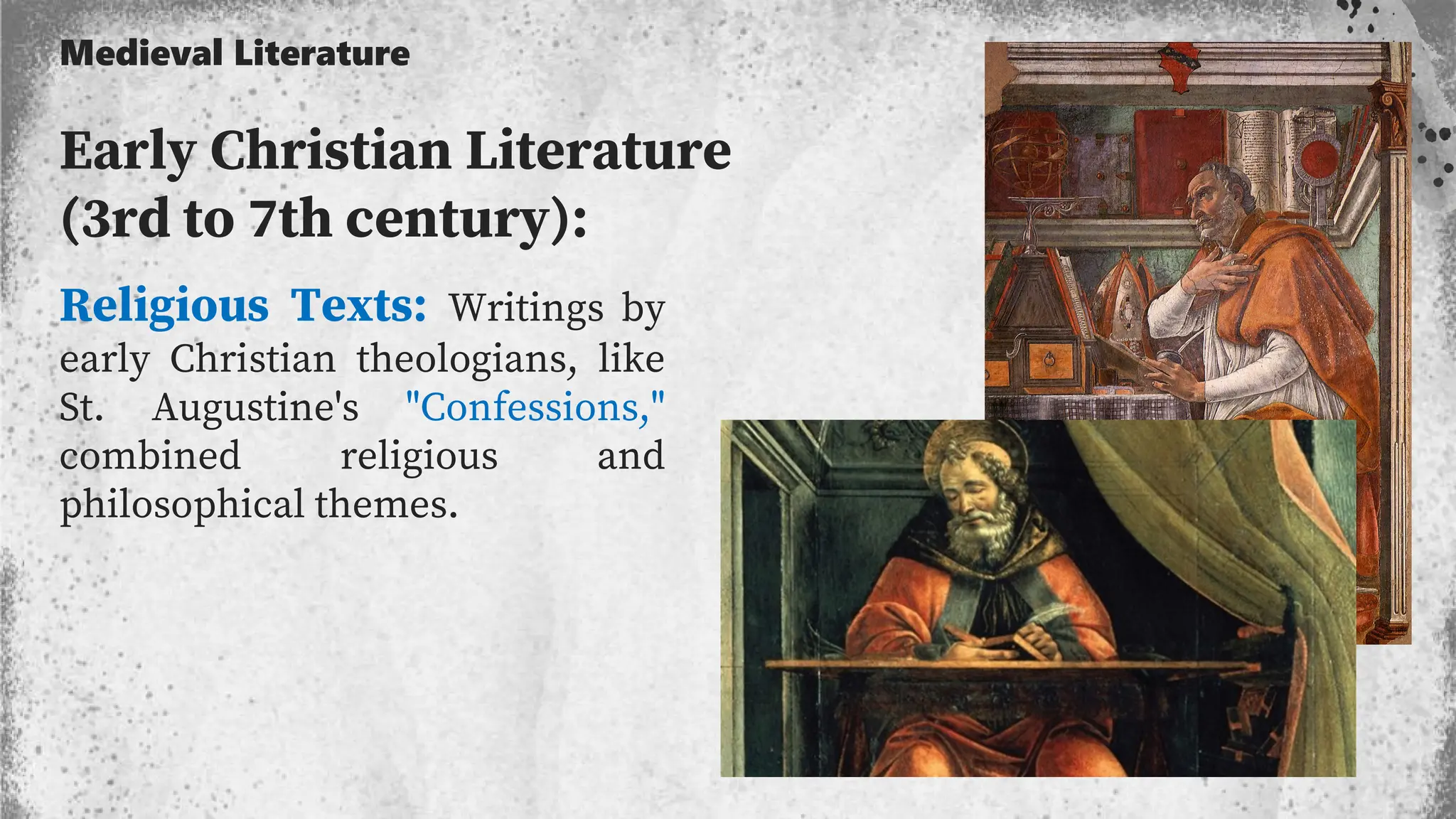
Religious Texts: Writings by
early Christian theologians, like
St. Augustine's "Confessions,"
combined religious and
philosophical themes.
Historical Roots of Literature
Medieval Literature (5th to 15th century):
Islamic Golden Age (8th to 14th century):
Medieval Literature
Islamic Golden Age (8th to
14th century):
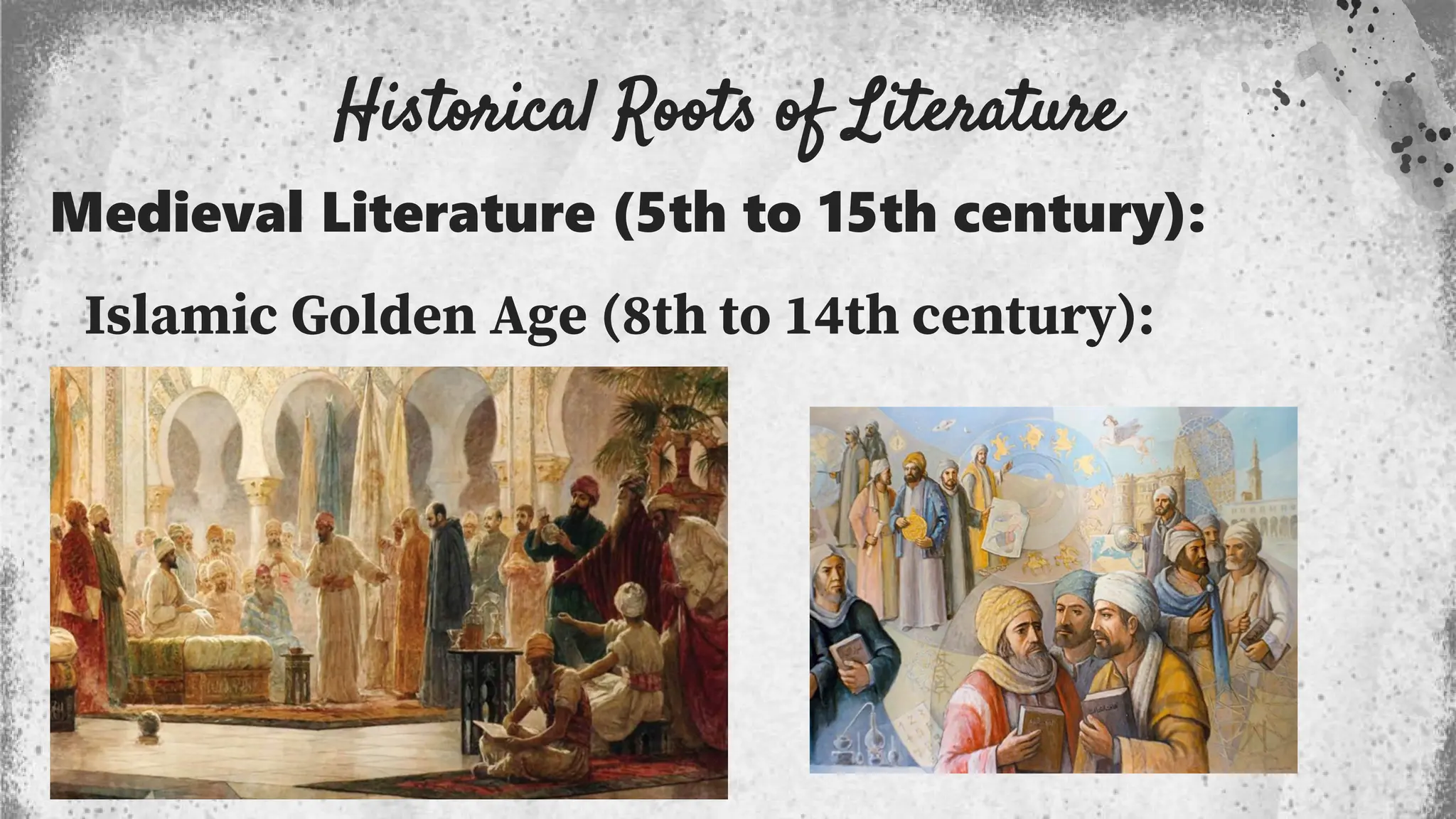
Arabic Literature: The
"Thousand and One Nights"
showcased Arabic storytelling.
Scholars translated Greek and
Roman works, preserving
classical knowledge.
Historical Roots of Literature
Renaissance and Early Modern Period
(14th to 18th century):
Italian Renaissance (14th to 17th century):
Renaissance and Early Modern Period
Italian Renaissance (14th to
17th century):
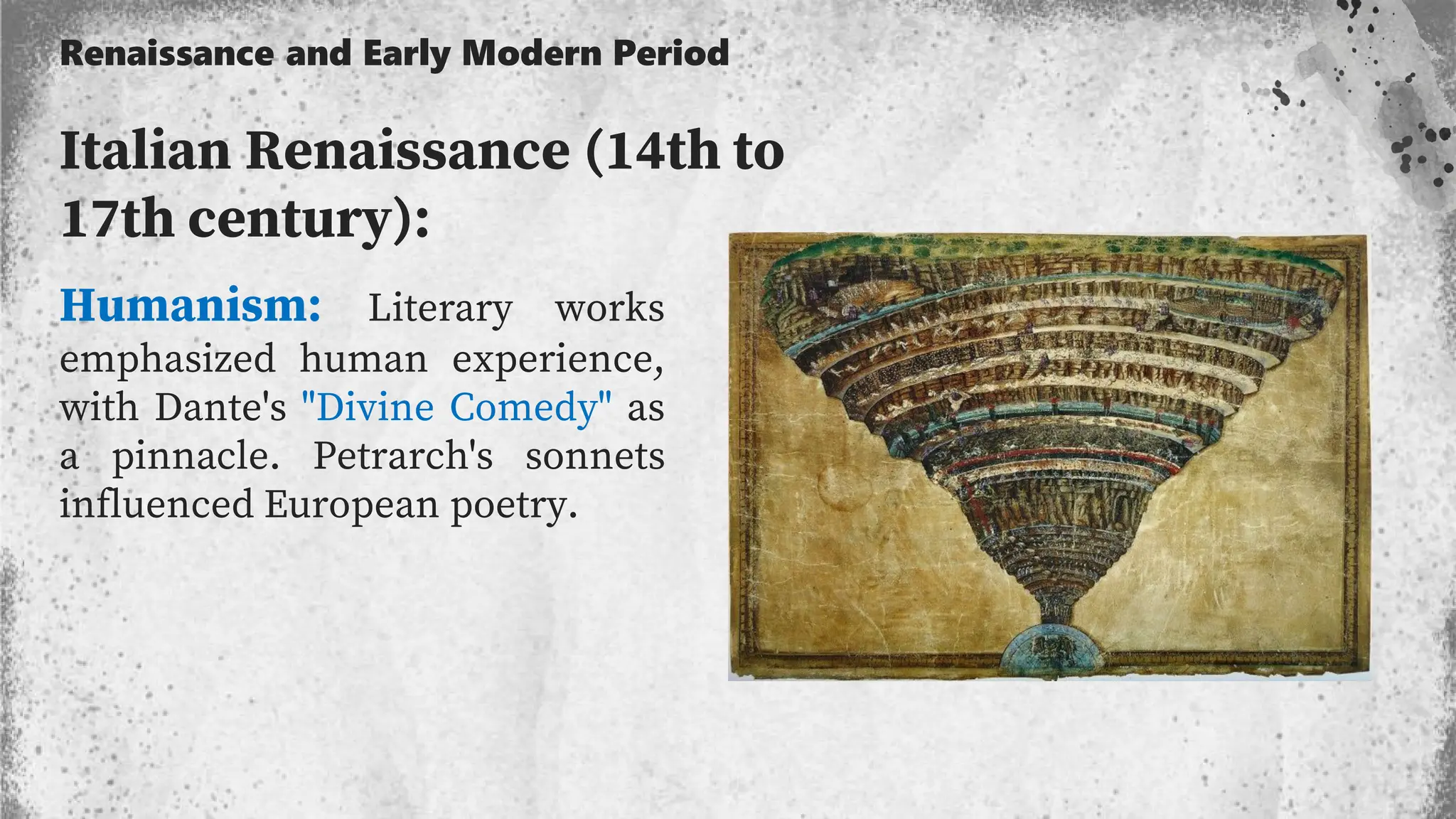
Humanism: Literary works
emphasized human experience,
with Dante's "Divine Comedy" as
a pinnacle. Petrarch's sonnets
influenced European poetry.
Historical Roots of Literature
Renaissance and Early Modern Period
(14th to 18th century):
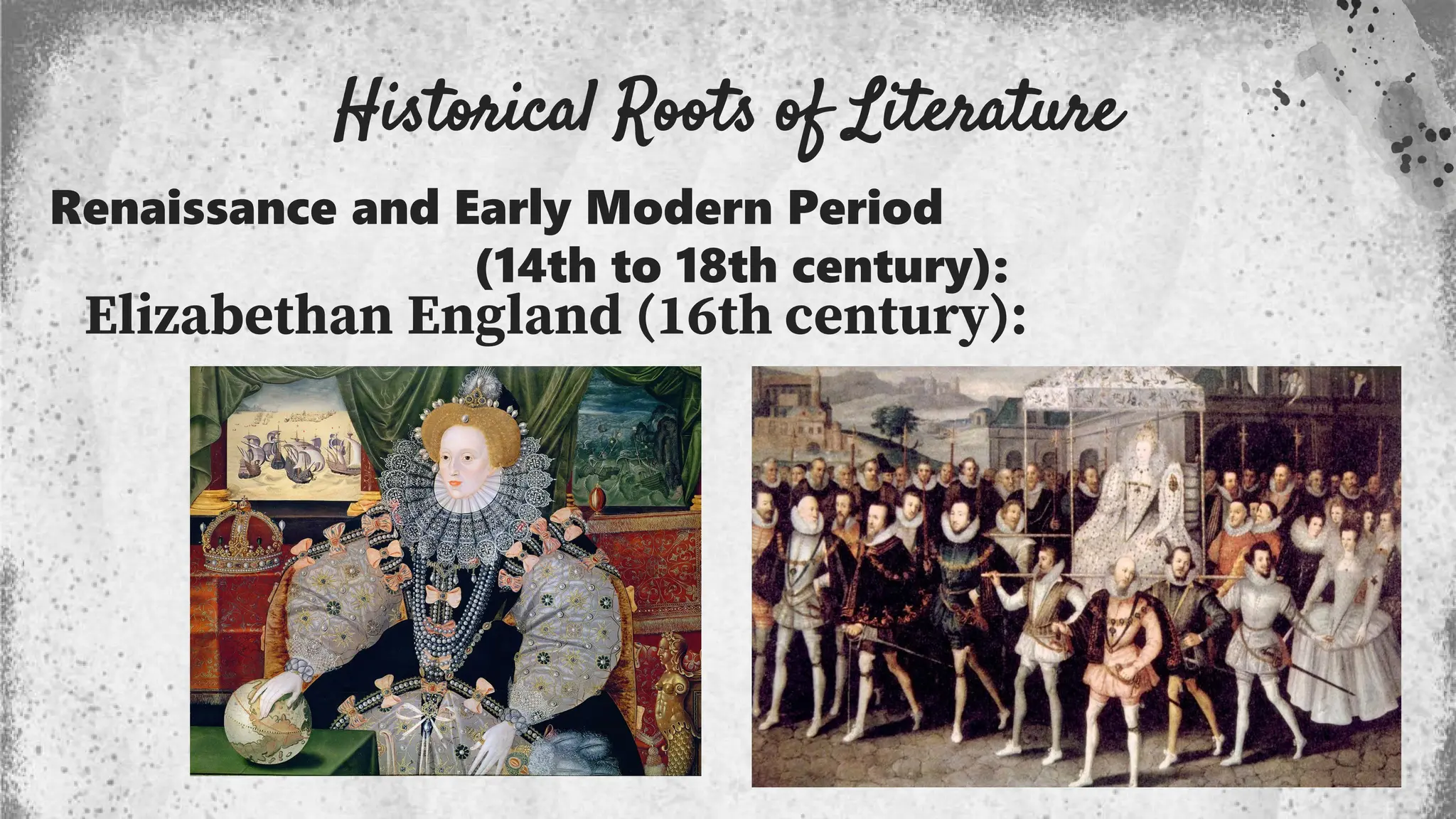
Elizabethan England (16th century):
Renaissance and Early Modern Period
Elizabethan England (16th
century):
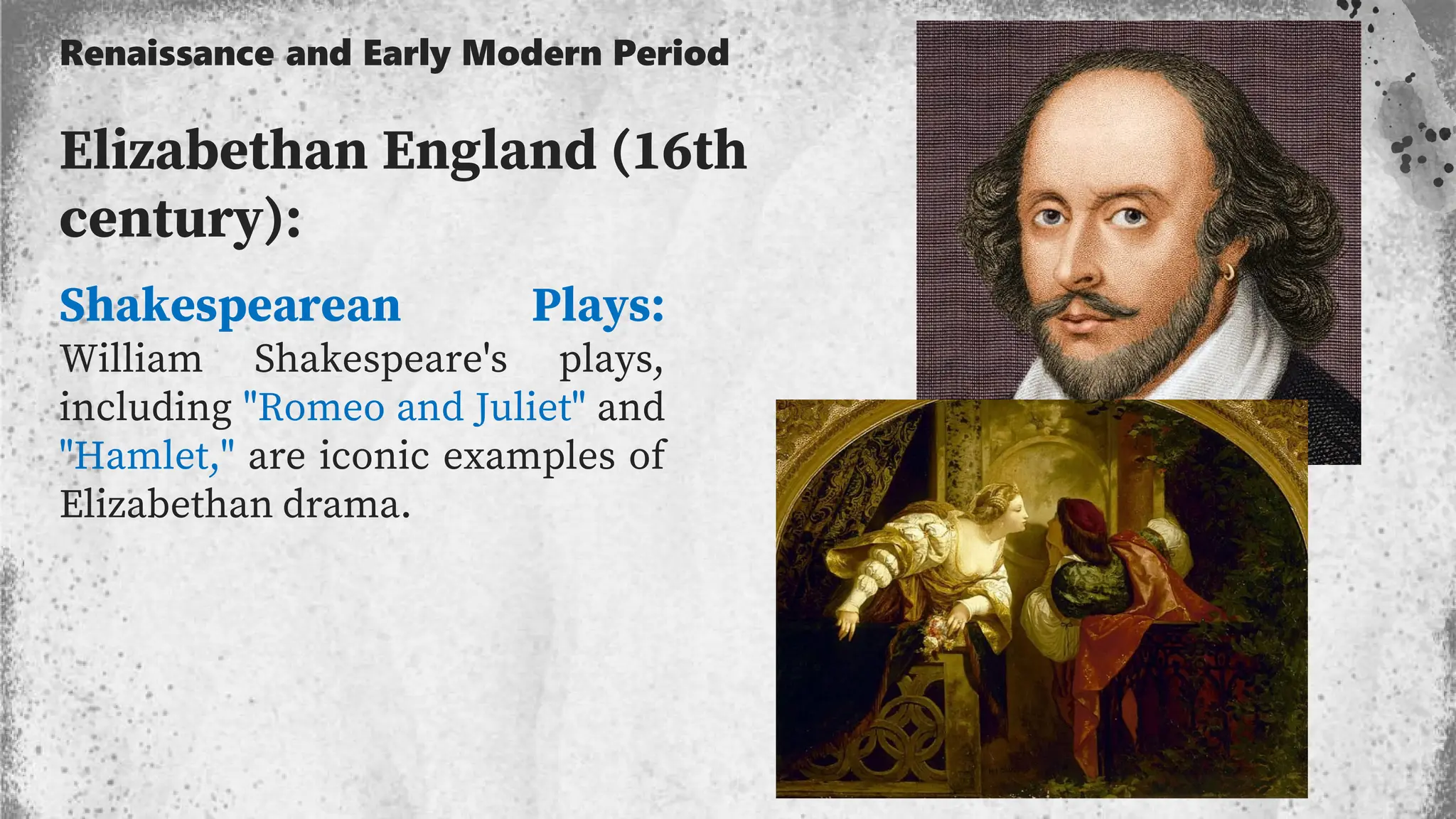
Shakespearean Plays:
William Shakespeare's plays,
including "Romeo and Juliet" and
"Hamlet," are iconic examples of
Elizabethan drama.
Historical Roots of Literature
Enlightenment and Romanticism (18th to 19th century):
Age of Enlightenment (17th to 18th century):
Enlightenment and Romanticism
Age of Enlightenment (17th
to 18th century):
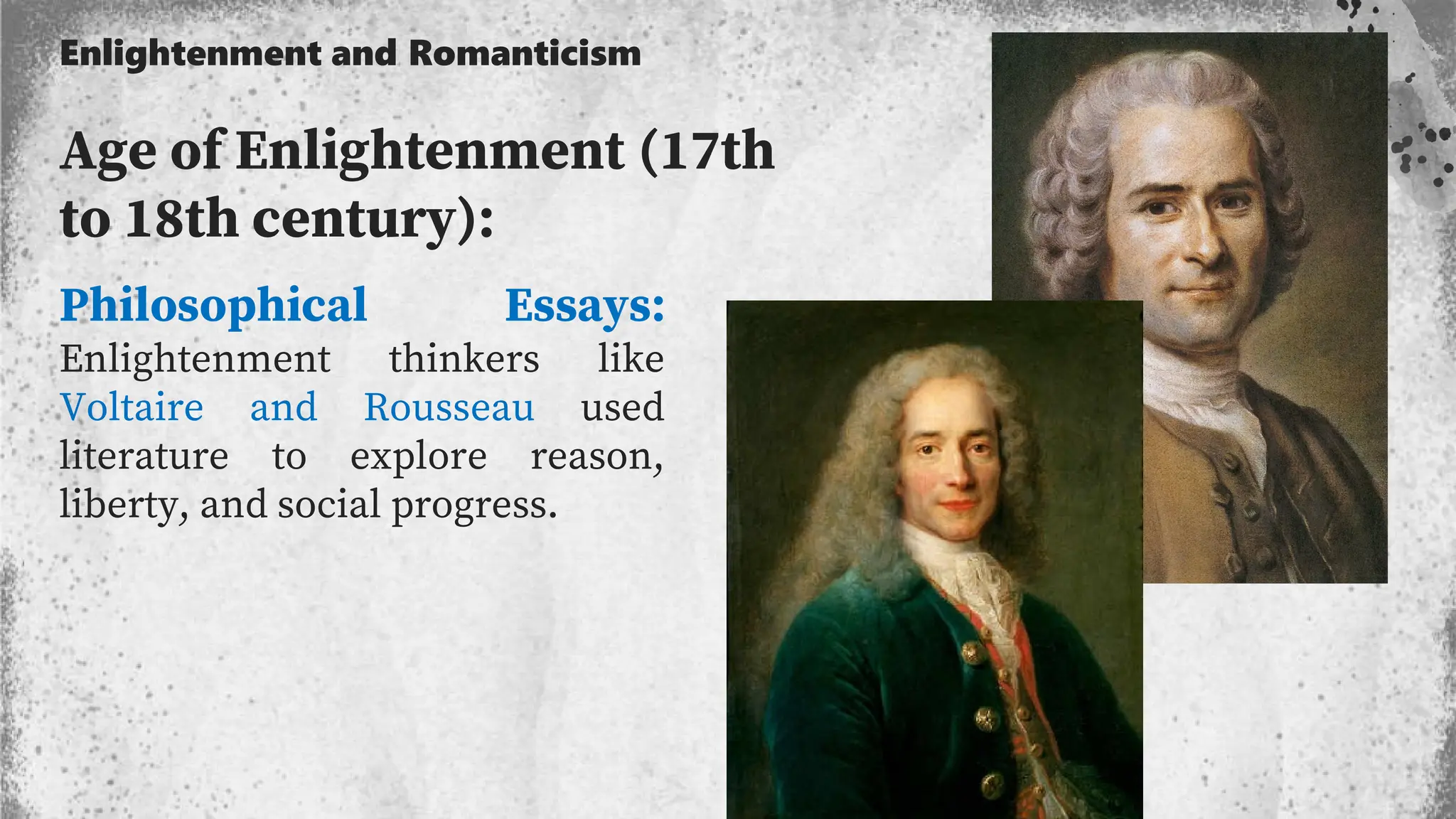
Philosophical Essays:
Enlightenment thinkers like
Voltaire and Rousseau used
literature to explore reason,
liberty, and social progress.
Historical Roots of Literature
Enlightenment and Romanticism (18th to 19th century):
Romantic Movement (late 18th to early 19th century):
Enlightenment and Romanticism
Romantic Movement (late
18th to early 19th century):
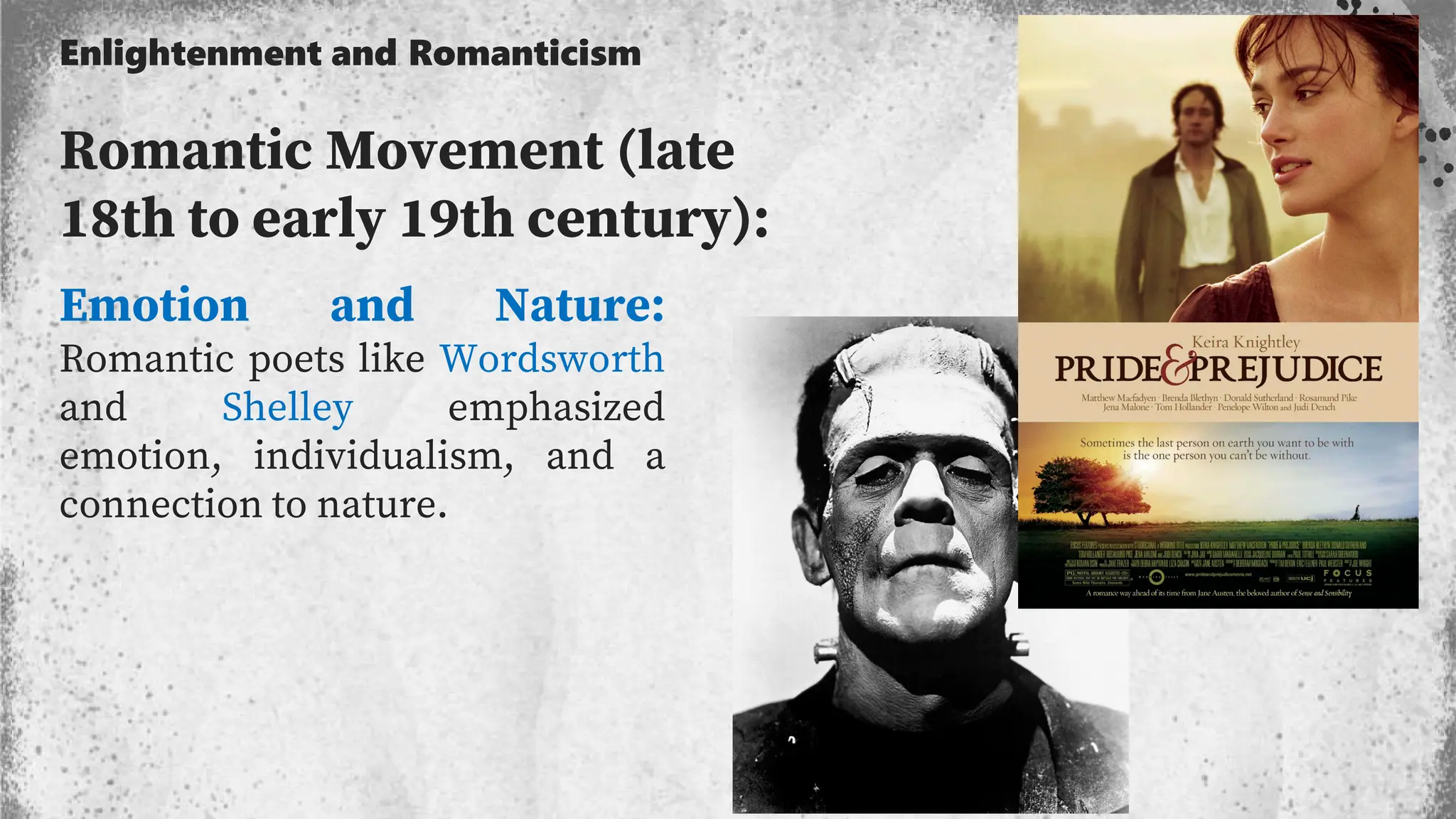
Emotion and Nature:
Romantic poets like Wordsworth
and Shelley emphasized
emotion, individualism, and a
connection to nature.
Historical Roots of Literature
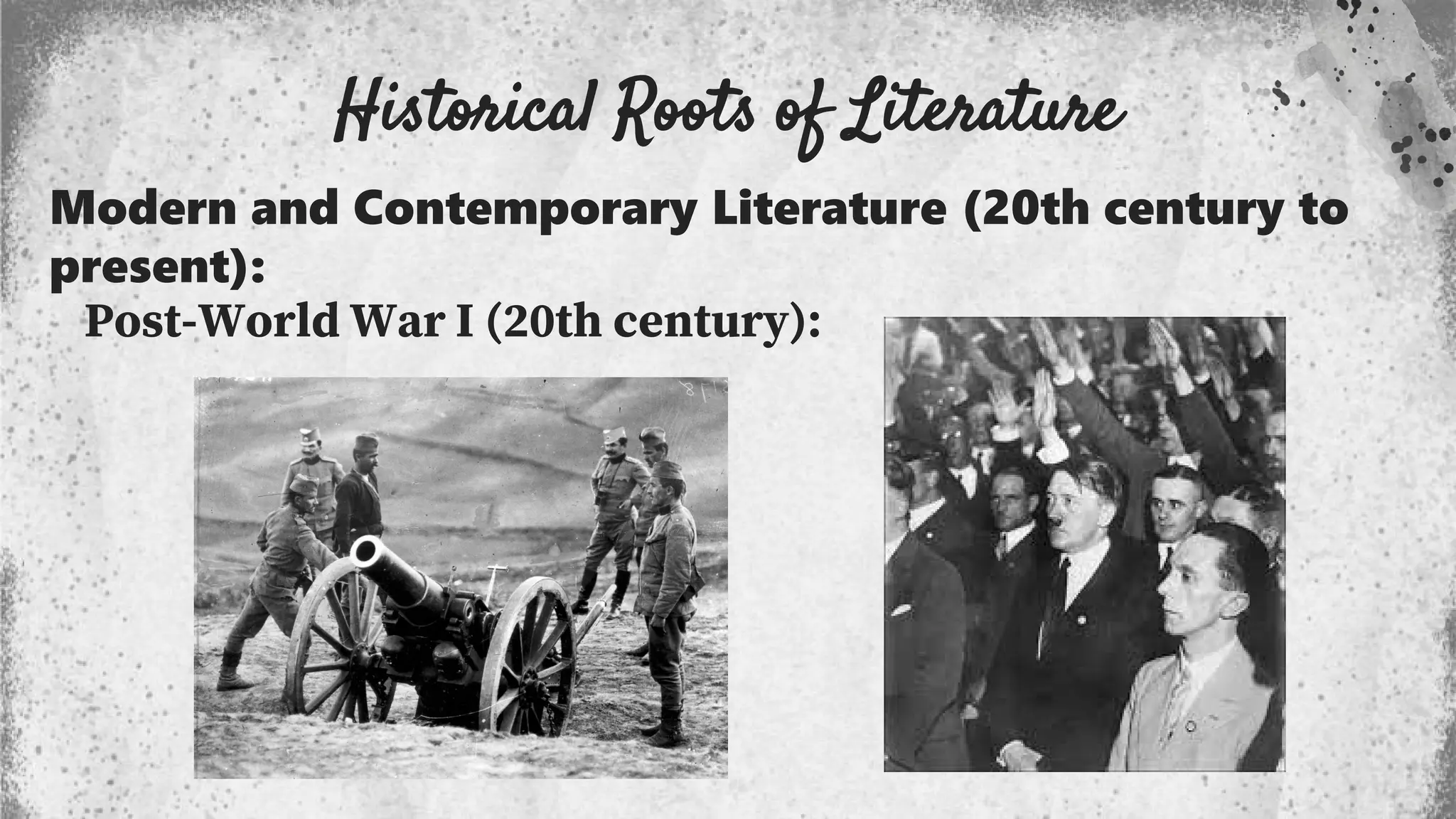
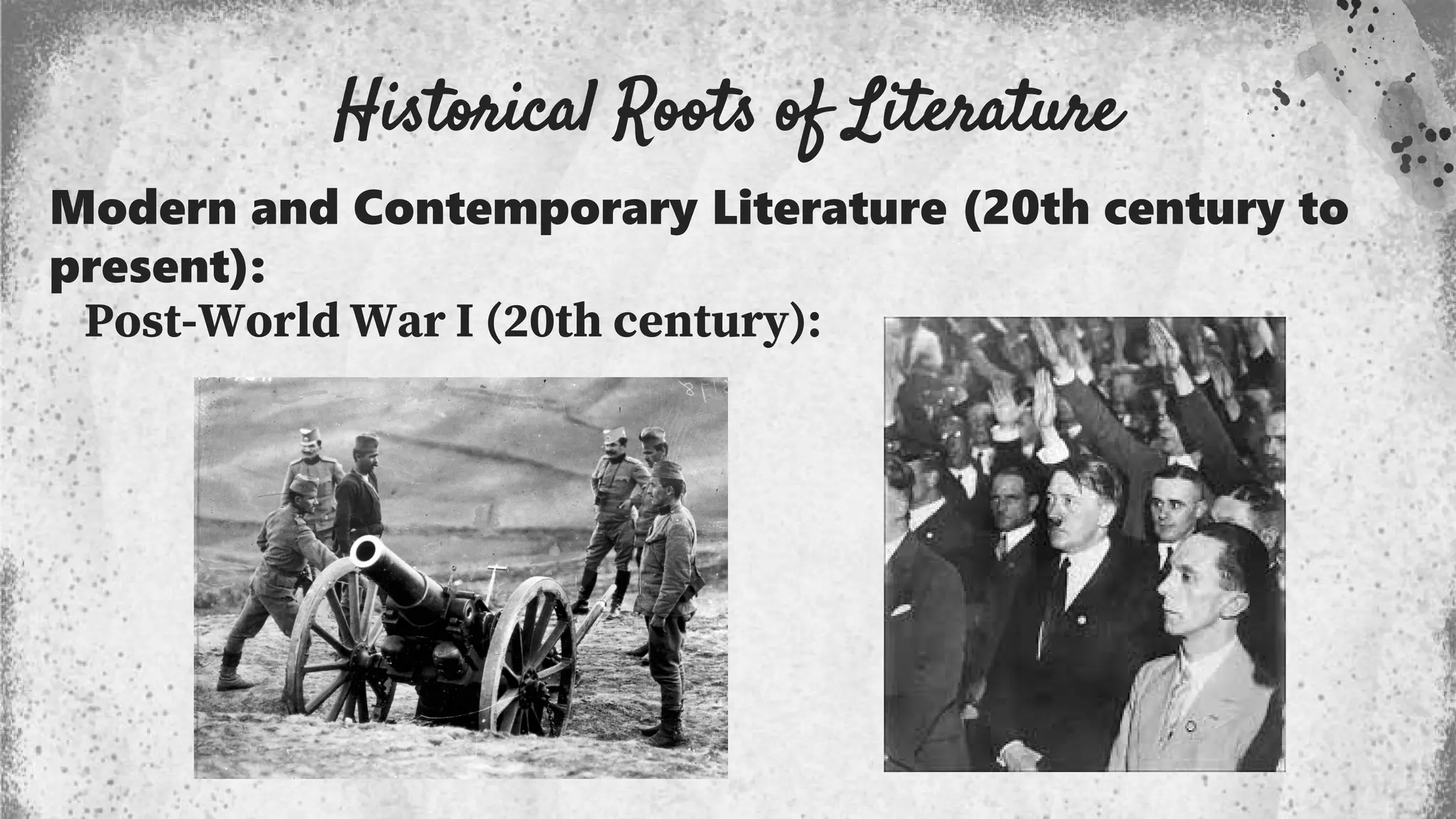
Modern and Contemporary Literature (20th century to
present):
Post-World War I (20th century):
Modern and Contemporary Literature
Post-World War I (20th
century):
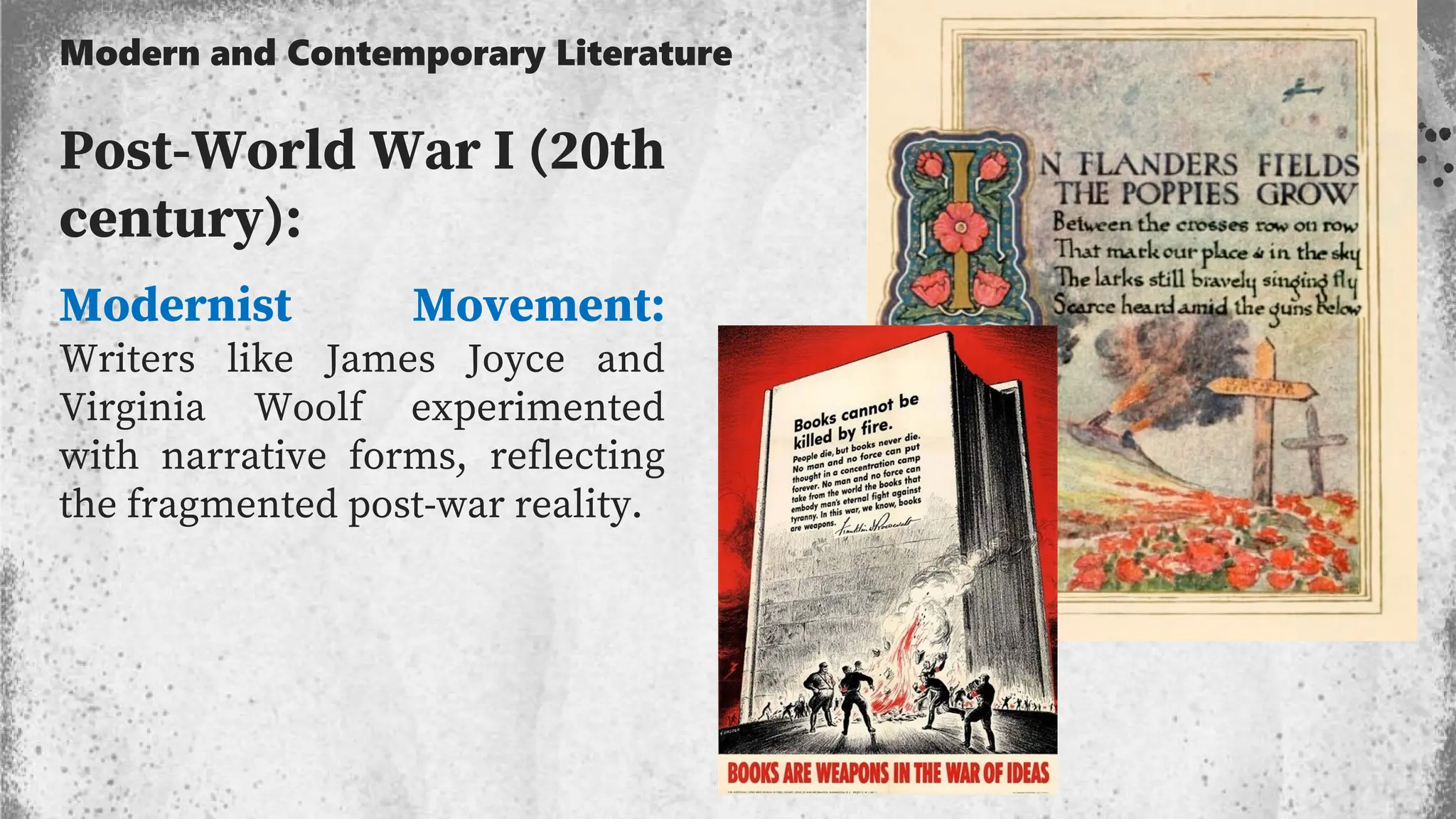
Modernist Movement:
Writers like James Joyce and
Virginia Woolf experimented
with narrative forms, reflecting
the fragmented post-war reality.
Historical Roots of Literature
Modern and Contemporary Literature (20th century to
present):
Post-World War I (20th century):
Modern and Contemporary Literature
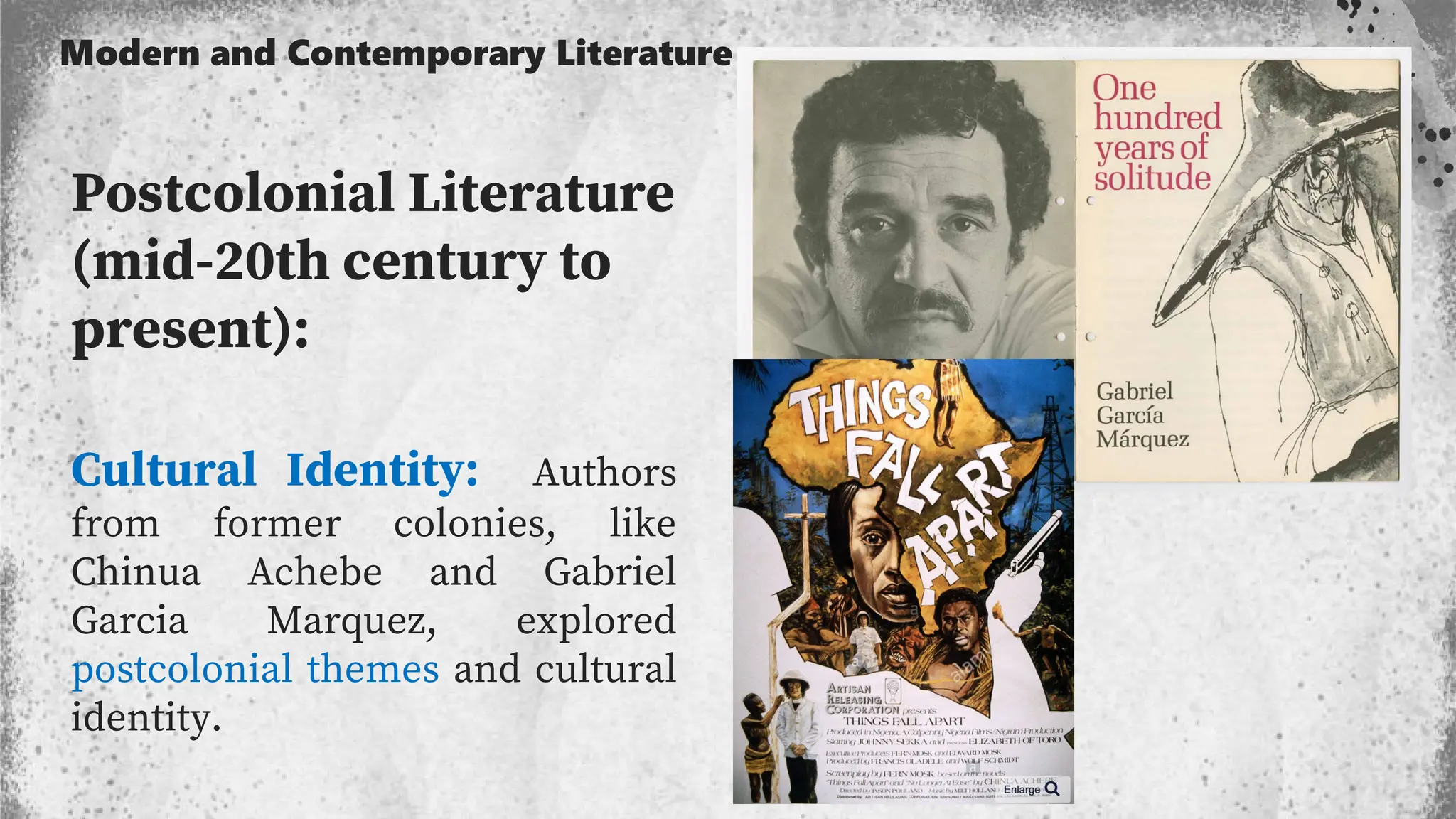
Postcolonial Literature
(mid-20th century to
present):
Cultural Identity: Authors
from former colonies, like
Chinua Achebe and Gabriel
Garcia Marquez, explored
postcolonial themes and cultural
identity.
This historical journey illustrates how
literature evolved alongside human
civilization, mirroring the shifting
cultural, philosophical, and societal
paradigms across the ages. Each era
contributed distinct literary styles
and themes, collectively shaping the
rich tapestry of world literature we
appreciate today.
Famous
Writers
Across the
World
United States of America
Mark Twain
(Samuel Langhorne
Clemens)
The Adventures of Tom Sawyer"
(1876)
Adventures of Huckleberry Finn"
(1885)
Mark Twain is renowned for his
wit and insight into human nature.
"The Adventures of Huckleberry
Finn" is considered one of the
greatest American novels and a
classic in the genre of American
literature.
United States of America
F. Scott Fitzgerald
"The Great Gatsby"
(1925)
"The Great Gatsby" is a
masterpiece of the Roaring
Twenties, exploring themes of
wealth, love, and the
American Dream. It is widely
regarded as one of the
greatest American novels.
United States of America
Ernest Hemingway
The Old Man and the Sea"
(1952)
"A Farewell to Arms" (1929)
Hemingway's succinct prose and
focus on the human condition make
his works enduring. "The Old Man
and the Sea" won the Pulitzer Prize
and Nobel Prize for Literature.
United States of America
Jerome David Salinger
“The Catcher in the Rye" (1951)
"The Catcher in the Rye" is a
classic of adolescent alienation.
Holden Caulfield's voice has
resonated with readers, making it
a significant work in American
literature.
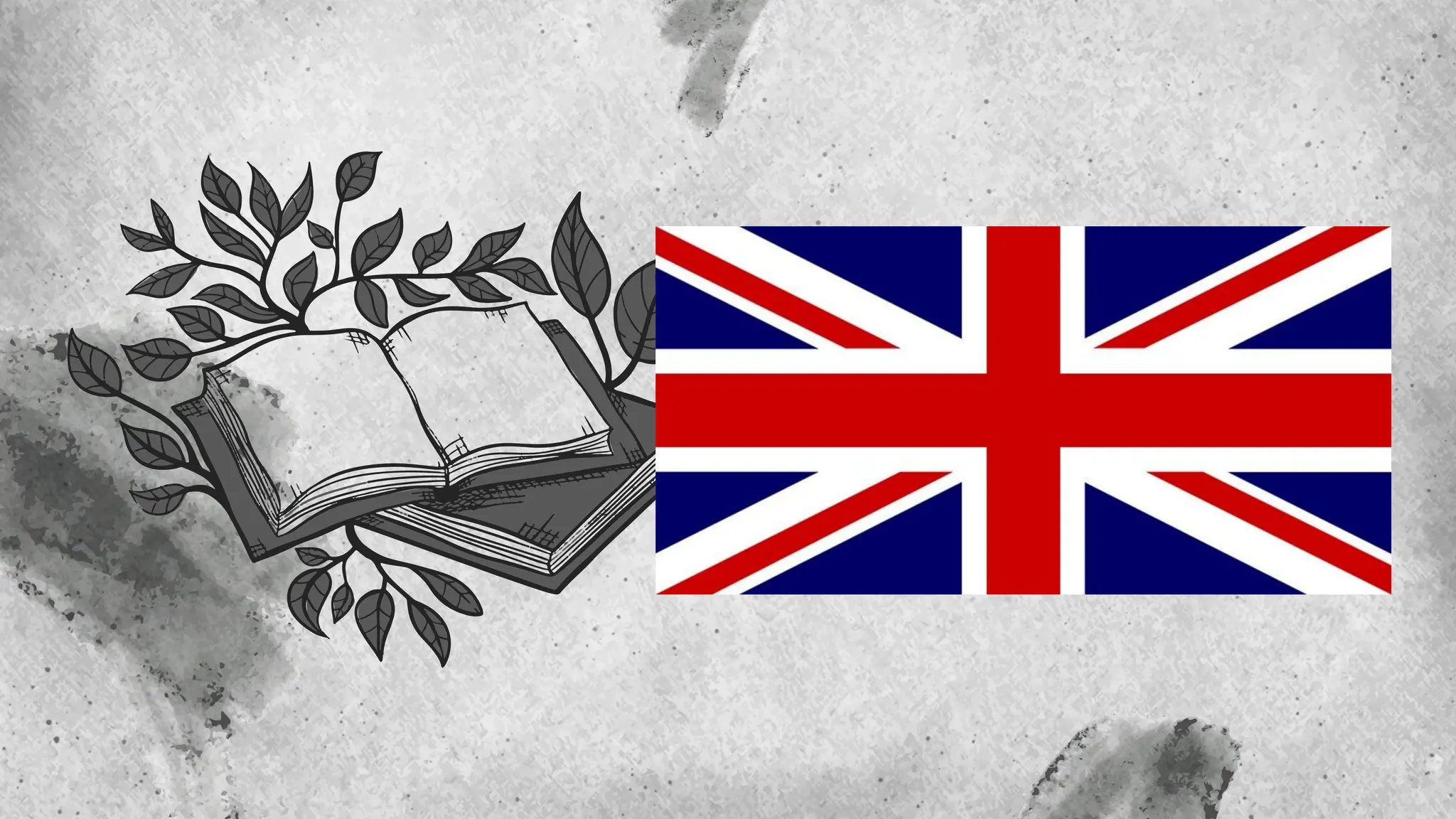
United Kingdom
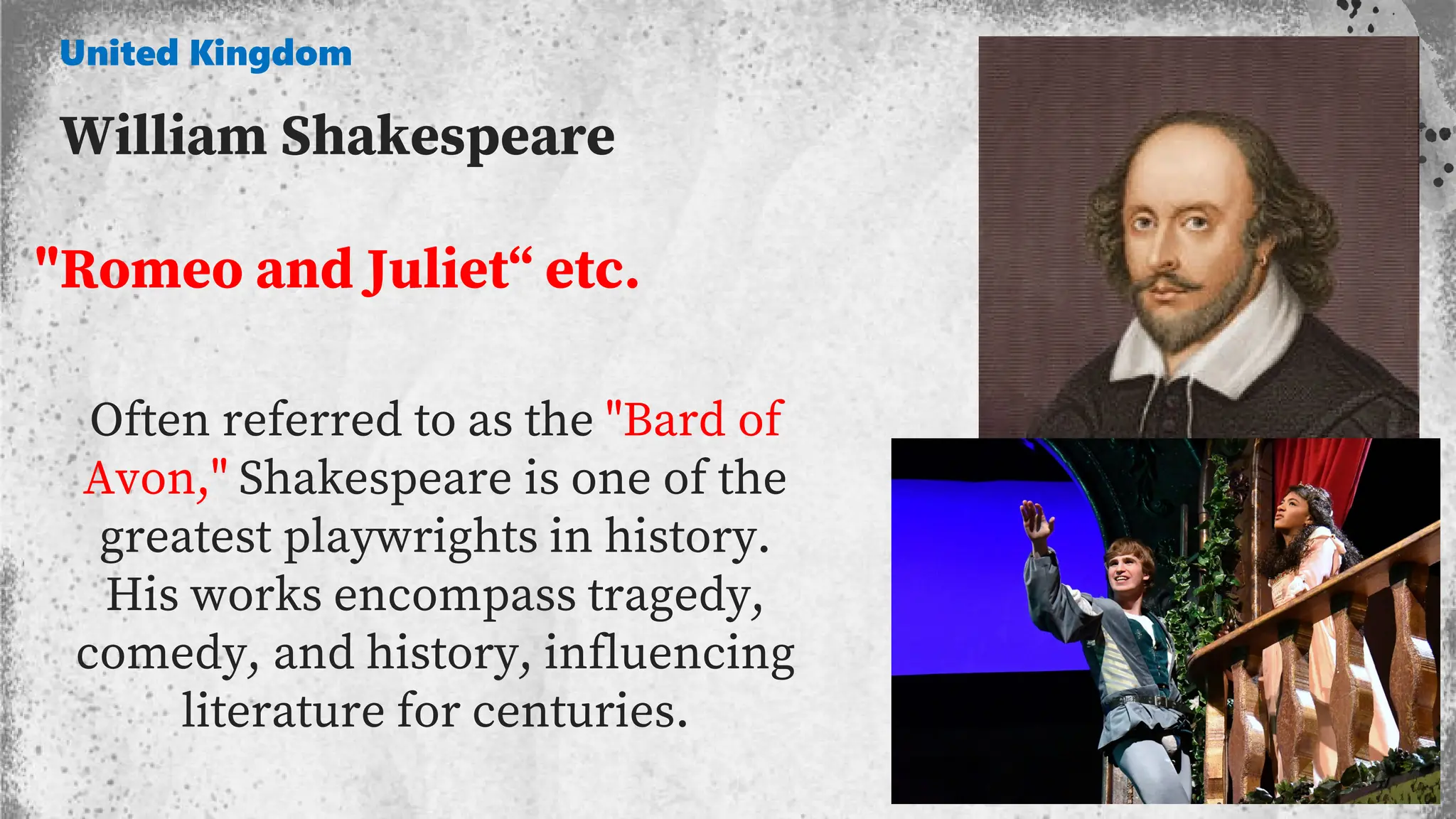
William Shakespeare
"Romeo and Juliet“ etc.
Often referred to as the "Bard of
Avon," Shakespeare is one of the
greatest playwrights in history.
His works encompass tragedy,
comedy, and history, influencing
literature for centuries.
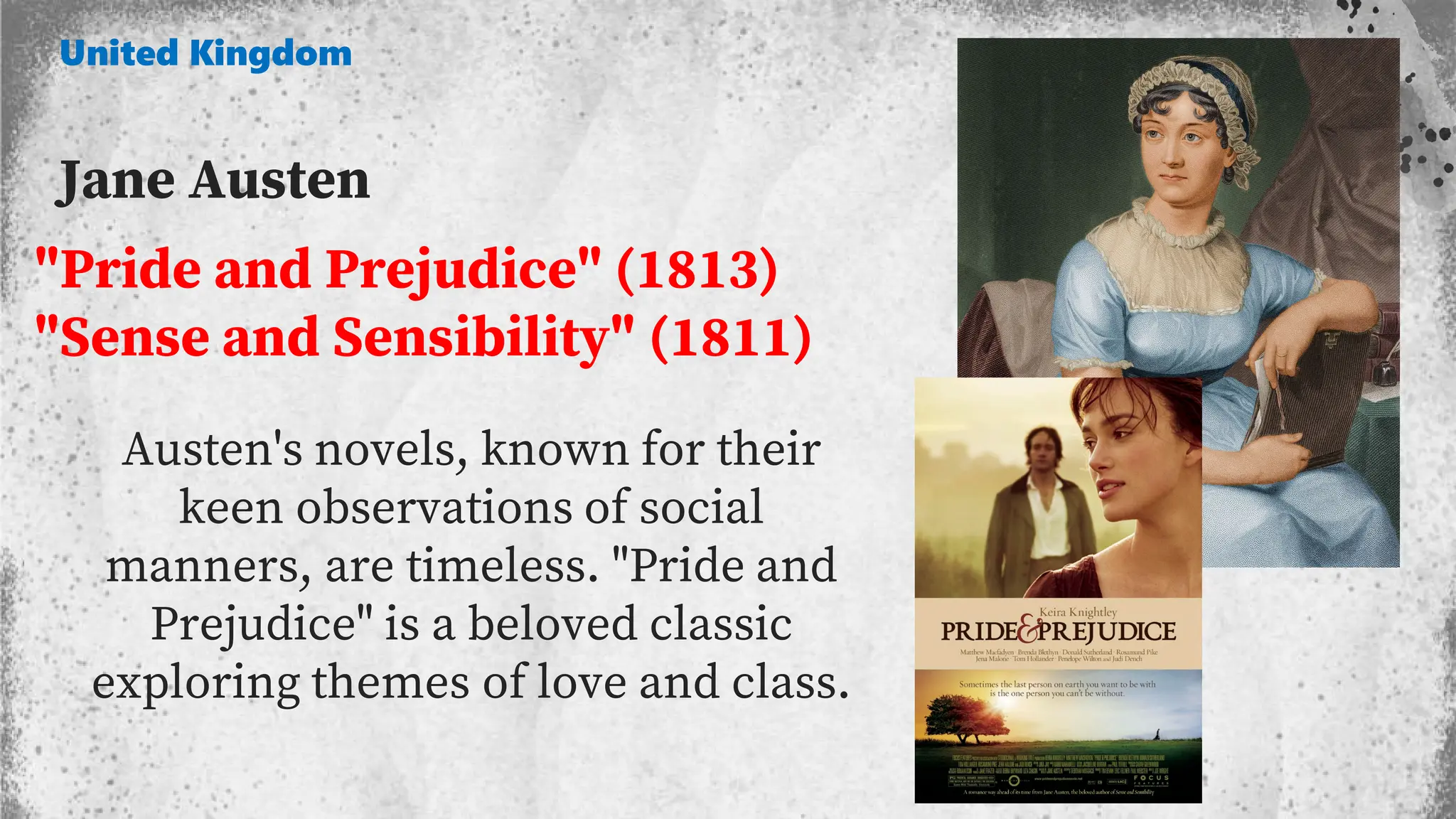
Jane Austen
Austen's novels, known for their
keen observations of social
manners, are timeless. "Pride and
Prejudice" is a beloved classic
exploring themes of love and class.
United Kingdom
"Pride and Prejudice" (1813)
"Sense and Sensibility" (1811)
Charles Dickens
Dickens is a master of character
and social commentary. "A Tale of
Two Cities" explores themes of
resurrection and sacrifice against
the backdrop of the French
Revolution.
United Kingdom
"A Tale of Two Cities" (1859)
"Great Expectations" (1861)
Geoffrey Chaucer
a collection of stories told by a
diverse group of pilgrims
traveling to the shrine of
Thomas Becket in Canterbury.
Chaucer, often referred to as the
"Father of English Literature,"
was a medieval English poet and
author
United Kingdom
The Canterbury Tales
Victor Hugo
A sprawling novel that follows the
lives of several characters in 19th-
century France, exploring themes
of justice, love, and redemption.
France
Les Misérables (1862)
The Hunchback of Notre Dame
Haruki Murakami
A coming-of-age novel that
explores themes of love,
loss, and the passage of
time, set against the
backdrop of 1960s Tokyo.
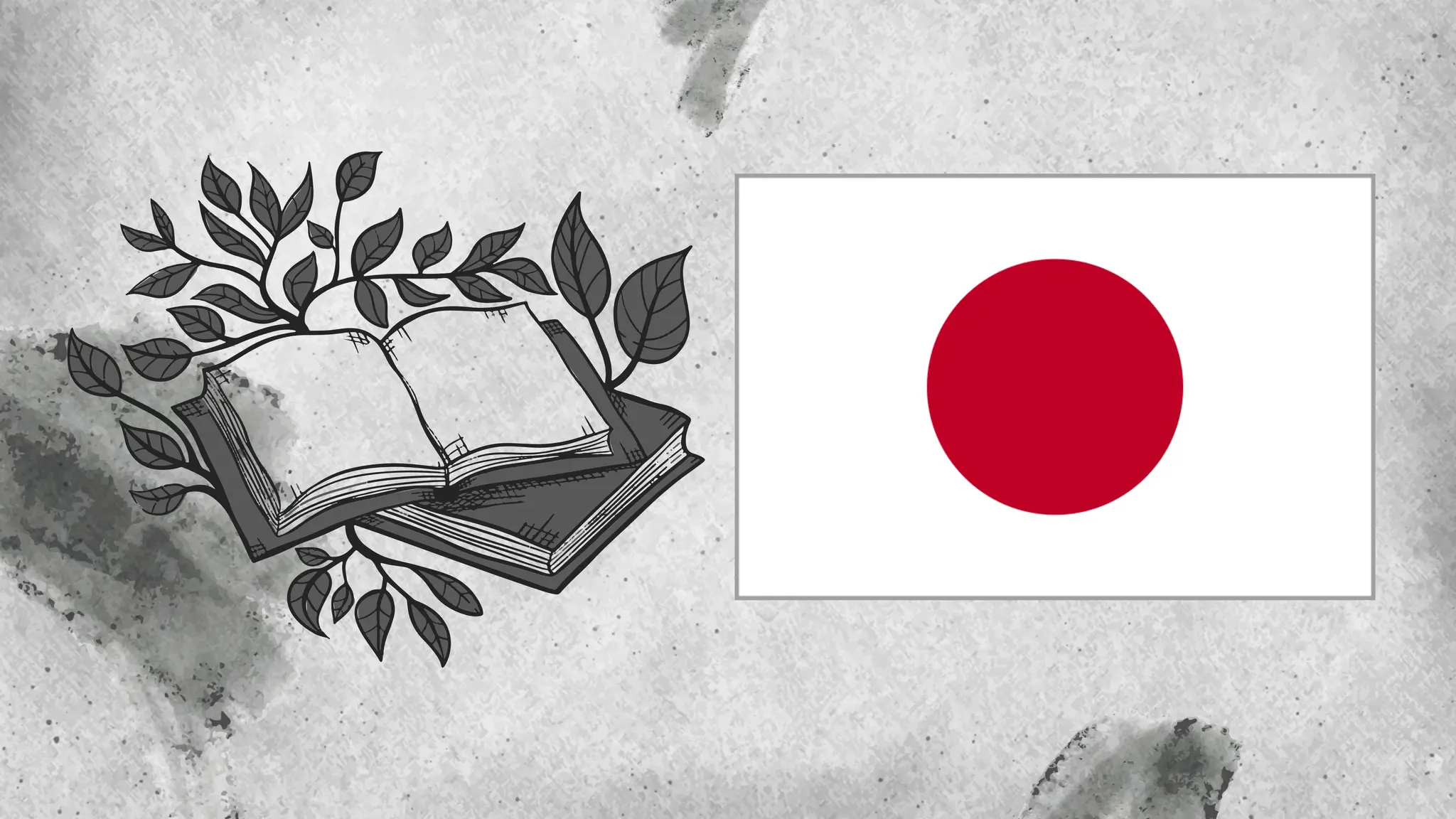
Japan
Norwegian Wood (ノルウェイの
森, Noruwei no Mori) (1987)
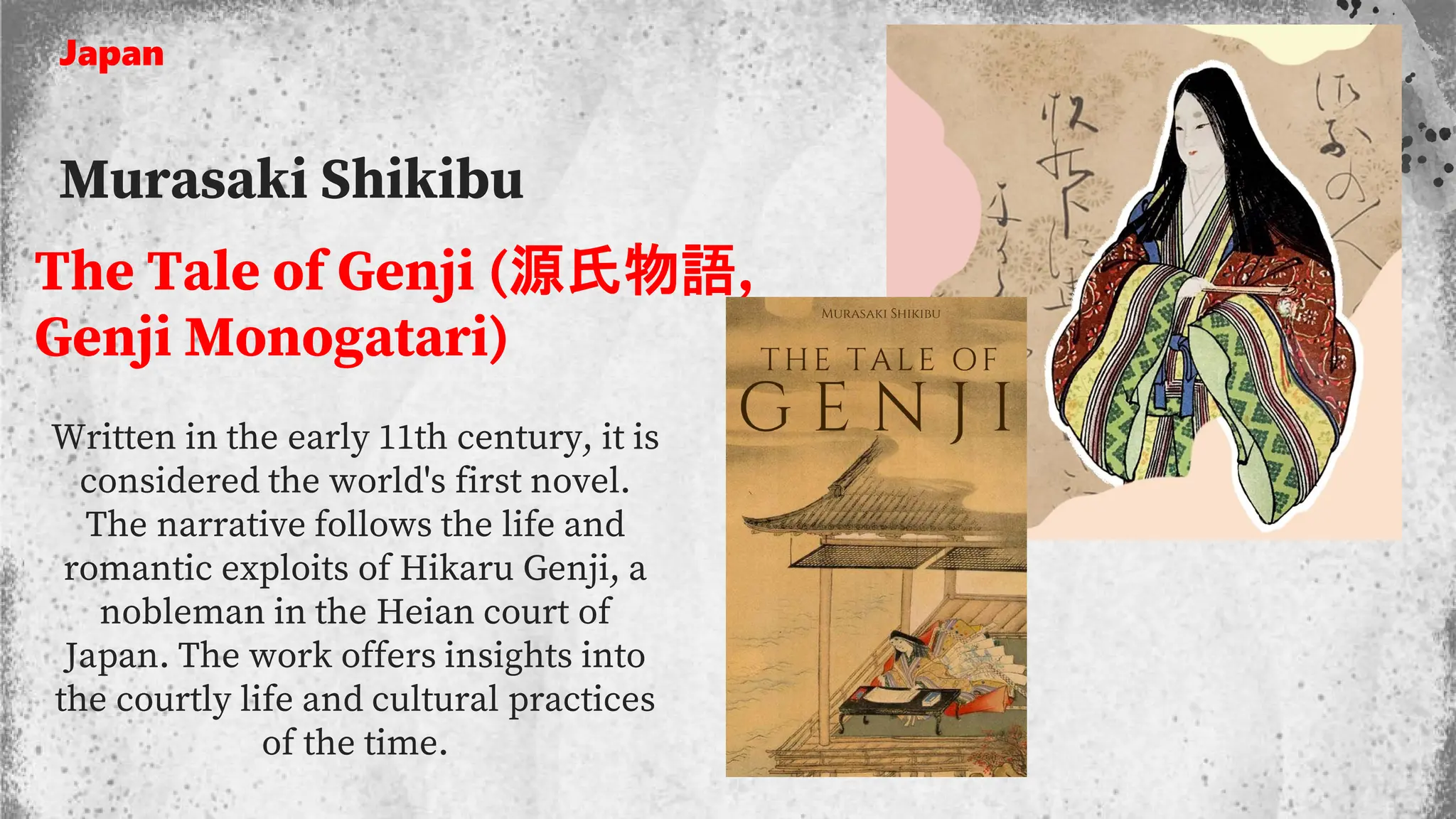
Murasaki Shikibu
Written in the early 11th century, it is
considered the world's first novel.
The narrative follows the life and
romantic exploits of Hikaru Genji, a
nobleman in the Heian court of
Japan. The work offers insights into
the courtly life and cultural practices
of the time.
Japan
The Tale of Genji (源氏物語,
Genji Monogatari)
Rabindranath Tagore
(1861–1941)
Tagore was a poet, philosopher, and the
first non-European to be awarded the
Nobel Prize in Literature. "Gitanjali" is a
collection of poems that reflects his
spiritual and philosophical insights.
India
"Gitanjali" (Song Offerings)
Lu Xun (1881–1936)
Lu Xun is considered one of the most
influential modern Chinese writers. "The
True Story of Ah Q" is a satirical novella
that critiques traditional Chinese society
and the problems of the early 20th century.
China
"The True Story of Ah Q"
Chinue Achebe
"Things Fall Apart" is a seminal work in
African literature. It tells the story of
Okonkwo, an Igbo warrior, and explores
the effects of British colonialism on
traditional African society.
Nigeria
Things Fall Apart
Wole Soyinka (1934–)
Soyinka, a playwright and poet, was the
first African to be awarded a Nobel Prize
in Literature. "A Dance of the Forests" is
one of his early plays, and his works
often explore themes of political
oppression and cultural identity.
Nigeria
“A Dance of the Forests"
Dante Alighieri (1265–
1321)
Dante's "The Divine Comedy" is an epic
poem that consists of three parts: "Inferno"
(Hell), "Purgatorio" (Purgatory), and
"Paradiso" (Paradise). The poem is a
journey through the afterlife, guided by the
Roman poet Virgil. It's considered a
masterpiece of world literature and a
fundamental work in Italian literature.
Italia
"The Divine Comedy" ("La
Divina Commedia")
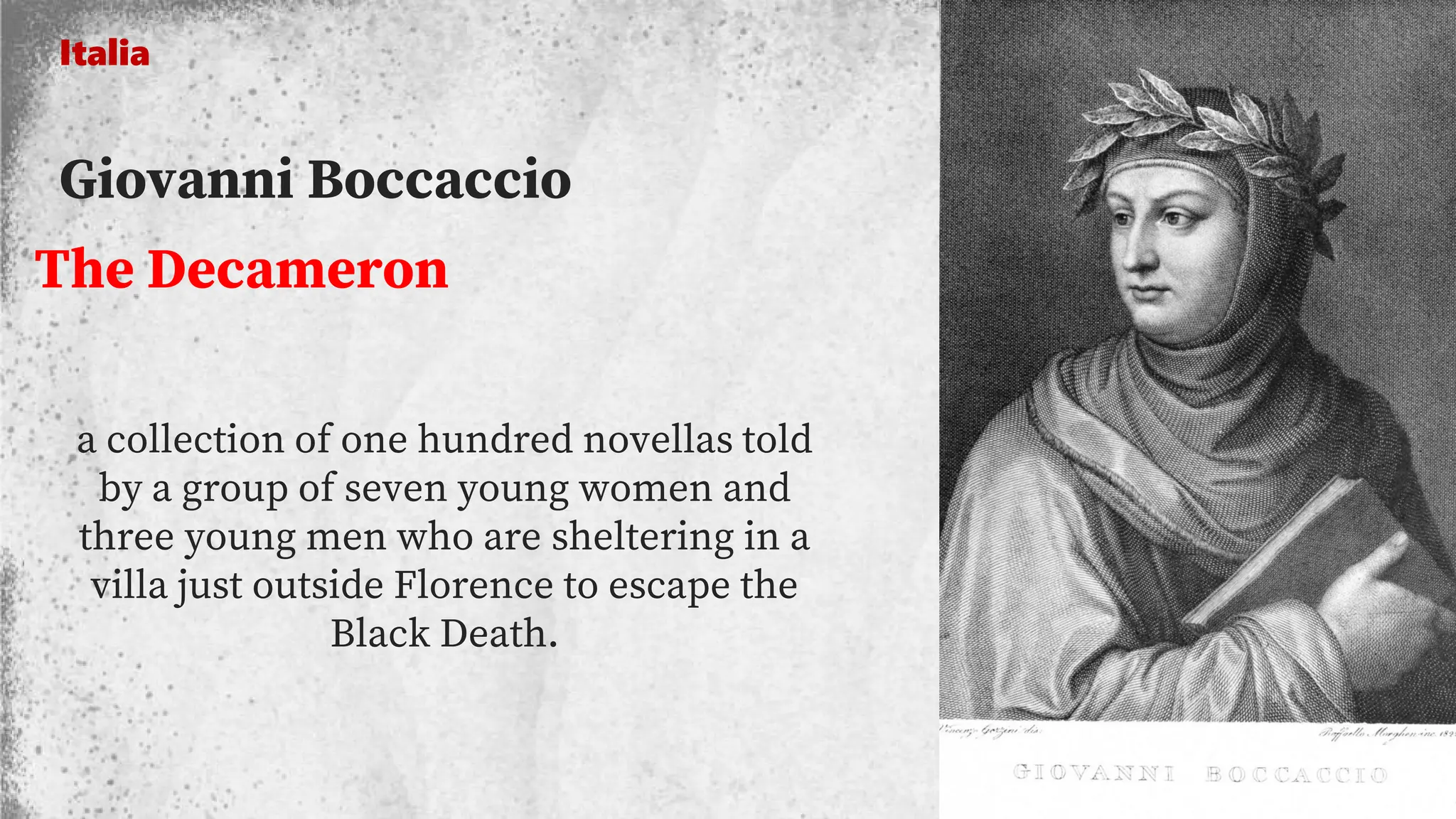
Giovanni Boccaccio
a collection of one hundred novellas told
by a group of seven young women and
three young men who are sheltering in a
villa just outside Florence to escape the
Black Death.
Italia
The Decameron
Leo Tolstoy
Leo Tolstoy, a renowned Russian author,
is best known for his epic novels "War
and Peace" and "Anna Karenina,"
exploring themes of morality, spirituality,
and the human condition in the 19th-
century Russian society.
Russia
War and Peace
Ana Karenina
Fyodor Dostoevsky
Dostoevsky (1821-1881) was a Russian
novelist and philosopher whose works
often delved into the complexities of
human psychology, morality, and
existentialism, making him one of the
most influential figures in world
literature.
Russia
Crime and Punishment
The Brothers Karamazov
Gabriel García Márquez
Gabriel García Márquez, born in 1927, is
one of the most influential and celebrated
authors in the world, known for his
contribution to the literary movement of
magical realism. His writing often
combines everyday events with fantastical
elements, blurring the lines between
reality and fantasy.
Columbia
One Hundred Years of Solitude
(Cien años de soledad)
21st Century
Contemporary
Writers
WORLD LITERATURE
WORLD LITERATURE
WORLD LITERATURE
WORLD LITERATURE
WORLD LITERATURE
WORLD LITERATURE
WORLD LITERATURE
WORLD LITERATURE
WORLD LITERATURE

WORLD LITERATURE

  • 1.
    Literature of the World 21stCentury Literature
  • 2.
  • 3.
    Literature of the World Worldliterature refers to writings and stories that come from various parts of the world, representing different cultures, perspectives, and experiences.
  • 4.
    Literature is apowerful means of conveying ideas, emotions, and cultural perspectives. It plays a significant role in shaping societies and connecting people across time and place. World Literature
  • 5.
    Historical Roots ofLiterature Ancient Civilization 1. Mesopotamia (circa 3500 BCE)
  • 6.
    Ancient Civilization 1. Mesopotamia(circa 3500 BCE) Cuneiform Writing: The Sumerians in Mesopotamia developed cuneiform script, one of the earliest known writing systems. Early writings on clay tablets included epic tales like the "Epic of Gilgamesh," providing insights into their beliefs and values.
  • 7.
    Historical Roots ofLiterature Ancient Civilization 2. Ancient Egypt (circa 3100 BCE):
  • 8.
    Ancient Civilization 2. AncientEgypt (circa 3100 BCE): Hieroglyphics: Egyptians used hieroglyphics to record religious texts, administrative information, and stories. The "Book of the Dead" is a notable example, reflecting beliefs about the afterlife.
  • 9.
    Historical Roots ofLiterature Classic Antiquity: Ancient Greece (8th to 4th century BCE):
  • 10.
    Classic Antiquity Ancient Greece(8th to 4th century BCE): Epics and Drama: Homer's "Iliad" and "Odyssey" set the stage for Greek literature. Tragedies and comedies by playwrights like Sophocles and Aristophanes became central to cultural expression.
  • 11.
    Historical Roots ofLiterature Classic Antiquity: Ancient Rome (3rd century BCE to 5th century CE):
  • 12.
    Classic Antiquity Ancient Rome(3rd century BCE to 5th century CE): Latin Literature: Virgil's "Aeneid" and Cicero's philosophical works were influential. The Roman Empire's decline saw a shift to early Christian literature.
  • 13.
    Historical Roots ofLiterature Medieval Literature (5th to 15th century): Early Christian Literature (3rd to 7th century):
  • 14.
    Medieval Literature Early ChristianLiterature (3rd to 7th century): Religious Texts: Writings by early Christian theologians, like St. Augustine's "Confessions," combined religious and philosophical themes.
  • 15.
    Historical Roots ofLiterature Medieval Literature (5th to 15th century): Islamic Golden Age (8th to 14th century):
  • 16.
    Medieval Literature Islamic GoldenAge (8th to 14th century): Arabic Literature: The "Thousand and One Nights" showcased Arabic storytelling. Scholars translated Greek and Roman works, preserving classical knowledge.
  • 17.
    Historical Roots ofLiterature Renaissance and Early Modern Period (14th to 18th century): Italian Renaissance (14th to 17th century):
  • 18.
    Renaissance and EarlyModern Period Italian Renaissance (14th to 17th century): Humanism: Literary works emphasized human experience, with Dante's "Divine Comedy" as a pinnacle. Petrarch's sonnets influenced European poetry.
  • 19.
    Historical Roots ofLiterature Renaissance and Early Modern Period (14th to 18th century): Elizabethan England (16th century):
  • 20.
    Renaissance and EarlyModern Period Elizabethan England (16th century): Shakespearean Plays: William Shakespeare's plays, including "Romeo and Juliet" and "Hamlet," are iconic examples of Elizabethan drama.
  • 21.
    Historical Roots ofLiterature Enlightenment and Romanticism (18th to 19th century): Age of Enlightenment (17th to 18th century):
  • 22.
    Enlightenment and Romanticism Ageof Enlightenment (17th to 18th century): Philosophical Essays: Enlightenment thinkers like Voltaire and Rousseau used literature to explore reason, liberty, and social progress.
  • 23.
    Historical Roots ofLiterature Enlightenment and Romanticism (18th to 19th century): Romantic Movement (late 18th to early 19th century):
  • 24.
    Enlightenment and Romanticism RomanticMovement (late 18th to early 19th century): Emotion and Nature: Romantic poets like Wordsworth and Shelley emphasized emotion, individualism, and a connection to nature.
  • 25.
    Historical Roots ofLiterature Modern and Contemporary Literature (20th century to present): Post-World War I (20th century):
  • 26.
    Modern and ContemporaryLiterature Post-World War I (20th century): Modernist Movement: Writers like James Joyce and Virginia Woolf experimented with narrative forms, reflecting the fragmented post-war reality.
  • 27.
    Historical Roots ofLiterature Modern and Contemporary Literature (20th century to present): Post-World War I (20th century):
  • 28.
    Modern and ContemporaryLiterature Postcolonial Literature (mid-20th century to present): Cultural Identity: Authors from former colonies, like Chinua Achebe and Gabriel Garcia Marquez, explored postcolonial themes and cultural identity.
  • 29.
    This historical journeyillustrates how literature evolved alongside human civilization, mirroring the shifting cultural, philosophical, and societal paradigms across the ages. Each era contributed distinct literary styles and themes, collectively shaping the rich tapestry of world literature we appreciate today.
  • 30.
  • 32.
    United States ofAmerica Mark Twain (Samuel Langhorne Clemens) The Adventures of Tom Sawyer" (1876) Adventures of Huckleberry Finn" (1885) Mark Twain is renowned for his wit and insight into human nature. "The Adventures of Huckleberry Finn" is considered one of the greatest American novels and a classic in the genre of American literature.
  • 33.
    United States ofAmerica F. Scott Fitzgerald "The Great Gatsby" (1925) "The Great Gatsby" is a masterpiece of the Roaring Twenties, exploring themes of wealth, love, and the American Dream. It is widely regarded as one of the greatest American novels.
  • 34.
    United States ofAmerica Ernest Hemingway The Old Man and the Sea" (1952) "A Farewell to Arms" (1929) Hemingway's succinct prose and focus on the human condition make his works enduring. "The Old Man and the Sea" won the Pulitzer Prize and Nobel Prize for Literature.
  • 35.
    United States ofAmerica Jerome David Salinger “The Catcher in the Rye" (1951) "The Catcher in the Rye" is a classic of adolescent alienation. Holden Caulfield's voice has resonated with readers, making it a significant work in American literature.
  • 37.
    United Kingdom William Shakespeare "Romeoand Juliet“ etc. Often referred to as the "Bard of Avon," Shakespeare is one of the greatest playwrights in history. His works encompass tragedy, comedy, and history, influencing literature for centuries.
  • 38.
    Jane Austen Austen's novels,known for their keen observations of social manners, are timeless. "Pride and Prejudice" is a beloved classic exploring themes of love and class. United Kingdom "Pride and Prejudice" (1813) "Sense and Sensibility" (1811)
  • 39.
    Charles Dickens Dickens isa master of character and social commentary. "A Tale of Two Cities" explores themes of resurrection and sacrifice against the backdrop of the French Revolution. United Kingdom "A Tale of Two Cities" (1859) "Great Expectations" (1861)
  • 40.
    Geoffrey Chaucer a collectionof stories told by a diverse group of pilgrims traveling to the shrine of Thomas Becket in Canterbury. Chaucer, often referred to as the "Father of English Literature," was a medieval English poet and author United Kingdom The Canterbury Tales
  • 42.
    Victor Hugo A sprawlingnovel that follows the lives of several characters in 19th- century France, exploring themes of justice, love, and redemption. France Les Misérables (1862) The Hunchback of Notre Dame
  • 44.
    Haruki Murakami A coming-of-agenovel that explores themes of love, loss, and the passage of time, set against the backdrop of 1960s Tokyo. Japan Norwegian Wood (ノルウェイの 森, Noruwei no Mori) (1987)
  • 45.
    Murasaki Shikibu Written inthe early 11th century, it is considered the world's first novel. The narrative follows the life and romantic exploits of Hikaru Genji, a nobleman in the Heian court of Japan. The work offers insights into the courtly life and cultural practices of the time. Japan The Tale of Genji (源氏物語, Genji Monogatari)
  • 47.
    Rabindranath Tagore (1861–1941) Tagore wasa poet, philosopher, and the first non-European to be awarded the Nobel Prize in Literature. "Gitanjali" is a collection of poems that reflects his spiritual and philosophical insights. India "Gitanjali" (Song Offerings)
  • 49.
    Lu Xun (1881–1936) LuXun is considered one of the most influential modern Chinese writers. "The True Story of Ah Q" is a satirical novella that critiques traditional Chinese society and the problems of the early 20th century. China "The True Story of Ah Q"
  • 51.
    Chinue Achebe "Things FallApart" is a seminal work in African literature. It tells the story of Okonkwo, an Igbo warrior, and explores the effects of British colonialism on traditional African society. Nigeria Things Fall Apart
  • 52.
    Wole Soyinka (1934–) Soyinka,a playwright and poet, was the first African to be awarded a Nobel Prize in Literature. "A Dance of the Forests" is one of his early plays, and his works often explore themes of political oppression and cultural identity. Nigeria “A Dance of the Forests"
  • 54.
    Dante Alighieri (1265– 1321) Dante's"The Divine Comedy" is an epic poem that consists of three parts: "Inferno" (Hell), "Purgatorio" (Purgatory), and "Paradiso" (Paradise). The poem is a journey through the afterlife, guided by the Roman poet Virgil. It's considered a masterpiece of world literature and a fundamental work in Italian literature. Italia "The Divine Comedy" ("La Divina Commedia")
  • 55.
    Giovanni Boccaccio a collectionof one hundred novellas told by a group of seven young women and three young men who are sheltering in a villa just outside Florence to escape the Black Death. Italia The Decameron
  • 57.
    Leo Tolstoy Leo Tolstoy,a renowned Russian author, is best known for his epic novels "War and Peace" and "Anna Karenina," exploring themes of morality, spirituality, and the human condition in the 19th- century Russian society. Russia War and Peace Ana Karenina
  • 58.
    Fyodor Dostoevsky Dostoevsky (1821-1881)was a Russian novelist and philosopher whose works often delved into the complexities of human psychology, morality, and existentialism, making him one of the most influential figures in world literature. Russia Crime and Punishment The Brothers Karamazov
  • 60.
    Gabriel García Márquez GabrielGarcía Márquez, born in 1927, is one of the most influential and celebrated authors in the world, known for his contribution to the literary movement of magical realism. His writing often combines everyday events with fantastical elements, blurring the lines between reality and fantasy. Columbia One Hundred Years of Solitude (Cien años de soledad)
  • 61.