




Introduction to the
Philosophy
of the Human Person
Second Semester:
CORE SUBJECT DESCRIPTION:
An initiation to the activity and process of
philosophical reflection as a search for a
synoptic vision of life. Topics to be discussed
include the human experiences of
embodiment, being in the world with others
and the environment, freedom,
intersubjectivity, sociality, being unto death.
First Grading Period:
The meaning and method of doing
philosophy in relation to the human person
as an embodied being in the world and the
environment
Standard Content:
The student should be able to show an
understanding of the activity of doing
philosophy of the human person as an
embodied being in the world and the
environment
Foundational Concept:
Understanding the meaning and process of
doing philosophy of the human person as an
embodied being in the world and the
environment as a means towards a holistic
understanding of life.
Second Grading Period: Human Living
Standard Content:
The learner is able to show an understanding
of philosophy within the context of the
human person as free, intersubjective,
immersed in society and oriented towards
death.
Fundamental Concept:
The learner is able to understand that doing
philosophy within the context of the human
person as free, intersubjective, immersed in
society, and oriented towards their
impending death will lead to a deeper
understanding of the human person.
What is Philosophy?
1."The pursuit of happiness is the ultimate goal of human life."
2."Water boils at 100 degrees Celsius at standard atmospheric
pressure."
3."Love and justice are the guiding principles for a just society."
4."The Earth revolves around the Sun due to gravitational forces."
5."What is the meaning of life?"
6."Rocks are composed of minerals and undergo various geological
processes."
PHILOSOPHY
The Etymological Definition:
Philosophy came from two
Greek wors “Philos” meaning
LOVE and
“Sophia” meaning WISDOM.
Therefore, Philosophy is the
LOVE of WISDOM
PHILOSOPHY
The Dictionary Definition:
The study or discipline that
uses HUMAN REASON to
investigate the ULTIMATE
CAUSES, REASONS and
PRINCIPLES which govern
all things.
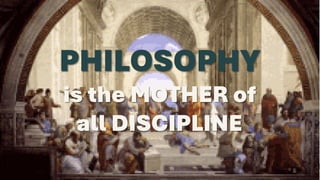
PHILOSOPHY
is the MOTHER of
all DISCIPLINE
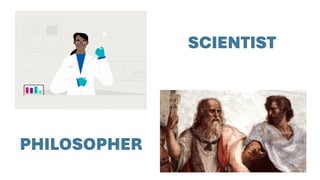
SCIENTIST
PHILOSOPHER
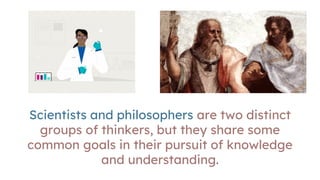
Scientists and philosophers are two distinct
groups of thinkers, but they share some
common goals in their pursuit of knowledge
and understanding.
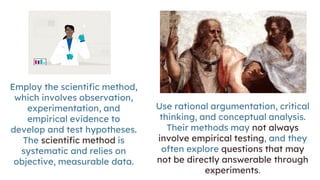
Employ the scientific method,
which involves observation,
experimentation, and
empirical evidence to
develop and test hypotheses.
The scientific method is
systematic and relies on
objective, measurable data.
Use rational argumentation, critical
thinking, and conceptual analysis.
Their methods may not always
involve empirical testing, and they
often explore questions that may
not be directly answerable through
experiments.
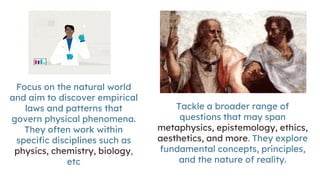
Focus on the natural world
and aim to discover empirical
laws and patterns that
govern physical phenomena.
They often work within
specific disciplines such as
physics, chemistry, biology,
etc
Tackle a broader range of
questions that may span
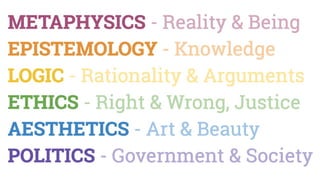
metaphysics, epistemology, ethics,
aesthetics, and more. They explore
fundamental concepts, principles,
and the nature of reality.
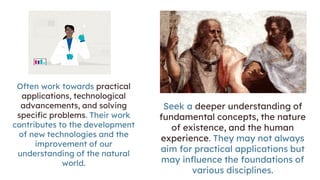
Often work towards practical
applications, technological
advancements, and solving
specific problems. Their work
contributes to the development
of new technologies and the
improvement of our
understanding of the natural
world.
Seek a deeper understanding of
fundamental concepts, the nature
of existence, and the human
experience. They may not always
aim for practical applications but
may influence the foundations of
various disciplines.
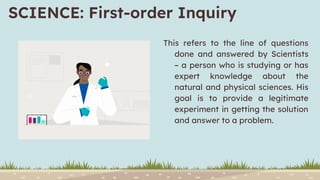
SCIENCE: First-order Inquiry
This refers to the line of questions
done and answered by Scientists
– a person who is studying or has
expert knowledge about the
natural and physical sciences. His
goal is to provide a legitimate
experiment in getting the solution
and answer to a problem.
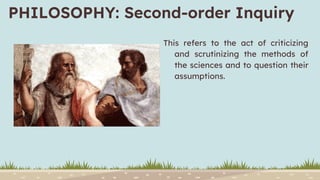
PHILOSOPHY: Second-order Inquiry
This refers to the act of criticizing
and scrutinizing the methods of
the sciences and to question their
assumptions.
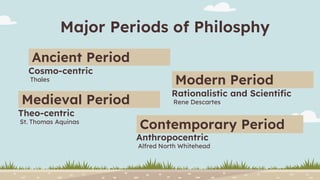
Major Periods of Philosphy
Thales
Ancient Period
Cosmo-centric
St. Thomas Aquinas
Medieval Period
Theo-centric
Rene Descartes
Modern Period
Rationalistic and Scientific
Alfred North Whitehead
Contemporary Period
Anthropocentric
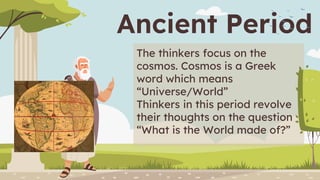
Ancient Period
The thinkers focus on the
cosmos. Cosmos is a Greek
word which means
“Universe/World”
Thinkers in this period revolve
their thoughts on the question
“What is the World made of?”
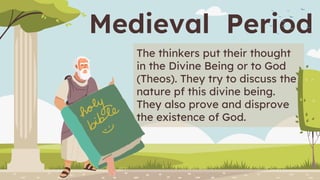
Medieval Period
The thinkers put their thought
in the Divine Being or to God
(Theos). They try to discuss the
nature pf this divine being.
They also prove and disprove
the existence of God.
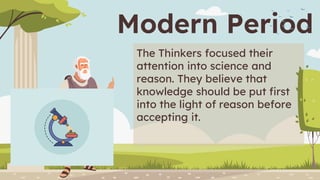
Modern Period
The Thinkers focused their
attention into science and
reason. They believe that
knowledge should be put first
into the light of reason before
accepting it.
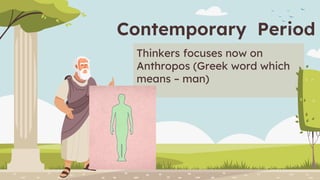
Contemporary Period
Thinkers focuses now on
Anthropos (Greek word which
means – man)
What is the goal of Philosophy?
TO KNOW THE ABSOLUTE
TRUTH.
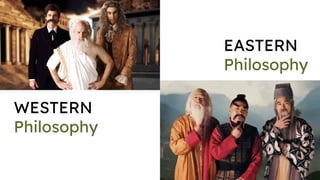
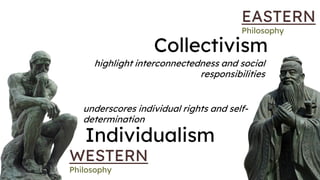
WESTERN
Philosophy
EASTERN
Philosophy
EASTERN
Philosophy
WESTERN
Philosophy
Individualism
Collectivism
underscores individual rights and self-
determination
highlight interconnectedness and social
responsibilities
Philosophy
is not just a
noun but
more on a
verb to be
experienced.
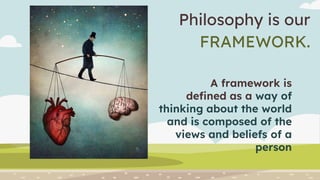
A framework is
defined as a way of
thinking about the world
and is composed of the
views and beliefs of a
person
Philosophy is our
FRAMEWORK.
Philosophy is reflective and reflections arise from our
experiences. Man is rich with experiences both good
and evil. These experiences are the starting point of
wonder and awe. Reason leads to reflection and that’s
what makes us human. We are capable of becoming
aware of our consciousness and daily activities. Man,
by essence is reflective. However, people nowadays
have less time to think and reflect on their
experiences. Man is simply now becoming a
contradiction of his own. (Garcia 2016)
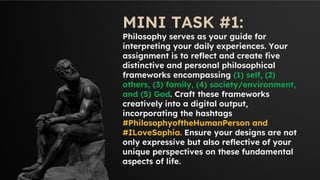
MINI TASK #1:
Philosophy serves as your guide for
interpreting your daily experiences. Your
assignment is to reflect and create five
distinctive and personal philosophical
frameworks encompassing (1) self, (2)
others, (3) family, (4) society/environment,
and (5) God. Craft these frameworks
creatively into a digital output,
incorporating the hashtags
#PhilosophyoftheHumanPerson and
#ILoveSophia. Ensure your designs are not
only expressive but also reflective of your
unique perspectives on these fundamental
aspects of life.
Introduction to Philosophy

Introduction to Philosophy

  • 1.
    Introduction to the Philosophy ofthe Human Person Second Semester:
  • 2.
    CORE SUBJECT DESCRIPTION: Aninitiation to the activity and process of philosophical reflection as a search for a synoptic vision of life. Topics to be discussed include the human experiences of embodiment, being in the world with others and the environment, freedom, intersubjectivity, sociality, being unto death.
  • 3.
    First Grading Period: Themeaning and method of doing philosophy in relation to the human person as an embodied being in the world and the environment
  • 4.
    Standard Content: The studentshould be able to show an understanding of the activity of doing philosophy of the human person as an embodied being in the world and the environment
  • 5.
    Foundational Concept: Understanding themeaning and process of doing philosophy of the human person as an embodied being in the world and the environment as a means towards a holistic understanding of life.
  • 6.
    Second Grading Period:Human Living Standard Content: The learner is able to show an understanding of philosophy within the context of the human person as free, intersubjective, immersed in society and oriented towards death.
  • 7.
    Fundamental Concept: The learneris able to understand that doing philosophy within the context of the human person as free, intersubjective, immersed in society, and oriented towards their impending death will lead to a deeper understanding of the human person.
  • 9.
    What is Philosophy? 1."Thepursuit of happiness is the ultimate goal of human life." 2."Water boils at 100 degrees Celsius at standard atmospheric pressure." 3."Love and justice are the guiding principles for a just society." 4."The Earth revolves around the Sun due to gravitational forces." 5."What is the meaning of life?" 6."Rocks are composed of minerals and undergo various geological processes."
  • 10.
    PHILOSOPHY The Etymological Definition: Philosophycame from two Greek wors “Philos” meaning LOVE and “Sophia” meaning WISDOM. Therefore, Philosophy is the LOVE of WISDOM
  • 11.
    PHILOSOPHY The Dictionary Definition: Thestudy or discipline that uses HUMAN REASON to investigate the ULTIMATE CAUSES, REASONS and PRINCIPLES which govern all things.
  • 12.
    PHILOSOPHY is the MOTHERof all DISCIPLINE
  • 13.
  • 14.
    Scientists and philosophersare two distinct groups of thinkers, but they share some common goals in their pursuit of knowledge and understanding.
  • 15.
    Employ the scientificmethod, which involves observation, experimentation, and empirical evidence to develop and test hypotheses. The scientific method is systematic and relies on objective, measurable data. Use rational argumentation, critical thinking, and conceptual analysis. Their methods may not always involve empirical testing, and they often explore questions that may not be directly answerable through experiments.
  • 16.
    Focus on thenatural world and aim to discover empirical laws and patterns that govern physical phenomena. They often work within specific disciplines such as physics, chemistry, biology, etc Tackle a broader range of questions that may span metaphysics, epistemology, ethics, aesthetics, and more. They explore fundamental concepts, principles, and the nature of reality.
  • 17.
    Often work towardspractical applications, technological advancements, and solving specific problems. Their work contributes to the development of new technologies and the improvement of our understanding of the natural world. Seek a deeper understanding of fundamental concepts, the nature of existence, and the human experience. They may not always aim for practical applications but may influence the foundations of various disciplines.
  • 18.
    SCIENCE: First-order Inquiry Thisrefers to the line of questions done and answered by Scientists – a person who is studying or has expert knowledge about the natural and physical sciences. His goal is to provide a legitimate experiment in getting the solution and answer to a problem.
  • 19.
    PHILOSOPHY: Second-order Inquiry Thisrefers to the act of criticizing and scrutinizing the methods of the sciences and to question their assumptions.
  • 20.
    Major Periods ofPhilosphy Thales Ancient Period Cosmo-centric St. Thomas Aquinas Medieval Period Theo-centric Rene Descartes Modern Period Rationalistic and Scientific Alfred North Whitehead Contemporary Period Anthropocentric
  • 21.
    Ancient Period The thinkersfocus on the cosmos. Cosmos is a Greek word which means “Universe/World” Thinkers in this period revolve their thoughts on the question “What is the World made of?”
  • 22.
    Medieval Period The thinkersput their thought in the Divine Being or to God (Theos). They try to discuss the nature pf this divine being. They also prove and disprove the existence of God.
  • 23.
    Modern Period The Thinkersfocused their attention into science and reason. They believe that knowledge should be put first into the light of reason before accepting it.
  • 24.
    Contemporary Period Thinkers focusesnow on Anthropos (Greek word which means – man)
  • 25.
    What is thegoal of Philosophy? TO KNOW THE ABSOLUTE TRUTH.
  • 29.
  • 30.
    EASTERN Philosophy WESTERN Philosophy Individualism Collectivism underscores individual rightsand self- determination highlight interconnectedness and social responsibilities
  • 31.
    Philosophy is not justa noun but more on a verb to be experienced.
  • 32.
    A framework is definedas a way of thinking about the world and is composed of the views and beliefs of a person Philosophy is our FRAMEWORK.
  • 33.
    Philosophy is reflectiveand reflections arise from our experiences. Man is rich with experiences both good and evil. These experiences are the starting point of wonder and awe. Reason leads to reflection and that’s what makes us human. We are capable of becoming aware of our consciousness and daily activities. Man, by essence is reflective. However, people nowadays have less time to think and reflect on their experiences. Man is simply now becoming a contradiction of his own. (Garcia 2016)
  • 34.
    MINI TASK #1: Philosophyserves as your guide for interpreting your daily experiences. Your assignment is to reflect and create five distinctive and personal philosophical frameworks encompassing (1) self, (2) others, (3) family, (4) society/environment, and (5) God. Craft these frameworks creatively into a digital output, incorporating the hashtags #PhilosophyoftheHumanPerson and #ILoveSophia. Ensure your designs are not only expressive but also reflective of your unique perspectives on these fundamental aspects of life.