
STRUCTURES OF
MODIFICATION
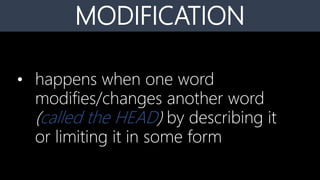
MODIFICATION
• happens when one word
modifies/changes another word
(called the HEAD) by describing it
or limiting it in some form
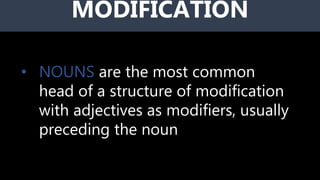
• NOUNS are the most common
head of a structure of modification
with adjectives as modifiers, usually
preceding the noun
MODIFICATION
• NOUNS can also act as modifiers in
the noun-noun combination.
• Another common structure is the
adverb-verb pair where you have
the adverb either preceding the
verb or following it.
MODIFICATION
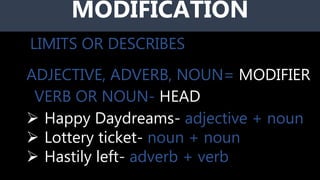
 Happy Daydreams- adjective + noun
 Lottery ticket- noun + noun
 Hastily left- adverb + verb
MODIFICATION
ADJECTIVE, ADVERB, NOUN= MODIFIER
VERB OR NOUN- HEAD
LIMITS OR DESCRIBES
Adjective as Head
The word that is mostly used as modifier of
adjective is a qualifier such as very, rather,
pretty, etc.
Example:
The sound was loud enough
She is very pretty.
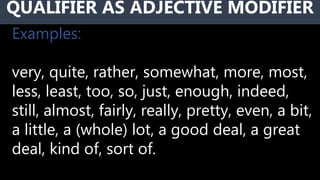
QUALIFIER AS ADJECTIVE MODIFIER
Examples:
very, quite, rather, somewhat, more, most,
less, least, too, so, just, enough, indeed,
still, almost, fairly, really, pretty, even, a bit,
a little, a (whole) lot, a good deal, a great
deal, kind of, sort of.
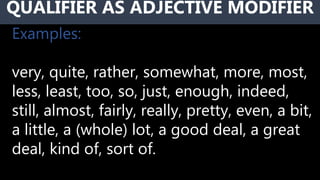
QUALIFIER AS ADJECTIVE MODIFIER
Examples:
very, quite, rather, somewhat, more, most,
less, least, too, so, just, enough, indeed,
still, almost, fairly, really, pretty, even, a bit,
a little, a (whole) lot, a good deal, a great
deal, kind of, sort of.
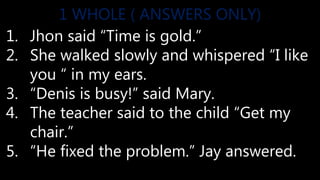
QUALIFIER AS ADJECTIVE MODIFIER
1. Jhon said “Time is gold.”
2. She walked slowly and whispered “I like
you “ in my ears.
3. “Denis is busy!” said Mary.
4. The teacher said to the child “Get my
chair.”
5. “He fixed the problem.” Jay answered.
1 WHOLE ( ANSWERS ONLY)
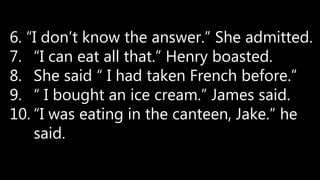
6. “I don’t know the answer.” She admitted.
7. “I can eat all that.” Henry boasted.
8. She said “ I had taken French before.”
9. “ I bought an ice cream.” James said.
10. “I was eating in the canteen, Jake.” he
said.
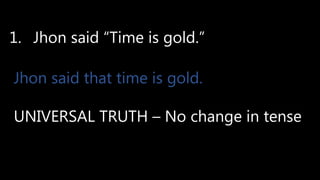
1. Jhon said “Time is gold.”
Jhon said that time is gold.
UNIVERSAL TRUTH – No change in tense
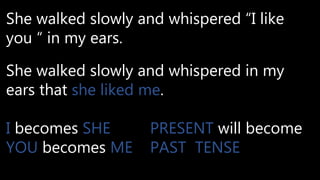
She walked slowly and whispered “I like
you “ in my ears.
She walked slowly and whispered in my
ears that she liked me.
I becomes SHE PRESENT will become
YOU becomes ME PAST TENSE
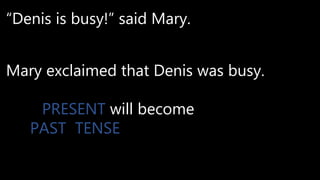
“Denis is busy!” said Mary.
Mary exclaimed that Denis was busy.
PRESENT will become
PAST TENSE
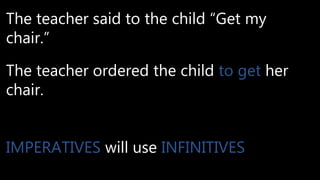
The teacher said to the child “Get my
chair.”
The teacher ordered the child to get her
chair.
IMPERATIVES will use INFINITIVES
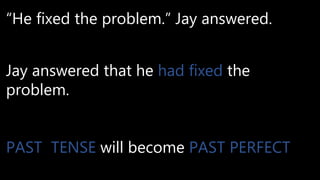
“He fixed the problem.” Jay answered.
Jay answered that he had fixed the
problem.
PAST TENSE will become PAST PERFECT
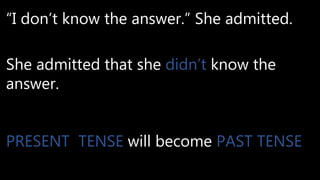
“I don’t know the answer.” She admitted.
She admitted that she didn’t know the
answer.
PRESENT TENSE will become PAST TENSE
“I can eat all that.” Henry boasted.
Henry boasted that he could eat all those.
CHANGE in TENSE
CAN will become COULD
THAT becomes THOSE
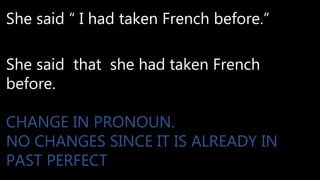
She said “ I had taken French before.”
She said that she had taken French
before.
CHANGE IN PRONOUN.
NO CHANGES SINCE IT IS ALREADY IN
PAST PERFECT
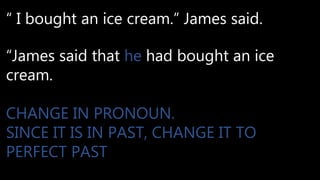
“ I bought an ice cream.” James said.
“James said that he had bought an ice
cream.
CHANGE IN PRONOUN.
SINCE IT IS IN PAST, CHANGE IT TO
PERFECT PAST
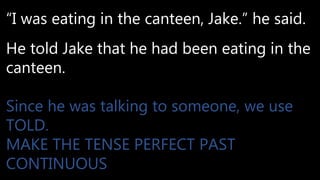
“I was eating in the canteen, Jake.” he said.
He told Jake that he had been eating in the
canteen.
Since he was talking to someone, we use
TOLD.
MAKE THE TENSE PERFECT PAST
CONTINUOUS

Structures of modification

  • 1.
  • 2.
    MODIFICATION • happens whenone word modifies/changes another word (called the HEAD) by describing it or limiting it in some form
  • 3.
    • NOUNS arethe most common head of a structure of modification with adjectives as modifiers, usually preceding the noun MODIFICATION
  • 4.
    • NOUNS canalso act as modifiers in the noun-noun combination. • Another common structure is the adverb-verb pair where you have the adverb either preceding the verb or following it. MODIFICATION
  • 5.
     Happy Daydreams-adjective + noun  Lottery ticket- noun + noun  Hastily left- adverb + verb MODIFICATION ADJECTIVE, ADVERB, NOUN= MODIFIER VERB OR NOUN- HEAD LIMITS OR DESCRIBES
  • 6.
  • 7.
    The word thatis mostly used as modifier of adjective is a qualifier such as very, rather, pretty, etc. Example: The sound was loud enough She is very pretty. QUALIFIER AS ADJECTIVE MODIFIER
  • 8.
    Examples: very, quite, rather,somewhat, more, most, less, least, too, so, just, enough, indeed, still, almost, fairly, really, pretty, even, a bit, a little, a (whole) lot, a good deal, a great deal, kind of, sort of. QUALIFIER AS ADJECTIVE MODIFIER
  • 9.
    Examples: very, quite, rather,somewhat, more, most, less, least, too, so, just, enough, indeed, still, almost, fairly, really, pretty, even, a bit, a little, a (whole) lot, a good deal, a great deal, kind of, sort of. QUALIFIER AS ADJECTIVE MODIFIER
  • 10.
    1. Jhon said“Time is gold.” 2. She walked slowly and whispered “I like you “ in my ears. 3. “Denis is busy!” said Mary. 4. The teacher said to the child “Get my chair.” 5. “He fixed the problem.” Jay answered. 1 WHOLE ( ANSWERS ONLY)
  • 11.
    6. “I don’tknow the answer.” She admitted. 7. “I can eat all that.” Henry boasted. 8. She said “ I had taken French before.” 9. “ I bought an ice cream.” James said. 10. “I was eating in the canteen, Jake.” he said.
  • 12.
    1. Jhon said“Time is gold.” Jhon said that time is gold. UNIVERSAL TRUTH – No change in tense
  • 13.
    She walked slowlyand whispered “I like you “ in my ears. She walked slowly and whispered in my ears that she liked me. I becomes SHE PRESENT will become YOU becomes ME PAST TENSE
  • 14.
    “Denis is busy!”said Mary. Mary exclaimed that Denis was busy. PRESENT will become PAST TENSE
  • 15.
    The teacher saidto the child “Get my chair.” The teacher ordered the child to get her chair. IMPERATIVES will use INFINITIVES
  • 16.
    “He fixed theproblem.” Jay answered. Jay answered that he had fixed the problem. PAST TENSE will become PAST PERFECT
  • 17.
    “I don’t knowthe answer.” She admitted. She admitted that she didn’t know the answer. PRESENT TENSE will become PAST TENSE
  • 18.
    “I can eatall that.” Henry boasted. Henry boasted that he could eat all those. CHANGE in TENSE CAN will become COULD THAT becomes THOSE
  • 19.
    She said “I had taken French before.” She said that she had taken French before. CHANGE IN PRONOUN. NO CHANGES SINCE IT IS ALREADY IN PAST PERFECT
  • 20.
    “ I boughtan ice cream.” James said. “James said that he had bought an ice cream. CHANGE IN PRONOUN. SINCE IT IS IN PAST, CHANGE IT TO PERFECT PAST
  • 21.
    “I was eatingin the canteen, Jake.” he said. He told Jake that he had been eating in the canteen. Since he was talking to someone, we use TOLD. MAKE THE TENSE PERFECT PAST CONTINUOUS