Reaching the Summit:
 Using Assessment to Help You
          Get There


JULIE NANAVATI, INFORMATION LITERACY COORDINATOR
           LOYOLA-NOTRE DAME LIBRARY

    BRANDY WHITLOCK, INSTRUCTION LIBRARIAN
       ANNE ARUNDEL COMMUNITY COLLEGE
Learning Outcomes for Today’s Session

Upon successful completion of today’s session, participants will be able to:
 Define key terms related to assessment
 Distinguish among objective, performative, and authentic measures of
  assessment
 Prepare a performative or authentic assessment for a particular learning
  outcome
Why Assess?
Why Assess?


 Gauge the effects of our teaching on student
 learning

 Extend learning outside of the classroom

 Find ways to improve instruction

 Prove our worth
Why Assess?


           Good teaching is inseparable
              from good assessing.


Source: Wiggins, G. (1996), “Creating tests worth taking”, in Blum, R.E. and
Arter, J.A. (Eds), A handbook for student performance in an era of
restructuring (pp. 1-9), Association for Supervision and Curriculum
Development, Alexandria, VA.
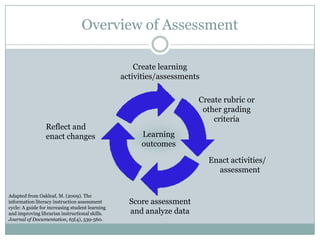
Overview of Assessment

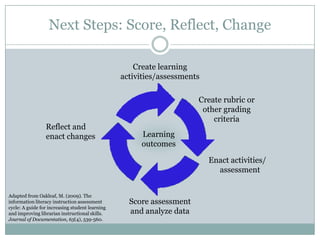
                                                     Create learning
                                                 activities/assessments

                                                                      Create rubric or
                                                                       other grading
                                                                          criteria
                 Reflect and
                 enact changes                        Learning
                                                      outcomes

                                                                          Enact activities/
                                                                            assessment


Adapted from Oakleaf, M. (2009). The
information literacy instruction assessment        Score assessment
cycle: A guide for increasing student learning
and improving librarian instructional skills.      and analyze data
Journal of Documentation, 65(4), 539-560.
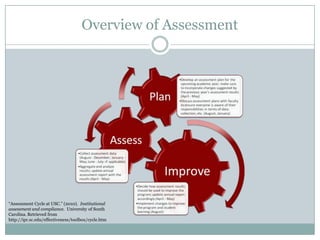
Overview of Assessment


“Assessment Cycle at USC.” (2010). Institutional
assessment and compliance. University of South
Carolina. Retrieved from
http://ipr.sc.edu/effectiveness/toolbox/cycle.htm
First Step: Outcomes


When developing a learning experience, start with
outcomes,

i.e., what should students be able to do?

Upon successful completion of the
course/class/session/assignment, students will be able
to:
First Step: Outcomes


When designing learning outcomes, be sure they are:

   Clear
   Specific
   Achievable
   Observable
   Measurable
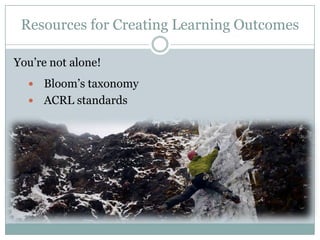
Resources for Creating Learning Outcomes

You’re not alone!
   Bloom’s taxonomy
   ACRL standards
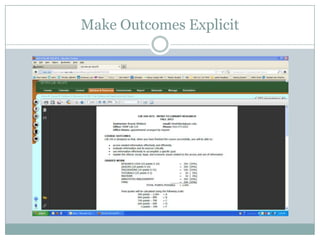
Make Outcomes Explicit
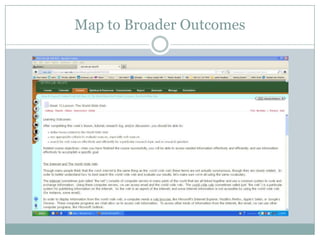
Map to Broader Outcomes


Module 12 Learning Outcomes:
After completing this week's lesson, tutorial, research log, and/or
discussion, you should be able to:

  • define terms related to the World Wide Web
  • use appropriate criteria to evaluate sources, especially web sources
  • search for web sources effectively and efficiently for a particular
    research topic and/or research question

Related course objectives: When you have finished the course
successfully, you will be able to access needed information effectively
and efficiently, and use information effectively to accomplish a specific
goal.
Hey, remember this?
Second Step: Activities & Assessments


Next, develop learning activities and assessments,

i.e., what will students do to develop their skill(s) and
demonstrate what they’ve learned?
Learning Activities

Through what experiences will students learn the
knowledge and skills that you will assess?

 Lecture
 Discussion
 Direct observation
 Experimentation
 Problem-solving
 Service
 Research
 etc.
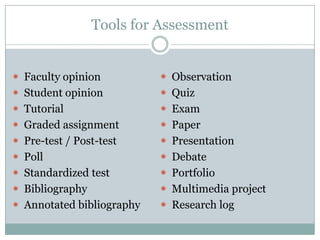
Tools for Assessment


   Faculty opinion             Observation
   Student opinion             Quiz
   Tutorial                    Exam
   Graded assignment           Paper
   Pre-test / Post-test        Presentation
   Poll                        Debate
   Standardized test           Portfolio
   Bibliography                Multimedia project
   Annotated bibliography      Research log
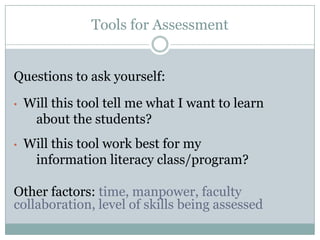
Tools for Assessment


Questions to ask yourself:

•   Will this tool tell me what I want to learn
     about the students?
•   Will this tool work best for my
     information literacy class/program?

Other factors: time, manpower, faculty
collaboration, level of skills being assessed
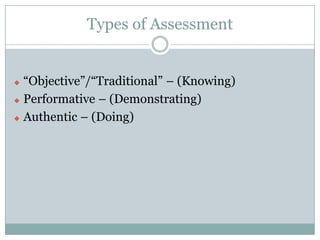
Types of Assessment


 “Objective”/“Traditional” – (Knowing)
 Performative – (Demonstrating)

 Authentic – (Doing)
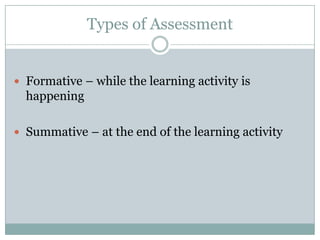
Types of Assessment


 Formative – while the learning activity is
  happening

 Summative – at the end of the learning activity
Types of Assessment


 Formal – data collected


 Informal – no data collected
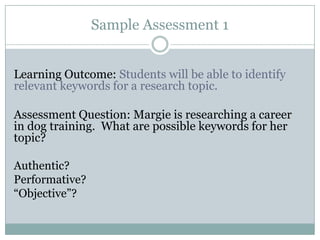
Sample Assessment 1


Learning Outcome: Students will be able to identify
relevant keywords for a research topic.

Assessment Question: Margie is researching a career
in dog training. What are possible keywords for her
topic?

Authentic?
Performative?
“Objective”?
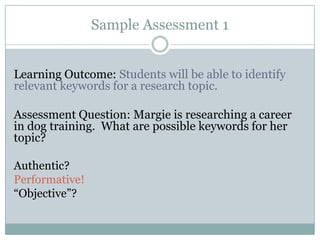
Sample Assessment 1


Learning Outcome: Students will be able to identify
relevant keywords for a research topic.

Assessment Question: Margie is researching a career
in dog training. What are possible keywords for her
topic?

Authentic?
Performative!
“Objective”?
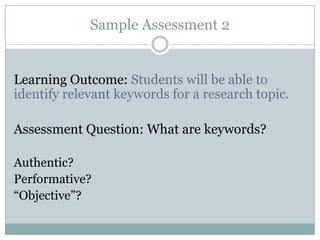
Sample Assessment 2


Learning Outcome: Students will be able to
identify relevant keywords for a research topic.

Assessment Question: What are keywords?

Authentic?
Performative?
“Objective”?
Sample Assessment 2


Learning Outcome: Students will be able to
identify relevant keywords for a research topic.

Assessment Question: What are keywords?

Authentic?
Performative?
“Objective”!
Sample Assessment 3


Learning Outcome: Students will be able to
identify relevant keywords for a research topic.

Assessment Question: List possible keywords for
a topic you want or need to research.

Authentic?
Performative?
“Objective”?
Sample Assessment 3


Learning Outcome: Students will be able to
identify relevant keywords for a research topic.

Assessment Question: List possible keywords for
a topic you want or need to research.

Authentic!
Performative?
“Objective”?
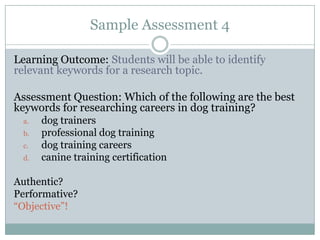
Sample Assessment 4

Learning Outcome: Students will be able to identify
relevant keywords for a research topic.

Assessment Question: Which of the following are the best
keywords for researching careers in dog training?
 a.   dog trainers
 b.   professional dog training
 c.   dog training careers
 d.   canine training certification

Authentic?
Performative?
“Objective”?
Sample Assessment 4

Learning Outcome: Students will be able to identify
relevant keywords for a research topic.

Assessment Question: Which of the following are the best
keywords for researching careers in dog training?
 a.   dog trainers
 b.   professional dog training
 c.   dog training careers
 d.   canine training certification

Authentic?
Performative?
“Objective”!
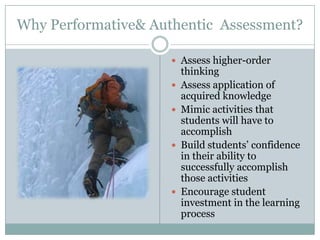
Why Performative& Authentic Assessment?

                      Assess higher-order
                         thinking
                        Assess application of
                         acquired knowledge
                        Mimic activities that
                         students will have to
                         accomplish
                        Build students’ confidence
                         in their ability to
                         successfully accomplish
                         those activities
                        Encourage student
                         investment in the learning
                         process
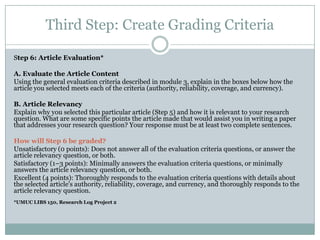
Third Step: Create Grading Criteria

Step 6: Article Evaluation*

A. Evaluate the Article Content
Using the general evaluation criteria described in module 3, explain in the boxes below how the
article you selected meets each of the criteria (authority, reliability, coverage, and currency).

B. Article Relevancy
Explain why you selected this particular article (Step 5) and how it is relevant to your research
question. What are some specific points the article made that would assist you in writing a paper
that addresses your research question? Your response must be at least two complete sentences.

How will Step 6 be graded?
Unsatisfactory (0 points): Does not answer all of the evaluation criteria questions, or answer the
article relevancy question, or both.
Satisfactory (1–3 points): Minimally answers the evaluation criteria questions, or minimally
answers the article relevancy question, or both.
Excellent (4 points): Thoroughly responds to the evaluation criteria questions with details about
the selected article's authority, reliability, coverage, and currency, and thoroughly responds to the
article relevancy question.
*UMUC LIBS 150, Research Log Project 2
Why Use Rubrics?


   Students better understand instructor’s
    expectations
   Eases grading dilemmas for instructors
   More standardized and consistent grading
   Students better understand what they’ve learned
    and what they still have to learn
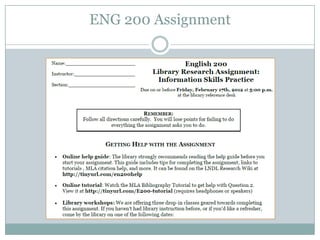
ENG 200 Assignment
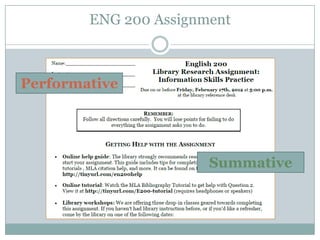
ENG 200 Assignment


Performative


                       Summative
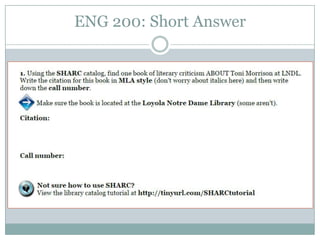
ENG 200: Short Answer
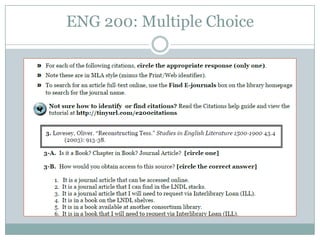
ENG 200: Multiple Choice
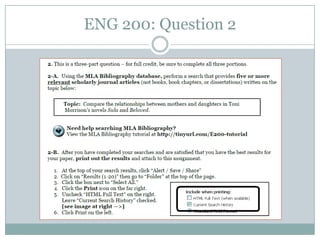
ENG 200: Question 2
ENG 200: Question 2


What did we want to learn?

1. Can a student construct an effective search?

2. Can a student evaluate the results that she or he
  generates to find results that answer her or his
  research question?
ENG 200: Question 2

ACRL Standards:

 Standard 2, ACRL Information Literacy
 The information literate person accesses needed
 information effectively and efficiently.

 Standard 3, ACRL Information Literacy
 The information literate person evaluates
 information and its sources.
ENG 200: Question 2


Learning Outcomes:

1.   Identify key terms from a research question
2.   Access database appropriate for research need
     (MLA Bibliography)
3.   Combine key terms using the connectors and&or
4.   Evaluate results and identify scholarly journal
     articles relevant to research need
5.   Cite a scholarly journal article using MLA style
ENG 200: Question 2
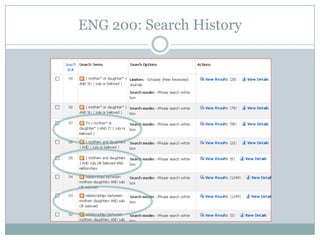
ENG 200: Search History
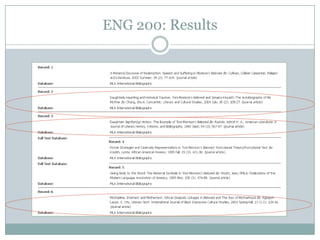
ENG 200: Results
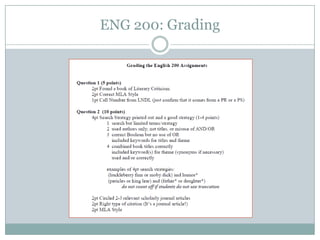
ENG 200: Grading
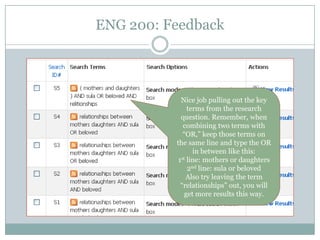
ENG 200: Feedback


            Nice job pulling out the key
               terms from the research
            question. Remember, when
             combining two terms with
             “OR,” keep those terms on
          the same line and type the OR
                 in between like this:
           1st line: mothers or daughters

               2nd line: sula or beloved
              Also try leaving the term
            “relationships” out, you will
              get more results this way.
ENG 200: Challenges

Challenges:
 We grade about 270 assignments a semester.
 We all have to be on board with the grading
  process (rubric)
 We have to keep faculty buy-in
 We have to make sure students are invested
ENG 200: Why We Do It


Benefits for Students:

 Prepares students for their literature class research
  assignment
 Serves as another opportunity to learn information
  literacy skills
 Provides students with feedback
ENG 200: Why We Do It


Benefits for Us:
 Provides us with a window into how well students are able
  to do what we teach (Search History)
 Shows us where we can strengthen our instruction
 Gives us data we can use to demonstrate our effectiveness
ENG 200: Changes We’ve Made


 Changed the way we taught how to use “ORs” in our
  freshman class
 Explained to all classes the challenges of using “TX-All
  Text” in a search
 Reemphasized the importance of evaluating results before
  using them in all library classes
 Created an interactive tutorial for students to use before
  completing the assignment
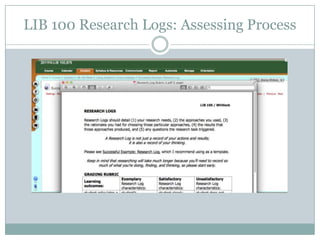
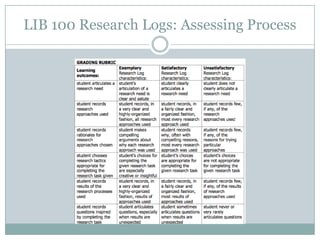
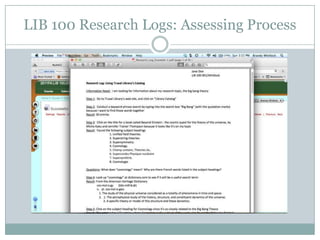
LIB 100 Research Logs: Assessing Process
Assignment for Today’s Session

1.   Identify one ACRL learning outcome that is challenging for
     you to assess.
2.   To assess that outcome, select an optimal assessment tool
     that will work with your information literacy program.
3.   Design one question or task that uses authentic or
     performative assessment to evaluate whether students
     have met that learning outcome.
4.   Mark whether this question or task will be part of a formal
     (FM) or informal (IN) assessment, and whether the
     assessment will be summative (SU) or formative (FV).


      Write your answers on the carbons provided.
Next Steps: Score, Reflect, Change

                                                     Create learning
                                                 activities/assessments

                                                                      Create rubric or
                                                                       other grading
                                                                          criteria
                 Reflect and
                 enact changes                        Learning
                                                      outcomes

                                                                          Enact activities/
                                                                            assessment


Adapted from Oakleaf, M. (2009). The
information literacy instruction assessment        Score assessment
cycle: A guide for increasing student learning
and improving librarian instructional skills.      and analyze data
Journal of Documentation, 65(4), 539-560.
We Made It!

Visit Our LibGuide for an extensive bibliography, full and
     additional sample assignments, rubrics, and more:
           libguides.aacc.edu/LOTWassessment


      Photos courtesy of Mike Cooperstein, http://www.andesmountainguides.com

LOTW

  • 1.
    Reaching the Summit: Using Assessment to Help You Get There JULIE NANAVATI, INFORMATION LITERACY COORDINATOR LOYOLA-NOTRE DAME LIBRARY BRANDY WHITLOCK, INSTRUCTION LIBRARIAN ANNE ARUNDEL COMMUNITY COLLEGE
  • 2.
    Learning Outcomes forToday’s Session Upon successful completion of today’s session, participants will be able to:  Define key terms related to assessment  Distinguish among objective, performative, and authentic measures of assessment  Prepare a performative or authentic assessment for a particular learning outcome
  • 3.
  • 4.
    Why Assess?  Gaugethe effects of our teaching on student learning  Extend learning outside of the classroom  Find ways to improve instruction  Prove our worth
  • 5.
    Why Assess? Good teaching is inseparable from good assessing. Source: Wiggins, G. (1996), “Creating tests worth taking”, in Blum, R.E. and Arter, J.A. (Eds), A handbook for student performance in an era of restructuring (pp. 1-9), Association for Supervision and Curriculum Development, Alexandria, VA.
  • 6.
    Overview of Assessment Create learning activities/assessments Create rubric or other grading criteria Reflect and enact changes Learning outcomes Enact activities/ assessment Adapted from Oakleaf, M. (2009). The information literacy instruction assessment Score assessment cycle: A guide for increasing student learning and improving librarian instructional skills. and analyze data Journal of Documentation, 65(4), 539-560.
  • 7.
    Overview of Assessment “AssessmentCycle at USC.” (2010). Institutional assessment and compliance. University of South Carolina. Retrieved from http://ipr.sc.edu/effectiveness/toolbox/cycle.htm
  • 8.
    First Step: Outcomes Whendeveloping a learning experience, start with outcomes, i.e., what should students be able to do? Upon successful completion of the course/class/session/assignment, students will be able to:
  • 9.
    First Step: Outcomes Whendesigning learning outcomes, be sure they are:  Clear  Specific  Achievable  Observable  Measurable
  • 10.
    Resources for CreatingLearning Outcomes You’re not alone!  Bloom’s taxonomy  ACRL standards
  • 11.
  • 12.
  • 13.
    Map to BroaderOutcomes Module 12 Learning Outcomes: After completing this week's lesson, tutorial, research log, and/or discussion, you should be able to: • define terms related to the World Wide Web • use appropriate criteria to evaluate sources, especially web sources • search for web sources effectively and efficiently for a particular research topic and/or research question Related course objectives: When you have finished the course successfully, you will be able to access needed information effectively and efficiently, and use information effectively to accomplish a specific goal.
  • 14.
  • 15.
    Second Step: Activities& Assessments Next, develop learning activities and assessments, i.e., what will students do to develop their skill(s) and demonstrate what they’ve learned?
  • 16.
    Learning Activities Through whatexperiences will students learn the knowledge and skills that you will assess?  Lecture  Discussion  Direct observation  Experimentation  Problem-solving  Service  Research  etc.
  • 17.
    Tools for Assessment  Faculty opinion  Observation  Student opinion  Quiz  Tutorial  Exam  Graded assignment  Paper  Pre-test / Post-test  Presentation  Poll  Debate  Standardized test  Portfolio  Bibliography  Multimedia project  Annotated bibliography  Research log
  • 18.
    Tools for Assessment Questionsto ask yourself: • Will this tool tell me what I want to learn about the students? • Will this tool work best for my information literacy class/program? Other factors: time, manpower, faculty collaboration, level of skills being assessed
  • 19.
    Types of Assessment “Objective”/“Traditional” – (Knowing)  Performative – (Demonstrating)  Authentic – (Doing)
  • 20.
    Types of Assessment Formative – while the learning activity is happening  Summative – at the end of the learning activity
  • 21.
    Types of Assessment Formal – data collected  Informal – no data collected
  • 22.
    Sample Assessment 1 LearningOutcome: Students will be able to identify relevant keywords for a research topic. Assessment Question: Margie is researching a career in dog training. What are possible keywords for her topic? Authentic? Performative? “Objective”?
  • 23.
    Sample Assessment 1 LearningOutcome: Students will be able to identify relevant keywords for a research topic. Assessment Question: Margie is researching a career in dog training. What are possible keywords for her topic? Authentic? Performative! “Objective”?
  • 24.
    Sample Assessment 2 LearningOutcome: Students will be able to identify relevant keywords for a research topic. Assessment Question: What are keywords? Authentic? Performative? “Objective”?
  • 25.
    Sample Assessment 2 LearningOutcome: Students will be able to identify relevant keywords for a research topic. Assessment Question: What are keywords? Authentic? Performative? “Objective”!
  • 26.
    Sample Assessment 3 LearningOutcome: Students will be able to identify relevant keywords for a research topic. Assessment Question: List possible keywords for a topic you want or need to research. Authentic? Performative? “Objective”?
  • 27.
    Sample Assessment 3 LearningOutcome: Students will be able to identify relevant keywords for a research topic. Assessment Question: List possible keywords for a topic you want or need to research. Authentic! Performative? “Objective”?
  • 28.
    Sample Assessment 4 LearningOutcome: Students will be able to identify relevant keywords for a research topic. Assessment Question: Which of the following are the best keywords for researching careers in dog training? a. dog trainers b. professional dog training c. dog training careers d. canine training certification Authentic? Performative? “Objective”?
  • 29.
    Sample Assessment 4 LearningOutcome: Students will be able to identify relevant keywords for a research topic. Assessment Question: Which of the following are the best keywords for researching careers in dog training? a. dog trainers b. professional dog training c. dog training careers d. canine training certification Authentic? Performative? “Objective”!
  • 30.
  • 31.
    Why Performative& AuthenticAssessment?  Assess higher-order thinking  Assess application of acquired knowledge  Mimic activities that students will have to accomplish  Build students’ confidence in their ability to successfully accomplish those activities  Encourage student investment in the learning process
  • 32.
    Third Step: CreateGrading Criteria Step 6: Article Evaluation* A. Evaluate the Article Content Using the general evaluation criteria described in module 3, explain in the boxes below how the article you selected meets each of the criteria (authority, reliability, coverage, and currency). B. Article Relevancy Explain why you selected this particular article (Step 5) and how it is relevant to your research question. What are some specific points the article made that would assist you in writing a paper that addresses your research question? Your response must be at least two complete sentences. How will Step 6 be graded? Unsatisfactory (0 points): Does not answer all of the evaluation criteria questions, or answer the article relevancy question, or both. Satisfactory (1–3 points): Minimally answers the evaluation criteria questions, or minimally answers the article relevancy question, or both. Excellent (4 points): Thoroughly responds to the evaluation criteria questions with details about the selected article's authority, reliability, coverage, and currency, and thoroughly responds to the article relevancy question. *UMUC LIBS 150, Research Log Project 2
  • 33.
    Why Use Rubrics?  Students better understand instructor’s expectations  Eases grading dilemmas for instructors  More standardized and consistent grading  Students better understand what they’ve learned and what they still have to learn
  • 34.
  • 35.
  • 36.
  • 37.
  • 38.
  • 39.
    ENG 200: Question2 What did we want to learn? 1. Can a student construct an effective search? 2. Can a student evaluate the results that she or he generates to find results that answer her or his research question?
  • 40.
    ENG 200: Question2 ACRL Standards:  Standard 2, ACRL Information Literacy The information literate person accesses needed information effectively and efficiently.  Standard 3, ACRL Information Literacy The information literate person evaluates information and its sources.
  • 41.
    ENG 200: Question2 Learning Outcomes: 1. Identify key terms from a research question 2. Access database appropriate for research need (MLA Bibliography) 3. Combine key terms using the connectors and&or 4. Evaluate results and identify scholarly journal articles relevant to research need 5. Cite a scholarly journal article using MLA style
  • 42.
  • 43.
  • 44.
  • 45.
  • 46.
    ENG 200: Feedback Nice job pulling out the key terms from the research question. Remember, when combining two terms with “OR,” keep those terms on the same line and type the OR in between like this: 1st line: mothers or daughters 2nd line: sula or beloved Also try leaving the term “relationships” out, you will get more results this way.
  • 47.
    ENG 200: Challenges Challenges: We grade about 270 assignments a semester.  We all have to be on board with the grading process (rubric)  We have to keep faculty buy-in  We have to make sure students are invested
  • 48.
    ENG 200: WhyWe Do It Benefits for Students:  Prepares students for their literature class research assignment  Serves as another opportunity to learn information literacy skills  Provides students with feedback
  • 49.
    ENG 200: WhyWe Do It Benefits for Us:  Provides us with a window into how well students are able to do what we teach (Search History)  Shows us where we can strengthen our instruction  Gives us data we can use to demonstrate our effectiveness
  • 50.
    ENG 200: ChangesWe’ve Made  Changed the way we taught how to use “ORs” in our freshman class  Explained to all classes the challenges of using “TX-All Text” in a search  Reemphasized the importance of evaluating results before using them in all library classes  Created an interactive tutorial for students to use before completing the assignment
  • 51.
    LIB 100 ResearchLogs: Assessing Process
  • 52.
    LIB 100 ResearchLogs: Assessing Process
  • 53.
    LIB 100 ResearchLogs: Assessing Process
  • 54.
    Assignment for Today’sSession 1. Identify one ACRL learning outcome that is challenging for you to assess. 2. To assess that outcome, select an optimal assessment tool that will work with your information literacy program. 3. Design one question or task that uses authentic or performative assessment to evaluate whether students have met that learning outcome. 4. Mark whether this question or task will be part of a formal (FM) or informal (IN) assessment, and whether the assessment will be summative (SU) or formative (FV). Write your answers on the carbons provided.
  • 55.
    Next Steps: Score,Reflect, Change Create learning activities/assessments Create rubric or other grading criteria Reflect and enact changes Learning outcomes Enact activities/ assessment Adapted from Oakleaf, M. (2009). The information literacy instruction assessment Score assessment cycle: A guide for increasing student learning and improving librarian instructional skills. and analyze data Journal of Documentation, 65(4), 539-560.
  • 56.
    We Made It! VisitOur LibGuide for an extensive bibliography, full and additional sample assignments, rubrics, and more: libguides.aacc.edu/LOTWassessment Photos courtesy of Mike Cooperstein, http://www.andesmountainguides.com

Editor's Notes

  • #3 Brandy?
  • #4 Julie
  • #5 JulieAre students able to do what we teach them to do?“If libraries intend to remain relevant on campus, they must demonstrate their contributions to the mission of the institution by becoming involved in assessment (Oakleaf, 2009).”
  • #6 Julie
  • #7 Julie
  • #8 Brandy?
  • #9 Brandy
  • #10 Brandy
  • #11 Julie
  • #12 Brandy:List course outcomes right in the syllabus.
  • #13 Brandy
  • #14 Brandy
  • #15 Julie
  • #16 Julie
  • #17 Julie
  • #18 Julie– Will this tool tell you what you want to learn?
  • #19 Julie
  • #20 Brandy“Objective”/“Traditional” – attempts to measure knowledge acquisition as proxy for skill acquisitionAuthentic – attempts to measure students’ skill acquisition during real-world experiencesPerformative – attempts to measure students’ skill acquisition in simulated real-world contexts
  • #21 Brandy
  • #22 Brandy
  • #23 Brandy
  • #24 Julie
  • #25 Julie
  • #26 Brandy
  • #27 Brandy
  • #28 Julie
  • #29  Julie
  • #30 Brandy
  • #31 Julie
  • #32 Julie
  • #33 Brandy
  • #34 Brandy
  • #38 All questions are performative.
  • #40 What we wanted to learn
  • #42 More things we wanted to know. Can they use truncation effectively. Can they use Subject Headings. But had to focus on what we felt was the most important.
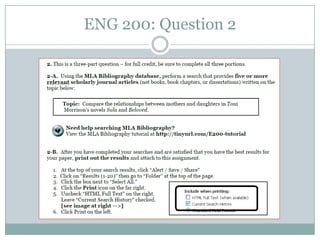
  • #43 Scenario that mimicked the final paper they would be writing in their classes. Really wanted to see if students could combine terms using Ors. Set up a scenario that would force them to use ors.
  • #47 Feedback to the students
  • #48 (rubric) (emphasize value of assignment) (explain in the assignment why learning to complete these particular questions are valuable)
  • #50 Which learning outcomes we should target
  • #53 Nursing 402 Class—Let students create their own research question based on issues/problems they have noticed in their workplace. This encourages critical thinking and ties the assignment to real life sitations)IDS 100—Large scale assessment for Middle States (formal rubric where we assessed each learning outcome on an “Beginner, “Developing,” “Advanced.”
  • #54 Brandy
  • #55 Brandy
  • #56 Brandy
  • #57 BrandyWork individually at first, then in pairs?(I think we could have different areas of the room for people to go depending on the standard that they pick and they can talk to others in their area)
  • #58 Julie
  • #59 Brandy