TEACHING TOOLS FOR
    REAL LIFE SKILLS:
INFORMATION LITERACY                           Georgia
                                            International
                                             Conference
  FOR THE WORKPLACE                               On
                                             Information
                                               Literacy

                                           September 2012


 Alessia Zanin-Yost and Betsy Clementson
   Research and Instruction Librarians
        Western Carolina University
WHAT ARE WE GOING TO DO TODAY

 Discussion
1. Learn about information literacy
2. Evaluate what types of assessment you can use
3. Investigate what skills new graduates should have

 Activities
1. Explore ways to reach to your constituents
2. How to incorporate the ACRL standards into assignments
3. Develop methods of evaluation
INFORMATION LITERACY

  We are using the ACRL definition
  Information literacy is a set of abilities requiring individuals to
   “recognize when information is needed and have the ability to
   locate, evaluate, and use effectively the needed information.”

Why do we need information literacy today? We have the Web, Google and Wikipedia….


                     Why do we- librarians- need to teach it?
CRITICAL THINKING SKILLS

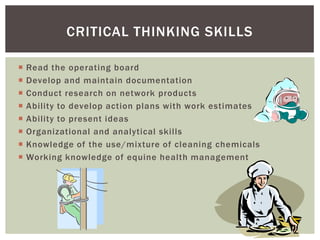
   Read the operating board
   Develop and maintain documentation
   Conduct research on network products
   Ability to develop action plans with work estimates
   Ability to present ideas
   Organizational and analytical skills
   Knowledge of the use/mixture of cleaning chemicals
   Working knowledge of equine health management
FROM CLASS TO WORK– WHY?


        What do you teach students in your library instruction classes?


Is it possible to combine academics, information literacy, and “working” skills?
EXAMPLE

 Interior Design
   Traditional research paper
   Issues: plagiarism, poor content, poor use of resources, boooooring…


  BRIGHT IDEA


 Why not change the assignment into something students can actually use later on
 in their profession?
GOOD IDEAS NEED ASSESSMENT

  Why do I need to assess?


Because assessment is an INTEGRAL part of teaching and learning. It will affect what
            and how you teach and what and how your students learn.


                            1. Begin with one small project
                                2. Assess the impact
                                  3. Make changes
                                     4. Re-apply
ASSESSMENT

 Testing is NOT assessment. Testing is just a component of
  assessing learning.

 Assessment must be authentic - meaning it needs to reflect
  real-world expectations.

 In the workplace students will not be assessed through
  multiple-choice tests or research papers.

 Assessment comes before planning. Ask yourself “What am I
  going to assess?” and “Why?”
THE A WORD…. ASSESSMENT

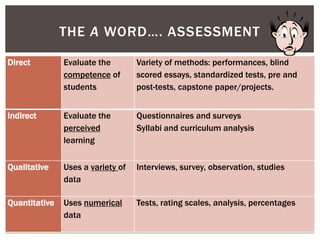
Direct         Evaluate the        Variety of methods: performances, blind
               competence of       scored essays, standardized tests, pre and
               students            post-tests, capstone paper/projects.


Indirect       Evaluate the        Questionnaires and surveys
               perceived           Syllabi and curriculum analysis
               learning


Qualitative    Uses a variety of   Interviews, survey, observation, studies
               data

Quantitative   Uses numerical      Tests, rating scales, analysis, percentages
               data
KNOW WHAT EMPLOYERS WANT

 Business research skills: What are employer s expecting of our
       graduates, and are we meeting those expectations?

                        Let’s ask them!


       What do faculty and students think they need?
EXAMPLE: WHAT WE’RE DOING NOW

 Entrepreneurship class : Semester-long project where
  undergraduate students gather forms and material they would
  need in order to start a business

 Library session for this class is designed to get the students
  using the resources they will need to use to find this information -
  must look for clues and read (!) in order to understand what they
  need.
THEY’RE GETTING IT…


 “I really enjoyed this week’s assignments, especially
  the Research Guide Worksheet. Going through that
  exercise revealed so much more information than I
  had anticipated.”
LET’S GET BUSY AND
WORK ON WHAT WE
     LEARNED
ACTIVIT Y #1

What are some ways you can reach
    out to your constituents?
       Brainstorm, discuss, and share.
   Write your ideas on the gigantic post -it!
ACTIVIT Y #2

 How do you incorporate the ACRL IL standards in an
                   assignment?

Directions:
1. Work with the people at your table
2. Read your case study and determine which one of
   the ACRL IL standards/outcomes would work best
   for this case study.
3. Make sure to take notes-one of you will need to
   report back to everybody.
ACTIVIT Y #3

            Develop methods of assessment

Directions
1. Work with your group
2. Read your case study from the previous activity
3. Read the assessment section in your handout
4. As a group discuss and determine what steps you
   will take to teach information literacy. Fill out the
   chart provided
QUESTIONS??

Georgia Conference on Information Literacy 2012

  • 1.
    TEACHING TOOLS FOR REAL LIFE SKILLS: INFORMATION LITERACY Georgia International Conference FOR THE WORKPLACE On Information Literacy September 2012 Alessia Zanin-Yost and Betsy Clementson Research and Instruction Librarians Western Carolina University
  • 2.
    WHAT ARE WEGOING TO DO TODAY  Discussion 1. Learn about information literacy 2. Evaluate what types of assessment you can use 3. Investigate what skills new graduates should have  Activities 1. Explore ways to reach to your constituents 2. How to incorporate the ACRL standards into assignments 3. Develop methods of evaluation
  • 3.
    INFORMATION LITERACY We are using the ACRL definition Information literacy is a set of abilities requiring individuals to “recognize when information is needed and have the ability to locate, evaluate, and use effectively the needed information.” Why do we need information literacy today? We have the Web, Google and Wikipedia…. Why do we- librarians- need to teach it?
  • 4.
    CRITICAL THINKING SKILLS  Read the operating board  Develop and maintain documentation  Conduct research on network products  Ability to develop action plans with work estimates  Ability to present ideas  Organizational and analytical skills  Knowledge of the use/mixture of cleaning chemicals  Working knowledge of equine health management
  • 5.
    FROM CLASS TOWORK– WHY? What do you teach students in your library instruction classes? Is it possible to combine academics, information literacy, and “working” skills?
  • 6.
    EXAMPLE  Interior Design  Traditional research paper  Issues: plagiarism, poor content, poor use of resources, boooooring… BRIGHT IDEA Why not change the assignment into something students can actually use later on in their profession?
  • 7.
    GOOD IDEAS NEEDASSESSMENT  Why do I need to assess? Because assessment is an INTEGRAL part of teaching and learning. It will affect what and how you teach and what and how your students learn. 1. Begin with one small project 2. Assess the impact 3. Make changes 4. Re-apply
  • 8.
    ASSESSMENT  Testing isNOT assessment. Testing is just a component of assessing learning.  Assessment must be authentic - meaning it needs to reflect real-world expectations.  In the workplace students will not be assessed through multiple-choice tests or research papers.  Assessment comes before planning. Ask yourself “What am I going to assess?” and “Why?”
  • 9.
    THE A WORD….ASSESSMENT Direct Evaluate the Variety of methods: performances, blind competence of scored essays, standardized tests, pre and students post-tests, capstone paper/projects. Indirect Evaluate the Questionnaires and surveys perceived Syllabi and curriculum analysis learning Qualitative Uses a variety of Interviews, survey, observation, studies data Quantitative Uses numerical Tests, rating scales, analysis, percentages data
  • 10.
    KNOW WHAT EMPLOYERSWANT  Business research skills: What are employer s expecting of our graduates, and are we meeting those expectations?  Let’s ask them!  What do faculty and students think they need?
  • 11.
    EXAMPLE: WHAT WE’REDOING NOW  Entrepreneurship class : Semester-long project where undergraduate students gather forms and material they would need in order to start a business  Library session for this class is designed to get the students using the resources they will need to use to find this information - must look for clues and read (!) in order to understand what they need.
  • 12.
    THEY’RE GETTING IT… “I really enjoyed this week’s assignments, especially the Research Guide Worksheet. Going through that exercise revealed so much more information than I had anticipated.”
  • 13.
    LET’S GET BUSYAND WORK ON WHAT WE LEARNED
  • 14.
    ACTIVIT Y #1 Whatare some ways you can reach out to your constituents? Brainstorm, discuss, and share. Write your ideas on the gigantic post -it!
  • 15.
    ACTIVIT Y #2 How do you incorporate the ACRL IL standards in an assignment? Directions: 1. Work with the people at your table 2. Read your case study and determine which one of the ACRL IL standards/outcomes would work best for this case study. 3. Make sure to take notes-one of you will need to report back to everybody.
  • 16.
    ACTIVIT Y #3 Develop methods of assessment Directions 1. Work with your group 2. Read your case study from the previous activity 3. Read the assessment section in your handout 4. As a group discuss and determine what steps you will take to teach information literacy. Fill out the chart provided
  • 17.

Editor's Notes

  • #3 Alessia
  • #4 AlessiaTalk about our background- Betsy and Alessia at different stages
  • #5 Something we connect to higher level jobs- jobs that need lots of education like doctor, teacher. ALL jobs can use information literacy
  • #6 Alessia
  • #7 Alessia
  • #8 Alessia
  • #9 Alessia- Not limited to standard assessment- projects, group discussions, portfolio. Need to be centered on what students will do in their jobs. Development of concrete skills
  • #10 Measures are what you are looking to achieve. 10% of the students will be able to… Methods are tools. See above chart Outcomes the results of the assessment.
  • #11 BetsySince I started this position 3 years ago, have been thinking about the connection between research skills we are teaching and those that are needed and being used out in the ‘real world’ –business research skills needed to uncover information to make sound business decisions. In planning stages of a research project to find out more about this- a mix of qualitative and quantitative research- interview employers, survey employers and alumni (employees)To start, reached out to:Faculty and program coordinator- specifically for the MBA programprogram advisory boards made up of employers/practitioners- ex: MBA advisory boardStarting with alumni from MBA program and their employers, as well as local employers and business leaders Adapting questions from previous surveys – Cornell Univ did something similar in late 1980s; James Madison Univ business librarian has done something similar more recently; also literature review- business information literacy, workplace information literacy…Research project intends to gather information from employers and alumni and analyze if we are meeting their needs and expectationsWill this lead to changes in curriculum? How will results differ from what faculty and students think they need to know about business research?
  • #12 Betsy** Need better transition to this slide ** - example of connection to ACRL standards? Already trying to infuse hands-on activities and real-world examples into business IL sessions – Entrepreneurship program designed to prepare students to start a business. I want to make sure students at every level of this program can find info for their assignments and know how to find and evaluate information so they can make good business decisions. Example is Entrepreneurship class called New Venture GrowthExamples of things they must find include: IRS forms, partnership agreements, articles of incorporation, sample income statements and balance sheets, HR forms, intellectual property agreements,…Course is being taught online this semester for the first time. Challenge is how to translate classroom workshop to online environment- beyond a research guide.
  • #13 Betsy-Some previous ENT 350 students wondered why I didn’t just post the docs in the research guide. This is a quote from a student in this semester’s online ENT 350 class. We’re getting our message across!
  • #16 Discussion-Have each table report their findingsType responses in Word doc as they are reporting- send to participants- ask them to sign up w/email address
  • #17 Fill in chart as they reportNumber the assignments