PHYSICAL EXAMINATION 
Prepared By: Mr.Mihir Patel 
Lecturer,JCN,Bhandu.
Definition 
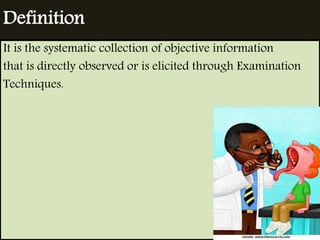
It is the systematic collection of objective information 
that is directly observed or is elicited through Examination 
Techniques.
Purposes 
 To understand the physical and mental well being of the clients. 
 To detect diseases in its early stage. 
 To determine the cause and the extent of the disease. 
 To understand any changes in the condition of diseases. 
 To determine the nature of the treatment or nursing care needed for 
the client. 
 To safeguard the client and his family by noting the early signs. 
 To contribute to the medical research. 
 To find out whether the person is medically fit or not for a particular 
task.
Techniques of Physical Examination 
The four basic techniques used in physical examination 
are explained as follows. 
Inspection 
Palpation 
Percussion 
Auscultation 
Manipulation
Cont… 
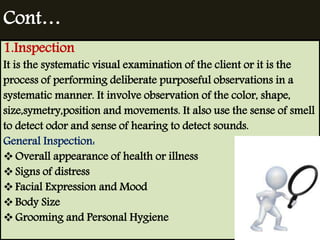
1.Inspection 
It is the systematic visual examination of the client or it is the 
process of performing deliberate purposeful observations in a 
systematic manner. It involve observation of the color, shape, 
size,symetry,position and movements. It also use the sense of smell 
to detect odor and sense of hearing to detect sounds. 
General Inspection: 
Overall appearance of health or illness 
 Signs of distress 
 Facial Expression and Mood 
 Body Size 
Grooming and Personal Hygiene
Cont… 
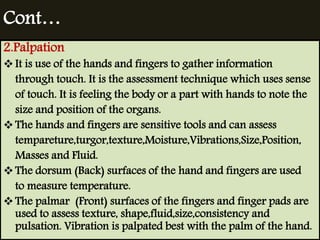
2.Palpation 
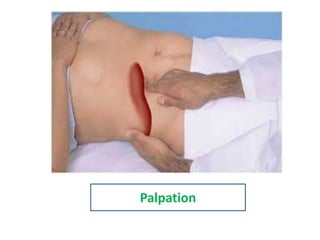
 It is use of the hands and fingers to gather information 
through touch. It is the assessment technique which uses sense 
of touch. It is feeling the body or a part with hands to note the 
size and position of the organs. 
 The hands and fingers are sensitive tools and can assess 
tempareture,turgor,texture,Moisture,Vibrations,Size,Position, 
Masses and Fluid. 
 The dorsum (Back) surfaces of the hand and fingers are used 
to measure temperature. 
 The palmar (Front) surfaces of the fingers and finger pads are 
used to assess texture, shape,fluid,size,consistency and 
pulsation. Vibration is palpated best with the palm of the hand.
Palpation
Cont.. 
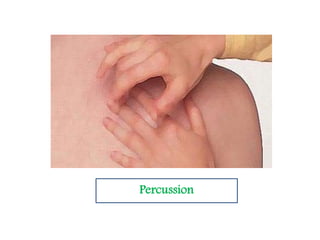
3.Percussion 
It is the examination by tapping the fingers on the body to 
determine the condition of the internal organs by the sounds 
that are produced. Percussion is the act of striking one object 
against another to produce sound. The sound waves 
produced 
by the striking action over body tissues are known as 
percussion tones or percussion notes. Percussion is also used 
to 
determine if a structure is air filled, fluid filled or solid.
Cont.. 
The degree to which sound propagates is called Resonance. 
Percussion produces characteristic tones Tympanic, 
Hyper-resonant, Resonant, Dull and Flat. 
Hyper Inflated Lung Tissue - Hyper resonant 
Normal Lung Tissue - Resonant 
Liver - Dull 
Bone - Flat
Percussion
Cont… 
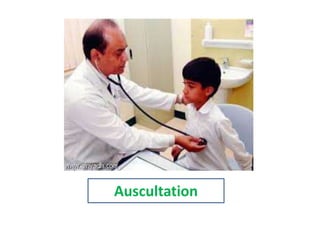
4.Auscultation 
It is the process of listening to sounds that are generated 
within the body. Auscultation is usually done with a 
Sthethoscope.The heart and blood vessels are auscultated for 
circulation of blood, the lungs are auscultated for moving air 
(Breath Sound), The abdomen is auscultated for movement of 
gastrointestinal contents (Bowel Sounds)
Cont.. 
Four Characteristics of sound are assessed by auscultation; 
Pitch (Ranging from High to low) 
Loudness (Ranging from Soft to Loud) 
Quality (Gurgling ) 
Duration (Short, Medium or Long)
Auscultation
Cont.. 
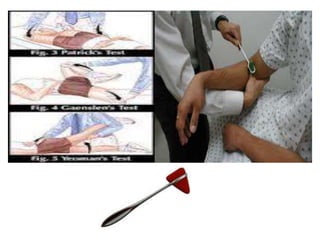
5.Manipulation 
It is the moving of a part of the body to note its flexibility. 
Limitation of movement is discovered by this movement. 
Testing of reflexes 
The response of the tissues to external stimuli is tested by 
means of a percussion hammer, safety pin, wisp of cotton or 
hot and cold water.
General Examination or Head to Toe 
Examination 
Role of Nurse in General Examination 
Preparation of Environment 
 Maintenance of Privacy 
A separate examination room is needed, Keep the door 
closed. The relatives are not allowed. 
 Lighting 
There should be Adequate Lighting.(Natural Lighting) 
 Comfortable Bed or Examination Table 
The client should be placed comfortably throughout the 
examination
Cont… 
 Preparation of the Equipment 
 Preparation of the Client 
Physical Preparation 
Mental Preparation
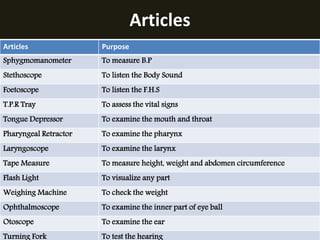
Articles 
Articles Purpose 
Sphygmomanometer To measure B.P 
Stethoscope To listen the Body Sound 
Foetoscope To listen the F.H.S 
T.P.R Tray To assess the vital signs 
Tongue Depressor To examine the mouth and throat 
Pharyngeal Retractor To examine the pharynx 
Laryngoscope To examine the larynx 
Tape Measure To measure height, weight and abdomen circumference 
Flash Light To visualize any part 
Weighing Machine To check the weight 
Ophthalmoscope To examine the inner part of eye ball 
Otoscope To examine the ear 
Turning Fork To test the hearing
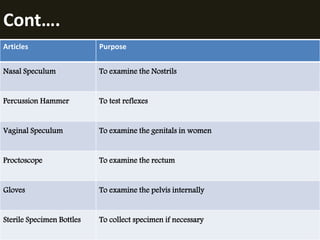
Cont…. 
Articles Purpose 
Nasal Speculum To examine the Nostrils 
Percussion Hammer To test reflexes 
Vaginal Speculum To examine the genitals in women 
Proctoscope To examine the rectum 
Gloves To examine the pelvis internally 
Sterile Specimen Bottles To collect specimen if necessary
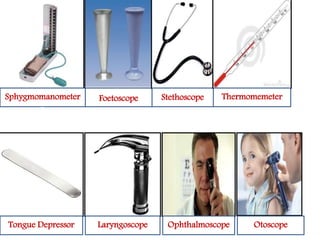
Sphygmomanometer 
p 
Foetoscope Stethoscope Thermomemeter 
Tongue Depressor Laryngoscope Ophthalmoscope Otoscope
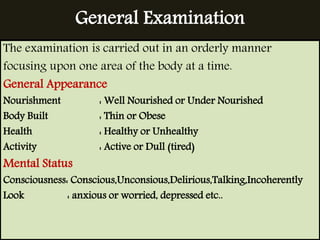
General Examination 
The examination is carried out in an orderly manner 
focusing upon one area of the body at a time. 
General Appearance 
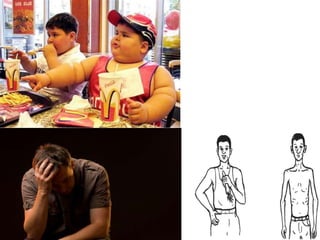
Nourishment : Well Nourished or Under Nourished 
Body Built : Thin or Obese 
Health : Healthy or Unhealthy 
Activity : Active or Dull (tired) 
Mental Status 
Consciousness: Conscious,Unconsious,Delirious,Talking,Incoherently 
Look : anxious or worried, depressed etc..
Cont…. 
Posture 
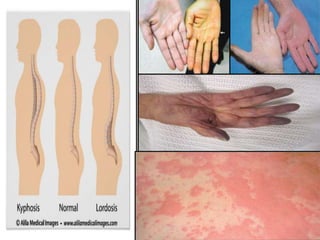
Body Curves: Lordosis,Kyphosis,scoliosis 
Movement: Any limp. 
Height and Weight 
Skin Conditions 
Colour : Pallor,Jaundice,Cyanosis,Flushing etc… 
Texture : Dryness,Flaking,Wrinkling or Excessive 
moisture. 
Temperature: Warm, Cold and Clammy. 
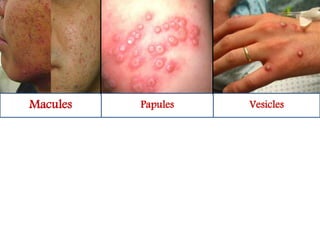
Lesions : Macules,Papules,vesicles,wound etc…
Macules Papules Vesicles
Cont… 
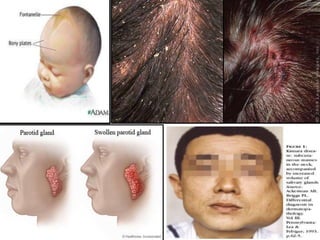
Head and Face 
Shape of the Skull and Fontanels (newborns) 
Skull Circumference 
Scalp: Cleanliness, Condition of Hair,dandruff,Pediculi or 
Infection. 
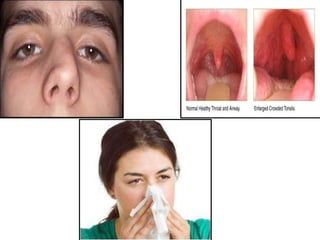
Face: Pale,Flushed,Puffiness,Fatigue,Pain,Fear,Anxiety, 
Enlargement of Perotid Glands etc…
Cont… 
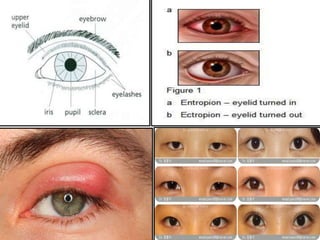
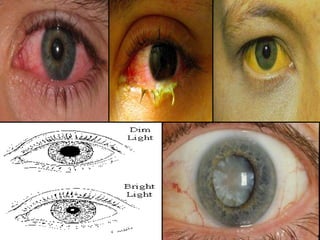
Eyes: 
Eye Brows : Normal or Absent 
Eye Lashes : Infection, Sty. 
Eye Lids : Oedema,Lesions,Ectropion (eversion), 
Entropion(inversion) 
Eyeballs : Sunken or Protruded 
Conjuctive : Pale,Red.Purulent. 
Sclera : Jaundiced 
Cornea and Iris: Irregularities and abrasions 
Pupils : Dilated,Constricted,Reaction to light 
Lens : Opaque or Transparent
Cont…. 
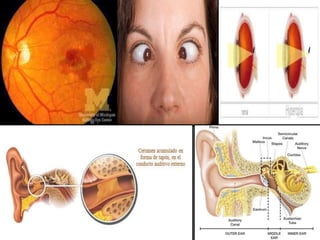
Fundus : Congestion,Hemorrahagic Spots. 
Eye Muscles : Strabismus (Squint) 
Vision: Normal Myopia (Short Sight),Hyperopia (Long sight) 
Ears: 
External Ear : Discharges, Cerumen, Obstructing the ear 
Passage. 
Tympanic Membrane: Perforations,Lesions,Bulging. 
Hearing : Hearing Aquity
Cont.. 
Nose: 
External Nares: Crusts or Discharges 
Nostrils: Inflammation of the Mucus Membrane,Septal 
Deviations. 
Mouth and Pharynx: 
Lips : Redness,Swelling,Crusts,Cyanosis,stomatitis. 
Odour of the mouth : Foul Smelling 
Teeth : Discoloration and dental caries 
Mucus Membrane : Ulceration and Bleeding, swelling. 
Tongue: Pale,Dry,Lesions etc… 
Throat and Pharynx : Enlarged Tonsils,Redness,Pus.
Cont….. 
Neck: 
Lymph Nodes: Enlarged,Plapable. 
Thyroid Gland : Enlarged 
Range of Motion : Flexion, Extension and Rotation. 
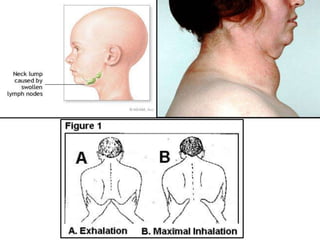
Chest: 
Thorax : Shape, Symmetry of expansion, Posture. 
Breath Sound: wheezing,crepitations,pleural rub etc,, 
Heart : Size and Location, Cardiac Murmur. 
Breasts : Enlarged lymph nodes.
Cont….. 
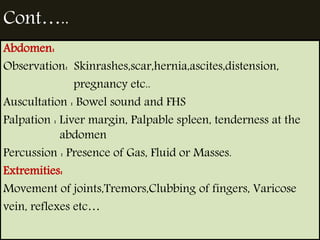
Abdomen: 
Observation: Skinrashes,scar,hernia,ascites,distension, 
pregnancy etc.. 
Auscultation : Bowel sound and FHS 
Palpation : Liver margin, Palpable spleen, tenderness at the 
abdomen 
Percussion : Presence of Gas, Fluid or Masses. 
Extremities: 
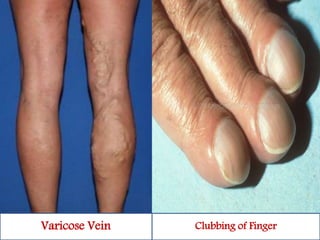
Movement of joints,Tremors,Clubbing of fingers, Varicose 
vein, reflexes etc…
Varicose Vein Clubbing of Finger
Cont….. 
Back: 
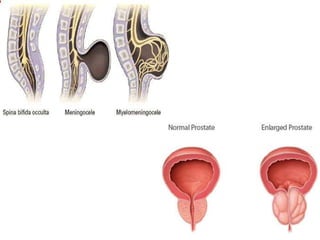
Spina Bifida, Curves. 
Genitals and Rectum: 
Inguinal lymph glands : Enlarged, Palpable. 
Patency of Urinary meatus and rectum. 
Descent of the testes 
Vaginal discharges 
Presence of STD 
Hemorrhoids 
Enlargement of Prostate Gland
Cont….. 
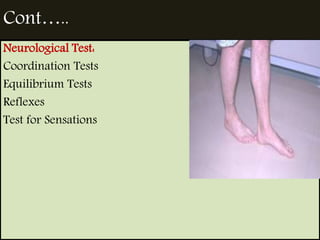
Neurological Test: 
Coordination Tests 
Equilibrium Tests 
Reflexes 
Test for Sensations

Physical examination

  • 1.
    PHYSICAL EXAMINATION PreparedBy: Mr.Mihir Patel Lecturer,JCN,Bhandu.
  • 2.
    Definition It isthe systematic collection of objective information that is directly observed or is elicited through Examination Techniques.
  • 3.
    Purposes  Tounderstand the physical and mental well being of the clients.  To detect diseases in its early stage.  To determine the cause and the extent of the disease.  To understand any changes in the condition of diseases.  To determine the nature of the treatment or nursing care needed for the client.  To safeguard the client and his family by noting the early signs.  To contribute to the medical research.  To find out whether the person is medically fit or not for a particular task.
  • 4.
    Techniques of PhysicalExamination The four basic techniques used in physical examination are explained as follows. Inspection Palpation Percussion Auscultation Manipulation
  • 5.
    Cont… 1.Inspection Itis the systematic visual examination of the client or it is the process of performing deliberate purposeful observations in a systematic manner. It involve observation of the color, shape, size,symetry,position and movements. It also use the sense of smell to detect odor and sense of hearing to detect sounds. General Inspection: Overall appearance of health or illness  Signs of distress  Facial Expression and Mood  Body Size Grooming and Personal Hygiene
  • 6.
    Cont… 2.Palpation It is use of the hands and fingers to gather information through touch. It is the assessment technique which uses sense of touch. It is feeling the body or a part with hands to note the size and position of the organs.  The hands and fingers are sensitive tools and can assess tempareture,turgor,texture,Moisture,Vibrations,Size,Position, Masses and Fluid.  The dorsum (Back) surfaces of the hand and fingers are used to measure temperature.  The palmar (Front) surfaces of the fingers and finger pads are used to assess texture, shape,fluid,size,consistency and pulsation. Vibration is palpated best with the palm of the hand.
  • 7.
  • 8.
    Cont.. 3.Percussion Itis the examination by tapping the fingers on the body to determine the condition of the internal organs by the sounds that are produced. Percussion is the act of striking one object against another to produce sound. The sound waves produced by the striking action over body tissues are known as percussion tones or percussion notes. Percussion is also used to determine if a structure is air filled, fluid filled or solid.
  • 9.
    Cont.. The degreeto which sound propagates is called Resonance. Percussion produces characteristic tones Tympanic, Hyper-resonant, Resonant, Dull and Flat. Hyper Inflated Lung Tissue - Hyper resonant Normal Lung Tissue - Resonant Liver - Dull Bone - Flat
  • 10.
  • 11.
    Cont… 4.Auscultation Itis the process of listening to sounds that are generated within the body. Auscultation is usually done with a Sthethoscope.The heart and blood vessels are auscultated for circulation of blood, the lungs are auscultated for moving air (Breath Sound), The abdomen is auscultated for movement of gastrointestinal contents (Bowel Sounds)
  • 12.
    Cont.. Four Characteristicsof sound are assessed by auscultation; Pitch (Ranging from High to low) Loudness (Ranging from Soft to Loud) Quality (Gurgling ) Duration (Short, Medium or Long)
  • 13.
  • 14.
    Cont.. 5.Manipulation Itis the moving of a part of the body to note its flexibility. Limitation of movement is discovered by this movement. Testing of reflexes The response of the tissues to external stimuli is tested by means of a percussion hammer, safety pin, wisp of cotton or hot and cold water.
  • 16.
    General Examination orHead to Toe Examination Role of Nurse in General Examination Preparation of Environment  Maintenance of Privacy A separate examination room is needed, Keep the door closed. The relatives are not allowed.  Lighting There should be Adequate Lighting.(Natural Lighting)  Comfortable Bed or Examination Table The client should be placed comfortably throughout the examination
  • 17.
    Cont…  Preparationof the Equipment  Preparation of the Client Physical Preparation Mental Preparation
  • 18.
    Articles Articles Purpose Sphygmomanometer To measure B.P Stethoscope To listen the Body Sound Foetoscope To listen the F.H.S T.P.R Tray To assess the vital signs Tongue Depressor To examine the mouth and throat Pharyngeal Retractor To examine the pharynx Laryngoscope To examine the larynx Tape Measure To measure height, weight and abdomen circumference Flash Light To visualize any part Weighing Machine To check the weight Ophthalmoscope To examine the inner part of eye ball Otoscope To examine the ear Turning Fork To test the hearing
  • 19.
    Cont…. Articles Purpose Nasal Speculum To examine the Nostrils Percussion Hammer To test reflexes Vaginal Speculum To examine the genitals in women Proctoscope To examine the rectum Gloves To examine the pelvis internally Sterile Specimen Bottles To collect specimen if necessary
  • 20.
    Sphygmomanometer p FoetoscopeStethoscope Thermomemeter Tongue Depressor Laryngoscope Ophthalmoscope Otoscope
  • 21.
    General Examination Theexamination is carried out in an orderly manner focusing upon one area of the body at a time. General Appearance Nourishment : Well Nourished or Under Nourished Body Built : Thin or Obese Health : Healthy or Unhealthy Activity : Active or Dull (tired) Mental Status Consciousness: Conscious,Unconsious,Delirious,Talking,Incoherently Look : anxious or worried, depressed etc..
  • 23.
    Cont…. Posture BodyCurves: Lordosis,Kyphosis,scoliosis Movement: Any limp. Height and Weight Skin Conditions Colour : Pallor,Jaundice,Cyanosis,Flushing etc… Texture : Dryness,Flaking,Wrinkling or Excessive moisture. Temperature: Warm, Cold and Clammy. Lesions : Macules,Papules,vesicles,wound etc…
  • 25.
  • 26.
    Cont… Head andFace Shape of the Skull and Fontanels (newborns) Skull Circumference Scalp: Cleanliness, Condition of Hair,dandruff,Pediculi or Infection. Face: Pale,Flushed,Puffiness,Fatigue,Pain,Fear,Anxiety, Enlargement of Perotid Glands etc…
  • 28.
    Cont… Eyes: EyeBrows : Normal or Absent Eye Lashes : Infection, Sty. Eye Lids : Oedema,Lesions,Ectropion (eversion), Entropion(inversion) Eyeballs : Sunken or Protruded Conjuctive : Pale,Red.Purulent. Sclera : Jaundiced Cornea and Iris: Irregularities and abrasions Pupils : Dilated,Constricted,Reaction to light Lens : Opaque or Transparent
  • 31.
    Cont…. Fundus :Congestion,Hemorrahagic Spots. Eye Muscles : Strabismus (Squint) Vision: Normal Myopia (Short Sight),Hyperopia (Long sight) Ears: External Ear : Discharges, Cerumen, Obstructing the ear Passage. Tympanic Membrane: Perforations,Lesions,Bulging. Hearing : Hearing Aquity
  • 33.
    Cont.. Nose: ExternalNares: Crusts or Discharges Nostrils: Inflammation of the Mucus Membrane,Septal Deviations. Mouth and Pharynx: Lips : Redness,Swelling,Crusts,Cyanosis,stomatitis. Odour of the mouth : Foul Smelling Teeth : Discoloration and dental caries Mucus Membrane : Ulceration and Bleeding, swelling. Tongue: Pale,Dry,Lesions etc… Throat and Pharynx : Enlarged Tonsils,Redness,Pus.
  • 35.
    Cont….. Neck: LymphNodes: Enlarged,Plapable. Thyroid Gland : Enlarged Range of Motion : Flexion, Extension and Rotation. Chest: Thorax : Shape, Symmetry of expansion, Posture. Breath Sound: wheezing,crepitations,pleural rub etc,, Heart : Size and Location, Cardiac Murmur. Breasts : Enlarged lymph nodes.
  • 37.
    Cont….. Abdomen: Observation:Skinrashes,scar,hernia,ascites,distension, pregnancy etc.. Auscultation : Bowel sound and FHS Palpation : Liver margin, Palpable spleen, tenderness at the abdomen Percussion : Presence of Gas, Fluid or Masses. Extremities: Movement of joints,Tremors,Clubbing of fingers, Varicose vein, reflexes etc…
  • 38.
  • 39.
    Cont….. Back: SpinaBifida, Curves. Genitals and Rectum: Inguinal lymph glands : Enlarged, Palpable. Patency of Urinary meatus and rectum. Descent of the testes Vaginal discharges Presence of STD Hemorrhoids Enlargement of Prostate Gland
  • 41.
    Cont….. Neurological Test: Coordination Tests Equilibrium Tests Reflexes Test for Sensations