Barry Kidd 2010 1
Burn Assessment and
Management
Barry Kidd 2010 2
Objectives
 • Discuss the mechanisms and
 complications of a thermal burn,
 electrical burn and an inhalation burn
 • Explain the factors to consider when
 determining the severity of a burn
Barry Kidd 2010 3
Burn Assessment and
Management
Case Study
• You are called to an elementary school
for a burn injury.
• You are told that a staff member lost
their grip on a vat of hot oil and spilled
it on their arms.
• The patient is in the school nurse’s
office.
Barry Kidd 2010 4
Questions Regarding the Case
Study
• How severe is this mechanism of injury?
• Will you expect to find any compromise
to airway, breathing or circulation during your
initial assessment?
• How severe will you expect the burn to be?
Barry Kidd 2010 5
Patient Assessment
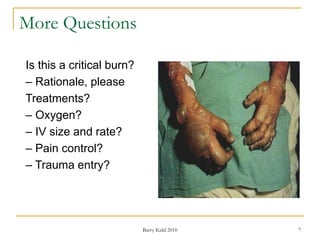
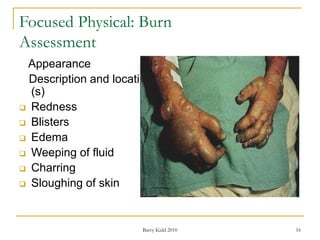
The patient is awake,
conscious and tearful
She is breathing
normally but appears to
be in significant pain
Her burns appear
isolated to her hands
and lower arms.
Barry Kidd 2010 6
Patient Assessment
Vital signs
– HR is 96
– RR is 16
– BP is 140/88
Patient History
– She is 55 years old
– History of hypertension
Barry Kidd 2010 7
More Questions
Is this a critical burn?
– Rationale, please
Treatments?
– Oxygen?
– IV size and rate?
– Pain control?
– Trauma entry?
Barry Kidd 2010 8
Mechanisms of Thermal Burns
Barry Kidd 2010 9
Phases of a Burn Injury
• Emergent Phase
• Fluid Shift Phase
• Hypermetabolic Phase
• Resolution Phase
Barry Kidd 2010 10
Complications of Thermal Burns
• Infection
• Eschar formation
Barry Kidd 2010 11
Burn Assessment
Barry Kidd 2010 12
Burn Assessment
Scene Assessment
 Safety First!
 Mechanism of Injury
 Chemicals
 Enclosed space?
 Other trauma?
 Intentional?
Initial Assessment
 Airway compromise
now?
Potential for this later?
 Breathing
associated with cough
Circulation
 Signs of shock
Barry Kidd 2010 13
Burn Assessment
Barry Kidd 2010 14
Potentially Critical Findings
Hoarseness
Adventitious airway
sounds
Soot in nose or on
tongue
Singed hair
Facial edema
Scene
Dysphagia (difficulty in
swallowing)
Dysphasia (difficulty in
producing or
comprehending spoken
word )
Adventitious breath sounds
Significant dyspnea
Altered level of
consciousness
Barry Kidd 2010 15
Focused Physical Assessment
Signs of trauma
– Musculoskeletal injuries
– Isolated injuries
– Evidence of abuse
– Signs of shock
Barry Kidd 2010 16
Focused Physical: Burn
Assessment
Appearance
Description and location
(s)
 Redness
 Blisters
 Edema
 Weeping of fluid
 Charring
 Sloughing of skin
Barry Kidd 2010 17
Focused Physical Assessment
Determining the Severity of a Burn
 Depth of the burn
 Percentage of the body burned
 Location of the burn
 Other factors
Barry Kidd 2010 18
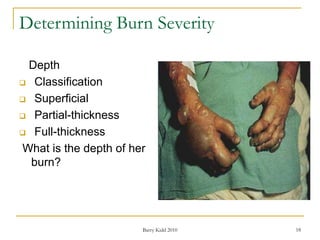
Determining Burn Severity
Depth
 Classification
 Superficial
 Partial-thickness
 Full-thickness
What is the depth of her
burn?
Barry Kidd 2010 19
Determining Burn Severity
Body surface area
Rule of Nines
 Adult
 Pediatric
 Rule of Palms
 Small burns
 Use of the patient’s
palm
Barry Kidd 2010 20
What is the % of BSA Involved in
Our Patient?
Barry Kidd 2010 21
Determining Burn Severity
Other factors
 Burn location
 Hands, feet, genitalia
 Age
 Pre-existing medical conditions
 Medications
 Presence of multi-systems trauma
 Inhalation injury
Barry Kidd 2010 22
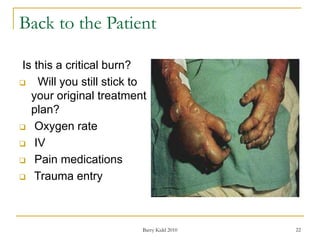
Back to the Patient
Is this a critical burn?
 Will you still stick to
your original treatment
plan?
 Oxygen rate
 IV
 Pain medications
 Trauma entry
Barry Kidd 2010 23
Complications From a
Significant Burn Injury
Barry Kidd 2010 24
Complications
 Fluid loss
 Weeping of wounds
 Hypothermia potential
 Electrolyte loss
 Hypovolemia
Signs of shock indicate that there is another
serious injury present
Shock resulting from a burn will typically occur hours
after the insult
Barry Kidd 2010 25
Complications
Systemic acidosis
 From tissue death
 Hypoxia
 Infection
 Organ failure
 Eschar (a scab formed especially after a
burn.)
 Circumferential burns
Barry Kidd 2010 26
General Management of Burns
Airway and ventilatory support
 Early recognition of potential airway
compromise
 ALS intercept is critical for early advanced
airway management
 Consider transport to a trauma facility if the
MOI and/or initial patient presentation
indicates a severe inhalation injury
Barry Kidd 2010 27
Emergency Care - Thermal
Burns
 Stop the burning
 Assess breathing
 Look for signs of airway injury, soot, burnt
nasal hair, facial burns
 Oxygen
 Complete initial assessment
 Treat for shock
Barry Kidd 2010 28
Emergency Care - Thermal
Burns
 Evaluate burns by depth, extent, and severity
 Remove clothing and jewelry
 Separate fingers or toes with sterile
 gauze pads
 Wrap in dry sterile dressing
Barry Kidd 2010 29
General Management of Burns
 Medications for pain management
 Entonox
 Suppresses the conscious awareness of pain
in the brain
 Reduces anxiety
 NSAID
Barry Kidd 2010 30
General Management of Burns
 Suppresses the pain response in the cell
membrane
 Works well with acute, severe pain
Barry Kidd 2010 31
Specific Burn Profiles
Barry Kidd 2010 32
Barry Kidd 2010 33
Patient Assessment
 Patient is approximately 45 years old and is
unconscious/unresponsive to painful stimuli.
 He has heavy soot deposits on his face and in his
nose. He is not breathing.
 Firefighters tell you that the patient was not moving
when they found him on his bed.
 The patient has no thermal burns on his body.
Barry Kidd 2010 34
Mechanisms of Inhalation Injuries
 Superheated air
 Mechanism similar to a thermal burn
 Mucous membranes will intensify the burn
 Fluid shifts may cause progressive airway
obstruction
 Chemical burns
Barry Kidd 2010 35
Inhalation Injuries Severity
 Product of combustion
 Duration of exposure
 Confined space
Barry Kidd 2010 36
Inhalation Injuries
Edema can be progressive and may appear
mild at first
Symptoms may not appear for hours
Barry Kidd 2010 37
Progressive Edema
Barry Kidd 2010 38
Signs and Symptoms of Upper
Airway Injury
 Singed nasal hairs
 Facial burns
 Burned specks of
carbon in the sputum
 Sooty or smoky smell
on breath
 You may see burns of
the oral mucosa
Barry Kidd 2010 39
Upper Airway
 Restriction of chest wall
movement
 Restlessness
 Chest tightness
 Stridor
 Wheezing
 Difficulty in swallowing
 Hoarseness
 Coughing
 Cyanosis
 Signs of Respiratory
Distress
Barry Kidd 2010 40
Inhalation of Noxious Fumes
 Mucosa in lungs swell
and break
 Fluid leaks into alveolar
space
 Cilia is damaged
 Mucus builds up
 Airway is plugged
 Oxygen exchange is
reduced
Barry Kidd 2010 41
Inhalation Assessment Tip
Isolated burns do not alter levels of
consciousness of the patient
If the patient is unconscious assume carbon
monoxide poisoning
Barry Kidd 2010 42
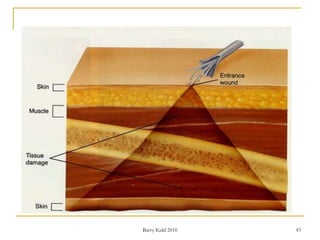
Electrical Burns
 Contact Burns (when
the current is intense
at the entrance and exit
sites)
 Flash Burns
 Arcing injuries (when
current jumps from one
surface to another)
Barry Kidd 2010 43
Barry Kidd 2010 44
Severity of Electrical Shock
 Voltage and amperage of the current
(amperage kills)
 Alternating or Direct current
 Amount of time the patient is exposed
 Amount of moisture on the patient
Barry Kidd 2010 45
Severity of Electrical Shock
 Amount of body surface in contact with water
 Amount of insulation worn by the patient
 Area of the body through which the current
passes
Barry Kidd 2010 46
Signs and Symptoms of
Electrocution
 Patient is dazed or confused
 There are obvious and severe burns on the
skin
 The patient is unconsciousness
 Weak, irregular, or no pulse
 Shallow, irregular, or absent breathing
 Multiple severe fractures due to intense
muscle contractions
Barry Kidd 2010 47
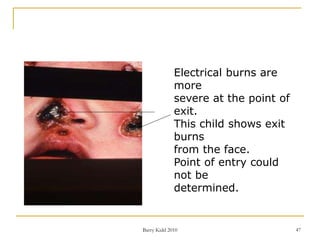
Electrical burns are
more
severe at the point of
exit.
This child shows exit
burns
from the face.
Point of entry could
not be
determined.
Barry Kidd 2010 48
Barry Kidd 2010 49
Barry Kidd 2010 50
Barry Kidd 2010 51
Emergency Care - Electrical
Burns
 Assure your safety first
 Provide airway care
 Provide CPR as needed
 Care for shock
 Care for spinal injuries, head injuries, and
severe fractures
Barry Kidd 2010 52
Emergency Care - Electrical
Burns
 Evaluate electrical burns, looking for at least
two external burn sites, entrance and exit
 Cool the burn, remove clothing
 Apply sterile dressing
 Transport, be prepared for cardiac or
respiratory arrest
Barry Kidd 2010 53
Summary
 Multiple factors should be evaluated when
determining the severity of a burn
 Burn injuries will generate inflammation and
swelling
 Severe injuries will result in severe swelling
 Consider this complication when making treatment
and transport decisions
 Emotional care is also a necessary component in
the EMRs treatment plan
Don’t neglect this!

Burn assessment and management

  • 1.
    Barry Kidd 20101 Burn Assessment and Management
  • 2.
    Barry Kidd 20102 Objectives  • Discuss the mechanisms and  complications of a thermal burn,  electrical burn and an inhalation burn  • Explain the factors to consider when  determining the severity of a burn
  • 3.
    Barry Kidd 20103 Burn Assessment and Management Case Study • You are called to an elementary school for a burn injury. • You are told that a staff member lost their grip on a vat of hot oil and spilled it on their arms. • The patient is in the school nurse’s office.
  • 4.
    Barry Kidd 20104 Questions Regarding the Case Study • How severe is this mechanism of injury? • Will you expect to find any compromise to airway, breathing or circulation during your initial assessment? • How severe will you expect the burn to be?
  • 5.
    Barry Kidd 20105 Patient Assessment The patient is awake, conscious and tearful She is breathing normally but appears to be in significant pain Her burns appear isolated to her hands and lower arms.
  • 6.
    Barry Kidd 20106 Patient Assessment Vital signs – HR is 96 – RR is 16 – BP is 140/88 Patient History – She is 55 years old – History of hypertension
  • 7.
    Barry Kidd 20107 More Questions Is this a critical burn? – Rationale, please Treatments? – Oxygen? – IV size and rate? – Pain control? – Trauma entry?
  • 8.
    Barry Kidd 20108 Mechanisms of Thermal Burns
  • 9.
    Barry Kidd 20109 Phases of a Burn Injury • Emergent Phase • Fluid Shift Phase • Hypermetabolic Phase • Resolution Phase
  • 10.
    Barry Kidd 201010 Complications of Thermal Burns • Infection • Eschar formation
  • 11.
    Barry Kidd 201011 Burn Assessment
  • 12.
    Barry Kidd 201012 Burn Assessment Scene Assessment  Safety First!  Mechanism of Injury  Chemicals  Enclosed space?  Other trauma?  Intentional? Initial Assessment  Airway compromise now? Potential for this later?  Breathing associated with cough Circulation  Signs of shock
  • 13.
    Barry Kidd 201013 Burn Assessment
  • 14.
    Barry Kidd 201014 Potentially Critical Findings Hoarseness Adventitious airway sounds Soot in nose or on tongue Singed hair Facial edema Scene Dysphagia (difficulty in swallowing) Dysphasia (difficulty in producing or comprehending spoken word ) Adventitious breath sounds Significant dyspnea Altered level of consciousness
  • 15.
    Barry Kidd 201015 Focused Physical Assessment Signs of trauma – Musculoskeletal injuries – Isolated injuries – Evidence of abuse – Signs of shock
  • 16.
    Barry Kidd 201016 Focused Physical: Burn Assessment Appearance Description and location (s)  Redness  Blisters  Edema  Weeping of fluid  Charring  Sloughing of skin
  • 17.
    Barry Kidd 201017 Focused Physical Assessment Determining the Severity of a Burn  Depth of the burn  Percentage of the body burned  Location of the burn  Other factors
  • 18.
    Barry Kidd 201018 Determining Burn Severity Depth  Classification  Superficial  Partial-thickness  Full-thickness What is the depth of her burn?
  • 19.
    Barry Kidd 201019 Determining Burn Severity Body surface area Rule of Nines  Adult  Pediatric  Rule of Palms  Small burns  Use of the patient’s palm
  • 20.
    Barry Kidd 201020 What is the % of BSA Involved in Our Patient?
  • 21.
    Barry Kidd 201021 Determining Burn Severity Other factors  Burn location  Hands, feet, genitalia  Age  Pre-existing medical conditions  Medications  Presence of multi-systems trauma  Inhalation injury
  • 22.
    Barry Kidd 201022 Back to the Patient Is this a critical burn?  Will you still stick to your original treatment plan?  Oxygen rate  IV  Pain medications  Trauma entry
  • 23.
    Barry Kidd 201023 Complications From a Significant Burn Injury
  • 24.
    Barry Kidd 201024 Complications  Fluid loss  Weeping of wounds  Hypothermia potential  Electrolyte loss  Hypovolemia Signs of shock indicate that there is another serious injury present Shock resulting from a burn will typically occur hours after the insult
  • 25.
    Barry Kidd 201025 Complications Systemic acidosis  From tissue death  Hypoxia  Infection  Organ failure  Eschar (a scab formed especially after a burn.)  Circumferential burns
  • 26.
    Barry Kidd 201026 General Management of Burns Airway and ventilatory support  Early recognition of potential airway compromise  ALS intercept is critical for early advanced airway management  Consider transport to a trauma facility if the MOI and/or initial patient presentation indicates a severe inhalation injury
  • 27.
    Barry Kidd 201027 Emergency Care - Thermal Burns  Stop the burning  Assess breathing  Look for signs of airway injury, soot, burnt nasal hair, facial burns  Oxygen  Complete initial assessment  Treat for shock
  • 28.
    Barry Kidd 201028 Emergency Care - Thermal Burns  Evaluate burns by depth, extent, and severity  Remove clothing and jewelry  Separate fingers or toes with sterile  gauze pads  Wrap in dry sterile dressing
  • 29.
    Barry Kidd 201029 General Management of Burns  Medications for pain management  Entonox  Suppresses the conscious awareness of pain in the brain  Reduces anxiety  NSAID
  • 30.
    Barry Kidd 201030 General Management of Burns  Suppresses the pain response in the cell membrane  Works well with acute, severe pain
  • 31.
    Barry Kidd 201031 Specific Burn Profiles
  • 32.
  • 33.
    Barry Kidd 201033 Patient Assessment  Patient is approximately 45 years old and is unconscious/unresponsive to painful stimuli.  He has heavy soot deposits on his face and in his nose. He is not breathing.  Firefighters tell you that the patient was not moving when they found him on his bed.  The patient has no thermal burns on his body.
  • 34.
    Barry Kidd 201034 Mechanisms of Inhalation Injuries  Superheated air  Mechanism similar to a thermal burn  Mucous membranes will intensify the burn  Fluid shifts may cause progressive airway obstruction  Chemical burns
  • 35.
    Barry Kidd 201035 Inhalation Injuries Severity  Product of combustion  Duration of exposure  Confined space
  • 36.
    Barry Kidd 201036 Inhalation Injuries Edema can be progressive and may appear mild at first Symptoms may not appear for hours
  • 37.
    Barry Kidd 201037 Progressive Edema
  • 38.
    Barry Kidd 201038 Signs and Symptoms of Upper Airway Injury  Singed nasal hairs  Facial burns  Burned specks of carbon in the sputum  Sooty or smoky smell on breath  You may see burns of the oral mucosa
  • 39.
    Barry Kidd 201039 Upper Airway  Restriction of chest wall movement  Restlessness  Chest tightness  Stridor  Wheezing  Difficulty in swallowing  Hoarseness  Coughing  Cyanosis  Signs of Respiratory Distress
  • 40.
    Barry Kidd 201040 Inhalation of Noxious Fumes  Mucosa in lungs swell and break  Fluid leaks into alveolar space  Cilia is damaged  Mucus builds up  Airway is plugged  Oxygen exchange is reduced
  • 41.
    Barry Kidd 201041 Inhalation Assessment Tip Isolated burns do not alter levels of consciousness of the patient If the patient is unconscious assume carbon monoxide poisoning
  • 42.
    Barry Kidd 201042 Electrical Burns  Contact Burns (when the current is intense at the entrance and exit sites)  Flash Burns  Arcing injuries (when current jumps from one surface to another)
  • 43.
  • 44.
    Barry Kidd 201044 Severity of Electrical Shock  Voltage and amperage of the current (amperage kills)  Alternating or Direct current  Amount of time the patient is exposed  Amount of moisture on the patient
  • 45.
    Barry Kidd 201045 Severity of Electrical Shock  Amount of body surface in contact with water  Amount of insulation worn by the patient  Area of the body through which the current passes
  • 46.
    Barry Kidd 201046 Signs and Symptoms of Electrocution  Patient is dazed or confused  There are obvious and severe burns on the skin  The patient is unconsciousness  Weak, irregular, or no pulse  Shallow, irregular, or absent breathing  Multiple severe fractures due to intense muscle contractions
  • 47.
    Barry Kidd 201047 Electrical burns are more severe at the point of exit. This child shows exit burns from the face. Point of entry could not be determined.
  • 48.
  • 49.
  • 50.
  • 51.
    Barry Kidd 201051 Emergency Care - Electrical Burns  Assure your safety first  Provide airway care  Provide CPR as needed  Care for shock  Care for spinal injuries, head injuries, and severe fractures
  • 52.
    Barry Kidd 201052 Emergency Care - Electrical Burns  Evaluate electrical burns, looking for at least two external burn sites, entrance and exit  Cool the burn, remove clothing  Apply sterile dressing  Transport, be prepared for cardiac or respiratory arrest
  • 53.
    Barry Kidd 201053 Summary  Multiple factors should be evaluated when determining the severity of a burn  Burn injuries will generate inflammation and swelling  Severe injuries will result in severe swelling  Consider this complication when making treatment and transport decisions  Emotional care is also a necessary component in the EMRs treatment plan Don’t neglect this!