Respiration
Applied Aspects
INTRODUCTION
Applied respiratory physiology forms
a link between the basics of respiration and
clinical manifestations of respiratory diseases.
The important applied aspects of respiration
include:
• Respiratory adjustments to stresses in health
• Disturbances of respiration
• Artificial respiration
• Pulmonary function tests.
DISTURBANCES OF RESPIRATION :
• Abnormal respiratory patterns
• Disturbances related to respiratory gases
• Pulmonary diseases: pathophysiological
aspects.
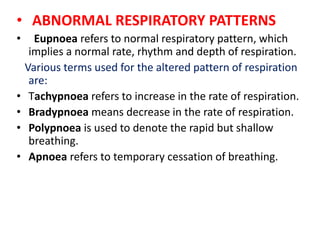
• ABNORMAL RESPIRATORY PATTERNS
• Eupnoea refers to normal respiratory pattern, which
implies a normal rate, rhythm and depth of respiration.
Various terms used for the altered pattern of respiration
are:
• Tachypnoea refers to increase in the rate of respiration.
• Bradypnoea means decrease in the rate of respiration.
• Polypnoea is used to denote the rapid but shallow
breathing.
• Apnoea refers to temporary cessation of breathing.
• Hypoventilation term is used to describe a
decrease in rate and force of respiration.
• Hyperventilation refers to increase in rate as well
as force of respiration.
• Hyperpnoea, signifies a marked increase in
pulmonary ventilation due to increase in rate
and/or force of respiration.
• Dyspnoea: When hyperpnoea involves 4-5 fold
increase in pulmonary ventilation, an unpleasant
sensation or discomfort is felt. This type of
respiration is called dyspnoea.
• Periodic breathing refers to a respiratory pattern
characterized by alternate periods of respiratory
activity and apnoea.
• APNOEA: Apnoea refers to temporary cessation of
breathing.
Depending upon the cause apnoea may be of following
types:
• Voluntary apnoea refers to temporary arrest of
breathing due to voluntary control of respiration.
It is also called breath holding. The breath-holding
time or apnoea time during which breathing can be
withheld voluntarily is about 40-60 seconds in a normal
person, after a deep inspiration.
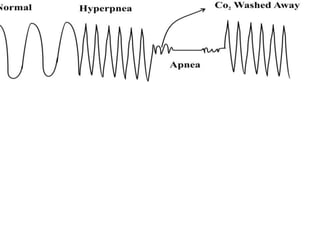
• Apnoea after hyperventilation occurs due to reduced
stimulation of respiratory centre owing to CO2 wash
caused by hyperventilation.
Deglutition apnoea
• Occurs reflexly during swallowing.
• During pharyngeal stage of swallowing the fluid
or food stimulates the sensory nerve endings(5th,9th
and 10th cranial nerves) around the pharynx.
• Nerve impulses from these irritant receptors, via
the swallowing centres specifically inhibit the
respiratory centre stopping the breathing at any
point of the cycle(Deglutition apnoea).
• Simultaneously, there is closure of glottis(the
opening between vocal cords).
• Both these effects prevent aspiration of fluid or food
into the lungs.
• Breath-holding attacks
• Vagal Apnoea:
• produced by stimulation of Vagus nerve.
• Produces Apnoea by inhibiting Inspiratory centre
• Adrenaline Apnoea
• Sleep Apnoea :
• Temporary cessation of breathing during sleep
due inhibition of central chemoreceptors.
Sleep Apnoea syndrome occurs in two forms:
Obstructive sleep apnoea
Non-obstructive(central) sleep apnoea
• DYSPNOEA
• Dyspnoea literally means distressed
breathing. Increased respiration without
discomfort is called hyperpnoea.
• When hyperpnoea involves 4-5 fold increase in
pulmonary ventilation, an unpleasant sensation
or discomfort is felt.
This type of respiration is called dyspnoea.
The word ‘air-hunger’ is used as synonym
to dyspnoea in general language.
• Dyspnoea point refers to the height of
hyperpnoea at which dyspnoea appears.
• Types:
• Predisposing factors for dyspnoea include:
• Low vital capacity
• Maximum ventilatory volume(MVV)
• Breathing reserve(BR) = MVV-RMV=114 L/min
Individuals with less BR are prone to Dyspnoea
• Dyspnoeic index(DI) refers to breathing reserve
percentage of MVV,
DI = BR*100/MVV=110*100/120=95%
Normal = 70-95%
DI<60% dyspnoea occurs
• Normal value of DI range from 70-95%
• Dyspnoea occurs when DI is <60%
• Causes of Dyspnoea :
• Physiological : Severe muscular excersise.
• Pathological –
(i) Respiratory disorders
(ii)Cardiac failure -
ORTHOPNOEA:
Dyspnoea occurring in lying down
position is called Orthopnoea.
(iii)Metabolic disorders
• Cardiac failure
• Pulmonary congestion Decreased vital
capacity
• Tachypnoea
• Increased pulmonary ventilation
• Dyspnoea
PERIODIC BREATHING
• Periodic breathing:
• Periodic breathing is characterized by alternate periods of
respiratory activity and apnoea.
It is of 2 types-
• Cheyne-Stokes respiration and
• Biot’s breathing
• Cheyne-Stokes respiration:
• Characterized by alternate periods of respiratory activity and
apnoea at regular intervals.
• During respiratory activity there is waxing and waning of tidal
volume.
• Duration of one cycle – 1 minute.
• pO2 is lowest pCo2 is highest at the end of apnoea.
Causes:
• Physiological: Voluntary hyper ventilation
High Altitude
During sleep in infants
• Pathological: Chronic heart failure
Brain damage
Uremia
Poisoning by narcotics.
Mechanism:
• Voluntary hyperventilation
• Cardiac failure
• Brain damage
Biots breathing-
• Also known as Ataxic breathing shows alternate
periods of respiratory activity and apnoea
• Occurring at irregular intervals.
• No waxing and waning of tidal volume.
• It is always pathological
• cannot be physiological.
Causes:
• Disruption of normal medullary rhythmicity of
respiration.
• meningitis ,head injury,
• medullary compressions,
• central medullary lesions.
BREATH HOLDING
• Breath holding:
• Voluntary control of respiration mediated by a
pathway from neocortex by passing the
medullary respiratory centres to project
directly on spinal respiratory neurons
exercised during some activities like talking,
singing, swimming.
• Breath-holding time-60-50 seconds.
• It can be prolonged by 50-20 seconds by
initial hyperventilation which lowers the
arterial pCO2
Breath holding attacks in infants & young
children:
• Precipitated by emotional stress like fright, fear,
cry, pain, frustration, anxiety etc.
• The child starts crying suddenly holds the
breath becomes stiff, blue, lose consciousness.
• Brief & recovery is rapid and complete.
• Harmless & stop by the age of 3 yrs.
ASPHYXIA
• Asphyxia means lack of O2 together with excess of CO2
Hypoxia + Hypercapnia.
• The causes of asphyxia can be divided as follows:
Local asphyxia:
complete obsruction /ligation of blood vessels.
General asphyxia
Acute Asphyxia:
Strangulation,
drowning,
choking,
paralysis of diaphragm
Chronic Asphyxia:
Cor pulmonale: RVF due to Respiratory Disease
There are 3 stages of Asphyxia.
1st Stage – 1 minute (stage of hyperpnoea):
• Here CO2 excess only is the stimulant which will stimulate the
respiratory center
• increased rate of respiration.
2nd stage – (stage of central excitation)-2 min.
• Here the stimulating factor is both hypoxia & excess of CO2
• becomes unconscious
• 1. Increased heart rate
• 2. Increased B.P
• 3. Increased saliva secretion
• 4. Increased deep reflex action.
• Here the breathing becomes difficult and expiration
prolonged.
3rd stage — stage of central depression (3 min)
• This is due to lack of O2
• heart rate decreased, BP decrease, reflexes
• lost. Finally respiration becomes short and gasping and finally
death
DROWNING
• Drowning is asphyxia caused by immersion,
usually in water.
• There are 2 mechanisms by which drowning
leads to death –
Asphyxia
Flooding of lungs with water
• In about 10% of drowning, the first gasp of
water after the losing struggle not to breathe
triggers laryngospasm, and death results from
asphyxia without any water in the lungs.
• In the remaining cases, the glottic muscles
eventually relax and fluid enters the lungs.
• Fresh water is rapidly absorbed, diluting the
plasma and causing intravascular hemolysis.
• Ocean water is markedly hypertonic and
draws fluid from the vascular system into the
lungs, decreasing plasma volume.
• The immediate goal in the treatment of
drowning is, of course, resuscitation, but long-
term treatment must also take into account
the circulatory effects of the water in the
lungs.

Respiration Applied Aspects.ppt

  • 1.
  • 2.
    INTRODUCTION Applied respiratory physiologyforms a link between the basics of respiration and clinical manifestations of respiratory diseases. The important applied aspects of respiration include: • Respiratory adjustments to stresses in health • Disturbances of respiration • Artificial respiration • Pulmonary function tests.
  • 3.
    DISTURBANCES OF RESPIRATION: • Abnormal respiratory patterns • Disturbances related to respiratory gases • Pulmonary diseases: pathophysiological aspects.
  • 4.
    • ABNORMAL RESPIRATORYPATTERNS • Eupnoea refers to normal respiratory pattern, which implies a normal rate, rhythm and depth of respiration. Various terms used for the altered pattern of respiration are: • Tachypnoea refers to increase in the rate of respiration. • Bradypnoea means decrease in the rate of respiration. • Polypnoea is used to denote the rapid but shallow breathing. • Apnoea refers to temporary cessation of breathing.
  • 5.
    • Hypoventilation termis used to describe a decrease in rate and force of respiration. • Hyperventilation refers to increase in rate as well as force of respiration. • Hyperpnoea, signifies a marked increase in pulmonary ventilation due to increase in rate and/or force of respiration. • Dyspnoea: When hyperpnoea involves 4-5 fold increase in pulmonary ventilation, an unpleasant sensation or discomfort is felt. This type of respiration is called dyspnoea. • Periodic breathing refers to a respiratory pattern characterized by alternate periods of respiratory activity and apnoea.
  • 7.
    • APNOEA: Apnoearefers to temporary cessation of breathing. Depending upon the cause apnoea may be of following types: • Voluntary apnoea refers to temporary arrest of breathing due to voluntary control of respiration. It is also called breath holding. The breath-holding time or apnoea time during which breathing can be withheld voluntarily is about 40-60 seconds in a normal person, after a deep inspiration. • Apnoea after hyperventilation occurs due to reduced stimulation of respiratory centre owing to CO2 wash caused by hyperventilation.
  • 8.
    Deglutition apnoea • Occursreflexly during swallowing. • During pharyngeal stage of swallowing the fluid or food stimulates the sensory nerve endings(5th,9th and 10th cranial nerves) around the pharynx. • Nerve impulses from these irritant receptors, via the swallowing centres specifically inhibit the respiratory centre stopping the breathing at any point of the cycle(Deglutition apnoea). • Simultaneously, there is closure of glottis(the opening between vocal cords). • Both these effects prevent aspiration of fluid or food into the lungs.
  • 10.
    • Breath-holding attacks •Vagal Apnoea: • produced by stimulation of Vagus nerve. • Produces Apnoea by inhibiting Inspiratory centre • Adrenaline Apnoea • Sleep Apnoea : • Temporary cessation of breathing during sleep due inhibition of central chemoreceptors. Sleep Apnoea syndrome occurs in two forms: Obstructive sleep apnoea Non-obstructive(central) sleep apnoea
  • 12.
    • DYSPNOEA • Dyspnoealiterally means distressed breathing. Increased respiration without discomfort is called hyperpnoea. • When hyperpnoea involves 4-5 fold increase in pulmonary ventilation, an unpleasant sensation or discomfort is felt. This type of respiration is called dyspnoea. The word ‘air-hunger’ is used as synonym to dyspnoea in general language. • Dyspnoea point refers to the height of hyperpnoea at which dyspnoea appears. • Types:
  • 13.
    • Predisposing factorsfor dyspnoea include: • Low vital capacity • Maximum ventilatory volume(MVV) • Breathing reserve(BR) = MVV-RMV=114 L/min Individuals with less BR are prone to Dyspnoea • Dyspnoeic index(DI) refers to breathing reserve percentage of MVV, DI = BR*100/MVV=110*100/120=95% Normal = 70-95% DI<60% dyspnoea occurs • Normal value of DI range from 70-95% • Dyspnoea occurs when DI is <60%
  • 14.
    • Causes ofDyspnoea : • Physiological : Severe muscular excersise. • Pathological – (i) Respiratory disorders (ii)Cardiac failure - ORTHOPNOEA: Dyspnoea occurring in lying down position is called Orthopnoea. (iii)Metabolic disorders
  • 15.
    • Cardiac failure •Pulmonary congestion Decreased vital capacity • Tachypnoea • Increased pulmonary ventilation • Dyspnoea
  • 16.
  • 17.
    • Periodic breathing: •Periodic breathing is characterized by alternate periods of respiratory activity and apnoea. It is of 2 types- • Cheyne-Stokes respiration and • Biot’s breathing • Cheyne-Stokes respiration: • Characterized by alternate periods of respiratory activity and apnoea at regular intervals. • During respiratory activity there is waxing and waning of tidal volume. • Duration of one cycle – 1 minute. • pO2 is lowest pCo2 is highest at the end of apnoea.
  • 19.
    Causes: • Physiological: Voluntaryhyper ventilation High Altitude During sleep in infants • Pathological: Chronic heart failure Brain damage Uremia Poisoning by narcotics. Mechanism: • Voluntary hyperventilation • Cardiac failure • Brain damage
  • 21.
    Biots breathing- • Alsoknown as Ataxic breathing shows alternate periods of respiratory activity and apnoea • Occurring at irregular intervals. • No waxing and waning of tidal volume. • It is always pathological • cannot be physiological. Causes: • Disruption of normal medullary rhythmicity of respiration. • meningitis ,head injury, • medullary compressions, • central medullary lesions.
  • 22.
  • 23.
    • Breath holding: •Voluntary control of respiration mediated by a pathway from neocortex by passing the medullary respiratory centres to project directly on spinal respiratory neurons exercised during some activities like talking, singing, swimming. • Breath-holding time-60-50 seconds. • It can be prolonged by 50-20 seconds by initial hyperventilation which lowers the arterial pCO2
  • 24.
    Breath holding attacksin infants & young children: • Precipitated by emotional stress like fright, fear, cry, pain, frustration, anxiety etc. • The child starts crying suddenly holds the breath becomes stiff, blue, lose consciousness. • Brief & recovery is rapid and complete. • Harmless & stop by the age of 3 yrs.
  • 25.
  • 26.
    • Asphyxia meanslack of O2 together with excess of CO2 Hypoxia + Hypercapnia. • The causes of asphyxia can be divided as follows: Local asphyxia: complete obsruction /ligation of blood vessels. General asphyxia Acute Asphyxia: Strangulation, drowning, choking, paralysis of diaphragm Chronic Asphyxia: Cor pulmonale: RVF due to Respiratory Disease There are 3 stages of Asphyxia.
  • 27.
    1st Stage –1 minute (stage of hyperpnoea): • Here CO2 excess only is the stimulant which will stimulate the respiratory center • increased rate of respiration. 2nd stage – (stage of central excitation)-2 min. • Here the stimulating factor is both hypoxia & excess of CO2 • becomes unconscious • 1. Increased heart rate • 2. Increased B.P • 3. Increased saliva secretion • 4. Increased deep reflex action. • Here the breathing becomes difficult and expiration prolonged. 3rd stage — stage of central depression (3 min) • This is due to lack of O2 • heart rate decreased, BP decrease, reflexes • lost. Finally respiration becomes short and gasping and finally death
  • 28.
  • 29.
    • Drowning isasphyxia caused by immersion, usually in water. • There are 2 mechanisms by which drowning leads to death – Asphyxia Flooding of lungs with water • In about 10% of drowning, the first gasp of water after the losing struggle not to breathe triggers laryngospasm, and death results from asphyxia without any water in the lungs.
  • 30.
    • In theremaining cases, the glottic muscles eventually relax and fluid enters the lungs. • Fresh water is rapidly absorbed, diluting the plasma and causing intravascular hemolysis. • Ocean water is markedly hypertonic and draws fluid from the vascular system into the lungs, decreasing plasma volume. • The immediate goal in the treatment of drowning is, of course, resuscitation, but long- term treatment must also take into account the circulatory effects of the water in the lungs.