1
Heat and Power Technology, Stockholm, Sweden
ASPEN ENGINEERING SUITE
OVERVIEW
2
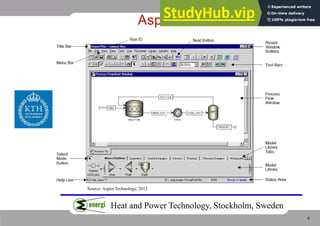
Heat and Power Technology, Stockholm, Sweden
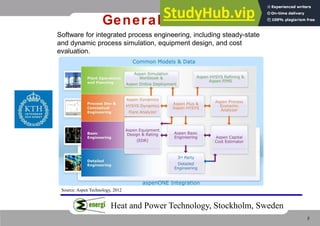
Software for integrated process engineering, including steady-state
and dynamic process simulation, equipment design, and cost
evaluation.
General Overview
Source: Aspen Technology, 2012
3
Heat and Power Technology, Stockholm, Sweden
ASPEN PLUS
OVERVIEW
4
Heat and Power Technology, Stockholm, Sweden
Aspen Plus
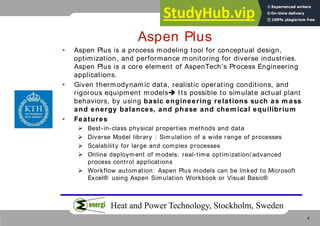
• Aspen Plus is a process modeling tool for conceptual design,
optimization, and performance monitoring for diverse industries.
Aspen Plus is a core element of AspenTech’s Process Engineering
applications.
• Given thermodynamic data, realistic operating conditions, and
rigorous equipment models Its possible to simulate actual plant
behaviors, by using basic engineering relations such as m ass
and energy balances, and phase and chem ical equilibrium
• Features
 Best-in-class physical properties methods and data
 Diverse Model library : Simulation of a wide range of processes
 Scalability for large and complex processes
 Online deployment of models: real-time optimization/ advanced
process control applications
 Workflow automation: Aspen Plus models can be linked to Microsoft
Excel® using Aspen Simulation Workbook or Visual Basic®
5
Heat and Power Technology, Stockholm, Sweden
Aspen Plus
Source: Aspen Technology, 2012
6
Heat and Power Technology, Stockholm, Sweden
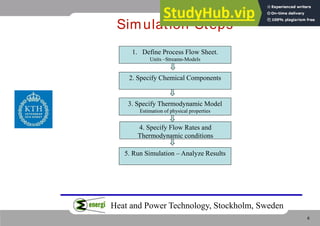
Simulation Steps
1. Define Process Flow Sheet.
Units –Streams-Models
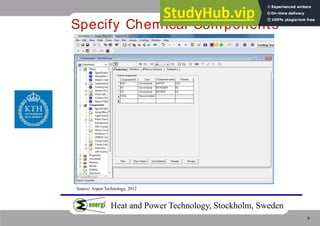
2. Specify Chemical Components
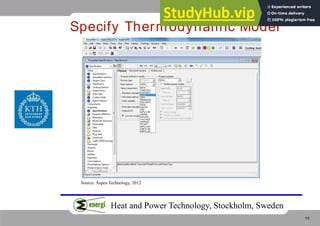
3. Specify Thermodynamic Model
Estimation of physical properties
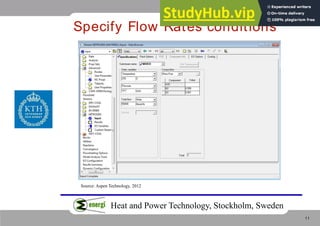
4. Specify Flow Rates and
Thermodynamic conditions
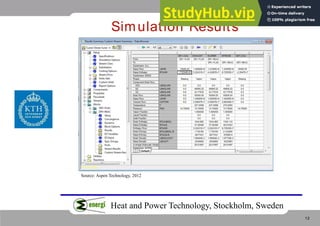
5. Run Simulation – Analyze Results
7
Heat and Power Technology, Stockholm, Sweden
Example
8
Heat and Power Technology, Stockholm, Sweden
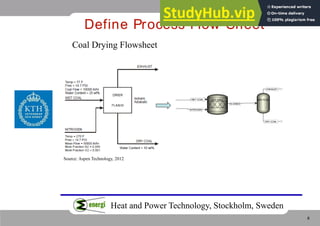
Define Process Flow Sheet
Coal Drying Flowsheet
WET-COAL
NITROGEN
DRY-REAC
IN-DRIER
DRY-FLSH
EXHAUST
DRY-COAL
Source: Aspen Technology, 2012
9
Heat and Power Technology, Stockholm, Sweden
Specify Chemical Components
Source: Aspen Technology, 2012
10
Heat and Power Technology, Stockholm, Sweden
Specify Thermodynamic Model
Source: Aspen Technology, 2012
11
Heat and Power Technology, Stockholm, Sweden
Specify Flow Rates conditions
Source: Aspen Technology, 2012
12
Heat and Power Technology, Stockholm, Sweden
Simulation Results
Source: Aspen Technology, 2012
13
Heat and Power Technology, Stockholm, Sweden
ASPEN CUSTOM MODELER
OVERVIEW
14
Heat and Power Technology, Stockholm, Sweden
General Overview
• Aspen Custom Modeler is a process and equipment
model development and simulation environment
• Aspen Custom Modeler (ACM) is used to create
rigorous models of processing equipment and to
apply these equipment models to simulate and
optimize continuous, batch, and semi-batch
processes.
• It is used across many industries including
chemicals, power, nuclear, food and beverage,
metals and minerals, pharmaceuticals, and othrers
15
Heat and Power Technology, Stockholm, Sweden
Features
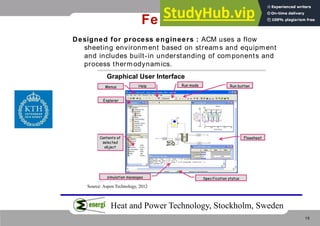
Designed for process engineers : ACM uses a flow
sheeting environment based on streams and equipment
and includes built-in understanding of components and
process thermodynamics.
Source: Aspen Technology, 2012
16
Heat and Power Technology, Stockholm, Sweden
Features
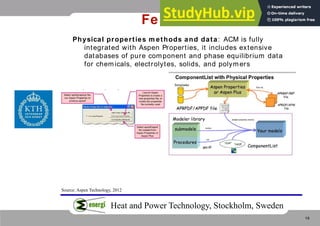
Physical properties m ethods and data: ACM is fully
integrated with Aspen Properties, it includes extensive
databases of pure component and phase equilibrium data
for chemicals, electrolytes, solids, and polymers
Source: Aspen Technology, 2012
17
Heat and Power Technology, Stockholm, Sweden
Features
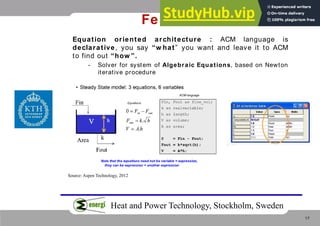
Equation oriented architecture : ACM language is
declarative, you say “w hat” you want and leave it to ACM
to find out “how ”.
- Solver for system of Algebraic Equations, based on Newton
iterative procedure
Source: Aspen Technology, 2012
18
Heat and Power Technology, Stockholm, Sweden
Features
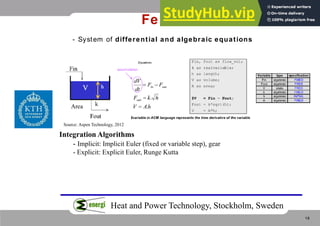
- System of differential and algebraic equations
Integration Algorithms
- Implicit: Implicit Euler (fixed or variable step), gear
- Explicit: Explicit Euler, Runge Kutta
Source: Aspen Technology, 2012
19
Heat and Power Technology, Stockholm, Sweden
Features
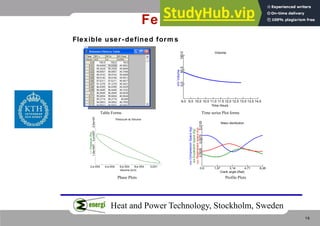
Flexible user-defined form s
Volume
Time Hours
Volume
9,0 9,5 10,0 10,5 11,0 11,5 12,0 12,5 13,0 13,5 14,0
0,0
50,0
100,0
Table Forms Time series Plot forms
Phase Plots
Pressure vs Volume
Volume (m3)
Pressure
(Pa)
2,e-004 4,e-004 6,e-004 8,e-004 0,001
1,5e+007
2,e+007
2,5e+007
Mass distribution
Crank angle (Rad)
Regenerator
space
(kg)
Expansion
space
(kg)
Compression
Space
(kg)
0,0 1,57 3,14 4,71 6,28
0,0025
0,0075
0,0125
Profile Plots
20
Heat and Power Technology, Stockholm, Sweden
Features
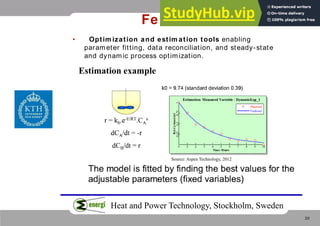
• Optim ization and estim ation tools enabling
parameter fitting, data reconciliation, and steady-state
and dynamic process optimization.
Estimation example
Source: Aspen Technology, 2012
21
Heat and Power Technology, Stockholm, Sweden
Features
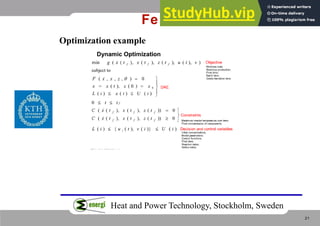
Optimization example
22
Heat and Power Technology, Stockholm, Sweden
Features
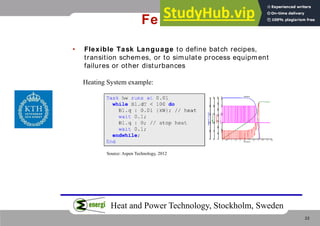
• Flexible Task Language to define batch recipes,
transition schemes, or to simulate process equipment
failures or other disturbances
Heating System example:
Source: Aspen Technology, 2012
23
Heat and Power Technology, Stockholm, Sweden
Features
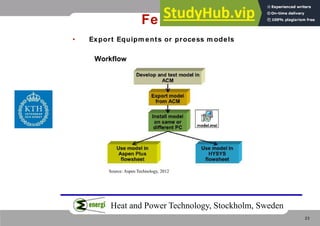
• Export Equipm ents or process m odels
Source: Aspen Technology, 2012
24
Heat and Power Technology, Stockholm, Sweden
Features
•Library of control models : to simulate process control
systems.
•Online deployment of models : ACM includes an OLE for
Process Control (OPC) interface, enabling links to process control
and information management systems
•Workflow automation: ACM models can be linked to Microsoft
Excel® using Aspen Simulation Workbook or Visual Basic®,
enabling workflow automation and allowing model deployment to
casual users
25
Heat and Power Technology, Stockholm, Sweden
Model Example
26
Heat and Power Technology, Stockholm, Sweden
Departm ent of Energy Technology
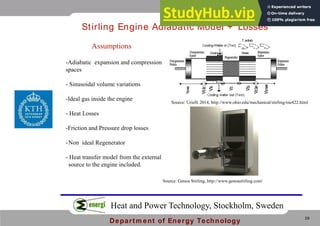
Stirling Engine Adiabatic Model + Losses
Assumptions
-Adiabatic expansion and compression
spaces
- Sinusoidal volume variations
-Ideal gas inside the engine
- Heat Losses
-Friction and Pressure drop losses
-Non ideal Regenerator
- Heat transfer model from the external
source to the engine included.
Source: Urielli 2014, http://www.ohio.edu/mechanical/stirling/me422.html
Source: Genoa Stirling, http://www.genoastirling.com/
27
Heat and Power Technology, Stockholm, Sweden
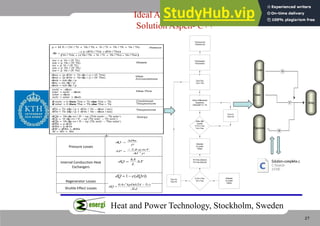
Heater
Regenerator
Cooler
Stirling
S7
S8
S9
Ideal Adiabatic Losses
Solution Aspen- C++
Pressure Losses
Internal Conducction Heat
Exchangers
Regenerator Losses
Shuttle Effect Losses
)
(
1 dQri
dQ ε
−
=
JLd
Tc
Td
kpDd
z
dQ
)
(
4
.
0 2
−
=
ρ
µ
ρ
2
.
2
A
d
V
m
fr
P
P
m
d
Q
−
=
∆
∆
=
T
L
kA
dQ ∆
=
+
Ths(source)
Tks(source)
Tho(heater)
Tko(cooler)
Teo=Tho
Tco= Tko
Solve Differential
Equations
Calculate Tc, Te
After 360
(cycle)
If Tc<>Tco
Te<>Teo
Tco=Tc
Teo=Te
Qheater
Q cooler
Qloss
Th=Ths-Qhs/UA
Tk=Tks-Qks/UA
If Th<>Tho
Tk<>Tko
Tho=Th
Tko=Tk
Qheater
Q cooler
Qloss
28
Heat and Power Technology, Stockholm, Sweden
Preliminary Results – Adiabatic model
Mass distribution
Crank angle (Rad)
Regenerator
space
(kg)
Expansion
space
(kg)
Compression
Space
(kg)
0,0 1,57 3,14 4,71 6,28
0,0025
0,0075
0,0125
Pressure vs Volume
Volume (m3)
Pressure
(Pa)
2,e-004 4,e-004 6,e-004 8,e-004 0,001
1,5e+007
2,e+007
2,5e+007
Heat
Crank angle (Rad)
Q
cooler
(Joules)
Q
heater
(Joules)
0,0 1,57 3,14 4,71 6,28
-4000,0
0,0
4000,0
8
000,0
Work
crank angle
Isothermal
Work
(Joules)
Expansion
work
(Joules)
Compression
Work(Joules)
Total
Work
(Joules)
0,0 1,57 3,14 4,71 6,28
0,0
20000,0
29
Heat and Power Technology, Stockholm, Sweden
THANKS

Aspen Custom Modeler Overview

  • 1.
    1 Heat and PowerTechnology, Stockholm, Sweden ASPEN ENGINEERING SUITE OVERVIEW
  • 2.
    2 Heat and PowerTechnology, Stockholm, Sweden Software for integrated process engineering, including steady-state and dynamic process simulation, equipment design, and cost evaluation. General Overview Source: Aspen Technology, 2012
  • 3.
    3 Heat and PowerTechnology, Stockholm, Sweden ASPEN PLUS OVERVIEW
  • 4.
    4 Heat and PowerTechnology, Stockholm, Sweden Aspen Plus • Aspen Plus is a process modeling tool for conceptual design, optimization, and performance monitoring for diverse industries. Aspen Plus is a core element of AspenTech’s Process Engineering applications. • Given thermodynamic data, realistic operating conditions, and rigorous equipment models Its possible to simulate actual plant behaviors, by using basic engineering relations such as m ass and energy balances, and phase and chem ical equilibrium • Features  Best-in-class physical properties methods and data  Diverse Model library : Simulation of a wide range of processes  Scalability for large and complex processes  Online deployment of models: real-time optimization/ advanced process control applications  Workflow automation: Aspen Plus models can be linked to Microsoft Excel® using Aspen Simulation Workbook or Visual Basic®
  • 5.
    5 Heat and PowerTechnology, Stockholm, Sweden Aspen Plus Source: Aspen Technology, 2012
  • 6.
    6 Heat and PowerTechnology, Stockholm, Sweden Simulation Steps 1. Define Process Flow Sheet. Units –Streams-Models 2. Specify Chemical Components 3. Specify Thermodynamic Model Estimation of physical properties 4. Specify Flow Rates and Thermodynamic conditions 5. Run Simulation – Analyze Results
  • 7.
    7 Heat and PowerTechnology, Stockholm, Sweden Example
  • 8.
    8 Heat and PowerTechnology, Stockholm, Sweden Define Process Flow Sheet Coal Drying Flowsheet WET-COAL NITROGEN DRY-REAC IN-DRIER DRY-FLSH EXHAUST DRY-COAL Source: Aspen Technology, 2012
  • 9.
    9 Heat and PowerTechnology, Stockholm, Sweden Specify Chemical Components Source: Aspen Technology, 2012
  • 10.
    10 Heat and PowerTechnology, Stockholm, Sweden Specify Thermodynamic Model Source: Aspen Technology, 2012
  • 11.
    11 Heat and PowerTechnology, Stockholm, Sweden Specify Flow Rates conditions Source: Aspen Technology, 2012
  • 12.
    12 Heat and PowerTechnology, Stockholm, Sweden Simulation Results Source: Aspen Technology, 2012
  • 13.
    13 Heat and PowerTechnology, Stockholm, Sweden ASPEN CUSTOM MODELER OVERVIEW
  • 14.
    14 Heat and PowerTechnology, Stockholm, Sweden General Overview • Aspen Custom Modeler is a process and equipment model development and simulation environment • Aspen Custom Modeler (ACM) is used to create rigorous models of processing equipment and to apply these equipment models to simulate and optimize continuous, batch, and semi-batch processes. • It is used across many industries including chemicals, power, nuclear, food and beverage, metals and minerals, pharmaceuticals, and othrers
  • 15.
    15 Heat and PowerTechnology, Stockholm, Sweden Features Designed for process engineers : ACM uses a flow sheeting environment based on streams and equipment and includes built-in understanding of components and process thermodynamics. Source: Aspen Technology, 2012
  • 16.
    16 Heat and PowerTechnology, Stockholm, Sweden Features Physical properties m ethods and data: ACM is fully integrated with Aspen Properties, it includes extensive databases of pure component and phase equilibrium data for chemicals, electrolytes, solids, and polymers Source: Aspen Technology, 2012
  • 17.
    17 Heat and PowerTechnology, Stockholm, Sweden Features Equation oriented architecture : ACM language is declarative, you say “w hat” you want and leave it to ACM to find out “how ”. - Solver for system of Algebraic Equations, based on Newton iterative procedure Source: Aspen Technology, 2012
  • 18.
    18 Heat and PowerTechnology, Stockholm, Sweden Features - System of differential and algebraic equations Integration Algorithms - Implicit: Implicit Euler (fixed or variable step), gear - Explicit: Explicit Euler, Runge Kutta Source: Aspen Technology, 2012
  • 19.
    19 Heat and PowerTechnology, Stockholm, Sweden Features Flexible user-defined form s Volume Time Hours Volume 9,0 9,5 10,0 10,5 11,0 11,5 12,0 12,5 13,0 13,5 14,0 0,0 50,0 100,0 Table Forms Time series Plot forms Phase Plots Pressure vs Volume Volume (m3) Pressure (Pa) 2,e-004 4,e-004 6,e-004 8,e-004 0,001 1,5e+007 2,e+007 2,5e+007 Mass distribution Crank angle (Rad) Regenerator space (kg) Expansion space (kg) Compression Space (kg) 0,0 1,57 3,14 4,71 6,28 0,0025 0,0075 0,0125 Profile Plots
  • 20.
    20 Heat and PowerTechnology, Stockholm, Sweden Features • Optim ization and estim ation tools enabling parameter fitting, data reconciliation, and steady-state and dynamic process optimization. Estimation example Source: Aspen Technology, 2012
  • 21.
    21 Heat and PowerTechnology, Stockholm, Sweden Features Optimization example
  • 22.
    22 Heat and PowerTechnology, Stockholm, Sweden Features • Flexible Task Language to define batch recipes, transition schemes, or to simulate process equipment failures or other disturbances Heating System example: Source: Aspen Technology, 2012
  • 23.
    23 Heat and PowerTechnology, Stockholm, Sweden Features • Export Equipm ents or process m odels Source: Aspen Technology, 2012
  • 24.
    24 Heat and PowerTechnology, Stockholm, Sweden Features •Library of control models : to simulate process control systems. •Online deployment of models : ACM includes an OLE for Process Control (OPC) interface, enabling links to process control and information management systems •Workflow automation: ACM models can be linked to Microsoft Excel® using Aspen Simulation Workbook or Visual Basic®, enabling workflow automation and allowing model deployment to casual users
  • 25.
    25 Heat and PowerTechnology, Stockholm, Sweden Model Example
  • 26.
    26 Heat and PowerTechnology, Stockholm, Sweden Departm ent of Energy Technology Stirling Engine Adiabatic Model + Losses Assumptions -Adiabatic expansion and compression spaces - Sinusoidal volume variations -Ideal gas inside the engine - Heat Losses -Friction and Pressure drop losses -Non ideal Regenerator - Heat transfer model from the external source to the engine included. Source: Urielli 2014, http://www.ohio.edu/mechanical/stirling/me422.html Source: Genoa Stirling, http://www.genoastirling.com/
  • 27.
    27 Heat and PowerTechnology, Stockholm, Sweden Heater Regenerator Cooler Stirling S7 S8 S9 Ideal Adiabatic Losses Solution Aspen- C++ Pressure Losses Internal Conducction Heat Exchangers Regenerator Losses Shuttle Effect Losses ) ( 1 dQri dQ ε − = JLd Tc Td kpDd z dQ ) ( 4 . 0 2 − = ρ µ ρ 2 . 2 A d V m fr P P m d Q − = ∆ ∆ = T L kA dQ ∆ = + Ths(source) Tks(source) Tho(heater) Tko(cooler) Teo=Tho Tco= Tko Solve Differential Equations Calculate Tc, Te After 360 (cycle) If Tc<>Tco Te<>Teo Tco=Tc Teo=Te Qheater Q cooler Qloss Th=Ths-Qhs/UA Tk=Tks-Qks/UA If Th<>Tho Tk<>Tko Tho=Th Tko=Tk Qheater Q cooler Qloss
  • 28.
    28 Heat and PowerTechnology, Stockholm, Sweden Preliminary Results – Adiabatic model Mass distribution Crank angle (Rad) Regenerator space (kg) Expansion space (kg) Compression Space (kg) 0,0 1,57 3,14 4,71 6,28 0,0025 0,0075 0,0125 Pressure vs Volume Volume (m3) Pressure (Pa) 2,e-004 4,e-004 6,e-004 8,e-004 0,001 1,5e+007 2,e+007 2,5e+007 Heat Crank angle (Rad) Q cooler (Joules) Q heater (Joules) 0,0 1,57 3,14 4,71 6,28 -4000,0 0,0 4000,0 8 000,0 Work crank angle Isothermal Work (Joules) Expansion work (Joules) Compression Work(Joules) Total Work (Joules) 0,0 1,57 3,14 4,71 6,28 0,0 20000,0
  • 29.
    29 Heat and PowerTechnology, Stockholm, Sweden THANKS